
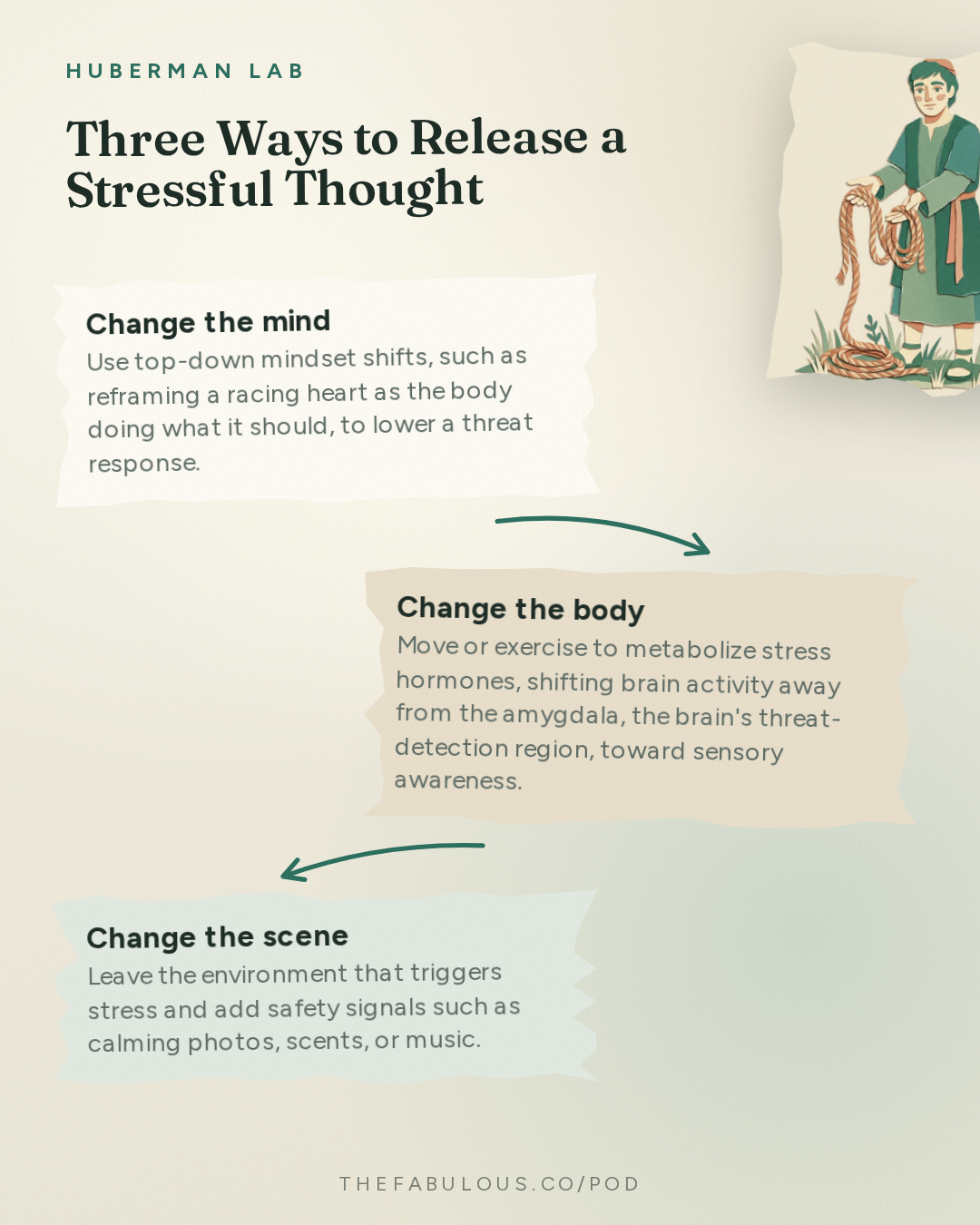
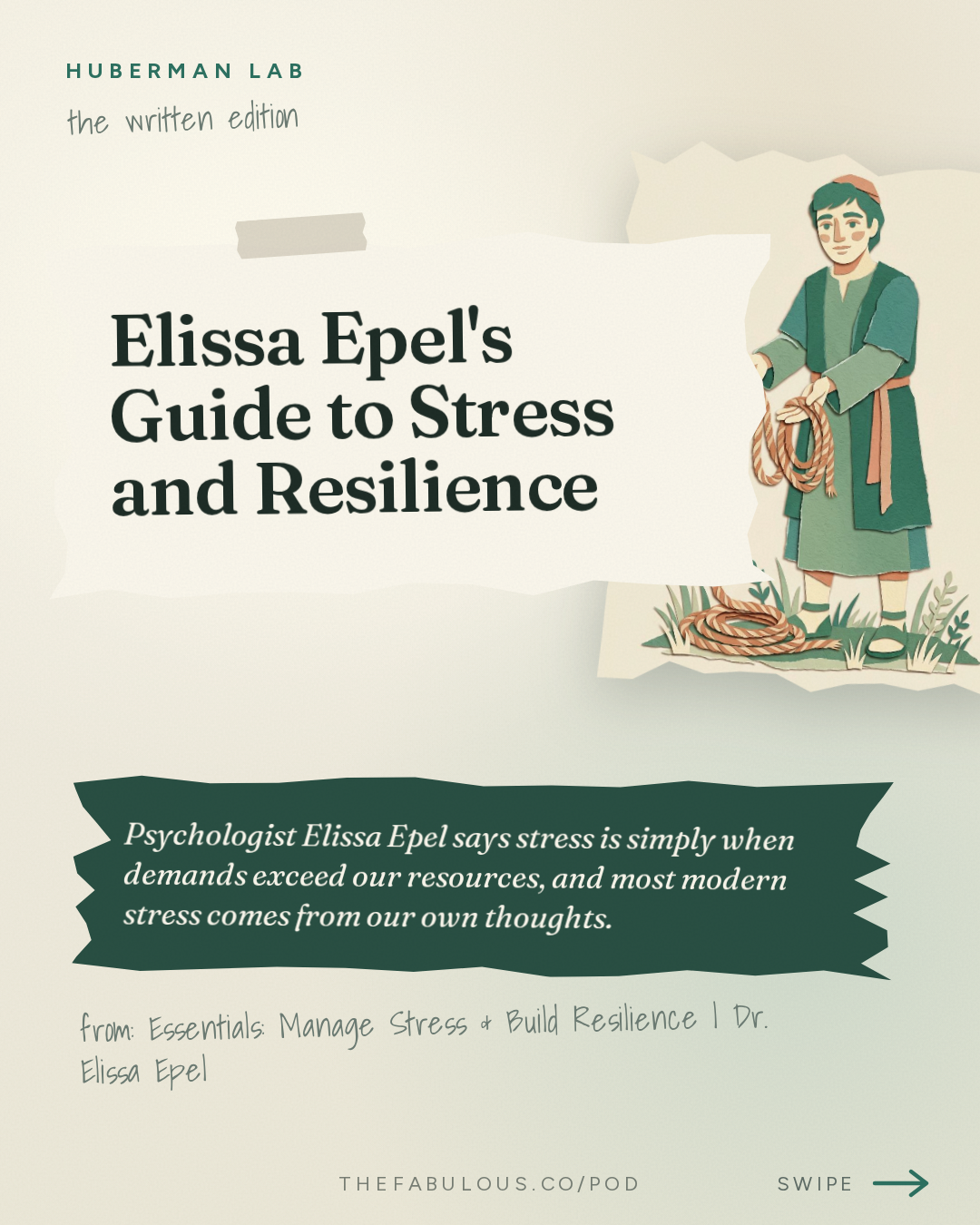
Elissa Epel's Guide to Stress and Resilience
Essentials: Manage Stress & Build Resilience | Dr. Elissa Epel
The brief
Psychologist Elissa Epel says stress is simply when demands exceed our resources, and most modern stress comes from our own thoughts. She shows how a challenge mindset, radical acceptance, and small daily practices like 'dropping the rope' change inflammation, telomere length, and mitochondrial energy output measurably.
A lion chasing a gazelle and the gazelle fleeing the lion show nearly identical vital signs: racing heart, spiking blood pressure, a flood of stress hormones. One of them is about to get dinner. The other might die. The chemistry looks the same from the outside. The experience, and what it does to the body over time, is not. This is the puzzle at the center of psychologist Elissa Epel's research on stress: two creatures, two different outcomes, from what looks like one shared biological event.
Epel has spent her career studying why some people age faster under pressure and others do not. Her starting point is a definition that strips the word stress of its vagueness. Stress, she says, is simply the feeling that demands exceed the resources available to meet them (01:11). It is not the traffic jam or the difficult email. It is the gap between what seems required and what seems possible. That gap, she argues, is usually manufactured less by events than by thought. Our own thoughts, she says, are the most common form of stress in modern life, because the mind keeps a difficult moment alive long after it has ended (01:40). A conversation ends, but the replaying of it does not, and the body cannot tell the difference between a real threat and an imagined one still running on a loop.
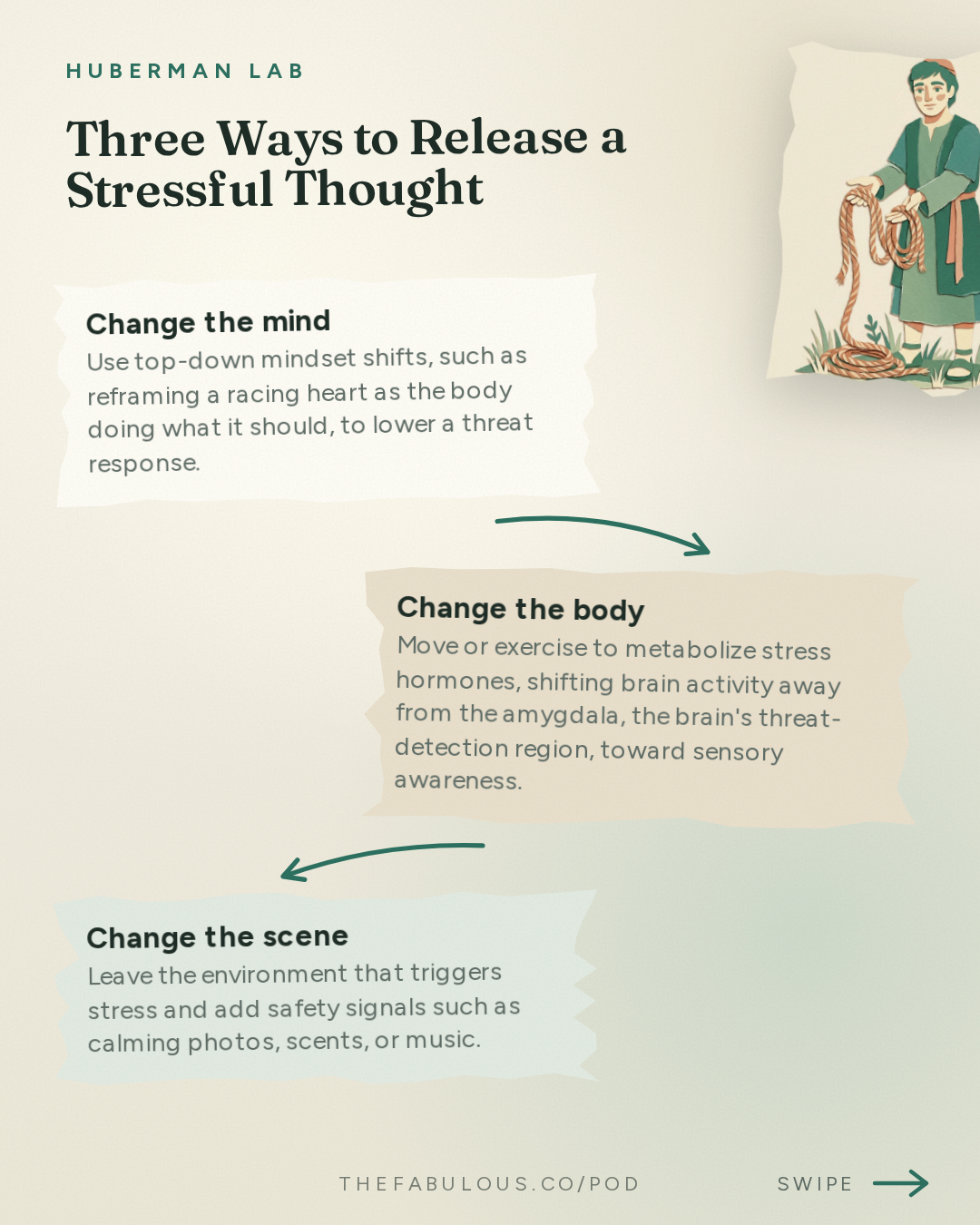
Epel sorts the tools for interrupting that loop into three categories. The first works top-down: changing the belief or the self-talk that surrounds a stressor. The second works bottom-up: moving the body, through exercise or breath, to burn off the chemical residue of stress and shift attention from anxious thought toward physical sensation. The third changes the environment altogether, by leaving the room, the desk, the city, for a place that signals safety, a photo, a scent, a certain kind of music. None of the three is sufficient alone. Most people reach for only one, usually the first, and wonder why rumination persists.
The Price of Staying Alert
What makes chronic, low-grade stress costly is not drama. It is vigilance, the sense of scanning for danger that never fully switches off (05:13). A person can report feeling fine and still carry a nervous system tuned to threat, using far more fuel than the moment requires. That fuel is ATP, the molecule cells burn for energy, manufactured by mitochondria, the small structures inside cells often described as their power plants.
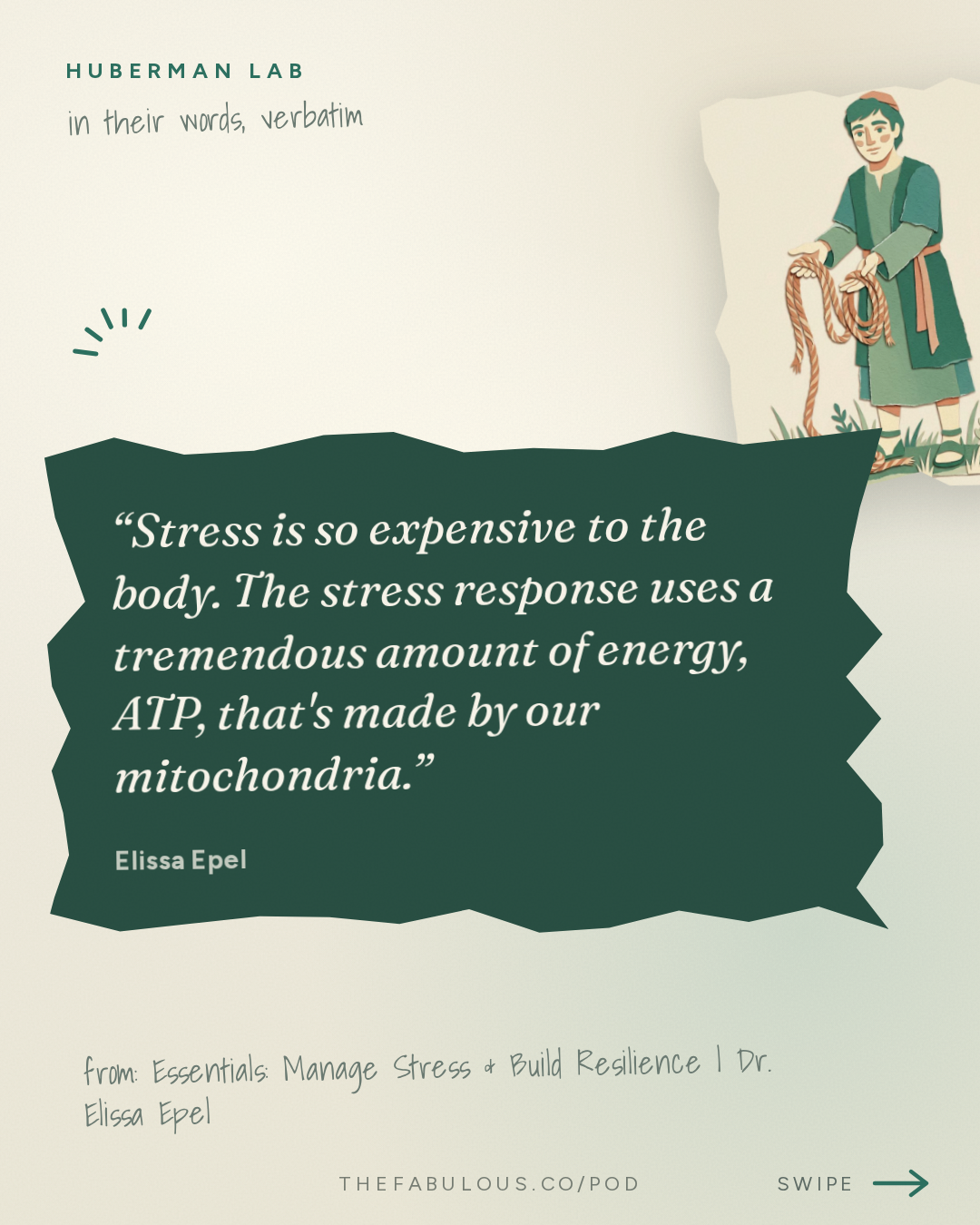
"Stress is so expensive to the body. The stress response uses a tremendous amount of energy, ATP, that's made by our mitochondria." (Elissa Epel, [05:37])
Epel's collaborator, mitochondrial biologist Martin Picard, built a way to measure this cost directly in blood. In a study he and Epel ran on mothers of children with autism, a group carrying sustained caregiving stress, the mitochondria produced measurably less energy-generating enzyme activity than in mothers of neurotypical children (19:43). Among the caregivers themselves, though, there was wide variation, and the variation tracked something unexpected: mood. Mothers who reported more positive feeling both in the morning and at the end of the day, especially the evening, had higher mitochondrial enzyme output that same day (20:15). The correlation weakened when mood was measured even a few days apart, suggesting the link between feeling and cellular energy is immediate rather than a fixed trait (21:09). Epel points to other research showing that how someone feels at night, calm or wiped out, predicts health outcomes like depression and heart disease roughly a decade later (20:44).
The same logic explains why Epel is not against stress itself. In one study she describes, retired adults, written off by a culture that treats retirement as the end of contribution, began tutoring at-risk students. They moved from feeling safe but understimulated to feeling challenged and useful. On brain scans, the men in the group showed actual growth in hippocampal volume, the brain region tied to memory and learning (09:52, 10:22). Difficulty, applied in the right dose, built rather than wore down.
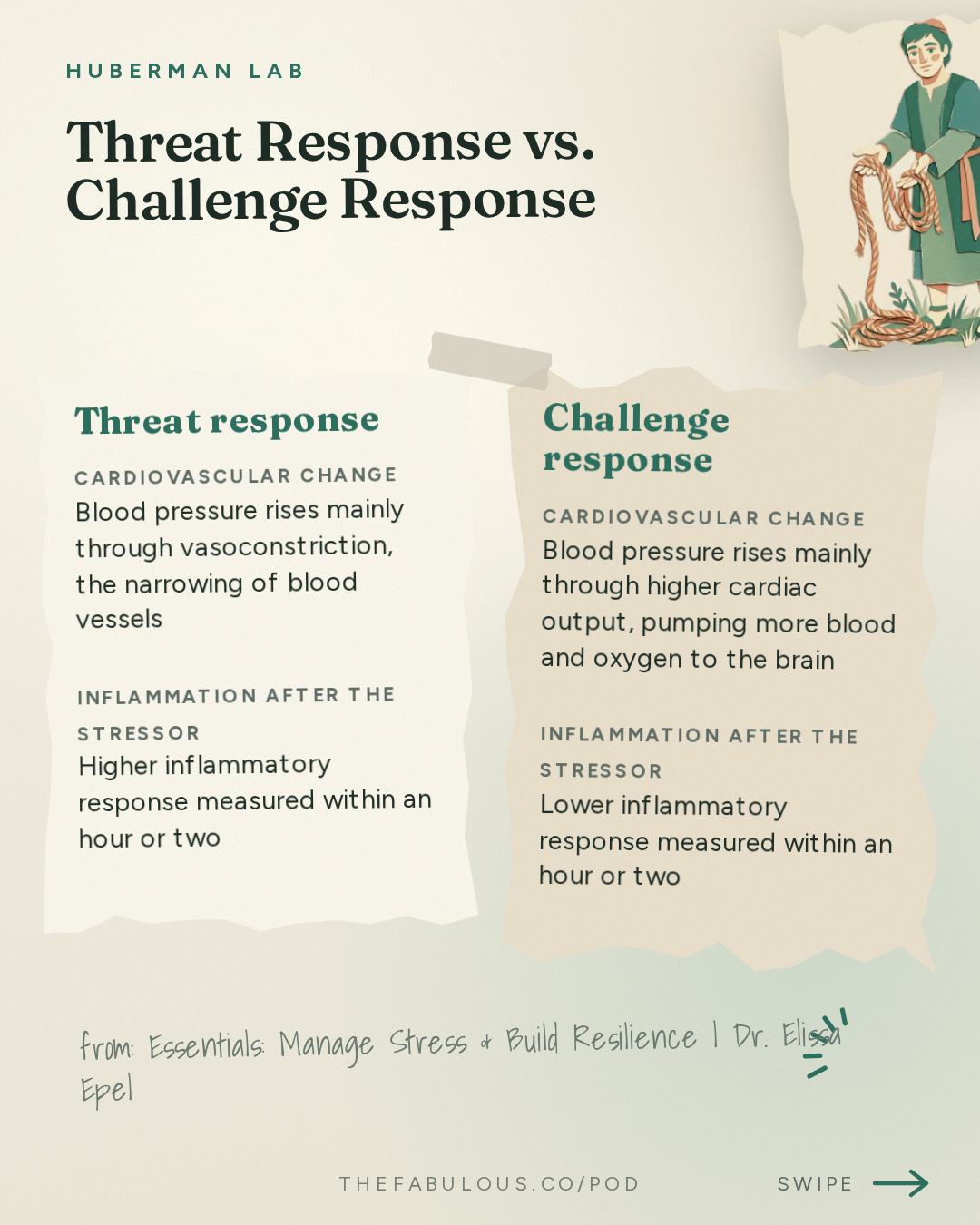
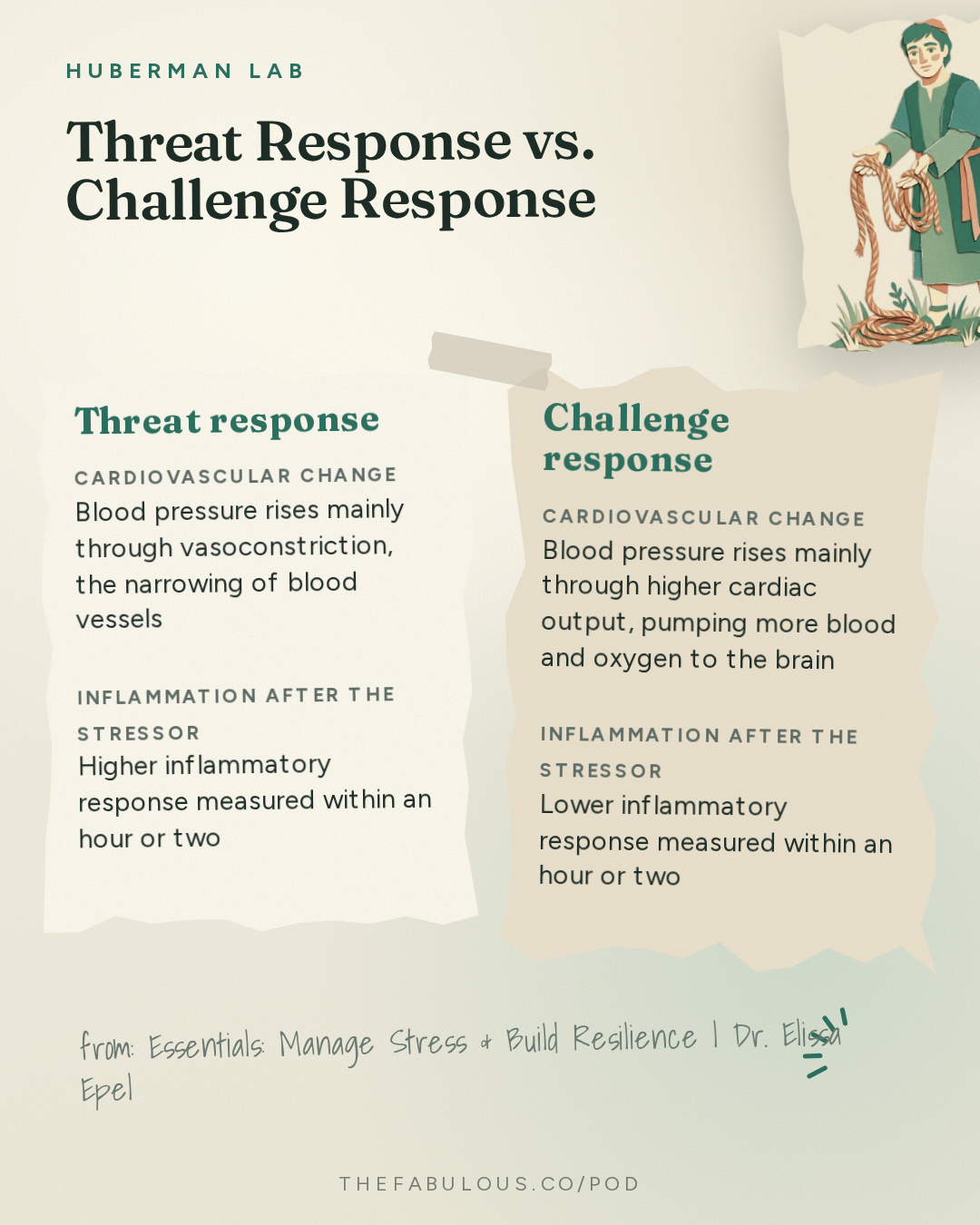
The dose matters, and so does the frame. Epel distinguishes a threat response from a challenge response, two patterns that look similar at first glance but diverge in the body. Both raise blood pressure. In a threat response, the rise comes mostly from vasoconstriction, the narrowing of blood vessels, driven by a sense that survival, physical or social, is on the line (12:48). In a challenge response, the rise comes from greater cardiac output, the heart pumping more blood, which delivers more oxygen to the brain and supports clearer thinking under pressure. People who respond with challenge rather than threat show less inflammation within an hour or two of a stressor, and tend to have longer telomeres, the protective caps on chromosomes whose length is used as a rough marker of cellular aging (13:12). The difference between the two responses often comes down to a sentence people tell themselves in the moment, something like "I can do this" instead of "I'm going to fail." Epel calls these sentences stress shields, and recommends finding ones that feel true rather than borrowed (15:11).
Dropping the Rope
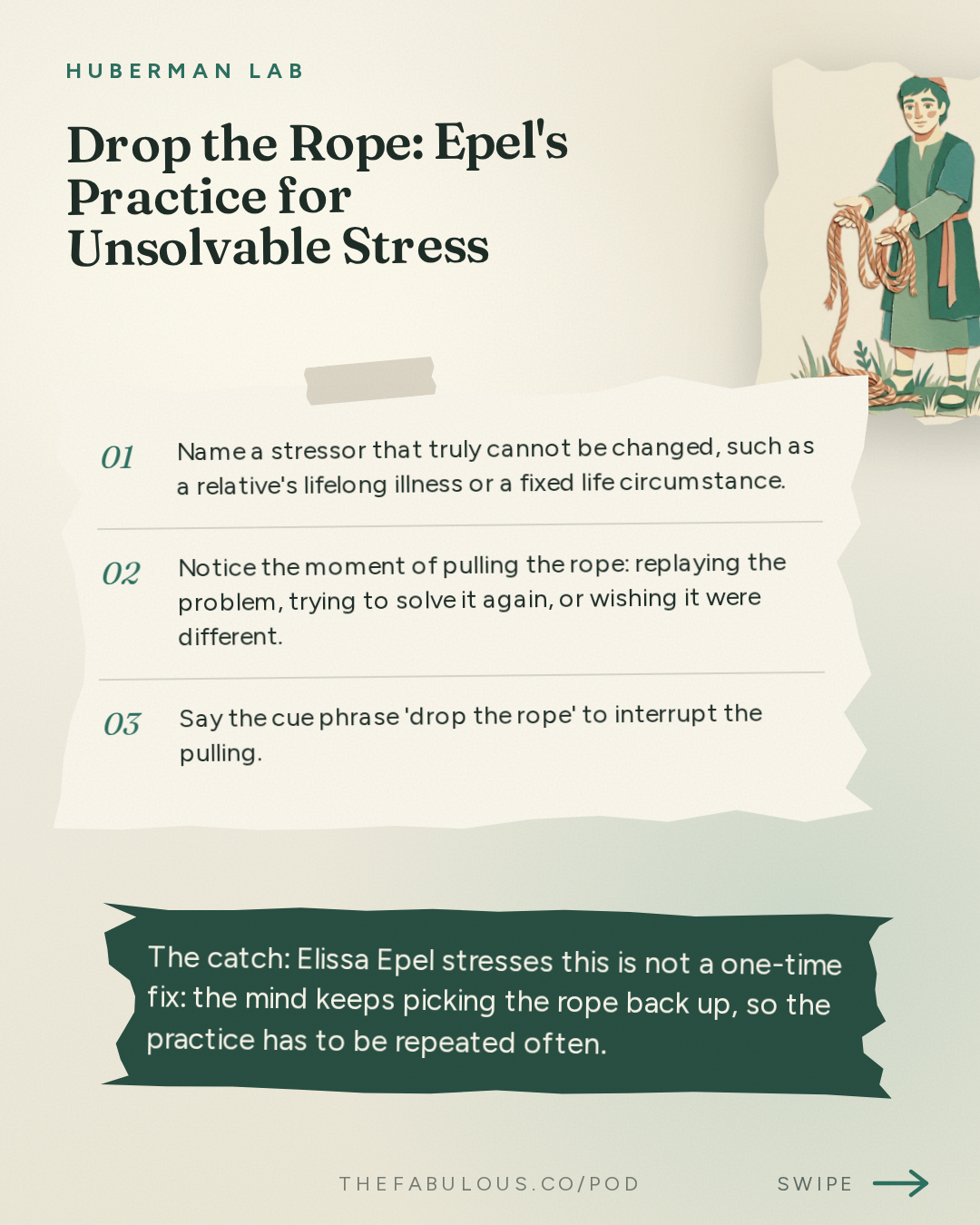
Not every stressor bends to reframing. Some are fixed: a chronic illness in the family, a situation with no exit. For these, Epel's recommendation is not optimism but what she calls radical acceptance, acknowledging that a situation will not change and redirecting energy away from the fight to change it (07:09). She offers an image for how this works: a rope tied to a brick wall, pulled every day because the cause matters, while the wall never moves.
"Think of how you're pulling a rope that's attached to a brick wall... What if you just drop the rope?" (Elissa Epel, [25:42])
In her research on caregivers, Epel's team pinged participants in the evening and asked two questions: how much of the last five minutes had been spent wishing things were different, and how much had been spent present and engaged (24:35). The answers predicted more than mood. Negative mind-wandering, the wishing, predicted shorter telomeres, regardless of whether someone was a caregiver or not (25:15). The rope has a measurable biological cost.
Letting go does not mean passivity everywhere. Epel separates situations that can be changed from those that cannot, and argues that tolerating uncertainty about the ones that remain open is itself a skill, a rare resilience factor linked to markedly lower anxiety and faster recovery from stressful events (27:03). She offers a small physical practice for it: instead of the forward-leaning, scanning posture that goes with trying to predict what happens next, lean back, slow the breath, and let the moment arrive rather than trying to seize it (28:38). She picked up the posture on a meditation retreat, as an antidote to her own habit of leaving calm and immediately reaching for a to-do list.
What ties the threat-challenge research, the mitochondrial data, and the rope metaphor together is a claim stated plainly near the end of the conversation: it is not what happens that determines the biological cost, but the story told about it (33:27). Epel's closing suggestion is almost old-fashioned: write the story down. A coherent narrative, built through journaling or conversation, helps convert raw experience into meaning, resolution, and identity (32:55). It is also, she suggests, one of the few acts that separates a stressed human from a stressed rat or monkey: the capacity to ask what the stress was for, and to decide, after the fact, what to do with it.
Ask this episode anything
Pod's AI answers from the episode itself, with the minute mark so you can hear it yourself.
Or start with one of these
Ask this episode
Pod's AI listens to the whole episode to answer, and points you to the minute it comes from.
The rest of this answer, and any question after it
Answers come from the episode itself, never from a summary of it.
ContinueKey takeaways
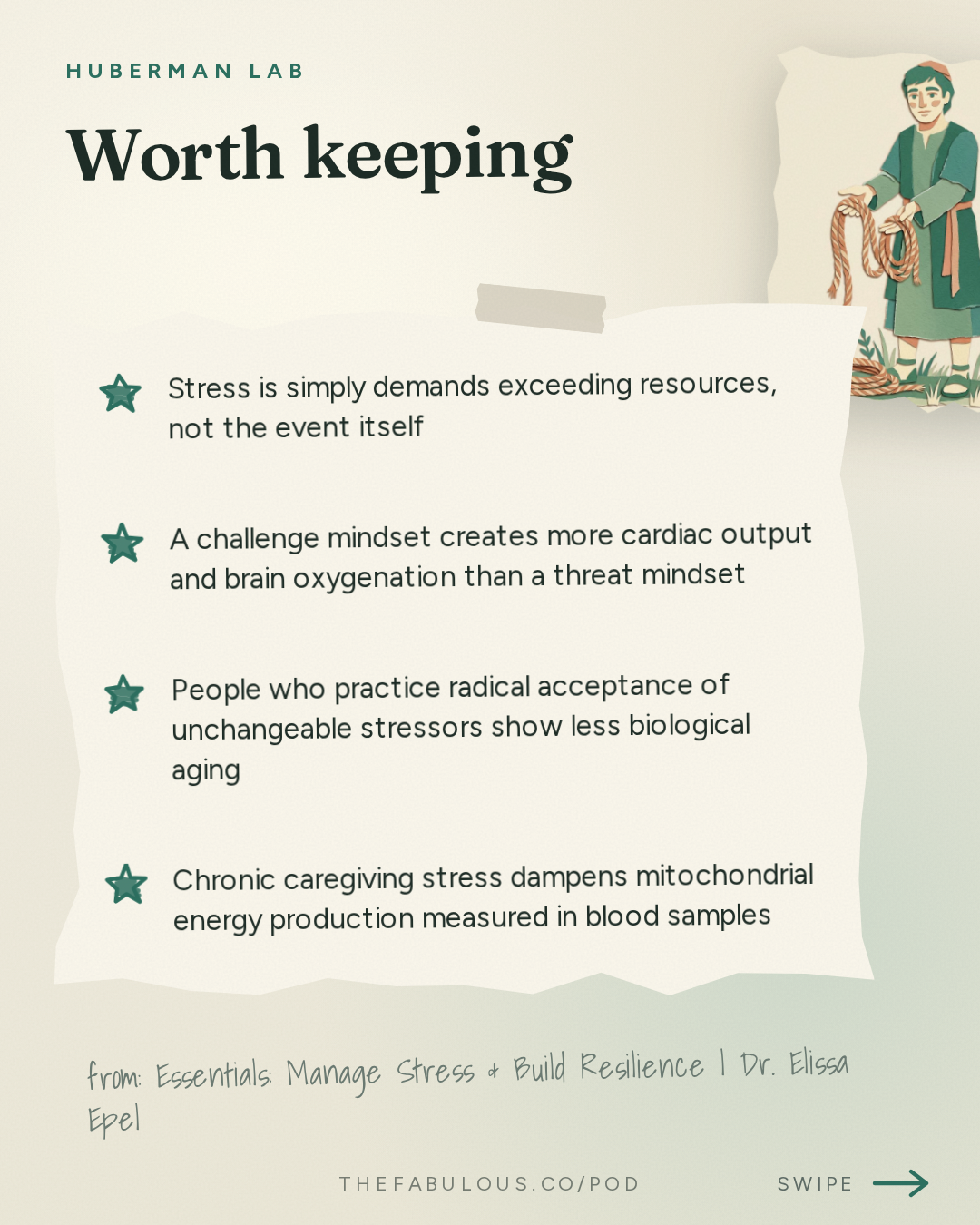
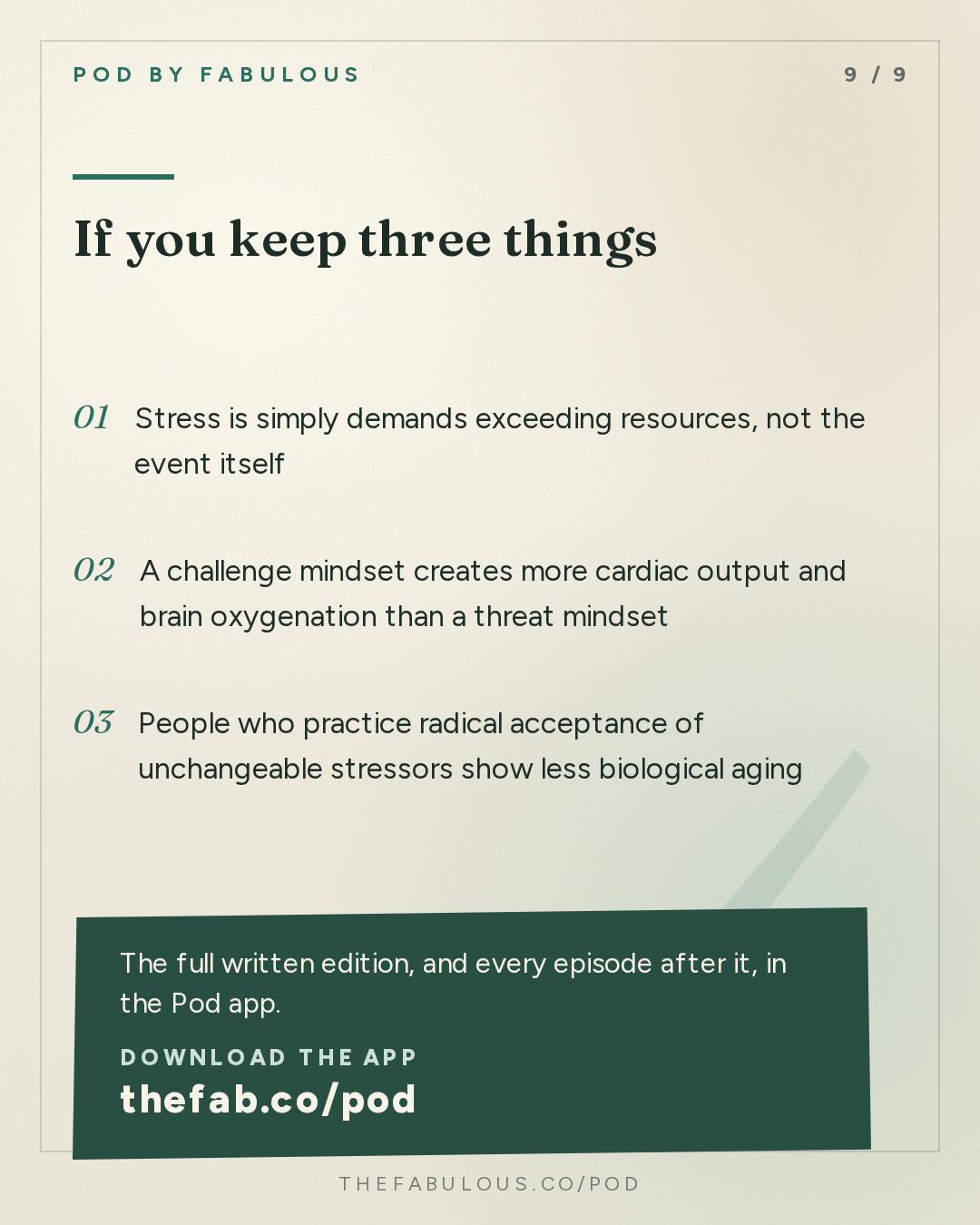
- Stress is simply demands exceeding resources, not the event itself
- A challenge mindset creates more cardiac output and brain oxygenation than a threat mindset
- People who practice radical acceptance of unchangeable stressors show less biological aging
- Chronic caregiving stress dampens mitochondrial energy production measured in blood samples
- Elderly adults who tutored students grew new hippocampal volume during the program
The episode in cards
By the numbers
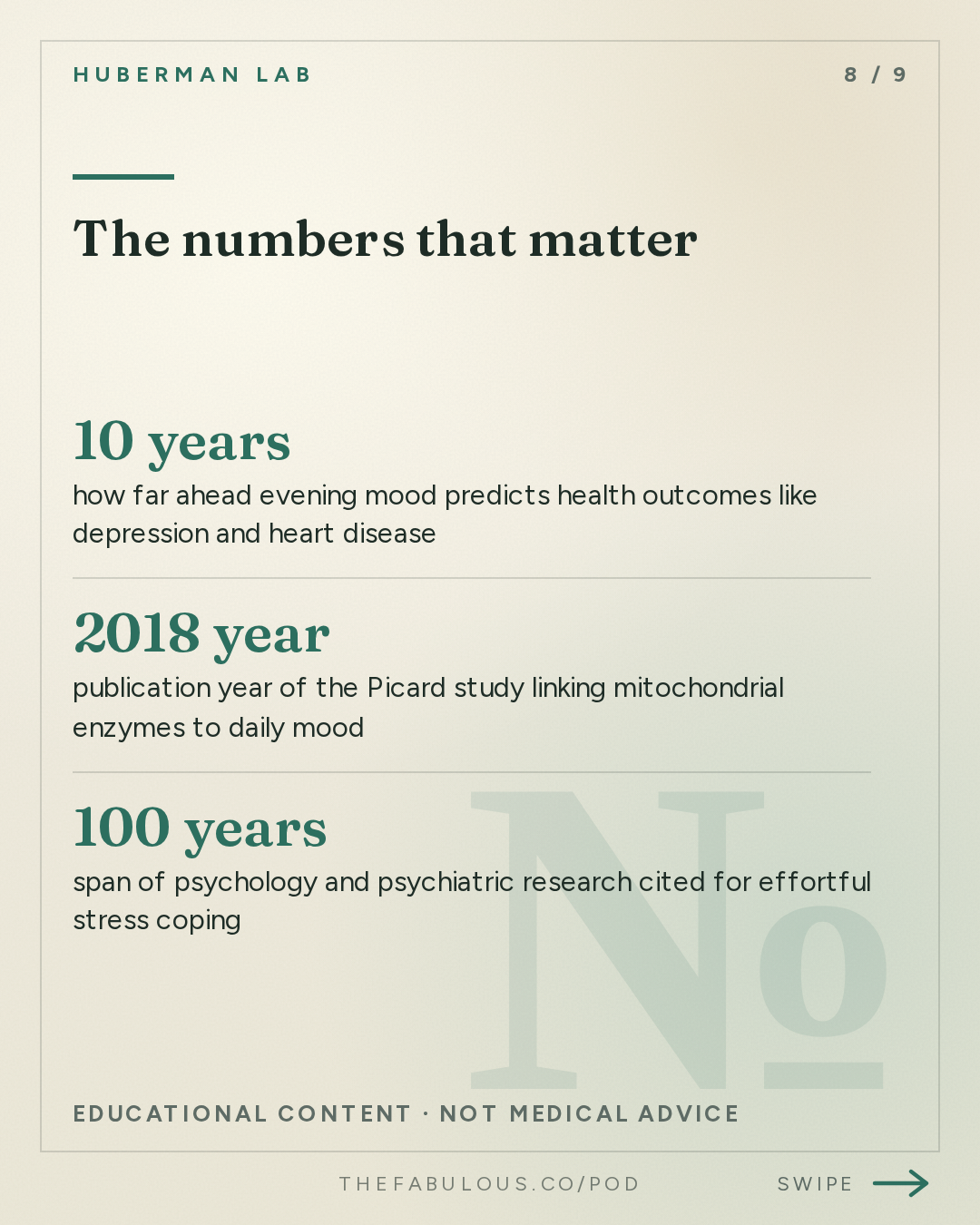
- 10 years how far ahead evening mood predicts health outcomes like depression and heart disease
- 2018 year publication year of the Picard study linking mitochondrial enzymes to daily mood
- 100 years span of psychology and psychiatric research cited for effortful stress coping
In their words
“It's a problem these days of just we keep it alive in our head. We keep it alive with our thoughts. Our thoughts are the most common form of stress.”
“Stress is so expensive to the body. The stress response uses a tremendous amount of energy, ATP, that's made by our mitochondria.”
“It's not what happens to us, it's how we're interpreting it and how we're responding to it.”
Protocols
-
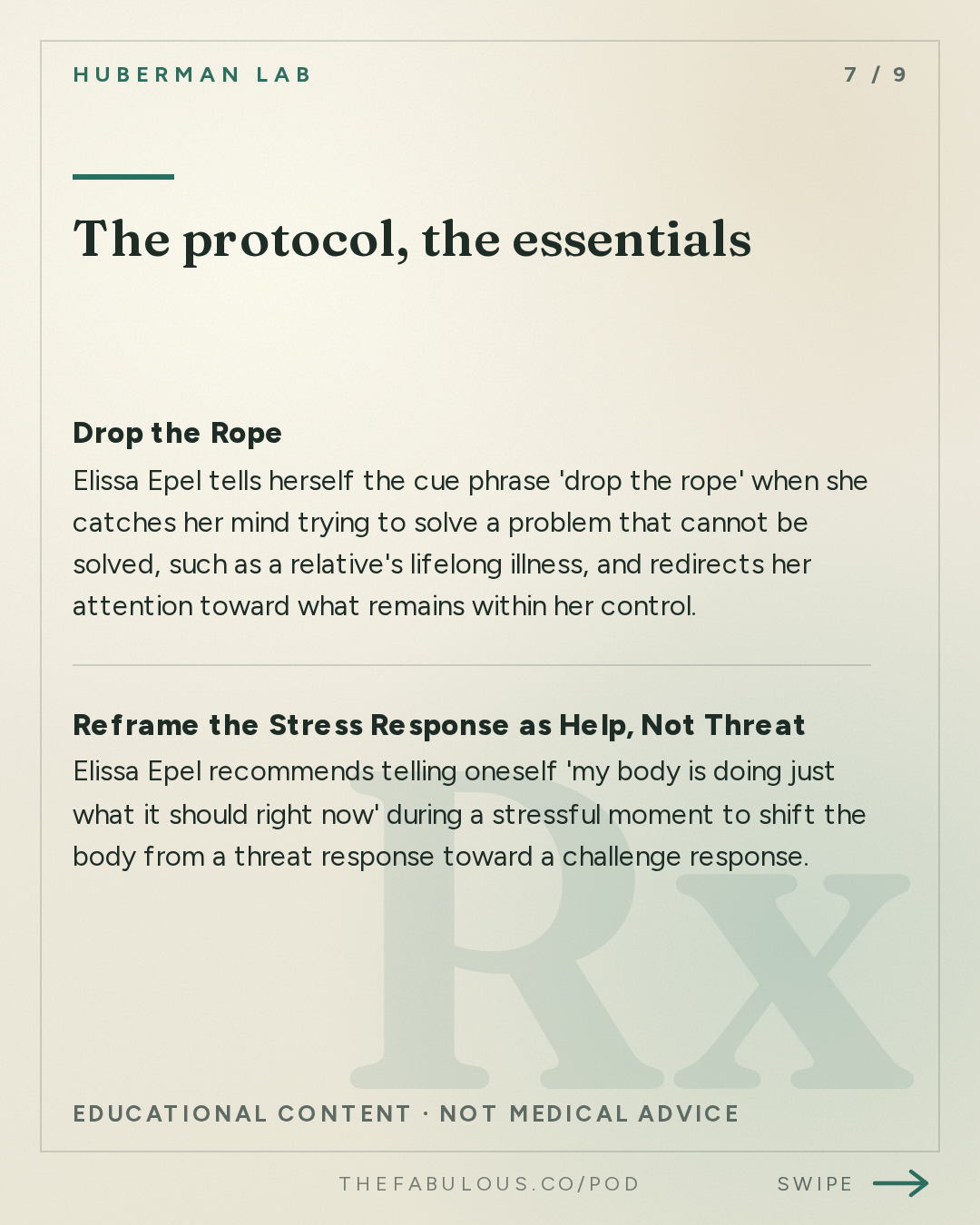
Drop the Rope
Elissa Epel tells herself the cue phrase 'drop the rope' when she catches her mind trying to solve a problem that cannot be solved, such as a relative's lifelong illness, and redirects her attention toward what remains within her control.
Repeated whenever rumination starts, not a one-time fix
-
Reframe the Stress Response as Help, Not Threat
Elissa Epel recommends telling oneself 'my body is doing just what it should right now' during a stressful moment to shift the body from a threat response toward a challenge response.
Use in the moment, whenever stress hormones rise
-
Radical Acceptance for Unchangeable Stress
Elissa Epel practices radical acceptance by naming a stressor that cannot change, such as caregiving for a family member, and reminding herself that wishing it were different only adds suffering on top of the situation.
An ongoing daily practice, not a single decision
-
Receptive Posture for Uncertainty
Elissa Epel suggests leaning back, slowing the breath, and dropping the forward, scanning posture to shift the body out of go mode when facing an uncertain future.
Use whenever anticipatory anxiety about the future arises
Questions this episode answers
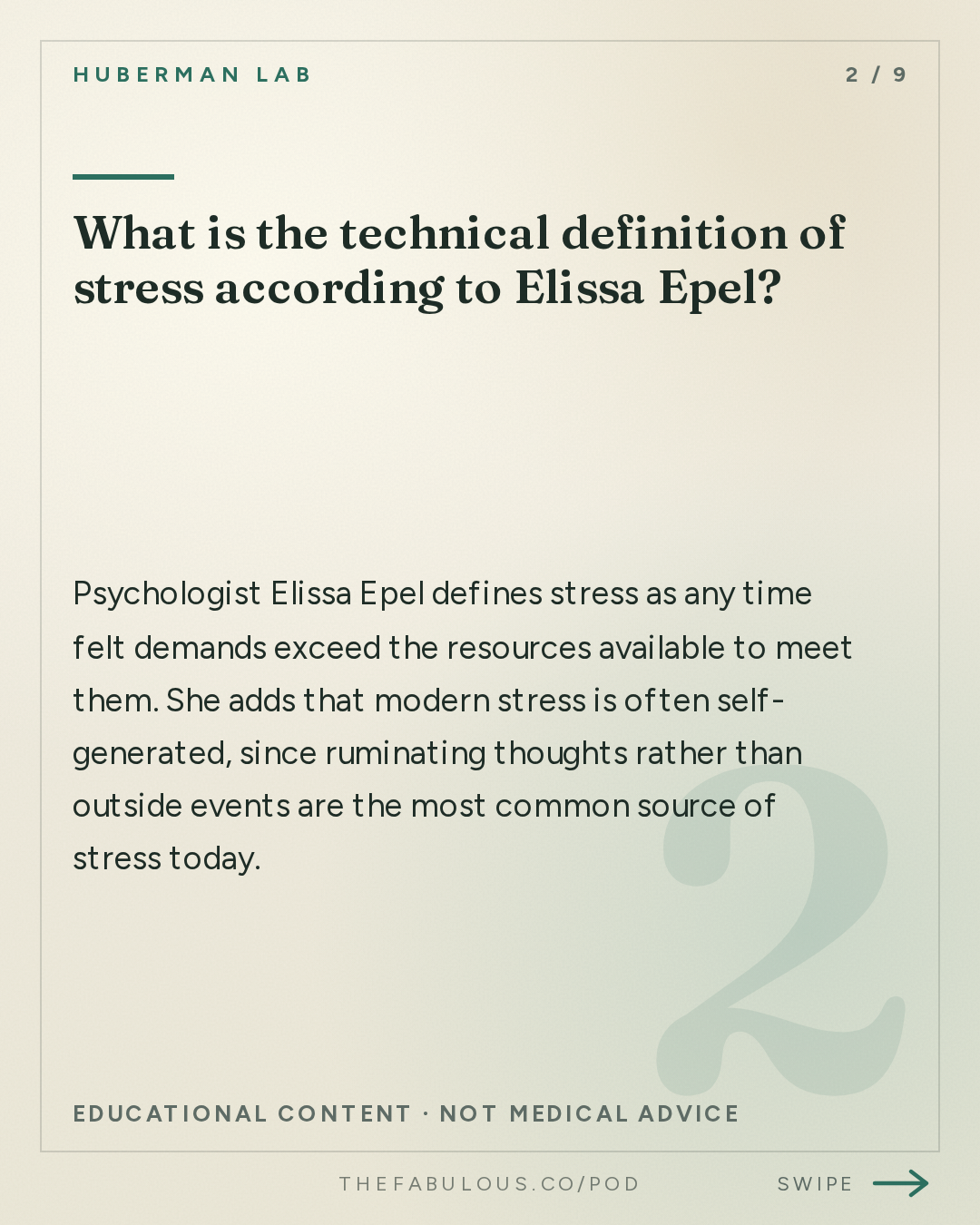
What is the technical definition of stress according to Elissa Epel?
Psychologist Elissa Epel defines stress as any time felt demands exceed the resources available to meet them (01:11). She adds that modern stress is often self-generated, since ruminating thoughts rather than outside events are the most common source of stress today (01:40).
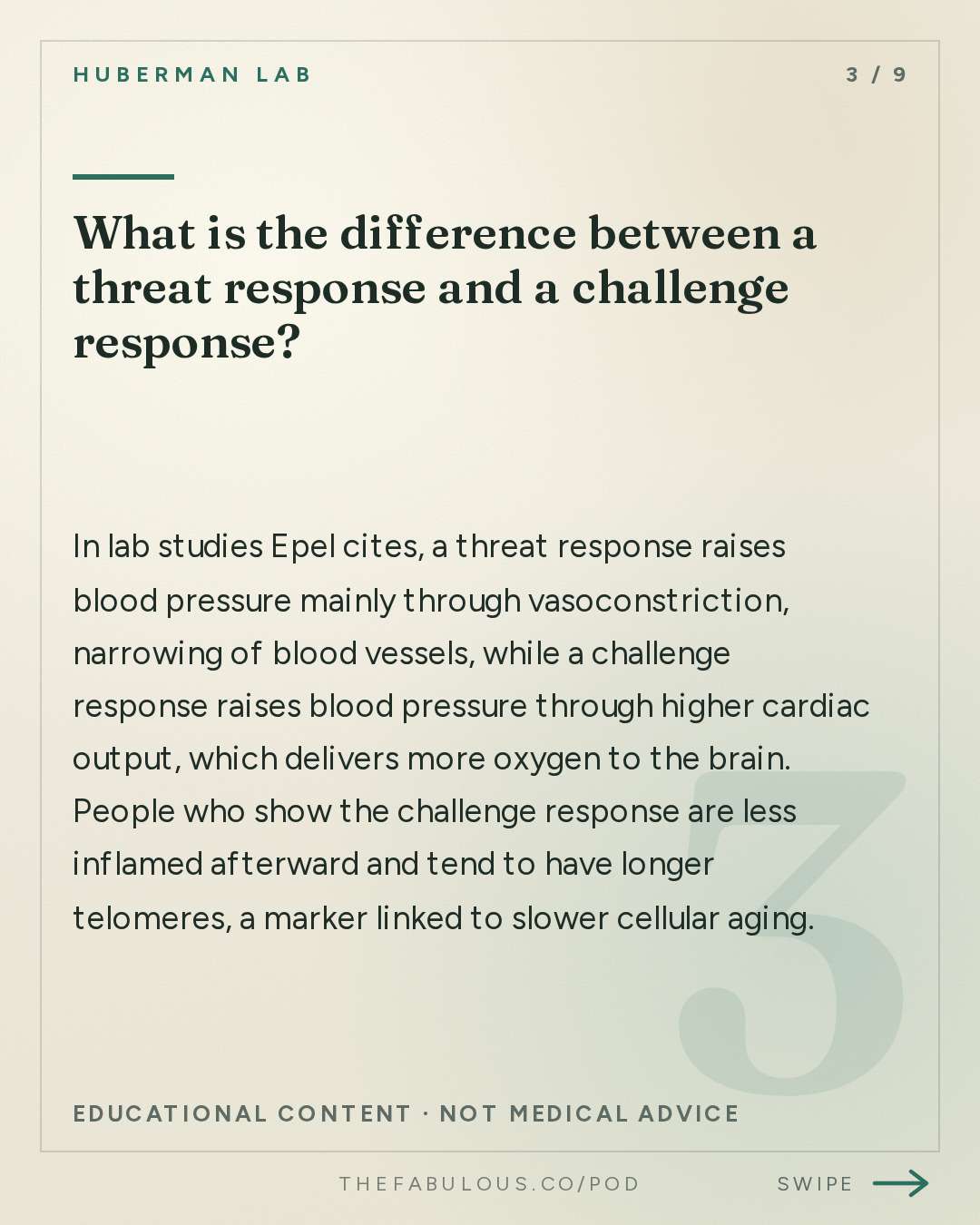
What is the difference between a threat response and a challenge response?
In lab studies Epel cites, a threat response raises blood pressure mainly through vasoconstriction, narrowing of blood vessels, while a challenge response raises blood pressure through higher cardiac output, which delivers more oxygen to the brain (12:48). People who show the challenge response are less inflamed afterward and tend to have longer telomeres, a marker linked to slower cellular aging (13:12).
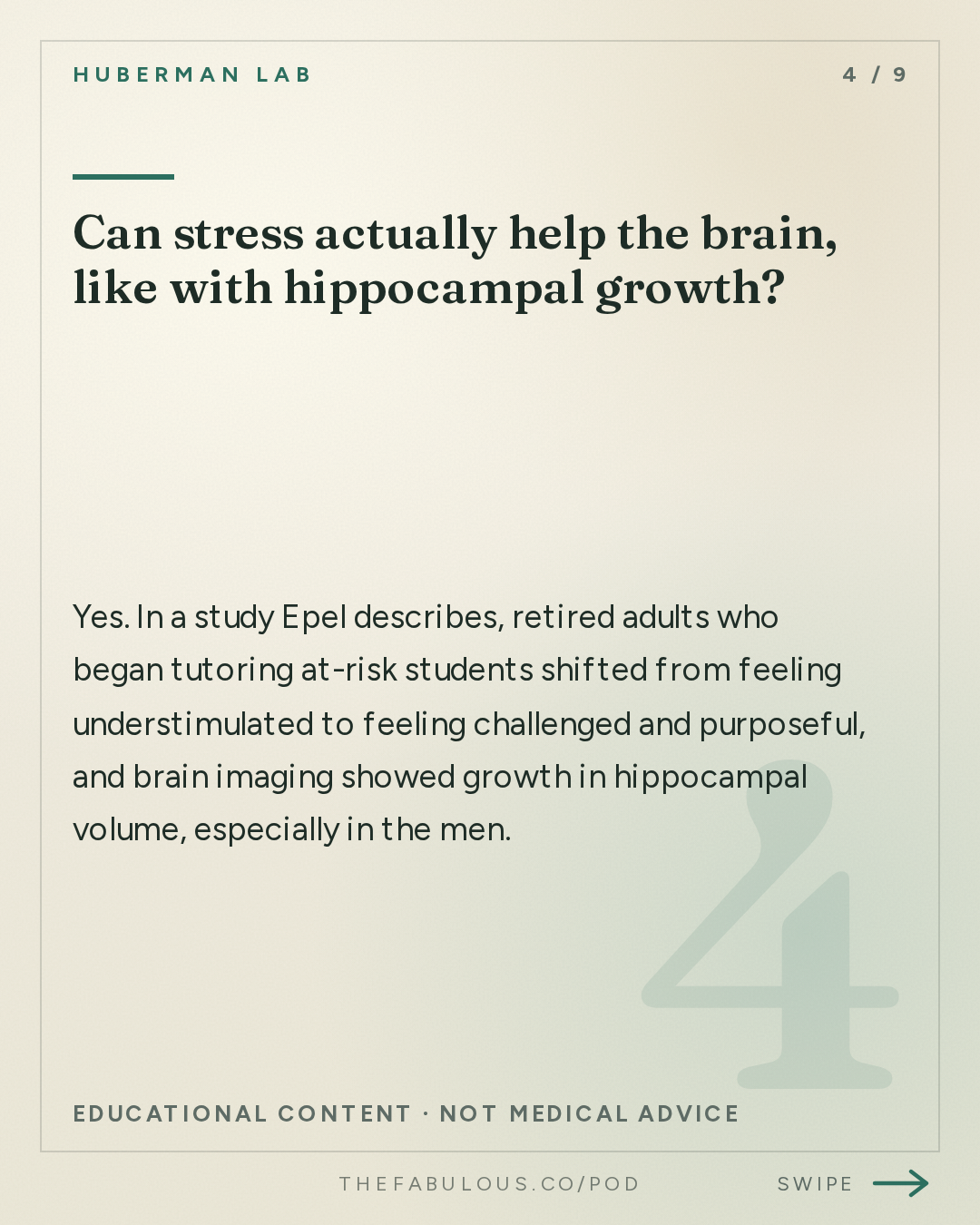
Can stress actually help the brain, like with hippocampal growth?
Yes. In a study Epel describes, retired adults who began tutoring at-risk students shifted from feeling understimulated to feeling challenged and purposeful, and brain imaging showed growth in hippocampal volume, especially in the men (09:52, 10:22).
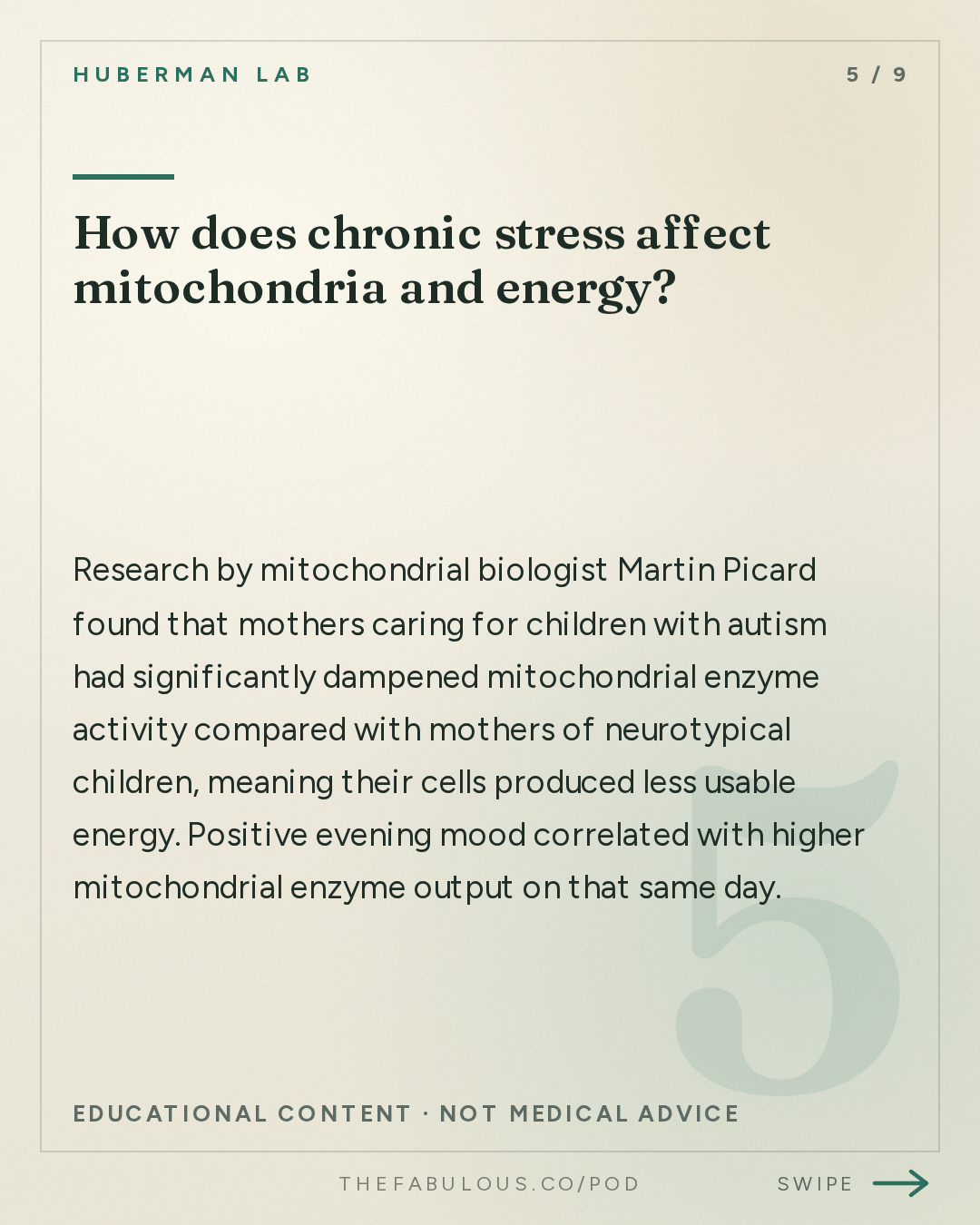
How does chronic stress affect mitochondria and energy?
Research by mitochondrial biologist Martin Picard found that mothers caring for children with autism had significantly dampened mitochondrial enzyme activity compared with mothers of neurotypical children, meaning their cells produced less usable energy (19:43). Positive evening mood correlated with higher mitochondrial enzyme output on that same day (20:15).
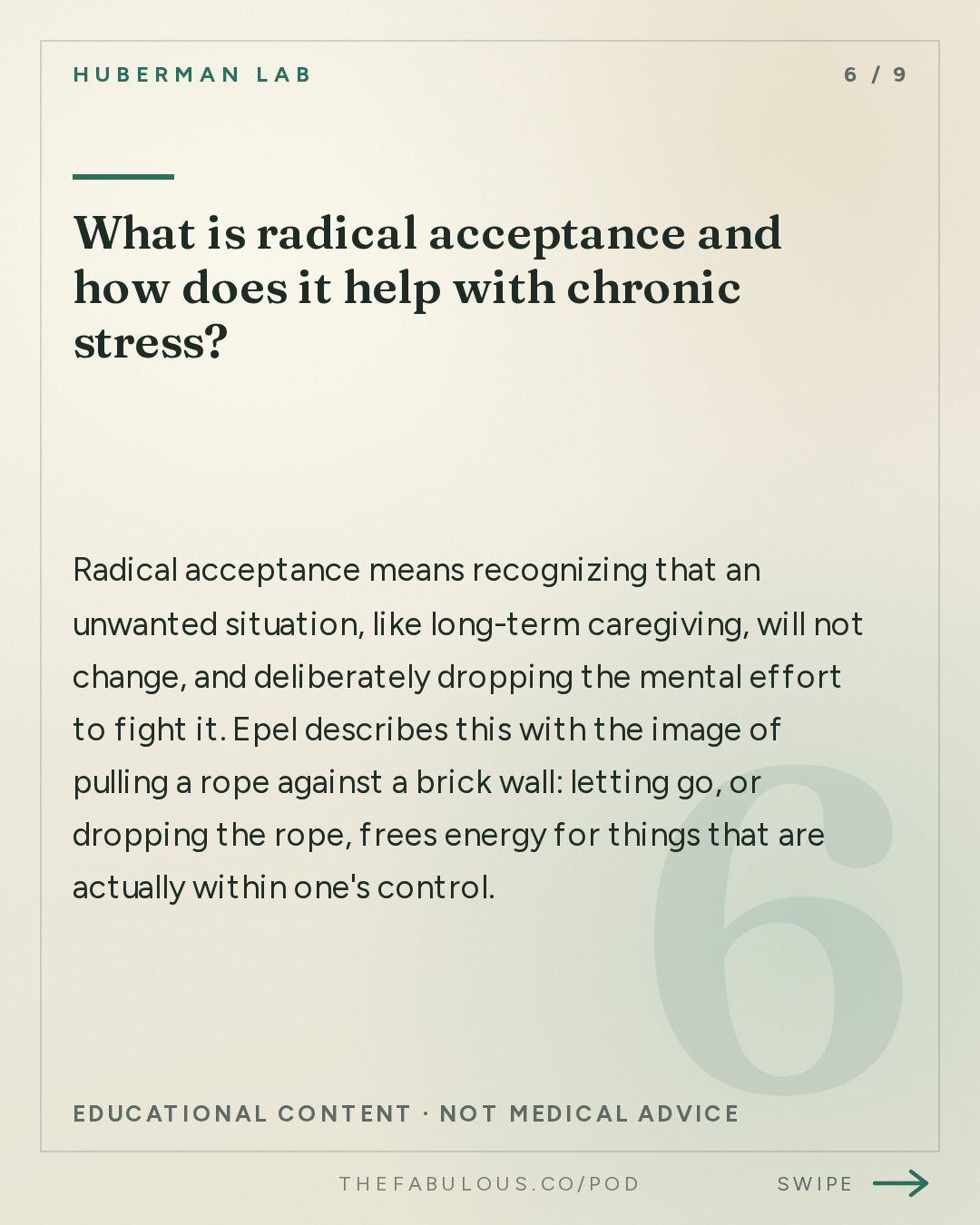
What is radical acceptance and how does it help with chronic stress?
Radical acceptance means recognizing that an unwanted situation, like long-term caregiving, will not change, and deliberately dropping the mental effort to fight it (07:09). Epel describes this with the image of pulling a rope against a brick wall: letting go, or dropping the rope, frees energy for things that are actually within one's control (25:42).
The full read, in cards
Go deeper
- Picard et al., mitochondrial health study (2018) — Found that caregiving mothers of children with autism had dampened mitochondrial enzyme activity linked to daily evening mood
- Reappraisal research by Wendy Mendes and colleagues — Trained people to view the stress response as positive, improving performance and recovery during lab stress tasks
- Hippocampal tutoring study in retired adults — Found hippocampal volume growth in retired men who began tutoring at-risk students
Mentioned
Elissa Epel · Martin Picard · Wendy Mendes · Andrew Huberman · Stanford School of Medicine · ATP · Mitochondria · Hippocampus · Telomeres
More from this show and category

Beth Shapiro on De-Extinction and Gene Editing
Evolutionary biologist Beth Shapiro explains why species are human categories and why dinosaur DNA cannot survive 66 million years. She describes how Colossal Biosciences engineered a dire wolf with 20 gene edits to a gray wolf genome, revived black-footed ferret genetics through cloning, and weighed the ethics of editing human embryos.

Huberman's Science-Based Focus Tools
Stanford neuroscientist Andrew Huberman lays out a stacked protocol for training focus, from sleep and caffeine to meditation and supplements. He covers 90-minute ultradian work blocks, a 13-minute daily breath meditation, cold exposure for epinephrine, and specific doses for creatine, alpha-GPC, and L-tyrosine, recommending behavioral tools before any supplement or drug.

Andy Galpin's Strength and Hypertrophy Protocols
Strength and muscle size are not the same adaptation: size can grow without strength, and power fades fastest with age. Kinesiologist Andy Galpin lays out concrete numbers, a 3-to-5 strength template, and a 10-to-25 weekly set range for hypertrophy that adapts to real-life chaos (11:30, 32:15).

Andy Galpin's 9 Fitness Benchmarks to Self-Test
Exercise scientist Andy Galpin breaks fitness into nine measurable adaptations, from movement skill to long-duration endurance, each with a home-testable benchmark. The takeaway: a broad jump, a dead hang, and a 12-minute run tell you more about your health trajectory than a single cardio number ever could (02:32).
