
Paul Stamets on Mushrooms, Immunity and Psilocybin
Mushrooms for the Mind & Immune System | Paul Stamets
The brief
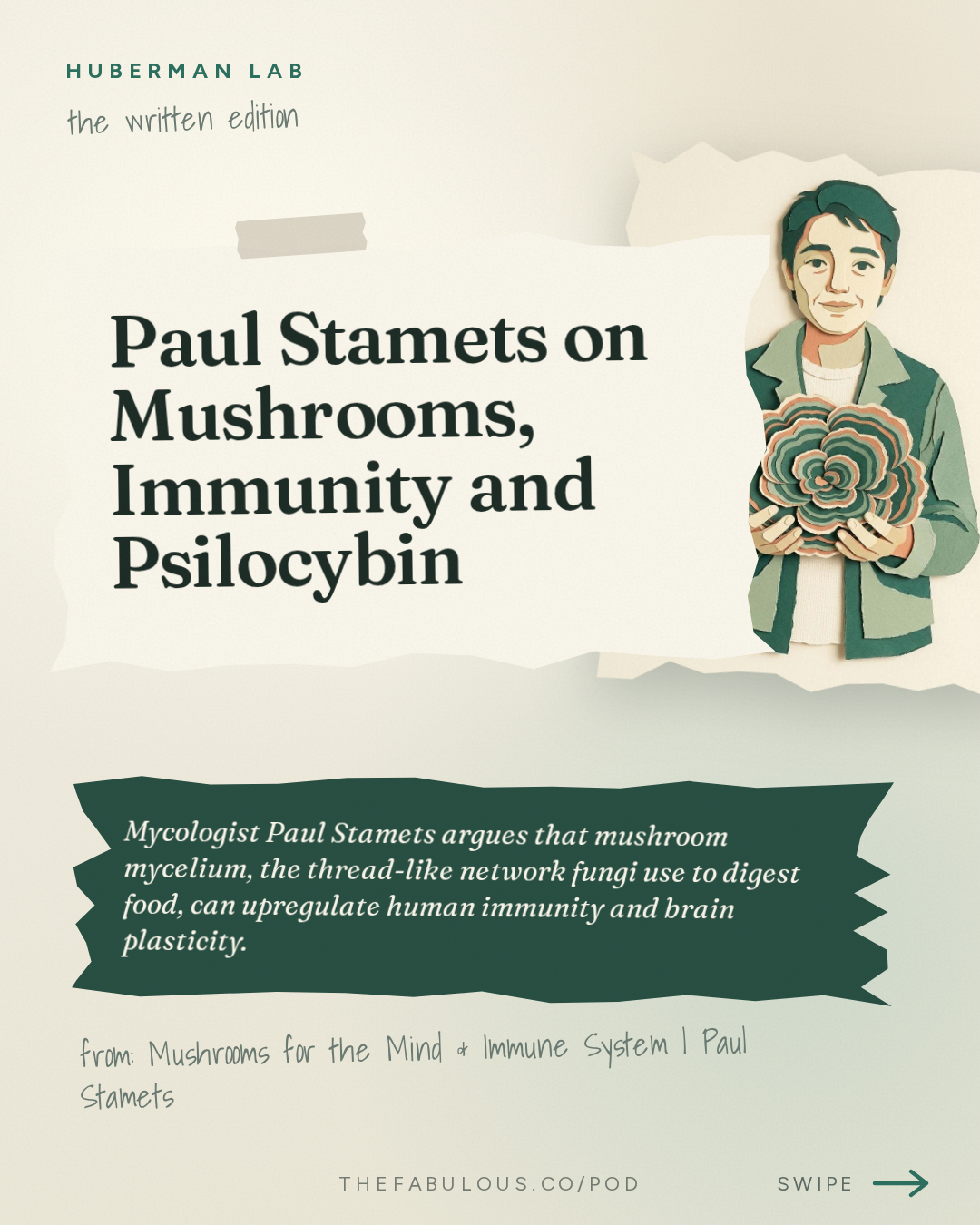
Mycologist Paul Stamets argues that mushroom mycelium, the thread-like network fungi use to digest food, can upregulate human immunity and brain plasticity. He cites COVID trials where Agarikon and Turkey Tail tripled antibody levels (34:37) and cut symptom duration by 5.1 days (38:19), plus psilocybin data on addiction and depression.
A single cubic inch of rich forest soil can hold up to eight miles of mycelium, the thread-like network that fungi use to feed (05:49). That number is the kind of thing that sounds like trivia until you realize what mycelium actually is: not the mushroom, but the vast underground organism that makes the mushroom, the way a cherry is to a cherry tree. Mycologist Paul Stamets has spent fifty years arguing that this network, and the chemistry it uses to fend off bacteria and viruses, has something to teach the human immune system and the human brain. His conversation with neuroscientist Andrew Huberman is really two arguments stitched together: one about fungi and infection, one about fungi and the mind. Both rest on the same premise, that evolution already solved problems we are still trying to solve with molecules.
Stamets traces his own interest back to a billion-and-a-half-year-old fork in the evolutionary road, when single-celled organisms split into two lineages. One swallowed its food and became animals. The other absorbed nutrients externally and became fungi (05:24). That external digestion, he says, forced fungi to evolve sophisticated chemical defenses against the same bacteria that plague us, E. coli, staph, Clostridium. The mushroom itself is fragile and rots in days. The mycelium underneath it is the part doing the defending.
"Mycelium is the immune system of the mushroom life cycle." — Paul Stamets [12:22]
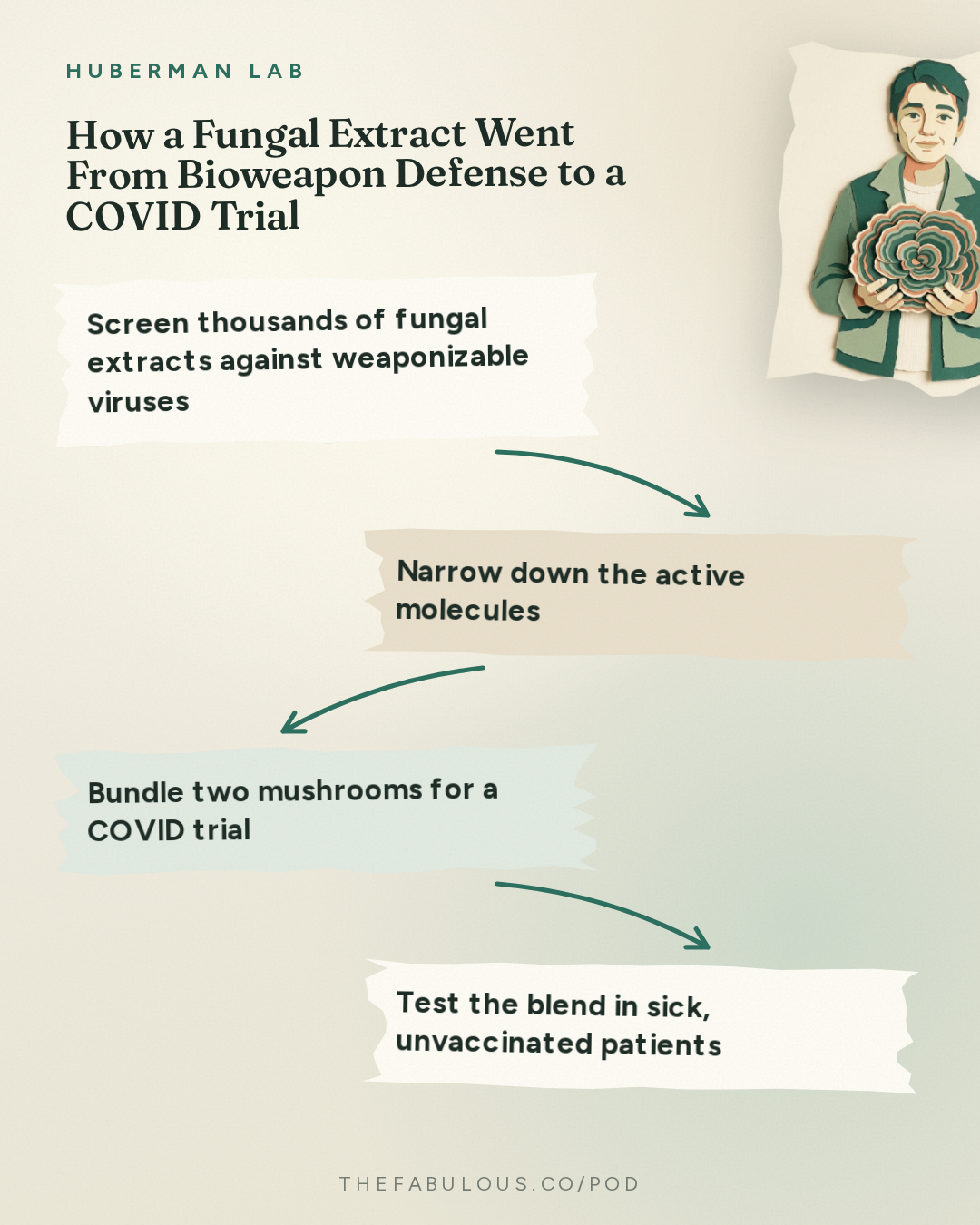
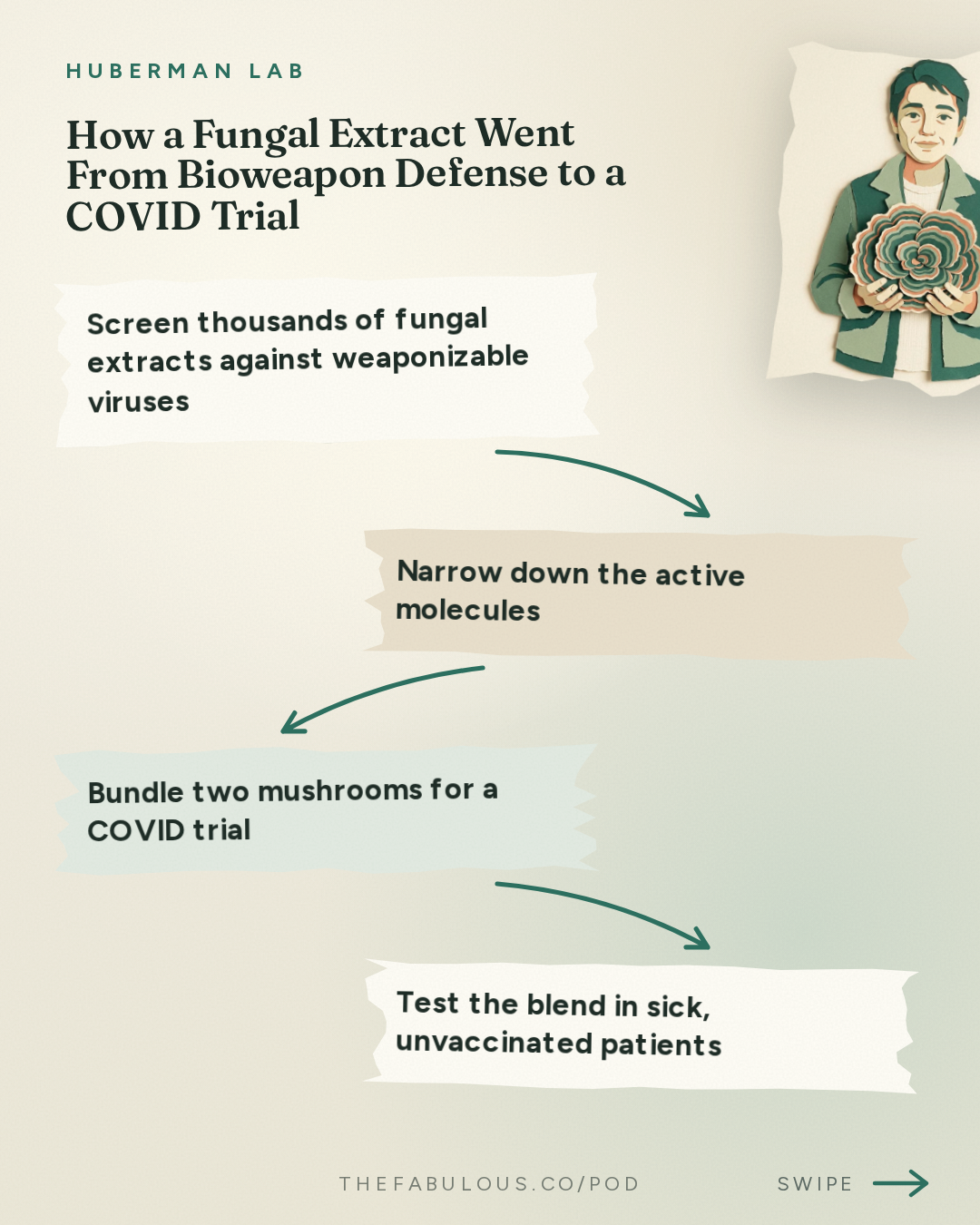
The immunity argument has a real paper trail. After September 11, Stamets was recruited into a federal biodefense program called BioShield, which ran 2,265 assays on his fungal extracts against weaponizable viruses (28:12). One mushroom, Agarikon, a slow-growing old-growth species first described in 65 A.D. as an "elixir of long life" (30:03), ranked in the top ten of more than two million samples tested against smallpox-related and flu viruses. Two decades later, when COVID arrived, Stamets and university collaborators bundled Agarikon with Turkey Tail, a common bracket mushroom, into a Phase 1 trial. The twist was regulatory as much as scientific: the FDA's first worry was that boosting immunity too much could worsen the cytokine storms that kill many COVID patients. Stamets had an answer waiting. Mycelium fermented on rice, it turns out, stimulates anti-inflammatory signals called interleukin-10 and interleukin-1RA, which calm an overactive immune response even while other compounds rev it up (31:21).
The trial results, across two studies and 140 participants, showed fewer vaccine side effects and, when researchers went back six months later to draw blood, triple the antibody levels in people who had taken the mushroom blend alongside their COVID vaccine (34:37). In a separate group of 50 unvaccinated, symptomatic patients, those taking the mycelium resolved half their symptoms 5.1 days sooner than placebo, a bigger effect than Tamiflu typically produces (38:19). Stamets is careful to call this correlation backed by trial data, not a settled mechanism. He frames it as raising the immune system's "state of readiness" rather than simply juicing it.
He is also blunt about the stakes of ignoring this kind of research. H5N1 bird flu has jumped to ninety mammal species, and its fatality rate in humans, if it takes hold, runs 40 to 50 percent (00:00), far deadlier than COVID. A $2.6 million grant is now funding a search through 130 cultured Agarikon strains for a high-potency variant, modeled on the discovery of an unusually productive penicillin mold on a moldy cantaloupe in Peoria, Illinois (44:12). Whether or not that search pays off, Stamets's broader point, that biodiversity itself is a kind of insurance against biological threats, has moved from fringe to something funders now take seriously.
The Mind Half of the Argument
The conversation's second half turns to psilocybin, the compound in so-called magic mushrooms, which the body converts into the active chemical psilocin. Stamets reports that 2.5 percent of Americans, by his estimate more than eight million people, used psilocybin in the past year (74:51). He points to observational data showing two large, supervised doses of psilocybin led to a 90 percent smoking cessation rate a year later, compared to standard nicotine-patch outcomes (75:37). He links this to synaptogenesis, a process where psilocybin appears to help new dendritic spines grow from the tips of axons, the branches neurons use to send signals, essentially building new neural pathways that let people break out of addictive or ruminative loops (79:33).
Huberman pushes back gently on the central tension here, that neuroplasticity, the brain's ability to rewire itself, is only useful if it gets pointed somewhere good. Stamets agrees that supervised therapy matters enormously, not freelance use, and tells a personal story about turning down his own father and his mentor, the mycologist Alexander Smith, when both asked to take psilocybin with him, because without a prepared support system he worried about the fallout (84:08). He points to a Canadian nonprofit, Roots to Thrive, as a model combining group preparation, guided sessions, and after-care.
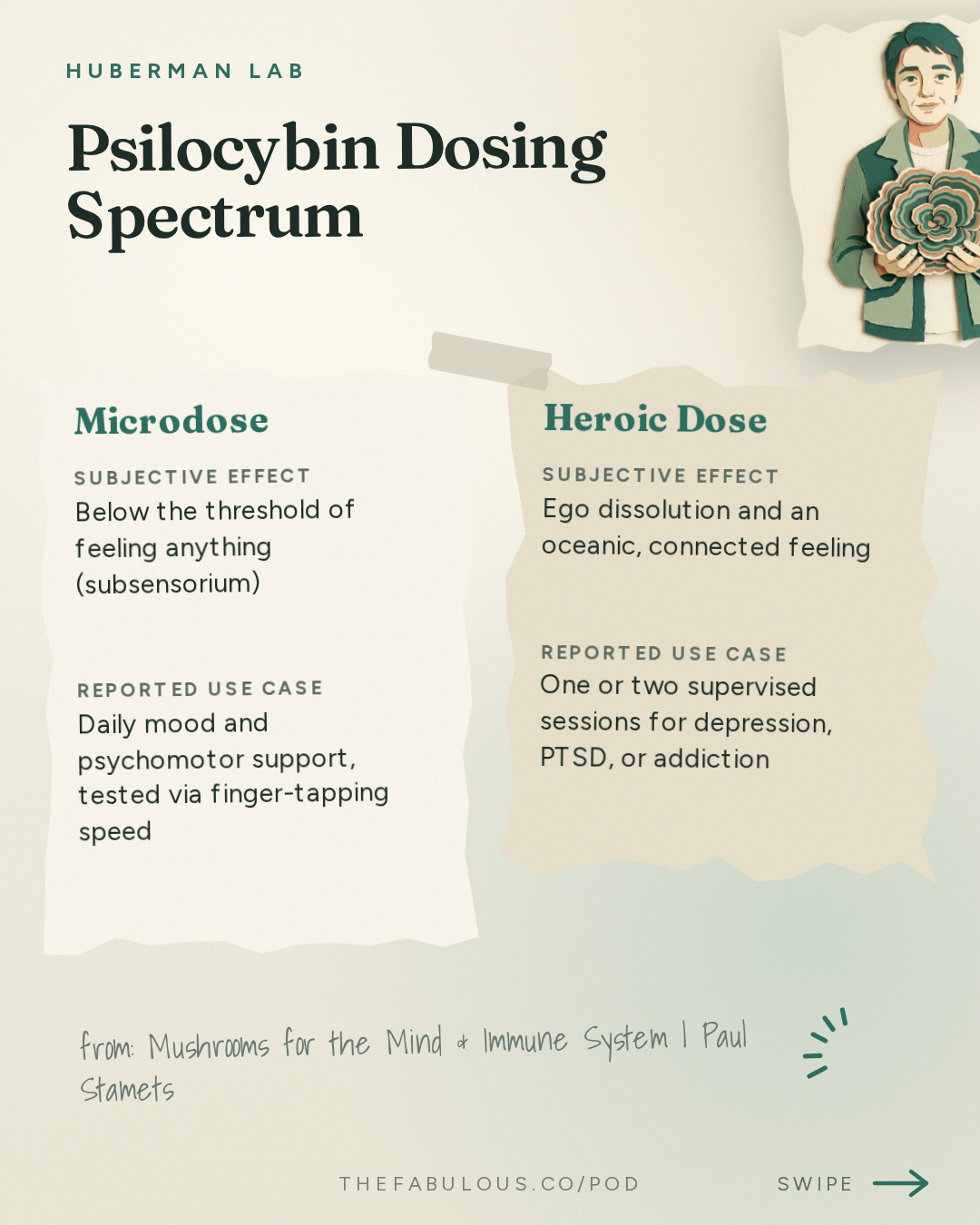
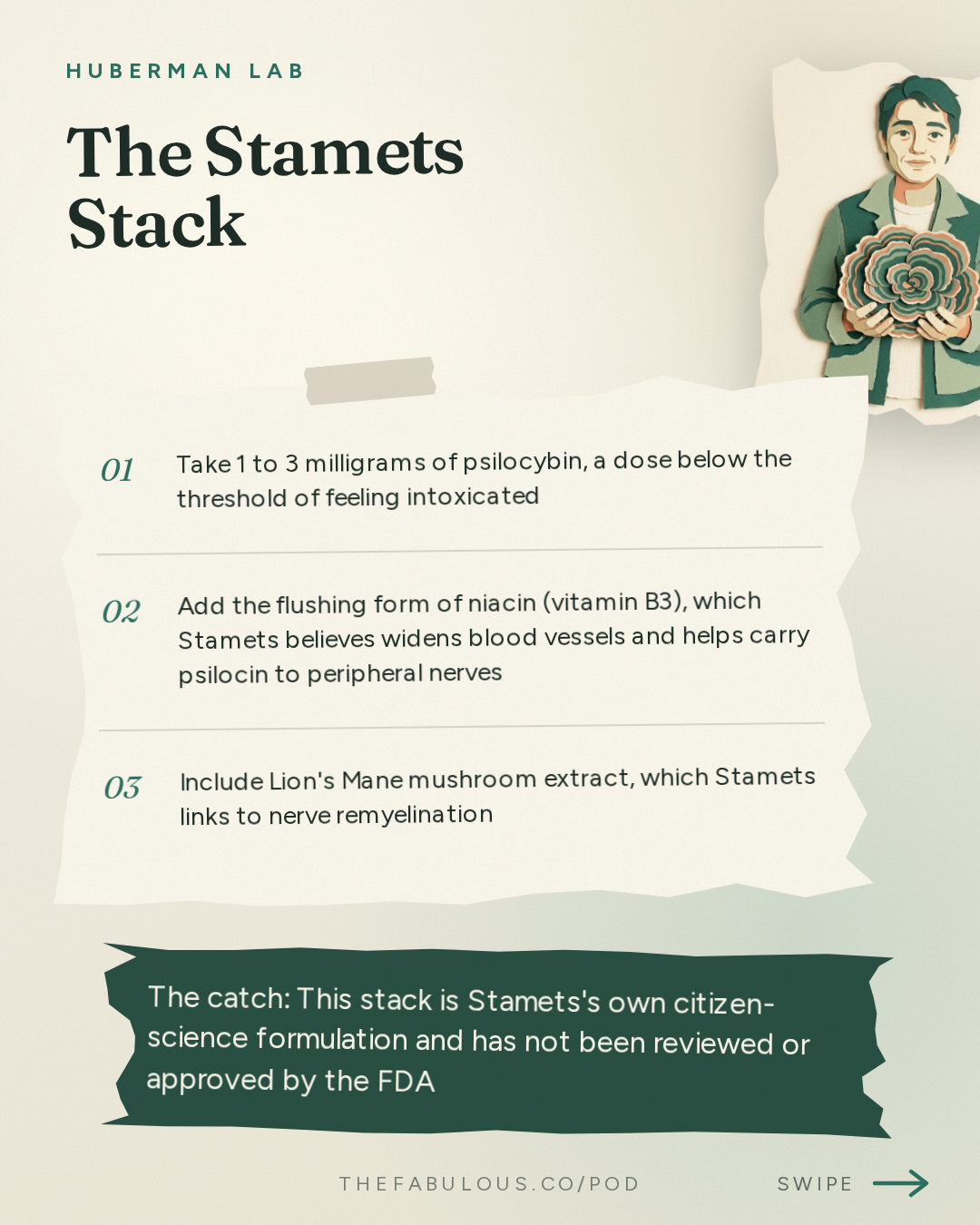
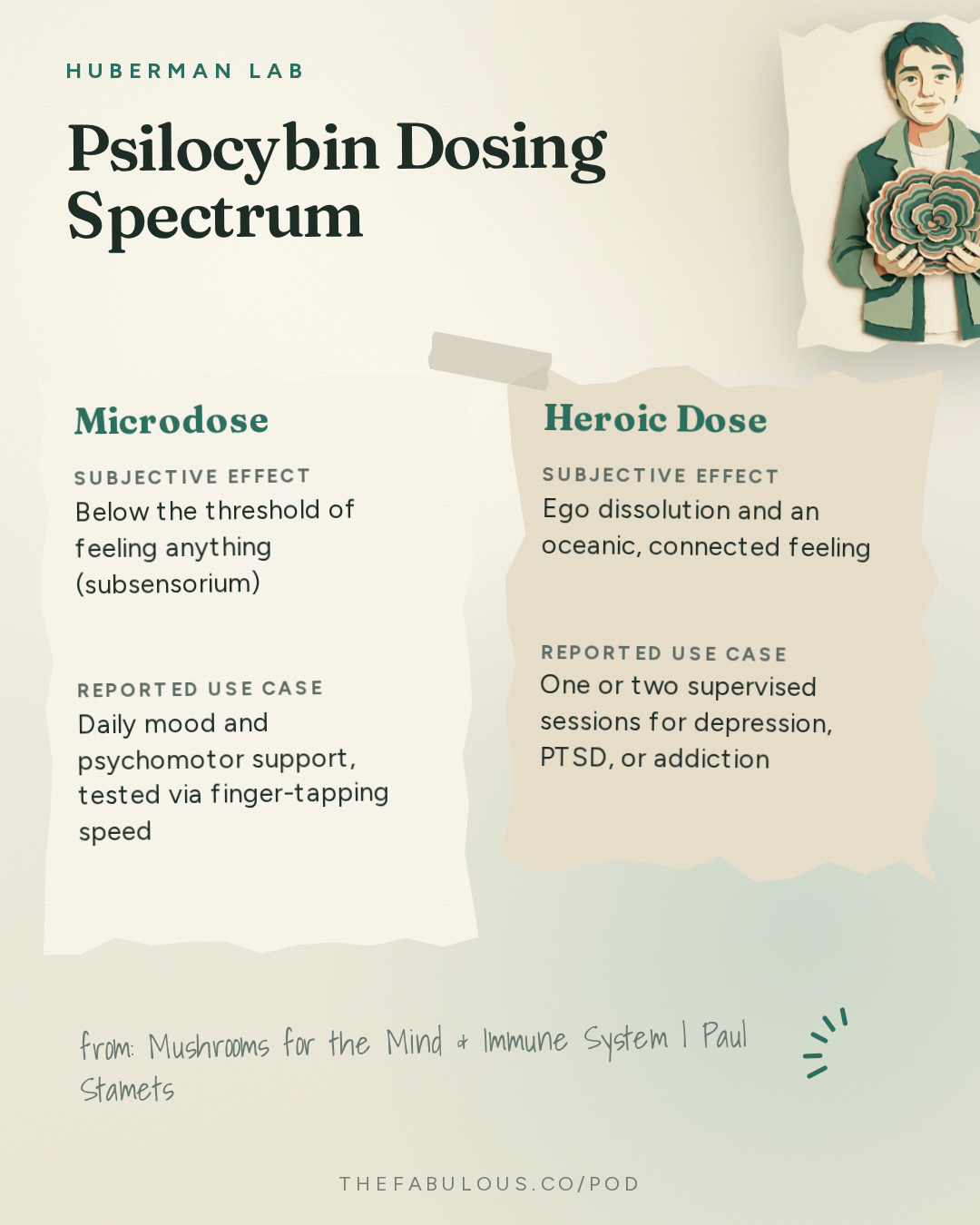
Microdosing gets its own, more measured treatment. A microdose, Stamets says, is defined as a dose too small to feel, typically 1 to 3 milligrams of pure psilocybin (97:36), far below the 25-milligram dose (about 2.5 grams of dried mushroom) used as the clinical standard in trials for depression (99:15). In a citizen-science study with roughly 25,000 participants, he and colleagues added a simple, hard-to-fake measure: a finger-tapping speed test. People following what he calls the Stamets Stack, psilocybin combined with niacin (vitamin B3) and Lion's Mane mushroom, raised their tapping frequency from 43 to 63 taps over thirty days (111:54), a psychomotor change Stamets argues can't be explained by expectation alone.
"Happiness is the anti-inflammatory drug. Ultimately, that's what we're seeking." — Paul Stamets [142:59]
Stamets is a scientist who also likes to speculate past the data, and the episode makes room for both modes. He describes electrical "word packets" passing through fungal networks (121:14), floats the idea of shoes wired to sense mycelium underfoot, and ends on a genuinely strange astronomical detail: NASA's 2025 analysis of dust from the asteroid Bennu turned up tryptophan, the fragile amino acid that is the chemical precursor to serotonin and to psilocybin-like tryptamines (126:27). From that one data point he builds a large claim about a "tryptamine universe." It's the kind of leap that invites skepticism, and to his credit, Stamets invites it too, repeatedly asking listeners to question him with "respect and humor" rather than deference.
"Question authority with respect and humor, because I thought that's the way you create a dialogue." — Paul Stamets [129:06]
What holds the episode together, underneath the biodefense grants and the asteroid dust, is a fairly narrow and testable claim: that natural products, used in combination rather than isolated into single molecules, might do things single-molecule pharmaceuticals can't, partly by working with the immune and nervous systems rather than overriding them. The clinical trials Stamets cites are small, mostly Phase 1, and funded without the patent protections that usually drive big pharmaceutical investment. That funding gap, more than any scientific objection, may be the real reason this research has moved slowly. Stamets ends not with a mechanism but with a wager on curiosity itself, the same instinct that sent a fourteen-year-old boy chasing his older brother's stories about psilocybin into the Ohio woods, and never really stopped.
Ask this episode anything
Pod's AI answers from the episode itself, with the minute mark so you can hear it yourself.
Or start with one of these
Ask this episode
Pod's AI listens to the whole episode to answer, and points you to the minute it comes from.
The rest of this answer, and any question after it
Answers come from the episode itself, never from a summary of it.
ContinueKey takeaways
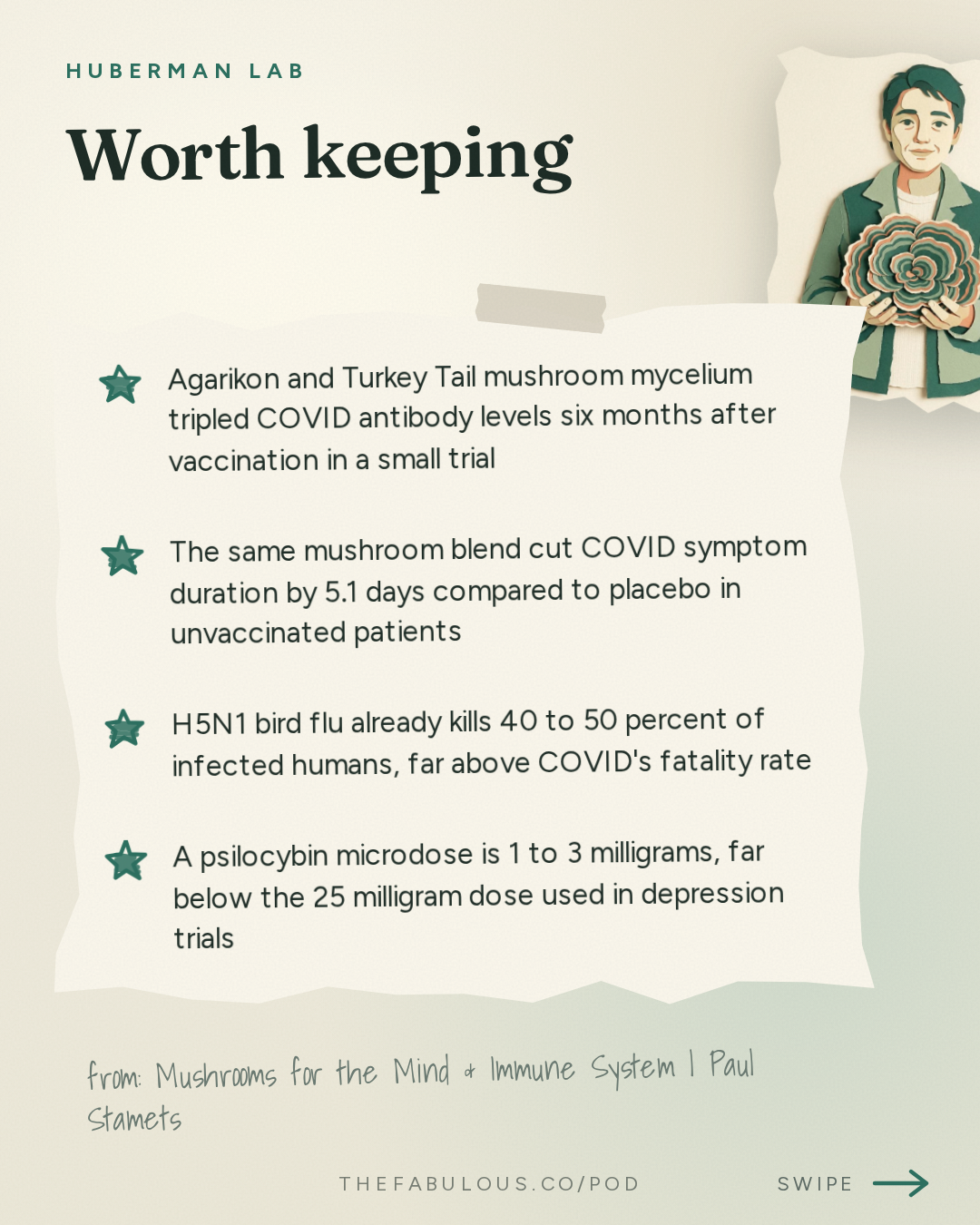
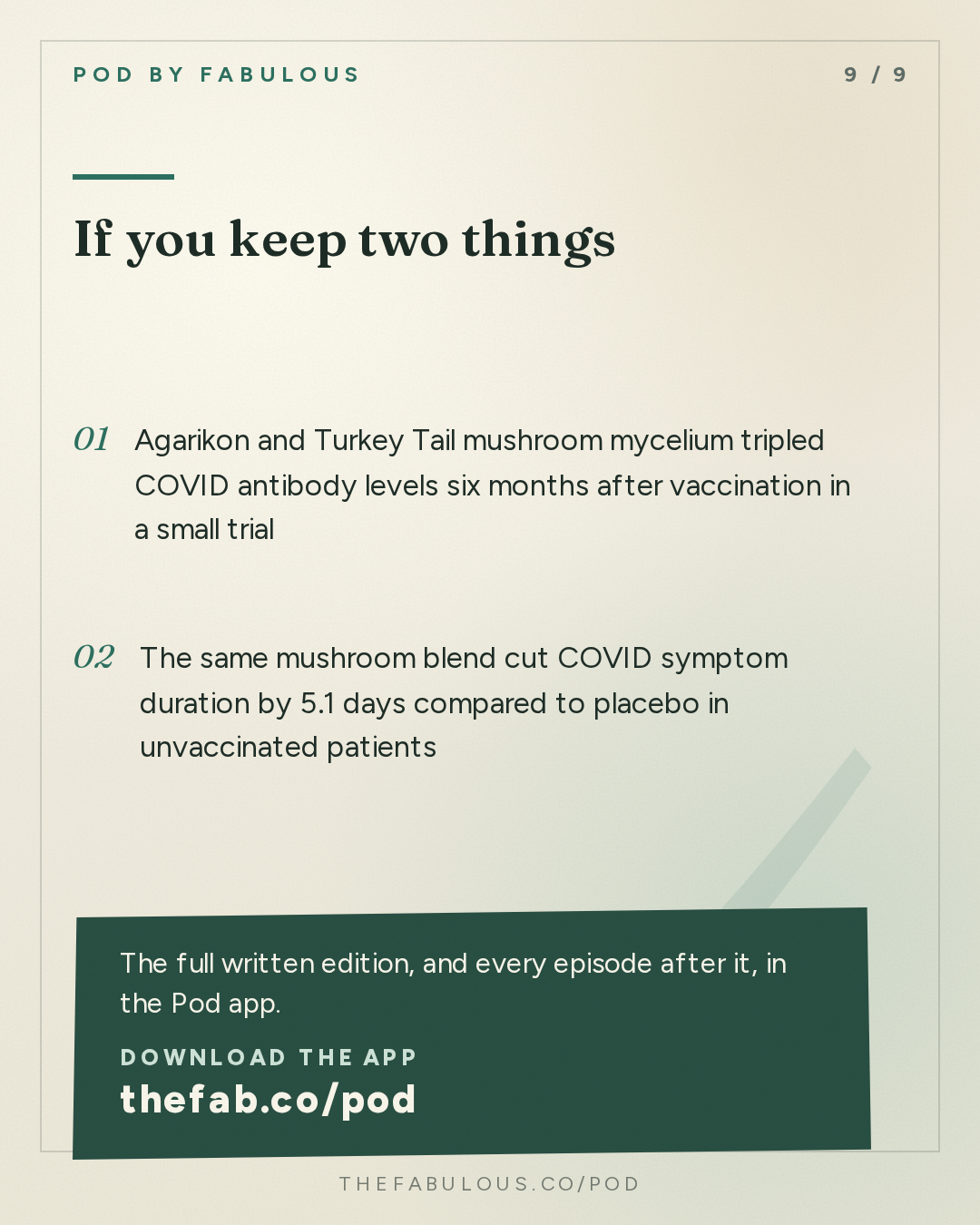
- Agarikon and Turkey Tail mushroom mycelium tripled COVID antibody levels six months after vaccination in a small trial
- The same mushroom blend cut COVID symptom duration by 5.1 days compared to placebo in unvaccinated patients
- H5N1 bird flu already kills 40 to 50 percent of infected humans, far above COVID's fatality rate
- A psilocybin microdose is 1 to 3 milligrams, far below the 25 milligram dose used in depression trials
- Doing 40 pushups in one set, three times a week, is linked to a 97 percent lower cardiac arrest risk in a Harvard study Stamets cites
The episode in cards
By the numbers
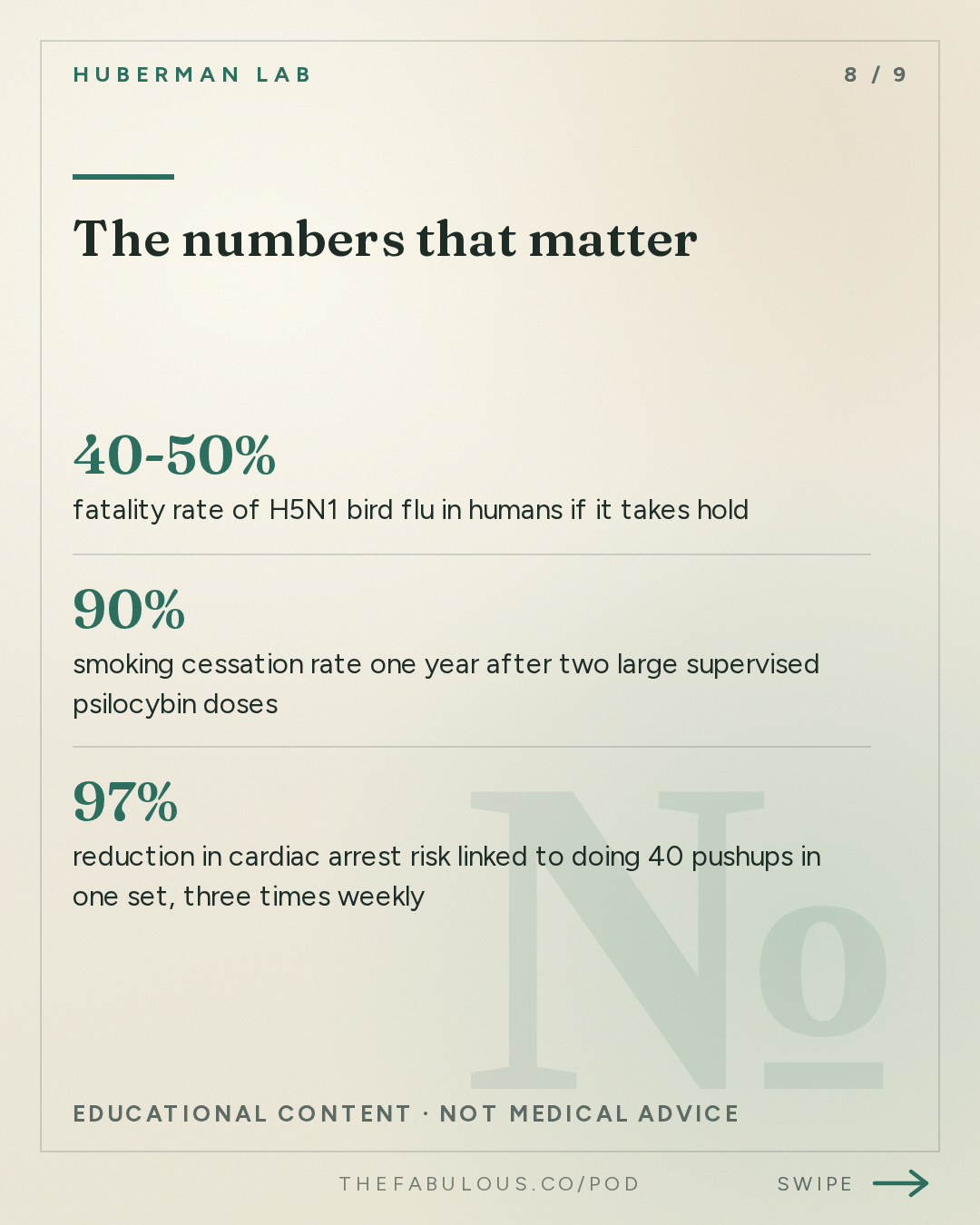
- 40-50% percent fatality rate of H5N1 bird flu in humans if it takes hold
- 90% percent smoking cessation rate one year after two large supervised psilocybin doses
- 97% percent reduction in cardiac arrest risk linked to doing 40 pushups in one set, three times weekly
In their words
“Mycelium is the immune system of the mushroom life cycle.”
“Investment in bios-biodiversity is an investment in our biosecurity”
“Happiness is the anti-inflammatory drug. Ultimately, that's what we're seeking.”
Protocols
-
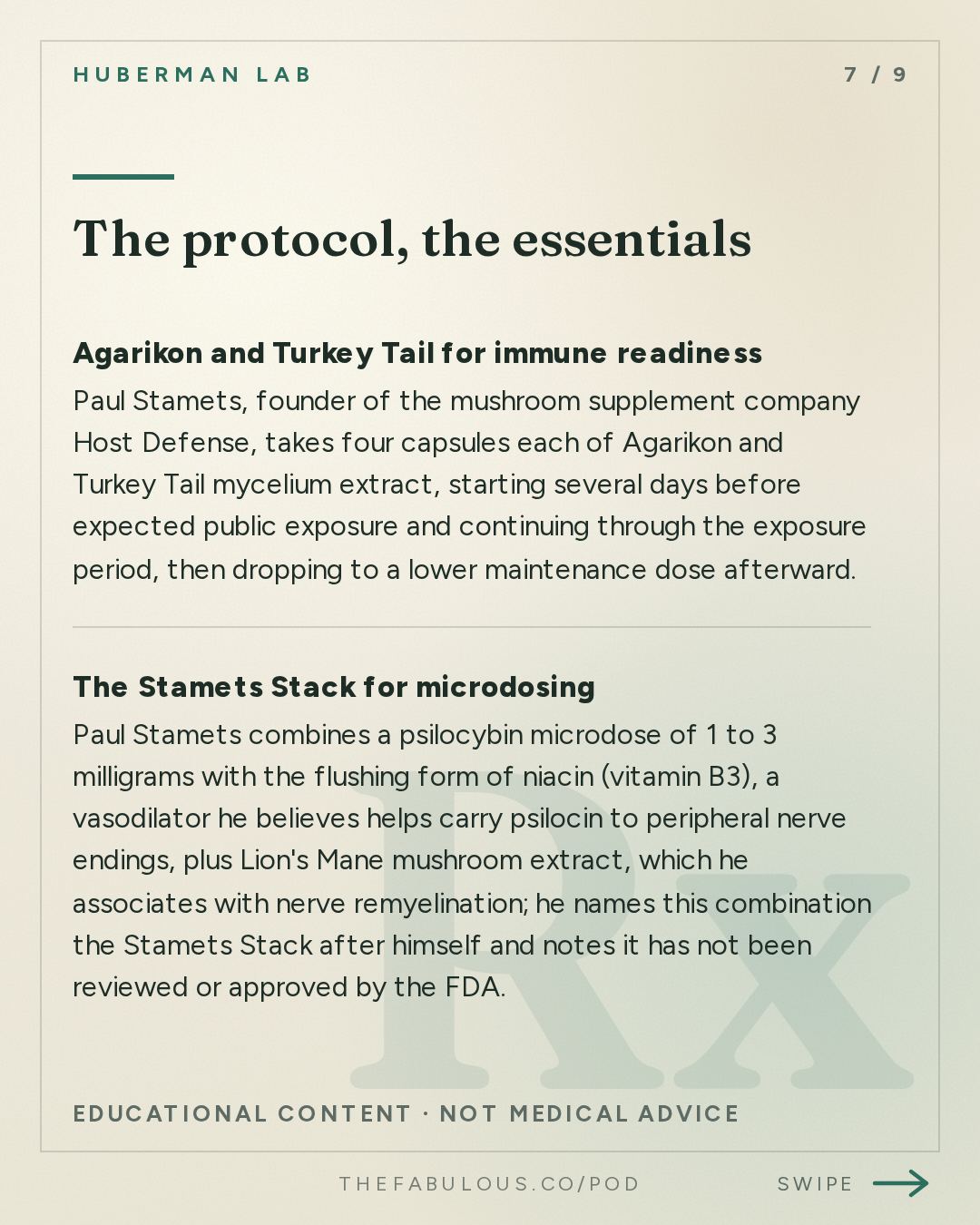
Agarikon and Turkey Tail for immune readiness
Paul Stamets, founder of the mushroom supplement company Host Defense, takes four capsules each of Agarikon and Turkey Tail mycelium extract, starting several days before expected public exposure and continuing through the exposure period, then dropping to a lower maintenance dose afterward.
Elevated dosing before and during public exposure, lower maintenance dose otherwise
-
The Stamets Stack for microdosing
Paul Stamets combines a psilocybin microdose of 1 to 3 milligrams with the flushing form of niacin (vitamin B3), a vasodilator he believes helps carry psilocin to peripheral nerve endings, plus Lion's Mane mushroom extract, which he associates with nerve remyelination; he names this combination the Stamets Stack after himself and notes it has not been reviewed or approved by the FDA.
Cycled microdosing, tested over a 30-day period in his cited study
-
Pushup test for cardiovascular risk
Paul Stamets cites a Harvard study reporting that men able to perform 40 pushups in a single set, three times a week, show a 97 percent reduction in cardiac arrest risk; he personally avoids locking out or hyperextending his elbows past his body during the movement to protect his joints.
Three times per week, 40 pushups per set
Questions this episode answers
Can mushrooms like Agarikon and Turkey Tail help with COVID?
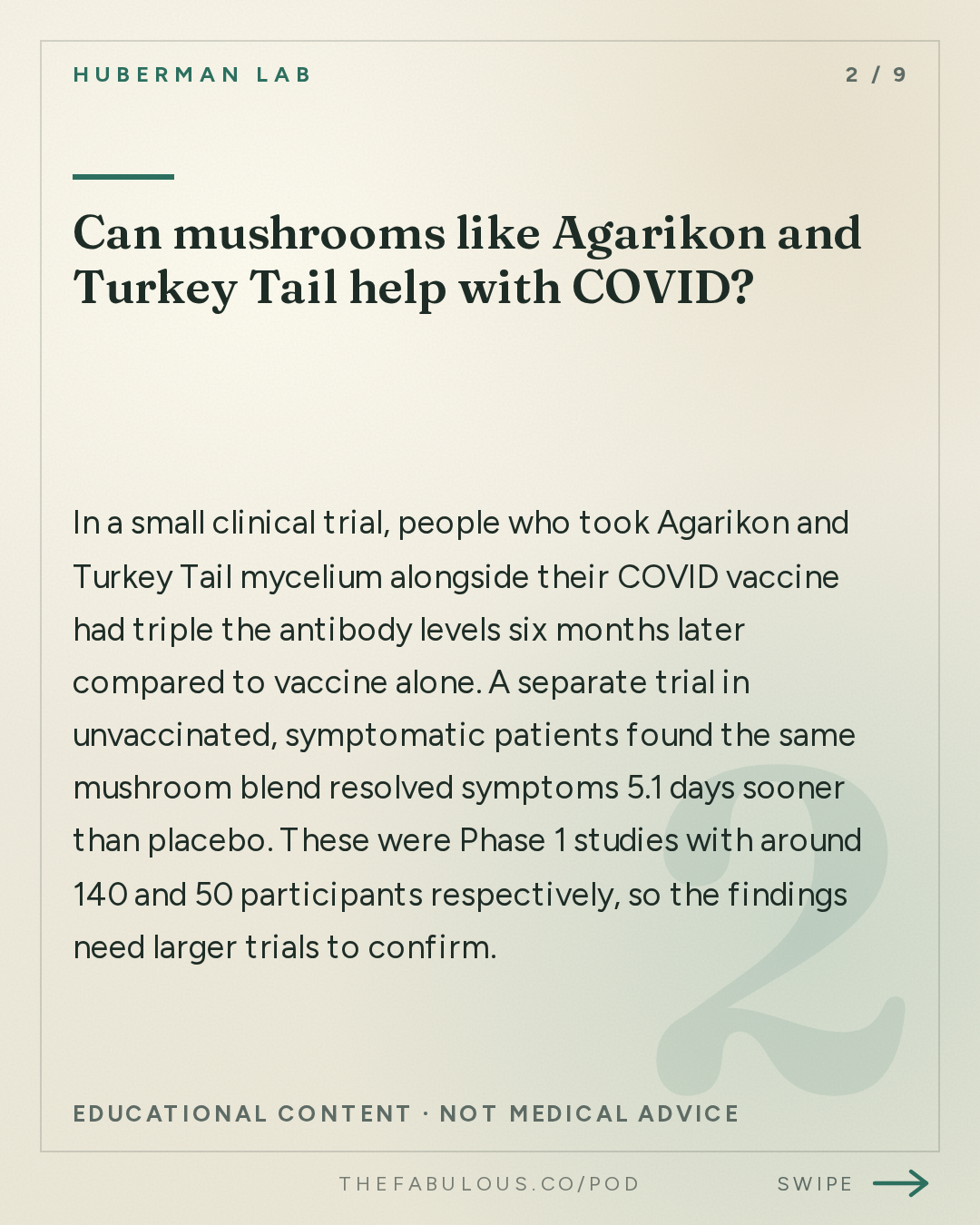
In a small clinical trial, people who took Agarikon and Turkey Tail mycelium alongside their COVID vaccine had triple the antibody levels six months later compared to vaccine alone (34:37). A separate trial in unvaccinated, symptomatic patients found the same mushroom blend resolved symptoms 5.1 days sooner than placebo (38:19). These were Phase 1 studies with around 140 and 50 participants respectively, so the findings need larger trials to confirm.
What is the Stamets Stack for microdosing?
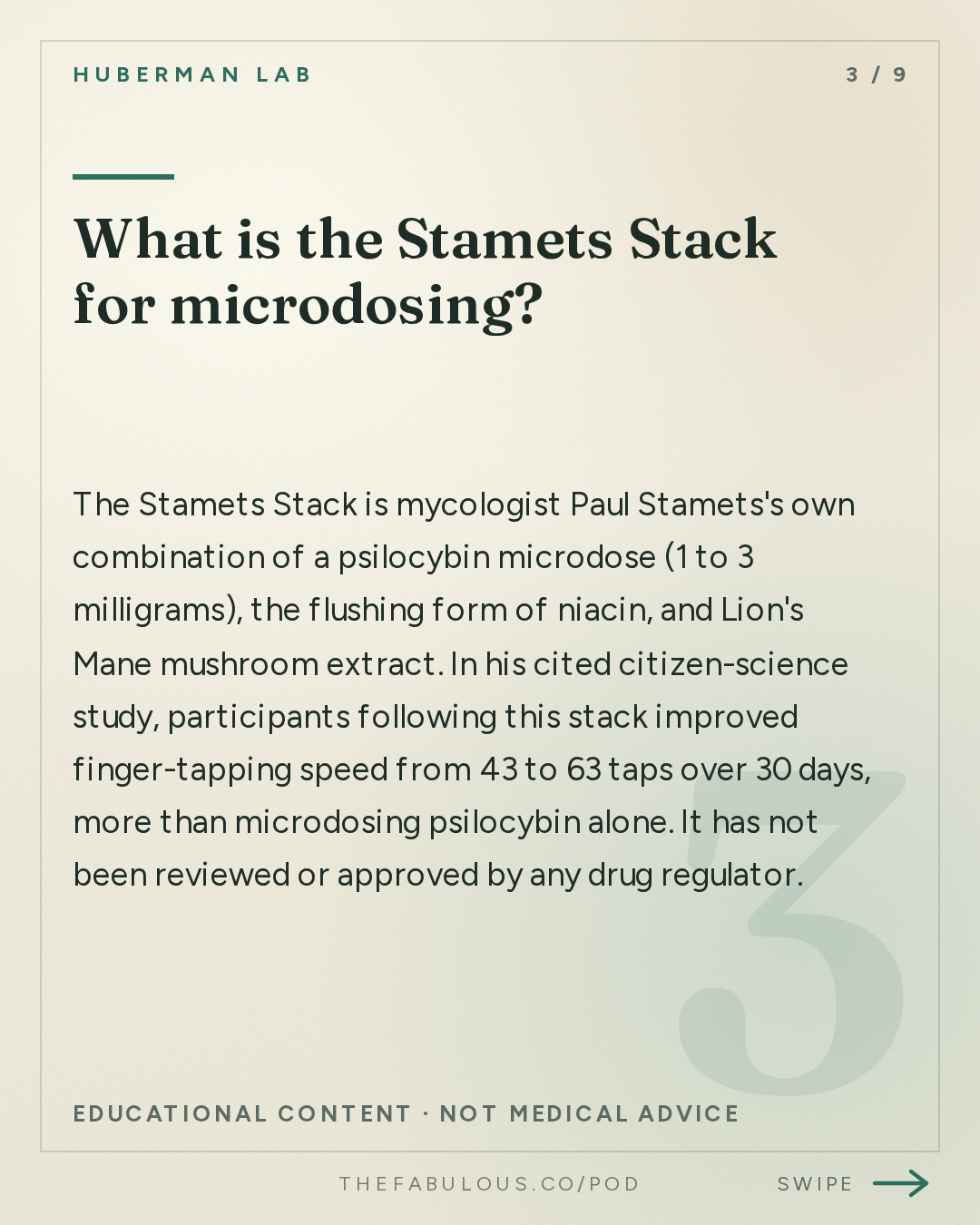
The Stamets Stack is mycologist Paul Stamets's own combination of a psilocybin microdose (1 to 3 milligrams), the flushing form of niacin, and Lion's Mane mushroom extract (111:03). In his cited citizen-science study, participants following this stack improved finger-tapping speed from 43 to 63 taps over 30 days, more than microdosing psilocybin alone (111:54). It has not been reviewed or approved by any drug regulator.
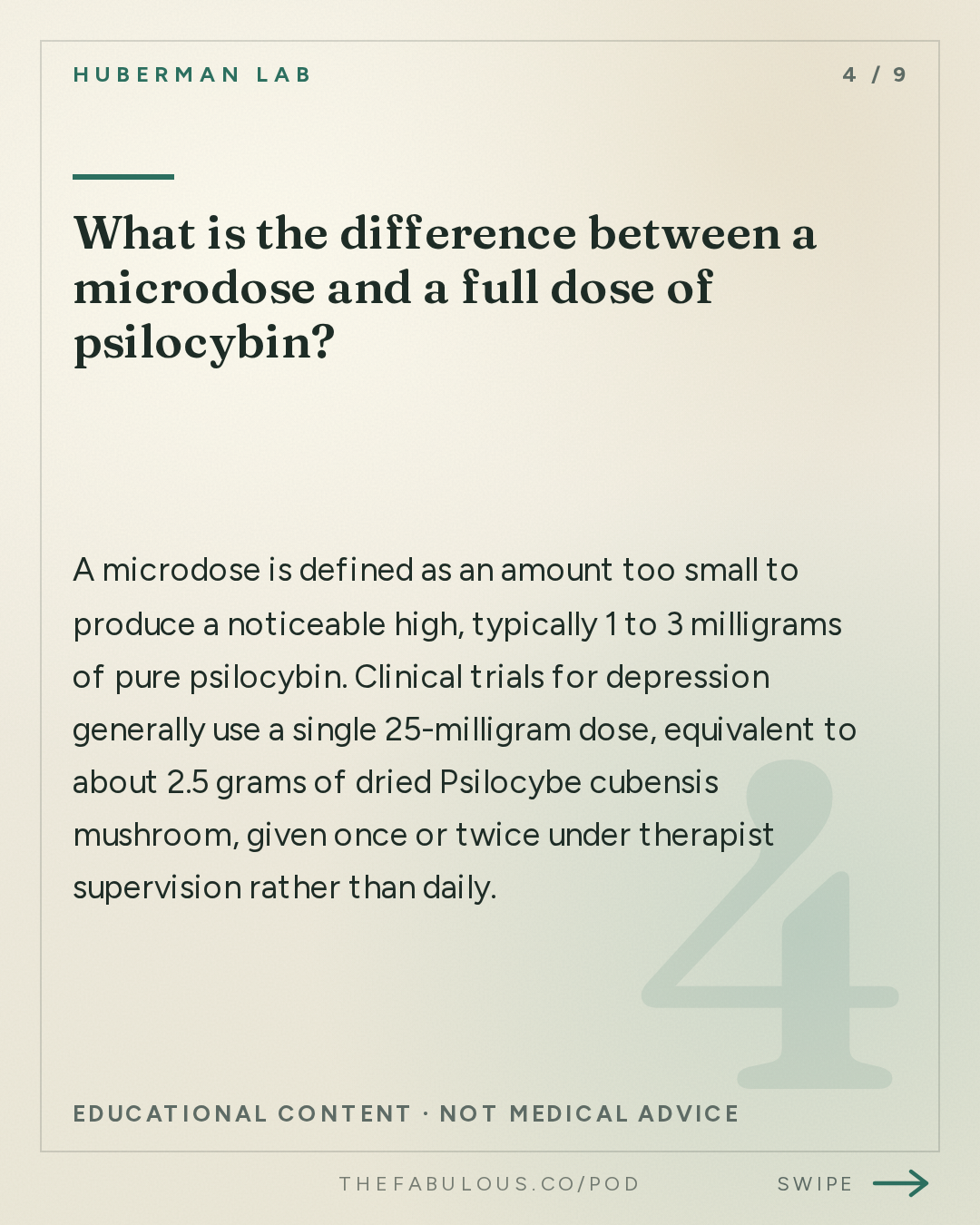
What is the difference between a microdose and a full dose of psilocybin?
A microdose is defined as an amount too small to produce a noticeable high, typically 1 to 3 milligrams of pure psilocybin (97:36). Clinical trials for depression generally use a single 25-milligram dose, equivalent to about 2.5 grams of dried Psilocybe cubensis mushroom (99:15), given once or twice under therapist supervision rather than daily.
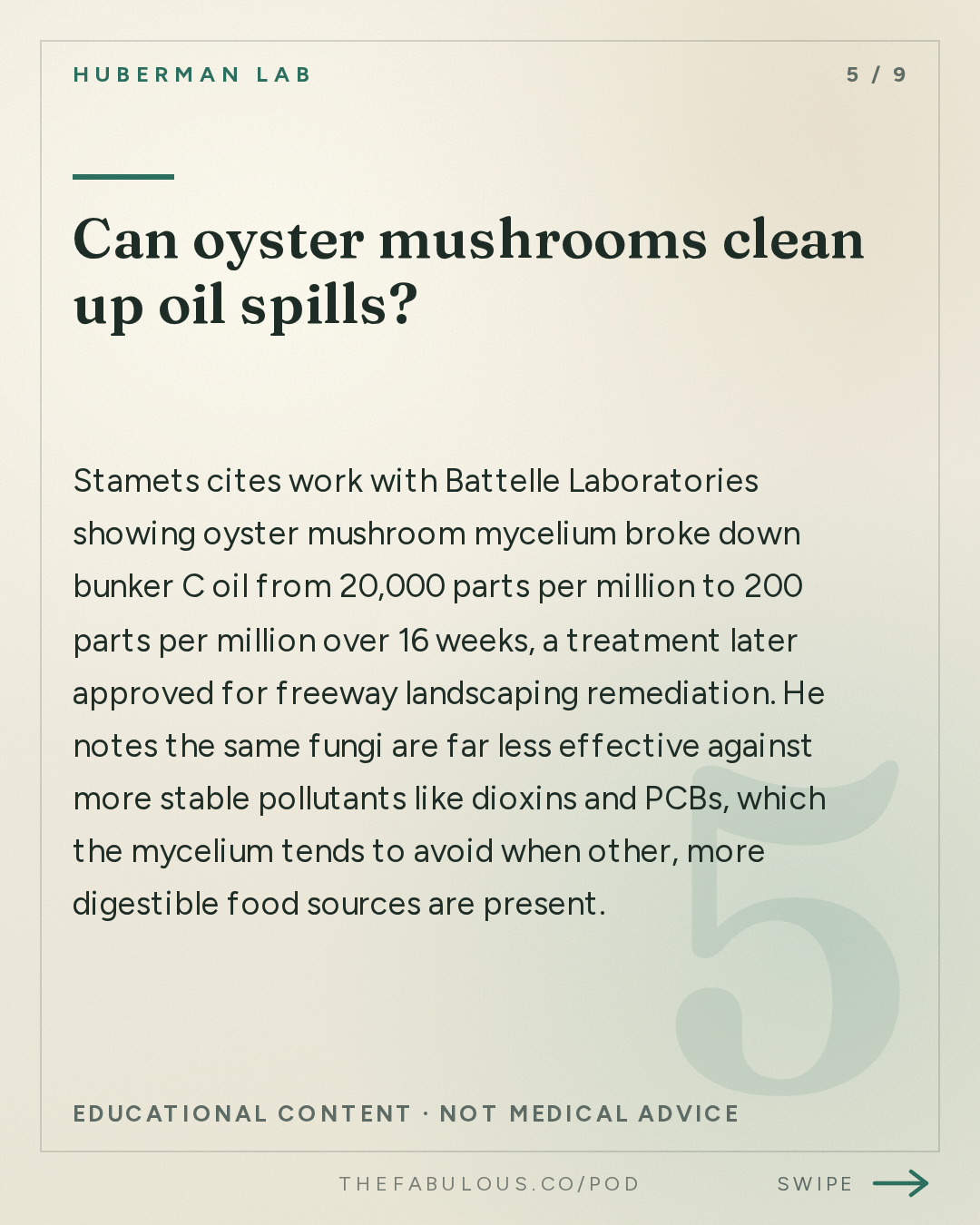
Can oyster mushrooms clean up oil spills?
Stamets cites work with Battelle Laboratories showing oyster mushroom mycelium broke down bunker C oil from 20,000 parts per million to 200 parts per million over 16 weeks, a treatment later approved for freeway landscaping remediation (135:08). He notes the same fungi are far less effective against more stable pollutants like dioxins and PCBs, which the mycelium tends to avoid when other, more digestible food sources are present (136:02).
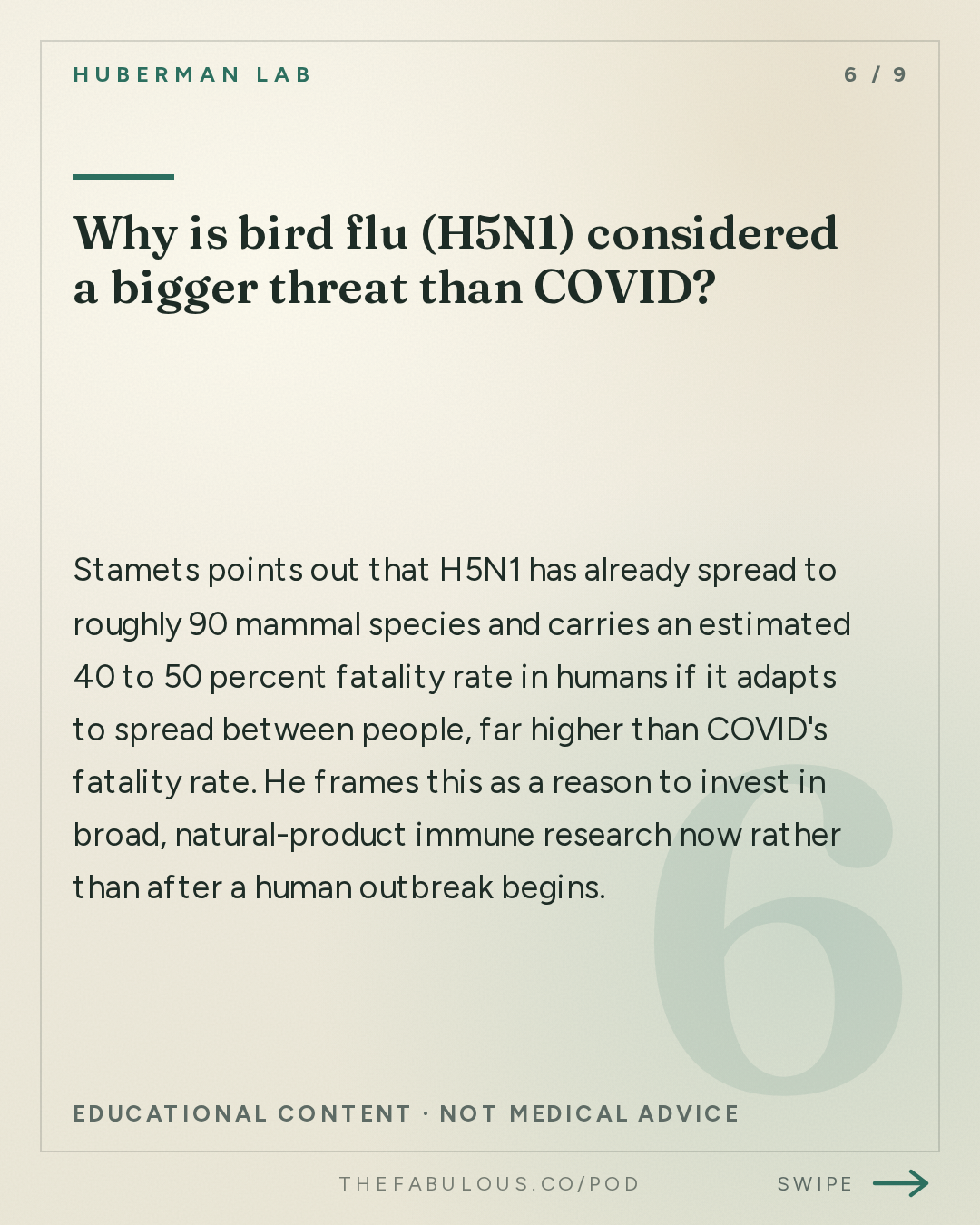
Why is bird flu (H5N1) considered a bigger threat than COVID?
Stamets points out that H5N1 has already spread to roughly 90 mammal species and carries an estimated 40 to 50 percent fatality rate in humans if it adapts to spread between people, far higher than COVID's fatality rate (00:00). He frames this as a reason to invest in broad, natural-product immune research now rather than after a human outbreak begins.
The full read, in cards
Go deeper
- Journal of Inflammation Research paper on mycelium-fermented rice — showed the product stimulates anti-inflammatory cytokines interleukin-10 and interleukin-1RA
- BMC Immunology vaccine enhancement study — found Agarikon and Turkey Tail tripled antibody reservoirs six months after COVID vaccination
- G3: Genes, Genomes and Genetics genome paper — published the first full genome sequencing of the Agarikon mushroom
- Nature Scientific Reports microdosing papers — citizen-science studies of roughly 25,000 participants reporting mood and psychomotor effects of microdosing
- The Crack in the Cosmic Egg — Joseph Pearce book Stamets cites on the deepening appreciation of one's own ignorance through expertise
- Mycelium Running: How Mushrooms Can Help Save the World — Stamets's 2004 book first proposing mycelium functions like microcomputers and neural networks
Mentioned
Paul Stamets · Andrew Huberman · Host Defense · Agarikon · Turkey Tail · Lion's Mane · Psilocybin · BioShield · Roland Griffiths · Stamets Stack · Roots to Thrive · Rick Doblin · Mary Hunt · Asteroid Bennu
More from this show and category

Mary Helen Immordino-Yang on Emotion and Learning
Psychologist Mary Helen Immordino-Yang says emotion is the substrate of thought, not a distraction from it. What a student feels about a topic, not just the grade, determines what actually gets learned, and she traces this from infant attachment through cultural perception to a call for project-based schooling over standardized tests.
Anna Lembke: Why Addiction Is Really About Control
Stanford psychiatrist Anna Lembke says the deepest addictions are addictions to control, not substances. She explains the brain's pleasure-pain balance, a 30-day protocol for resetting reward pathways, why the periaqueductal gray links threat and spirituality, and how surrender, codependency, ketamine, and GLP-1 drugs fit the same control framework.

The Søberg Principle: Cold Exposure Protocol
Cold and heat exposure activate brown fat, the tissue that burns fuel for heat instead of storing it, improving insulin sensitivity and lowering inflammation. Danish researcher Susanna Søberg found the minimum effective dose is about 11 minutes of cold water weekly and 57 minutes of sauna weekly, always ending on cold (26:47, 27:43, 33:29).
How Robert Greene Accesses the Sublime
Robert Greene, author of Mastery and The 48 Laws of Power, says the sublime is a jolt of awe that breaks open ordinary, filtered perception. In his new book The Law of the Sublime, he offers exercises built on trained attention, slowness, recovered childhood memory, and vulnerability in love to reach it without drugs or travel.
