
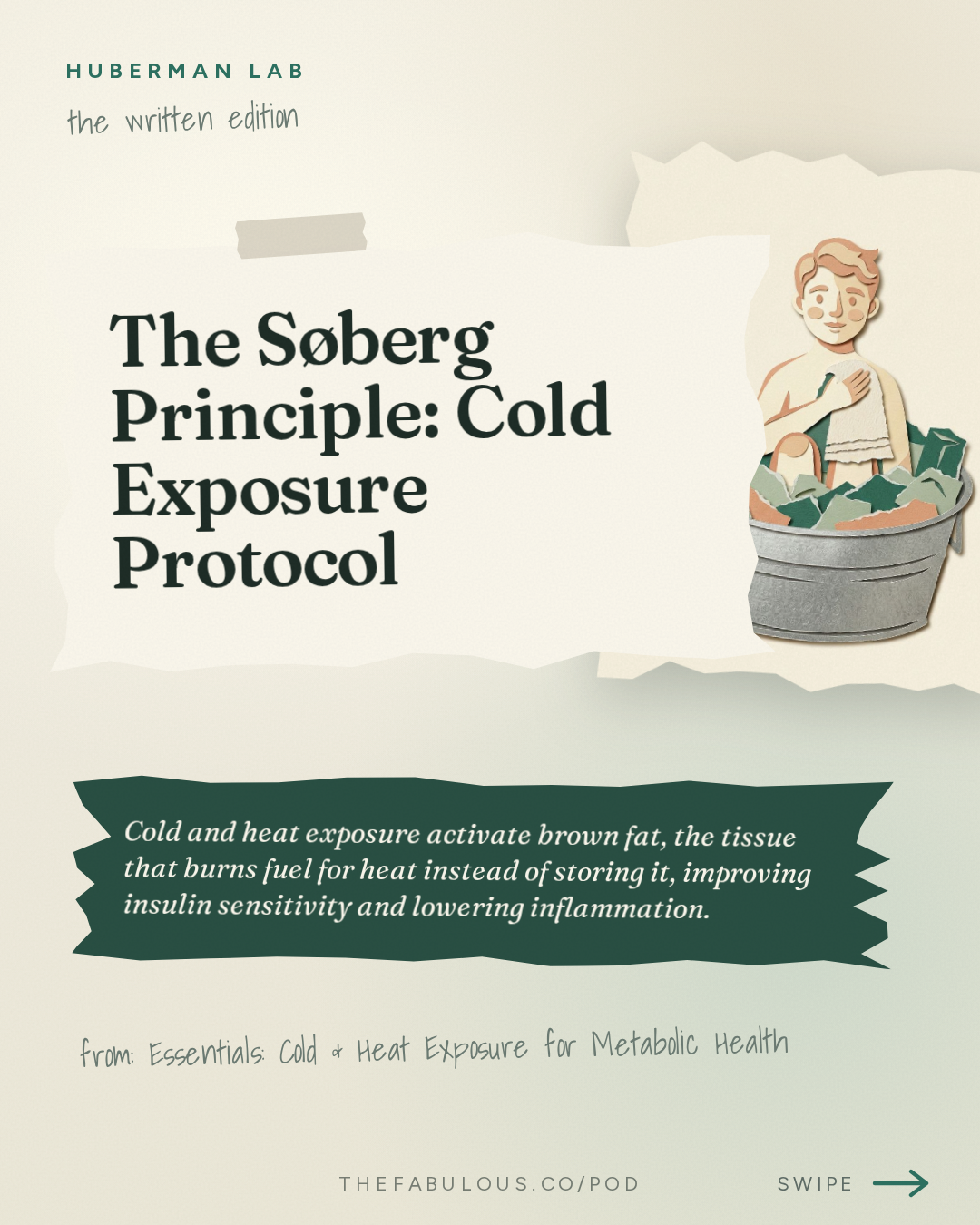
The Søberg Principle: Cold Exposure Protocol
Essentials: Cold & Heat Exposure for Metabolic Health | Dr. Susanna Søberg
The brief
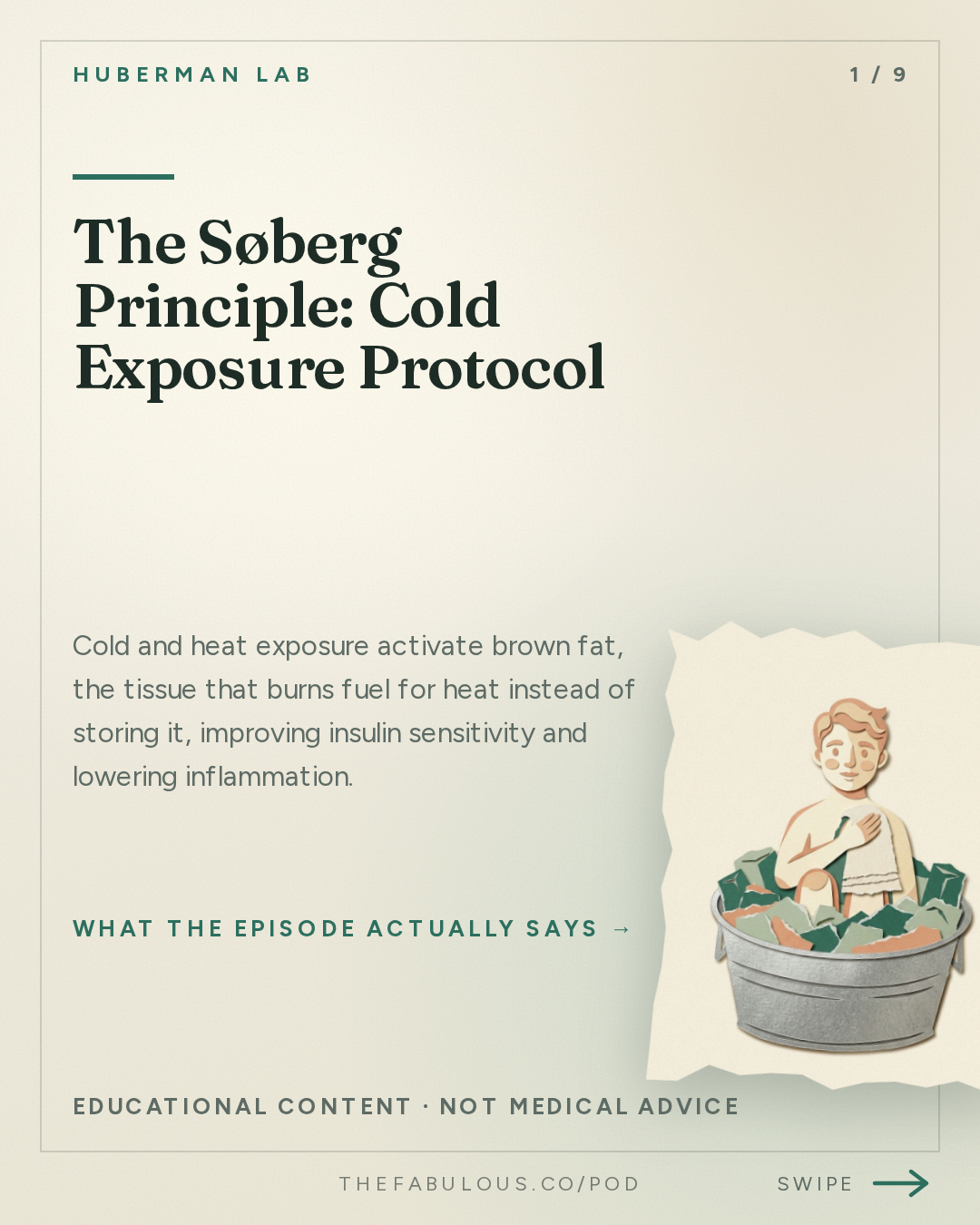
Cold and heat exposure activate brown fat, the tissue that burns fuel for heat instead of storing it, improving insulin sensitivity and lowering inflammation. Danish researcher Susanna Søberg found the minimum effective dose is about 11 minutes of cold water weekly and 57 minutes of sauna weekly, always ending on cold (26:47, 27:43, 33:29).
There is a tissue in the human body that works like a furnace nobody remembers installing. It sits mostly around the collarbones and along the spine, it is called brown fat, and its only job is to burn fuel for heat instead of storing it. Most people never feel it switch on, because modern life keeps skin at a steady, comfortable temperature. Danish researcher Susanna Søberg, who holds a PhD in the physiology of cold and heat exposure, spent years studying what happens when that furnace is forced awake on purpose, and her findings give one of the few concrete numbers in the entire cold-exposure conversation: 11 minutes a week.
Søberg's definition of the starting point is simple and a little uncomforting. The goal is not a specific temperature, it is a specific feeling, what she calls the cold shock: a jolt that activates the sympathetic nervous system, the branch of the nervous system that handles fight-or-flight arousal, and releases catecholamines, a group of stress hormones that includes adrenaline (00:45). The giveaway is breathing. New cold swimmers hyperventilate and trigger a gasping reflex, and that response fades with repeated exposure as the body adapts (01:10). Søberg is unsentimental about the discomfort itself.
"It should be hard because that's the point of it, right? If you enjoy it, then yeah, then I'm thinking something is wrong." — Susanna Søberg [01:59]
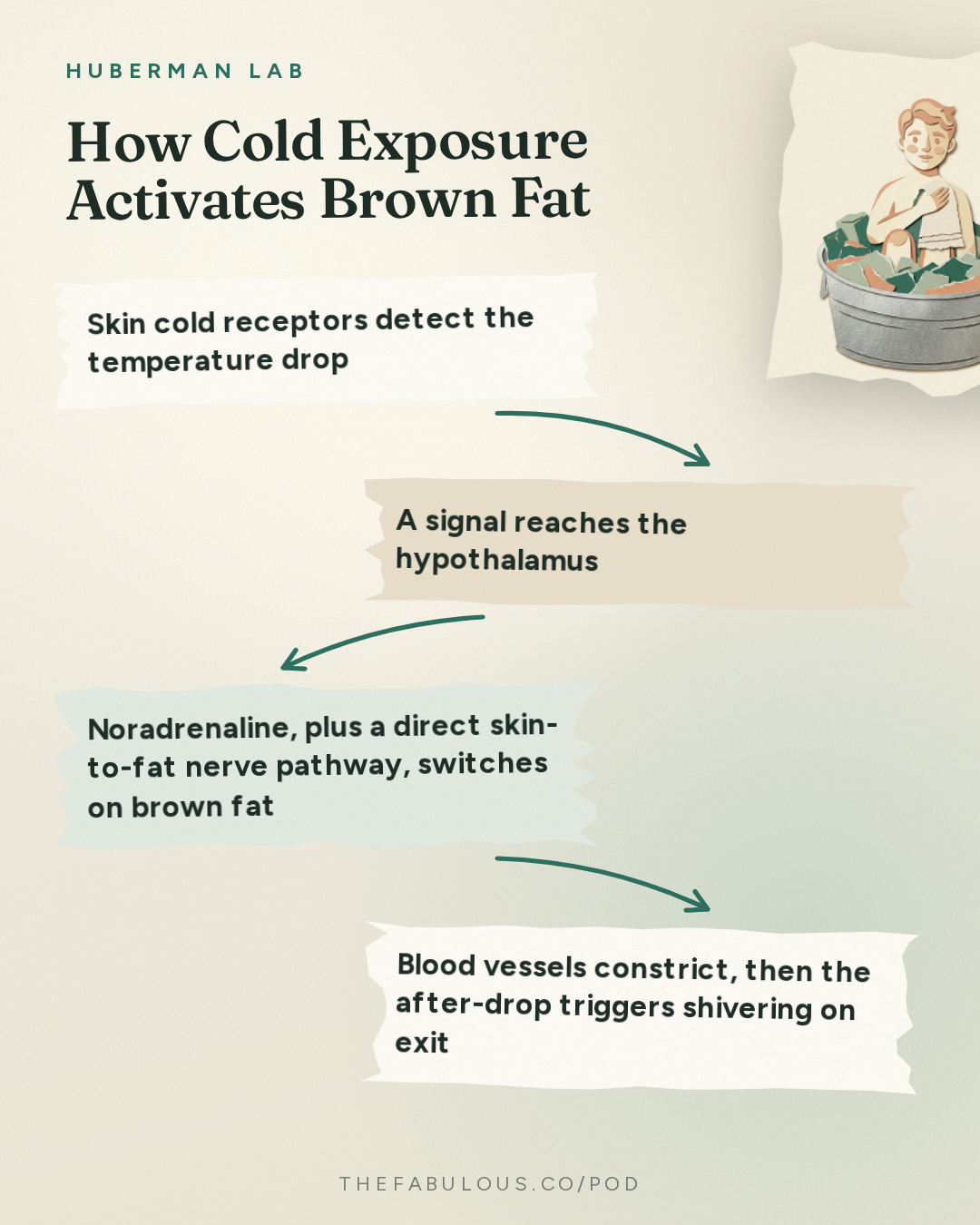
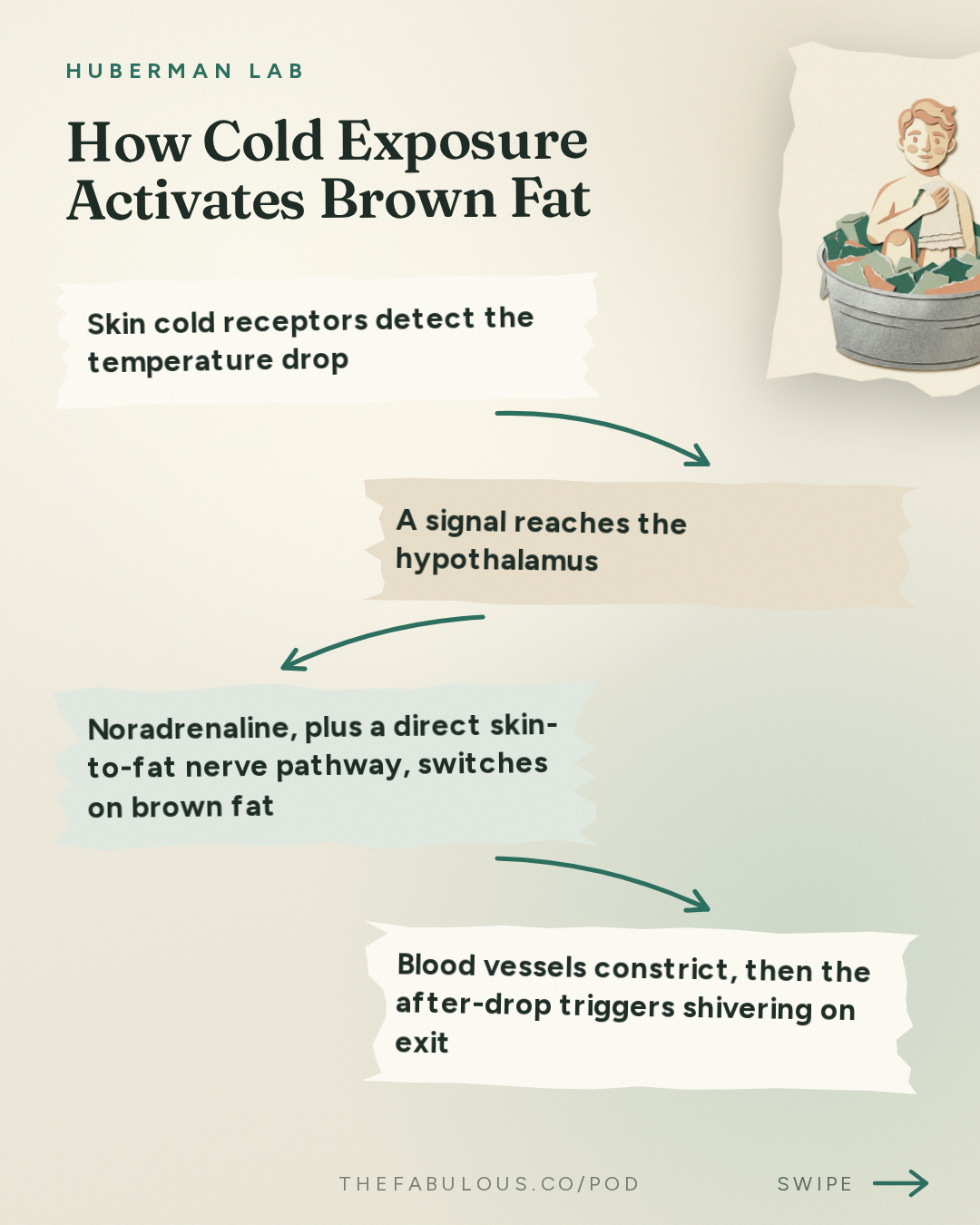
Not all cold is equal, and the reason is simple physics. Water molecules sit closer to the skin than air molecules, so full immersion in cold water activates far more cold receptors, nerve endings in the skin that detect temperature drops, than standing outside in a T-shirt does (02:29). Those receptors send a signal to the hypothalamus, the brain's temperature-control center, which answers by releasing noradrenaline, adrenaline, and a small amount of cortisol (04:46). There also appears to be a second, more direct wire: a pathway running straight from skin cold receptors to brown fat, bypassing the slower hormonal route entirely (05:08). Søberg's working theory is that this dual wiring is ancient, built to protect the body from both hypothermia and overheating, since brown fat seems to respond to warmth on the skin as well as cold (05:41).
The physics of the after-drop
One of the more useful things Søberg explains is a sensation most cold-water users have felt but rarely had described accurately: the after-drop, the continued fall in core temperature that happens after getting out of cold water, not during it (08:02). While submerged, blood vessels near the skin constrict to keep warm blood near the vital organs. On exit, those vessels dilate again, and the now-cooled blood near the skin surface flows back toward the core, dragging the body's internal temperature down even as the water is behind it. That drop is what triggers shivering, and shivering is not wasted discomfort. It is, in Søberg's framing, a second workout layered on top of the first, one that keeps burning calories for hours after the plunge is over (09:08). This is the mechanical basis for what Andrew Huberman calls the Søberg principle: end a hot-cold contrast session on cold, not heat, because finishing cold forces the body to spend hours re-heating itself, which means hours of elevated thermogenesis, the metabolic process of generating heat, and continued activation of brown fat and muscle (33:29).
"If you end on the cold, you have an exercise for your body going on for hours afterwards." — Susanna Søberg [33:29]
Repetition changes the tissue itself. With regular exposure, brown fat cells grow more mitochondria, the structures inside cells that produce energy, and those mitochondria become more efficient at generating heat (11:26). Skin capillaries get better at constricting on cue, the stress response quiets down over time, and the net metabolic effect is better insulin sensitivity, meaning the body needs less insulin to clear the same amount of glucose from the blood. Søberg points to a 2016 study by Gebbers-Stomer and colleagues that tracked middle-aged winter swimmers across a single season and found lower blood pressure, lower heart rate, and better insulin sensitivity by the end of it (12:18). Because that study never measured brown fat directly, Søberg suspected the tissue was the missing explanation, which became the premise of her own doctoral research.
Brown fat, it turns out, does not require heroics to switch on. A Danish study she cites, by Hansen and colleagues in 2017, had subjects sleep a month at a time in rooms set to 24, then 19, then 27 degrees Celsius, scanning their brown fat with PET/CT imaging at each stage. A month at 19 degrees Celsius, roughly 66 Fahrenheit, with a duvet and clothes on, increased both brown fat activity and insulin sensitivity. The next month at 24 degrees, the effect faded; at 27 degrees, warmer still, brown fat activation and insulin sensitivity dropped further (15:22, 16:11). Even a hand dunked in cold water is enough: in Søberg's own experiments, four degrees Celsius water for four minutes produced a measurable rise in brown fat activity, visible on an infrared thermography camera because the largest brown fat depot sits close to the skin surface under the collarbones (18:14).
Finding the minimum effective dose
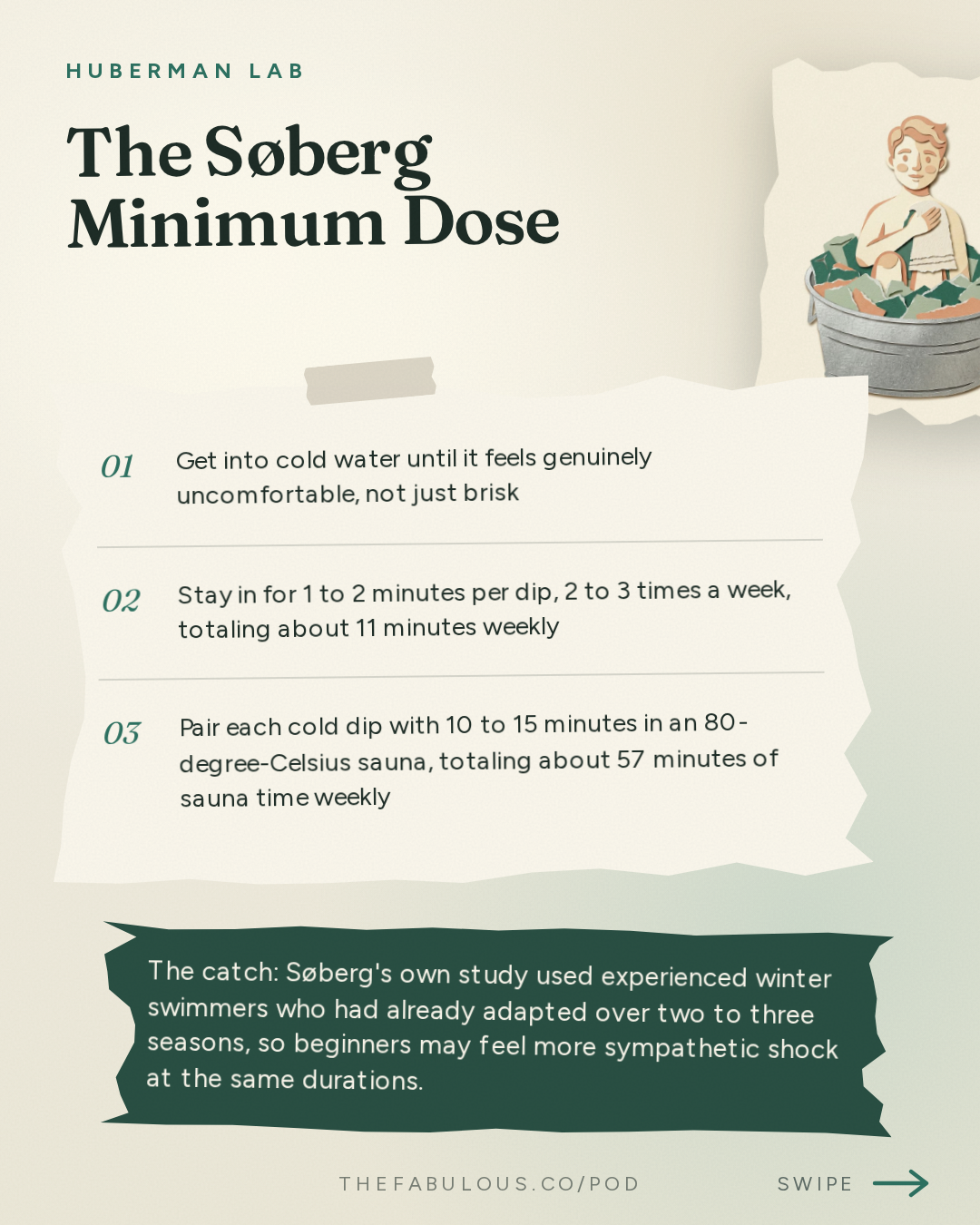
The headline number from Søberg's research came from a deliberately unglamorous study design. She recruited experienced winter swimmers, people who had already been dipping for two or three seasons, and measured them against a matched control group. The swimmers stayed in water as cold as 2 to 4 degrees Celsius for only one to two minutes at a time, two to three times a week, followed by 10 to 15 minutes in an 80-degree-Celsius sauna (21:02, 23:55). Compared with controls, the swimmers produced less insulin yet cleared glucose from their blood faster after a glucose drink, a combination that signals better metabolic health, not worse (25:37). When Søberg totaled the cold-water time across a typical week, it came out to about 11 minutes. The matching sauna total came to about 57 minutes a week (26:47, 27:43). Neither number demands an ice bath or a half-hour marathon in the cold; short, repeated dips did the work.
"When we then calculated the numbers together, we could see that this ended up being 11 minutes in total per week." — Susanna Søberg [26:47]
The swimmers also showed higher resting skin temperature than controls, likely because repeated cold-heat contrast made their skin more vascular and quicker to lose heat, which in turn keeps brown fat and muscle mildly active even at rest (34:29). And the benefits were not purely metabolic. Søberg measured interleukin-6 and interleukin-10, two signaling proteins involved in inflammation, and found a pattern consistent with lower chronic inflammation in the cold-adapted group (30:41). Since inflammation is linked in the research literature to depression, anxiety, and Alzheimer's disease, Søberg frames the finding cautiously but plainly: lowering inflammation through temperature exposure could, in theory, open a preventive door for both metabolic and mental health conditions (30:11).
What ties all of this together is not a target temperature but a principle of contrast. Søberg resists the idea that there is one correct number of degrees to chase. Twelve degrees Celsius water or nineteen degrees Celsius air both activate brown fat; what matters is the swing between warm and cold, repeated often enough for the tissue to stay primed (37:15). Huberman's closing synthesis captures it cleanly.
"It's not really about getting cold. It's about going from warm to cold and from cold to warm." — Andrew Huberman [36:18]
That reframing matters because it removes the excuse that cold exposure requires expensive equipment or extreme tolerance. A cold shower, a cool bedroom, a few minutes with a hand in ice water, a brisk walk without a jacket: all of these nudge the same internal furnace. The data suggest the furnace does not need much coaxing to stay lit. It needs only to be reminded, a few times a week, that temperature still moves.
Ask this episode anything
Pod's AI answers from the episode itself, with the minute mark so you can hear it yourself.
Or start with one of these
Ask this episode
Pod's AI listens to the whole episode to answer, and points you to the minute it comes from.
The rest of this answer, and any question after it
Answers come from the episode itself, never from a summary of it.
ContinueKey takeaways
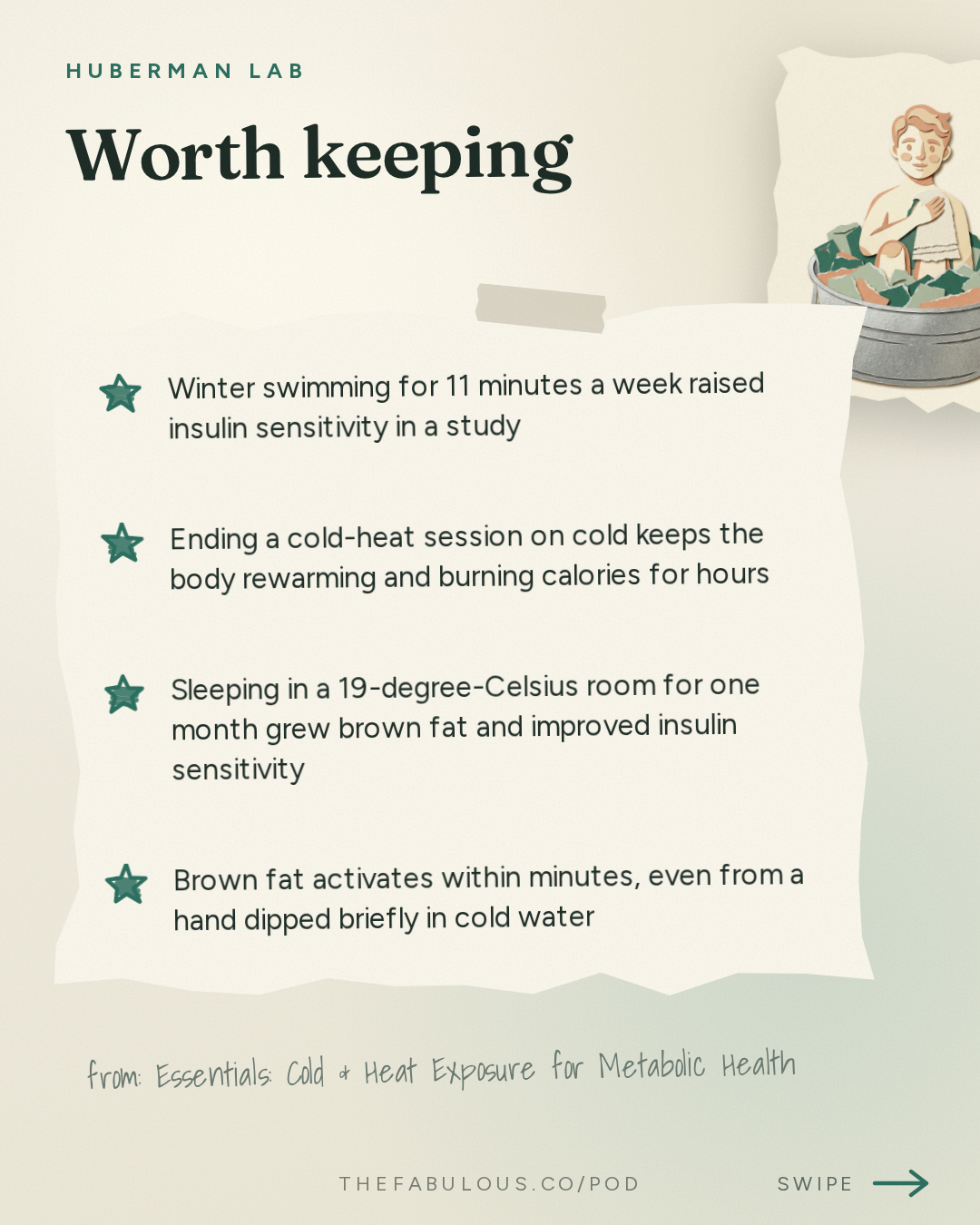
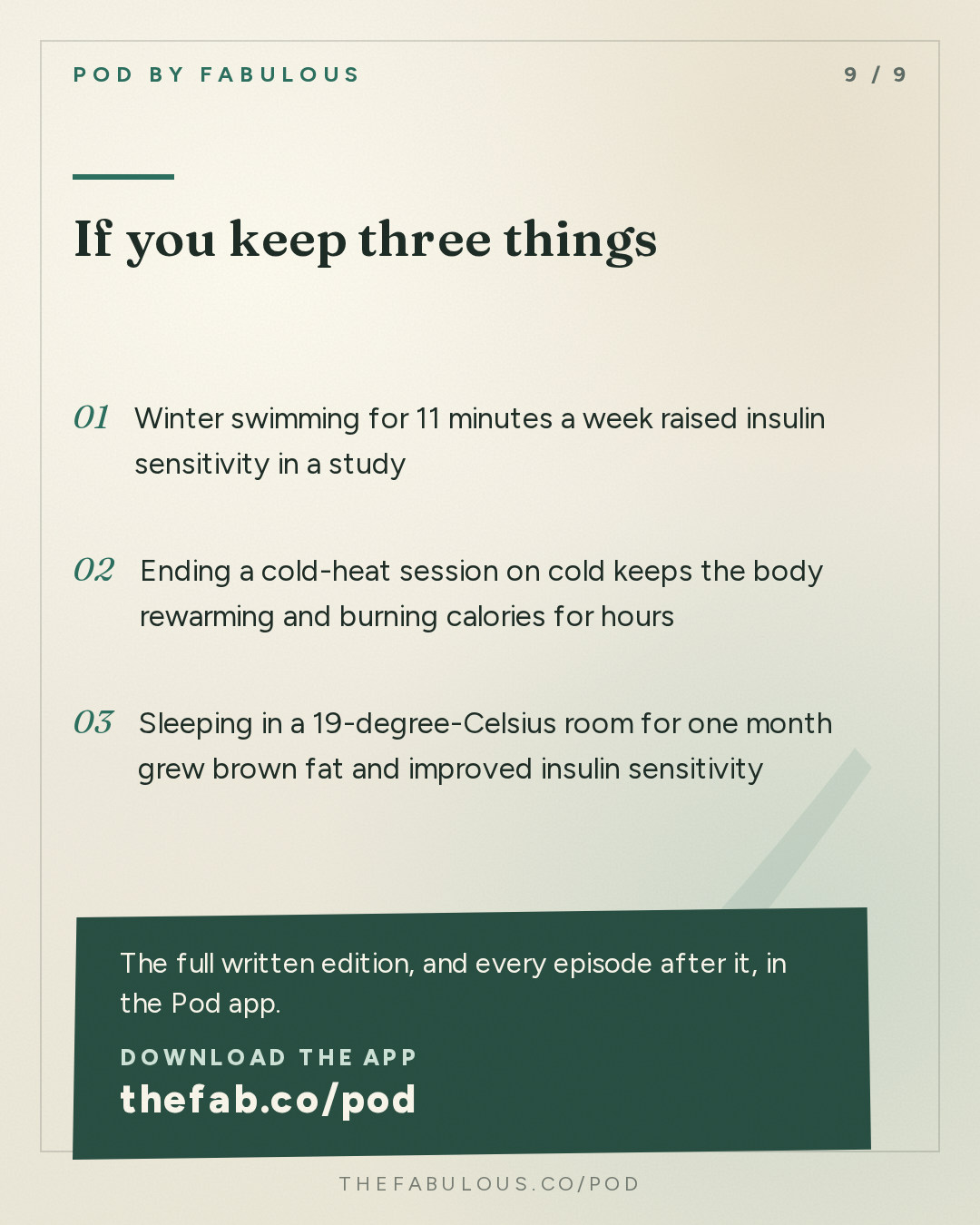
- Winter swimming for 11 minutes a week raised insulin sensitivity in a study
- Ending a cold-heat session on cold keeps the body rewarming and burning calories for hours
- Sleeping in a 19-degree-Celsius room for one month grew brown fat and improved insulin sensitivity
- Brown fat activates within minutes, even from a hand dipped briefly in cold water
- Sauna sessions need about 57 minutes total per week to match cold exposure's metabolic benefits
The episode in cards


By the numbers
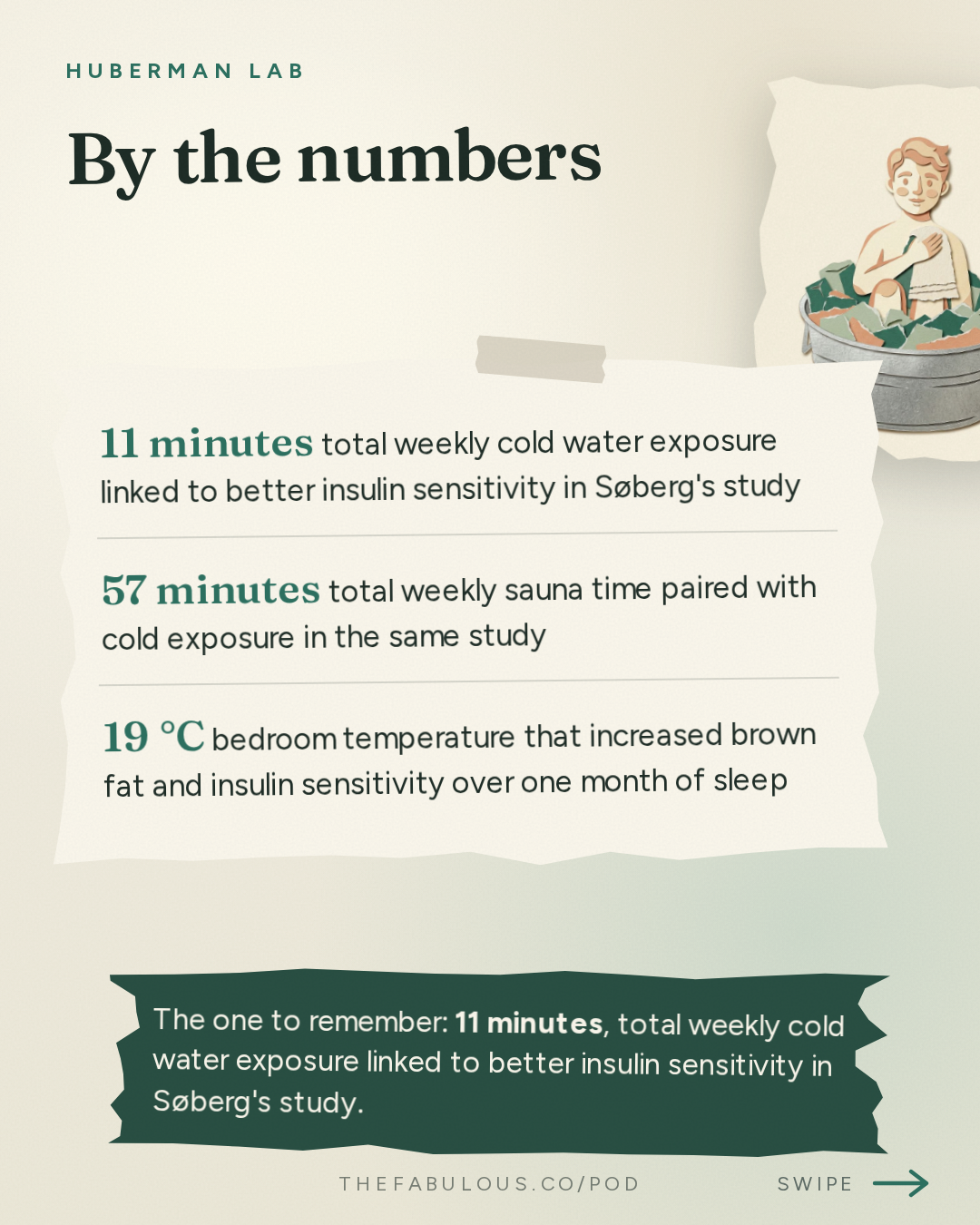
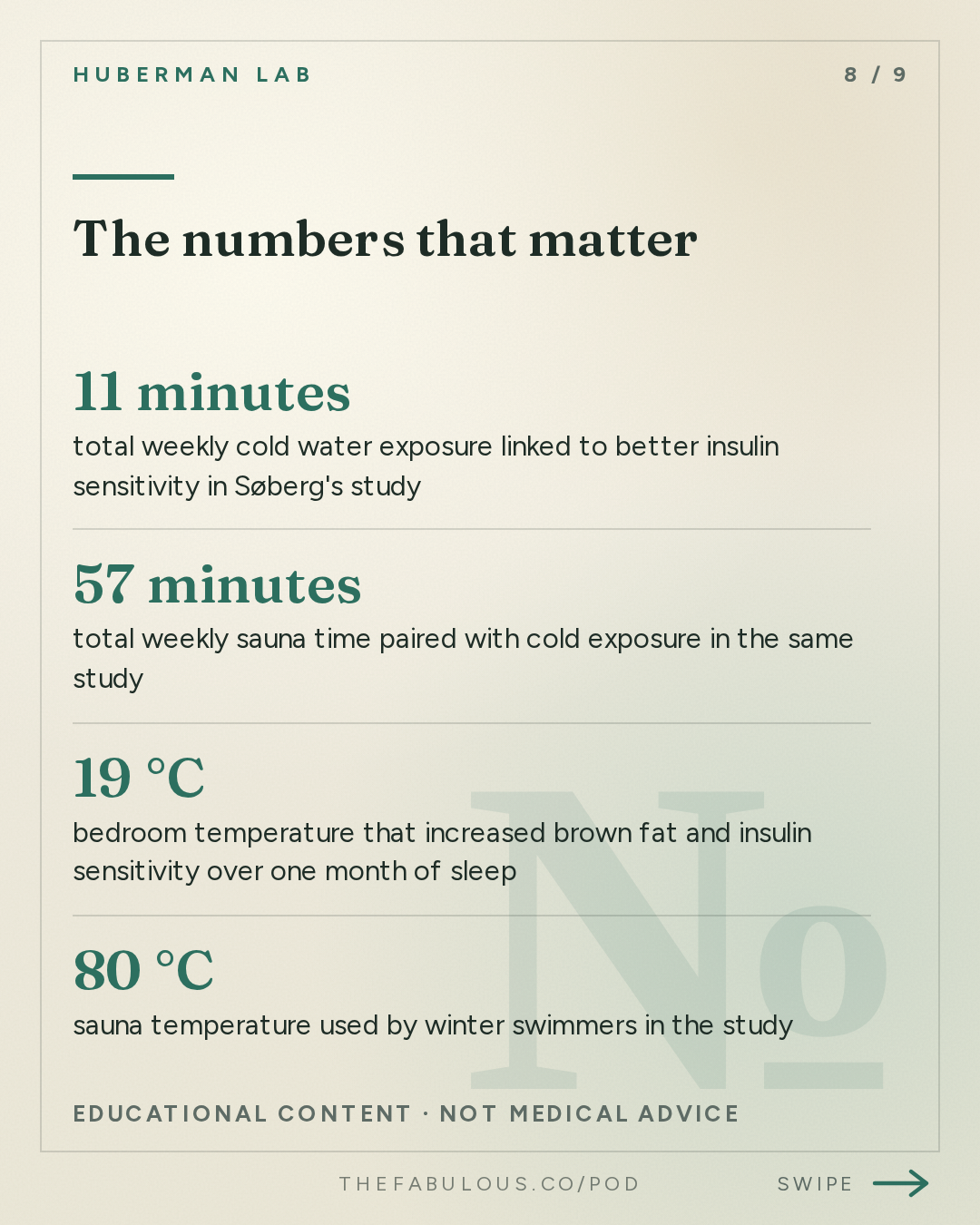
- 11 minutes total weekly cold water exposure linked to better insulin sensitivity in Søberg's study
- 57 minutes total weekly sauna time paired with cold exposure in the same study
- 19 °C bedroom temperature that increased brown fat and insulin sensitivity over one month of sleep
- 80 °C sauna temperature used by winter swimmers in the study
In their words
“It should be hard because that's the point of it, right? If you enjoy it, then yeah, then I'm, I'm thinking something is wrong.”
“When we then calculated the numbers together, we could see that this was ended up being 11 minutes, uh, in total per week.”
“If you, uh, end on the cold, you have an exercise for your body going on for hours afterwards”
“It's not really about getting cold. It's about going from warm to cold and from cold to warm”
Protocols
-
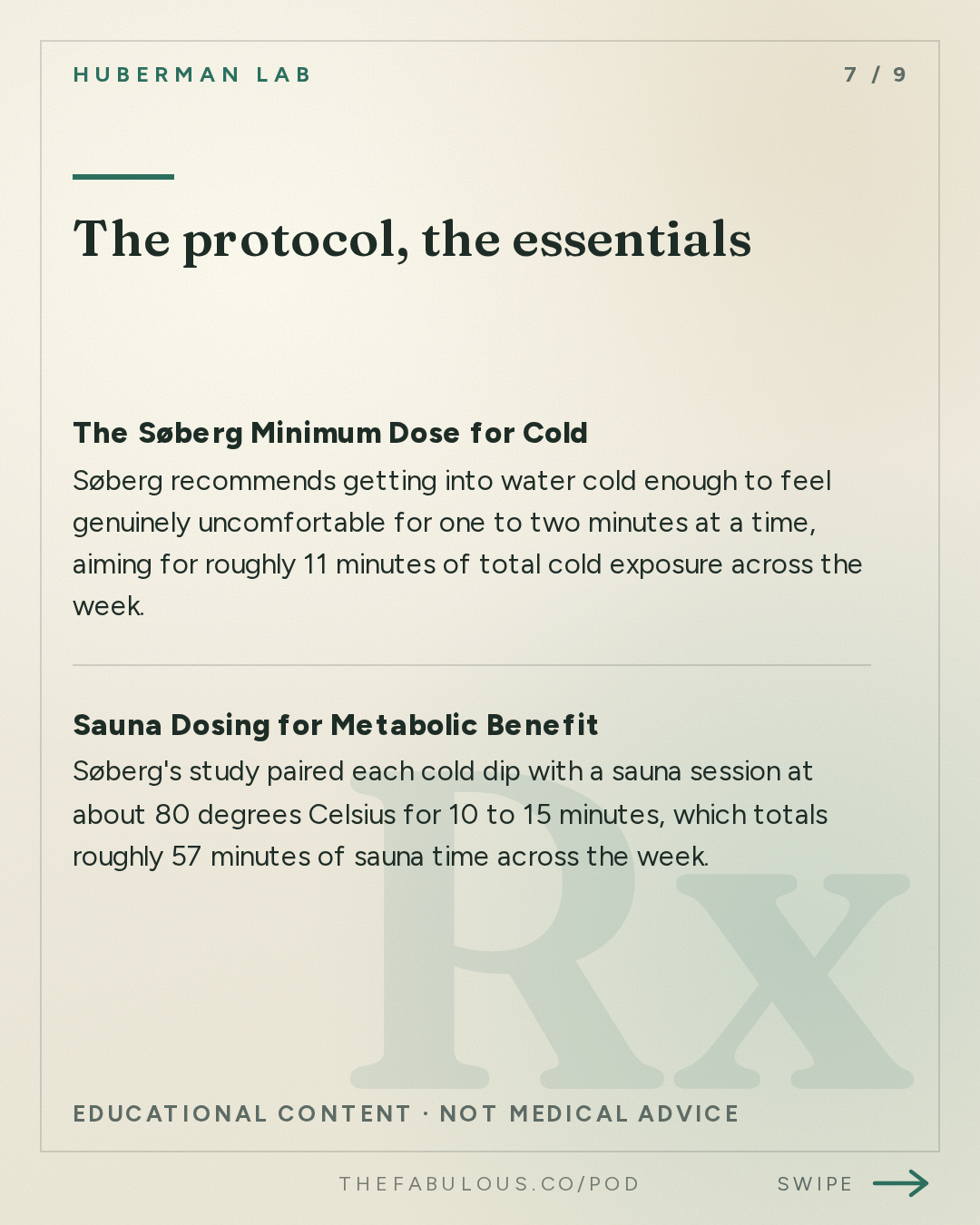
The Søberg Minimum Dose for Cold
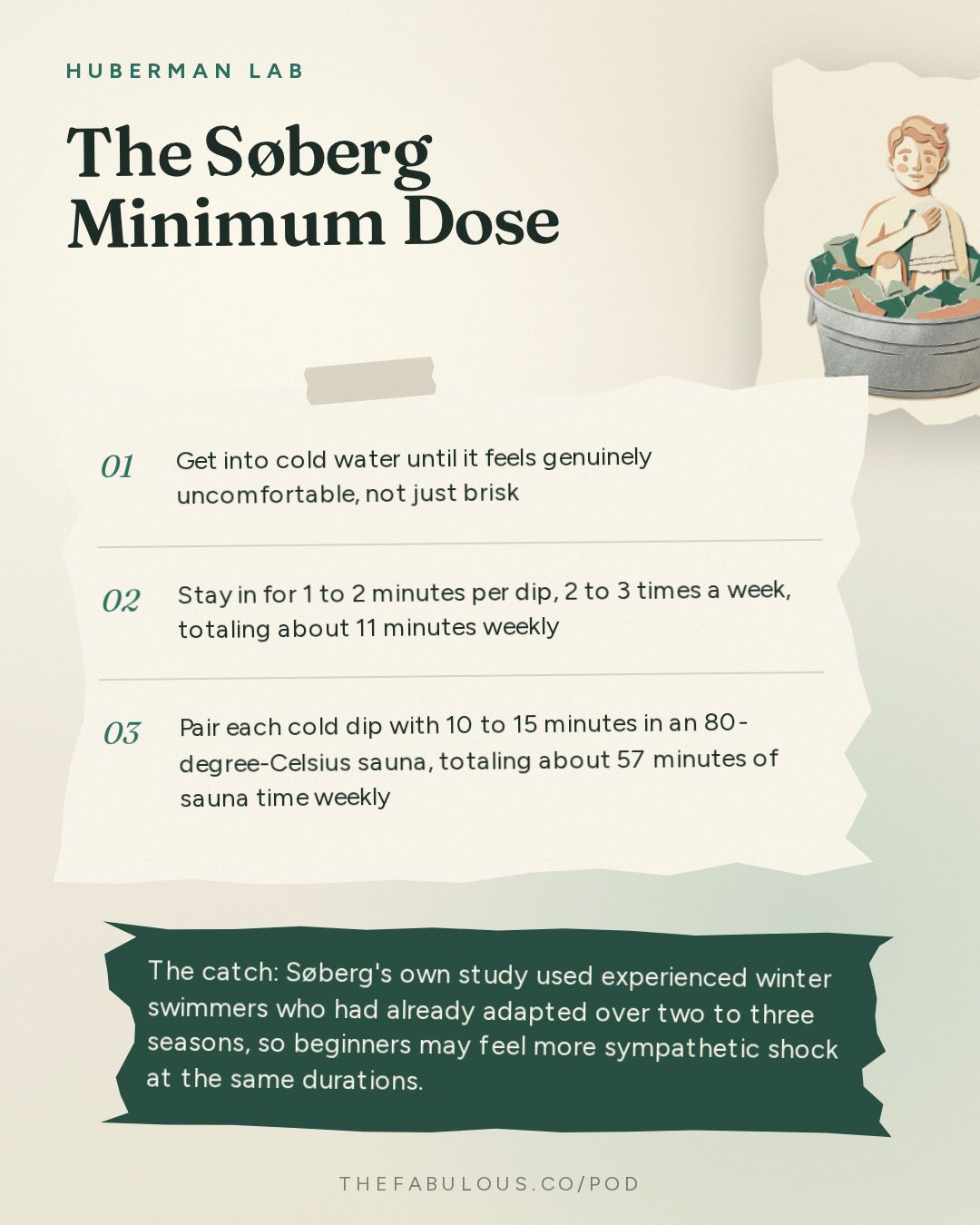
Søberg recommends getting into water cold enough to feel genuinely uncomfortable for one to two minutes at a time, aiming for roughly 11 minutes of total cold exposure across the week.
2 to 3 sessions per week
-
Sauna Dosing for Metabolic Benefit
Søberg's study paired each cold dip with a sauna session at about 80 degrees Celsius for 10 to 15 minutes, which totals roughly 57 minutes of sauna time across the week.
2 to 3 sessions per week
-
End on Cold, Not Heat
Søberg advises finishing a hot-cold contrast session in cold water rather than the sauna, because the body then has to spend energy rewarming itself for hours afterward, which keeps brown fat and muscle thermogenesis active.
every contrast session
-
Sleep Cool to Grow Brown Fat
Søberg points to research showing that sleeping in a room set to 19 degrees Celsius for one month increased brown fat activity and insulin sensitivity more than sleeping at 24 or 27 degrees.
nightly for at least one month
Questions this episode answers
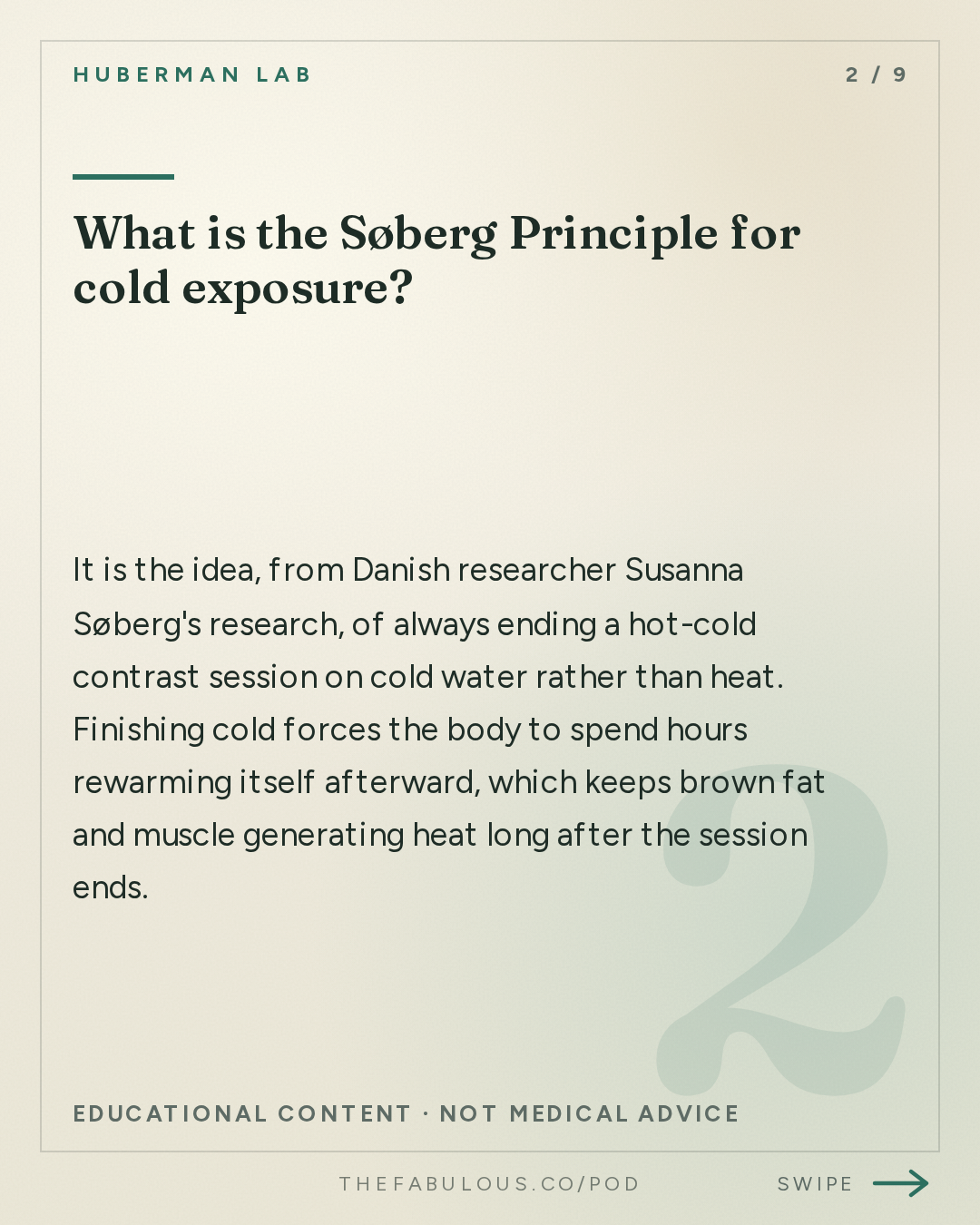
What is the Søberg Principle for cold exposure?
It is the idea, from Danish researcher Susanna Søberg's research, of always ending a hot-cold contrast session on cold water rather than heat. Finishing cold forces the body to spend hours rewarming itself afterward, which keeps brown fat and muscle generating heat long after the session ends (33:29).
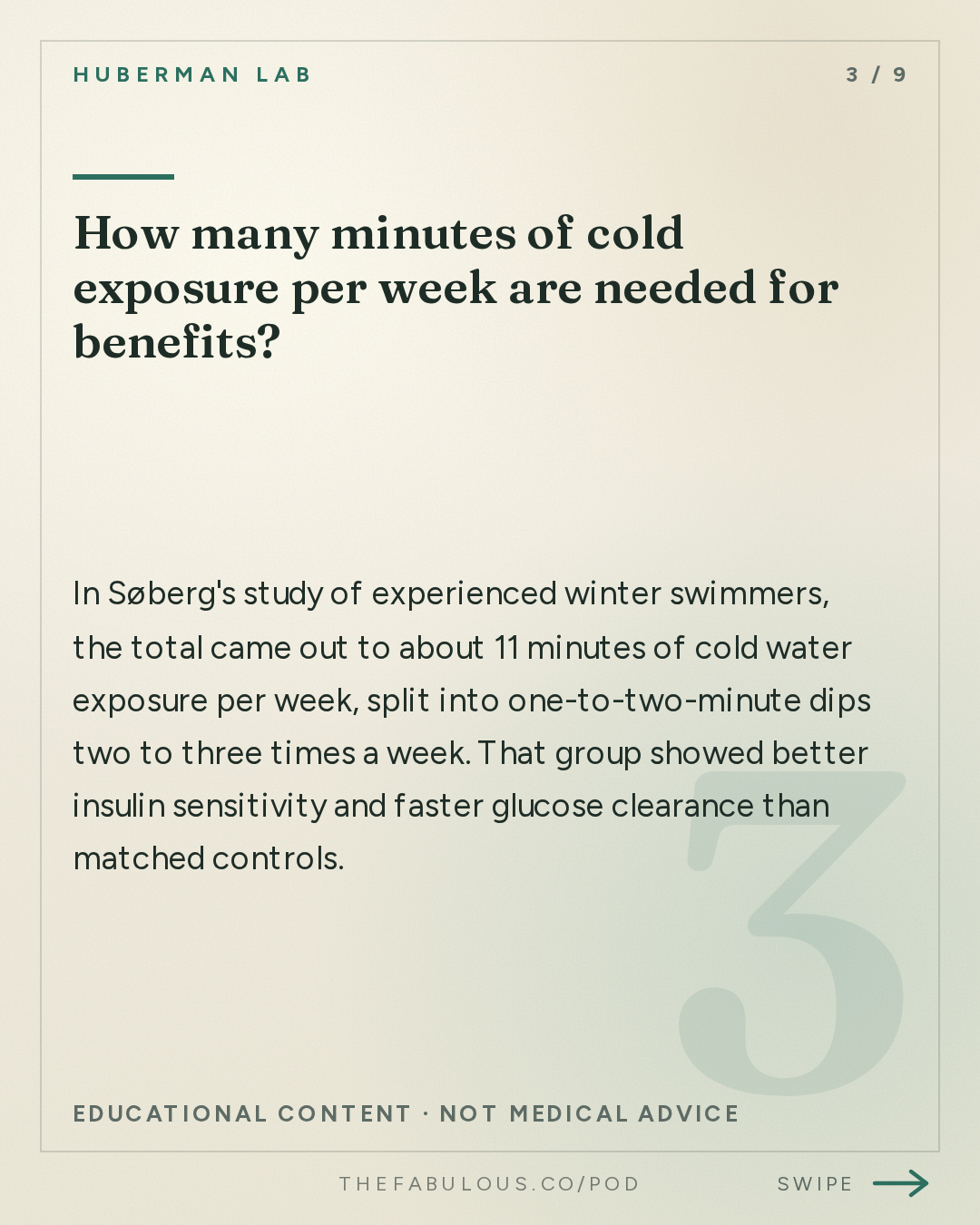
How many minutes of cold exposure per week are needed for benefits?
In Søberg's study of experienced winter swimmers, the total came out to about 11 minutes of cold water exposure per week, split into one-to-two-minute dips two to three times a week. That group showed better insulin sensitivity and faster glucose clearance than matched controls (26:47).
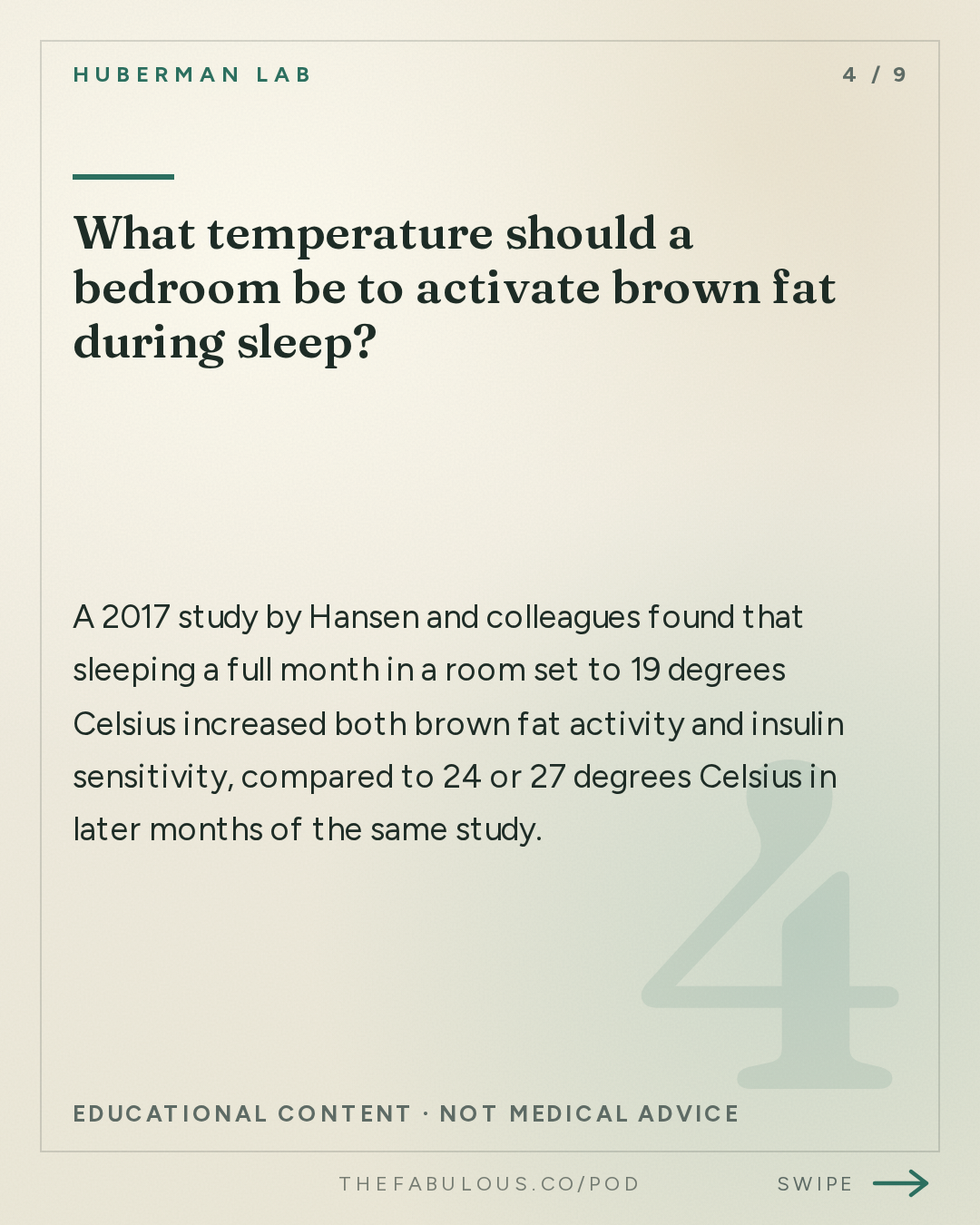
What temperature should a bedroom be to activate brown fat during sleep?
A 2017 study by Hansen and colleagues found that sleeping a full month in a room set to 19 degrees Celsius increased both brown fat activity and insulin sensitivity, compared to 24 or 27 degrees Celsius in later months of the same study (15:22, 16:11).
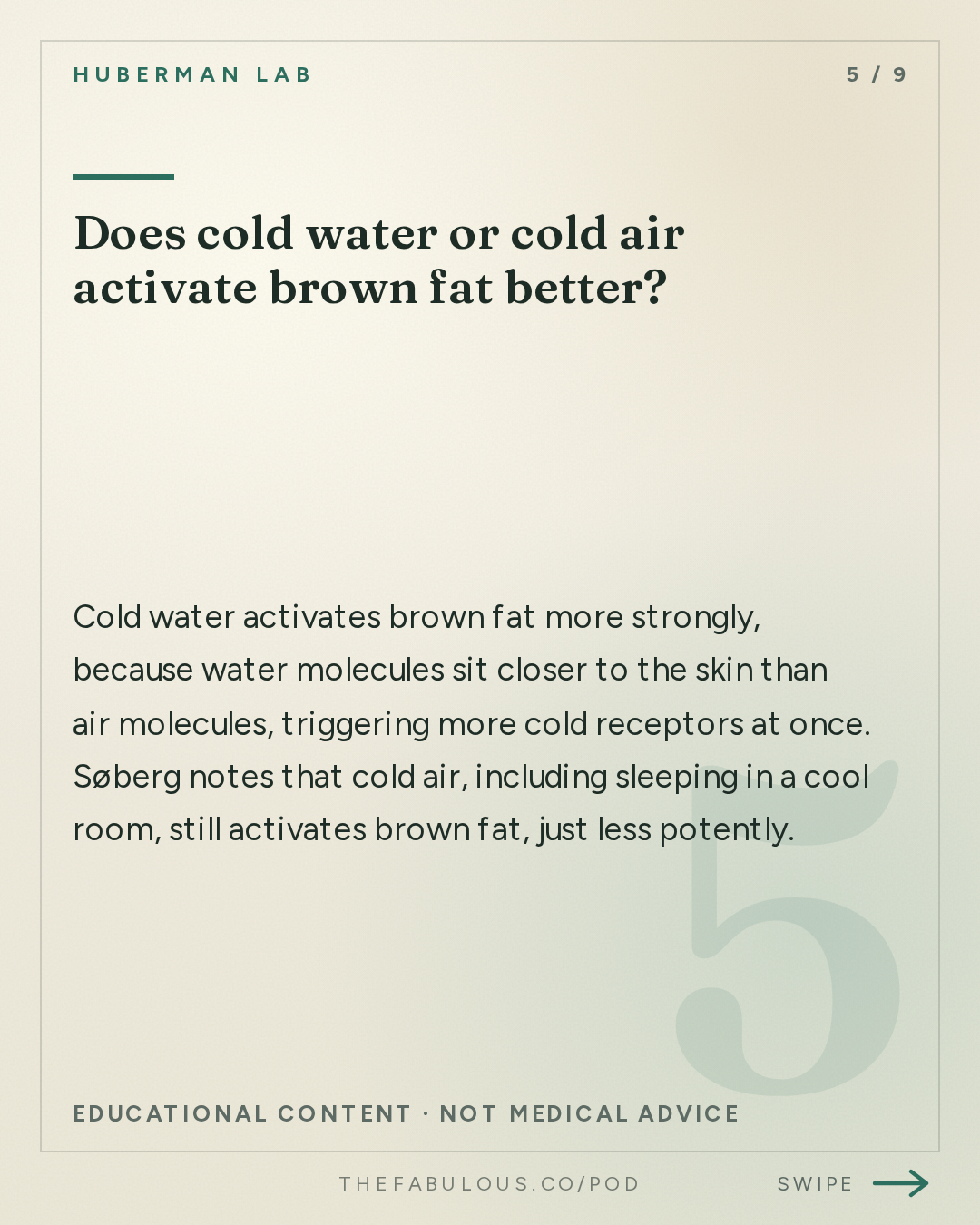
Does cold water or cold air activate brown fat better?
Cold water activates brown fat more strongly, because water molecules sit closer to the skin than air molecules, triggering more cold receptors at once. Søberg notes that cold air, including sleeping in a cool room, still activates brown fat, just less potently (02:29, 13:49).
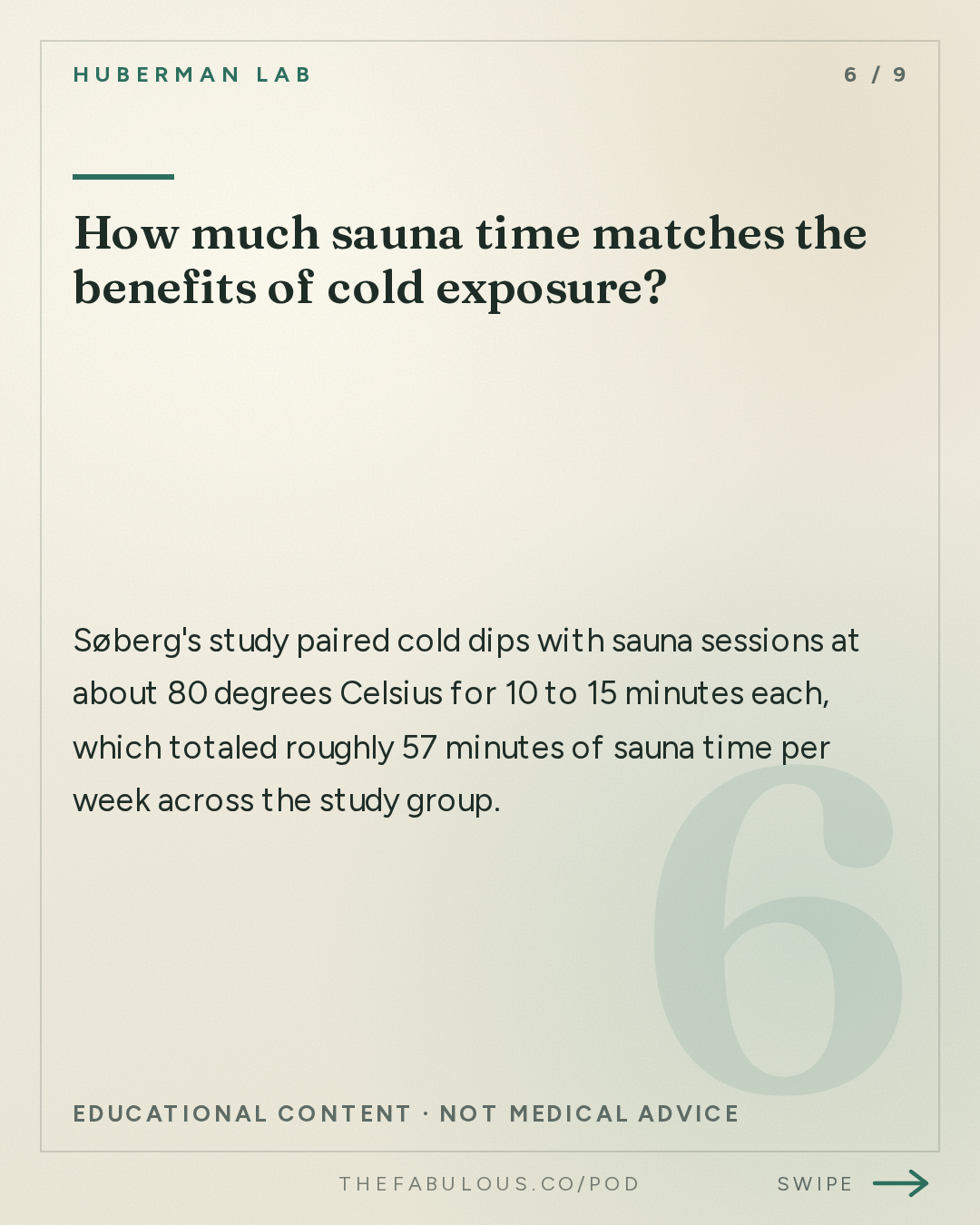
How much sauna time matches the benefits of cold exposure?
Søberg's study paired cold dips with sauna sessions at about 80 degrees Celsius for 10 to 15 minutes each, which totaled roughly 57 minutes of sauna time per week across the study group (27:43, 23:55).
The full read, in cards
Go deeper
- Gebbers-Stomer et al., 2016 — Tracked middle-aged winter swimmers over one season and found lower blood pressure, lower heart rate, and better insulin sensitivity by season's end
- Hansen et al., 2017 — Used PET/CT scans to show that sleeping a month at 19 degrees Celsius increased brown fat activity and insulin sensitivity compared to 24 or 27 degrees
- Søberg's doctoral winter-swimmer study — Found winter swimmers produced less insulin but cleared glucose faster than controls, and calculated the 11-minute cold and 57-minute sauna weekly dose
Mentioned
Susanna Søberg · Andrew Huberman · Wim Hof · Stanford School of Medicine · Eight Sleep · AG1
More from this show and category

How Robert Greene Accesses the Sublime
Robert Greene, author of Mastery and The 48 Laws of Power, says the sublime is a jolt of awe that breaks open ordinary, filtered perception. In his new book The Law of the Sublime, he offers exercises built on trained attention, slowness, recovered childhood memory, and vulnerability in love to reach it without drugs or travel.

How Smell Secretly Shapes Hormones and Behavior
Dr. Noam Sobel's research shows smell quietly shapes human bonding, fear, and hormones in ways we rarely notice. People secretly sniff their own hand after shaking a stranger's hand, body odor similarity predicts whether strangers click as friends, and sniffing women's odorless emotional tears drops men's free testosterone by 14% within 20 to 30 minutes (23:24).
Ross Edgley on the Neuroscience of Motivation
Ultra-endurance swimmer Ross Edgley and Andrew Huberman trace grit to the brain's anterior midcingulate cortex and sketch a five-spoke model of motivation. Drawing on swims around Great Britain and Iceland, they cover stress inoculation, vision and arousal, and protocols like 400 mg of caffeine and 10 g of daily creatine for performance under fatigue.

Huberman's Rational Guide to Supplements
Andrew Huberman's framework ranks behavior, then nutrition, then supplements, then prescription drugs, arguing supplements only work once the first two are solid (00:42). He gives exact doses for sleep, hormone, and focus compounds, and insists on testing one ingredient at a time (35:08).
