
Huberman's Rational Guide to Supplements
Essentials: Developing a Rational Approach to Supplementation for Health & Performance
The brief
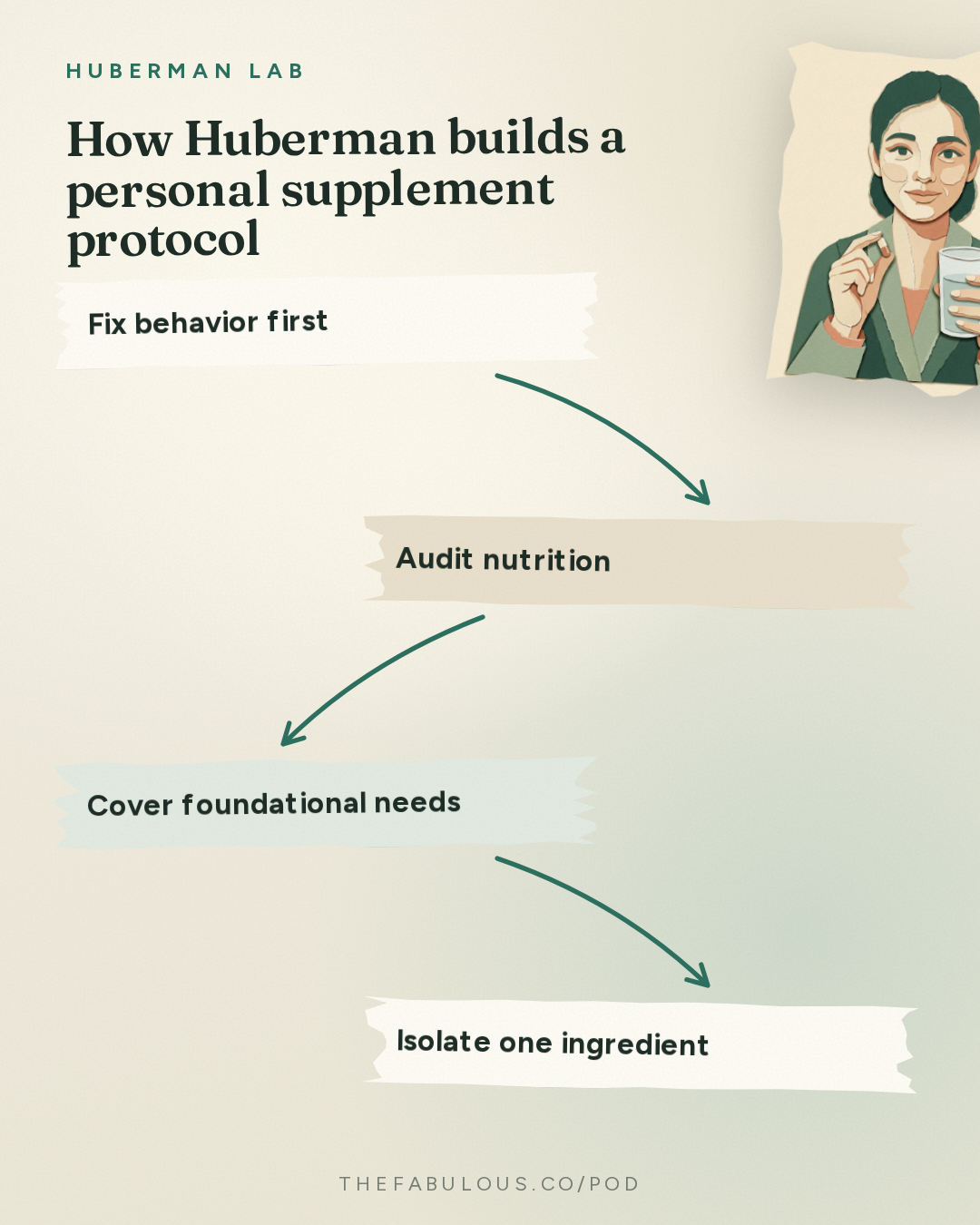
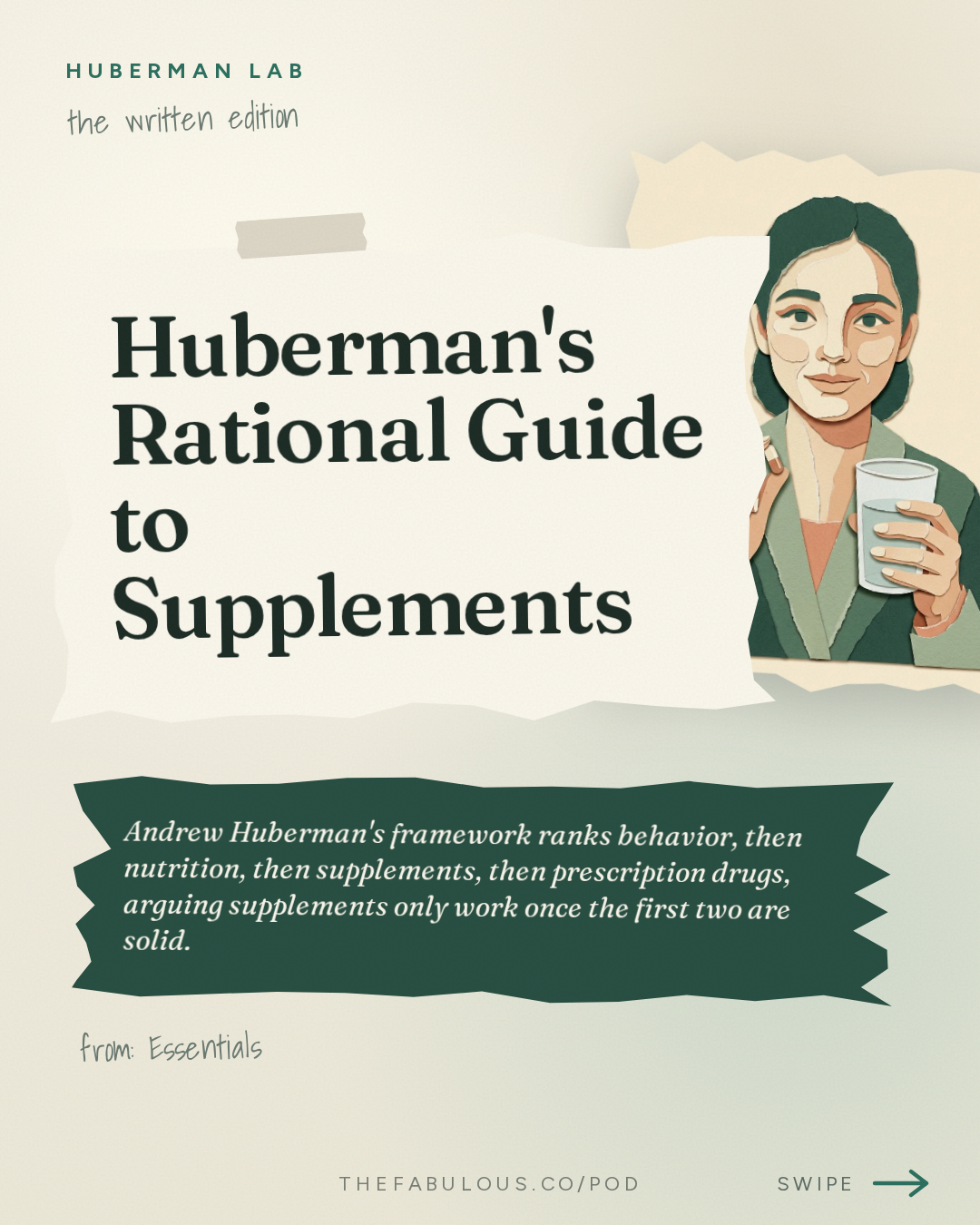
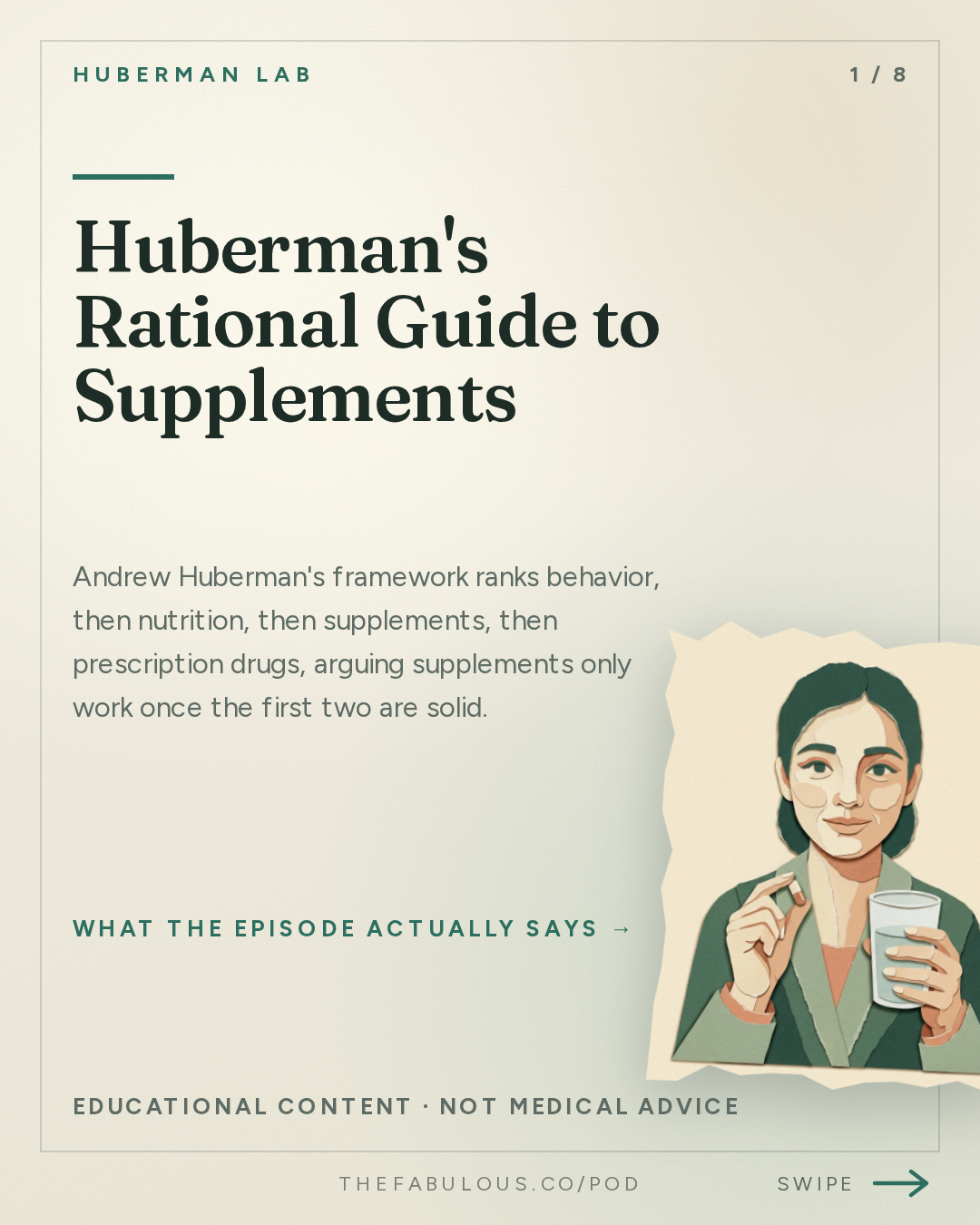
Andrew Huberman's framework ranks behavior, then nutrition, then supplements, then prescription drugs, arguing supplements only work once the first two are solid (00:42). He gives exact doses for sleep, hormone, and focus compounds, and insists on testing one ingredient at a time (35:08).
Stanford neuroscientist Andrew Huberman opens his guide to supplements with an idea that sounds like a trick: for some people, the correct dose of a given supplement is zero milligrams (03:27). That is not a dodge. It is the whole argument. Before anyone asks which pill to buy, Huberman wants them to ask whether they have a problem a pill can actually solve, and whether something cheaper and more basic already solves it.
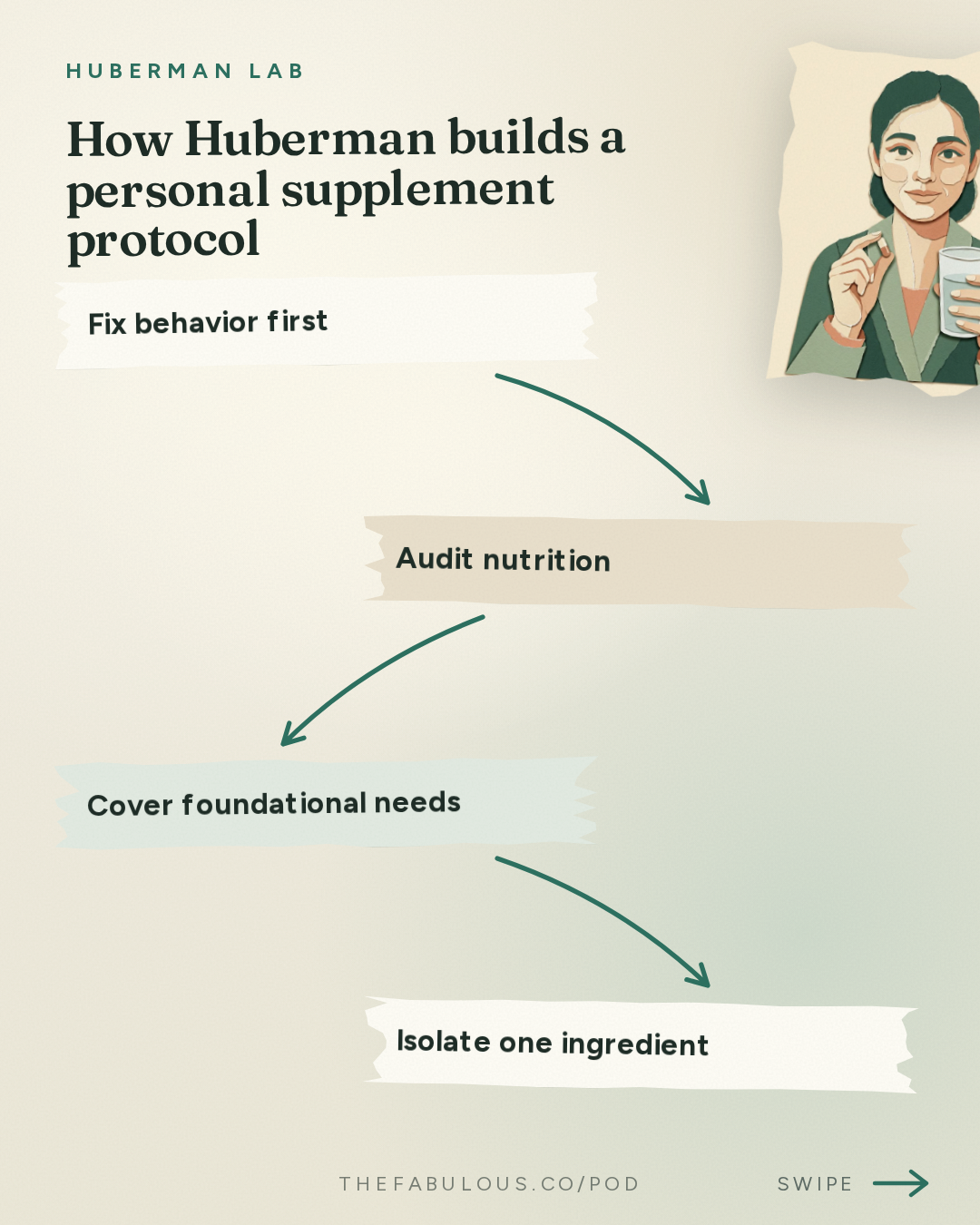
He lays out a four-layer stack. At the bottom are behaviors: things like viewing morning sunlight and exercising, which require ingesting nothing at all (00:42). Above that sits nutrition. His claim here is blunt: no amount of supplementation, prescription or otherwise, can compensate for poor nutrition for very long (01:06). Only above nutrition does he place supplementation, and above that, prescription drugs prescribed by a board-certified physician (01:38). The order matters because it is also a filter. If sleep, diet, and sunlight exposure are not in order, a supplement is being asked to patch a hole that behavior should be filling.
Within supplements themselves, Huberman draws a second distinction: foundational formulas versus single-ingredient ones. A foundational supplement, something combining vitamins, minerals, probiotics, prebiotics, digestive enzymes, and adaptogens, is the one case where he thinks multiple ingredients in one product makes sense (05:06). His practical test for whether someone needs one is almost comically simple: can they afford it, and can they reliably eat varied enough food to cover their micronutrient needs without it (05:25). People fasting intermittently or training heavily often cannot, so a multivitamin earns its place. He sets a rough budget marker here too: for someone able to spend around $100 a month or more on supplements, he recommends that money go toward foundational support rather than sleep or focus products first, because broad nutritional coverage raises what he calls the tide on every system, sleep included (06:41).
Past that foundational layer, Huberman is emphatic that single-ingredient formulations are the only rational way to proceed. Combination sleep or focus blends might feel convenient, but they make it impossible to know which ingredient is doing the work, which one is causing a side effect, and what the minimum effective dose actually is (35:08). His recommended method is almost experimental: take one ingredient alone for about a week, change nothing else, and watch what happens (14:12).
What One Ingredient at a Time Looks Like
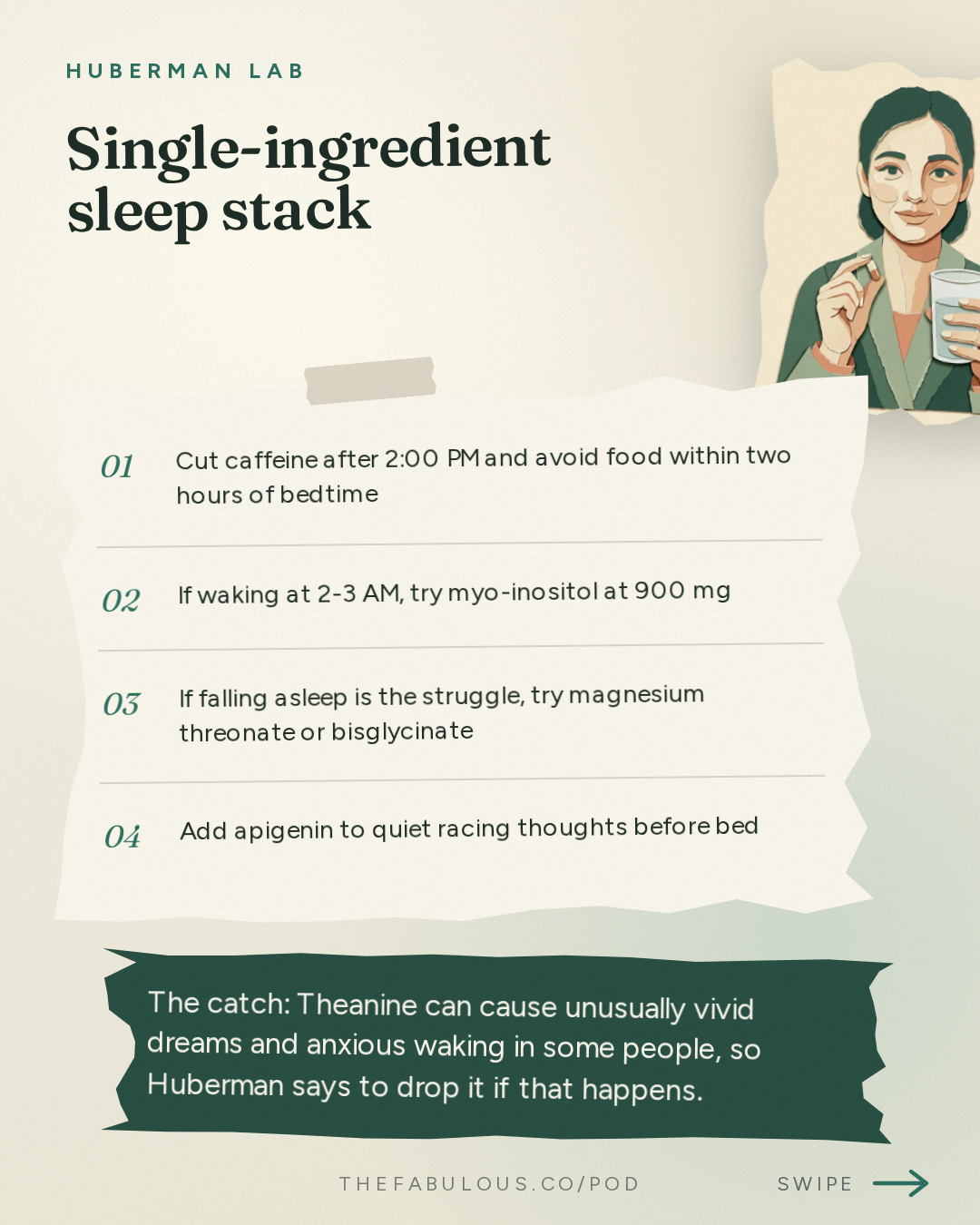
Applied to sleep, this produces a short menu rather than a stack. Caffeine after 2:00 PM and food within two hours of bedtime are the first things to fix, behaviorally, before any supplement enters the picture (10:14). For people who fall asleep fine but wake at 2 or 3 AM, Huberman points to myo-inositol, usually 900 milligrams, as something that can help them fall back asleep (10:54). For people whose middle-of-the-night waking comes with unusually vivid dreams, he flags a specific interaction worth knowing: theanine, taken at 100 to 400 milligrams, helps many people fall asleep but can intensify dreaming enough to jolt some people awake with anxiety (11:28). That is not a minor footnote; it is the kind of individual variation his whole framework is built to catch.
For people who struggle to fall asleep in the first place, he names magnesium threonate and magnesium bisglycinate, both of which cross the blood-brain barrier through transporter systems and produce a mild drowsiness, mild enough that it will not impair someone who needs to respond to an emergency in the night (11:59). Apigenin, a chamomile derivative, rounds out the list by acting as an anxiety-lowering compound that quiets the rumination and problem-solving that keep people awake (12:35).
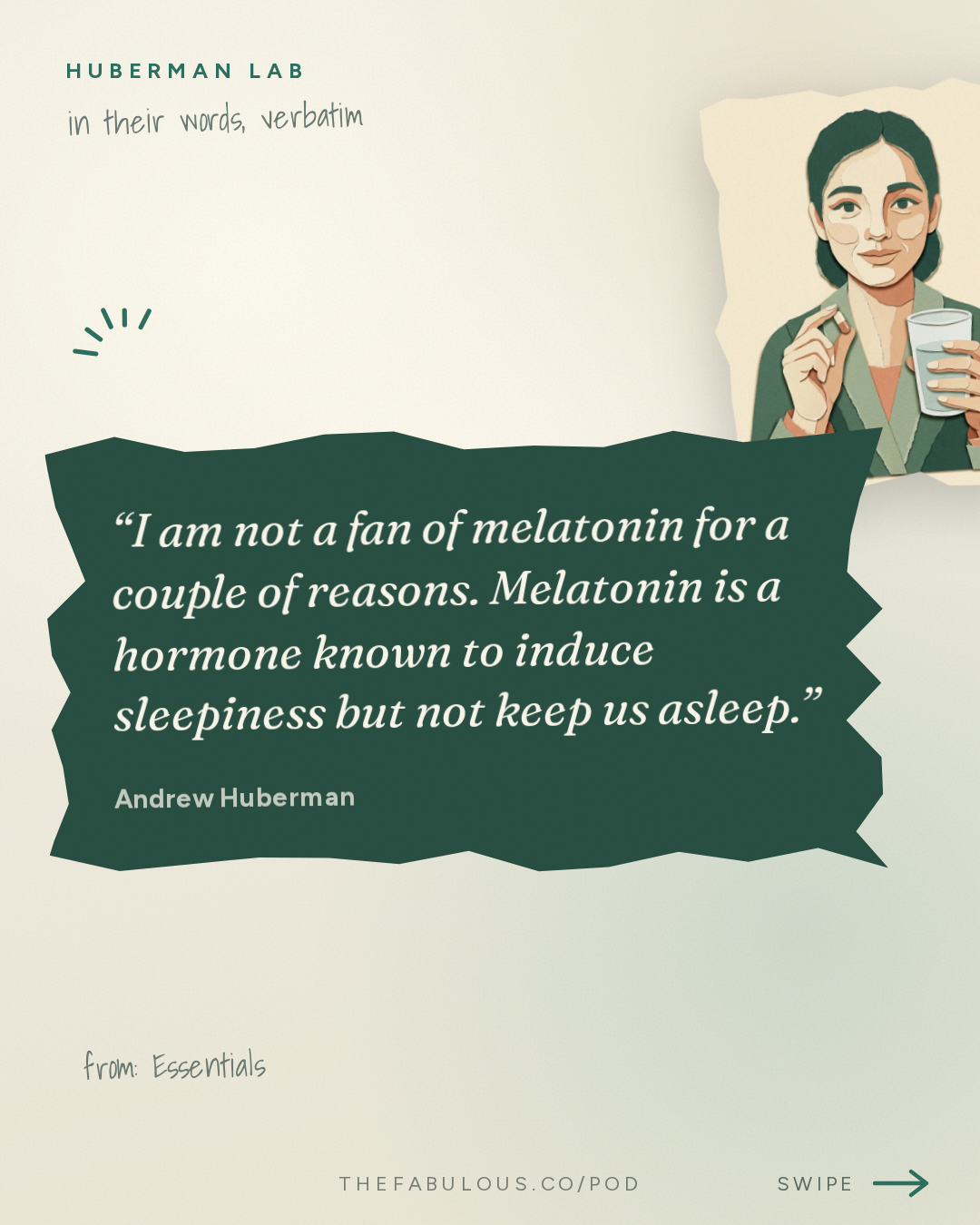
Melatonin gets a pointed exception. Huberman calls himself not a fan, for two linked reasons:
"I am not a fan of melatonin for a couple of reasons. Melatonin is a hormone known to induce sleepiness but not keep us asleep." (15:00) — Andrew Huberman
The second reason compounds the first: most melatonin supplements contain doses far above the body's normal endogenous levels, and melatonin affects systems well beyond sleep (15:25). A hormone that reliably starts sleep but does not sustain it, taken at doses the body never produces on its own, is, in his accounting, a poor trade.
The hormone section of the guide follows the same behavior-first logic. Morning sunlight raises cortisol, and that is a feature, not a bug: elevated cortisol early in the day supports focus and alertness, while keeping cortisol low at night allows growth hormone and testosterone, which peaks in secretion in the early morning, to rise instead (16:09). Only after that baseline is addressed does Huberman turn to compounds. Fadogia agrestis, an herb taken around 600 milligrams per day, is associated in many but not all users with higher libido, sperm production, and testosterone (16:59). The caveat is specific and serious: at high dosages, Fadogia agrestis has been shown to be toxic to testicular cells, which is why Huberman recommends staying within labeled doses and cycling it, for example eight weeks on and two weeks off, or twelve weeks on and a month off (17:50). Tongkat Ali works through a different mechanism, raising free testosterone by reducing sex hormone binding globulin, a protein that otherwise binds testosterone and keeps it from being biologically active (19:35). Unlike Fadogia agrestis, he says it does not appear to need cycling, though its effects build slowly enough that he suggests waiting eight to twelve weeks before checking bloodwork, a delay he attributes to the compound acting on neural pathways as much as hormonal ones (20:01). He also flags that women should expect some supplements to behave differently, even oppositely, across the phases of the menstrual cycle, which is one more argument for single-ingredient control rather than fixed combination stacks (20:41).
Stimulants and Neuromodulators Are Not the Same Lever
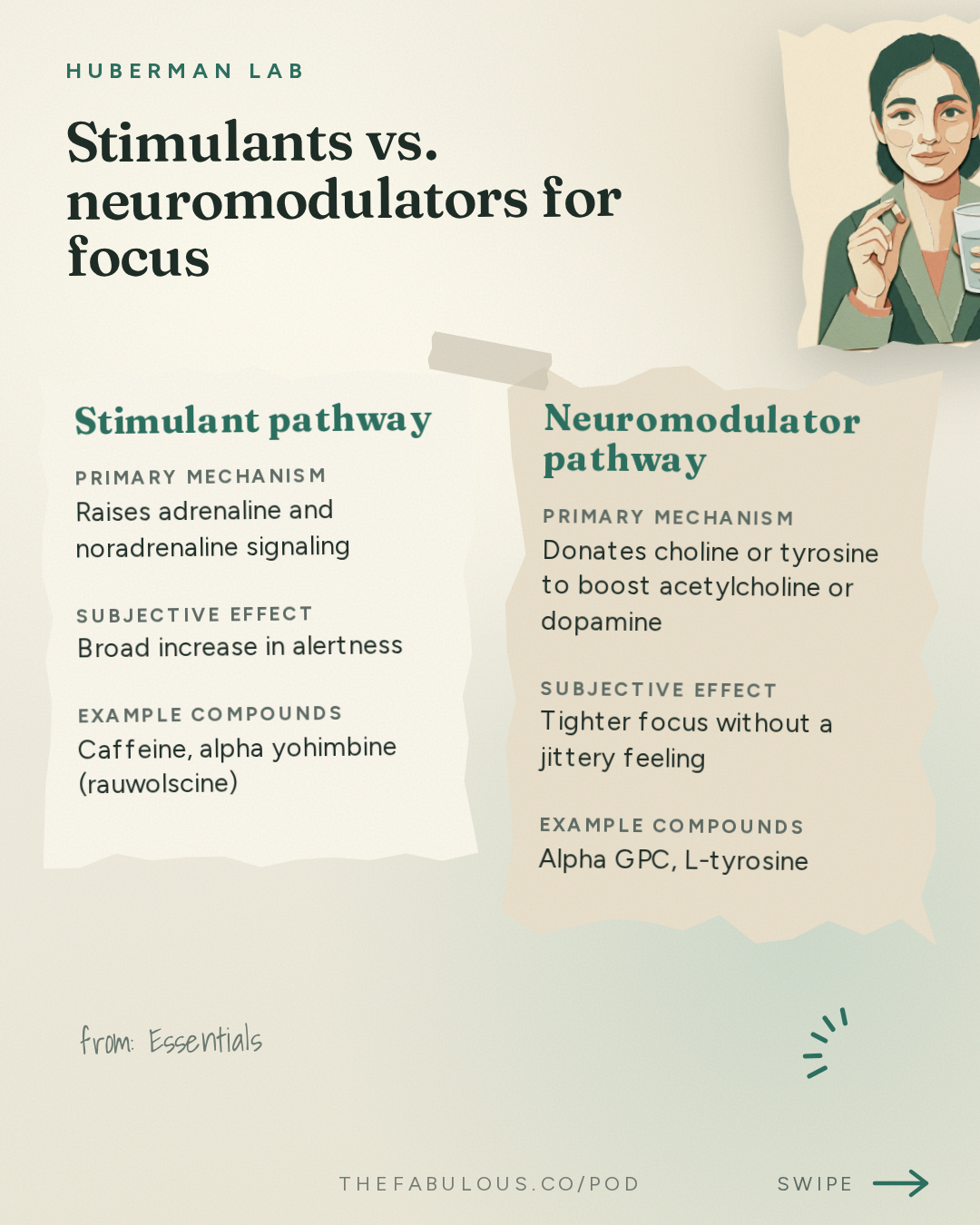
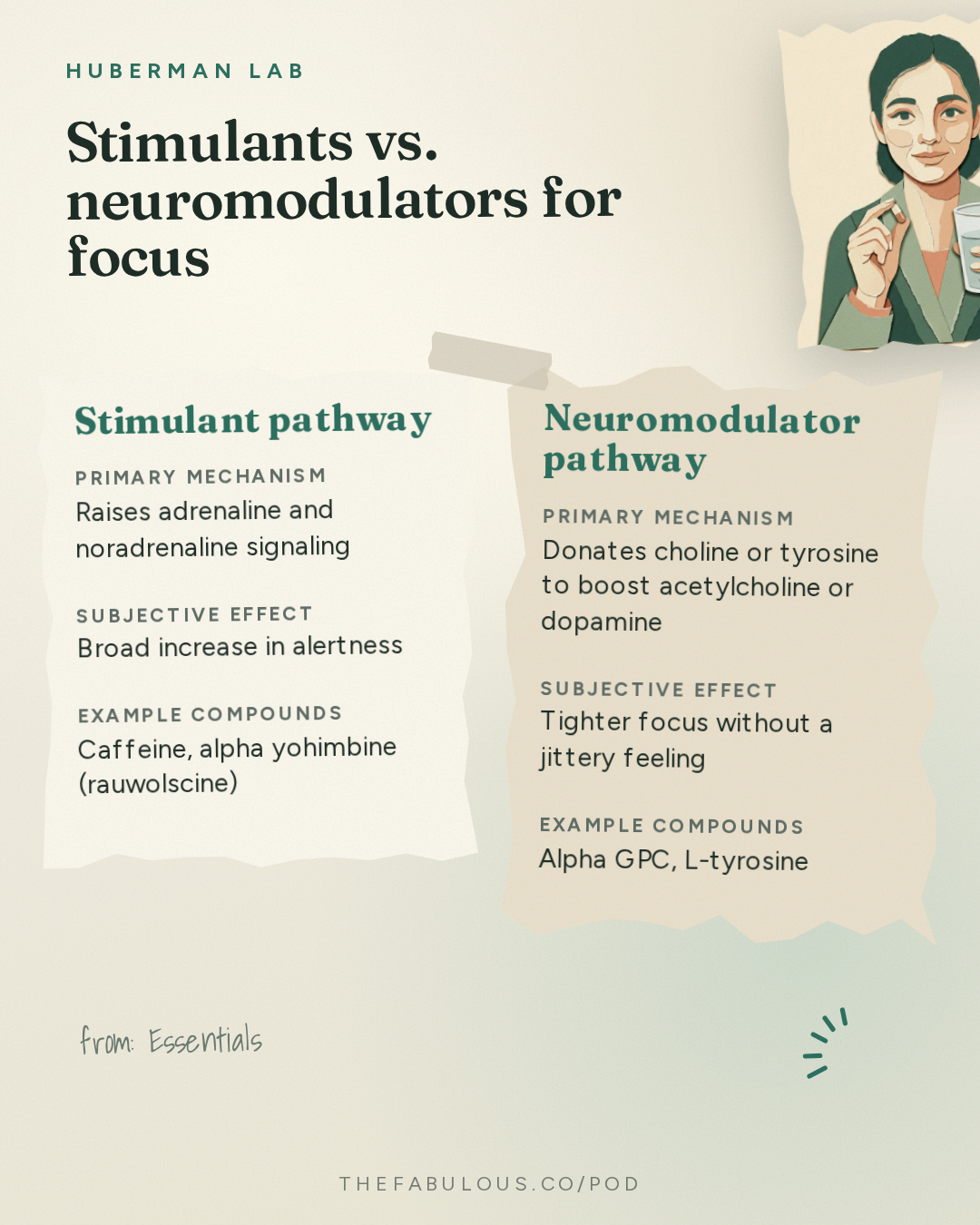
The cognition section draws a line that Huberman says most people never think to draw: stimulants versus neuromodulators. Caffeine and compounds like alpha yohimbine (also called rauwolscine) work through adrenaline and noradrenaline systems, raising general alertness (23:03). Alpha GPC, a choline donor with a half-life of four to six hours, instead feeds the acetylcholine pathway at doses of 300 to 600 milligrams, sharpening focus without the jittery feeling of a stimulant (25:08). L-tyrosine, an amino acid that is a direct precursor to dopamine, does something similar at 500 to 1,000 milligrams (26:06). His summary distinction is useful on its own: stimulants raise alertness broadly, while compounds like alpha GPC and L-tyrosine tighten focus specifically, which is why some people stack both categories rather than choosing one (27:01).
Omega-3 fatty acids, specifically EPA, get a different kind of endorsement. Huberman cites evidence that one to three grams of EPA per day, usually from fish oil, can help offset depression, support mood, and aid focus and cardiovascular and metabolic health (31:05). If forced to name the single most valuable single-ingredient supplement across mental health, physical health, and performance, he says it would be a high-quality omega-3, which matters for anyone choosing where to spend a limited supplement budget (32:10). Protein closes the nutrition side of the discussion: citing a conversation with physique and nutrition researcher Dr. Layne Norton, Huberman puts total daily protein needs for most people at roughly one gram per pound of body weight, with the caveat that activity level shifts the number and that sourcing and bioavailability matter as much as the total (32:47).
What ties all of this together is not a list of ingredients but a method for deciding whether any of them belong in a routine at all. Near the end, Huberman offers the line that probably best explains why he resists stacking first and testing never:
"While the word supplement makes it sound like these compounds are something just to add on top of or compensate for deficiencies... many of them are actually quite potent compounds." (37:02) — Andrew Huberman
Potent compounds deserve the same caution as any other intervention: one variable at a time, a clear sense of what problem is being solved, and an honest accounting of whether the problem is really upstream, in sleep, food, or sunlight, long before it reaches the supplement shelf.
Ask this episode anything
Pod's AI answers from the episode itself, with the minute mark so you can hear it yourself.
Or start with one of these
Ask this episode
Pod's AI listens to the whole episode to answer, and points you to the minute it comes from.
The rest of this answer, and any question after it
Answers come from the episode itself, never from a summary of it.
ContinueKey takeaways
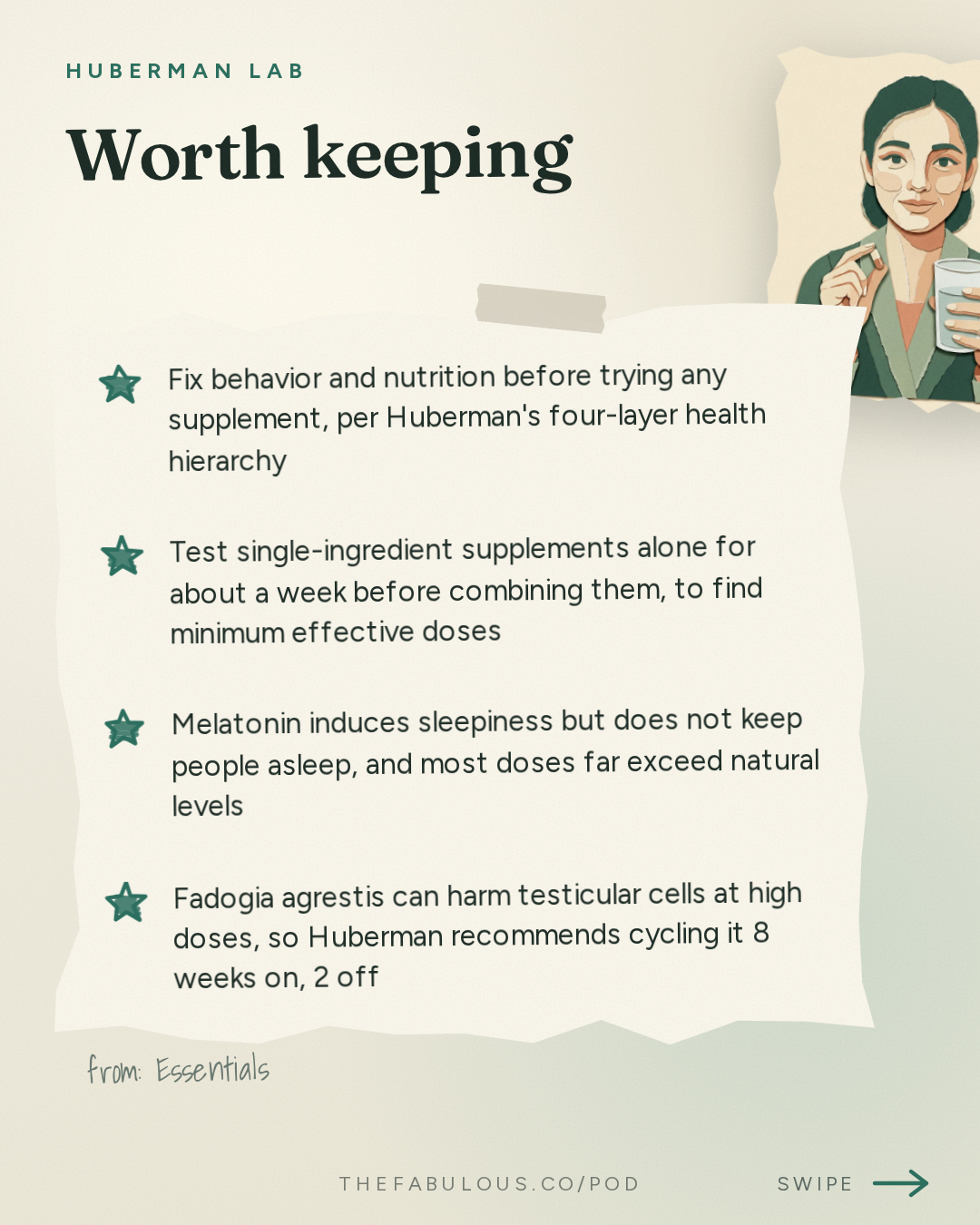
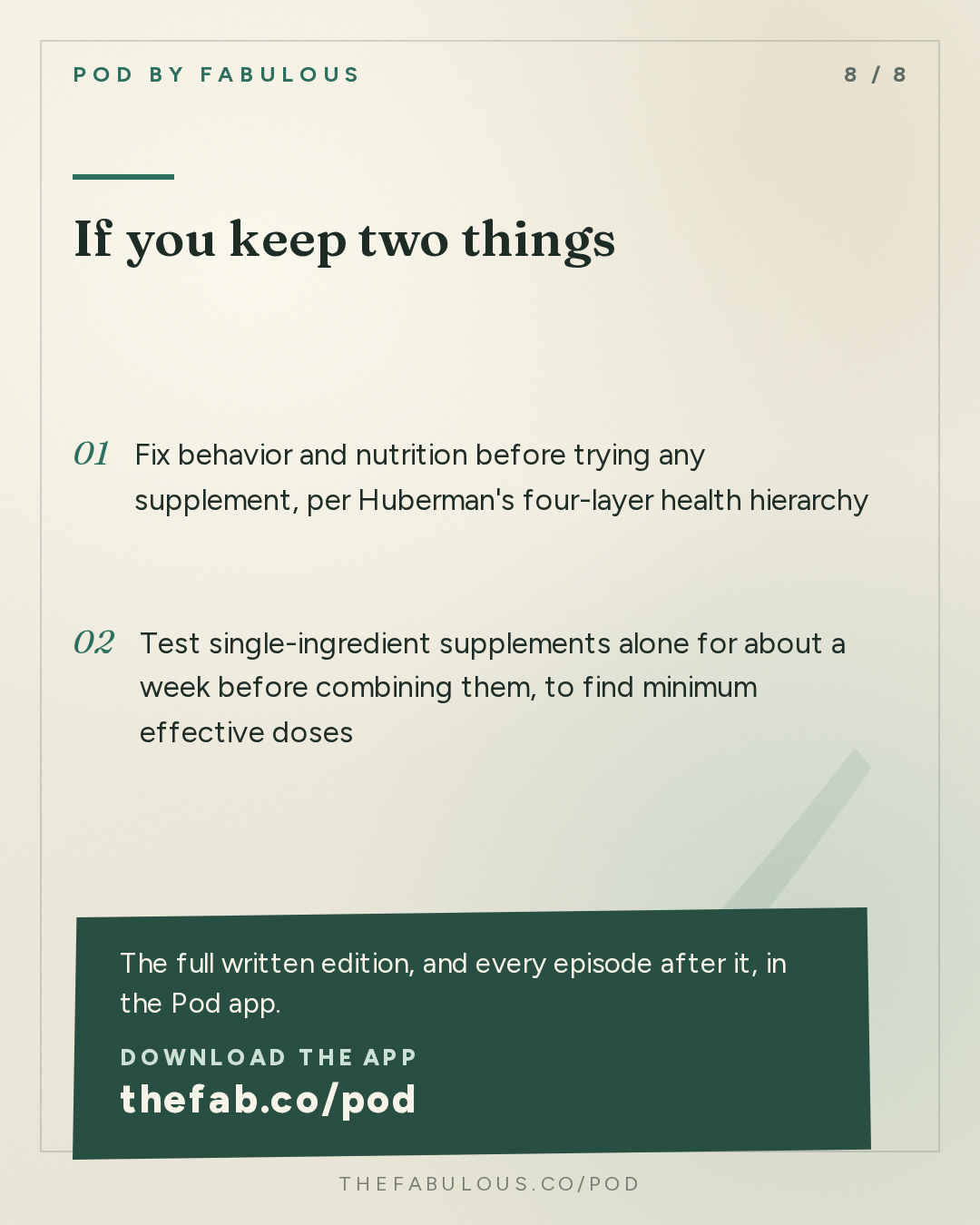
- Fix behavior and nutrition before trying any supplement, per Huberman's four-layer health hierarchy
- Test single-ingredient supplements alone for about a week before combining them, to find minimum effective doses
- Melatonin induces sleepiness but does not keep people asleep, and most doses far exceed natural levels
- Fadogia agrestis can harm testicular cells at high doses, so Huberman recommends cycling it 8 weeks on, 2 off
- Caffeine and alpha yohimbine raise general alertness, while alpha GPC and L-tyrosine tighten focus without jitters
The episode in cards
In their words
“I take the stance that behavioral tools, that is specific actions that we take and specific actions that we avoid, form the foundation of mental health, physical health, and performance.”
“No amount of supplementation or non-prescription compounds or prescription compounds for that matter, can ever compensate for poor nutrition, at least not for very long.”
“I am not a fan of melatonin for a couple of reasons. Melatonin is a hormone known to induce sleepiness but not keep us asleep.”
“Single-ingredient formulations are gonna give you the most power and control. They're going to make sure that you can find the minimal effective doses”
Protocols
-
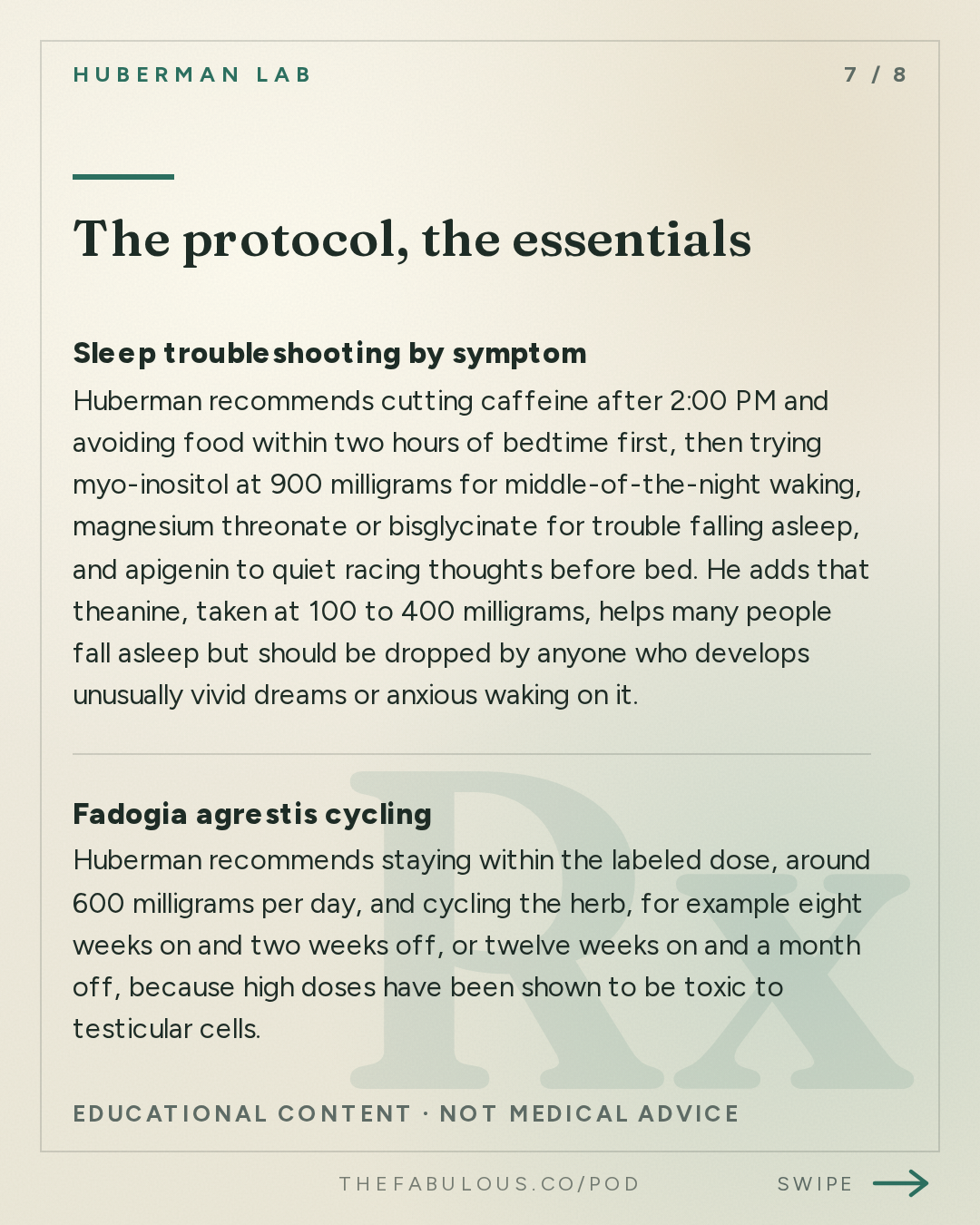
Sleep troubleshooting by symptom
Huberman recommends cutting caffeine after 2:00 PM and avoiding food within two hours of bedtime first, then trying myo-inositol at 900 milligrams for middle-of-the-night waking, magnesium threonate or bisglycinate for trouble falling asleep, and apigenin to quiet racing thoughts before bed. He adds that theanine, taken at 100 to 400 milligrams, helps many people fall asleep but should be dropped by anyone who develops unusually vivid dreams or anxious waking on it.
nightly, testing one ingredient per week
-
Fadogia agrestis cycling
Huberman recommends staying within the labeled dose, around 600 milligrams per day, and cycling the herb, for example eight weeks on and two weeks off, or twelve weeks on and a month off, because high doses have been shown to be toxic to testicular cells.
8 weeks on, 2 weeks off (or 12 weeks on, 1 month off)
-
Single-ingredient testing method
Huberman advises trying one supplement alone for about a week without changing anything else, dropping it immediately if it causes a negative effect, and only combining ingredients after testing each one individually.
one ingredient per week
Questions this episode answers
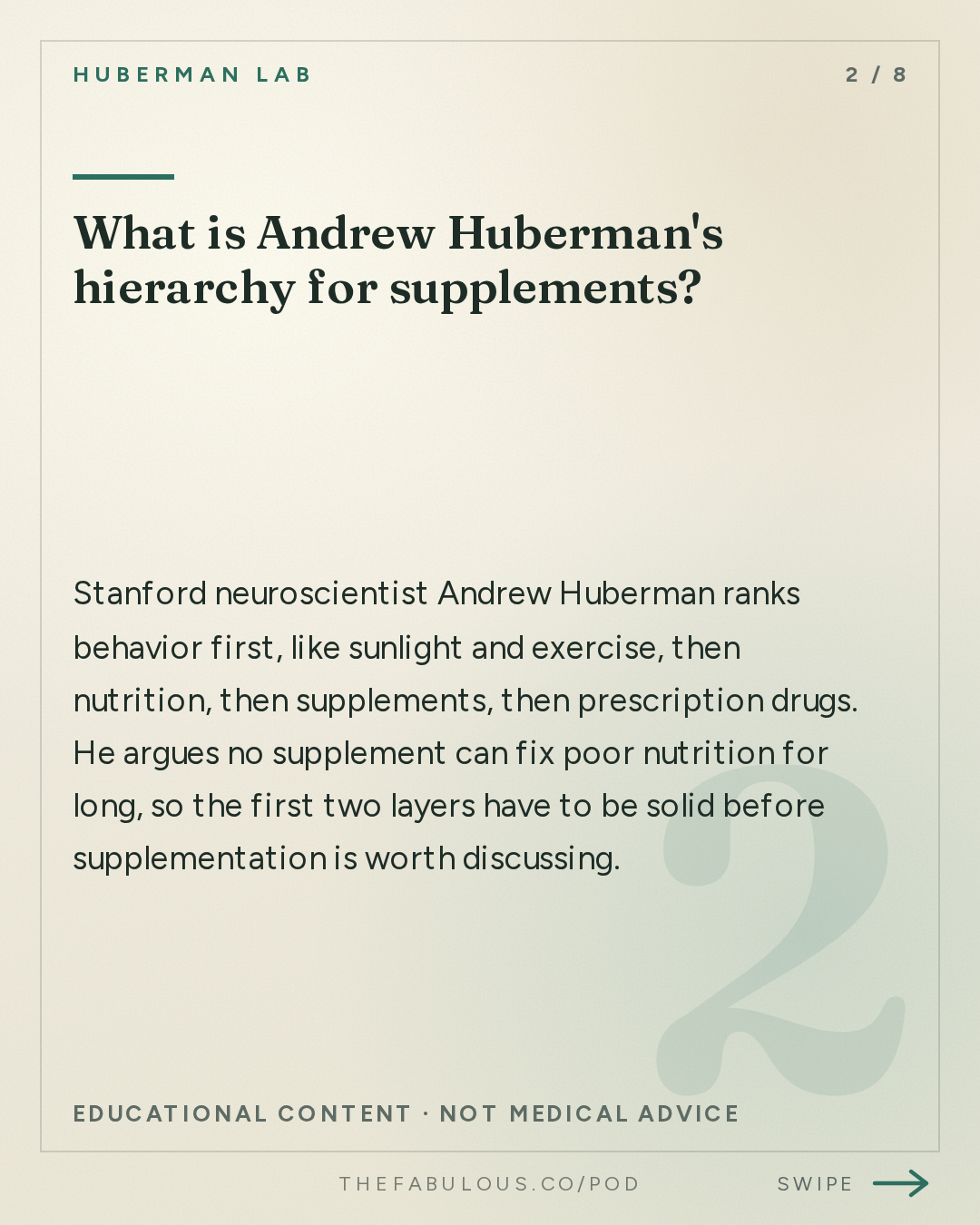
What is Andrew Huberman's hierarchy for supplements?
Stanford neuroscientist Andrew Huberman ranks behavior first, like sunlight and exercise, then nutrition, then supplements, then prescription drugs (00:42). He argues no supplement can fix poor nutrition for long, so the first two layers have to be solid before supplementation is worth discussing (01:06).
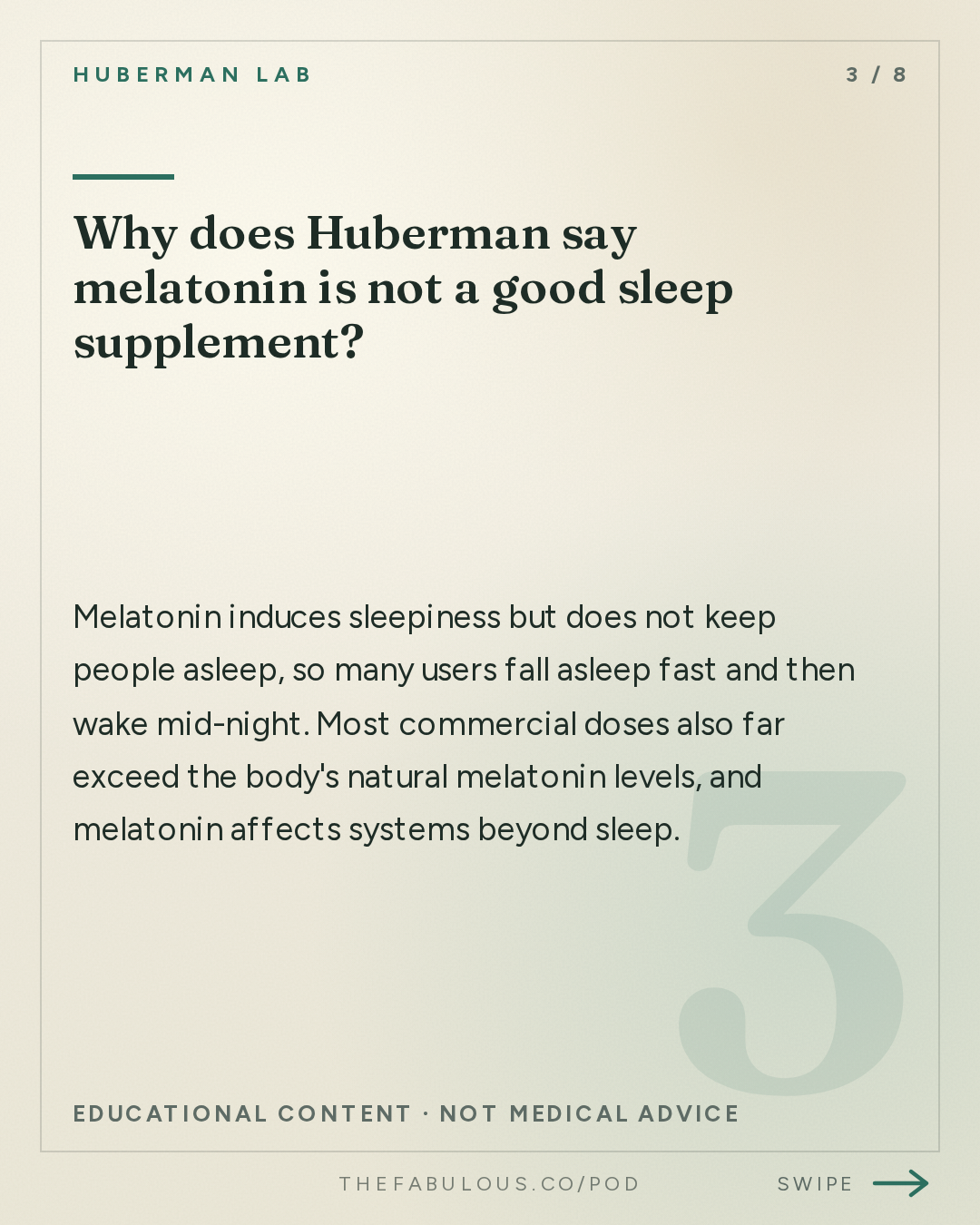
Why does Huberman say melatonin is not a good sleep supplement?
Melatonin induces sleepiness but does not keep people asleep, so many users fall asleep fast and then wake mid-night (15:00). Most commercial doses also far exceed the body's natural melatonin levels, and melatonin affects systems beyond sleep (15:25).
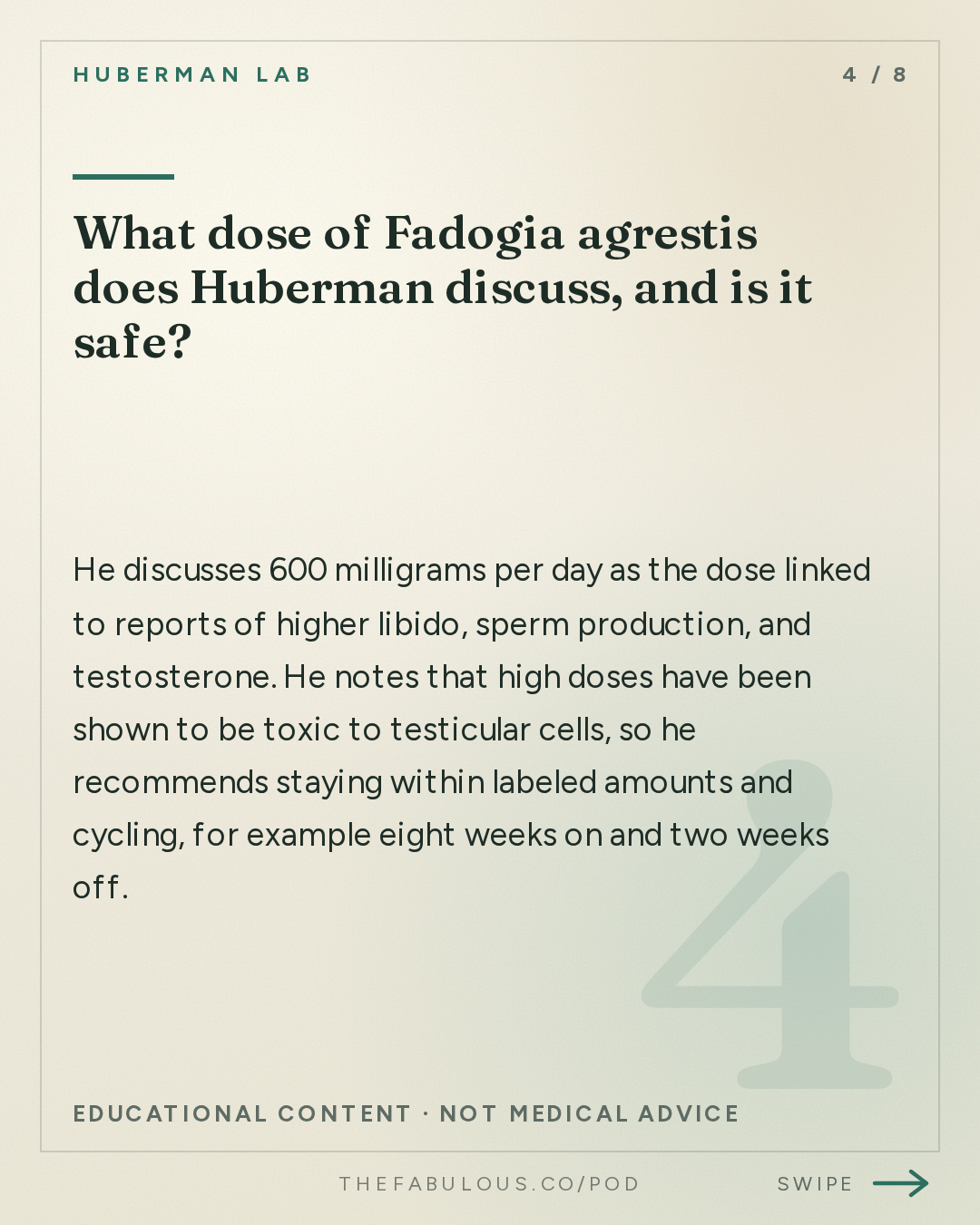
What dose of Fadogia agrestis does Huberman discuss, and is it safe?
He discusses 600 milligrams per day as the dose linked to reports of higher libido, sperm production, and testosterone (17:27). He notes that high doses have been shown to be toxic to testicular cells, so he recommends staying within labeled amounts and cycling, for example eight weeks on and two weeks off (17:50).
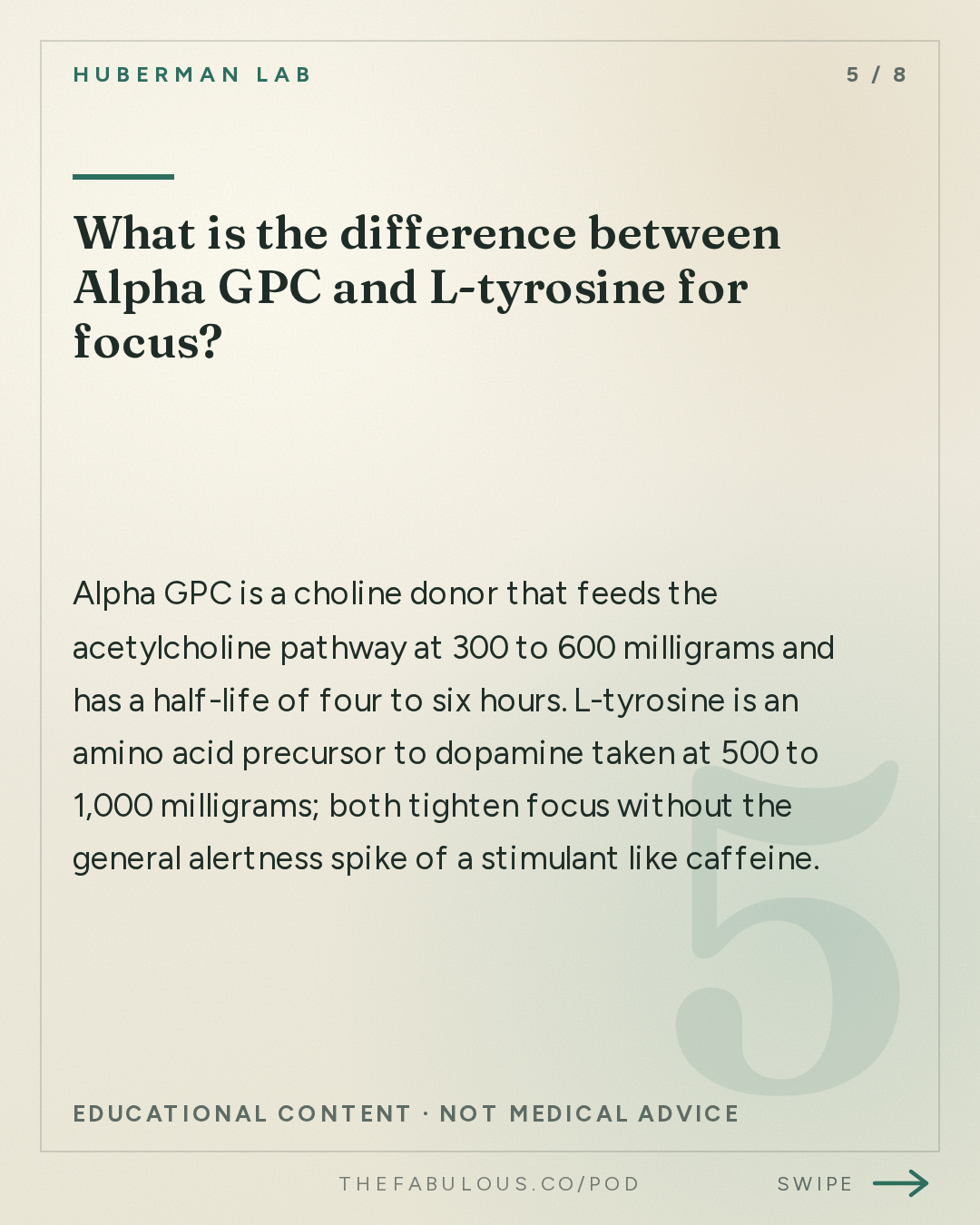
What is the difference between Alpha GPC and L-tyrosine for focus?
Alpha GPC is a choline donor that feeds the acetylcholine pathway at 300 to 600 milligrams and has a half-life of four to six hours (25:08). L-tyrosine is an amino acid precursor to dopamine taken at 500 to 1,000 milligrams; both tighten focus without the general alertness spike of a stimulant like caffeine (27:01).
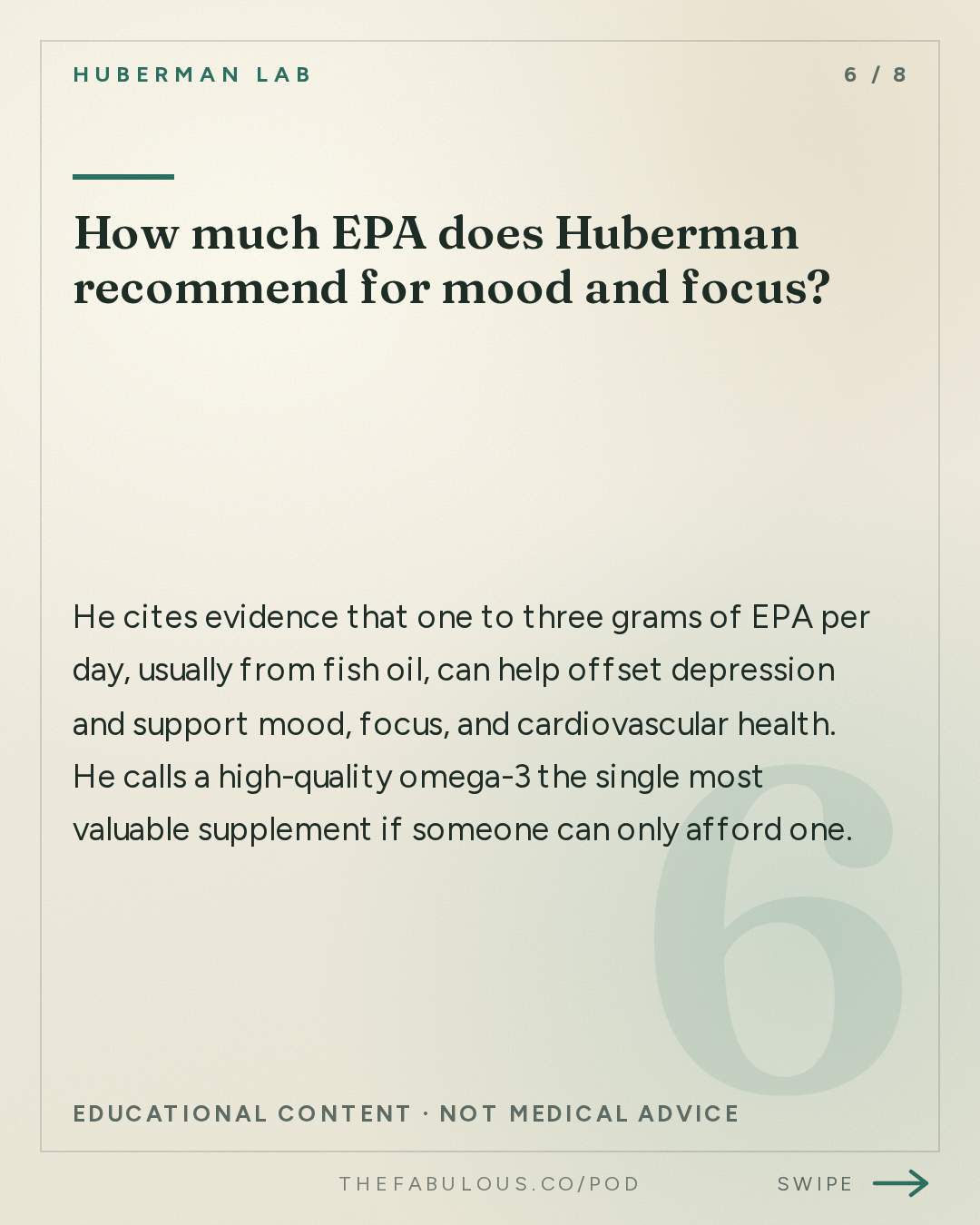
How much EPA does Huberman recommend for mood and focus?
He cites evidence that one to three grams of EPA per day, usually from fish oil, can help offset depression and support mood, focus, and cardiovascular health (31:05). He calls a high-quality omega-3 the single most valuable supplement if someone can only afford one (32:10).
Why does Huberman prefer single-ingredient supplements over blends?
Single-ingredient formulas let someone find the minimum effective dose and identify side effects, which is impossible with a multi-ingredient blend (35:08). He recommends testing one ingredient alone for about a week before combining it with anything else (14:12).
The full read, in cards
Go deeper
- Huberman Lab episode with Dr. Layne Norton — covers total daily protein needs and protein source quality, cited as roughly one gram per pound of body weight
Mentioned
Andrew Huberman · Stanford School of Medicine · Dr. Layne Norton · Examine.com · Alpha GPC · Tongkat Ali · Fadogia Agrestis
More from this show and category

Jared Diamond on Leadership: Why Charisma Isn't Required
Charisma is optional for great leadership, biologist and historian Jared Diamond argues, pointing to the uncharismatic dictators Stalin and Pinochet as proof (00:26). Diamond, 89, applies a 'natural experiment' method from biology to politics, religion, business, and sports, showing only 2 of 22 modern political leaders stepped down voluntarily and that coaches and CEOs get too much credit or blame for outcomes that are mostly random (95:37).

Neuralink Trials for Quadriplegia: What Comes First
Neuralink's head neurosurgeon Matt MacDougall explains that the implant's first job is letting quadriplegic patients move a cursor and type by thought alone, not reconnect limbs. He also covers the robotic surgery that makes this possible, the safety case made in pigs and monkeys, and his own subdermal RFID chip.
How Diet Affects Memory and the Hippocampus
USC neuroscientist Scott Kanoski says the hippocampus, the brain's memory hub, tracks recent meals via the vagus nerve to judge hunger and fullness. Sugar, heat-processed foods, and artificial sweeteners early in life can impair that memory system and its gut bacteria, while exercise and simple recall of a recent meal can help restore or harness it.

Elissa Epel's Guide to Stress and Resilience
Psychologist Elissa Epel says stress is simply when demands exceed our resources, and most modern stress comes from our own thoughts. She shows how a challenge mindset, radical acceptance, and small daily practices like 'dropping the rope' change inflammation, telomere length, and mitochondrial energy output measurably.
