
Jared Diamond on Leadership: Why Charisma Isn't Required
What Makes Great Leaders & How to Live an Extraordinary Life | Dr. Jared Diamond
The brief
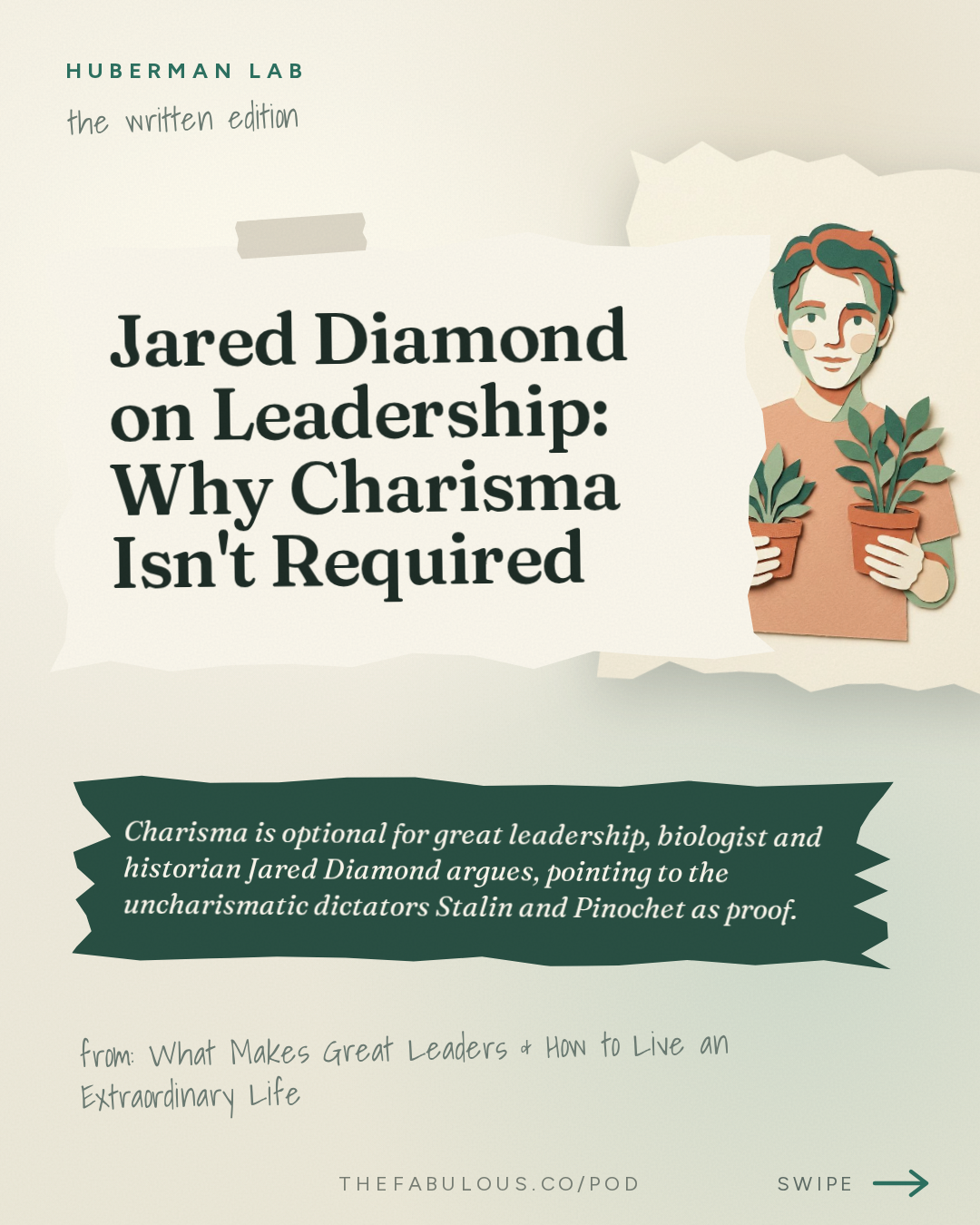
Charisma is optional for great leadership, biologist and historian Jared Diamond argues, pointing to the uncharismatic dictators Stalin and Pinochet as proof (00:26). Diamond, 89, applies a 'natural experiment' method from biology to politics, religion, business, and sports, showing only 2 of 22 modern political leaders stepped down voluntarily and that coaches and CEOs get too much credit or blame for outcomes that are mostly random (95:37).
Joseph Stalin could not charm a room. Augusto Pinochet, the dictator of Chile, had none of the magnetism people assume dictators need. Evolutionary biologist, geographer, and UCLA professor emeritus Jared Diamond argues in his new book, Prophets, Profits, Coaches, and Kings: When Do Leaders Matter?, that effective leadership does not require charm. Diamond, who is 89 and won a Pulitzer Prize for Guns, Germs, and Steel, counts instead.
"There are about 37 ways to be an effective leader, of which, um, charisma is, is one." — Jared Diamond [00:26]
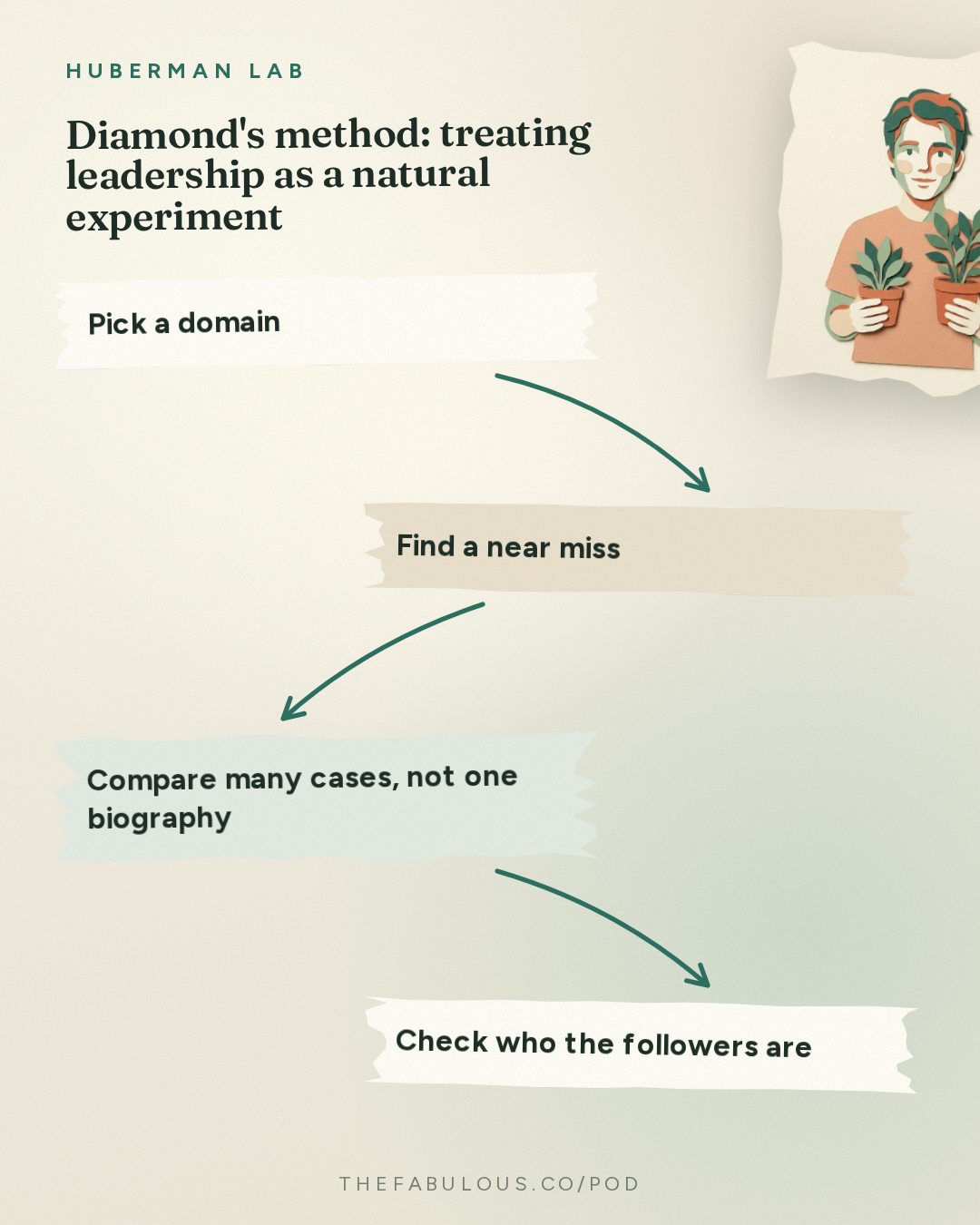
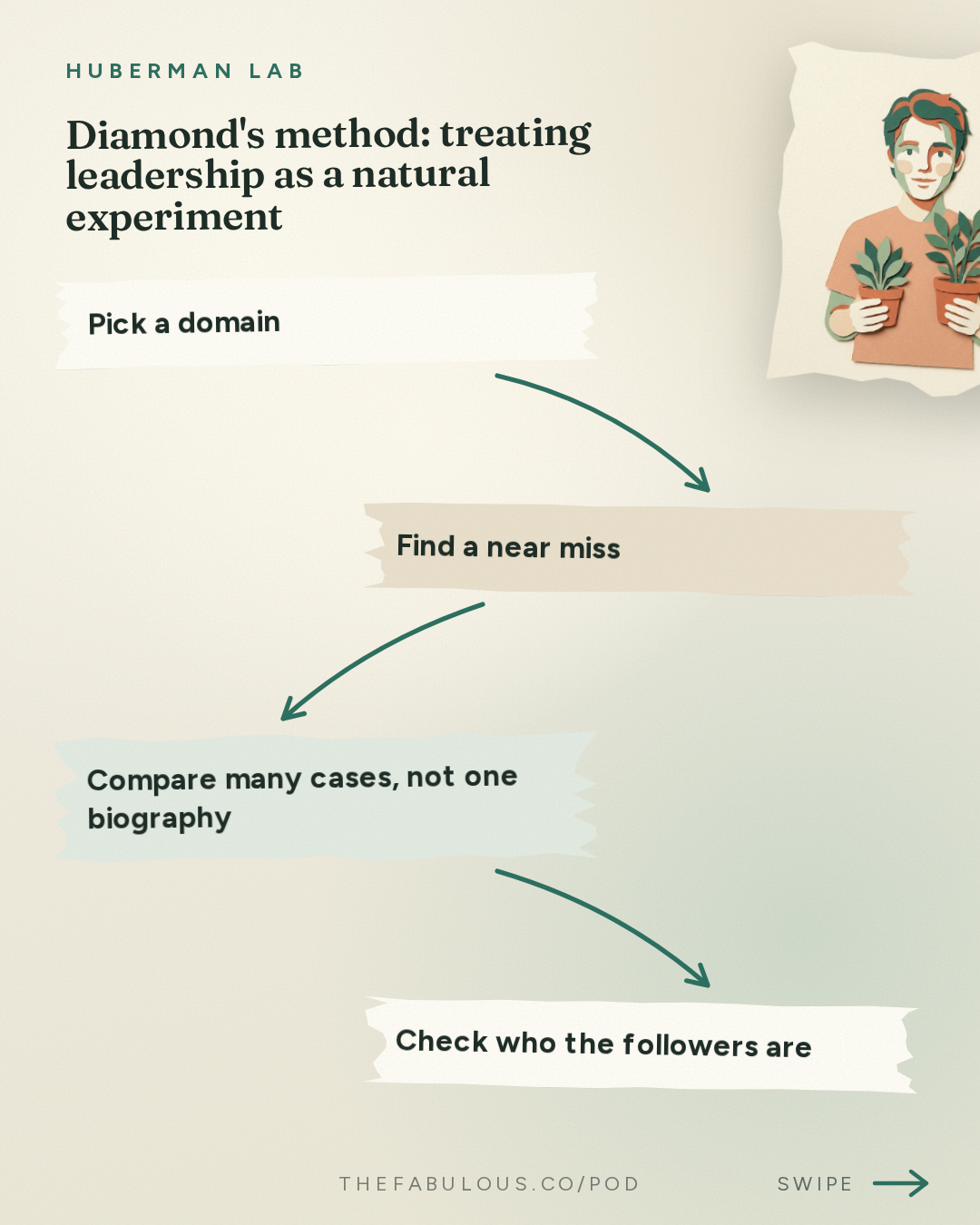
That number is not a throwaway line. It is the product of a mind that has spent a lifetime making lists, of bird species, of languages, of church cantatas, and now of leaders. The new book sorts leaders into four spheres: politics, religion, business, and sports (03:20). What unites the project is a method Diamond borrows from his first career as a laboratory biologist: the natural experiment, a comparison of cases that differ in one key variable, used when a controlled lab test is impossible.
He applies it first to Adolf Hitler. Most Hitler biographies read as single stories, and different historians, working from the same facts, reach opposite conclusions about whether Hitler mattered or whether any ambitious German nationalist would have done the same damage (10:50). Diamond prefers near misses. In 1930, three years before Hitler became chancellor, a truck nearly crushed his car at an intersection (06:45). In 1944, a bomb planted by army officer Claus von Stauffenberg went off under a conference table seconds after Hitler leaned forward, killing four other men in the room (08:14). Either accident removes Hitler from history. Diamond's own family history runs through that same accident of survival: his wife's mother survived Auschwitz, and other relatives did not (05:06).
Harry Truman gets a gentler kind of natural experiment. Truman was Franklin Roosevelt's forgettable fourth vice president, picked for small political reasons, and Roosevelt never once met with him in office (12:23). When Roosevelt died, Truman had not even been told about the atomic bomb, and the first decision on his desk was whether to drop it. He was "widely despised" at the time, Diamond says, for the Berlin Airlift, the hydrogen bomb, the Korean War, and firing General MacArthur (12:49). What made Truman effective, in Diamond's reading, was indifference to being loathed. He made the calls and let the hatred land.
What Counts as Luck, What Counts as Skill
Diamond's chapter on religious leaders asks why Christianity, and not five or six other first-century messianic movements named in the New Testament, became a world religion (26:46). His answer is not that Jesus was uniquely persuasive. It is that Jesus preached a universal message rather than one aimed at a single sect, that he was followed by a gifted organizer in Saint Paul, since Jesus himself died before building an institution, and that he happened to live inside the Western Roman Empire, the most powerful political entity of his era (29:03). Place and timing did the rest, Diamond argues, aided by Columbus, who nearly fifteen centuries later carried that empire's religion across the world.
Followers matter as much as leaders, Diamond insists, especially with cults. Jim Jones, who led more than 900 people to their deaths by cyanide-laced punch in Guyana in 1978, had earlier led the desegregation of housing in Indianapolis and later served as a housing commissioner in San Francisco (37:39). His followers in the People's Temple were not a random slice of the public. They were disproportionately poor, older, and Black. Diamond contrasts this with Hitler, whose Nazi party never won a parliamentary majority, meaning most Germans resisted him, and with Winston Churchill and Franklin Roosevelt, whose supporters cannot be dismissed as psychologically vulnerable (39:22). A charismatic leader without a population primed to follow, Diamond suggests, does not get very far.
Power, once gained, is rarely surrendered. Diamond built a table of 22 outstanding political leaders since World War II and found only two who stepped down voluntarily: Nelson Mandela, who retired from South Africa's presidency in his eighties, and Lee Kuan Yew, who led Singapore for roughly three decades before stepping aside (43:16). Everyone else was assassinated, forced out by a coup, voted out, or committed suicide. That finding leads directly into Diamond's sports and business chapters, where he uses analysis of variance, a statistical method called ANOVA that splits an outcome into the share explained by different factors, to ask how much credit a coach or CEO actually deserves. Roughly 15 percent to 30 percent of a team's success traces to the coach, another chunk to the players, and the rest to the institution (95:37). In business, CEOs account for about 30 percent of the variance in outcomes, with industry conditions explaining a comparable share: perfume and tech companies run profitable, regulated utilities do not (96:13). Because about 70 percent of the outcome is effectively random with respect to the leader, firing a coach or CEO after one bad season usually looks like an improvement the following year for reasons that have nothing to do with the replacement's talent (96:47). John Wooden, who led UCLA basketball to nine national championships including seven in a row, is Diamond's exception. His star players said they learned more from him about life than about basketball.
"For him, basketball was not a sport. Basketball was a philosophy of life." — Jared Diamond [99:28]
A Life Built on Lists
Diamond's own biography reads like one of his natural experiments, a life that kept branching. He learned to read at age three and immediately began keeping lists, of rivers, of animals, of Boston streetcar numbers (51:34). He has since learned 13 languages, the last being Italian, picked up at age 61, which he now reads daily for pleasure and practices weekly in two-hour conversations with a professor (45:22). A trip to New Guinea in his twenties to watch birds, a place with roughly 600 bird species, turned into a second career running parallel to his original work in gallbladder physiology, and later a third career in history and geography that produced Guns, Germs, and Steel (53:27). He credits birds as the best window into animal and human behavior because birds, like people, rely mainly on sight and sound, while most other mammals navigate by smell, a sense impossible for a human observer to track in the field (70:00).
At 89, Diamond is doing the math on time left. He notes that an American man's life expectancy at birth is about 78, but a man who has already reached 70 has a life expectancy closer to 93, because the biggest risks are already behind him (81:47).
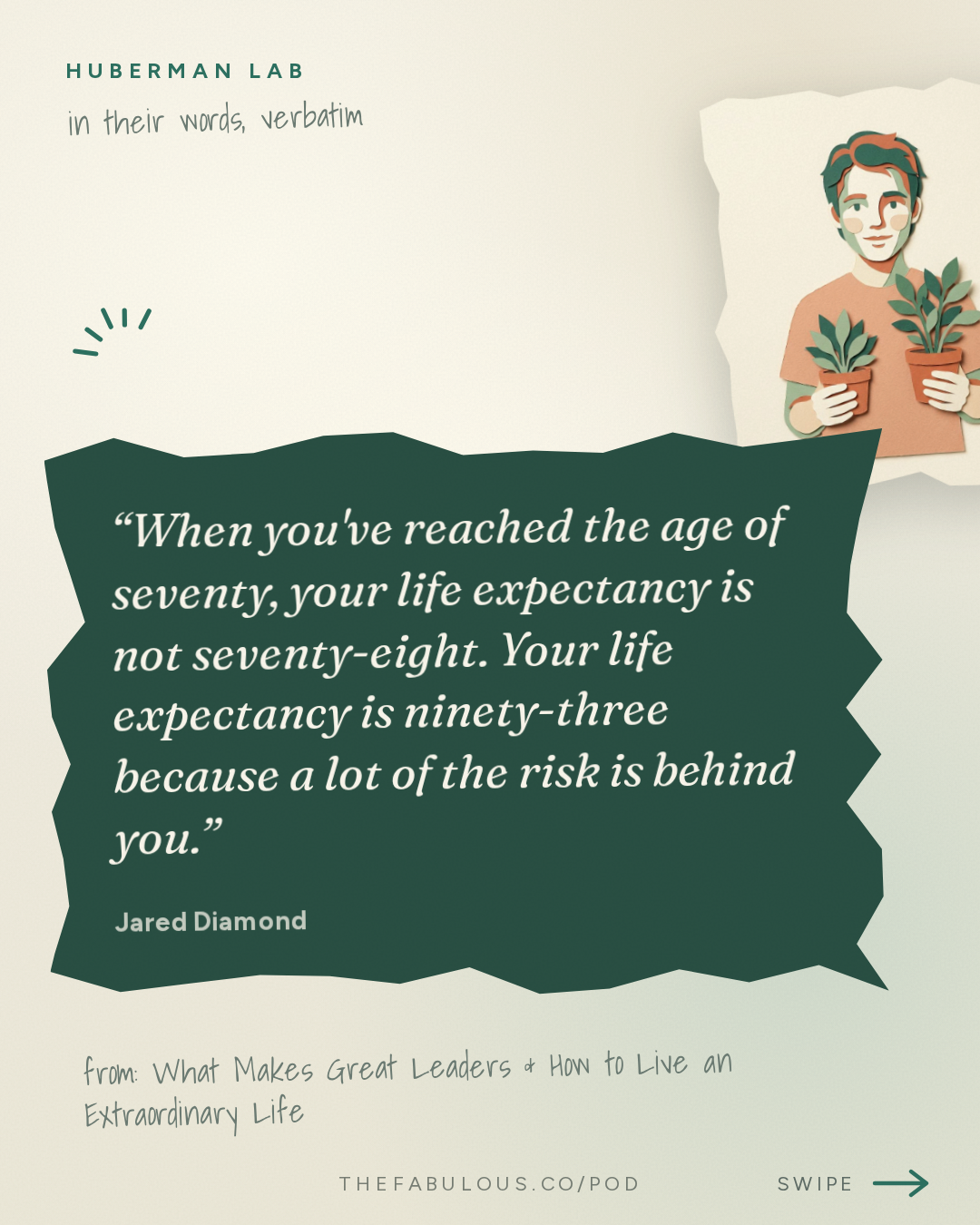
"When you've reached the age of seventy, your life expectancy is not seventy-eight. Your life expectancy is ninety-three because a lot of the risk is behind you." — Jared Diamond [81:53]
He is spending that remaining time on two long lists: a synthesis of bird colonization across New Guinea's ten isolated mountain ranges, data no one else has, and a slow listen through all 210 of Johann Sebastian Bach's surviving church cantatas, about one a week, a project he started because he realized the clock was not infinite (83:36). His closing advice is blunt. Work should pass three tests, Diamond says: something enjoyable, something you are good at, something useful to the world, and anyone who insists otherwise should be told, in his words, to go to hell (107:44). It is the same instinct that filled a three-year-old's notebook with lists of rivers: find what holds your attention, trust it, and keep the list going.
Ask this episode anything
Pod's AI answers from the episode itself, with the minute mark so you can hear it yourself.
Or start with one of these
Ask this episode
Pod's AI listens to the whole episode to answer, and points you to the minute it comes from.
The rest of this answer, and any question after it
Answers come from the episode itself, never from a summary of it.
ContinueKey takeaways
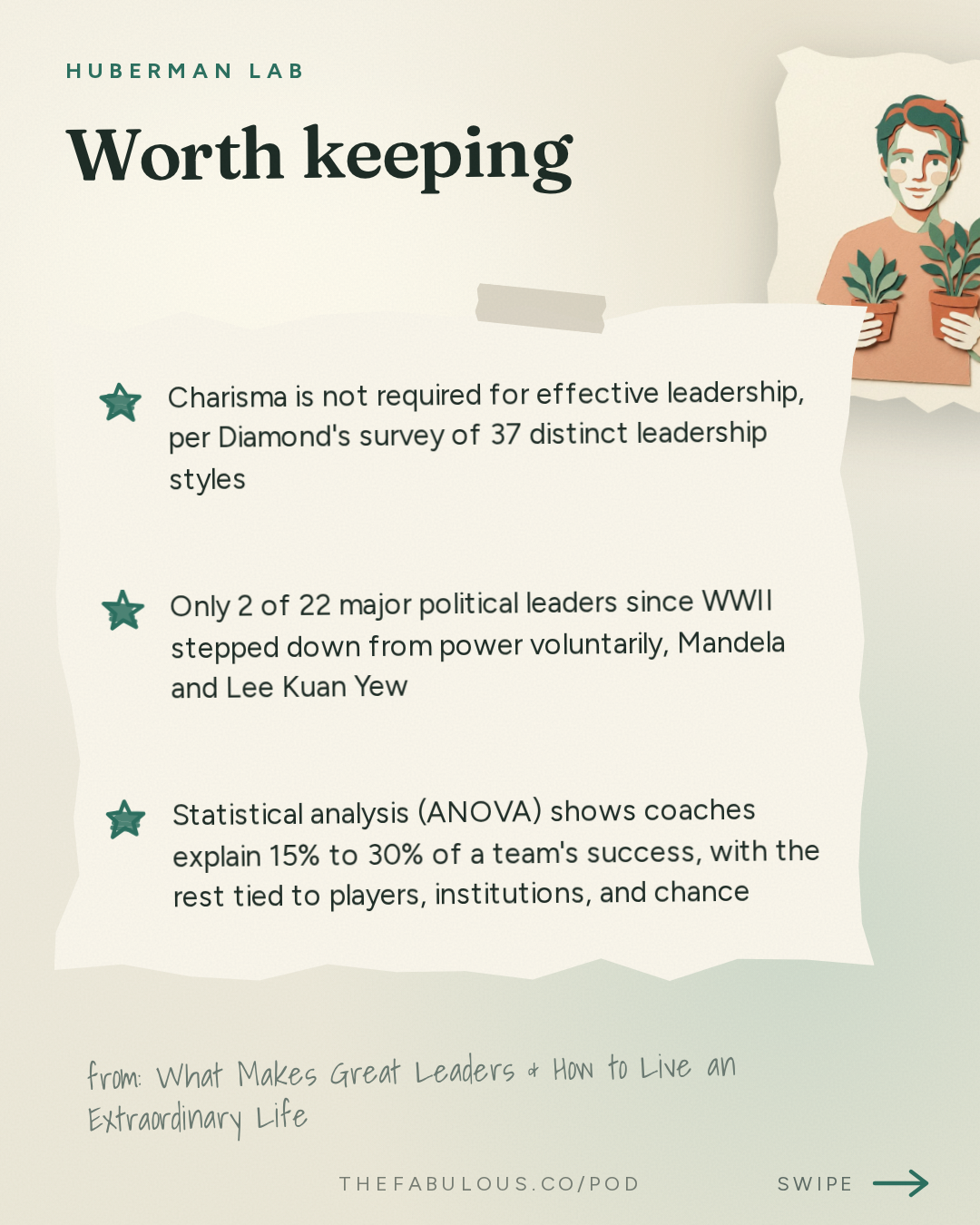
- Charisma is not required for effective leadership, per Diamond's survey of 37 distinct leadership styles
- Only 2 of 22 major political leaders since WWII stepped down from power voluntarily, Mandela and Lee Kuan Yew
- Statistical analysis (ANOVA) shows coaches explain 15% to 30% of a team's success, with the rest tied to players, institutions, and chance
- CEOs account for about 30% of a company's variance in outcomes, with industry conditions explaining a similar share
- A 70-year-old American man's life expectancy is 93, not 78, because the largest mortality risks have already passed
The episode in cards

By the numbers
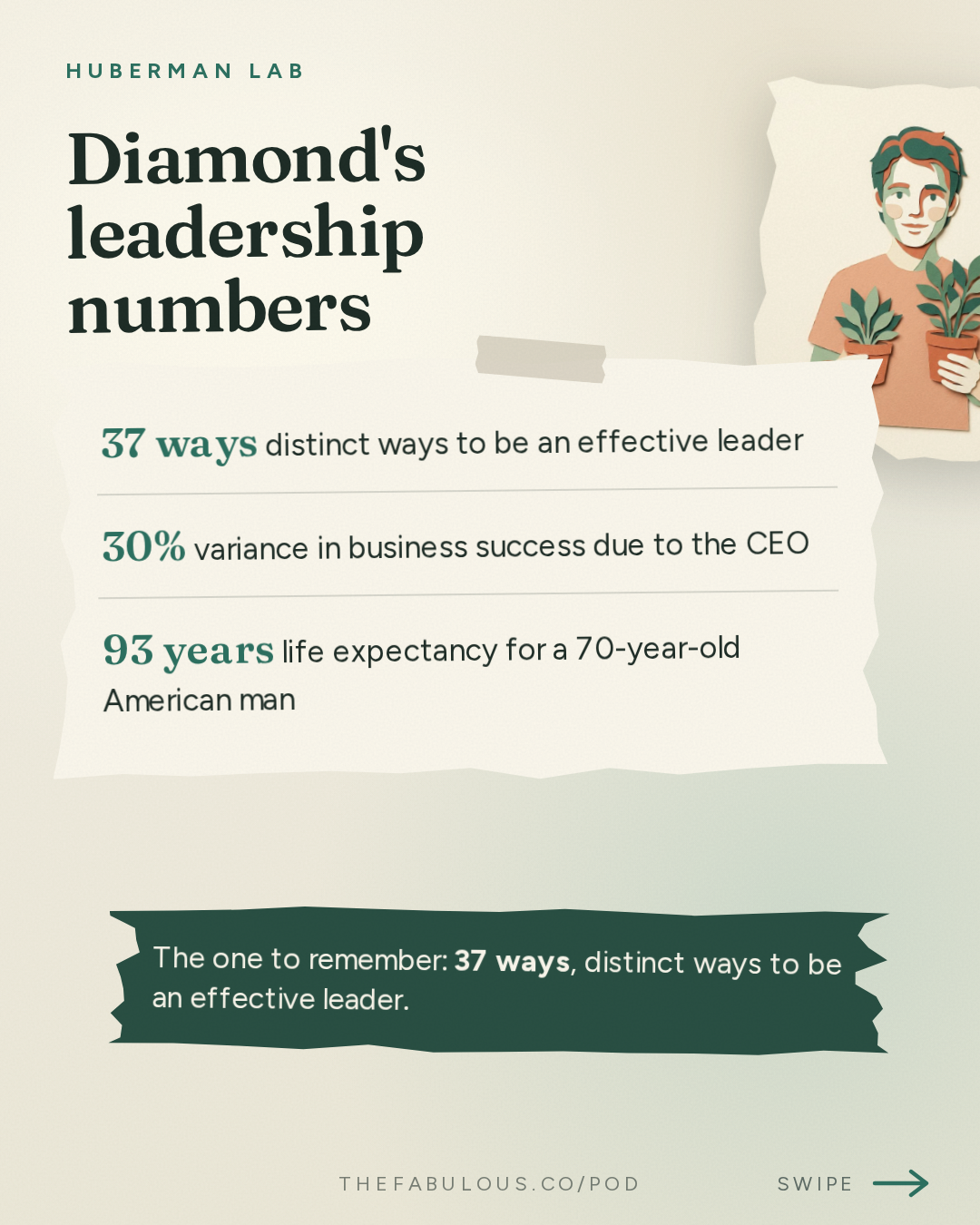
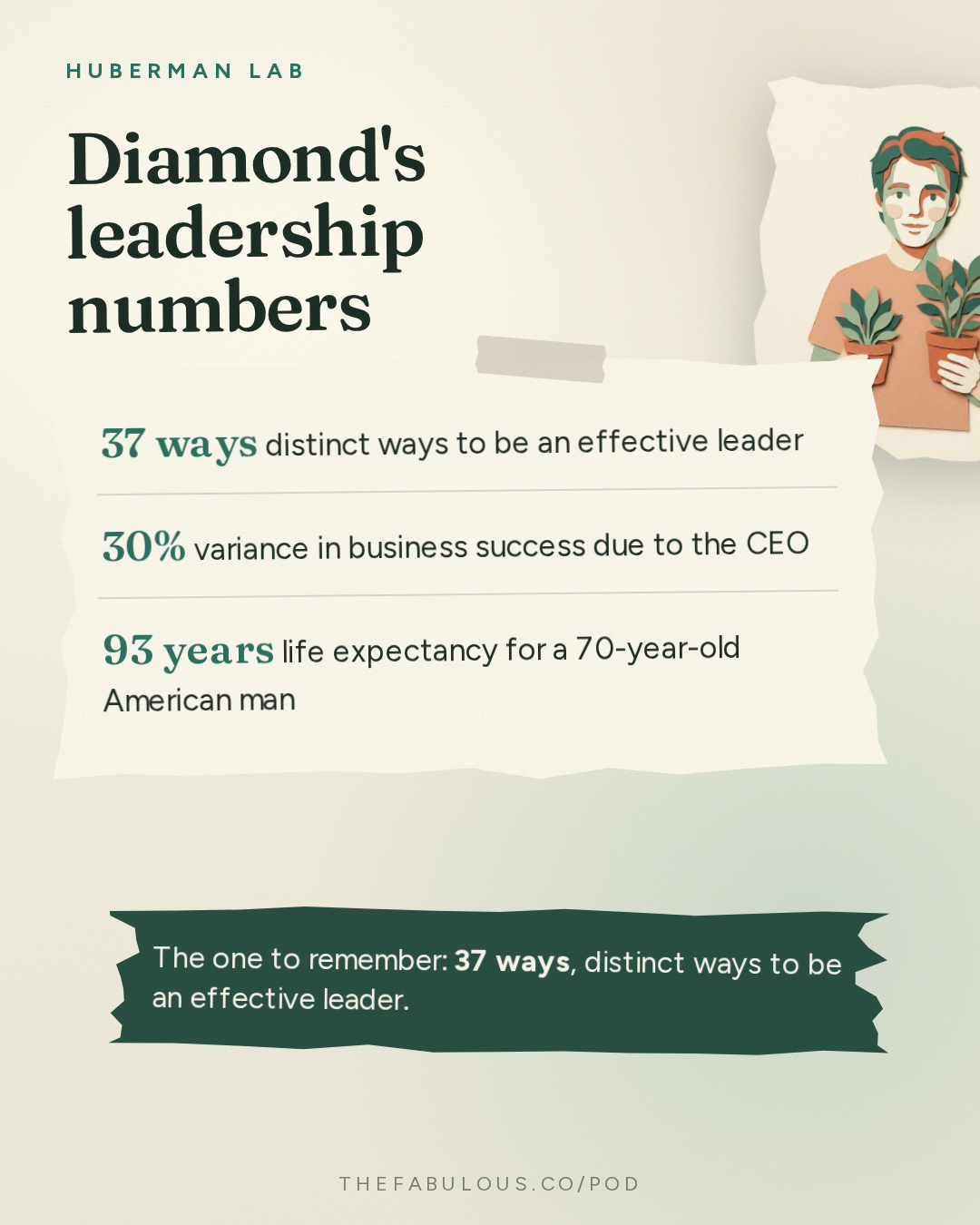
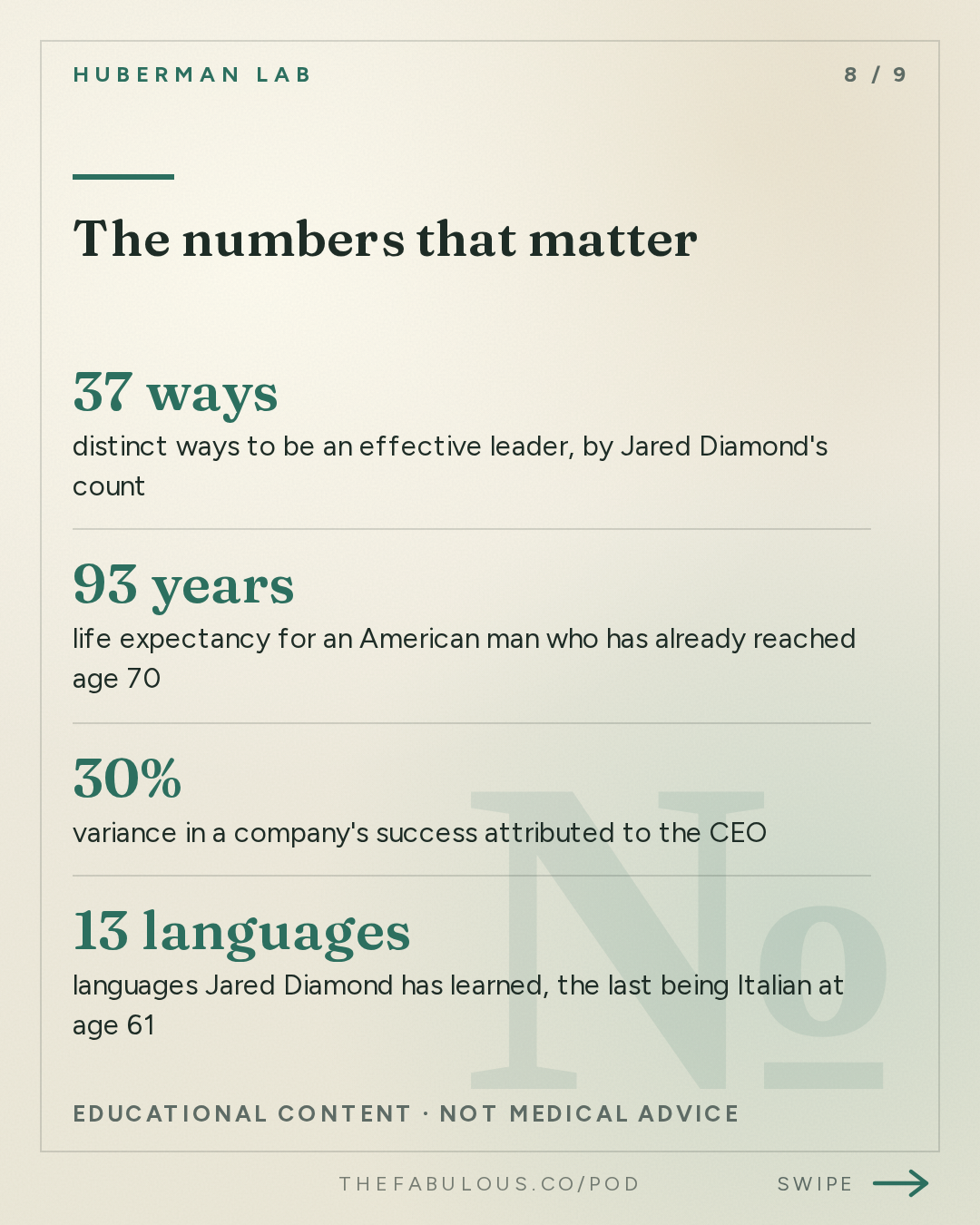
- 37 ways distinct ways to be an effective leader, by Jared Diamond's count
- 93 years life expectancy for an American man who has already reached age 70
- 30% variance in a company's success attributed to the CEO
- 13 languages languages Jared Diamond has learned, the last being Italian at age 61
In their words
“There are about 37 ways to be an effective leader, of which, um, charisma is, is one.”
“When you've reached the age of seventy, your life expectancy is not seventy-eight. Your life expectancy is ninety-three because a lot of the risk is behind you.”
“For him, basketball was not a sport. Basketball was a philosophy of life”
“Make sure that you do something that you enjoy. And if people tell you, 'No, you gotta do this, this, this,' tell them to go to hell.”
Protocols
-
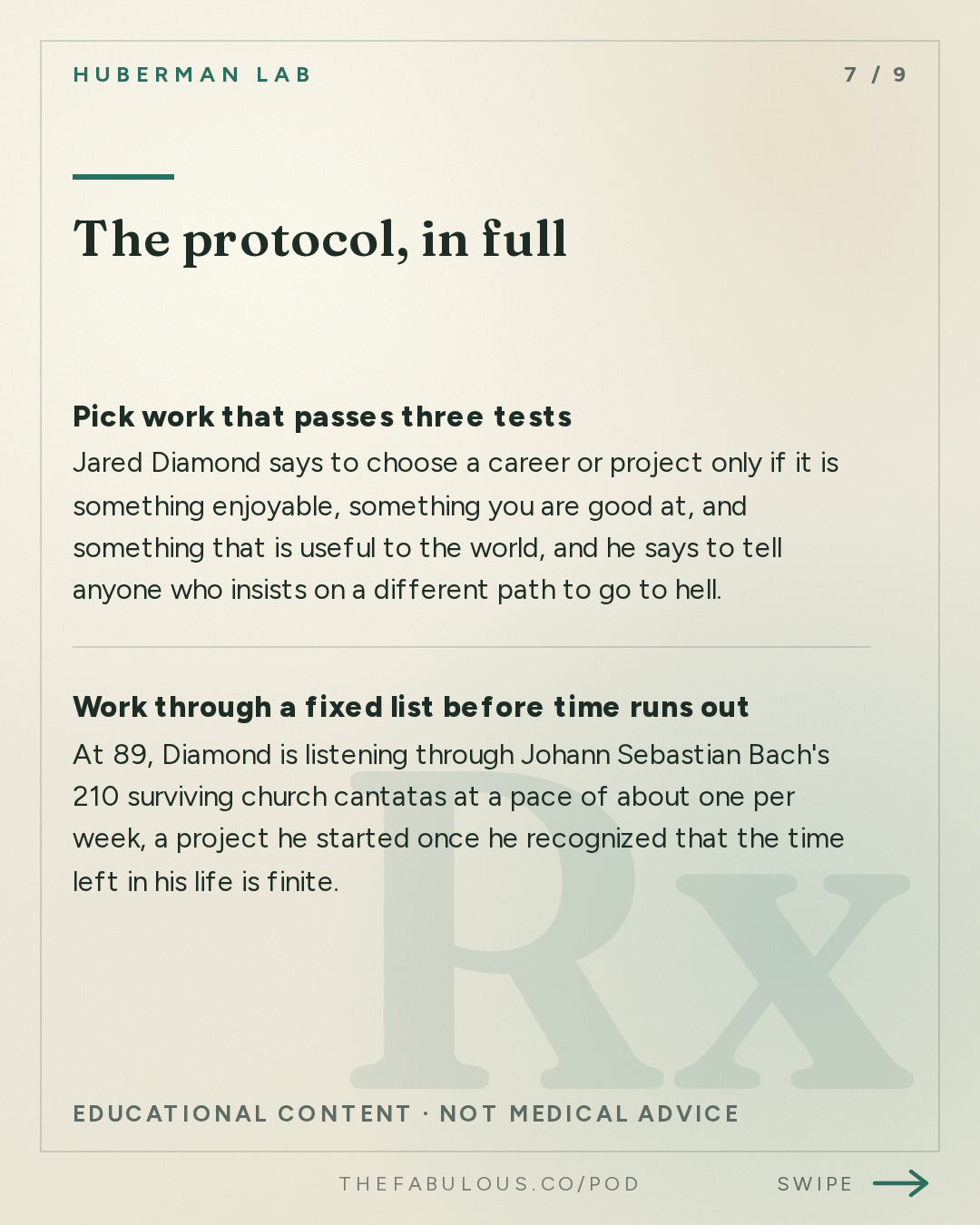
Pick work that passes three tests
Jared Diamond says to choose a career or project only if it is something enjoyable, something you are good at, and something that is useful to the world, and he says to tell anyone who insists on a different path to go to hell.
applied to every major career decision
-
Work through a fixed list before time runs out
At 89, Diamond is listening through Johann Sebastian Bach's 210 surviving church cantatas at a pace of about one per week, a project he started once he recognized that the time left in his life is finite.
about one cantata per week
Questions this episode answers
Does a leader need to be charismatic to be effective?
No. Jared Diamond points to Joseph Stalin and Chilean dictator Augusto Pinochet as powerful but uncharismatic leaders, and counts roughly 37 distinct ways to lead effectively, with charisma being only one of them (00:26).
How many political leaders have voluntarily given up power?
In Diamond's table of 22 outstanding political leaders since World War II, only two stepped down voluntarily: Nelson Mandela, South Africa's first post-apartheid president, and Lee Kuan Yew, the founding prime minister of Singapore. Every other leader in the table was assassinated, voted out, overthrown, or died in office (43:16).
How much does a coach or CEO actually affect success?
Using analysis of variance (ANOVA), a statistical method that splits an outcome into the share explained by different factors, Diamond finds coaches explain roughly 15% to 30% of a sports team's success, with players and institutional factors accounting for much of the rest (95:37). CEOs explain about 30% of a company's outcome, with industry conditions explaining a comparable share (96:13).
Why did Harry Truman become a respected president despite a rocky start?
Jared Diamond argues Truman's courage came from not caring whether he was hated for his decisions, including the Berlin Airlift, the hydrogen bomb program, the Korean War, and firing General MacArthur, all of which made him widely loathed while he was in office (12:49).
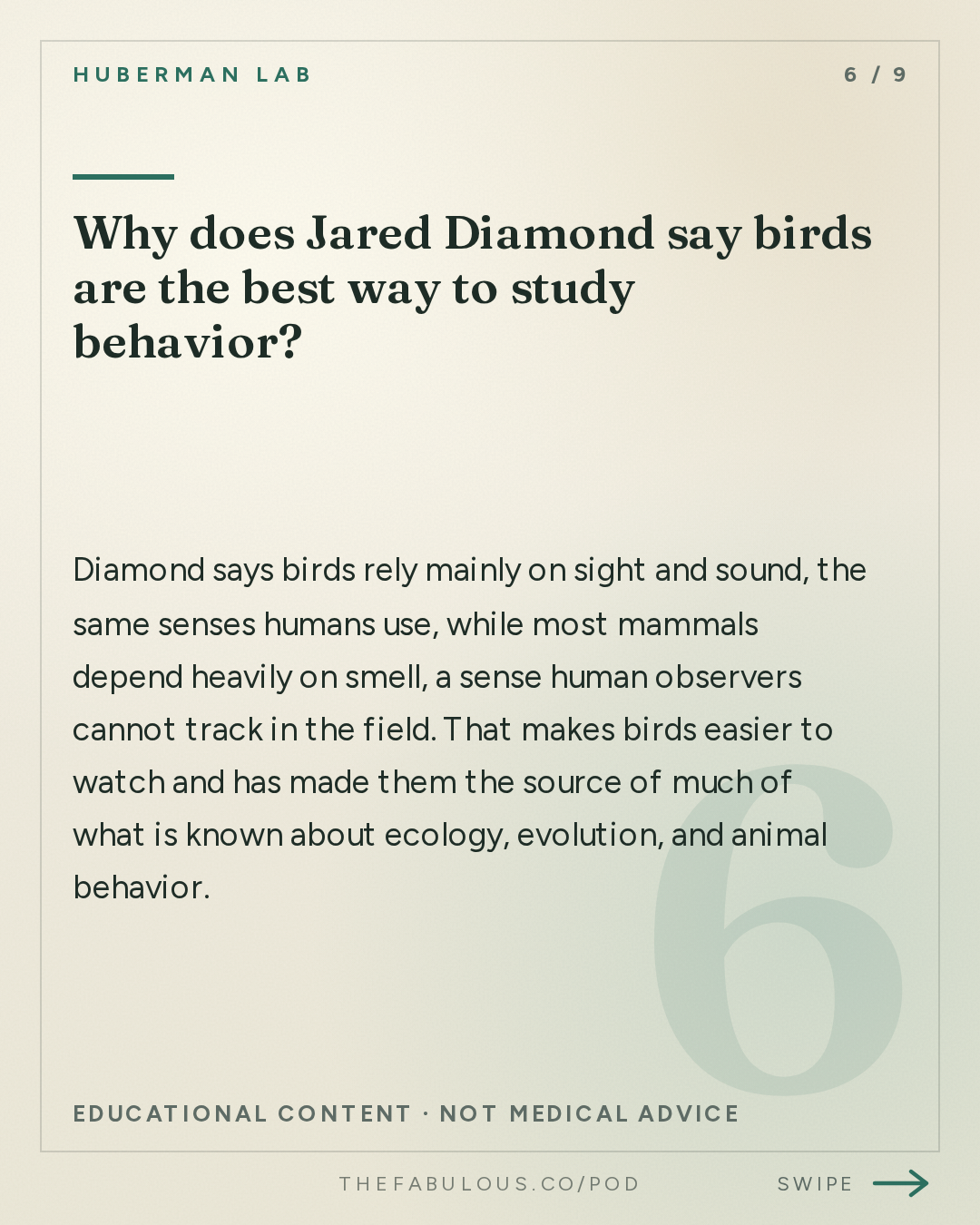
Why does Jared Diamond say birds are the best way to study behavior?
Diamond says birds rely mainly on sight and sound, the same senses humans use, while most mammals depend heavily on smell, a sense human observers cannot track in the field. That makes birds easier to watch and has made them the source of much of what is known about ecology, evolution, and animal behavior (70:00).
The full read, in cards
Go deeper
- Prophets, Profits, Coaches, and Kings: When Do Leaders Matter? — Jared Diamond's book applying a natural-experiment method to leaders in politics, religion, business, and sports
- Guns, Germs, and Steel — Diamond's Pulitzer Prize winning book on how geography and domesticable plants and animals shaped civilizations, with no role for individual leaders
- Jaws — A book by Paul Ehrlich and Sandra Kahn, with a foreword by Diamond, arguing mouth breathing harms facial development and health
Mentioned
Jared Diamond · Guns, Germs, and Steel · Prophets, Profits, Coaches, and Kings · John Wooden · Harry Truman · Paul Ehrlich · Steve Jobs · Nelson Mandela · Jim Jones · UCLA · Johann Sebastian Bach · Lee Kuan Yew · A.J.P. Taylor · Yvon Chouinard
More from this show and category

Neuralink Trials for Quadriplegia: What Comes First
Neuralink's head neurosurgeon Matt MacDougall explains that the implant's first job is letting quadriplegic patients move a cursor and type by thought alone, not reconnect limbs. He also covers the robotic surgery that makes this possible, the safety case made in pigs and monkeys, and his own subdermal RFID chip.
How Diet Affects Memory and the Hippocampus
USC neuroscientist Scott Kanoski says the hippocampus, the brain's memory hub, tracks recent meals via the vagus nerve to judge hunger and fullness. Sugar, heat-processed foods, and artificial sweeteners early in life can impair that memory system and its gut bacteria, while exercise and simple recall of a recent meal can help restore or harness it.

Elissa Epel's Guide to Stress and Resilience
Psychologist Elissa Epel says stress is simply when demands exceed our resources, and most modern stress comes from our own thoughts. She shows how a challenge mindset, radical acceptance, and small daily practices like 'dropping the rope' change inflammation, telomere length, and mitochondrial energy output measurably.
Beth Shapiro on De-Extinction and Gene Editing
Evolutionary biologist Beth Shapiro explains why species are human categories and why dinosaur DNA cannot survive 66 million years. She describes how Colossal Biosciences engineered a dire wolf with 20 gene edits to a gray wolf genome, revived black-footed ferret genetics through cloning, and weighed the ethics of editing human embryos.
