
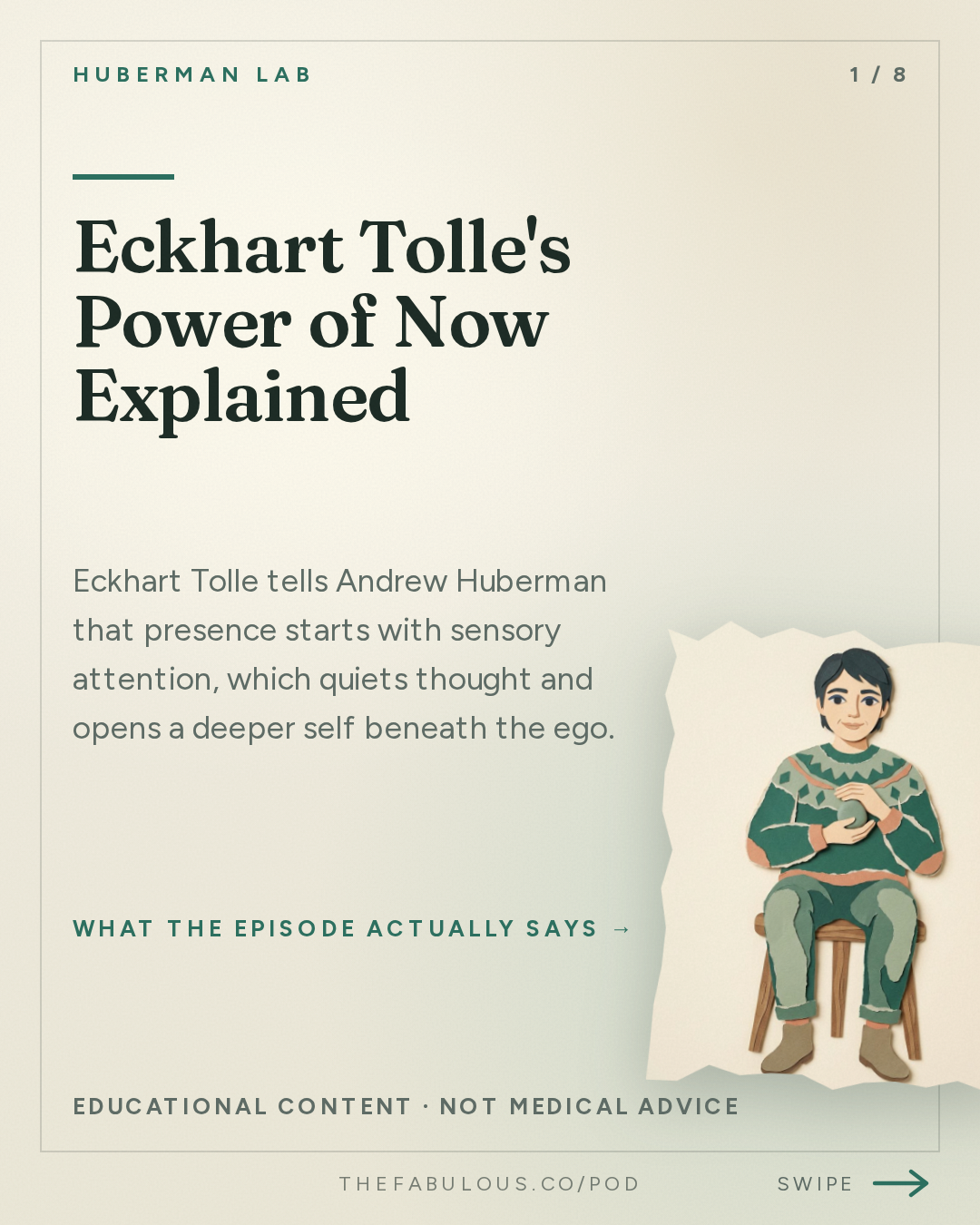
Eckhart Tolle's Power of Now Explained
Access the Power of Now to Experience Life More Fully | Eckhart Tolle
The brief
Eckhart Tolle tells Andrew Huberman that presence starts with sensory attention, which quiets thought and opens a deeper self beneath the ego. Tolle argues the ego forms from childhood naming and conceptualizing, and he offers a simple protocol: listen to silence in a room to shift from thinking into awareness, the source of mastery, flow, and resilience.
Albert Camus once wrote, "In the midst of winter, I found in myself an invincible summer." That line opens the episode as a preview before Eckhart Tolle's conversation with Andrew Huberman begins, and Tolle later returns to it directly, explaining what it means in practical terms (00:00, 72:57). The claim is simple to state and hard to live: there is a layer of experience that does not depend on circumstances, and most people never find it because they are too busy thinking about it instead of being in it.
Tolle, author of "The Power of Now" and "A New Earth," has spent decades teaching that human suffering comes from confusing thought with identity. Huberman, a Stanford neuroscientist, asks him early on for a demonstration rather than a definition. What follows is less an interview than a guided exercise.
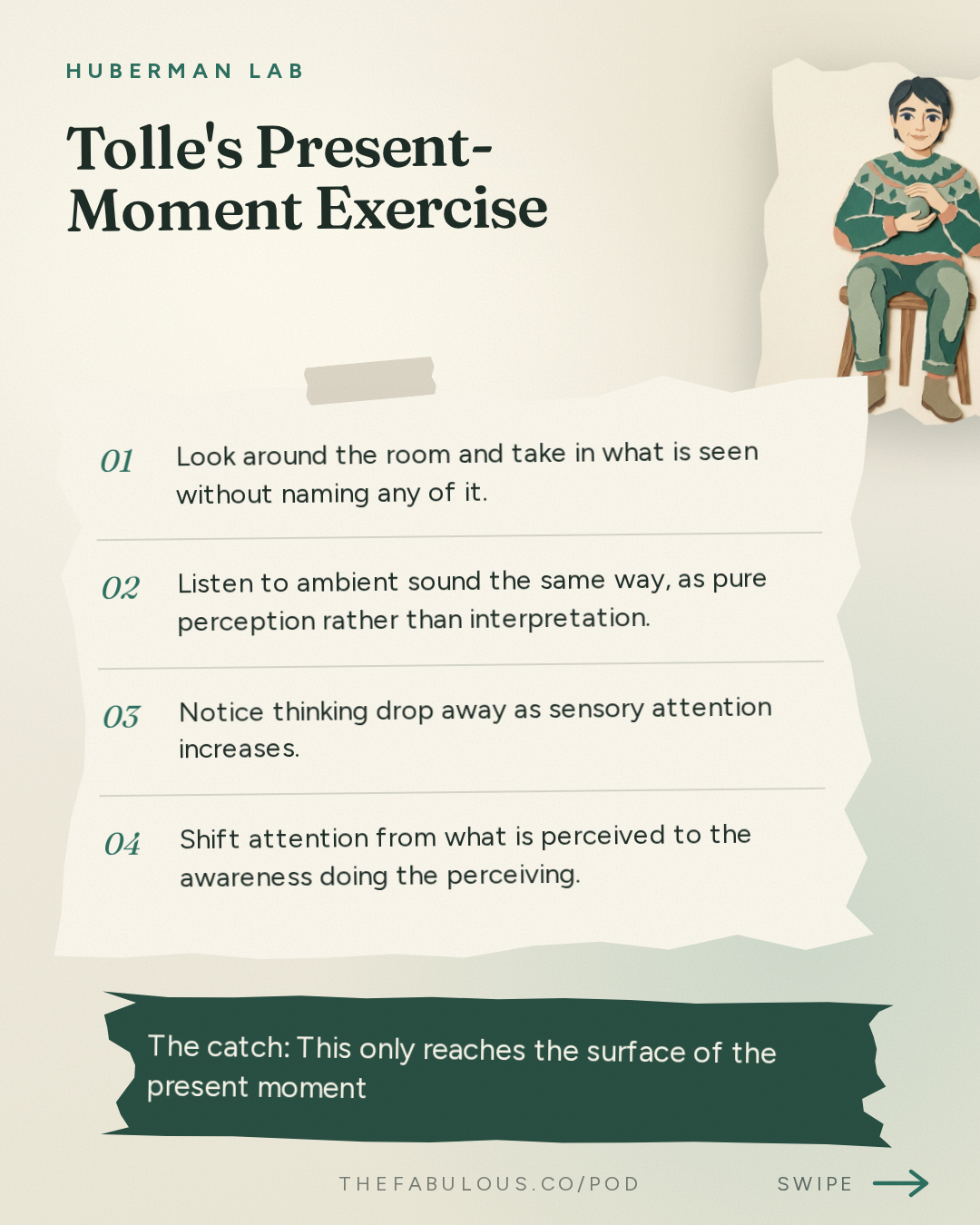
Tolle's first instruction is almost childishly plain. Look around the room. Notice what is seen and heard, without naming any of it (03:51). "The beginning of present moment awareness is conscious sensory perception," he says, and he claims that giving full attention to raw sensation significantly reduces the amount of compulsive thinking a mind generates (04:52). This is not meditation in the seated, eyes-closed sense. It is attention redirected from commentary to contact.
"Honor this moment because that's all there ever is. There is nothing else ever in your entire life." Eckhart Tolle, [07:03]
The claim sounds mystical until Tolle restates it more plainly: nothing has ever happened anywhere except now, since both memory and anticipation occur now too (07:03). Once a person actually notices this, thinking quiets, not because it is suppressed but because there is suddenly less to think about. Huberman, trying the exercise live on air, reports feeling the shift from planning his next question to simply listening (10:06).
How a Self Gets Built Out of Words
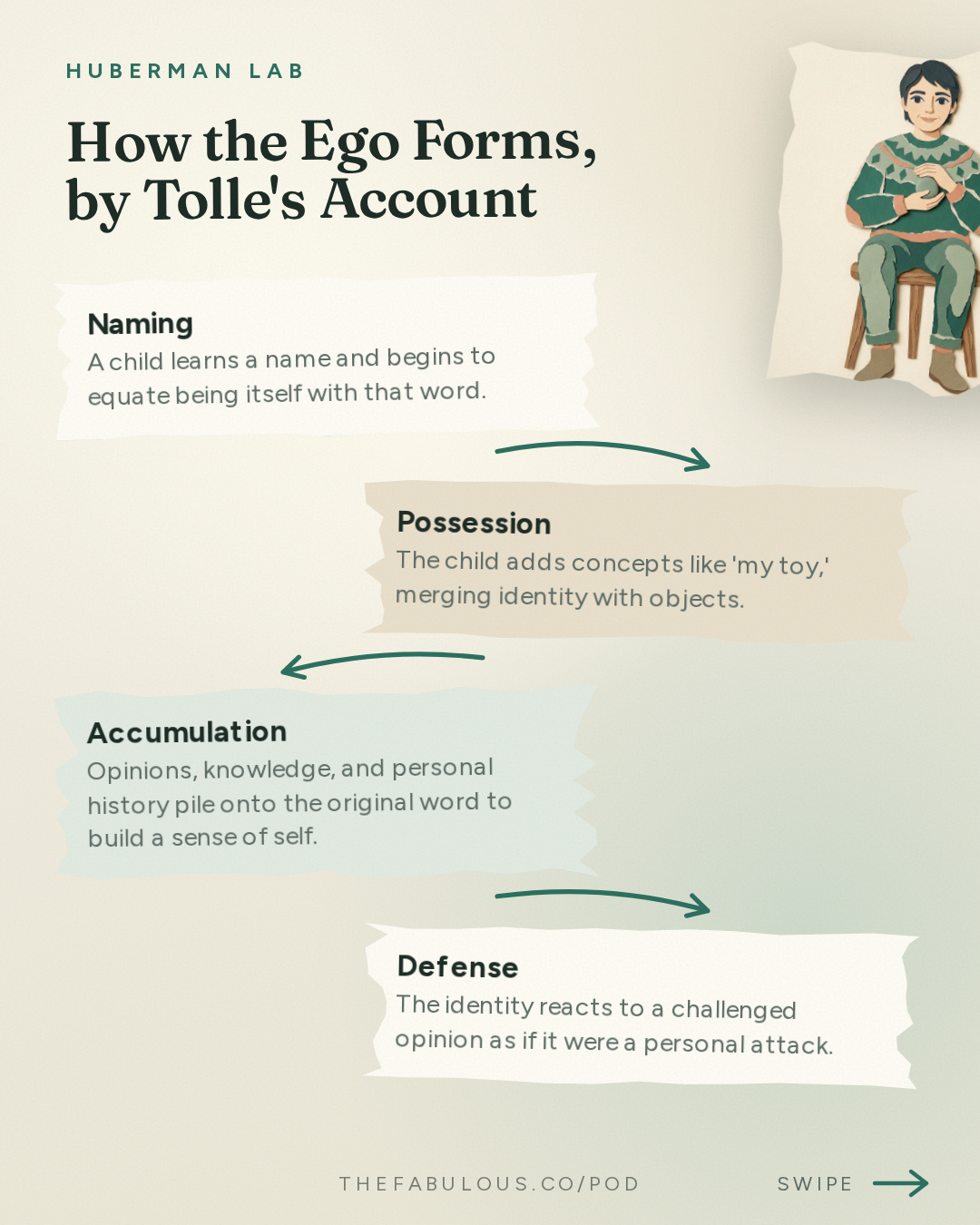
The conversation's most useful material is Tolle's account of how the ego, meaning the conceptual, word-built sense of "me," actually forms. It starts, he says, with a name. A small child initially refers to itself in the third person, "John is hungry," before merging with the label and saying "I am John" (13:36). That fusion, Tolle argues, is the first and most consequential mistake humans make: equating being with a sound.
From there the process compounds. A toy becomes "mine." The body becomes an object to compare and judge. Opinions, possessions, and accumulated history pile onto the original word until a person is walking around with what Tolle calls "a mental fiction that pretends to be me" (20:46). The practical cost shows up in arguments. Because an opinion is just another concept, he says, a challenge to that opinion gets misread as a challenge to one's whole identity, which is why disagreements escalate so easily into something closer to combat (21:13).
"Your dog has no conceptual image of itself. It does not have a problem with body image or anything else." Eckhart Tolle, [18:52]
Tolle adds a darker mechanic: a fragile, concept-built identity needs friction to feel real. It requires "the otherness of others," an enemy, a rival, a group to define itself against, because peace offers it nothing to hold onto (22:49). He extends this from individuals to nations and ideologies, which he says sustain their sense of identity the same way, through opposition (23:20). It is a compact explanation for why so much conflict, personal and political, runs on manufactured difference rather than real stakes.
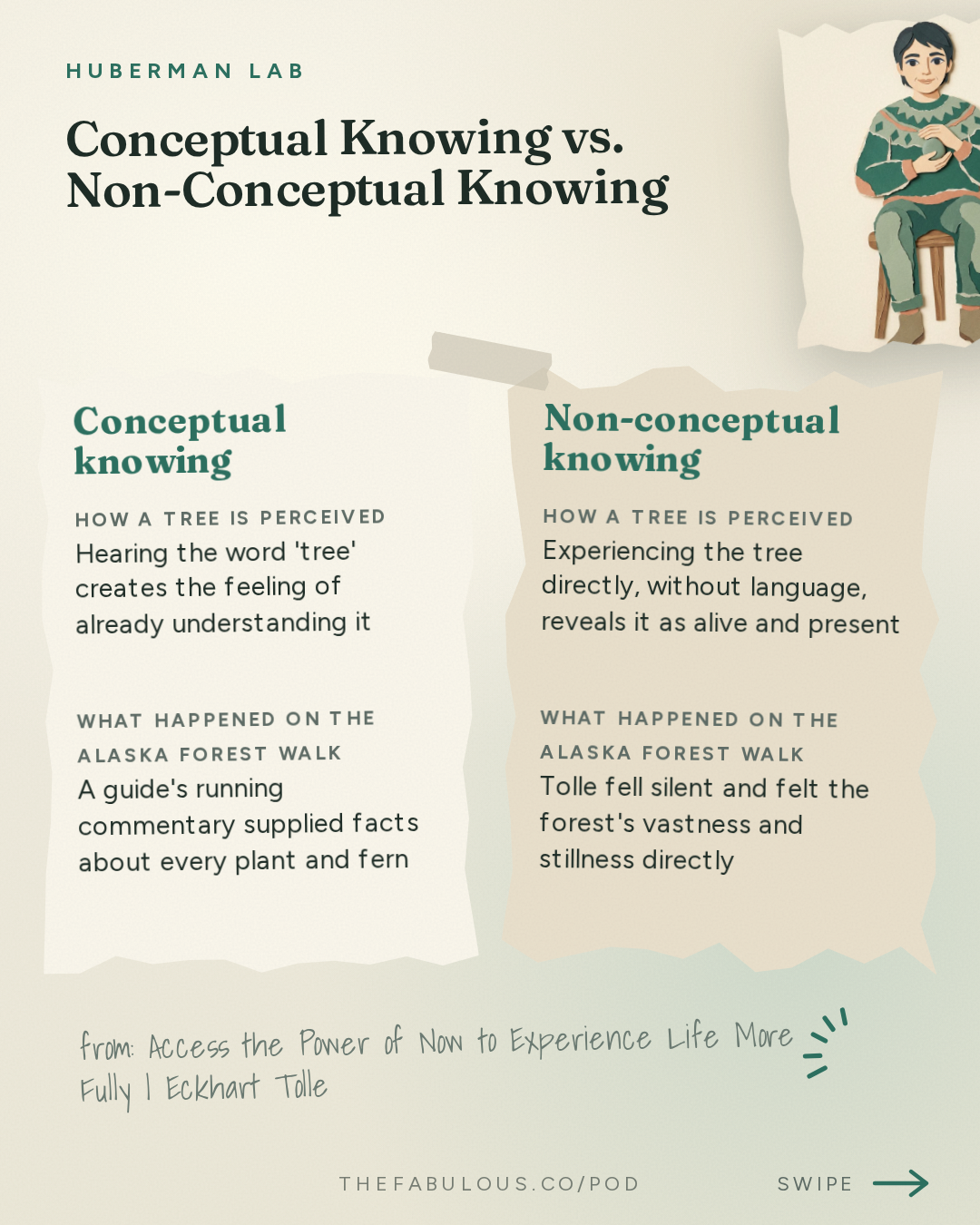
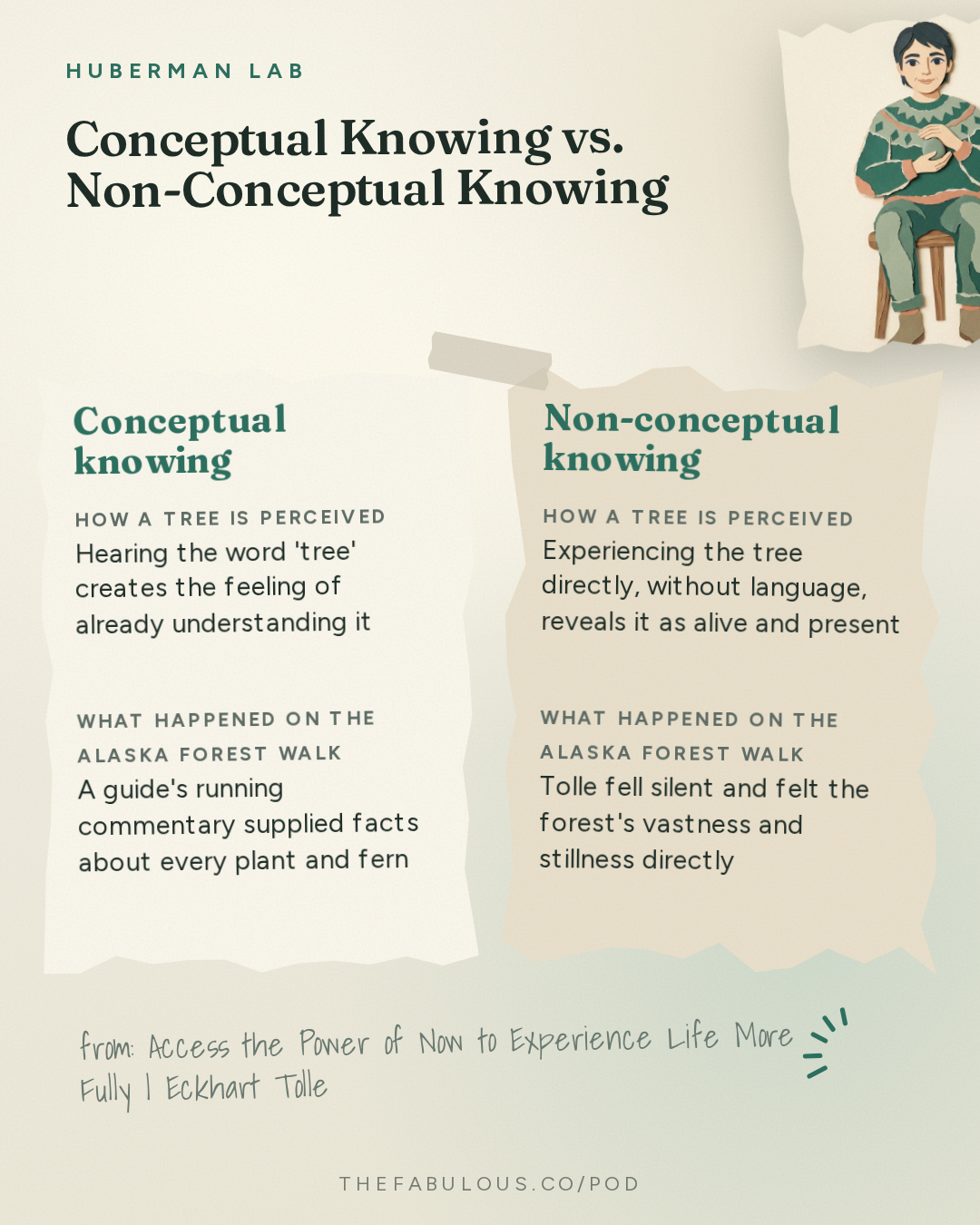
None of this means concepts are useless. Tolle is careful to say that naming things, including a tree, a cell, a disease, is necessary for science, medicine, and ordinary communication (37:51). His complaint is narrower: a name creates the feeling of already knowing something, which stops a person from looking any further. He illustrates this with a walk through an Alaskan forest, where a knowledgeable guide named every fern and explained every root system until Tolle quietly fell behind the group. Only once her commentary faded did he notice the forest's actual scale and stillness, what he calls "non-conceptual knowing," a kind of direct awareness that sits underneath language rather than inside it (35:49).
Where the Power Actually Comes From
This distinction explains something Huberman and Tolle both find fascinating: mastery. Tolle argues that anyone who has truly mastered a craft, a tennis serve, a guitar riff, a sentence of prose, has learned to stop thinking while doing it (51:44). The thinking mind steps aside, and something else, which he simply calls awareness, takes over and does the work. He connects this to the appeal of dangerous sports: a climber on a rock face cannot afford to daydream, so the activity forces total presence, and that forced presence produces the sensation people describe as feeling fully alive (52:40).
The two discuss the familiar claim, often credited to writer Malcolm Gladwell, that mastery takes about 10,000 hours of practice, and they use The Beatles as a test case: years playing small clubs in Hamburg before a celebrated creative run that both agree lasted only around seven years before the particular energy moved on (53:41, 55:34). Tolle's caveat matters: practice alone guarantees nothing. Some people put in the hours and never become a conduit for that deeper power, and what determines who does, he admits, he does not know (54:37).
The same mechanism, Tolle says, explains why successful people so often produce weaker work after a breakthrough. The ego claims credit for what awareness produced, and the moment it does, access to that source closes (103:41). He includes himself in the warning, insisting that when he steps off a stage after a talk, he sheds the identity of "spiritual teacher" entirely: "I'm only a spiritual teacher when I'm talking to a group. It's a function, not an identity" (104:20).
Huberman presses him for something concrete a listener can actually use, and Tolle offers a second exercise, simpler than the first. In a quiet room, deliberately listen to the silence, as if silence itself were a sound (62:22). He distinguishes external quiet, which he calls silence, from the absence of mental noise, which he calls stillness, and claims that listening for the first produces the second automatically (63:48). Huberman complicates this with a memory from graduate school, when he sat inside a fully soundproofed chamber and heard nothing but his own heartbeat, an experience he describes as initially unsettling (65:06). Tolle's response is practical rather than dogmatic: ordinary, slightly imperfect quiet works better than engineered total silence, because total silence can simply frighten people rather than still them (66:49).
Late in the conversation, Tolle offers an image for holding all of this together: a triangle, with the usual opposites, good and bad, success and failure, sitting at the two base corners, and awareness sitting at the apex (94:56). Staying at the apex, he says, is the only real defense against getting captured by an ideology or a collective grievance, because a person who is aware can move toward either pole without losing themselves in it (97:47). It is a useful corrective to the idea that spiritual practice means withdrawing from ordinary life. Tolle insists the opposite: bring awareness into daily transactions, arguments, and chores, rather than removing oneself from them (83:32).
"The world is not here to make you happy. That's a misconception." Eckhart Tolle, [111:43]
His closing argument reframes difficulty itself. Challenges, he says, are not a malfunction of life; they are its actual purpose, the mechanism by which consciousness is forced to grow, the same way a muscle only strengthens under load (111:43, 112:38). A life arranged so that nothing ever goes wrong is not a reasonable goal, and expecting one, from a career, a relationship, or a possession, is what manufactures most of the unhappiness people carry. The alternative Tolle proposes is not resignation. It is attention: noticing what is actually here, before deciding what to do about it, and finding, somewhere under the noise, the same invincible, circumstance-proof summer that Camus named a lifetime ago.
Ask this episode anything
Pod's AI answers from the episode itself, with the minute mark so you can hear it yourself.
Or start with one of these
Ask this episode
Pod's AI listens to the whole episode to answer, and points you to the minute it comes from.
The rest of this answer, and any question after it
Answers come from the episode itself, never from a summary of it.
ContinueKey takeaways
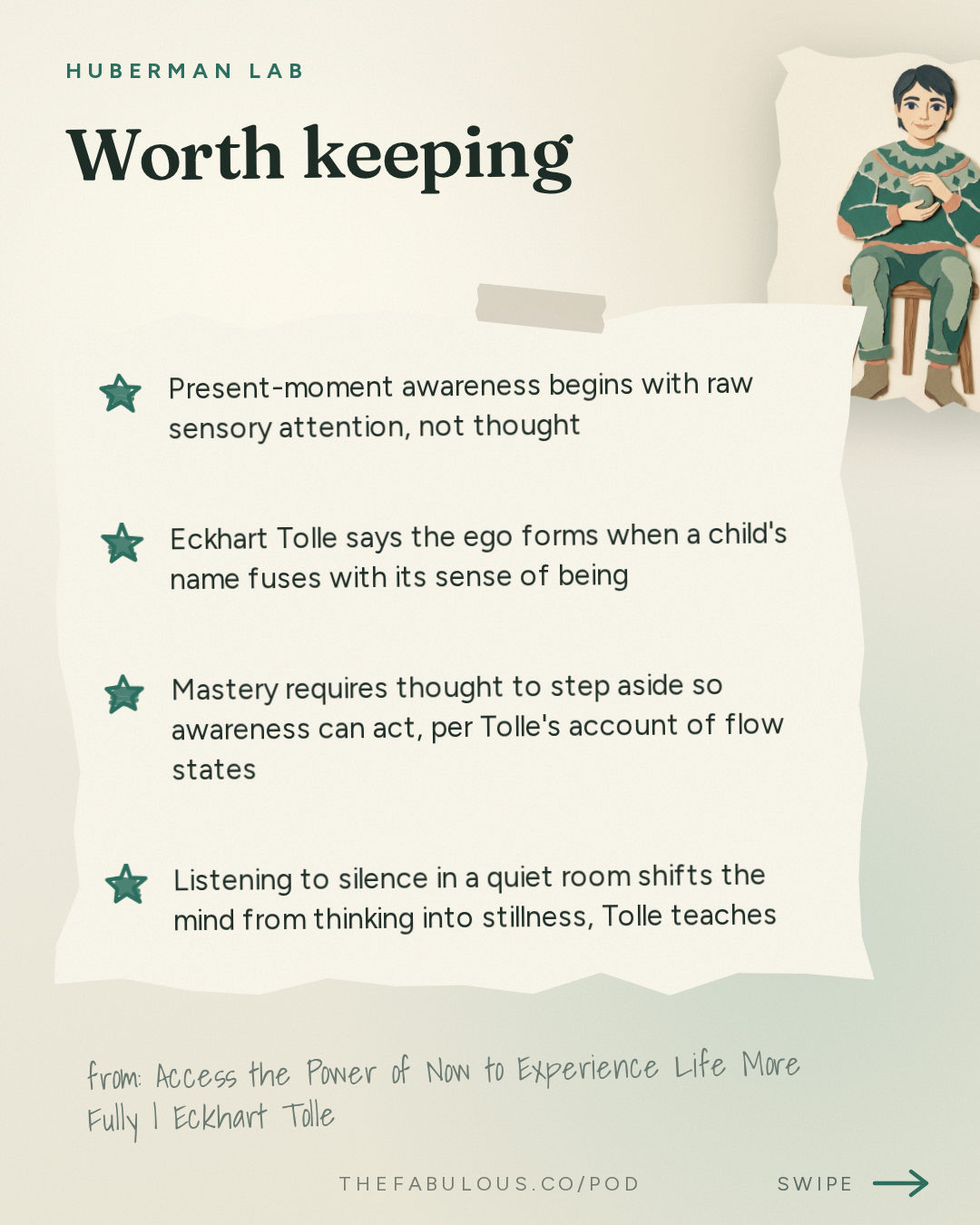
- Present-moment awareness begins with raw sensory attention, not thought
- Eckhart Tolle says the ego forms when a child's name fuses with its sense of being
- Mastery requires thought to step aside so awareness can act, per Tolle's account of flow states
- Listening to silence in a quiet room shifts the mind from thinking into stillness, Tolle teaches
- Tolle argues the world's purpose is to build consciousness through unavoidable challenges, not happiness
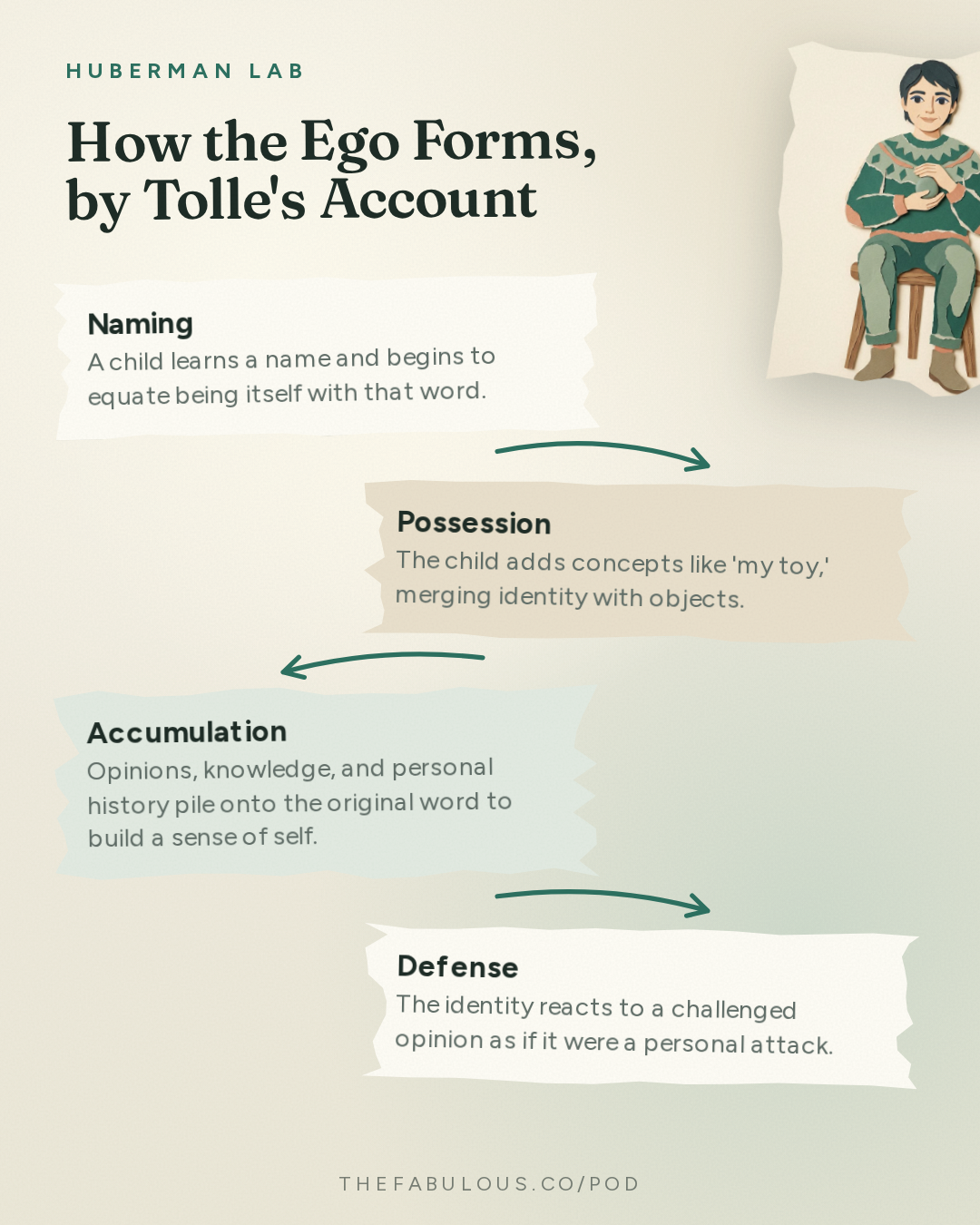
The episode in cards
By the numbers
- 10,000 hours practice time often cited for reaching mastery in a craft
- 10,000 varieties different words for sadness used to illustrate how language fails to capture feeling
In their words
“In the midst of winter, I found in myself an invincible summer.”
“Honor this moment because that's all there ever is. There is nothing else ever in your entire life.”
“Your dog has no conceptual image of itself. It does not have a problem with body image or anything else”
“The teaching is the finger that is pointing to something which is beyond the finger.”
Protocols
-
Sensory Grounding Exercise
Eckhart Tolle instructs listeners to look around the room and take in what they see and hear without naming or labeling any of it. He says this reduces compulsive thinking because attention rests on raw perception rather than commentary, though it only reaches the surface of the present moment and not the deeper awareness behind it.
Practice anytime, especially before a stressful conversation or task
-
Listening to Silence
Eckhart Tolle has listeners sit in a quiet room and deliberately listen to the silence as if it were a sound. He says this automatically shifts the mind from thinking into inner stillness, and he cautions that the exercise works best in ordinary quiet spaces rather than engineered total silence, which he says can unsettle rather than calm a person.
Use whenever a naturally quiet setting is available
-
Aligning with the Present Moment
Eckhart Tolle advises accepting whatever is happening right now before trying to change it, rather than treating the present moment as an enemy to escape. He adds that acceptance does not rule out taking action afterward, since a person can acknowledge a situation fully and still work to change it once resistance drops.
Apply whenever facing an unwanted circumstance
Questions this episode answers
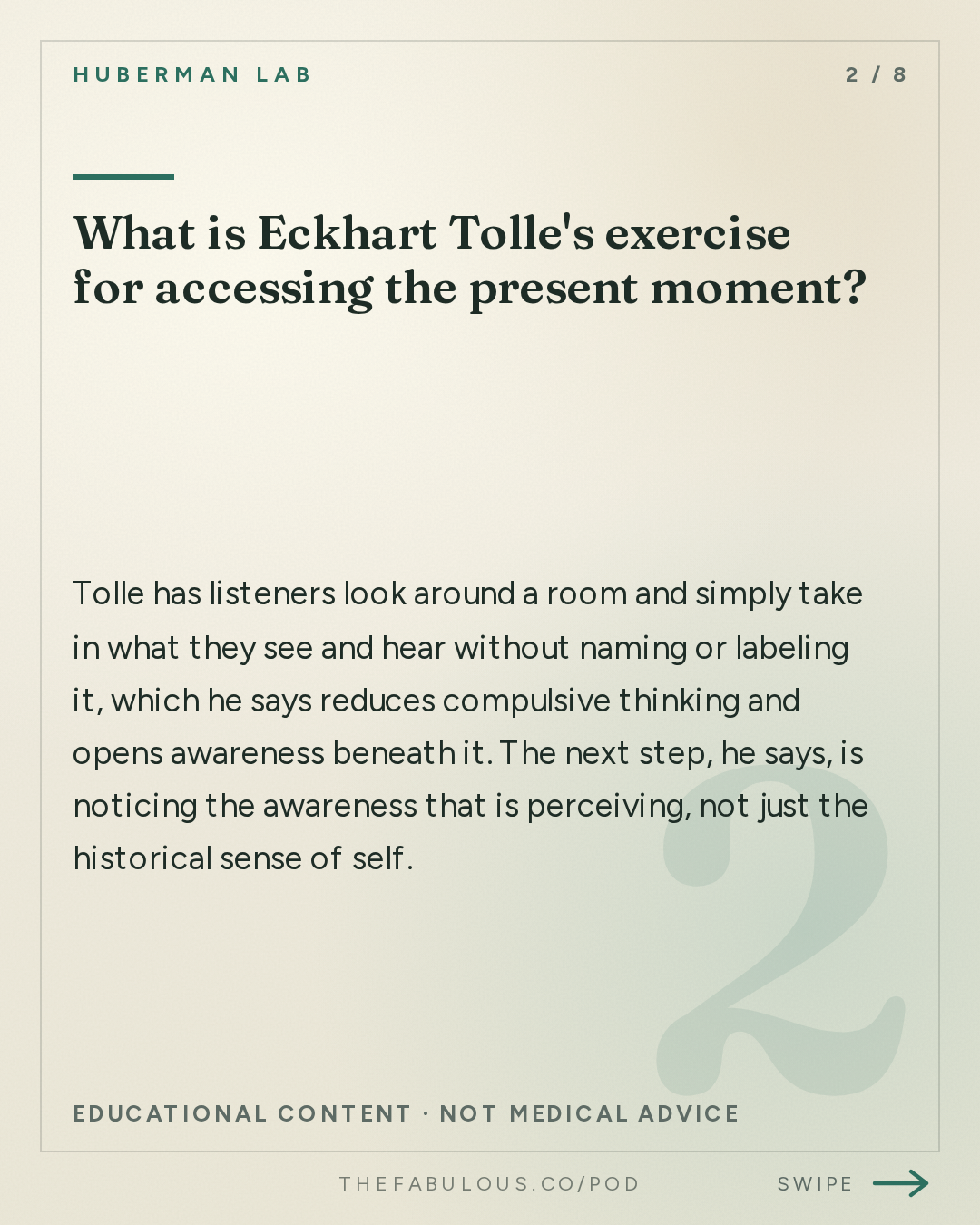
What is Eckhart Tolle's exercise for accessing the present moment?
Tolle has listeners look around a room and simply take in what they see and hear without naming or labeling it, which he says reduces compulsive thinking and opens awareness beneath it (03:51). The next step, he says, is noticing the awareness that is perceiving, not just the historical sense of self (08:24).
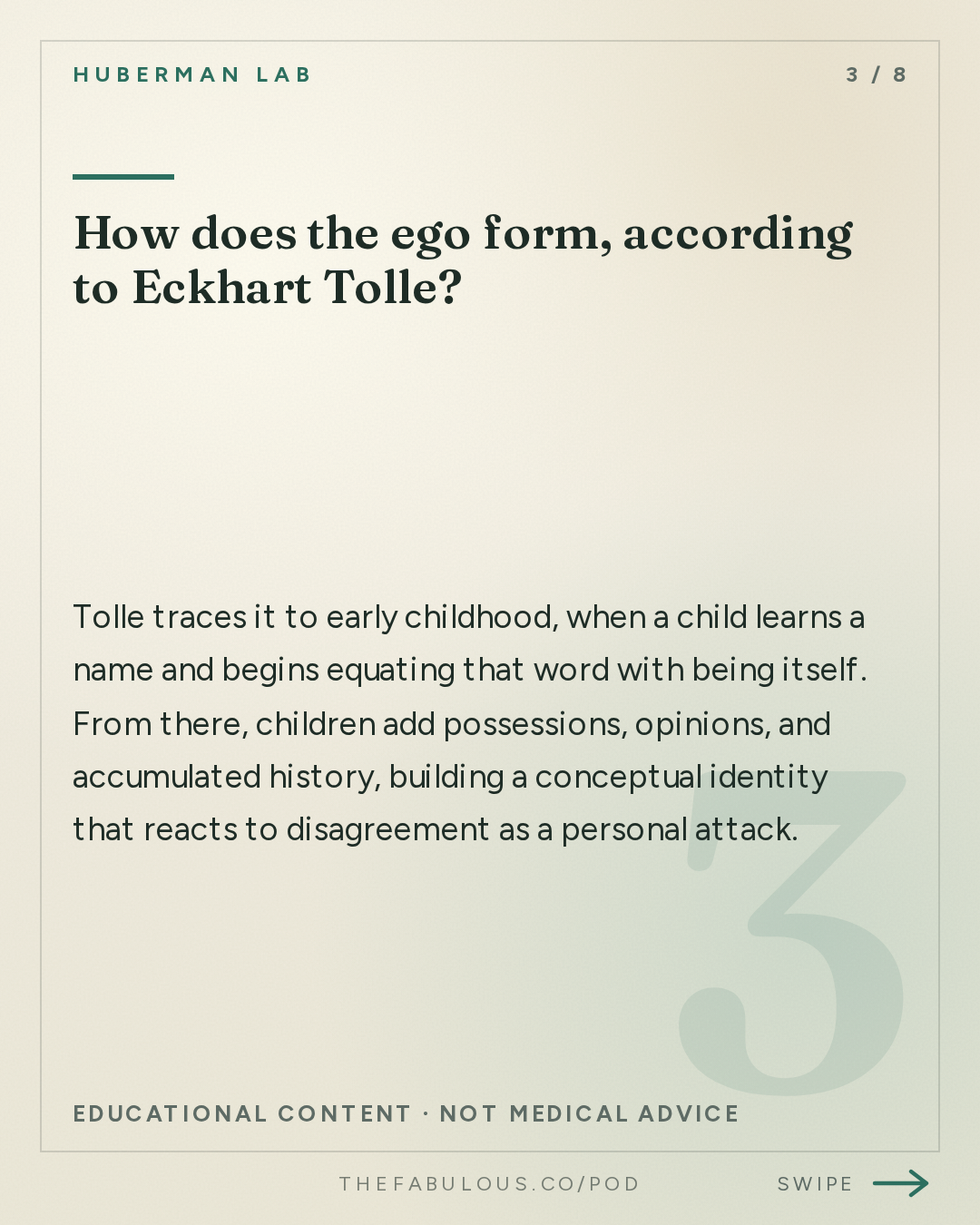
How does the ego form, according to Eckhart Tolle?
Tolle traces it to early childhood, when a child learns a name and begins equating that word with being itself (13:36). From there, children add possessions, opinions, and accumulated history, building a conceptual identity that reacts to disagreement as a personal attack (19:33, 21:13).
What is non-conceptual knowing?
Tolle describes it as direct awareness that comes without naming or labeling, illustrated by his story of a silent Alaska forest walk where he stopped following a guide's commentary and felt the forest's vastness directly (35:49). He contrasts this with conventional, concept-based knowing, which he says often obscures the deeper reality behind a name (34:13).
Does achieving flow or mastery require 10,000 hours of practice?
Tolle references the commonly cited idea, often attributed to writer Malcolm Gladwell, that roughly 10,000 hours of practice precede mastery, using the Beatles' years playing small clubs before their acclaimed period as an example (53:41). He adds that practice alone guarantees nothing, since some people never access the deeper power even after that much work (54:37).
Is the world supposed to make people happy, according to Eckhart Tolle?
No. Tolle argues the world's function is not happiness but increased consciousness, achieved through unavoidable challenges in relationships, work, and health (111:43, 112:09). He says believing that circumstances or achievements should deliver lasting happiness creates most of the unnecessary suffering people carry (115:39).
The full read, in cards
Go deeper
- The Power of Now — Tolle's own book on presence, which he says he wrote while a surge of creative energy flowed through him
- A New Earth — Tolle's follow-up book on ego and consciousness, written during the same creative period
- Being and Nothingness — Jean-Paul Sartre's study of being, cited by Tolle as an example of thinking about being rather than experiencing it
- Being and Time — Martin Heidegger's study of being, cited alongside Sartre's book as conceptual rather than experiential
Mentioned
Eckhart Tolle · Albert Camus · Jean-Paul Sartre · Martin Heidegger · Malcolm Gladwell · The Beatles · Einstein · Rick Rubin · Twyla Tharp · The Power of Now · A New Earth · Being and Nothingness · Being and Time
More from this show and category

How Nicotine Affects the Brain and How to Quit
Nicotine itself is not a carcinogen; it is a cholinergic molecule that spikes dopamine, acetylcholine, and norepinephrine, producing a brief window of alert-but-relaxed focus (24:55). The brief lays out why vaping is more addictive than smoking and why cold turkey fails 95% of the time, then walks through hypnosis, bupropion, and staggered nicotine replacement as evidence-backed ways to quit.
Paul Stamets on Mushrooms, Immunity and Psilocybin
Mycologist Paul Stamets argues that mushroom mycelium, the thread-like network fungi use to digest food, can upregulate human immunity and brain plasticity. He cites COVID trials where Agarikon and Turkey Tail tripled antibody levels (34:37) and cut symptom duration by 5.1 days (38:19), plus psilocybin data on addiction and depression.

Mary Helen Immordino-Yang on Emotion and Learning
Psychologist Mary Helen Immordino-Yang says emotion is the substrate of thought, not a distraction from it. What a student feels about a topic, not just the grade, determines what actually gets learned, and she traces this from infant attachment through cultural perception to a call for project-based schooling over standardized tests.
Anna Lembke: Why Addiction Is Really About Control
Stanford psychiatrist Anna Lembke says the deepest addictions are addictions to control, not substances. She explains the brain's pleasure-pain balance, a 30-day protocol for resetting reward pathways, why the periaqueductal gray links threat and spirituality, and how surrender, codependency, ketamine, and GLP-1 drugs fit the same control framework.
