
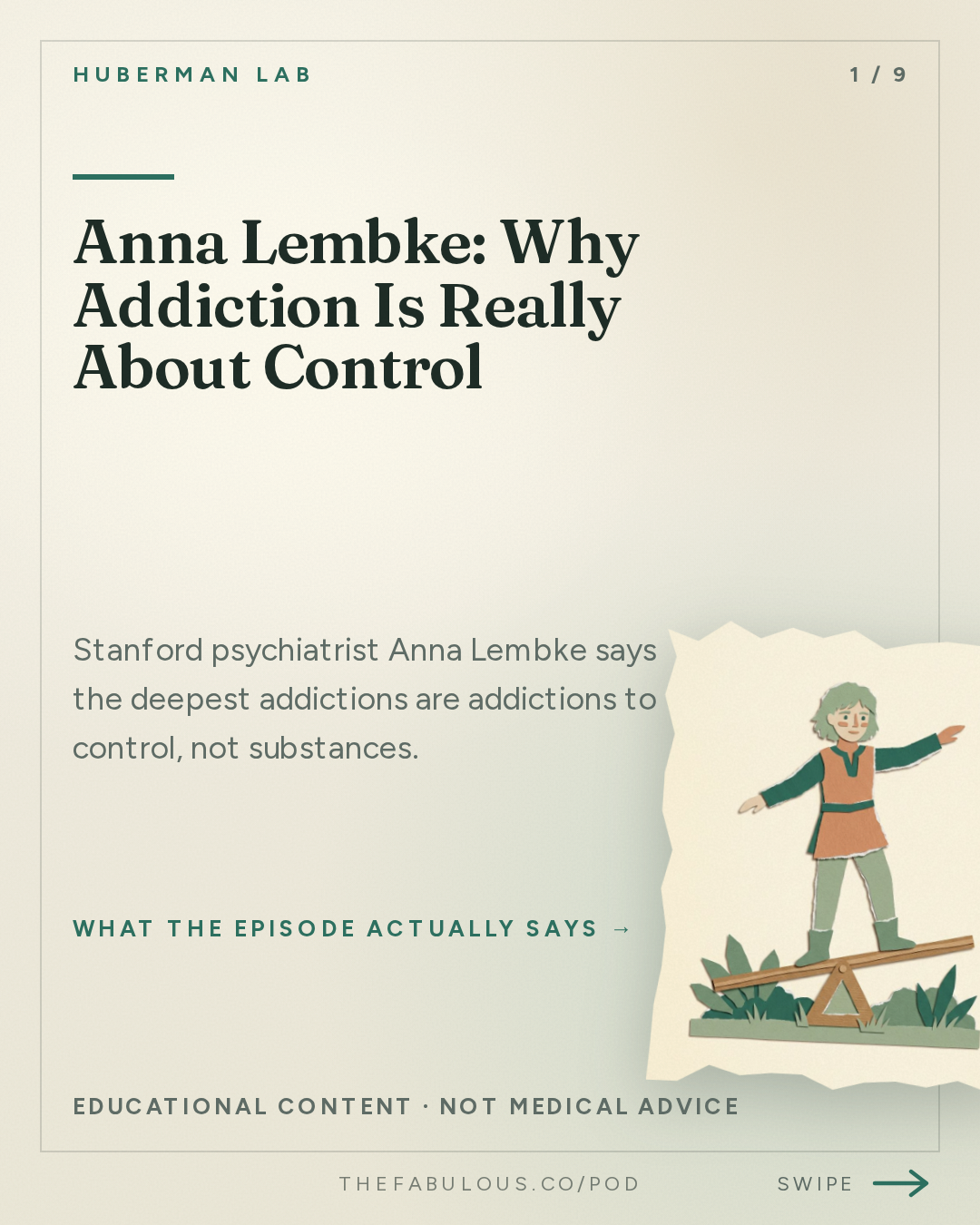
Anna Lembke: Why Addiction Is Really About Control
Overcome Addictions & Obsessions of All Kinds | Dr. Anna Lembke
The brief
Stanford psychiatrist Anna Lembke says the deepest addictions are addictions to control, not substances. She explains the brain's pleasure-pain balance, a 30-day protocol for resetting reward pathways, why the periaqueductal gray links threat and spirituality, and how surrender, codependency, ketamine, and GLP-1 drugs fit the same control framework.
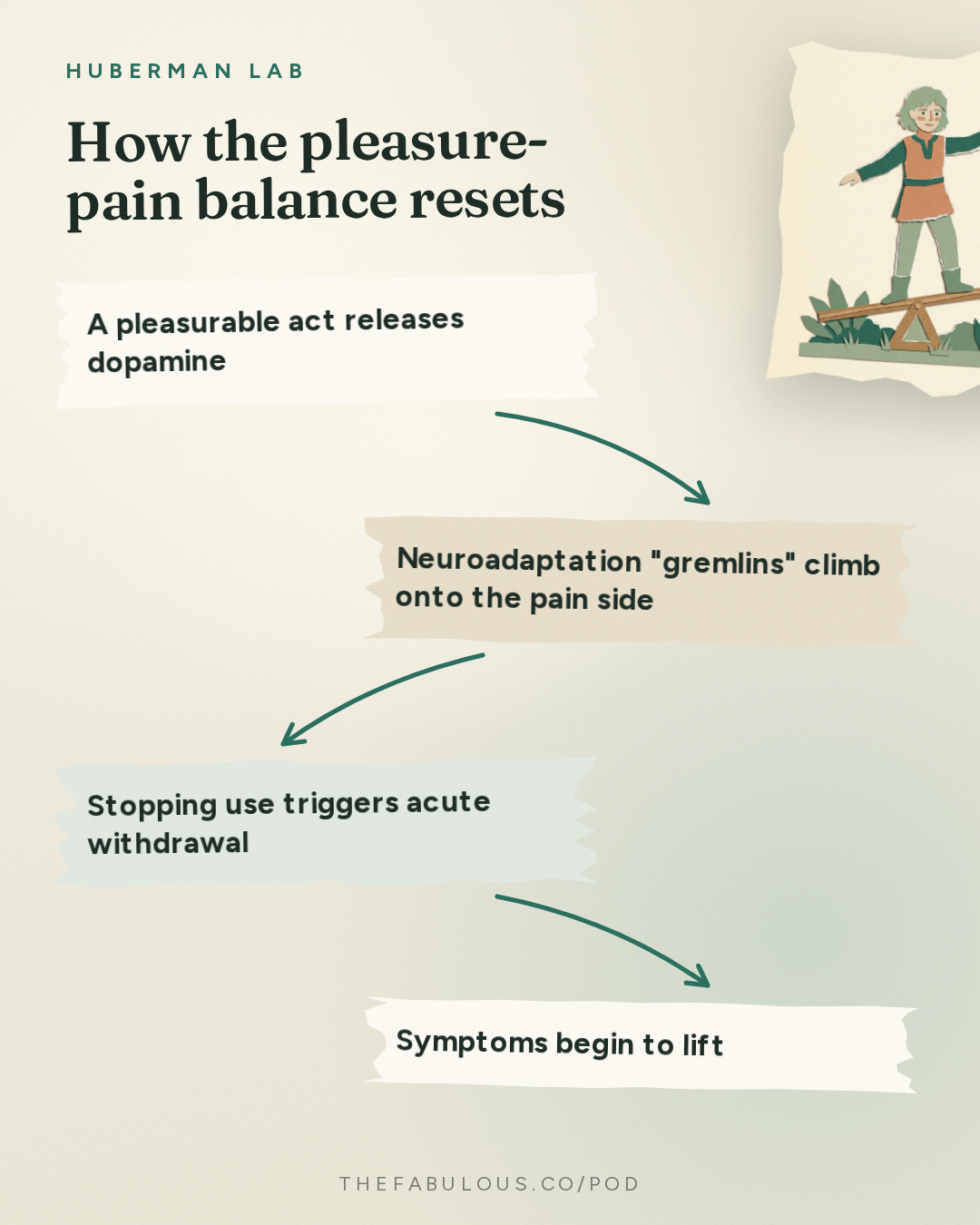
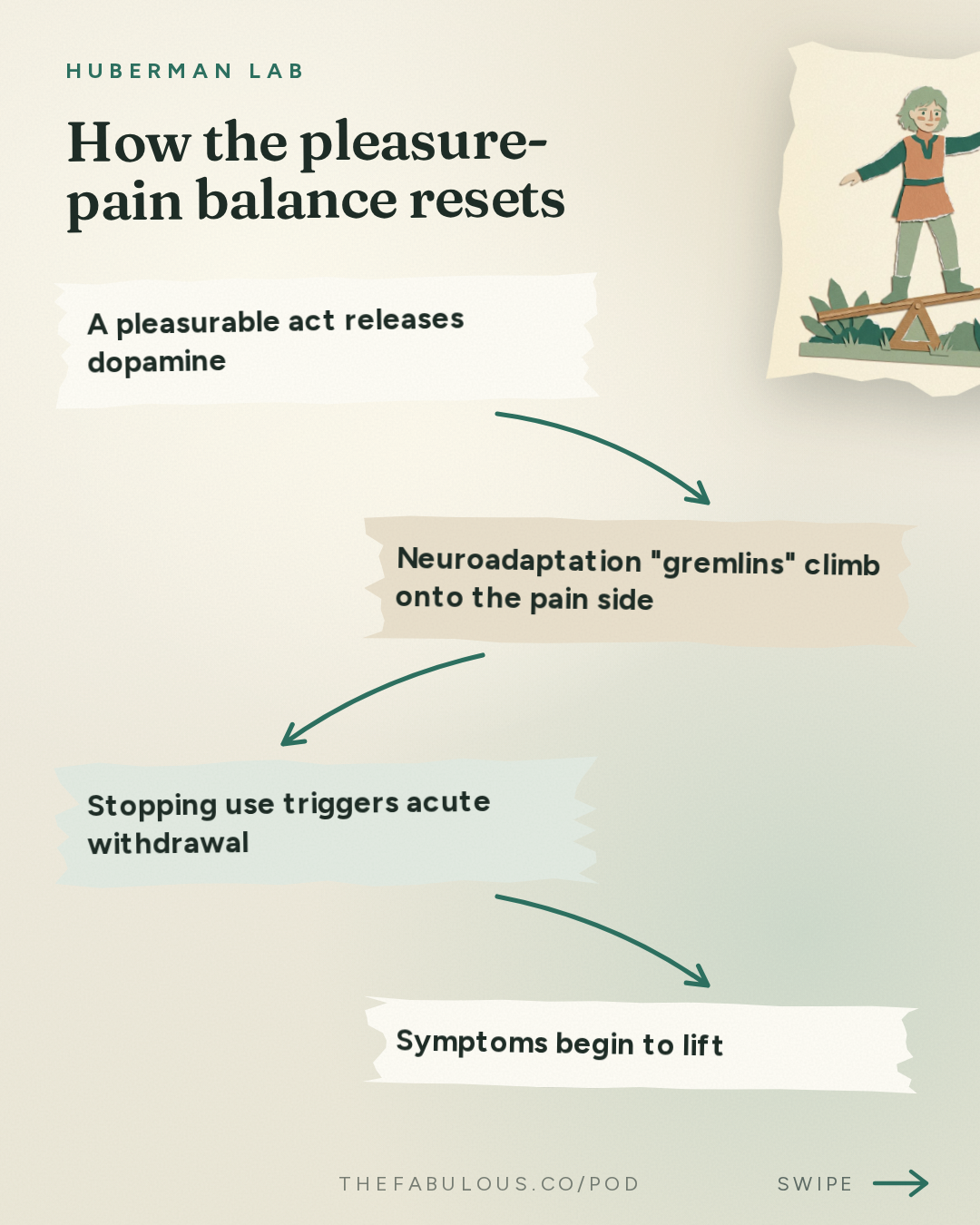
Imagine a scale with a beam balanced on a single pin. One side is pleasure, the other pain, and the whole system wants, more than anything, to sit level. This is the image Stanford psychiatrist Anna Lembke uses to explain why a good feeling always seems to come due. Watch one more video, eat a square of chocolate, check a phone: dopamine floods the brain's reward pathway and the beam tips toward pleasure. What happens next, Lembke tells Andrew Huberman, is almost comic.
"The gremlins like it on the balance, so they don't get off as soon as it's level. They stay on until I'm tilted an equal and opposite amount to the side of pain." (Anna Lembke, 13:19)
That overshoot is the comedown, the craving, the reason one episode of a show becomes four.
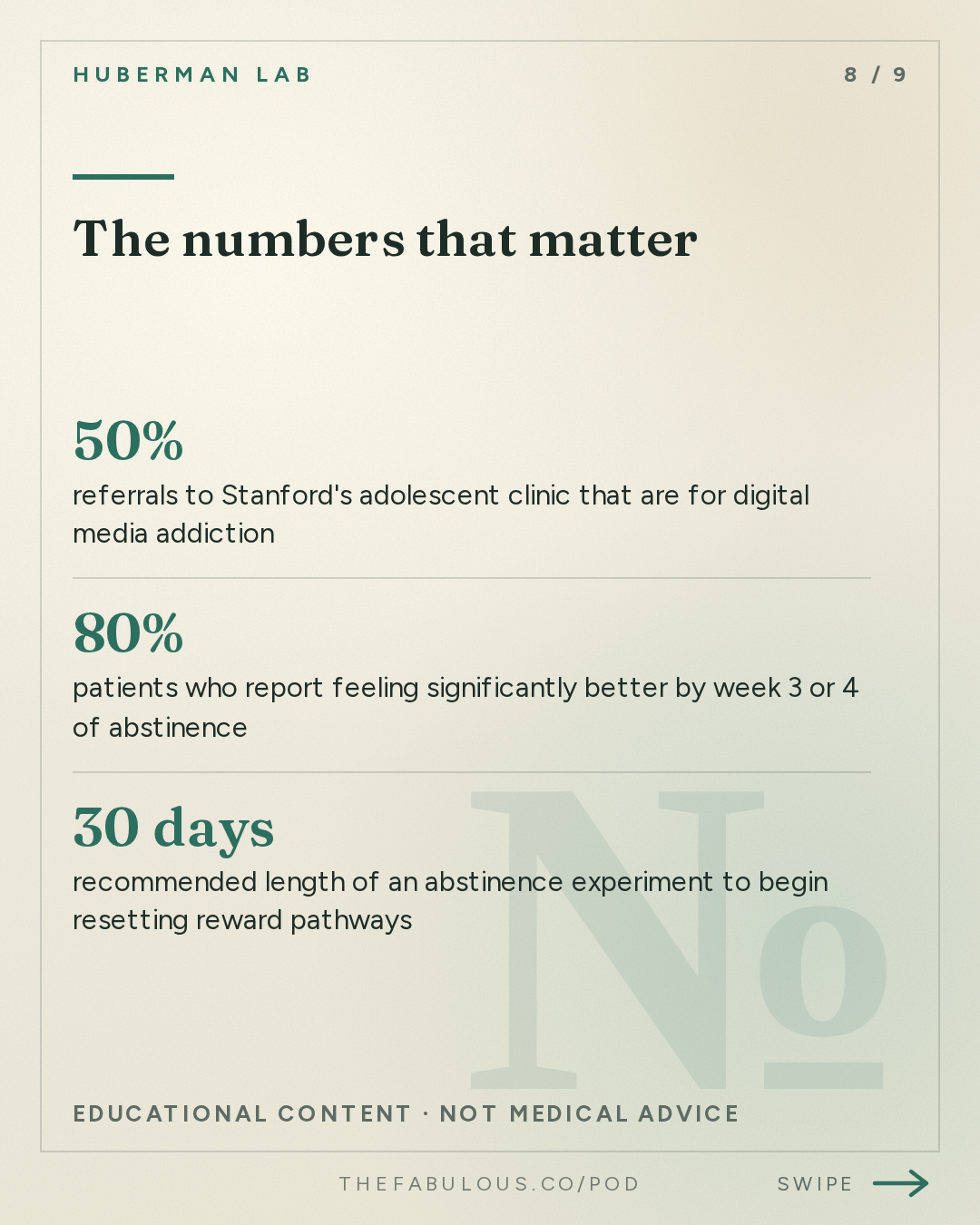
Lembke directs Stanford's Dual Diagnosis Addiction Clinic, and she defines addiction plainly: "the continued compulsive use of a substance or a behavior despite harm to self and/or others" (04:18). She looks for four signs, the four C's: out-of-control use, compulsive use, craving, and continued use despite consequences. Her adolescent caseload has shifted; about 50% of referrals to Stanford's adolescent clinic now involve digital media rather than drugs or alcohol (03:56). The underlying chemistry explains why screens compete so well with substances. In rodent studies, chocolate raises dopamine firing 55% above baseline, sex about 100%, nicotine 150%, and methamphetamine 1,000% (07:55). Humans are not rats, but Lembke says the ranking holds: the faster and larger the dopamine spike, the more reinforcing, and the more addictive, the experience becomes (08:28).
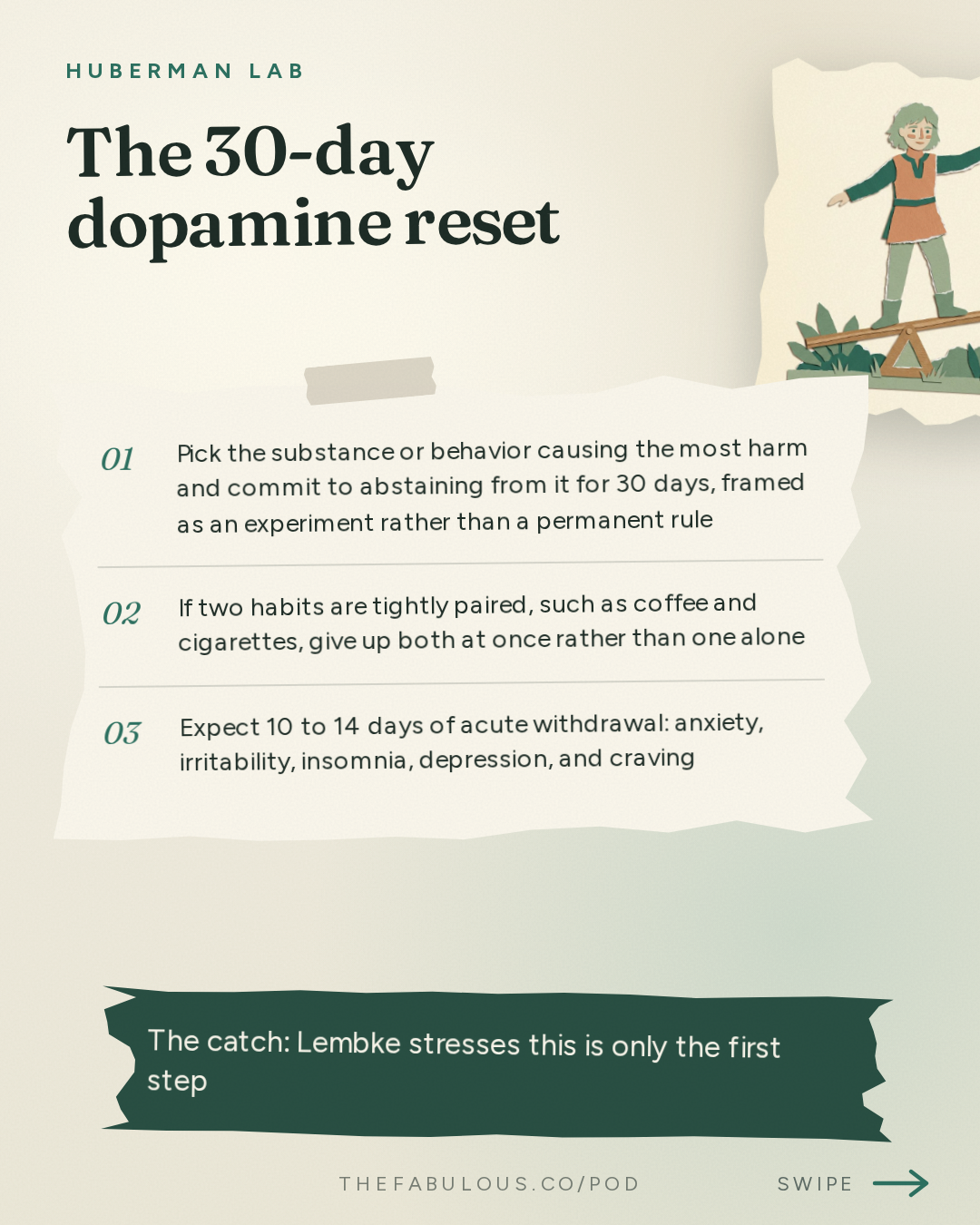
Because of that overshoot, quitting usually gets worse before it gets better. Lembke describes a predictable stretch of acute withdrawal, roughly 10 to 14 days, marked by anxiety, irritability, insomnia, depression and craving (14:11, 15:20). Most people who push through report feeling meaningfully better by week three or four, something she sees in about 80% of patients (15:39). Her standard intervention is less a sermon than an experiment: thirty days off the substance or behavior, framed not as a lifetime sentence but as data collection. "Why 30 days? Because on average that is the amount of time it takes to begin to reset reward pathways" (20:22). If two habits are chained together, like coffee and cigarettes, she asks patients to drop both at once, since partial abstinence while an adjacent cue stays active tends to fail.
The Real Drug Is Control
Midway through the conversation, Lembke offers a claim that reframes everything before it: in the most severe cases, the substance is almost beside the point. "What they're addicted to is control," she says (00:00). Human brains evolved to reduce uncertainty, building a predictive mental map of the world and constantly checking it against experience. Addiction, in her account, is what happens when that drive for certainty collapses into a single, simplified lever: press it, and the feeling changes, instantly, reliably. The job, the relationships, the long-term consequences, all of it falls away, because the lever offers something the rest of life cannot, total and immediate control over one's own internal state.
This is why gambling addiction rarely tracks with greed. Pathological gamblers, Lembke notes, often want to lose, because losing justifies staying in the game longer (42:40). The game itself, not the payout, is the drug. And this, she argues, is not confined to clinical cases. Modern life has handed everyone so many levers, step counts, sleep scores, calorie trackers, dating-app filters, that many people have quietly become addicted to optimizing their own existence, chasing a kind of control their ancestors never had, and that, paradoxically, leaves them more anxious, not less (41:40).
Letting Go as a Brain Event
The part of the conversation most likely to surprise listeners concerns a small structure near the base of the brainstem called the periaqueductal gray, or PAG, long known to neuroscientists as the hub of the fight, flight and freeze response. Newer lesion studies, Lembke says, suggest the PAG also sits at the center of a spirituality circuit, and the two roles are not unrelated (53:40). The PAG is rich in opioid receptors, which dull pain, and oxytocin receptors, tied to bonding, and its activation recruits serotonin, which Lembke says increases neuroplasticity, the brain's capacity to rewire itself, especially when old strategies keep failing (54:50). She says the control network and the spirituality network work in opposition: "spirituality network can't actually get activated when our control network is online, because the control network is inhibiting the spirituality network" (50:50).
That opposition, she argues, is why willpower alone so often fails and why a twelve-step surrender, or a crisis that strips away all remaining options, can succeed where strategizing cannot. She borrows a line for the addictive loop: "the definition of neurosis is doing the same action over and over again and expecting a different outcome" (55:19). Surrender interrupts the loop by quieting the rigid predictive machinery long enough for something new to form. One of her patients described the moment this way: "I realized I was at checkmate. There were no more moves" (57:34). Lembke's own version of that moment came after her son Lucas died of leukemia; no amount of research or therapy resolved the loss, and only letting go of the need to explain it allowed her to function again (72:10).
"Do the next right thing. That is a core piece of radical surrender because instead of trying to engineer some distant future, I'm owning that I have no idea what the future holds." (Anna Lembke, 84:38)
The practice, she says, requires no particular theology, only an honest admission that the controlling self has run out of good moves.
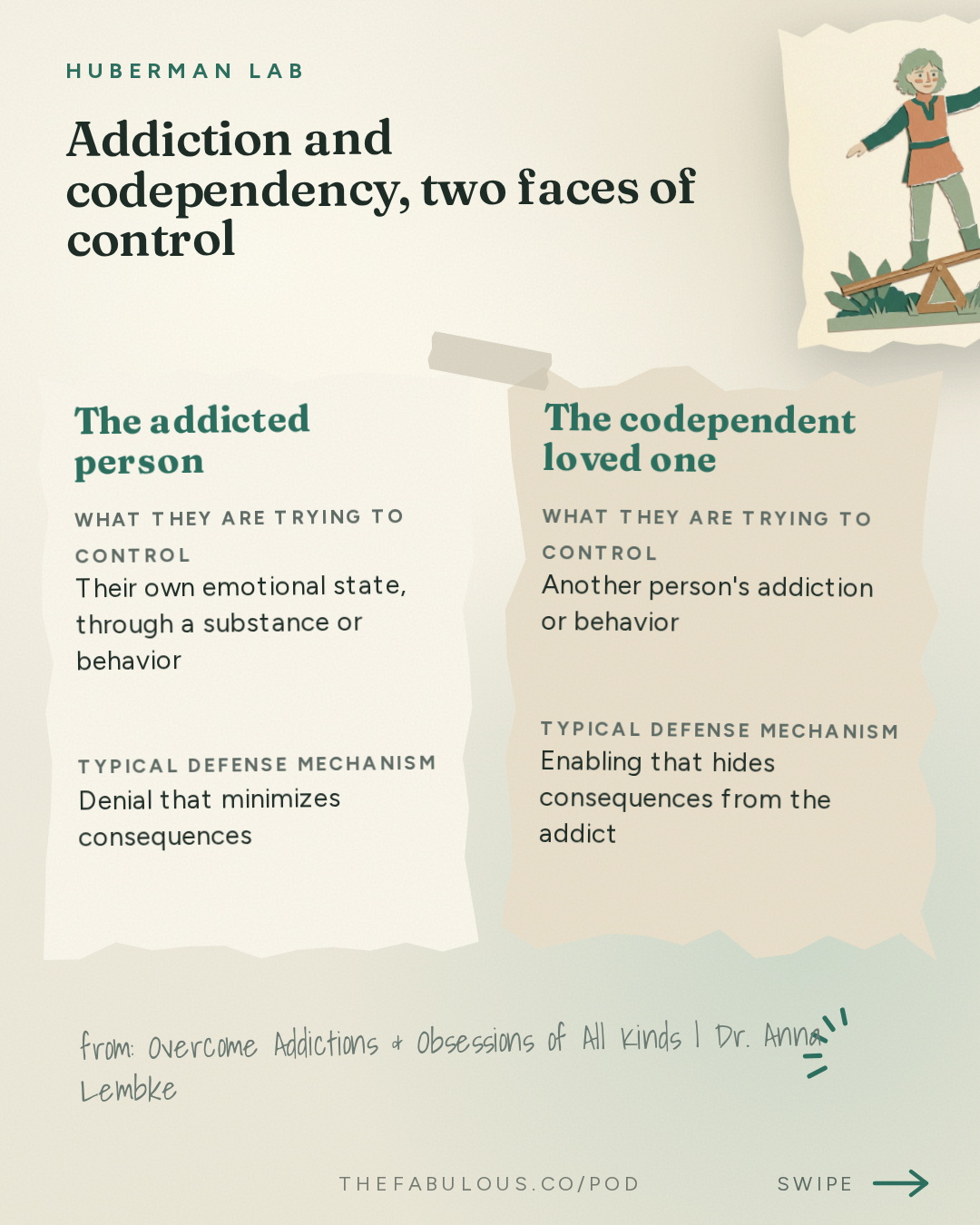
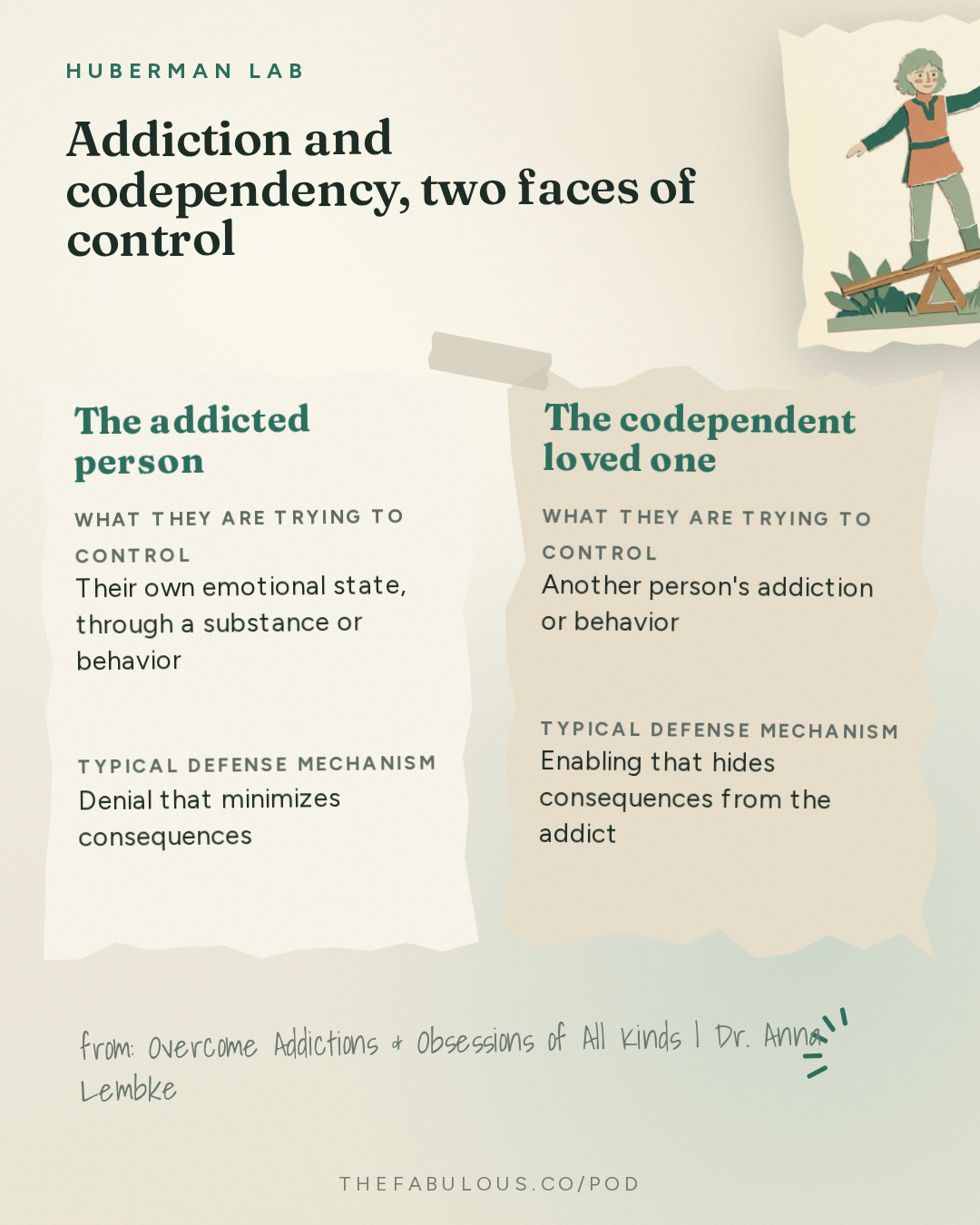
Lembke extends the control framework to relationships. Codependency, she says, is "a form of addiction where people use others to manage their own emotions" (86:07), and it shows up far beyond the old image of a wife covering for an alcoholic husband; she sees it in parents narrating a child's every achievement, in partners tracking each other's texts, in anyone who outsources their own regulation to someone else's behavior. The fix mirrors the fix for substance addiction: let go of the rope. "As soon as the codependent lets go, this person gets into recovery or starts to make the moves," she says, describing the family dynamic as two people pulling opposite ends of the same cord (95:33).
Technology, she argues, has made everyone's tolerance for uncertainty worse, not better, because constant tracking promises an answer that never fully arrives (104:28). Her own counter-practice is mundane on purpose: she does not check a device until her morning routine, exercise, breakfast, making the bed, is finished, because logging on sooner puts her mind on what she calls a completely different wavelength (123:10).
On newer clinical tools, Lembke is neither dismissive nor starry-eyed. Ketamine, approved for treatment-resistant depression, is also addictive, and she has treated patients who became dependent on take-home prescriptions bought through online telehealth clinics (124:33). A supervised alternative, the Montreal Model developed by her former mentee Nicholas Garel, administers ketamine only in-clinic alongside psychotherapy and is showing promise for depression paired with alcohol use disorder (125:22). GLP-1 drugs, built for weight loss, are producing an unexpected effect in some of her most treatment-resistant alcohol patients: craving itself goes quiet, which she attributes to the drugs dampening the initial dopamine release that a drink or dessert would normally trigger (129:50).
None of this amounts to a formula. Lembke's larger point is that the same circuitry that makes people vulnerable to addiction, the drive to predict, to manage, to control, is also the circuitry that, when it finally stands down, opens onto something steadier. The balance levels out not because anyone forced it level, but because, for a moment, they stopped trying.
Ask this episode anything
Pod's AI answers from the episode itself, with the minute mark so you can hear it yourself.
Or start with one of these
Ask this episode
Pod's AI listens to the whole episode to answer, and points you to the minute it comes from.
The rest of this answer, and any question after it
Answers come from the episode itself, never from a summary of it.
ContinueKey takeaways
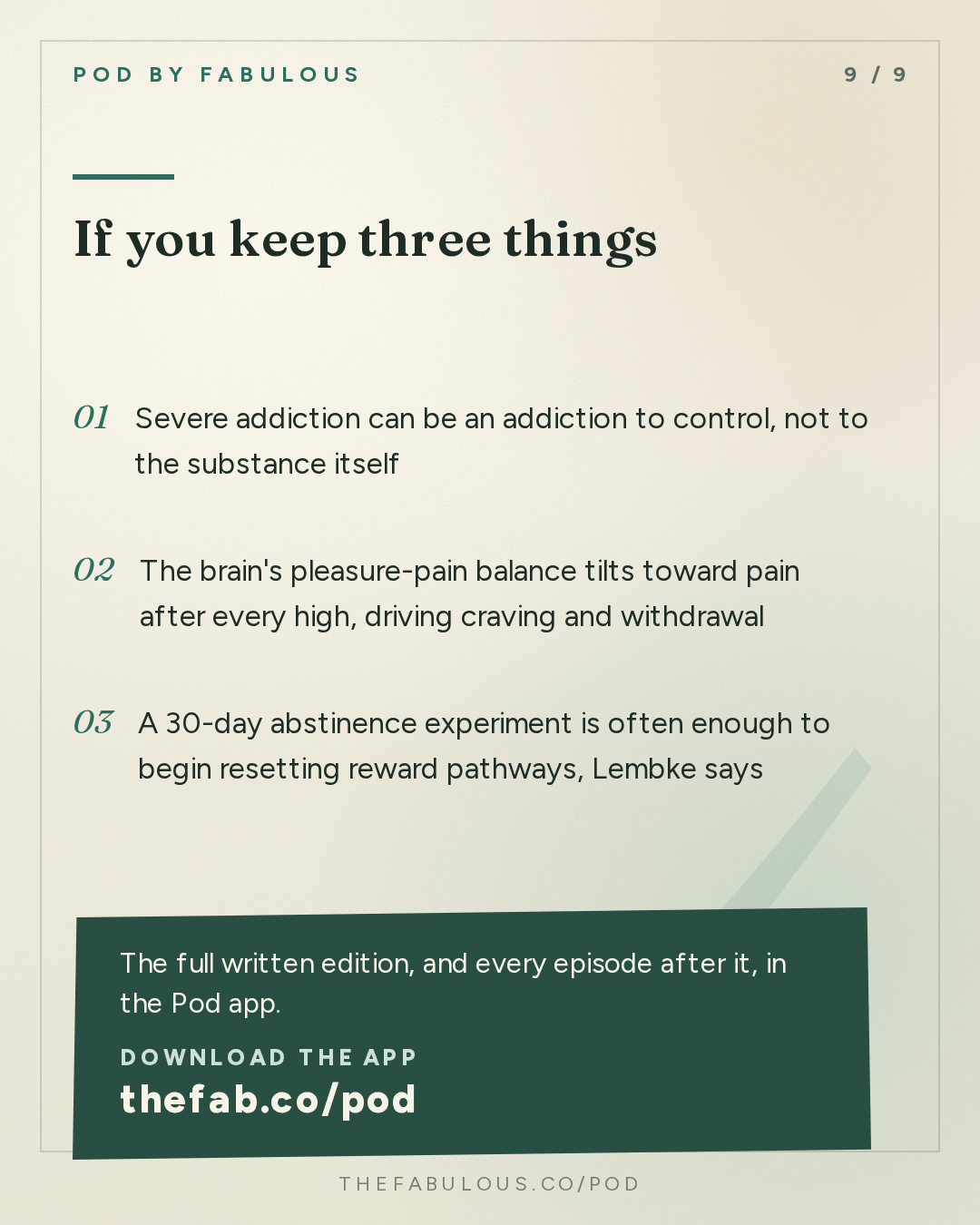
- Severe addiction can be an addiction to control, not to the substance itself
- The brain's pleasure-pain balance tilts toward pain after every high, driving craving and withdrawal
- A 30-day abstinence experiment is often enough to begin resetting reward pathways, Lembke says
- The periaqueductal gray, a brainstem hub for threat response, also seems to drive spiritual surrender
- GLP-1 drugs may blunt alcohol cravings by dampening dopamine release in the brain's reward pathway
The episode in cards
By the numbers
- 50% percent referrals to Stanford's adolescent clinic that are for digital media addiction
- 80% percent patients who report feeling significantly better by week 3 or 4 of abstinence
- 30 days recommended length of an abstinence experiment to begin resetting reward pathways
In their words
“In the severest cases of addiction, people are not actually addicted to that substance or that behavior. What they're addicted to is control.”
“The gremlins like it on the balance, so they don't get off as soon as it's level. They stay on until I'm tilted an equal and opposite amount to the side of pain.”
“"Do the next right thing." That is a core piece of radical surrender because instead of trying to engineer some distant future, I'm owning that I have no idea what the future holds”
Protocols
-
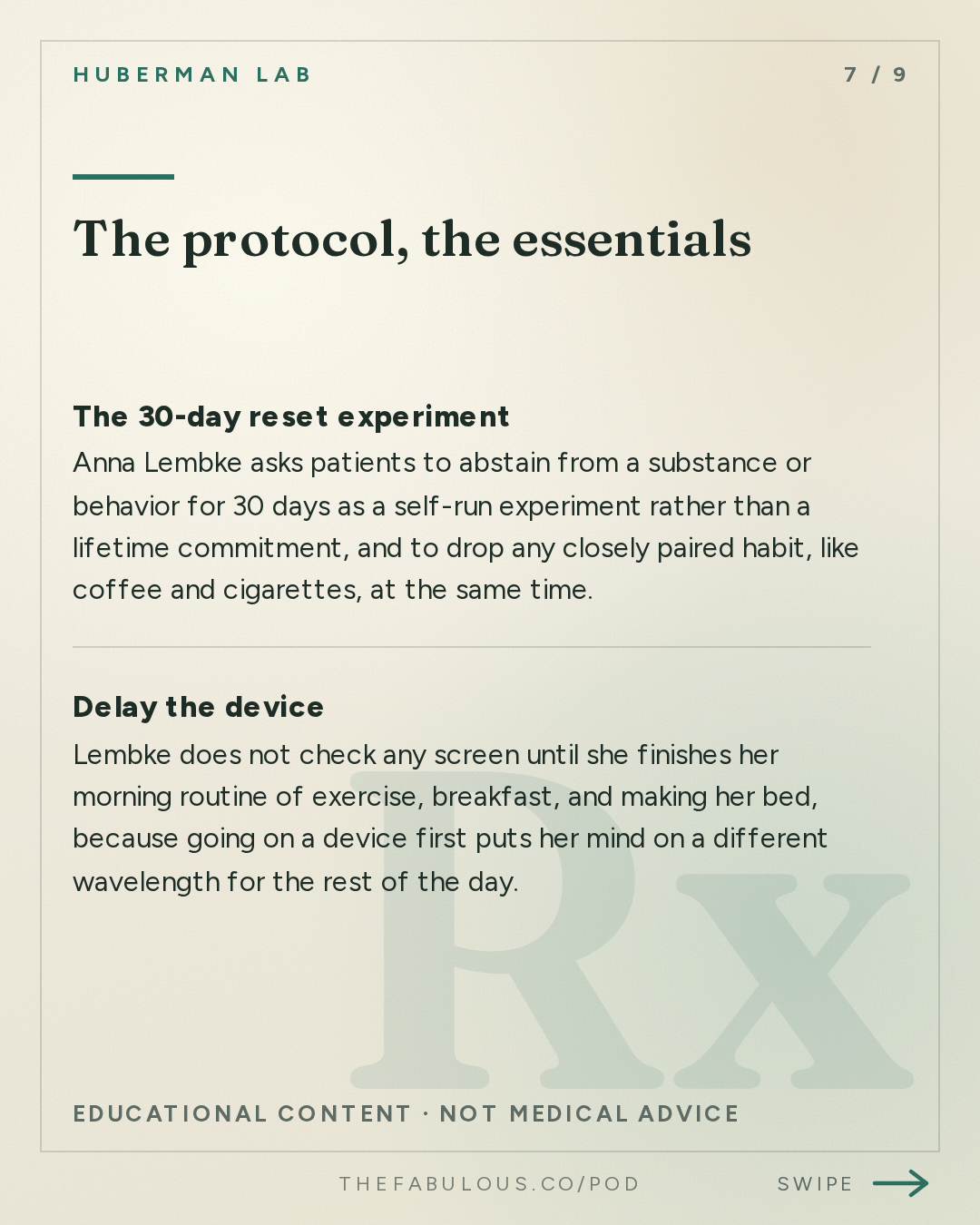
The 30-day reset experiment
Anna Lembke asks patients to abstain from a substance or behavior for 30 days as a self-run experiment rather than a lifetime commitment, and to drop any closely paired habit, like coffee and cigarettes, at the same time.
One 30-day trial, repeated or extended as needed
-
Delay the device
Lembke does not check any screen until she finishes her morning routine of exercise, breakfast, and making her bed, because going on a device first puts her mind on a different wavelength for the rest of the day.
Daily, every morning
-
Morning surrender practice
Lembke starts each day lying in bed with a brief prayer that simply asks for help showing up and doing the next right thing, without needing to define or believe in a specific higher power.
Daily, upon waking
-
In-clinic ketamine with therapy
Nicholas Garel's Montreal Model administers ketamine only inside the clinical setting, never as a take-home prescription, combined with psychotherapy, specifically for treatment-refractory depression alongside alcohol use disorder.
Supervised clinical sessions, not self-administered
Questions this episode answers
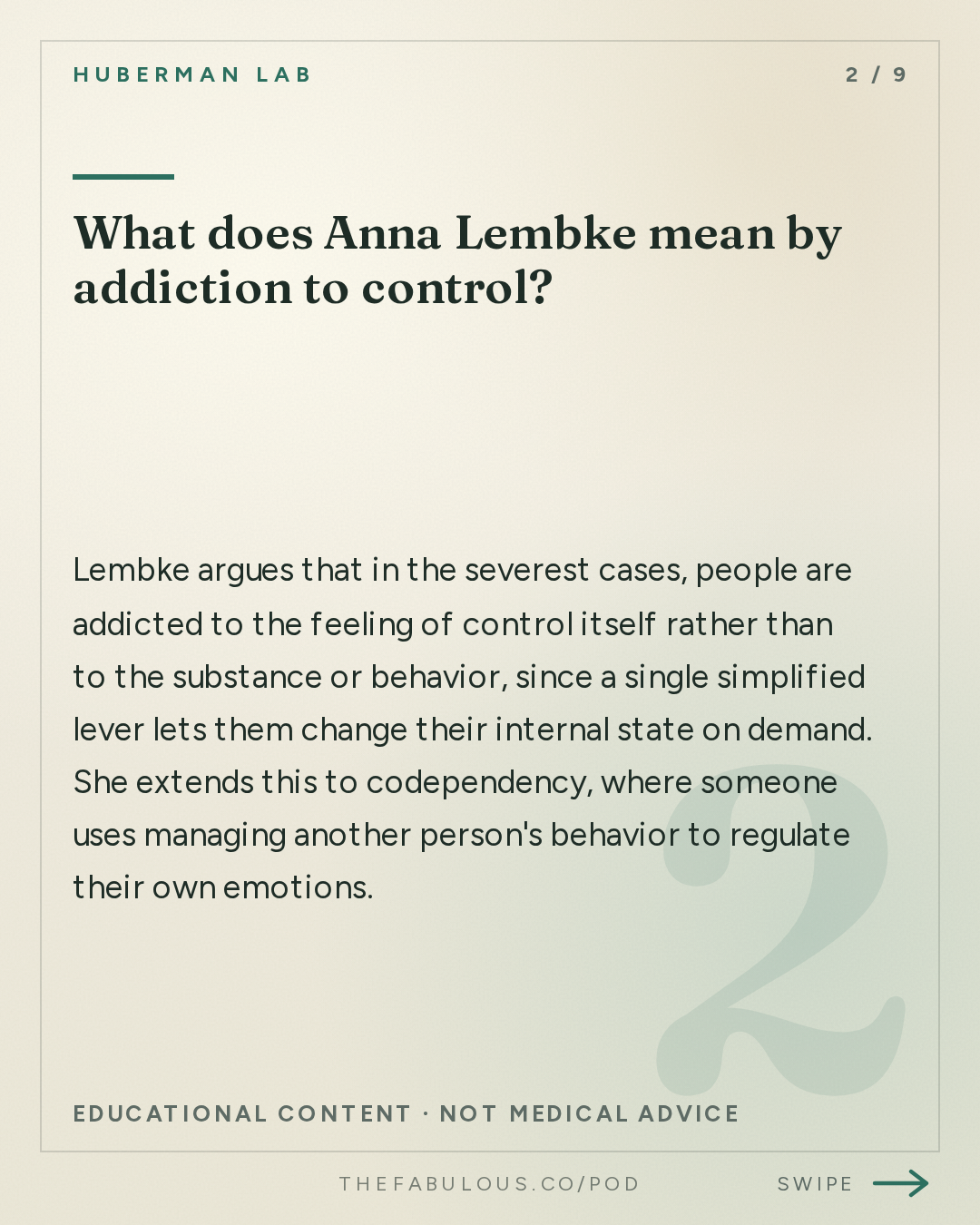
What does Anna Lembke mean by addiction to control?
Lembke argues that in the severest cases, people are addicted to the feeling of control itself rather than to the substance or behavior, since a single simplified lever lets them change their internal state on demand (00:00, 39:34). She extends this to codependency, where someone uses managing another person's behavior to regulate their own emotions (86:07).
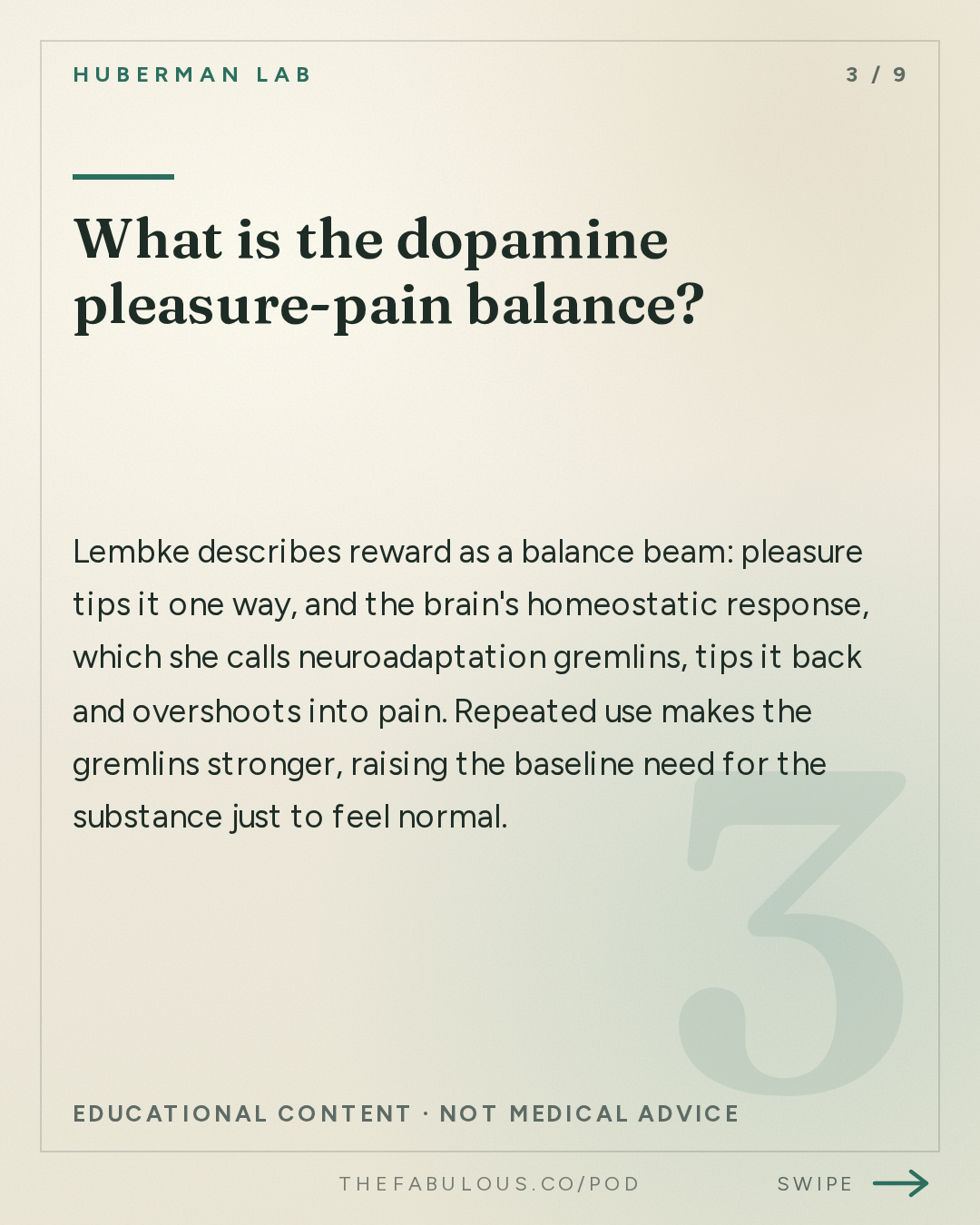
What is the dopamine pleasure-pain balance?
Lembke describes reward as a balance beam: pleasure tips it one way, and the brain's homeostatic response, which she calls neuroadaptation gremlins, tips it back and overshoots into pain (12:05, 13:19). Repeated use makes the gremlins stronger, raising the baseline need for the substance just to feel normal (13:41).
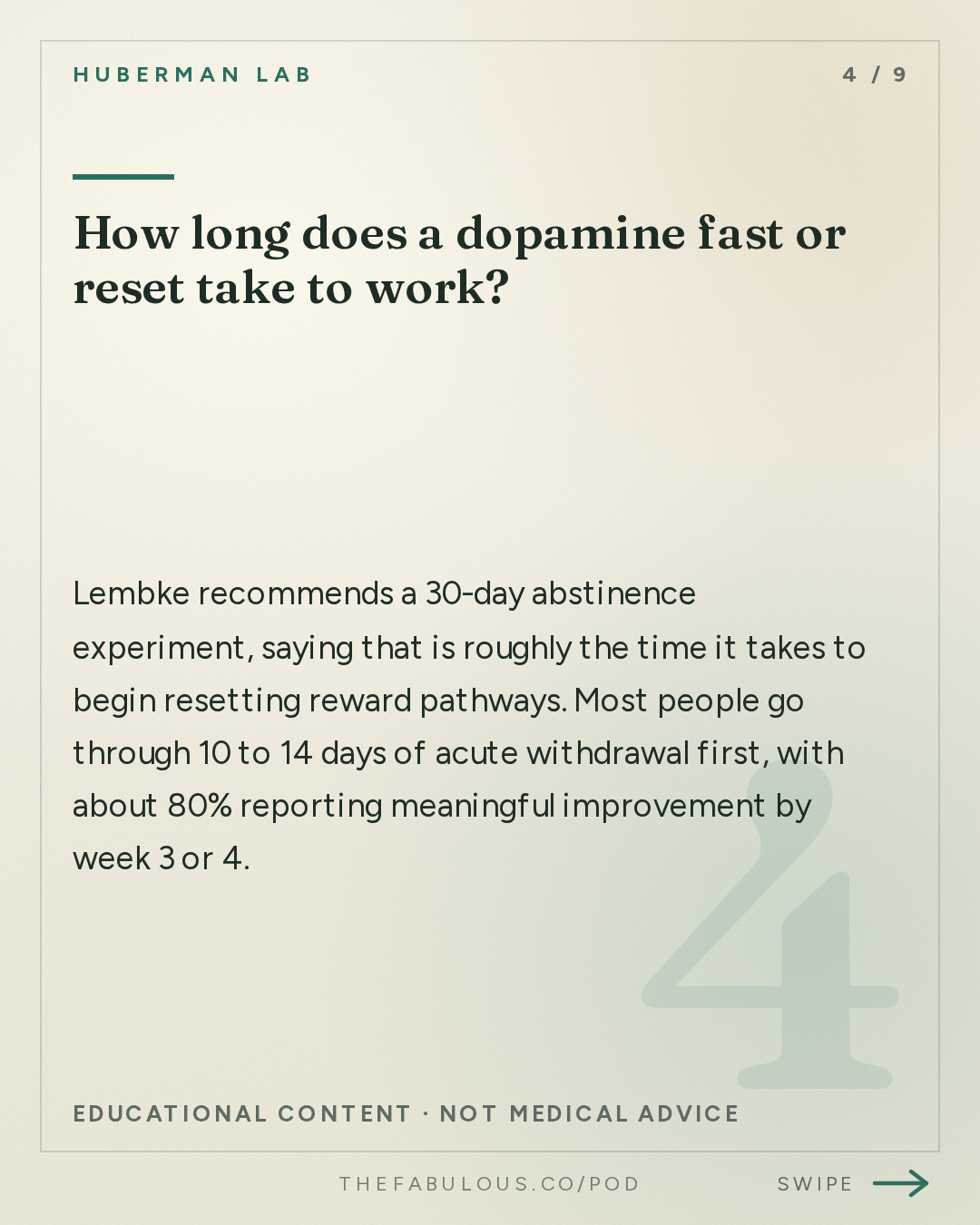
How long does a dopamine fast or reset take to work?
Lembke recommends a 30-day abstinence experiment, saying that is roughly the time it takes to begin resetting reward pathways (20:22). Most people go through 10 to 14 days of acute withdrawal first, with about 80% reporting meaningful improvement by week 3 or 4 (15:20, 15:39).
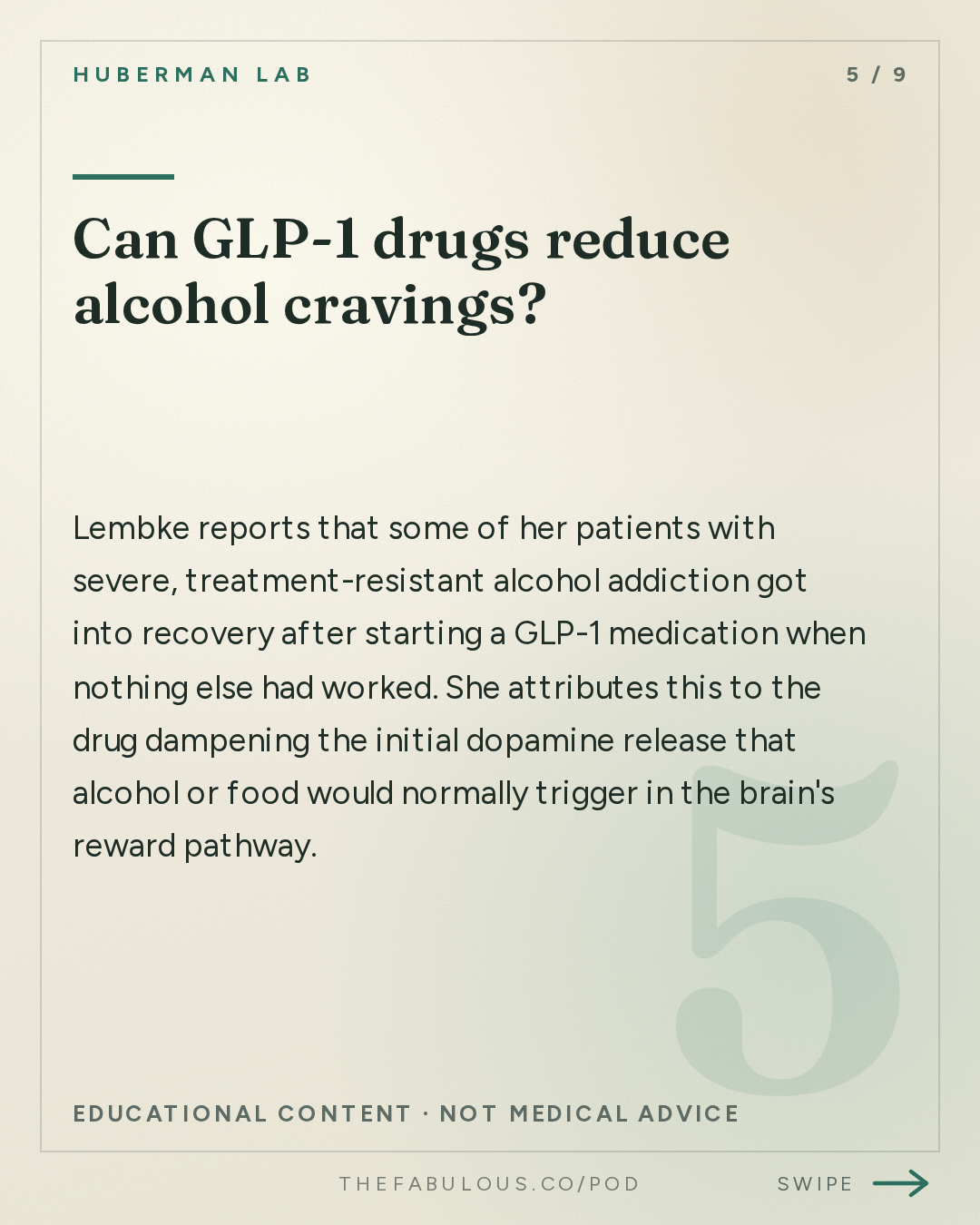
Can GLP-1 drugs reduce alcohol cravings?
Lembke reports that some of her patients with severe, treatment-resistant alcohol addiction got into recovery after starting a GLP-1 medication when nothing else had worked (129:15). She attributes this to the drug dampening the initial dopamine release that alcohol or food would normally trigger in the brain's reward pathway (129:50).
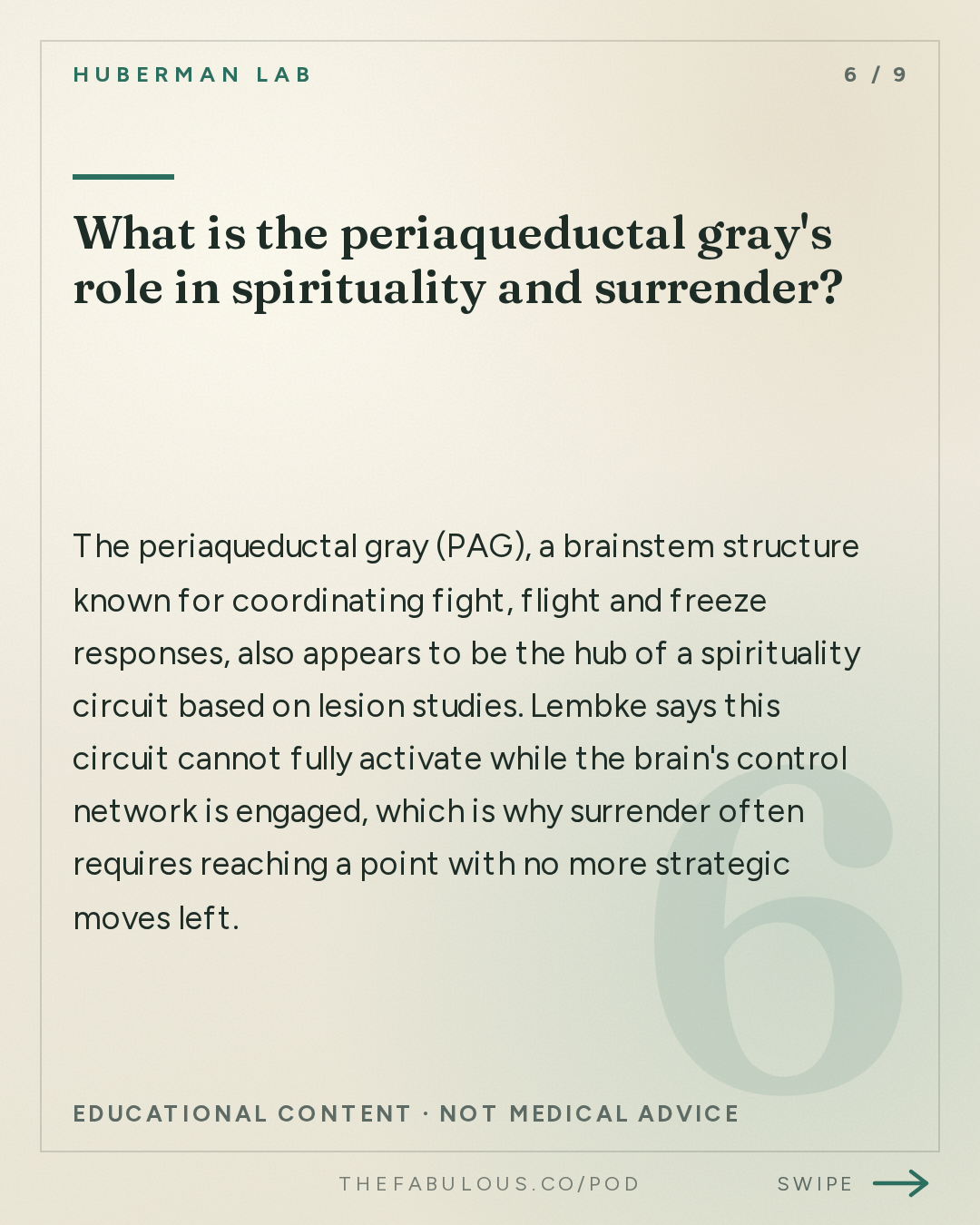
What is the periaqueductal gray's role in spirituality and surrender?
The periaqueductal gray (PAG), a brainstem structure known for coordinating fight, flight and freeze responses, also appears to be the hub of a spirituality circuit based on lesion studies (53:40). Lembke says this circuit cannot fully activate while the brain's control network is engaged, which is why surrender often requires reaching a point with no more strategic moves left (50:50, 57:34).
Is ketamine addictive?
Yes, Lembke says ketamine, despite being FDA approved for treatment-resistant depression, is itself addictive, and she treats patients who became dependent on take-home prescriptions obtained online (124:33, 126:12). A supervised alternative, the Montreal Model, keeps ketamine use in-clinic alongside psychotherapy to reduce that risk (125:22).
The full read, in cards
Go deeper
- Dopamine Nation — Lembke's earlier book introducing the pleasure-pain balance and the risks of a world saturated with reinforcing stimuli
- Radical Surrender — Lembke's new book on control, codependency, and spiritual surrender as a path out of addiction
- Rat cocaine relapse experiment — A rat extinguished from pressing a cocaine lever resumes pressing immediately after a painful foot shock, showing how stress reactivates dormant addiction circuits
- Lembke's hallucinogen ED-visit study — Found that emergency department visits and hospitalizations linked to hallucinogens rise as use rises, undercutting claims that psychedelics are far safer than alcohol
- PAG Pac-Man neuroimaging experiment — Showed the periaqueductal gray activates strongly only when an in-game threat becomes imminent, linking it to threat response
Mentioned
Anna Lembke · Andrew Huberman · Stanford University · Dopamine Nation · Radical Surrender · Periaqueductal Gray · Pia Mellody · Kent Dunnington · William James · GLP-1 · Ben Affleck · Nicholas Garel · Montreal Model · Mother Teresa
More from this show and category

The Søberg Principle: Cold Exposure Protocol
Cold and heat exposure activate brown fat, the tissue that burns fuel for heat instead of storing it, improving insulin sensitivity and lowering inflammation. Danish researcher Susanna Søberg found the minimum effective dose is about 11 minutes of cold water weekly and 57 minutes of sauna weekly, always ending on cold (26:47, 27:43, 33:29).
How Robert Greene Accesses the Sublime
Robert Greene, author of Mastery and The 48 Laws of Power, says the sublime is a jolt of awe that breaks open ordinary, filtered perception. In his new book The Law of the Sublime, he offers exercises built on trained attention, slowness, recovered childhood memory, and vulnerability in love to reach it without drugs or travel.

How Smell Secretly Shapes Hormones and Behavior
Dr. Noam Sobel's research shows smell quietly shapes human bonding, fear, and hormones in ways we rarely notice. People secretly sniff their own hand after shaking a stranger's hand, body odor similarity predicts whether strangers click as friends, and sniffing women's odorless emotional tears drops men's free testosterone by 14% within 20 to 30 minutes (23:24).
Ross Edgley on the Neuroscience of Motivation
Ultra-endurance swimmer Ross Edgley and Andrew Huberman trace grit to the brain's anterior midcingulate cortex and sketch a five-spoke model of motivation. Drawing on swims around Great Britain and Iceland, they cover stress inoculation, vision and arousal, and protocols like 400 mg of caffeine and 10 g of daily creatine for performance under fatigue.
