
How Robert Greene Accesses the Sublime
Access the Sublime & Live Your Best Life | Robert Greene
The brief
Robert Greene, author of Mastery and The 48 Laws of Power, says the sublime is a jolt of awe that breaks open ordinary, filtered perception. In his new book The Law of the Sublime, he offers exercises built on trained attention, slowness, recovered childhood memory, and vulnerability in love to reach it without drugs or travel.
Robert Greene was lying in a hospital bed, trying to understand what had just happened to his brain, when he noticed the sky outside his window looked strange. Not frightening, but wonderful, as if he were seeing blue for the first time. Greene, author of The 48 Laws of Power and Mastery, had just had a stroke. His left hand was frozen, and his balance was gone. Yet for a few days, ordinary things, clouds, birds, the sway of trees, carried a charge he had not felt since childhood. That feeling is the subject of his new book, The Law of the Sublime, and of a long conversation with Stanford neurobiologist Andrew Huberman on the Huberman Lab podcast.
The word "sublime" comes from the Latin sub limen, meaning up to the threshold of a door (06:03). Greene uses it to describe a narrow, intense experience that sits just outside the familiar loop of daily life: the same commute, the same coffee, the same scroll through a phone. He pictures ordinary consciousness as a circle. Inside the circle, life is safe and repetitive. The sublime lives at the doorways leading out of it, and stepping through one brings a mix of discomfort and delight.
"The sublime is a mix of pain and pleasure. The pain is, it's outside my comfort zone... but the pleasure is the newness of it." Robert Greene, [06:32]
Greene says the brain's main job is not to show reality as it is, but to filter it, so the mind is not overwhelmed by chaos (26:52). That filtering is useful for survival. It is also why a coffee cup, a tree, or a familiar street stops registering as strange or beautiful after the first few times we see it. Aldous Huxley called this filtered-down version of experience a narrowing of what he termed the "mind at large." Greene's claim is that the raw, unfiltered version never disappears. It is still there, waiting, and certain practices can pry the doors back open.
Training Attention Like a Muscle
One practice comes from Gurdjieff, an early twentieth century Armenian mystic who traveled through esoteric schools in the Middle East and Central Asia collecting techniques for altering consciousness (18:22). Gurdjieff argued that most people sleepwalk through life, and that true attention is rare enough to count as a different state of mind.
"What makes a human being human is our attention." Robert Greene, [18:57]
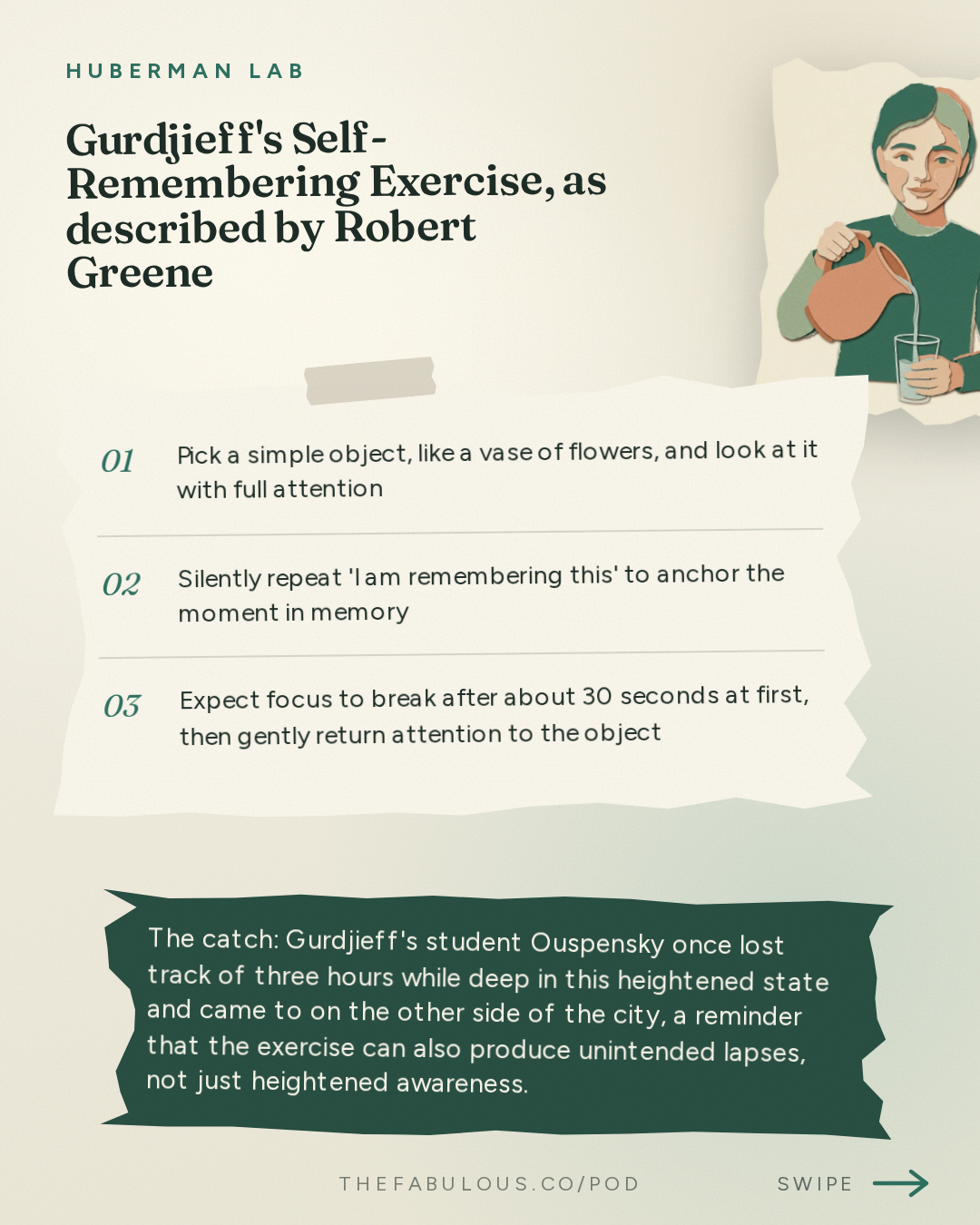
Gurdjieff's exercise, which he called self-remembering, is simple to describe and hard to sustain. Pick an object, like a vase of flowers. Look at it closely. Tell yourself "I am remembering this" so the moment gets stamped into memory rather than sliding past unnoticed. Greene recounts the story of Gurdjieff's student Ouspensky, a Russian mystic who was depressed and suicidal before taking up the practice. At first Ouspensky's focus broke after about 30 seconds (20:48). After months of daily practice, the flower itself began to look different, and eventually the houses on his street looked almost alive. One day he came to and realized he had walked clear across the city without remembering the trip, a sign of how automatic ordinary attention usually is (22:01). Greene also meditates 40 minutes each morning, a habit he says slows his internal sense of time until minutes pass without his noticing (38:31).
Huberman connects this to a finding from visual neuroscience: when researchers hold a person's eyes still on one spot, the way the brain renders that spot can shift over time, even though nothing in the world has changed (23:18). Attention, in other words, is not a passive camera. It is an active process that can be trained, and training it changes what a person actually perceives, not just what they think about.
Time Has a Shape
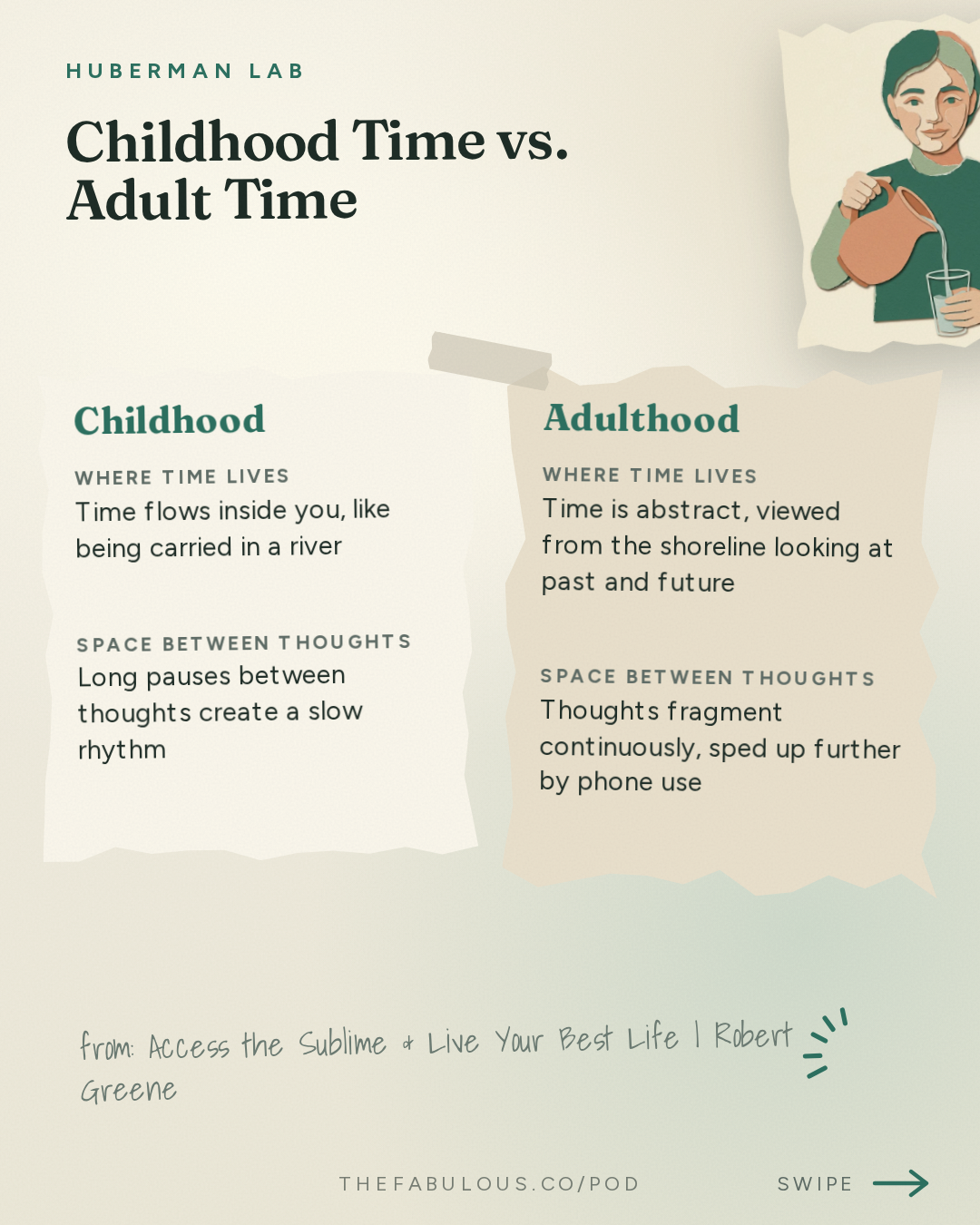
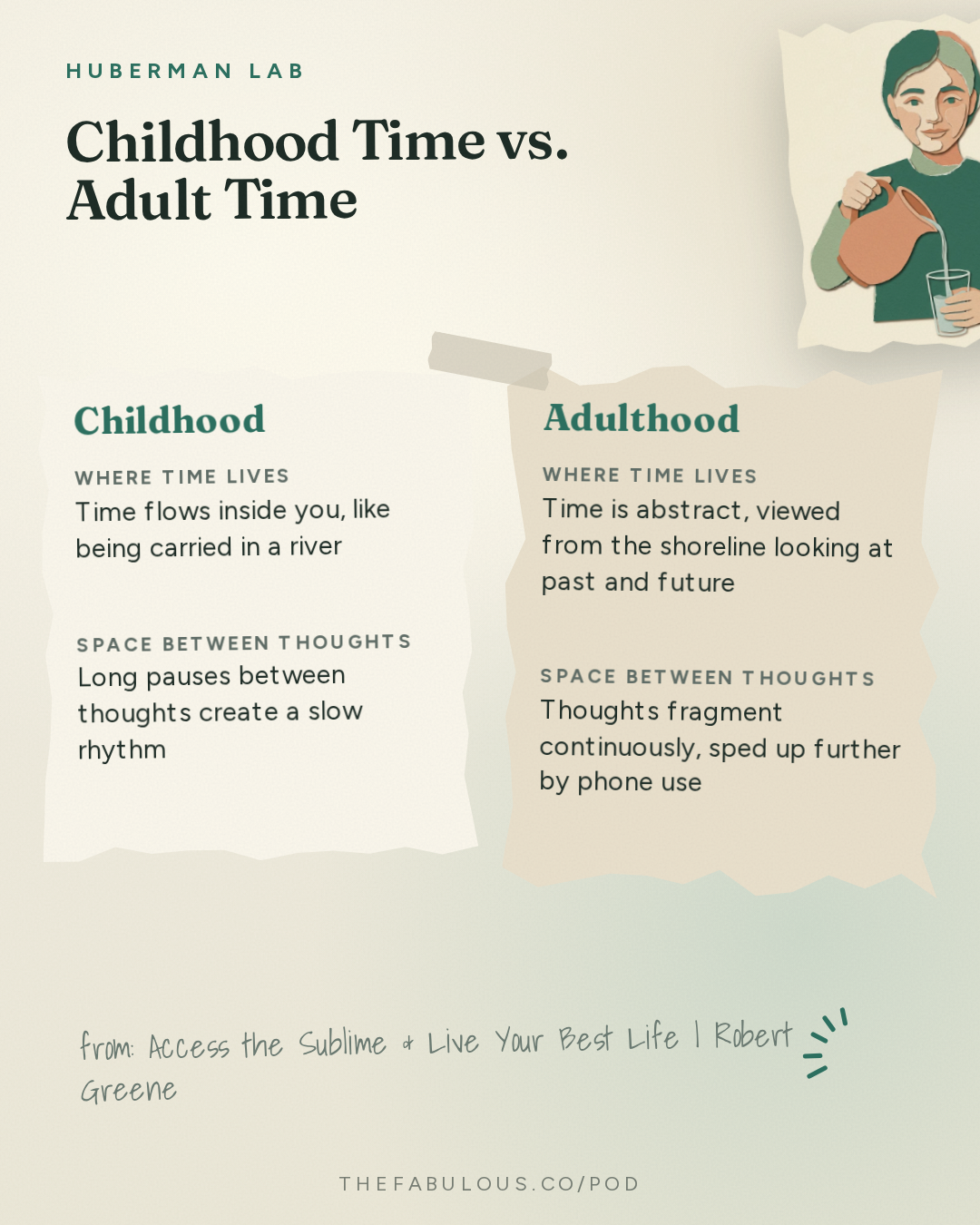
A second thread in the conversation concerns time. Huberman cites Berkeley psychologist Dacher Keltner's research on awe, which finds that the feeling tends to arrive when attention jumps quickly from a small visual scale to a large one, like walking through dense forest and suddenly reaching an open vista (32:01). Greene extends the idea to the passage of time itself. He describes childhood time as something lived from the inside, like being carried in a river, full of long gaps between thoughts. Adult time, by contrast, is something watched from the shore, abstract and divided into units (37:44). He points to novelist Vladimir Nabokov's memoir Speak, Memory, written after Nabokov lost his family, his home in Russia, and nearly every physical trace of his own childhood, as an attempt to recover that inside-the-river feeling of time through writing alone (36:17).
Near-death experience fits into this same discussion. Greene says that in studies of people who have come close to dying, about 85 percent report the experience as positive, often describing a sense of ego and time dissolving into something closer to ecstasy (40:32). He cites Albert Heim, a nineteenth century Swiss climber who fell roughly a hundred feet and later wrote that in 15 seconds of falling he seemed to relive years of his life (42:22). The claim across both threads, attention exercises and near-death time distortion, is the same: the clock most people live by is a construction, not a fixed law of nature.
The stroke changed more than Greene's sense of time. He says it shifted him toward the right hemisphere of the brain, which he associates with emotion and holistic processing rather than language and sequential logic, and left him crying more easily and feeling sudden waves of empathy for other people's pain (84:27). Writing from that state, rather than a purely intellectual one, became part of how he finished the book.
"I had to find a way to sing inside my cage." Robert Greene, [88:04]
The physical act of writing mattered too. Because his left hand still does not work well, Greene handwrote the entire manuscript, filling more than 100 notebooks before producing a final typed draft (68:24). Huberman links this to neuroscience by way of his friend Eddie Chang, chair of neurosurgery at the University of California, San Francisco, who told Huberman that the brain's hand representation sits nested inside its language areas, not just near them (72:32). Handwriting, in Greene's account, forces a slower, more physical kind of thought than typing or dictation allows.
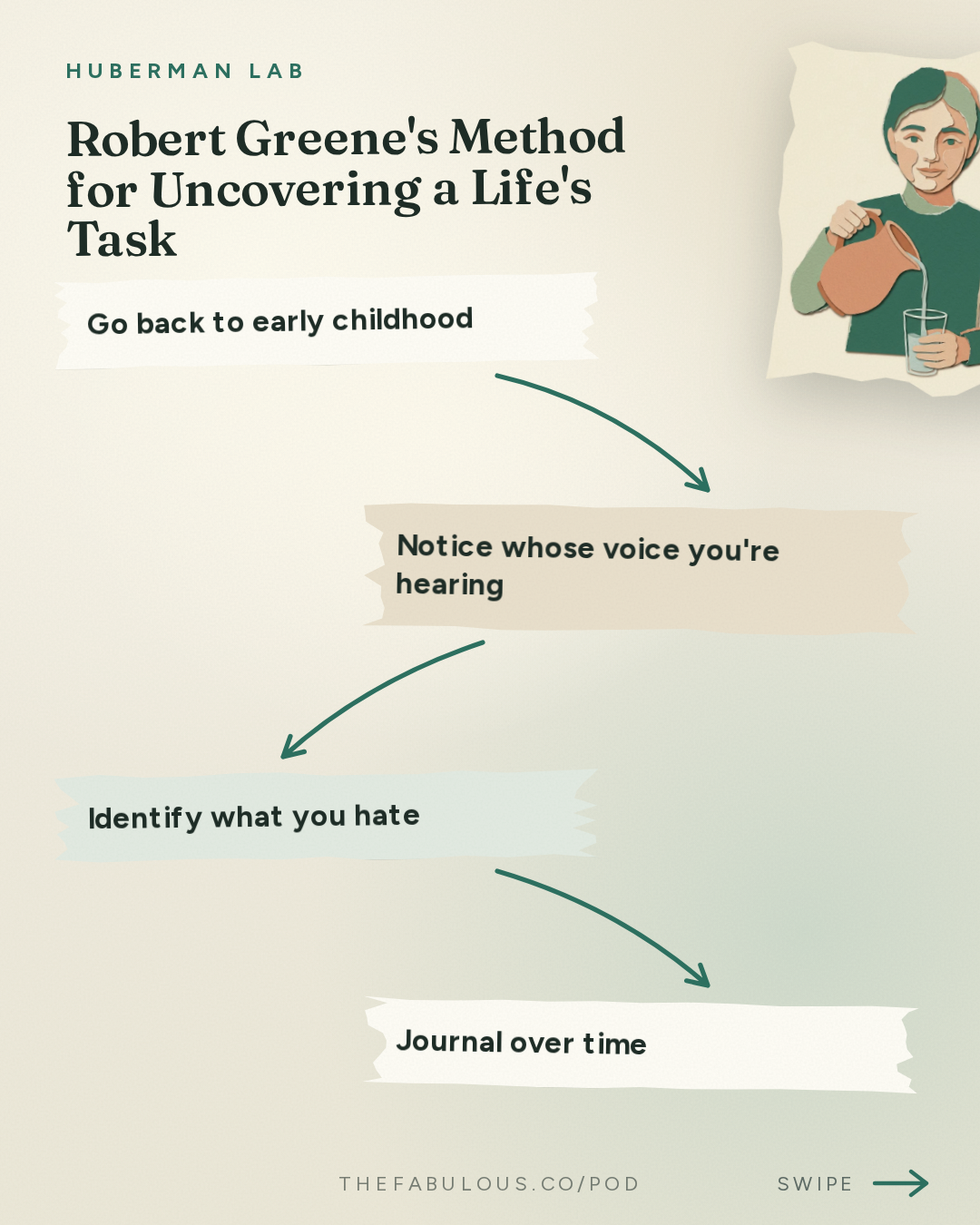
Much of the episode returns to a practical question Greene says readers of Mastery kept asking him: how do you find your life's task if you do not already know it? His answer is to treat early childhood like an archaeology site. People lose touch with the things that excited them before parents, teachers, and peers told them what to value (80:13). Greene also asks what work repels or frustrates a person, arguing that frustration is as reliable a signal as excitement, because both point away from a wrong path.
Love gets the same treatment as a route to the sublime. Greene frames falling in love as a literal kind of falling, with a real element of fear built in, because it requires dropping psychological defenses in front of another person (99:09). He argues that a culture built around self-protection and constant self-reporting makes that kind of vulnerability harder to sustain.
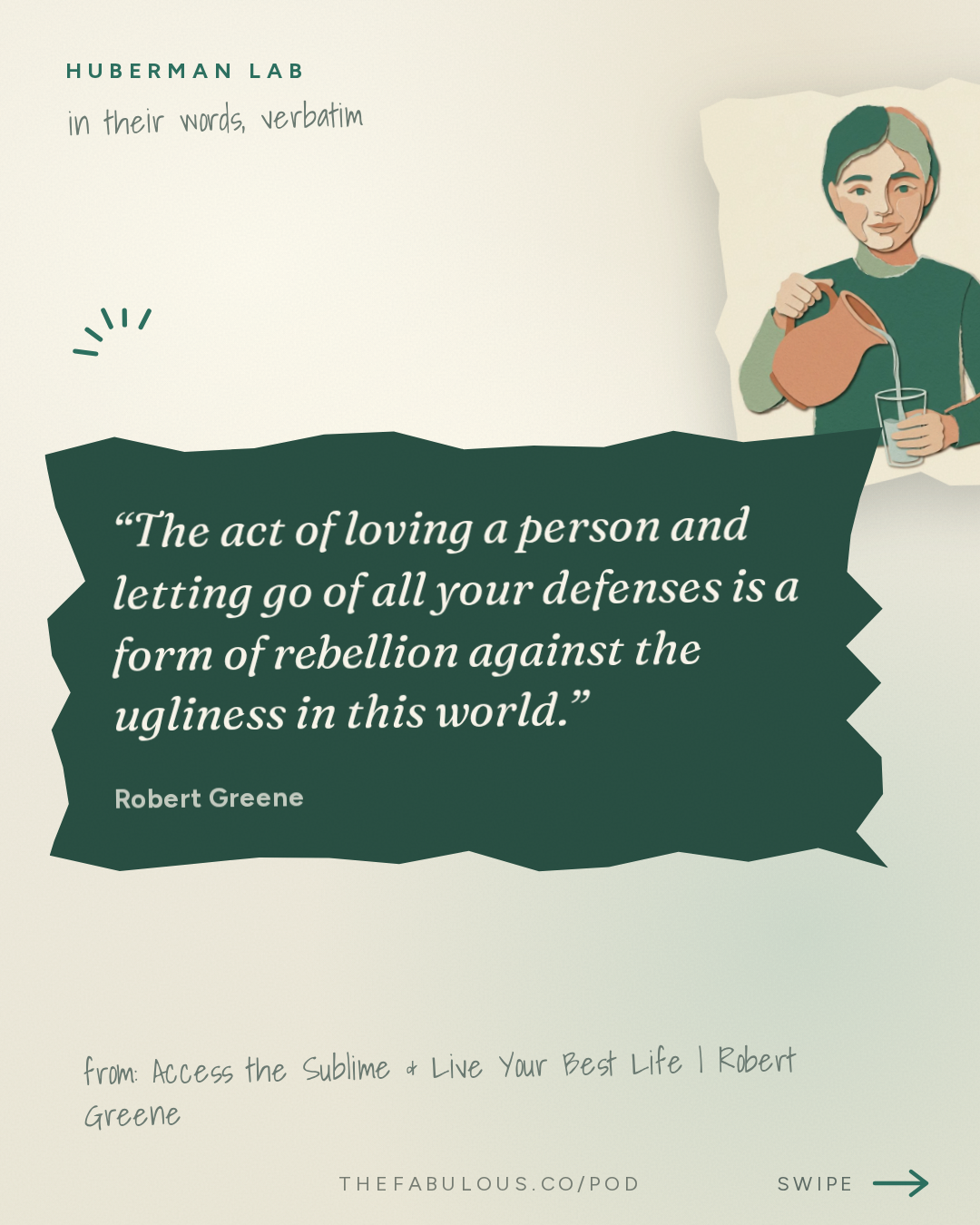
"The act of loving a person and letting go of all your defenses is a form of rebellion against the ugliness in this world." Robert Greene, [101:21]
Greene closes the conversation by tying all of this to the decline of organized religion. He argues that humans are unusual among animals in knowing, in advance, that they will die, and that this awareness creates a need for something larger than an individual life (109:51). Religion used to meet that need for most people. Its retreat since the Enlightenment, he says, has left many people without an anchor, and he connects some of today's polarization and anger to that loss (112:11).
None of this requires travel, drugs, or a medical crisis, which is Greene's real argument. He spent years planning adventures for the book, swimming with dolphins, a trip to the Amazon, before the stroke made all of that impossible, and he found the material in his own backyard instead. The sublime, as he describes it, is not an exotic destination. It is closer to a different setting on the senses people already have, available in a coffee cup, or forty minutes of stillness, if anyone bothers to look.
Ask this episode anything
Pod's AI answers from the episode itself, with the minute mark so you can hear it yourself.
Or start with one of these
Ask this episode
Pod's AI listens to the whole episode to answer, and points you to the minute it comes from.
The rest of this answer, and any question after it
Answers come from the episode itself, never from a summary of it.
ContinueKey takeaways
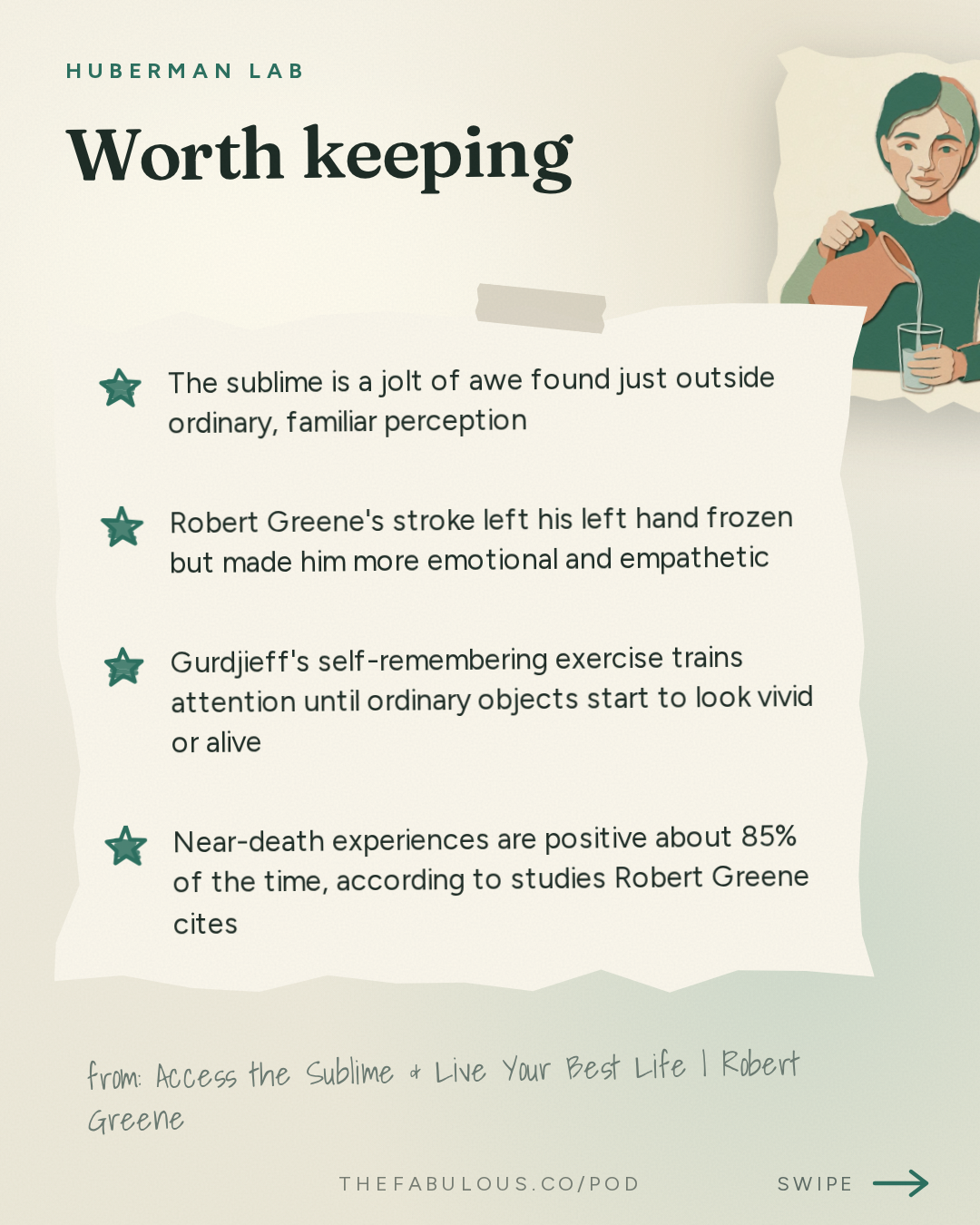
- The sublime is a jolt of awe found just outside ordinary, familiar perception
- Robert Greene's stroke left his left hand frozen but made him more emotional and empathetic
- Gurdjieff's self-remembering exercise trains attention until ordinary objects start to look vivid or alive
- Near-death experiences are positive about 85% of the time, according to studies Robert Greene cites
- Robert Greene says finding a life's task means recovering childhood sparks buried under parents' and teachers' expectations
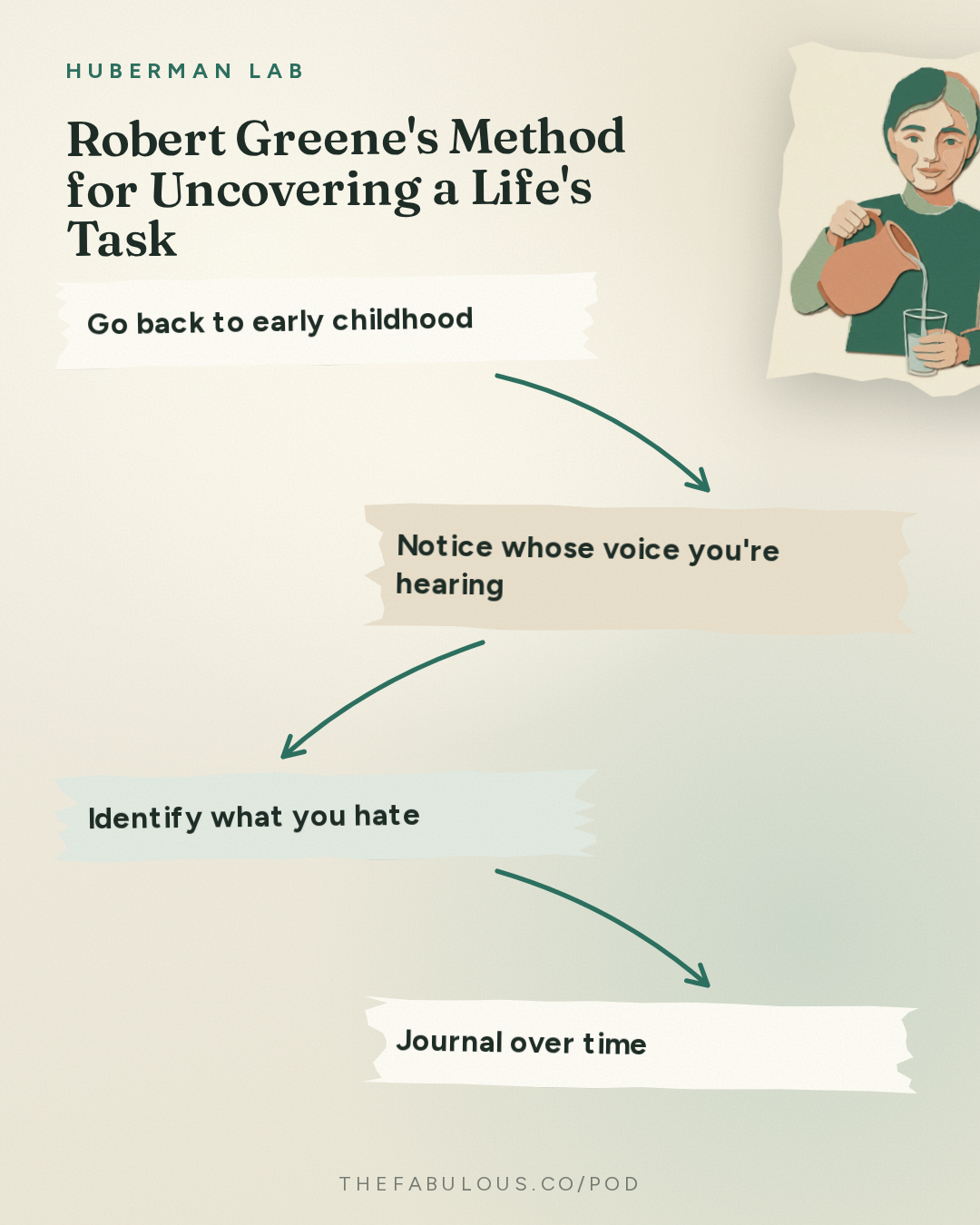
The episode in cards

By the numbers
- 85% near-death experiences reported as positive in studies Robert Greene cites
- 30 seconds how long focus lasted before the mind wandered in Gurdjieff's attention exercise
- 40 minutes length of Robert Greene's daily morning meditation
- 100 notebooks handwritten notebooks Robert Greene filled writing The Law of the Sublime
In their words
“"What makes a human being human is our, uh, attention."”
“I had to kind of find a way to sing inside my”
“The act of loving a person and letting go of all your defenses is a form of rebellion against the ugliness in this world.”
Protocols
-
Self-Remembering Attention Exercise
Robert Greene describes Gurdjieff's technique: pick a simple object, such as a vase of flowers, look at it closely, and silently repeat 'I am remembering this' to force deep attention. Focus typically breaks after about 30 seconds at first, so the practice is to keep returning attention to the object. Greene says that after months of daily repetition, the object and eventually the surrounding world can start to look vivid or alive.
Daily, over several months
-
Morning Meditation for Time Perception
Robert Greene meditates for 40 minutes each morning. He says the practice slows his internal sense of time so that minutes pass without his noticing, producing a physical feeling of being inside the flow of time rather than watching it from the outside.
Daily, 40 minutes
-
Finding a Life's Task Through Childhood Memory
Robert Greene has people journal about their earliest childhood memories to locate moments of excitement that were genuinely their own, not suggested by parents or teachers. He also asks what kind of work has frustrated or repelled them, because he says frustration points away from the wrong path as reliably as excitement points toward the right one. Greene notes that this process can take weeks of honest, sustained journaling and rarely resolves quickly.
Ongoing, journaling over weeks
-
Handwriting for Slower, Deeper Thought
Robert Greene wrote The Law of the Sublime entirely by hand because typing and dictation moved too fast for the depth of thought he wanted. He filled more than 100 notebooks before producing a final typed draft. He notes that this approach slows output dramatically, the book took seven years to finish.
Daily writing practice, sustained over 7 years
Questions this episode answers
What does Robert Greene mean by 'the sublime'?
Robert Greene, author of Mastery and The 48 Laws of Power, defines the sublime using its Latin root, sub limen, meaning up to the threshold of a door (06:03). He describes it as a jolt of awe that lies just outside ordinary, filtered perception, combining discomfort with novelty and pleasure (06:32).
What is Gurdjieff's self-remembering exercise?
It is an attention practice from the early twentieth century Armenian mystic Gurdjieff, in which a person focuses intently on a simple object while silently repeating 'I am remembering this' (18:22). Robert Greene says the technique can take months of daily practice before everyday objects start to look vivid or alive, based on the account of Gurdjieff's student Ouspensky (20:48).
How did Robert Greene's stroke change him?
Greene says the stroke left his left hand frozen and his balance impaired, but also shifted his thinking toward the brain's right hemisphere, making him more emotional and empathetic toward other people's suffering (84:27). He connects this shift to the more intuitive, feeling-based tone of his new book, The Law of the Sublime.
Are near-death experiences usually positive?
Robert Greene cites studies finding that about 85% of reported near-death experiences are positive, often described as a dissolving of the ego and ordinary sense of time (40:32). He notes a minority are described as distressing rather than peaceful, so the experience is not uniformly positive.
What is Robert Greene's 'life's task' concept?
It is Greene's term for a person's unique calling, which he says gets buried under the expectations of parents, teachers, and peers during childhood (80:13). His method for recovering it involves journaling about early childhood excitements as well as identifying work that feels frustrating or repellent, since he argues both signals point toward or away from the right path (82:08).
Why did Robert Greene handwrite his new book instead of typing or dictating it?
Greene says handwriting forces slower, deeper thought than typing or dictating, and that dictation in particular felt disconnected because it did not involve his hands (69:01). He filled more than 100 notebooks over several years before producing a final typed draft (68:24), citing neurosurgeon Eddie Chang's observation that the brain's hand representation sits nested inside its language areas (72:32).
The full read, in cards
Go deeper
- The Law of the Sublime — Robert Greene's new book on accessing transcendent moments in daily life
- Mastery — Greene's earlier book on mentorship and realizing one's unique capacities
- Speak, Memory — Vladimir Nabokov's memoir attempting to recreate the felt experience of childhood time after losing his family and homeland
- The Doors of Perception — Aldous Huxley's account of psychedelics describing the brain as a filter that restricts access to a wider 'mind at large'
- Near-death experience studies — Cited by Greene as finding about 85% of reported near-death experiences are positive
Mentioned
Robert Greene · Andrew Huberman · Mastery · The Law of the Sublime · The 48 Laws of Power · Gurdjieff · Ouspensky · Cezanne · Nabokov · Eddie Chang · Dacher Keltner · Albert Heim · Aldous Huxley · Speak, Memory · Stanford School of Medicine
More from this show and category

How Smell Secretly Shapes Hormones and Behavior
Dr. Noam Sobel's research shows smell quietly shapes human bonding, fear, and hormones in ways we rarely notice. People secretly sniff their own hand after shaking a stranger's hand, body odor similarity predicts whether strangers click as friends, and sniffing women's odorless emotional tears drops men's free testosterone by 14% within 20 to 30 minutes (23:24).
Ross Edgley on the Neuroscience of Motivation
Ultra-endurance swimmer Ross Edgley and Andrew Huberman trace grit to the brain's anterior midcingulate cortex and sketch a five-spoke model of motivation. Drawing on swims around Great Britain and Iceland, they cover stress inoculation, vision and arousal, and protocols like 400 mg of caffeine and 10 g of daily creatine for performance under fatigue.

Huberman's Rational Guide to Supplements
Andrew Huberman's framework ranks behavior, then nutrition, then supplements, then prescription drugs, arguing supplements only work once the first two are solid (00:42). He gives exact doses for sleep, hormone, and focus compounds, and insists on testing one ingredient at a time (35:08).
Jared Diamond on Leadership: Why Charisma Isn't Required
Charisma is optional for great leadership, biologist and historian Jared Diamond argues, pointing to the uncharismatic dictators Stalin and Pinochet as proof (00:26). Diamond, 89, applies a 'natural experiment' method from biology to politics, religion, business, and sports, showing only 2 of 22 modern political leaders stepped down voluntarily and that coaches and CEOs get too much credit or blame for outcomes that are mostly random (95:37).
