
How Smell Secretly Shapes Hormones and Behavior
Essentials: How Smells Influence Our Hormones, Health & Behavior | Dr. Noam Sobel
The brief
Dr. Noam Sobel's research shows smell quietly shapes human bonding, fear, and hormones in ways we rarely notice. People secretly sniff their own hand after shaking a stranger's hand, body odor similarity predicts whether strangers click as friends, and sniffing women's odorless emotional tears drops men's free testosterone by 14% within 20 to 30 minutes (23:24).
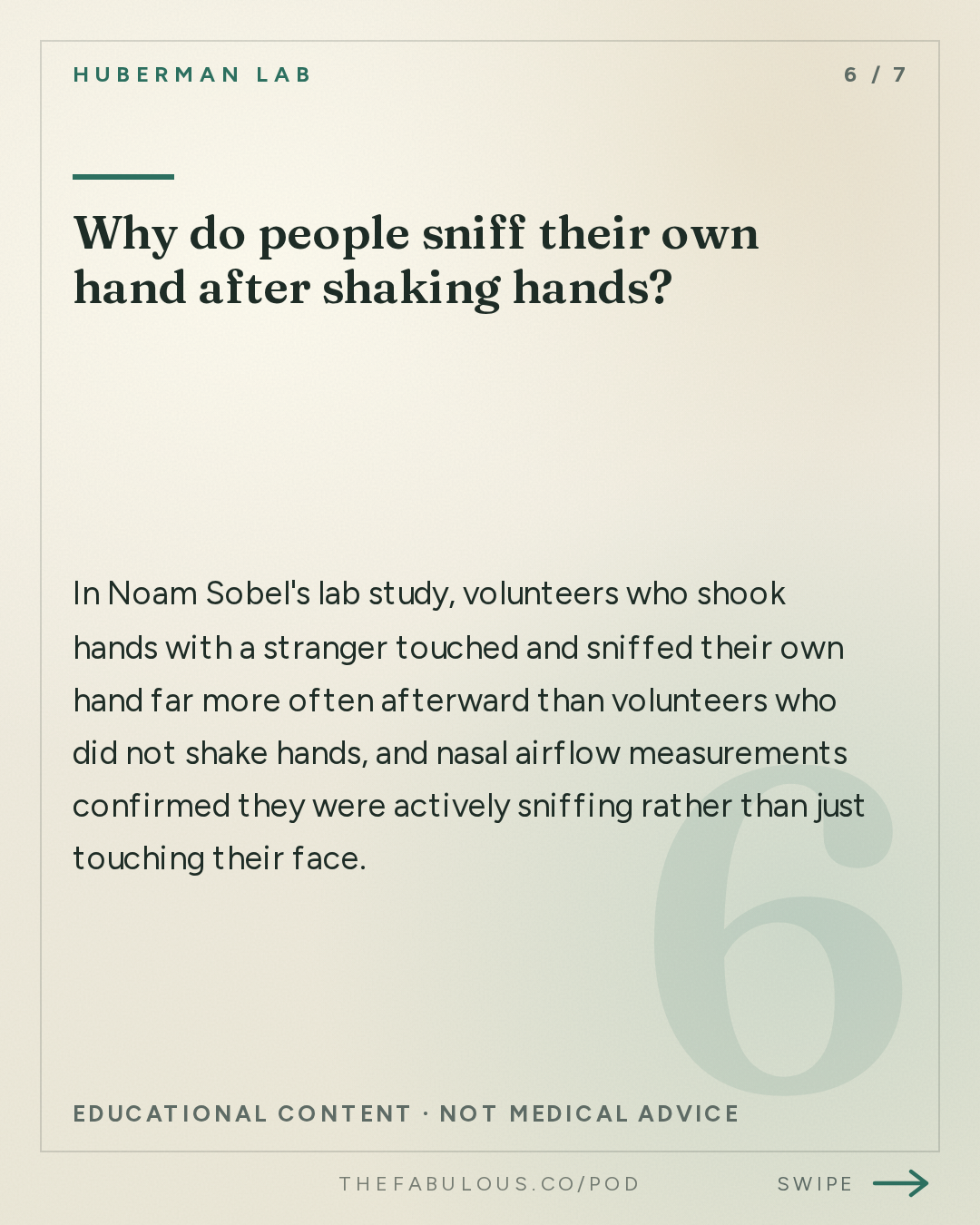
Shake a stranger's hand, and watch what happens next. Within moments, many people lift that same hand toward their face and quietly sniff it, usually without any awareness that they have done so. Olfaction researcher Noam Sobel calls this an olfactory behavior, and he has the measurements to prove it. His lab filmed volunteers sitting alone in a waiting room, then sent in an experimenter who either shook their hand or didn't before leaving again. The volunteers who got the handshake touched their nose and sniffed their hand far more often than the ones who didn't (05:46, 07:51). Some even sniffed the hand that never touched anyone, as if comparing their own scent to the stranger's.
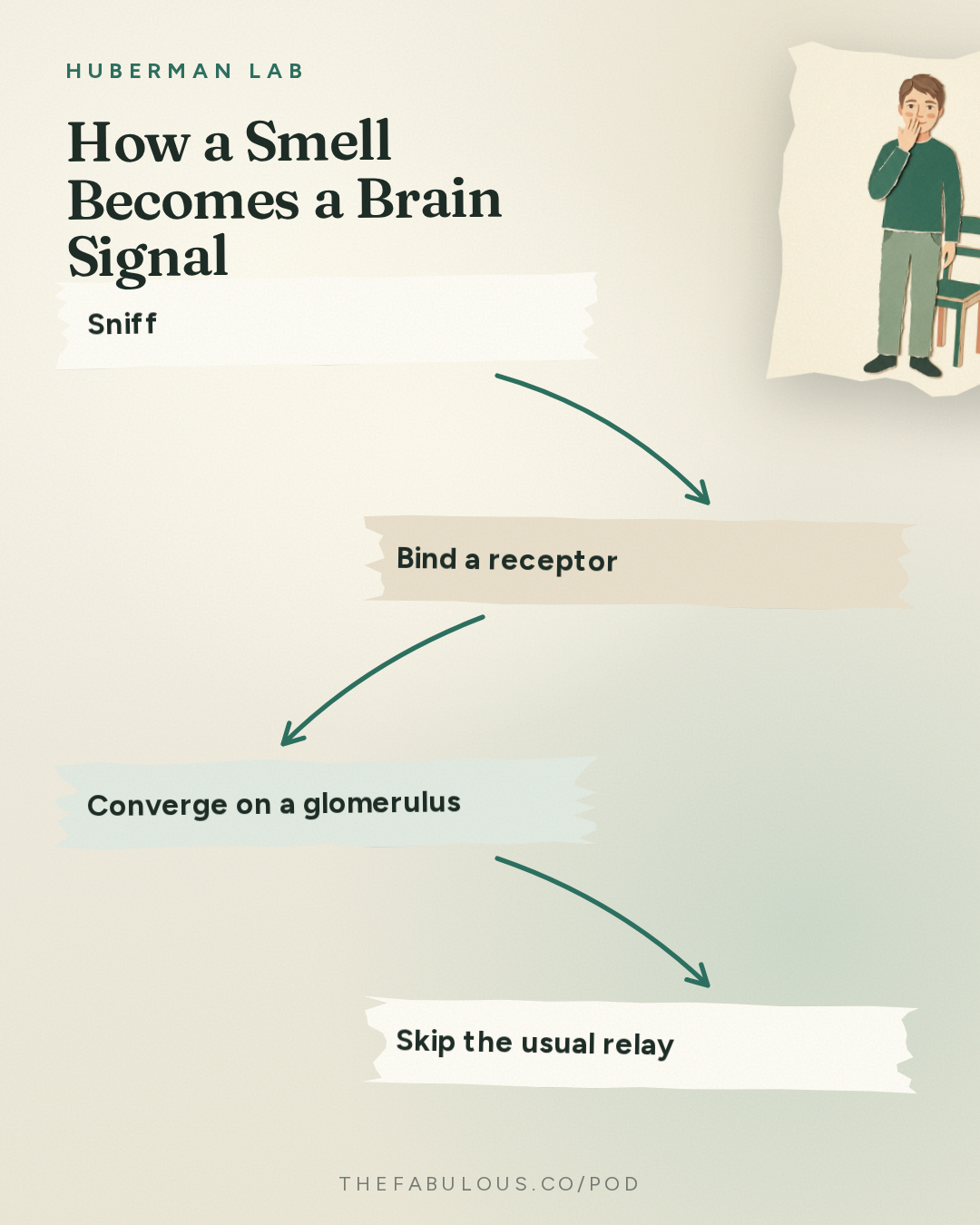
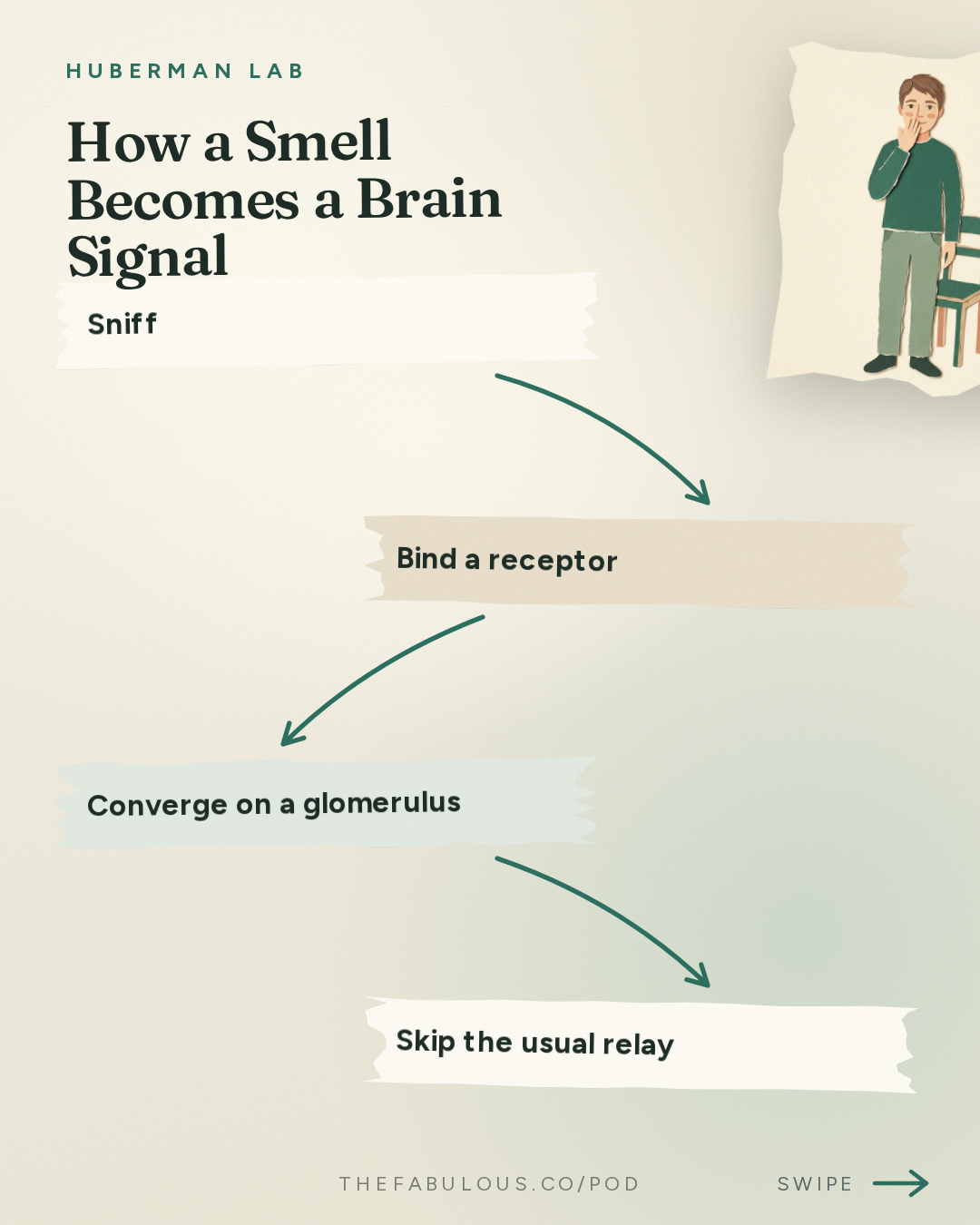
That small, invisible gesture is the thread running through Sobel's conversation with Stanford neurobiologist Andrew Huberman: humans behave like a nose-first species while insisting we are not. The hardware supports that claim. Odor molecules travel roughly six or seven centimeters up the nose before reaching the olfactory epithelium, a folded tissue packed with about seven million receptors across some 350 different subtypes (01:14, 01:40). Each receptor subtype converges onto a single relay point in the brain called a glomerulus, so a cup of coffee produces a specific pattern on the olfactory bulb, in effect a map of that smell (02:34, 03:25). From there, signals travel directly to the amygdala and the hypothalamus, brain regions tied to emotion and hormones, skipping the layover in the thalamus that vision and hearing require (03:50, 04:09). Smell has a backstage pass most senses don't get.
What a Nose Can Predict
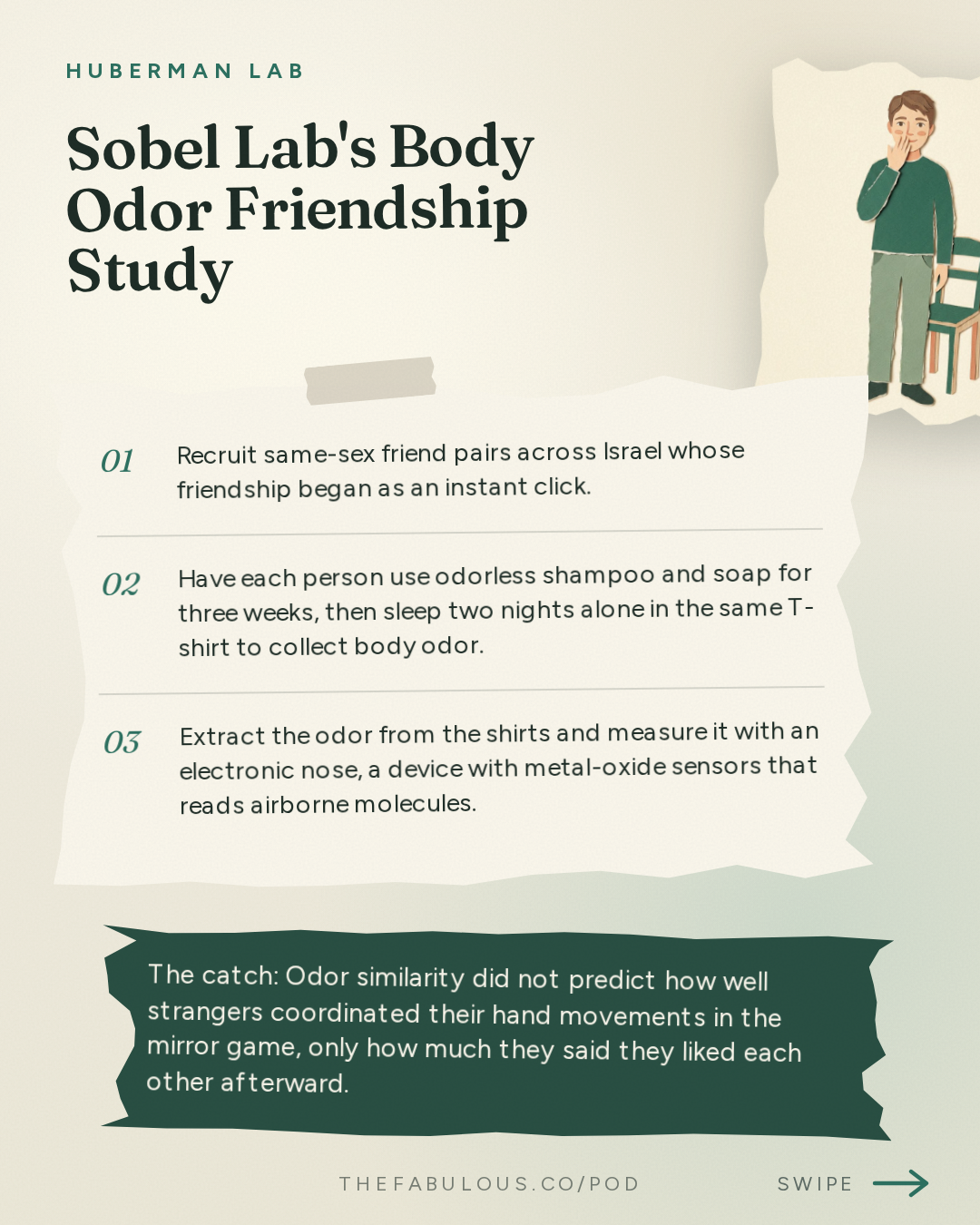
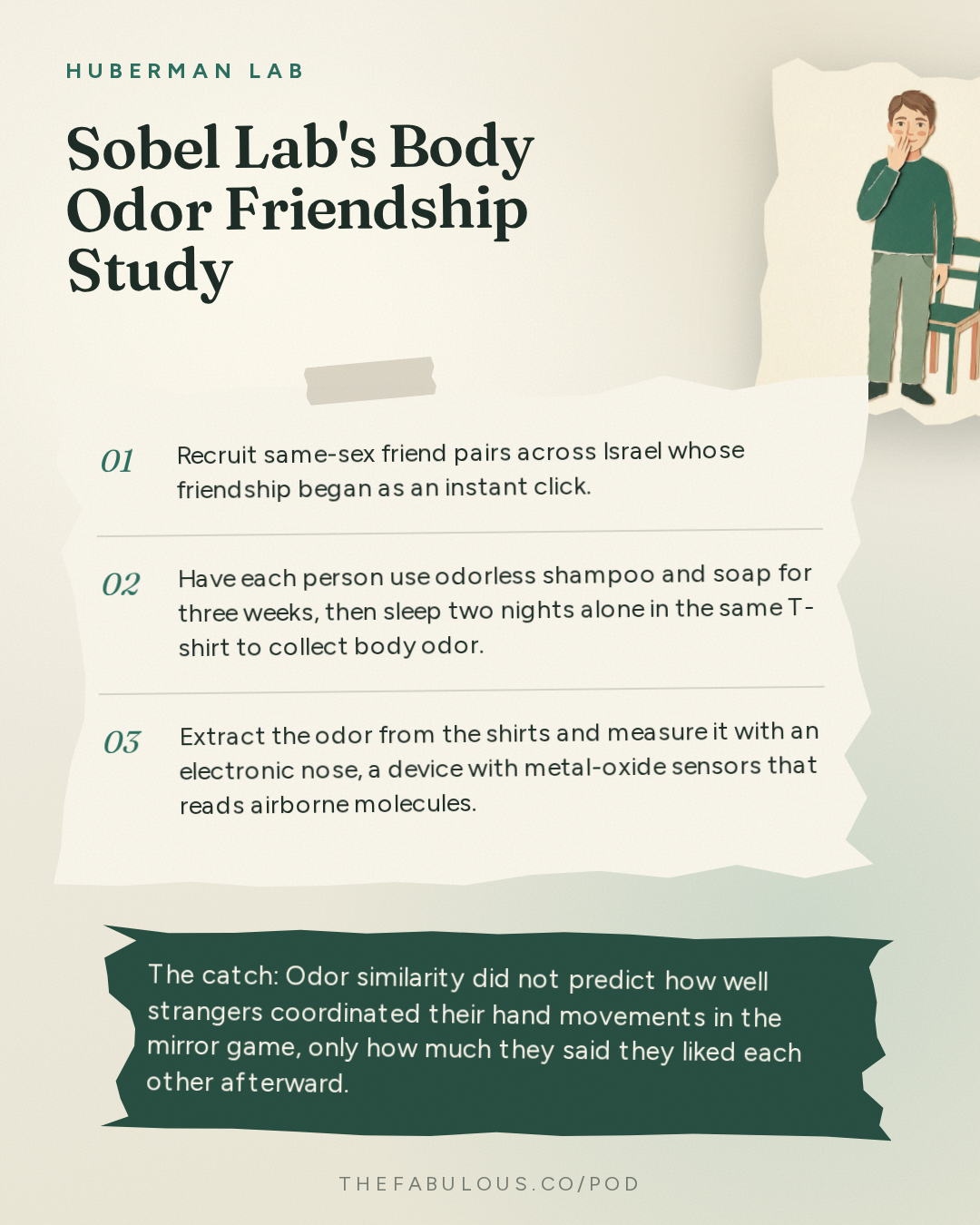
Sobel's lab has used that backstage pass to explain something people usually credit to conversation and shared interests: the instant click that turns strangers into friends. His graduate student Inbal Ravreby recruited same-sex friend pairs across Israel whose friendship had started as a click, had them use odorless shampoo for three weeks, then sleep two nights in the same T-shirt to collect their body odor (10:19, 11:12). An electronic nose, a device whose metal-oxide sensors read airborne molecules the way a biological nose does, found that click friends smelled more alike than randomly paired strangers (11:42). Human sniffers agreed.
The sharper test came next. Could scent predict friendship before it existed? Ravreby brought in strangers, measured their odor with the electronic nose, then paired them in a silent mirror game where they copied each other's hand movements at close range (12:35). Odor similarity did not predict how well they mirrored each other. But after a full round of pairings, each person rated how much they liked every other participant, and those ratings tracked the electronic nose's similarity scores closely.
"People who smell more similar to each other think that the other person is more likely to be their friend." (Noam Sobel, 13:34)
That is a strong claim: a machine reading of body chemistry anticipating a social judgment before anyone speaks. It doesn't make smell destiny. It means scent contributes to a process people assume runs entirely through words.
A related channel runs through fear. Several labs, including Sobel's, have shown that body odor collected from people in a state of fear changes the physiology of whoever smells it afterward, raising their sympathetic arousal, their fight-or-flight state (14:38, 15:21). Dogs can smell human fear too, something long assumed but only confirmed experimentally in the last couple of years (15:00).
The sharpest single example of chemical signaling in the conversation involves one molecule, hexadecanal. German researcher Heinz Breer had found it calmed groups of mice through what's called social buffering, and traced its receptor across a long stretch of mammalian evolution, suggesting it might be a signal shared across species (16:32). Sobel's then student Eva Michor tested that idea in humans using the Tyler Aggression Paradigm, a standard lab measure of aggressive behavior (17:50). Under hexadecanal, men became reliably less aggressive, with an effect size unusually large for aggression research (18:44). Women tested the same way became more aggressive, by a similarly strong margin (19:08). The result repeated inside an MRI scanner. The explanation arrived once Michor and Sobel asked who actually emits the molecule: hexadecanal is the single most abundant semi-volatile compound released from the heads of human infants (20:13).
"Babies are conducting chemical warfare, right? They're reducing aggression in their fathers or males around them and increasing aggression in their mothers or females around them, and both of those things are good for them." (Noam Sobel, 20:13)
Paternal aggression toward infants is a documented risk across mammals; maternal aggression, by contrast, tends to protect offspring. A molecule that turns one down and the other up, radiating from a baby's head while both parents hold it close, is doing exactly the job natural selection would favor.
Tears carry a stranger version of the same logic, because they are the one emotional secretion that carries no detectable smell at all (22:57). Sobel's lab collected women's emotional tears and had men sniff them. The men perceived nothing, yet their free testosterone fell by about 14 percent within 20 to 30 minutes (22:57, 23:24). Brain scans taken during exposure showed reduced activity in the hypothalamus and in the fusiform gyrus, a region involved in face recognition (24:15). A South Korean team led by a researcher named Oh independently replicated the testosterone finding two years later with nearly identical numbers (23:49), and a later Nature paper found that tears from mouse pups lower aggression in adult male mice through smell as well (25:04). Charles Darwin, writing in his 1872 book on the expression of emotion, found a plausible evolutionary function for nearly every emotional display he studied, except tears, which he filed away as an unexplained byproduct (22:11). A chemical signal that disarms aggression nearby is a reasonable candidate for the function he was missing.
Teaching a Computer to Smell
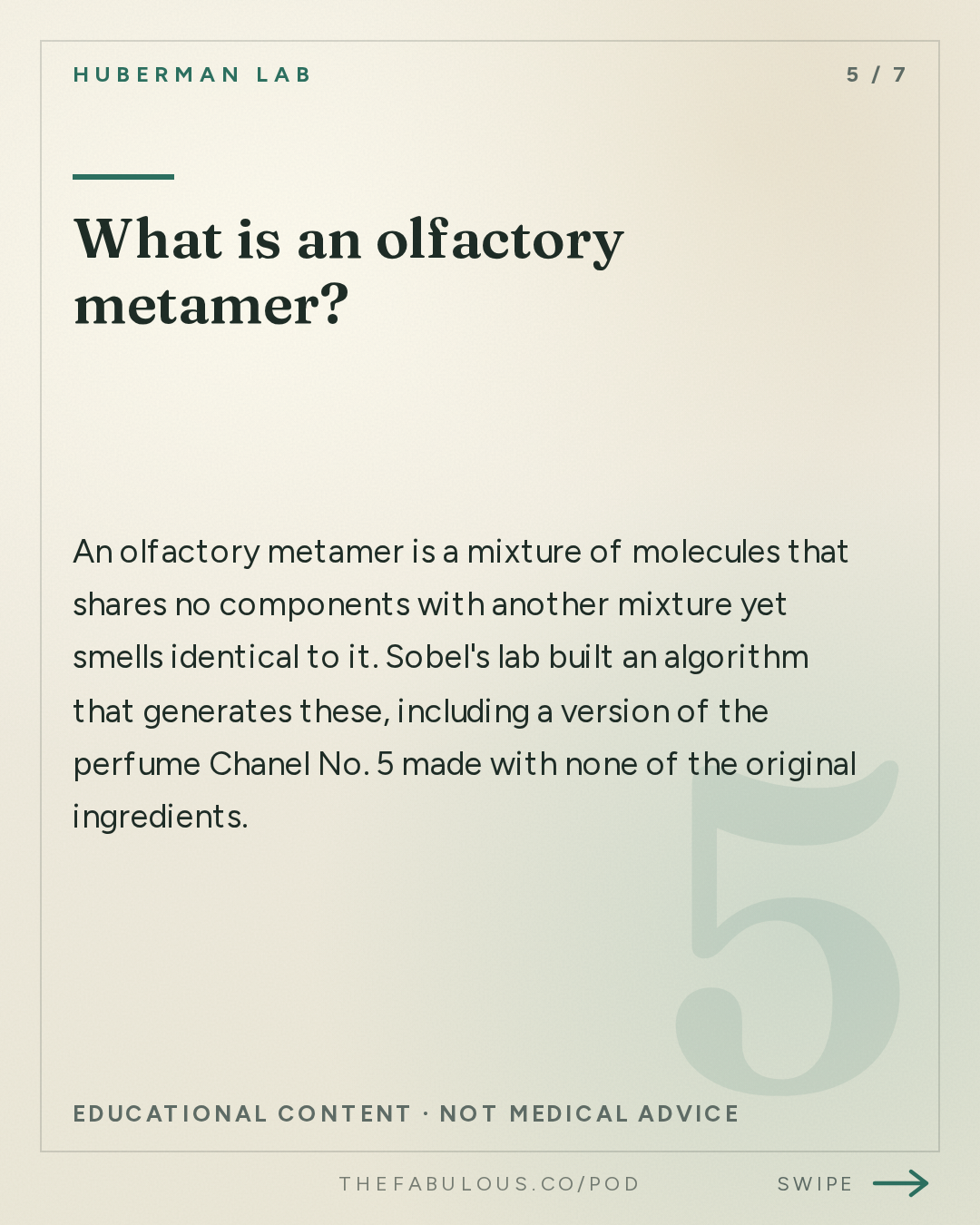
If smell carries this much information, the obvious next question is whether it can be captured, measured, and sent somewhere else, the way a photograph captures light or a recording captures sound. Sobel's lab has made a start. A paper led by lab members Aharon Ravia and Kobi Snitz built an algorithm that predicts how similar any two molecular mixtures will smell to a person, with high accuracy (27:10). The team then used that algorithm to design olfactory metamers: mixtures that share no molecules in common yet smell identical, including a version of the perfume Chanel No. 5 built from entirely different ingredients than the original (27:41).
"We measured mixtures completely non-overlapping in their molecular structure, but they smell exactly the same." (Noam Sobel, 27:41)
That similarity framework doubles as the start of a map. The lab has charted 4,000 molecules by their perceived smell, so any new mixture can be placed on that map and matched to its nearest neighbor, lemon, tomato, or anything else (30:00). The next step, in collaboration with atmospheric chemist Jonathan Williams at Germany's Max Planck Institute, is finding a small set of base molecules, odor primaries, that can be combined to recreate any smell, the olfactory equivalent of red, green, and blue light (30:27). In an early test, Williams measured real odorants in Germany and sent the data over the internet to Sobel's lab, which rebuilt them from primaries on the other end. Attempts at rose and anise failed, read by participants as bubblegum and cherry. Gasoline came through weakly but correctly. Violets succeeded outright: 15 of 16 participants named it correctly, making violets the first odor transmitted over the internet (31:22, 31:51).
Sobel is careful not to oversell where this stands. He compares it to the earliest days of black-and-white television, not anything close to high resolution (32:20). But he is willing to say where high-resolution smell would eventually matter most: medicine. Every disease produces its own metabolic signature, and metabolites have odors (32:43). An electronic nose sensitive enough to read those signatures, sitting quietly in a bathroom, could in principle flag disease long before symptoms do (33:10). That is decades away by his own admission. What the handshake study, the friendship study, the hexadecanal work, and the tears all point to in the meantime is simpler and already true: people are reading each other's chemistry constantly, acting on it, and almost never noticing that they do.
Ask this episode anything
Pod's AI answers from the episode itself, with the minute mark so you can hear it yourself.
Or start with one of these
Ask this episode
Pod's AI listens to the whole episode to answer, and points you to the minute it comes from.
The rest of this answer, and any question after it
Answers come from the episode itself, never from a summary of it.
ContinueKey takeaways
- People secretly sniff their own hand after shaking a stranger's hand
- Body odor similarity between strangers predicts whether they click as friends, Sobel's lab found
- The molecule hexadecanal lowers aggression in men but raises it in women, Sobel's lab found
- Sniffing a woman's odorless emotional tears drops men's free testosterone 14% within 20 to 30 minutes
- Sobel's lab created olfactory metamers: different molecules that smell identical
The episode in cards
By the numbers
- 14% percent drop in men's free testosterone after sniffing odorless emotional tears
In their words
“So this was an olfactory behavior, no doubt about it.”
“People who smell more similar to each other think that the other person is more likely to be their friend.”
“Babies are conducting chemical warfare, right? They're reducing aggression in their fathers or males around them and increasing aggression in their mothers or females around them, and both of those things are good for them.”
“And yet when you sniff them, you have a pronounced, uh, reduction in testosterone, uh, within about 20 minutes, half an hour.”
“We measured mixtures completely non-overlapping in their molecular structure, but they smell exactly the same.”
Questions this episode answers
Does smelling tears lower testosterone?
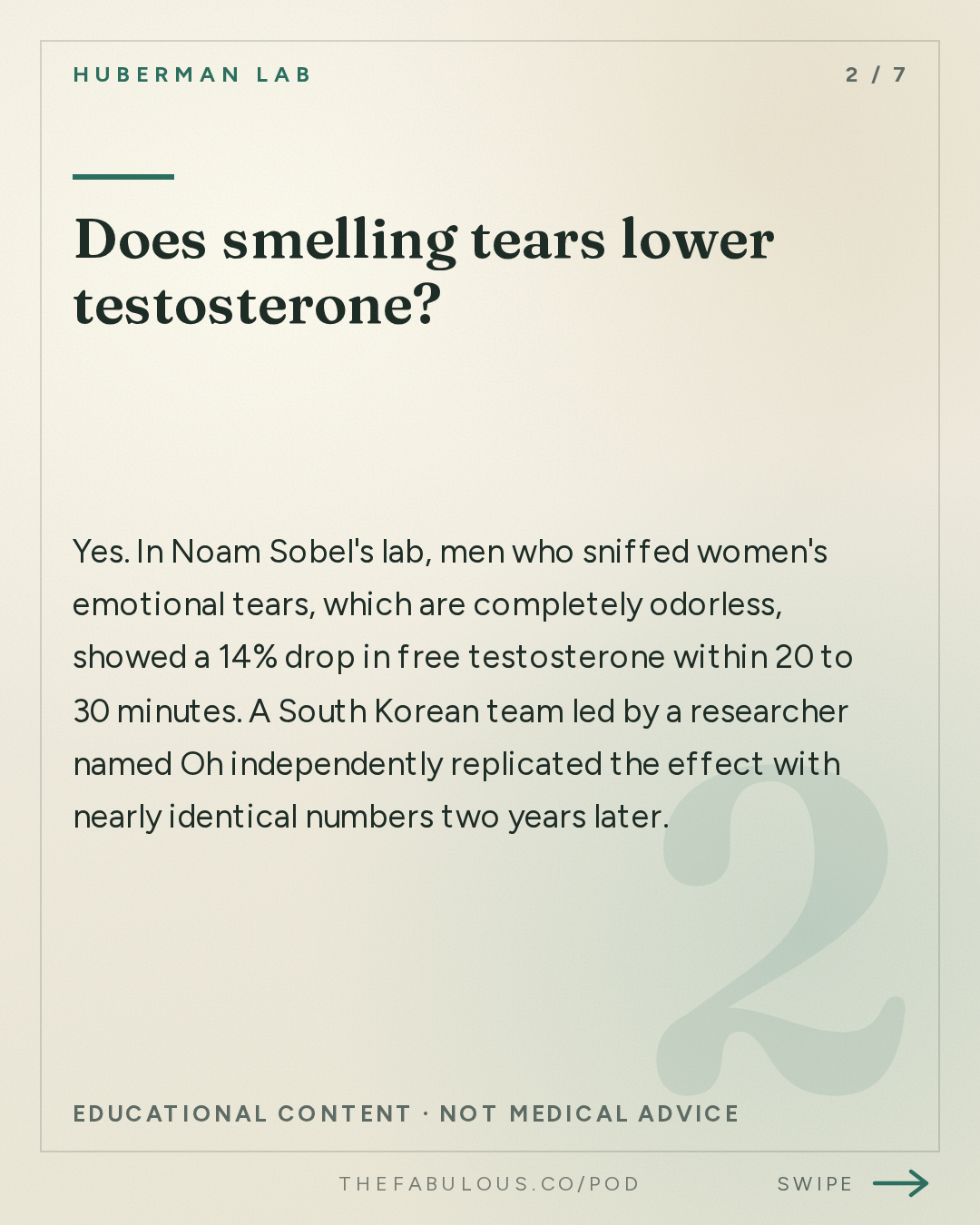
Yes. In Noam Sobel's lab, men who sniffed women's emotional tears, which are completely odorless, showed a 14% drop in free testosterone within 20 to 30 minutes (23:24). A South Korean team led by a researcher named Oh independently replicated the effect with nearly identical numbers two years later (23:49).
What is hexadecanal and how does it affect aggression?
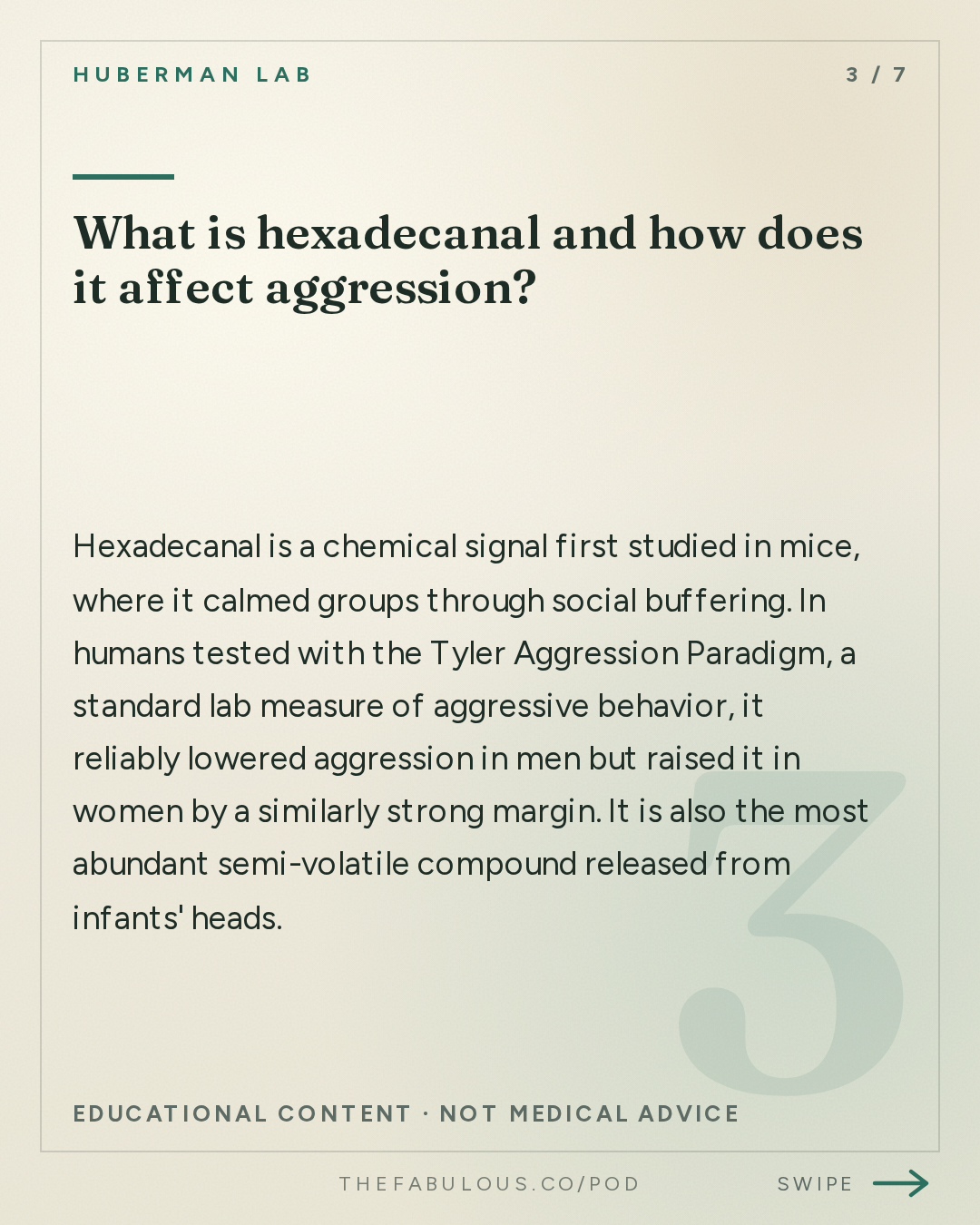
Hexadecanal is a chemical signal first studied in mice, where it calmed groups through social buffering. In humans tested with the Tyler Aggression Paradigm, a standard lab measure of aggressive behavior, it reliably lowered aggression in men but raised it in women by a similarly strong margin (18:44, 19:08). It is also the most abundant semi-volatile compound released from infants' heads (20:13).
Can an electronic nose predict whether two strangers will become friends?
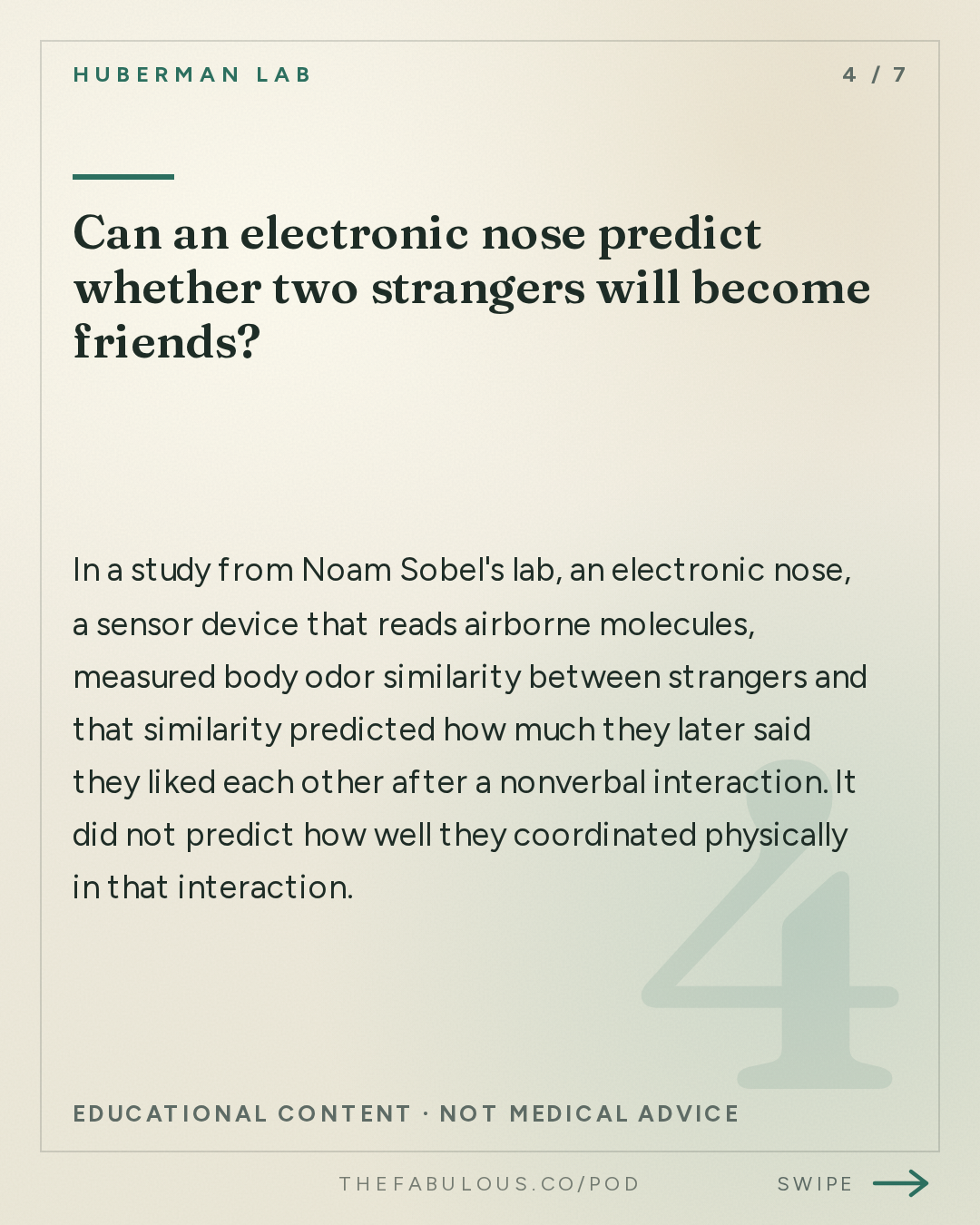
In a study from Noam Sobel's lab, an electronic nose, a sensor device that reads airborne molecules, measured body odor similarity between strangers and that similarity predicted how much they later said they liked each other after a nonverbal interaction (13:34). It did not predict how well they coordinated physically in that interaction (12:58).
What is an olfactory metamer?
An olfactory metamer is a mixture of molecules that shares no components with another mixture yet smells identical to it. Sobel's lab built an algorithm that generates these, including a version of the perfume Chanel No. 5 made with none of the original ingredients (27:41).
Why do people sniff their own hand after shaking hands?
In Noam Sobel's lab study, volunteers who shook hands with a stranger touched and sniffed their own hand far more often afterward than volunteers who did not shake hands, and nasal airflow measurements confirmed they were actively sniffing rather than just touching their face (05:46, 07:51).
Can smell be digitized and sent over the internet?
Noam Sobel's lab built a reference map of 4,000 molecules by perceived smell and used it to reconstruct odorants measured in Germany by atmospheric chemist Jonathan Williams, sending the data over the internet and rebuilding the scent from base molecules. Violets were successfully recreated, with 15 of 16 participants identifying them correctly, making it the first odor transmitted this way (31:51).
The full read, in cards
Go deeper
- The Expression of the Emotions in Man and Animals — Darwin found a function for nearly every emotional display except tears, which he could not explain
- Oh et al. replication study — South Korean team independently replicated the tear-testosterone drop with nearly identical numbers
- Nature paper on mouse pup tears — found that tears from mouse pups lower aggression in adult male mice through smell
- Nature paper on olfactory metamer algorithm — introduced a framework predicting perceptual similarity of molecular mixtures and generated scent metamers
Mentioned
Dr. Noam Sobel · Andrew Huberman · Olfactory Epithelium · Olfactory Bulb · Hexadecanal · Tyler Aggression Paradigm · Charles Zuker · Darwin · Electronic Nose · Max Planck Institute
More from this show and category

Ross Edgley on the Neuroscience of Motivation
Ultra-endurance swimmer Ross Edgley and Andrew Huberman trace grit to the brain's anterior midcingulate cortex and sketch a five-spoke model of motivation. Drawing on swims around Great Britain and Iceland, they cover stress inoculation, vision and arousal, and protocols like 400 mg of caffeine and 10 g of daily creatine for performance under fatigue.

Huberman's Rational Guide to Supplements
Andrew Huberman's framework ranks behavior, then nutrition, then supplements, then prescription drugs, arguing supplements only work once the first two are solid (00:42). He gives exact doses for sleep, hormone, and focus compounds, and insists on testing one ingredient at a time (35:08).
Jared Diamond on Leadership: Why Charisma Isn't Required
Charisma is optional for great leadership, biologist and historian Jared Diamond argues, pointing to the uncharismatic dictators Stalin and Pinochet as proof (00:26). Diamond, 89, applies a 'natural experiment' method from biology to politics, religion, business, and sports, showing only 2 of 22 modern political leaders stepped down voluntarily and that coaches and CEOs get too much credit or blame for outcomes that are mostly random (95:37).

Neuralink Trials for Quadriplegia: What Comes First
Neuralink's head neurosurgeon Matt MacDougall explains that the implant's first job is letting quadriplegic patients move a cursor and type by thought alone, not reconnect limbs. He also covers the robotic surgery that makes this possible, the safety case made in pigs and monkeys, and his own subdermal RFID chip.
