
Ross Edgley on the Neuroscience of Motivation
Unlocking Persistent Motivation & Extreme Resilience | Ross Edgley
The brief
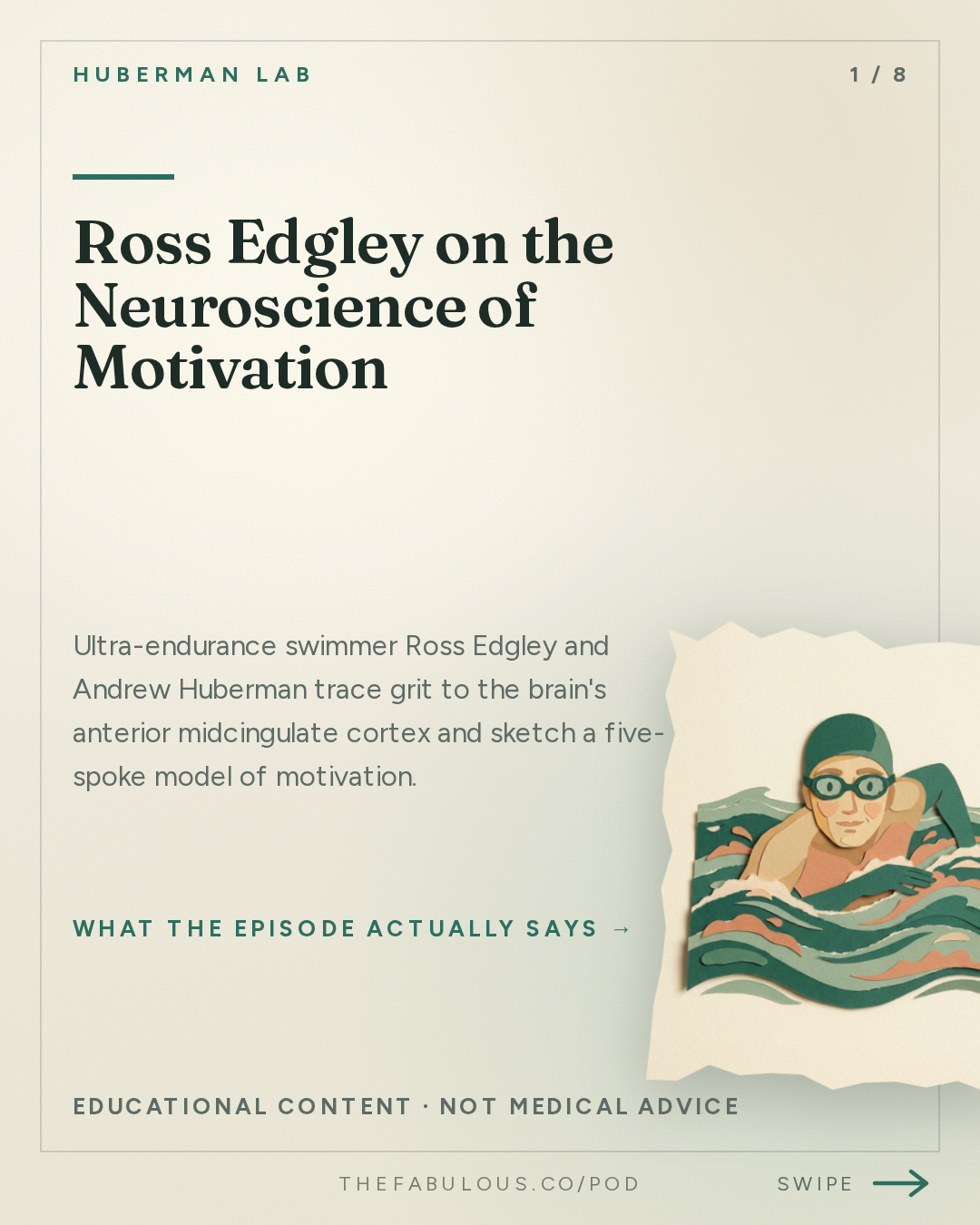
Ultra-endurance swimmer Ross Edgley and Andrew Huberman trace grit to the brain's anterior midcingulate cortex and sketch a five-spoke model of motivation. Drawing on swims around Great Britain and Iceland, they cover stress inoculation, vision and arousal, and protocols like 400 mg of caffeine and 10 g of daily creatine for performance under fatigue.
There is a small, folded strip of tissue near the center of the brain that seems to grow when people do things they would rather not do. It is called the anterior midcingulate cortex, and it does not care whether the hard thing is a marathon, a dissertation, or cleaning out the garage. It only registers that the task is unwanted and that the person kept going anyway. Stanford neurosurgeon Joe Parvizi found it by accident, stimulating electrodes in patients undergoing brain surgery and listening to what they said. People described a feeling like a storm arriving, paired with a strange resolve to walk into it (11:50). Andrew Huberman has talked about this structure before. On this episode he brought in someone who has spent more hours than almost anyone alive finding out what it feels like from the inside: Ross Edgley, a British ultra-endurance swimmer who swam around the entire coastline of Great Britain, a 157-day effort, and later swam the full length of Iceland's coast as well.
Edgley opens the conversation with a myth rather than a medal count. Sisyphus, he says, was condemned by the gods to push a boulder up a hill forever, only for it to roll back down each time he reached the top. The philosopher Albert Camus suggested imagining Sisyphus smiling. Edgley quotes him directly.
"Because the struggle alone is enough to fill a man's heart." (00:31)
That line becomes the spine of the episode. Edgley does not think of his tongue falling off in salt water, or the hypothermia that once put him in a Scottish hospital after 56 hours in a loch barely above freezing (24:46), as punishment. He thinks of it as his boulder. The question the two men spend two and a half hours chasing is simple to ask and hard to answer: what, exactly, keeps a person pushing.
A Wheel With Several Spokes
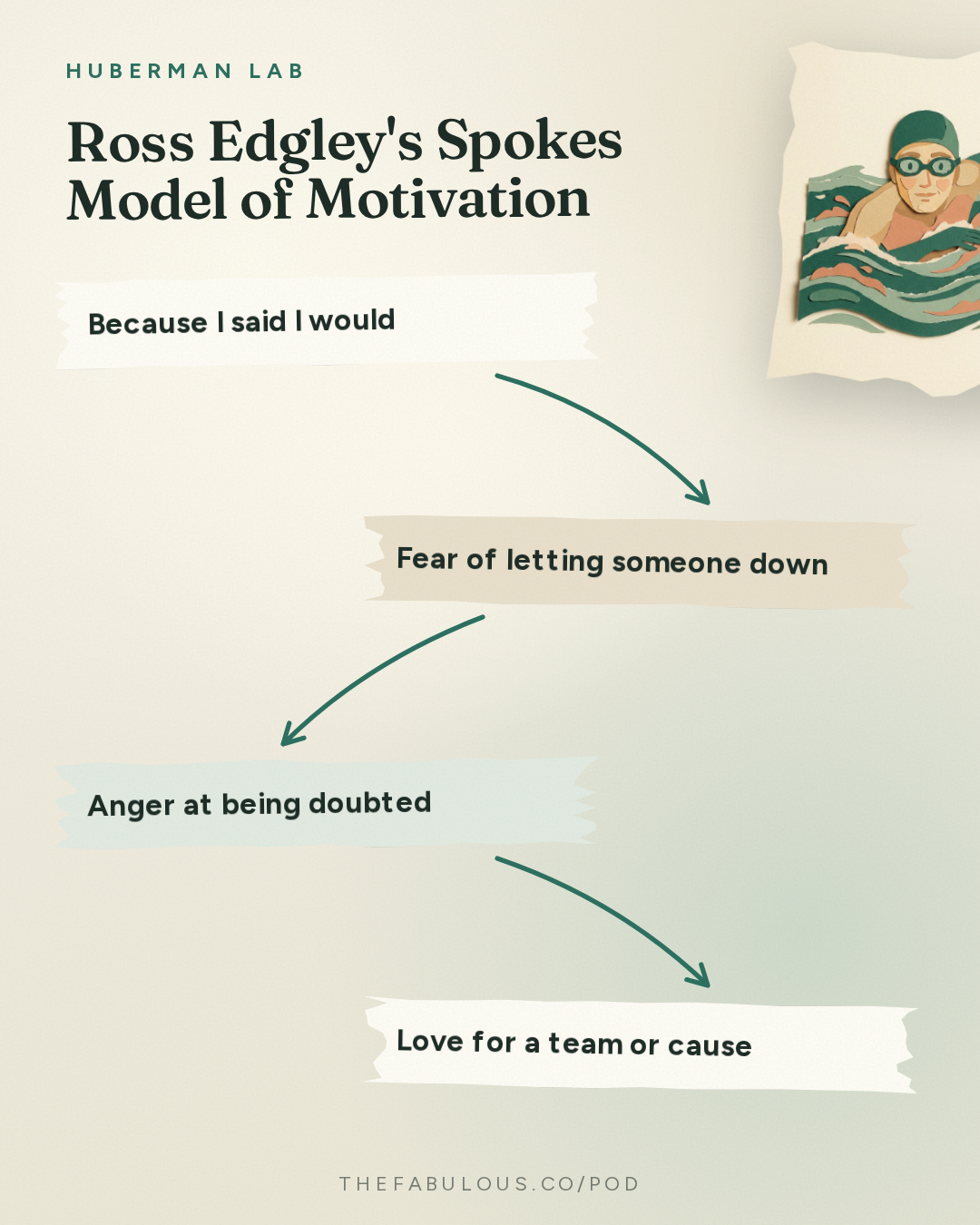
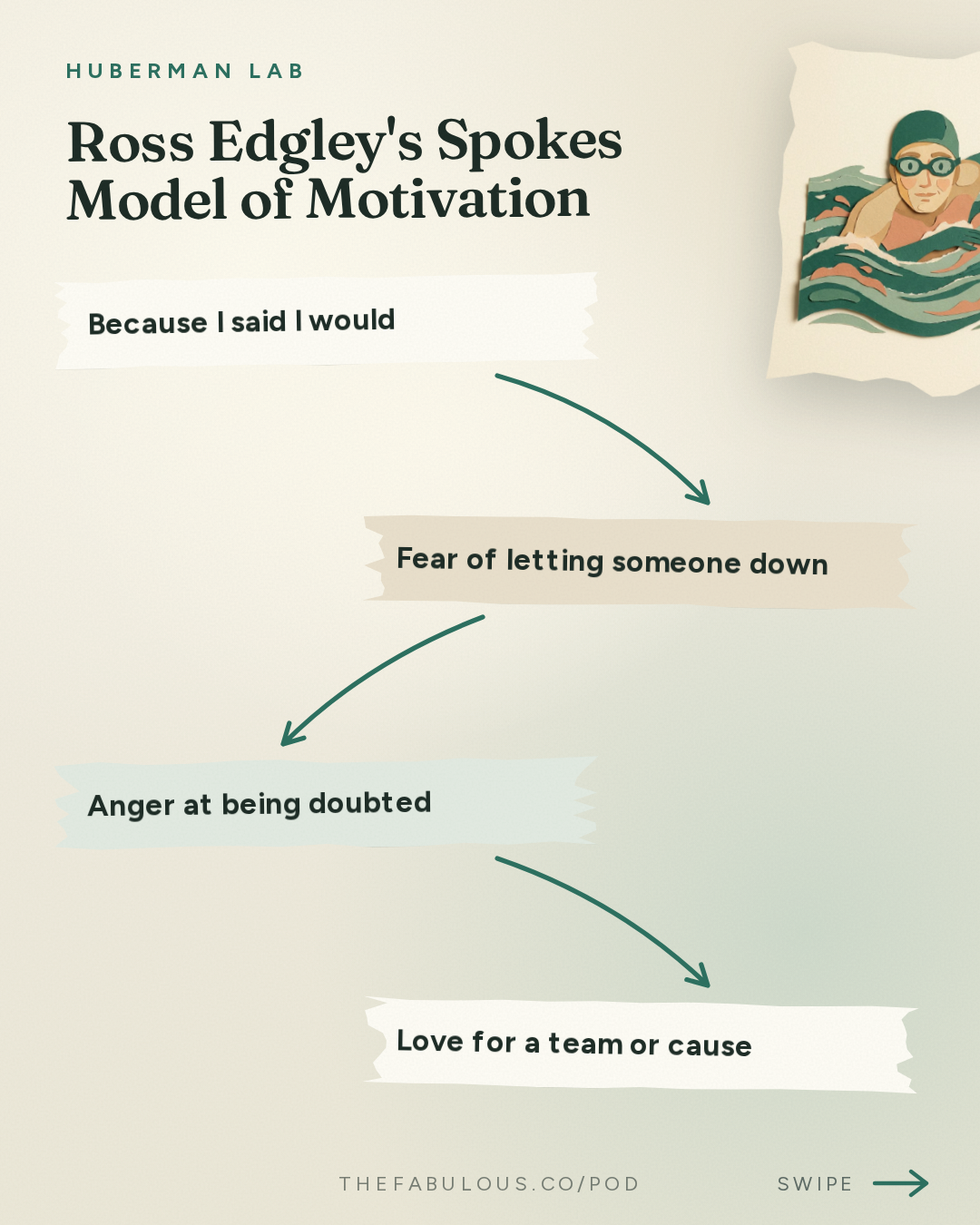
Huberman proposes a model on the spot, and Edgley, delighted, runs with it. Instead of a single dial that slides between quitting and persisting, imagine a wheel with several spokes, each one a different reason to keep moving, and as long as no single spoke touches the ground for too long, the wheel keeps turning (14:38). The first spoke is the plainest: doing something simply because you said you would. Edgley points to the swim around Great Britain, where he had already told sponsors, his brother, and the public what he intended to do, and quitting would have meant living with the gap between his word and his action (16:30). The second spoke is fear of disappointing someone else, which is subtly different from fear of failing yourself. He describes finishing an Iceland swim's last hundred miles while a hurricane, a volcano, and a glacier calving ice the size of a table all threatened the route, driven mainly by the fact that his son was due to be born in a week and he did not want to miss it (21:43).
The third spoke is anger, the useful kind. Online commenters told Edgley before the Great Britain swim that he was too big to finish, that he would quit within a hundred kilometers (55:42). He kept the comments and used them as fuel, and later admitted that once people stopped doubting him, he almost missed having something to prove (56:05). The fourth spoke is love, specifically what evolutionary biologists call affiliative motivation, the drive that exists for kin and close others rather than for the self alone. Edgley describes swimming the Yukon River, 317 miles nonstop over 56 hours, while a terminally ill river guide named Larry, who had weeks to live, steered alongside him and cheered. Larry died not long after watching the finished documentary with every nurse on his hospital ward (147:10). The fifth spoke, which Edgley articulates without quite naming it until Huberman does it for him, is gratitude for the ability to do the thing at all, something he learned from watching his father, a tennis coach with terminal cancer, insist on continuing to coach from a wheelchair the day after being told he could no longer stand on the court (145:06).
None of these spokes stays strong forever. Edgley is candid that a reason which carries him through one dark patch can feel hollow the next morning, which is why having several matters more than having one powerful one.
"Your reasons to continue need to be bigger than your reasons to stop." (56:38)
The Physics of Staying In
Huberman supplies the harder science to go with Edgley's lived experience, and some of it complicates the simple idea that suffering builds character evenly. A set of mouse studies known as the tube test shows that prior winners tend to keep winning fights over territory, and that this effect holds up independent of testosterone or body weight (32:54). When researchers silence a specific prefrontal region in a habitual winner, it starts losing. When they boost activity in that same region in a habitual loser, it starts winning every time (33:31). The implication is that persistence has a physical seat in the brain, not just a story we tell about character.
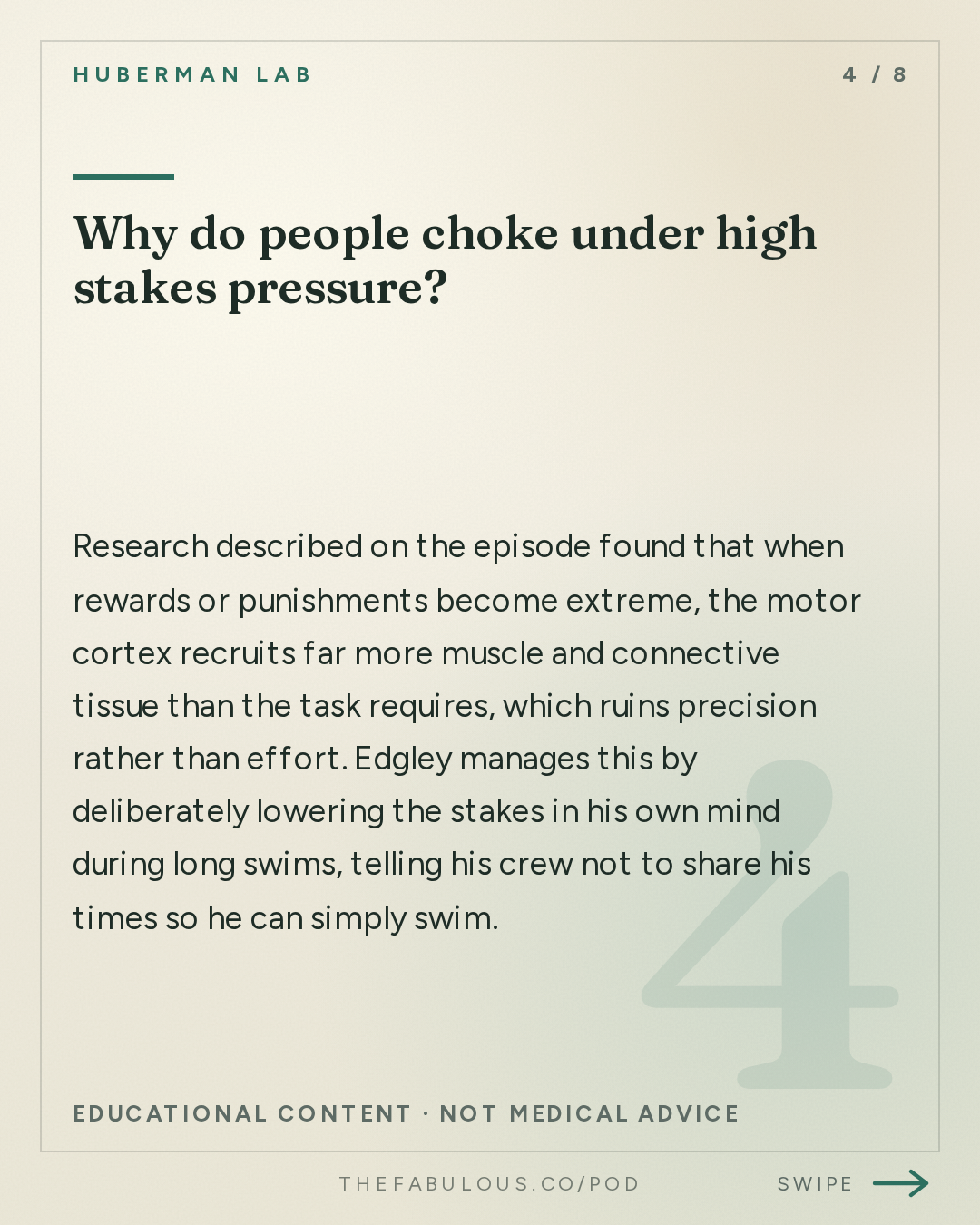
Stakes themselves can backfire. Huberman describes research showing that when a reward or punishment becomes extreme, the motor cortex recruits far more muscle and connective tissue than the task requires, and precision collapses, which is one mechanical explanation for choking (86:42). Edgley recognizes this from his own swims: when the pressure built too high, his coping move was to deliberately lower the stakes in his own head, telling his crew not to tell him his split times and simply swimming for the pleasure of the water (88:16). Time perception plays its own trick. Huberman notes that negative emotional states make time feel endless, while positive ones feel as if they will end too soon, a finding Edgley says matches his 2 a.m. certainty that a swim would never finish, a certainty that reliably proved wrong by morning (91:38).
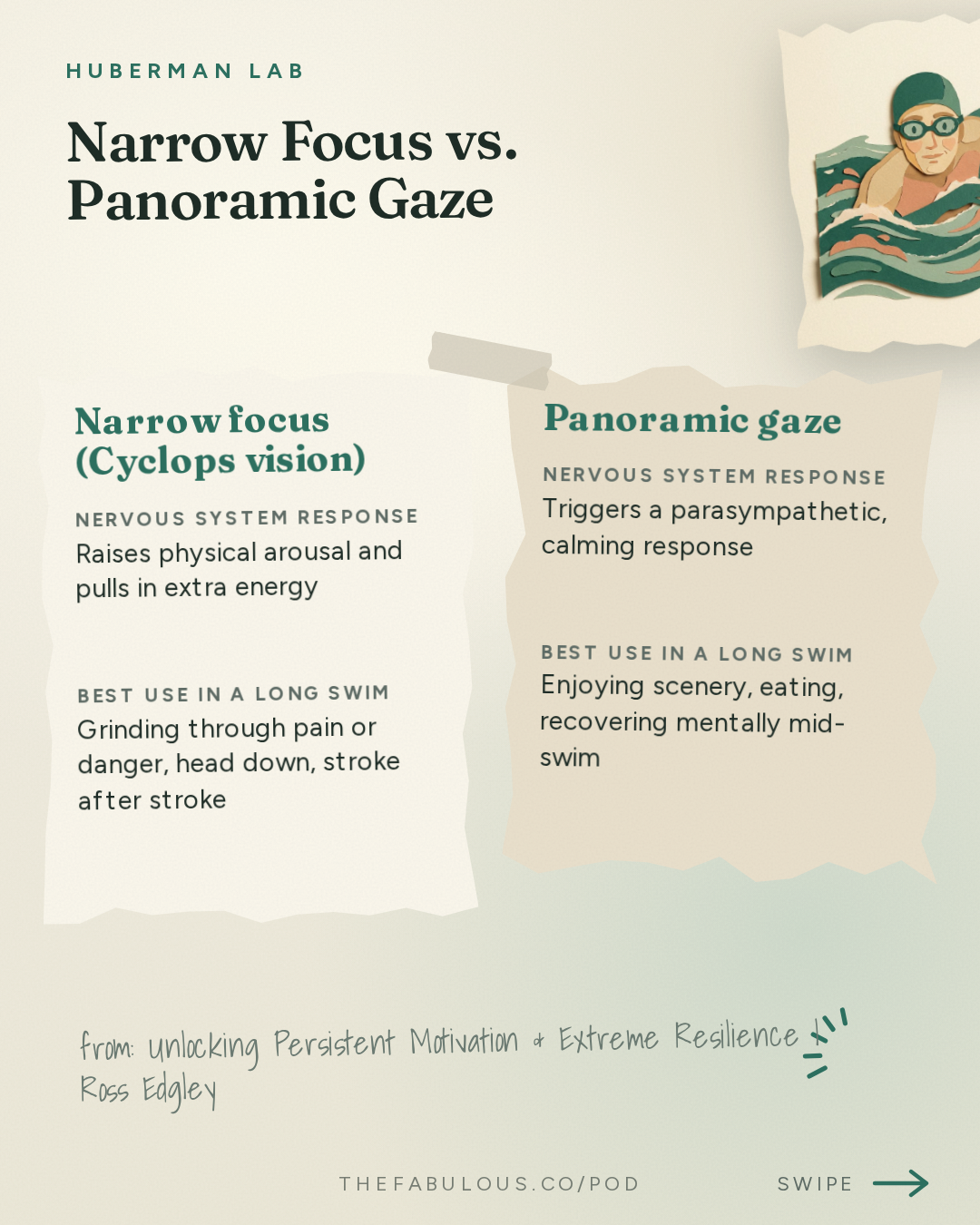
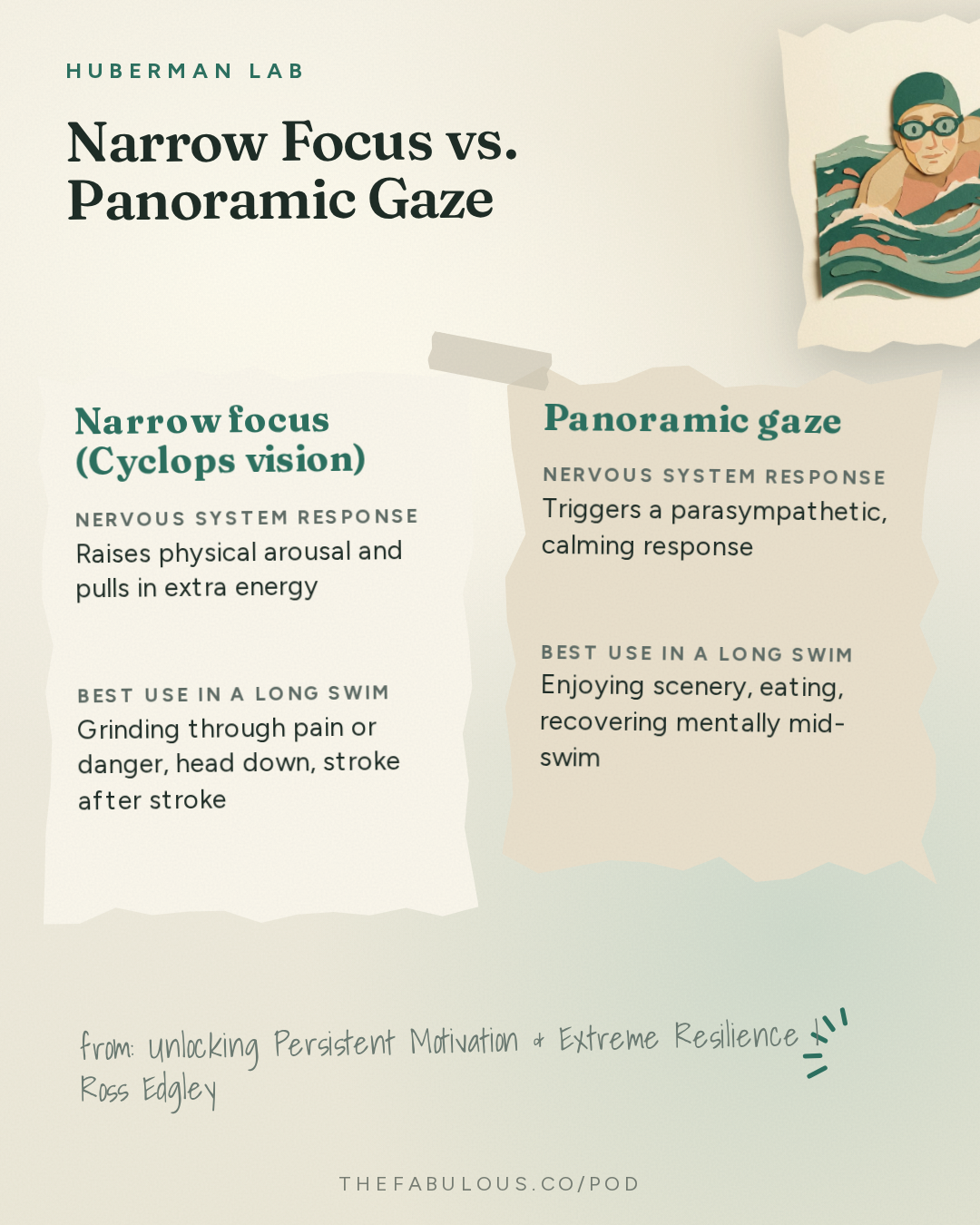
Vision turns out to be a lever too. Narrowing the gaze toward a single point raises physical arousal and pulls in more energy, the state Edgley calls Cyclops mode, useful for grinding through a night swim with his face an inch from the riverbed. Widening the gaze into a panoramic view does the opposite, triggering the parasympathetic nervous system and a felt sense of calm, which Edgley uses for the hours he wants to simply enjoy the scenery (116:03). The same creature, Huberman notes, is a cuttlefish: eyes on the side for safety, eyes rotated forward the instant it decides to hunt.
The physiology of extreme effort is not gentle. Prolonged saltwater immersion extracted so much moisture from Edgley's tongue during one swim that a piece of it came away in his soup (93:33). None of this, he insists, is heroic masochism. It is closer to information: a body telling him where its real limits sit, as distinct from the limits his brain invents at 3 a.m.
Building the Reserve
Edgley also treats his own training as an experiment, and it is here the episode turns practical. He lifts heavy on purpose, chasing a bigger one-rep max on pull-ups so that every stroke in open water draws on a smaller fraction of his total strength, a concept he calls the strength reserve (134:32). Before his heaviest pull-up sets he loads the bar well past his working weight, holds an active hang for a few seconds without fatiguing himself, then strips the extra weight and rests before lifting, a neural priming trick meant to switch the nervous system on rather than tire the muscle (137:53). Huberman, for his part, has taken 10 grams of creatine daily for years and notes that creatine can partly rescue cognitive function and physical vigor during severe sleep deprivation, though it is not a substitute for sleep (125:42). During his worst stretches of fatigue in the water, Edgley has leaned on 400 milligrams of caffeine, which he says can turn a dark fifteen minutes into something bearable again (123:00).
What holds the whole conversation together is a refusal to romanticize suffering for its own sake. Edgley outsources the decision to stop to his support crew precisely because he knows he would otherwise swim himself into a hospital bed, as he has done before (39:44). The spokes model is not a case for pain as virtue. It is closer to an inventory: know which reason you are running on, notice when it runs dry, and have another one ready. Sisyphus gets his hill back every day. The trick, both men seem to agree, is in finding enough reasons to keep smiling while you push.
Ask this episode anything
Pod's AI answers from the episode itself, with the minute mark so you can hear it yourself.
Or start with one of these
Ask this episode
Pod's AI listens to the whole episode to answer, and points you to the minute it comes from.
The rest of this answer, and any question after it
Answers come from the episode itself, never from a summary of it.
ContinueKey takeaways
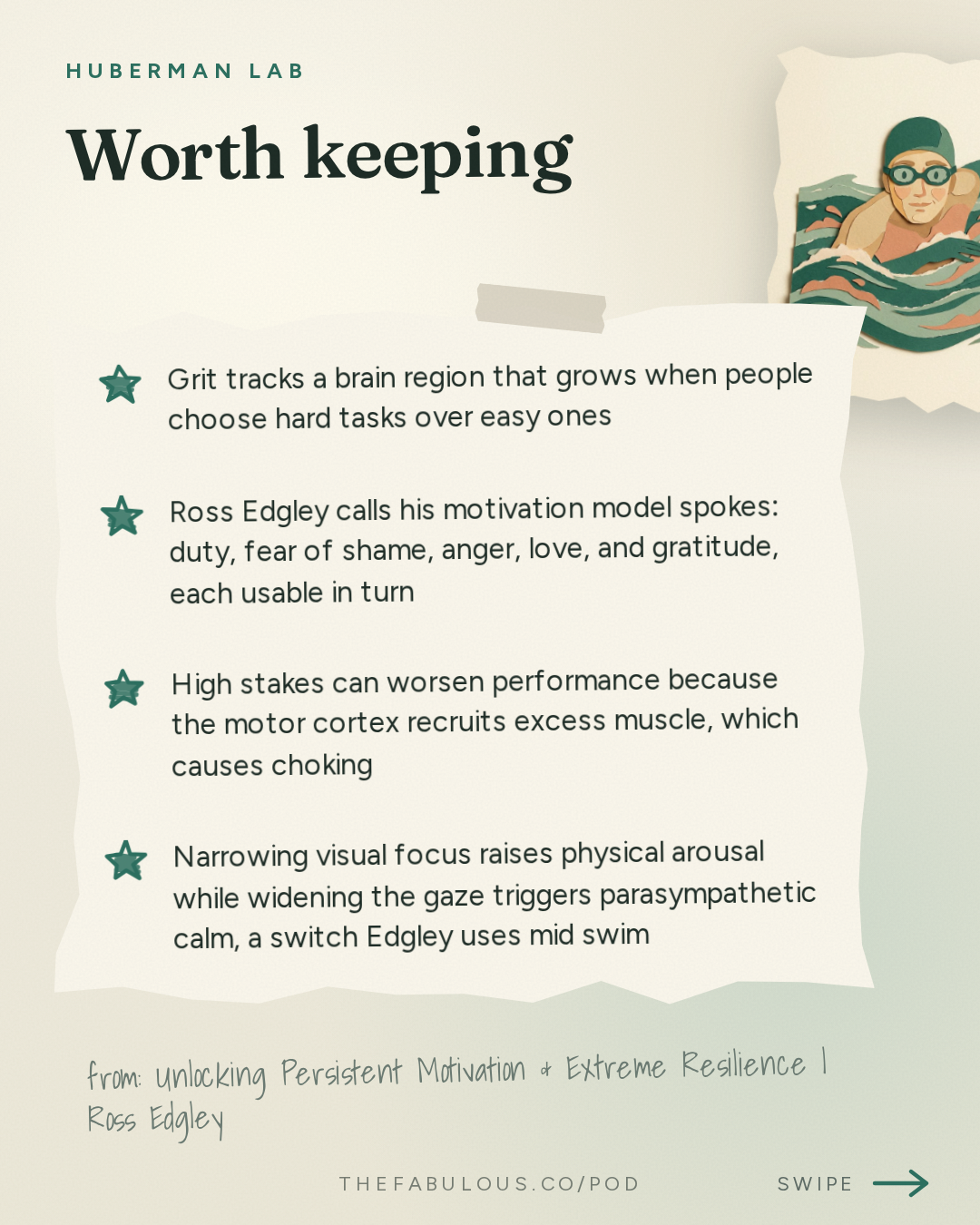
- Grit tracks a brain region that grows when people choose hard tasks over easy ones
- Ross Edgley calls his motivation model spokes: duty, fear of shame, anger, love, and gratitude, each usable in turn
- High stakes can worsen performance because the motor cortex recruits excess muscle, which causes choking
- Narrowing visual focus raises physical arousal while widening the gaze triggers parasympathetic calm, a switch Edgley uses mid swim
- Creatine at 10 grams daily can partly rescue cognitive function during severe sleep deprivation, Huberman says
The episode in cards
In their words
“Because the struggle alone is enough to fill a man's heart.”
“Adversity introduces you to you.”
“Your reasons to continue need to be bigger than your reasons to stop.”
“Whoever makes a beast of himself gets rid of the pain of being a man.”
Protocols
-
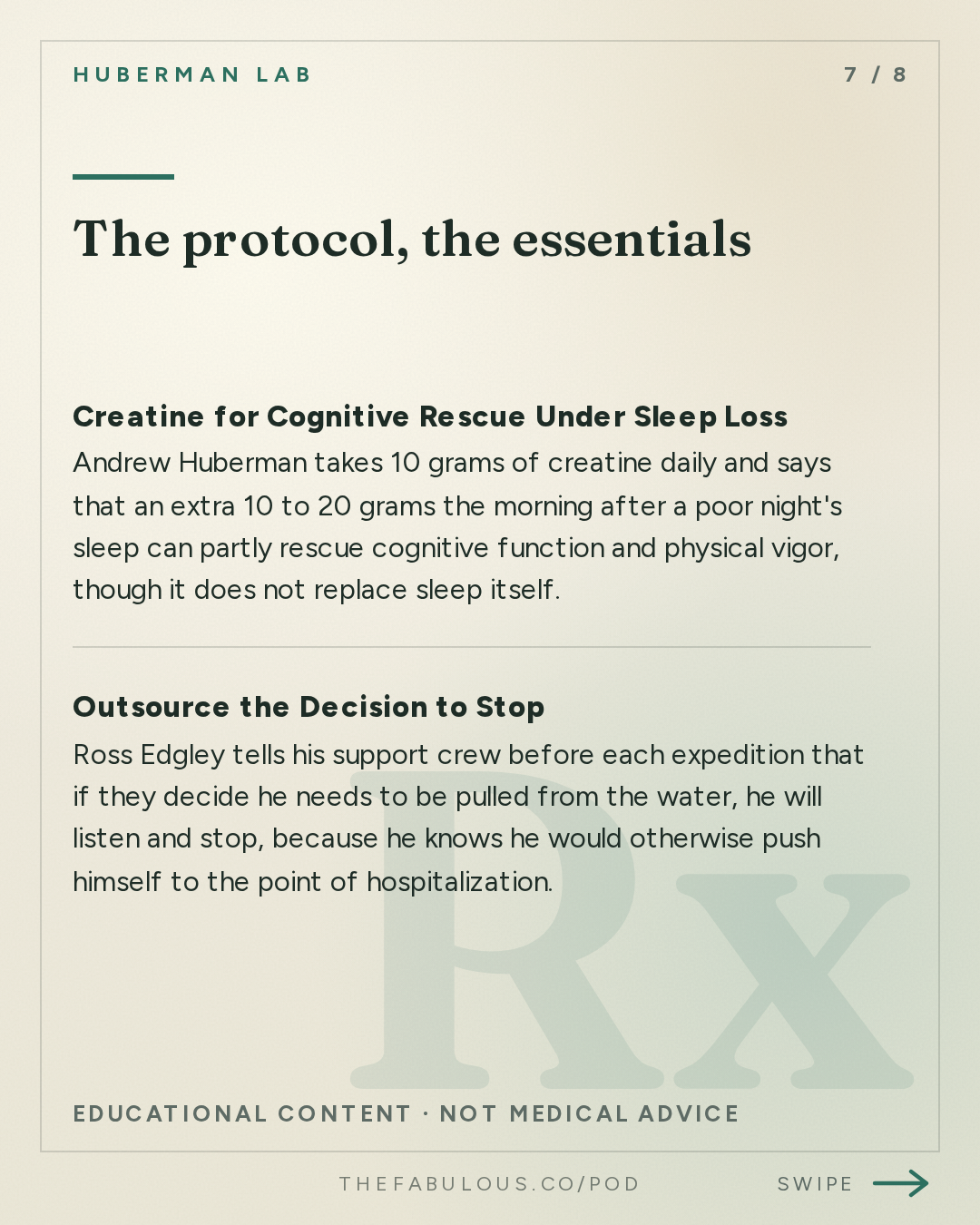
Creatine for Cognitive Rescue Under Sleep Loss
Andrew Huberman takes 10 grams of creatine daily and says that an extra 10 to 20 grams the morning after a poor night's sleep can partly rescue cognitive function and physical vigor, though it does not replace sleep itself.
Daily, with an extra dose after poor sleep
-
Outsource the Decision to Stop
Ross Edgley tells his support crew before each expedition that if they decide he needs to be pulled from the water, he will listen and stop, because he knows he would otherwise push himself to the point of hospitalization.
Set before each expedition begins
-
Focus on Process, Not Outcome
Ross Edgley concentrates on stroke mechanics, such as a high elbow catch, rather than on distance remaining, because dwelling on the outcome produces mental fatigue while focusing on the process lets the outcome take care of itself.
Continuously during long swims
-
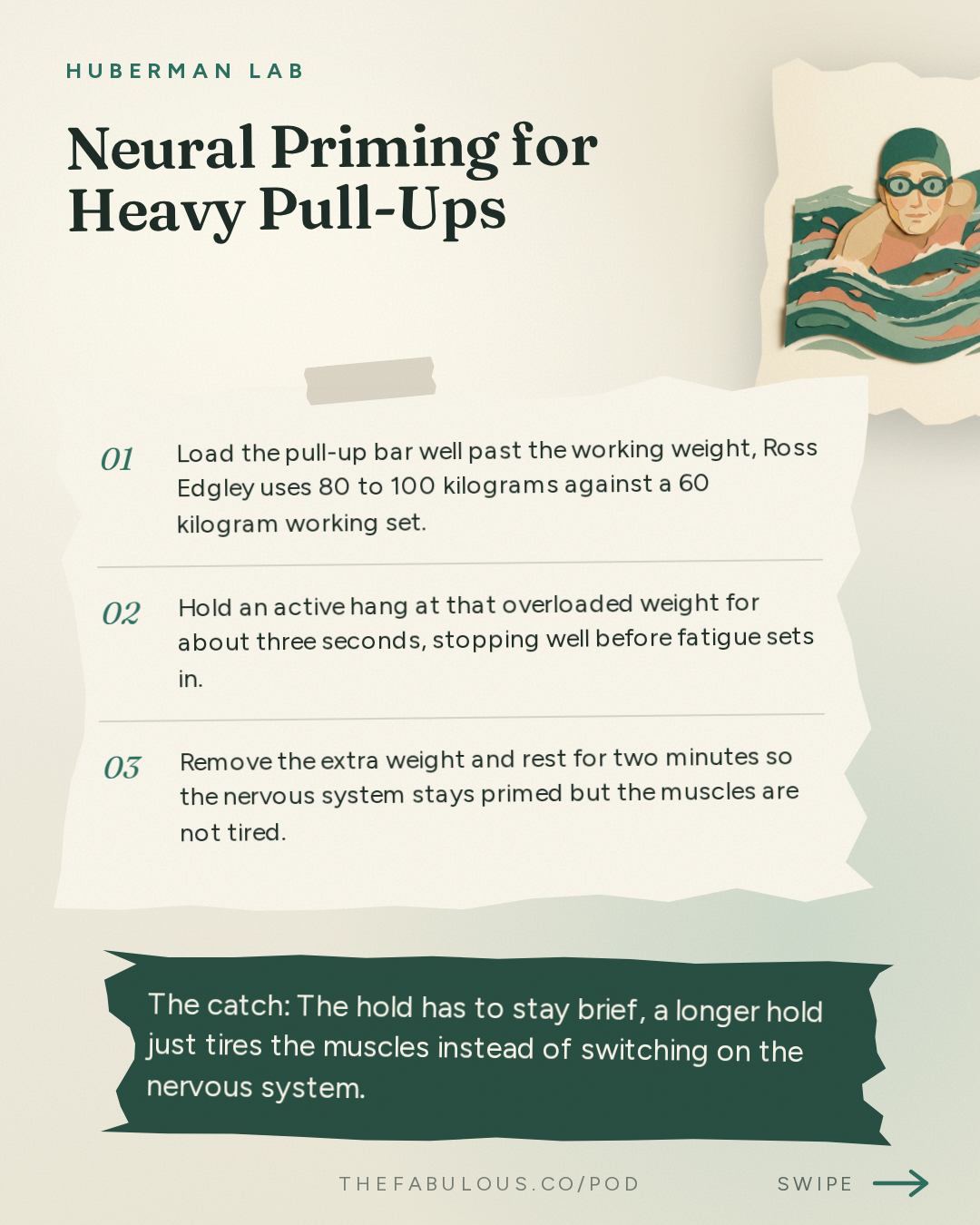
Neural Priming Before Heavy Pull-Ups
Ross Edgley loads 80 to 100 kilograms onto the pull-up bar and holds a brief active hang of about three seconds without fatiguing himself, removes the extra weight, rests two minutes, and then performs his working set at 60 kilograms, which then feels lighter and moves faster.
Before heavy pull-up sets in training
Questions this episode answers
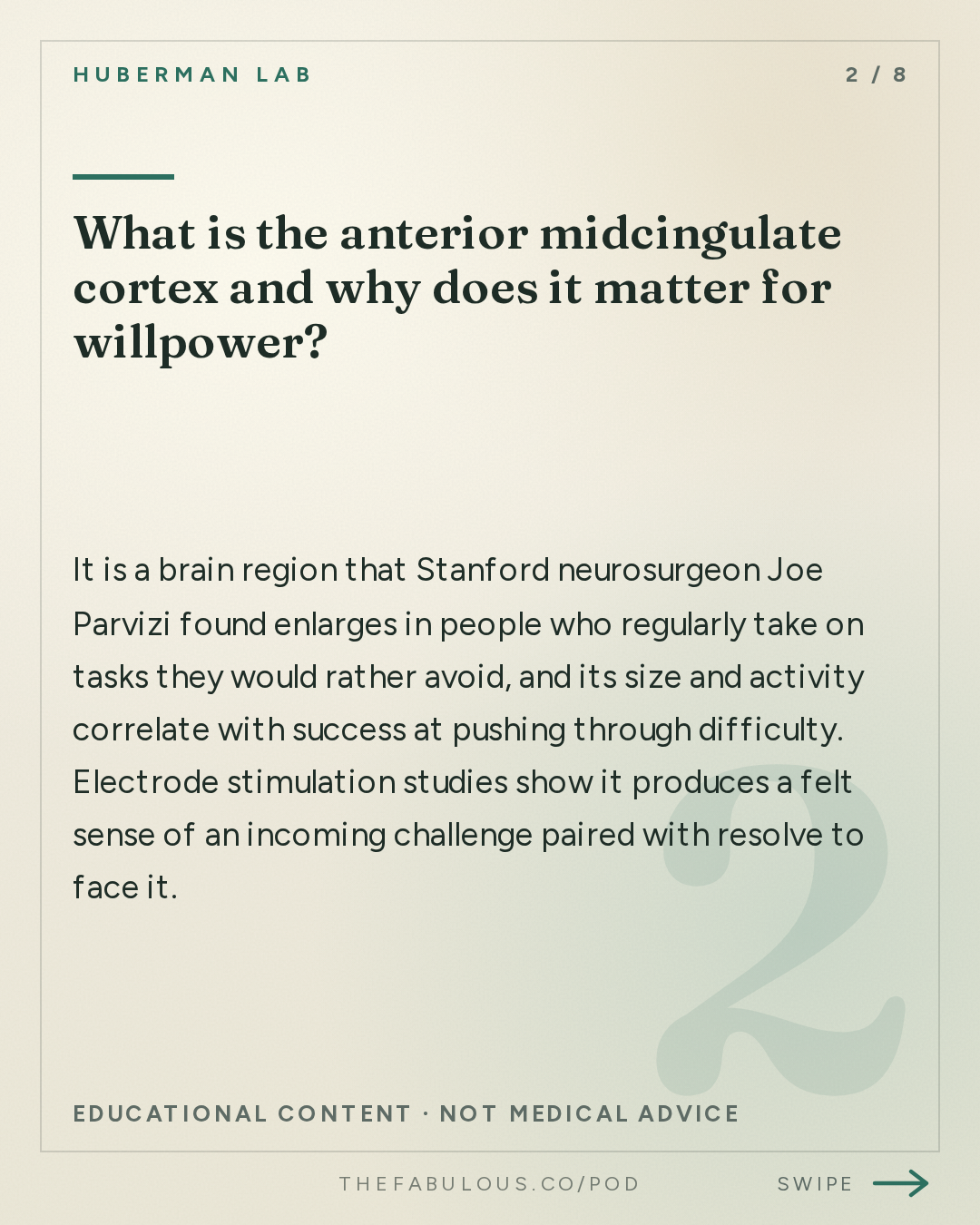
What is the anterior midcingulate cortex and why does it matter for willpower?
It is a brain region that Stanford neurosurgeon Joe Parvizi found enlarges in people who regularly take on tasks they would rather avoid, and its size and activity correlate with success at pushing through difficulty (12:55). Electrode stimulation studies show it produces a felt sense of an incoming challenge paired with resolve to face it (11:50).
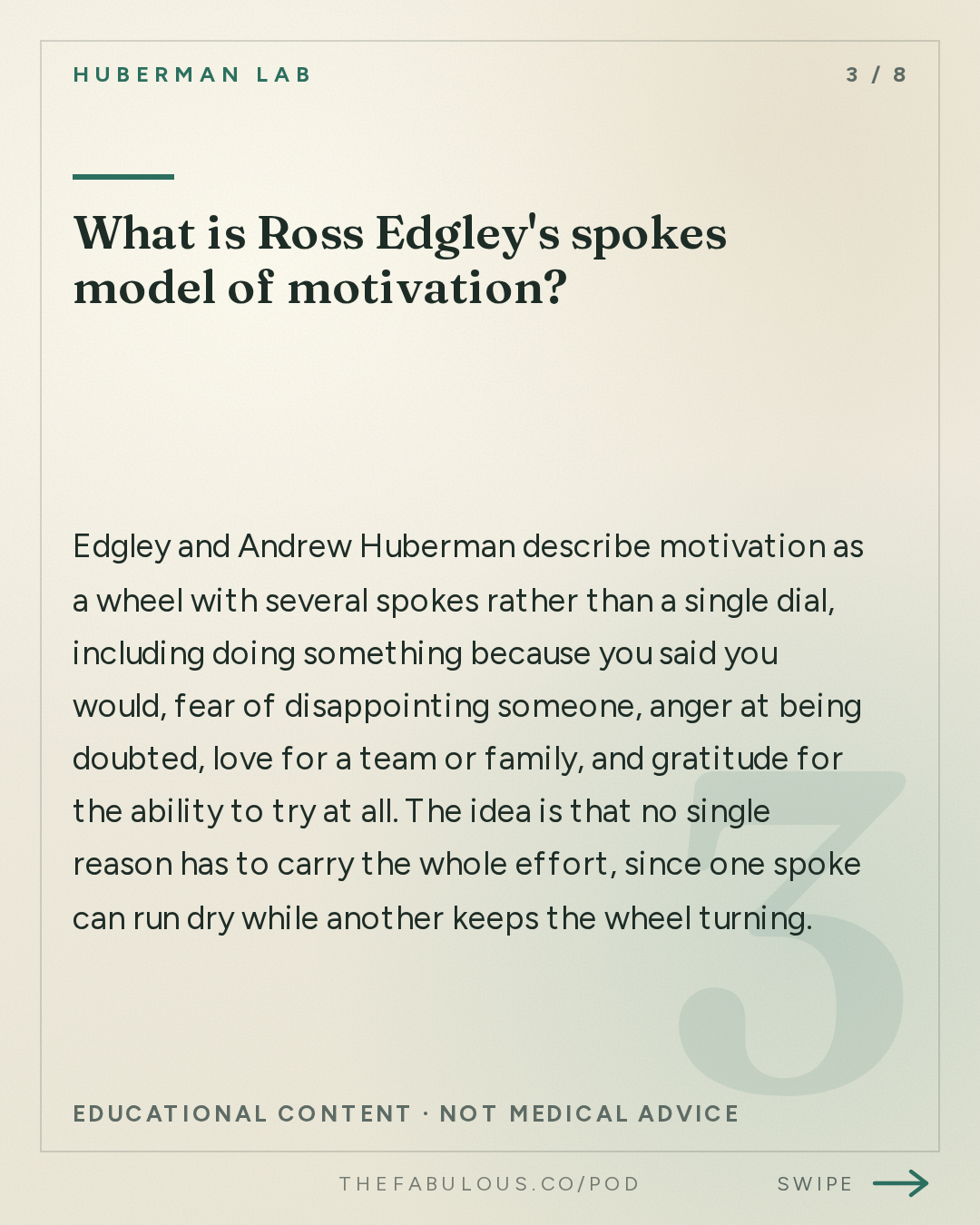
What is Ross Edgley's spokes model of motivation?
Edgley and Andrew Huberman describe motivation as a wheel with several spokes rather than a single dial, including doing something because you said you would, fear of disappointing someone, anger at being doubted, love for a team or family, and gratitude for the ability to try at all (14:38). The idea is that no single reason has to carry the whole effort, since one spoke can run dry while another keeps the wheel turning.
Why do people choke under high stakes pressure?
Research described on the episode found that when rewards or punishments become extreme, the motor cortex recruits far more muscle and connective tissue than the task requires, which ruins precision rather than effort (86:42). Edgley manages this by deliberately lowering the stakes in his own mind during long swims, telling his crew not to share his times so he can simply swim.
Does cold exposure training build general resilience, or just resistance to cold?
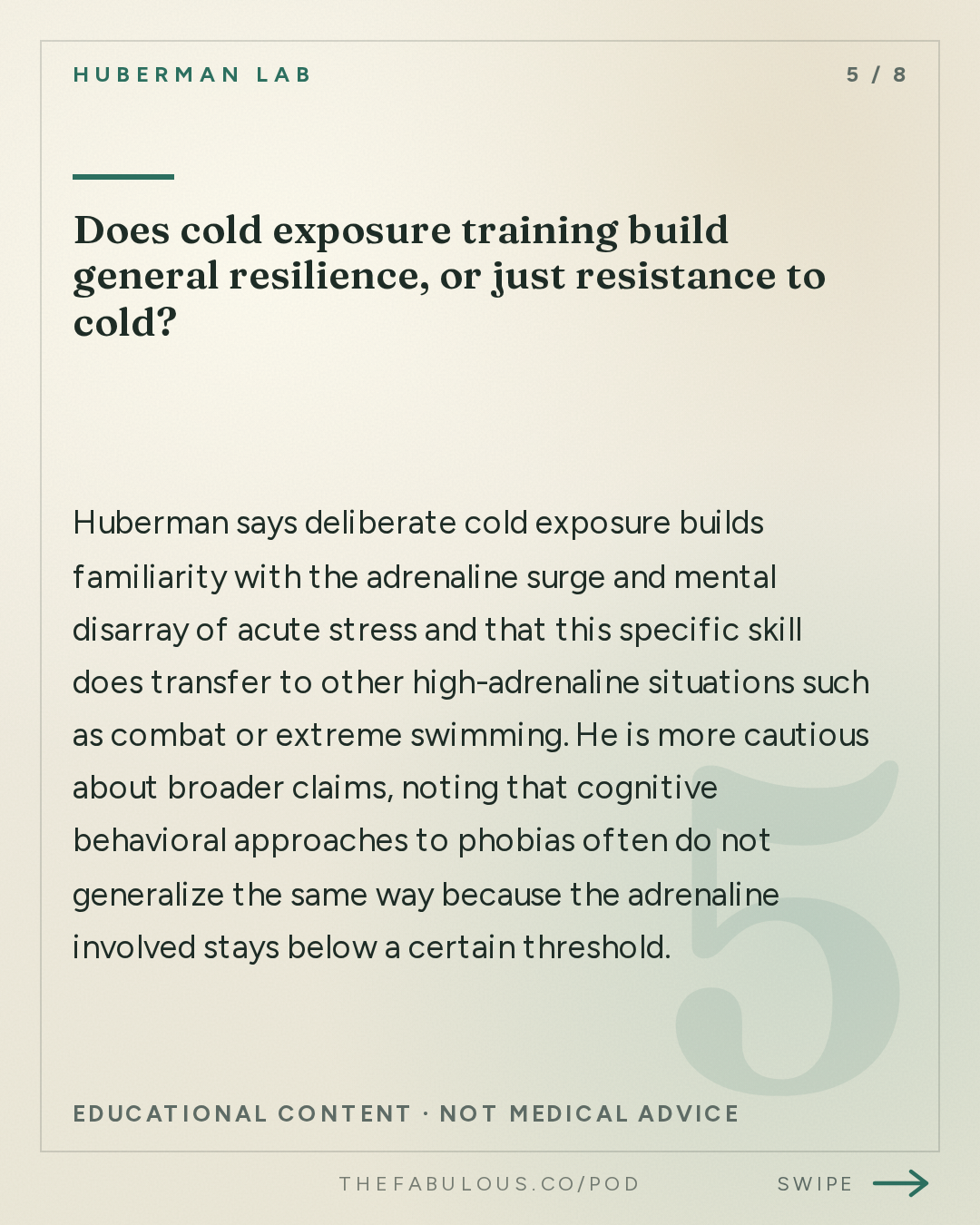
Huberman says deliberate cold exposure builds familiarity with the adrenaline surge and mental disarray of acute stress and that this specific skill does transfer to other high-adrenaline situations such as combat or extreme swimming (103:21). He is more cautious about broader claims, noting that cognitive behavioral approaches to phobias often do not generalize the same way because the adrenaline involved stays below a certain threshold (103:55).
How much creatine does Andrew Huberman take and why?
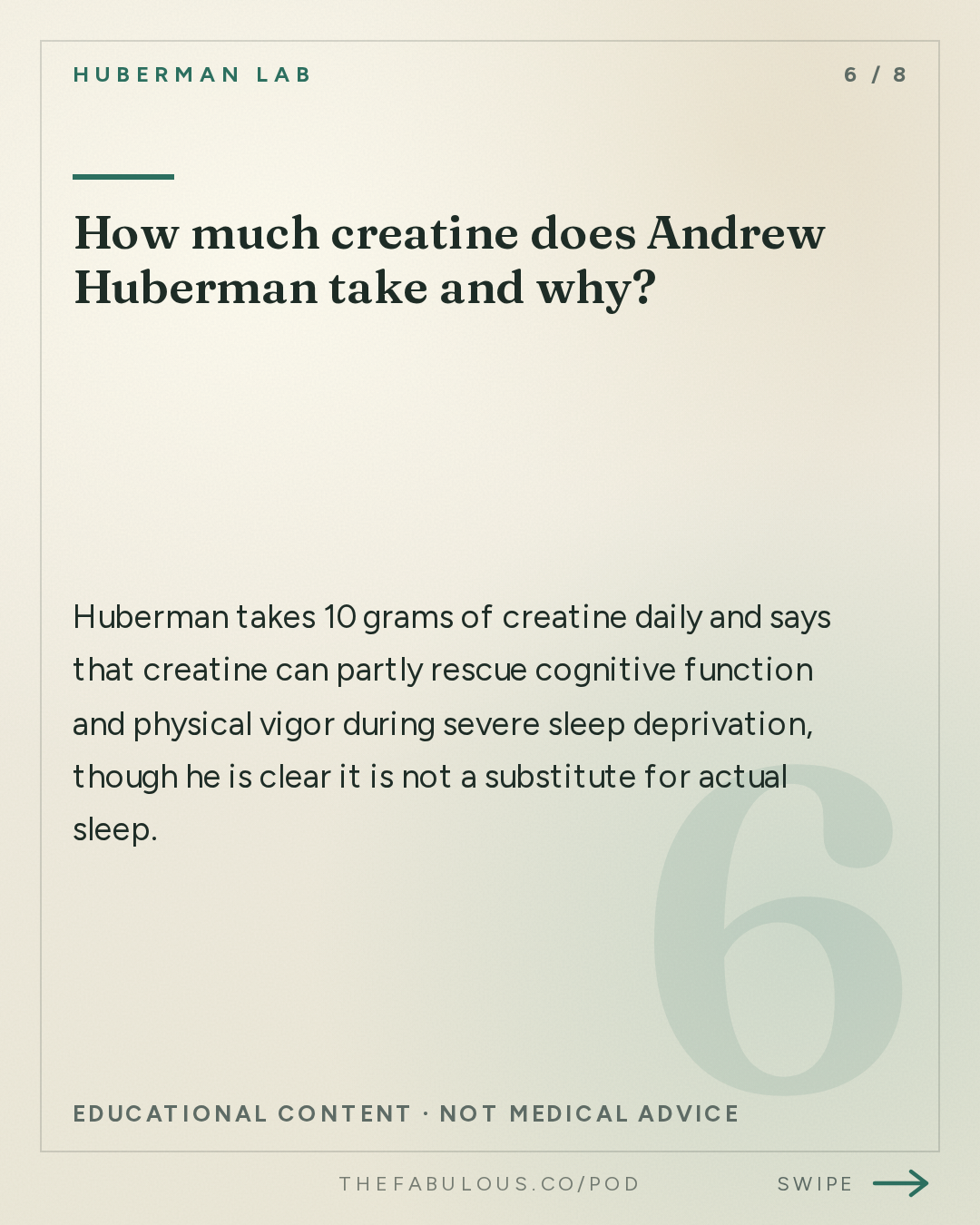
Huberman takes 10 grams of creatine daily and says that creatine can partly rescue cognitive function and physical vigor during severe sleep deprivation, though he is clear it is not a substitute for actual sleep (125:42).
What is the strength reserve concept Ross Edgley uses in training?
Edgley trains for a high one-rep max on pull-ups so that each swimming stroke, which functions like a one-armed lat pulldown, draws on a smaller fraction of his total strength, making sub-maximal efforts feel easier over long swims (134:32).
The full read, in cards
Go deeper
- How to Hero — Ross Edgley's book on strength, resilience, and finding purpose
- Tube test experiments on competitive mice — showed prefrontal cortex activity, not testosterone or body weight, predicts repeated winning
- Joe Parvizi's anterior midcingulate cortex stimulation research — electrode stimulation in awake patients linked the region to felt tenacity and willpower
- Robert Heath's brain self-stimulation experiments — patients with implanted electrodes preferred to stimulate a region tied to mild frustration and anger over any other site
- Tim Noakes' central governor theory — describes the brain applying a physiological handbrake before true physical exhaustion
Mentioned
Ross Edgley · Andrew Huberman · How to Hero · David Goggins · Albert Camus · Viktor Frankl · Jordan Peterson · Joe Parvizi · University of Iceland · Eddie Hall · Marcus Aurelius · Tim Noakes · Robert Heath · Carl Jung · Samuel Johnson · Dorian Yates · Cam McEvoy
More from this show and category

Huberman's Rational Guide to Supplements
Andrew Huberman's framework ranks behavior, then nutrition, then supplements, then prescription drugs, arguing supplements only work once the first two are solid (00:42). He gives exact doses for sleep, hormone, and focus compounds, and insists on testing one ingredient at a time (35:08).
Jared Diamond on Leadership: Why Charisma Isn't Required
Charisma is optional for great leadership, biologist and historian Jared Diamond argues, pointing to the uncharismatic dictators Stalin and Pinochet as proof (00:26). Diamond, 89, applies a 'natural experiment' method from biology to politics, religion, business, and sports, showing only 2 of 22 modern political leaders stepped down voluntarily and that coaches and CEOs get too much credit or blame for outcomes that are mostly random (95:37).

Neuralink Trials for Quadriplegia: What Comes First
Neuralink's head neurosurgeon Matt MacDougall explains that the implant's first job is letting quadriplegic patients move a cursor and type by thought alone, not reconnect limbs. He also covers the robotic surgery that makes this possible, the safety case made in pigs and monkeys, and his own subdermal RFID chip.
How Diet Affects Memory and the Hippocampus
USC neuroscientist Scott Kanoski says the hippocampus, the brain's memory hub, tracks recent meals via the vagus nerve to judge hunger and fullness. Sugar, heat-processed foods, and artificial sweeteners early in life can impair that memory system and its gut bacteria, while exercise and simple recall of a recent meal can help restore or harness it.
