
Mary Helen Immordino-Yang on Emotion and Learning
Essentials: How Emotions & Social Factors Impact Learning | Dr. Mary Helen Immordino-Yang
The brief
Psychologist Mary Helen Immordino-Yang says emotion is the substrate of thought, not a distraction from it. What a student feels about a topic, not just the grade, determines what actually gets learned, and she traces this from infant attachment through cultural perception to a call for project-based schooling over standardized tests.
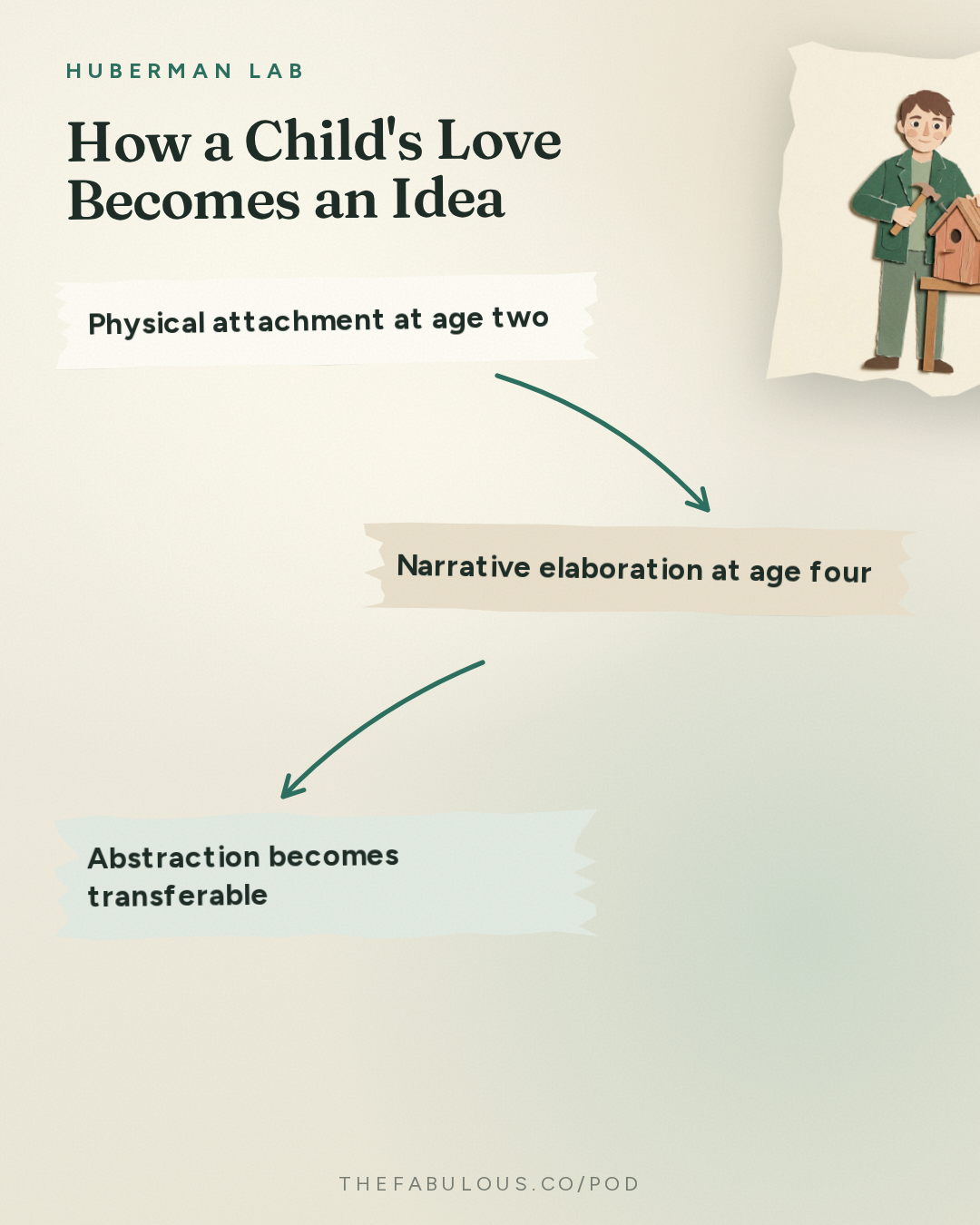
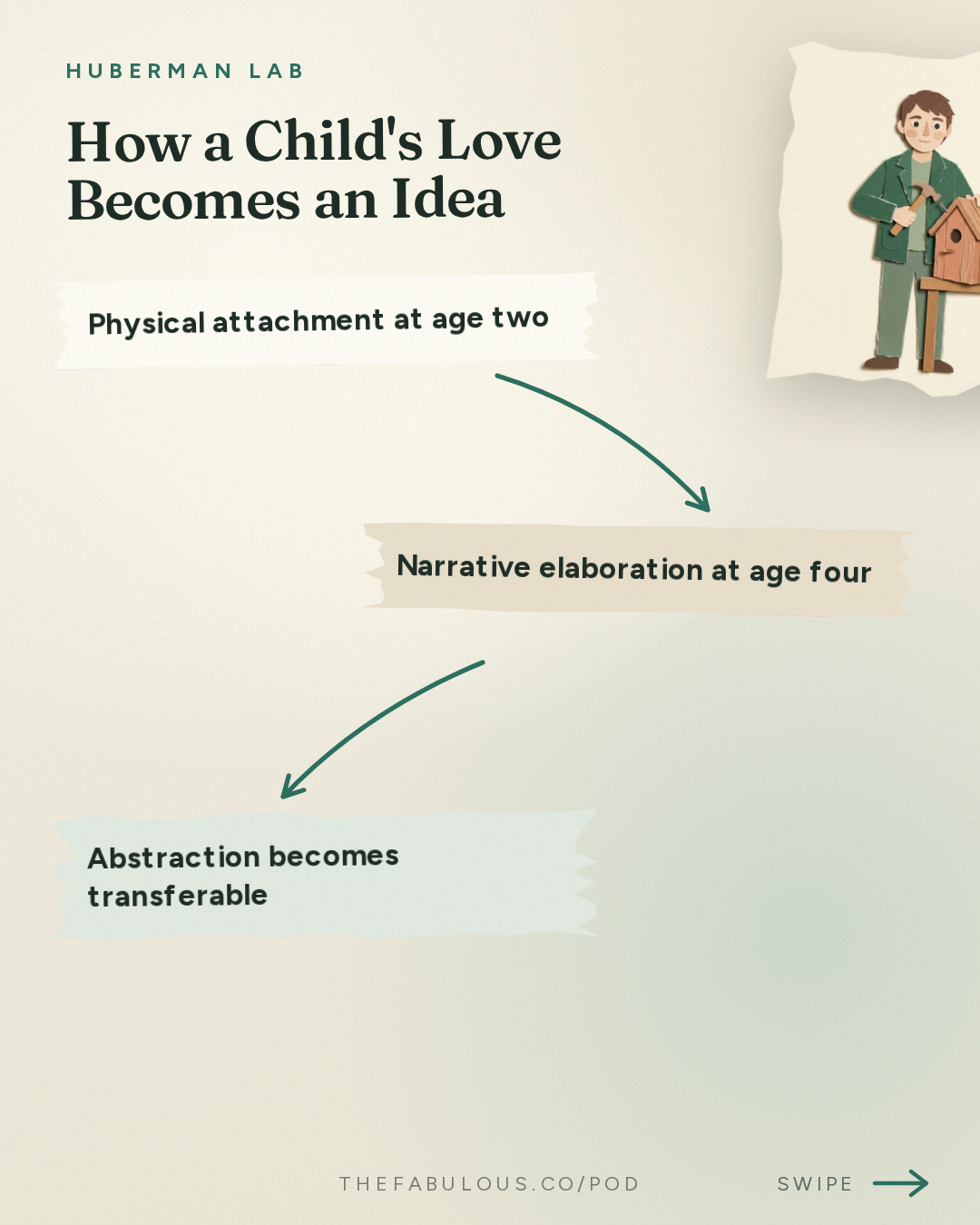
A mother sits at her kitchen table, lost in a private sadness, her arm hanging slack at her side. Her two-year-old daughter notices, picks up the arm, presses it to her own cheek, and says, "Don't worry, Mama, I'll take care of you. I really love you. I mean, I really love your arm." Two years later, in the dark of her bedroom, the same child whispers a different kind of love: she loves her mother more than she is glad there is daytime. Nothing about her attachment to her mother has changed in that gap. What has changed is her mind's capacity to turn a raw bodily feeling into an idea. That small, exact difference, offered by developmental psychologist Mary Helen Immordino-Yang about her daughter Nora (08:32, 09:11), is the key to her whole account of how humans learn.
Immordino-Yang, who studies the neuroscience and psychology of emotion and learning, argues that feeling is not a distraction from thinking. Feeling is the material thinking is built from. She credits neuroscientist Antonio Damasio with the founding idea: that an organism's ability to map the state of its own body, inside and out, is "the substrate for consciousness and for the mind" (02:38). The brain, on this view, did not evolve to do pure abstract reasoning. It evolved to keep a body alive, by constantly tracking hunger, threat, warmth, and injury, and then narrating those signals into something that feels like a self having an experience. "Our most high level complex brain states, mind states, are also fundamentally hooking themselves into the most basic biological machinery that keeps us alive," she says (00:50). Awe, inspiration, grief, love: all of it runs on the same old circuitry that regulates heartbeat and appetite. The sophistication is real, but it never leaves the body behind.
That circuitry, she adds, is not private. Humans are built to need other people in order to know who they are. "We are directly dependent on other people for the formulation of our own sense of self," she says (03:36), pointing to research across immunology, the gut microbiome, and stress physiology showing that social context changes bodily regulation, not just mood. A sense of self is not assembled alone in a skull. It is co-built, in conversation with caregivers, culture, and community, the way Nora's mother supplied the context, and the words, that let a two-year-old's bodily attachment eventually become a four-year-old's small philosophy of gratitude.
Perception Is Never Neutral
If selfhood is co-constructed, so is perception. Immordino-Yang points to a classic finding from psychologist Shinobu Kitayama: show people in Japan and the United States the same underwater scene, full of rocks, plants, small fish, and one large fish, and ask what they saw (15:12). Japanese viewers tend to describe the whole scene first, the setting, and then the big fish moving through it. American viewers tend to say a fish was swimming through a scene, foregrounding the single actor and backgrounding the context. The difference shows up not just in what people say but in what they later remember, meaning culture shapes perception itself, below the level of conscious choice. Jean Piaget described a version of this a century ago (16:20) when he wrote about assimilation and accommodation, the two ways a mind either bends new information to fit its existing schema or bends its schema to fit new information. Immordino-Yang's point is sharper: the schema is cultural as much as cognitive, and it decides what counts as noticeable in the first place.
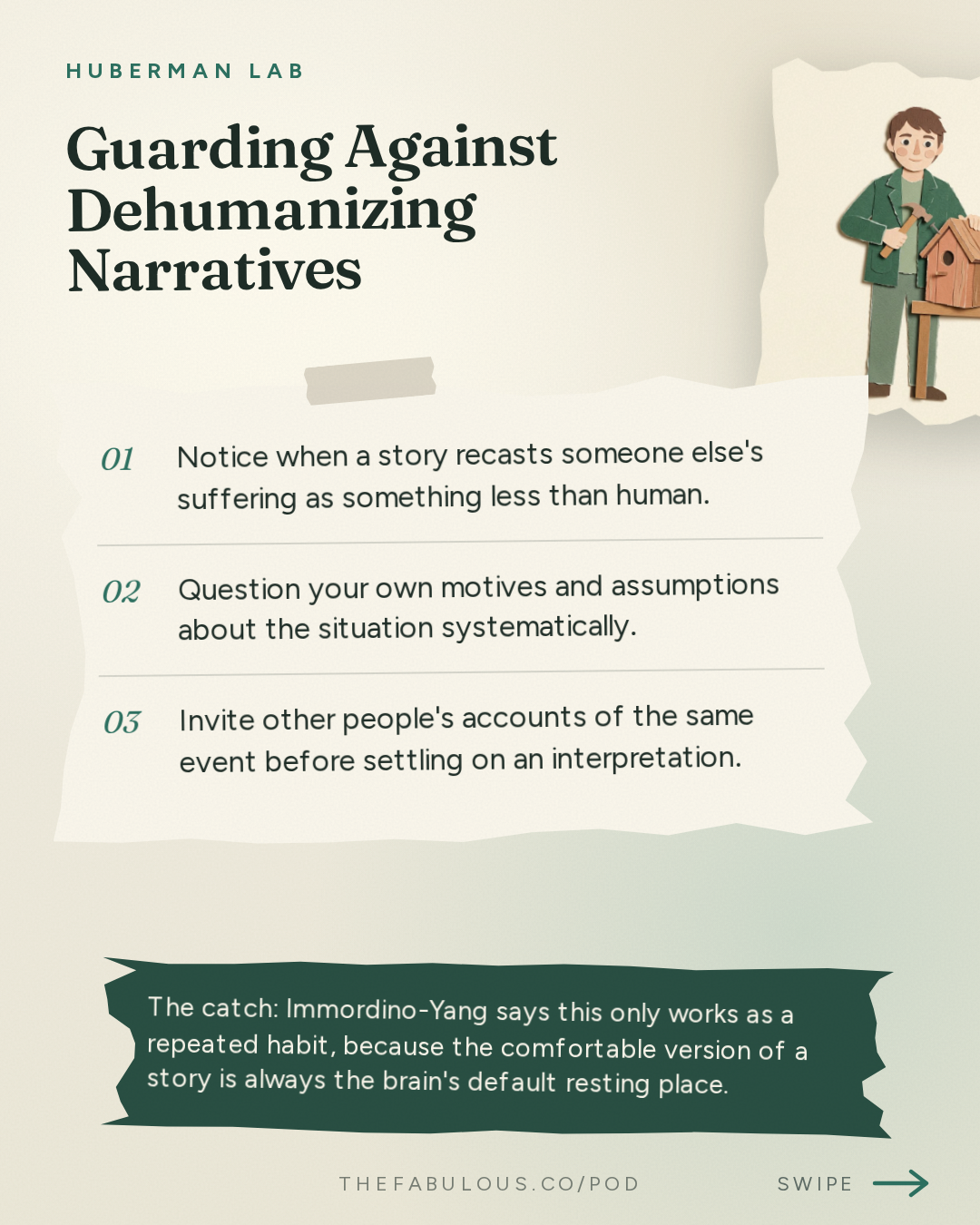
This matters for something far darker than fish tanks. Immordino-Yang uses the same mechanism to explain how ordinary, loving people participate in atrocities like genocide. Empathy is not simply switched off. The narrative around another person's suffering gets rewritten so that the suffering no longer registers as human. "The way in which they impose interpretation on somebody else's pain has been fundamentally shifted from that's another human suffering to that's not a human," she says (17:04). Once a person is recast as vermin or animal in the collective story, the neural circuits that would normally produce empathy have nothing human left to respond to. She is careful to say this is not a defense of the behavior, only an explanation of how it becomes psychologically possible: the same story-making machinery that lets a toddler's love for an arm become a love of daylight can, pointed in the wrong direction by culture and propaganda, make cruelty feel coherent.
Her proposed defense against this is not a rule but a disposition: a trained habit of mind that questions its own motives, checks its assumptions against other people's accounts of the same event, and treats a first interpretation as a draft rather than a verdict (18:45, 21:28). She calls this intellectual humility, and she thinks it has to be built deliberately, because the brain's default is to settle quickly on the story that is most comfortable and then stop looking.
What You Feel Is What You Learn
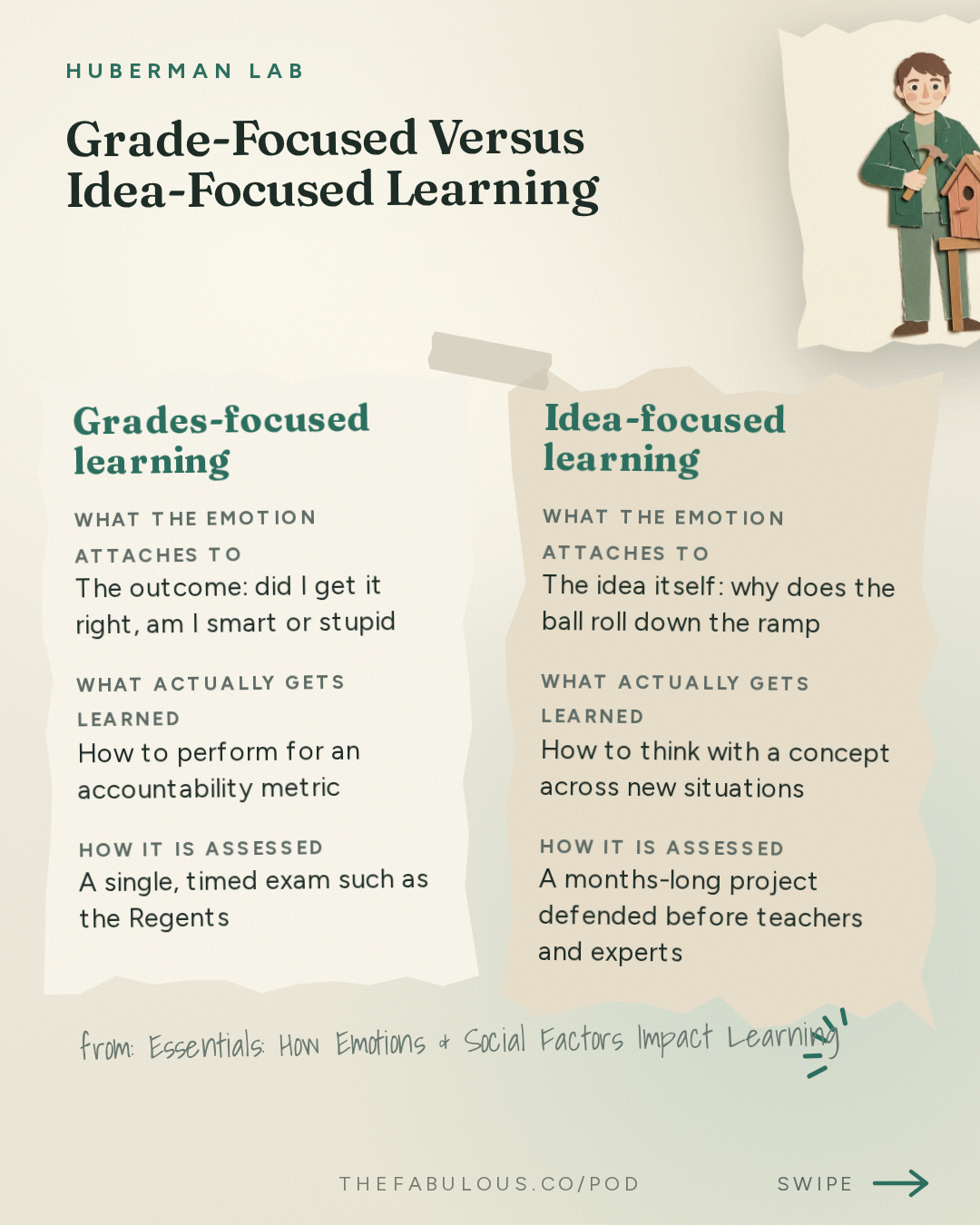
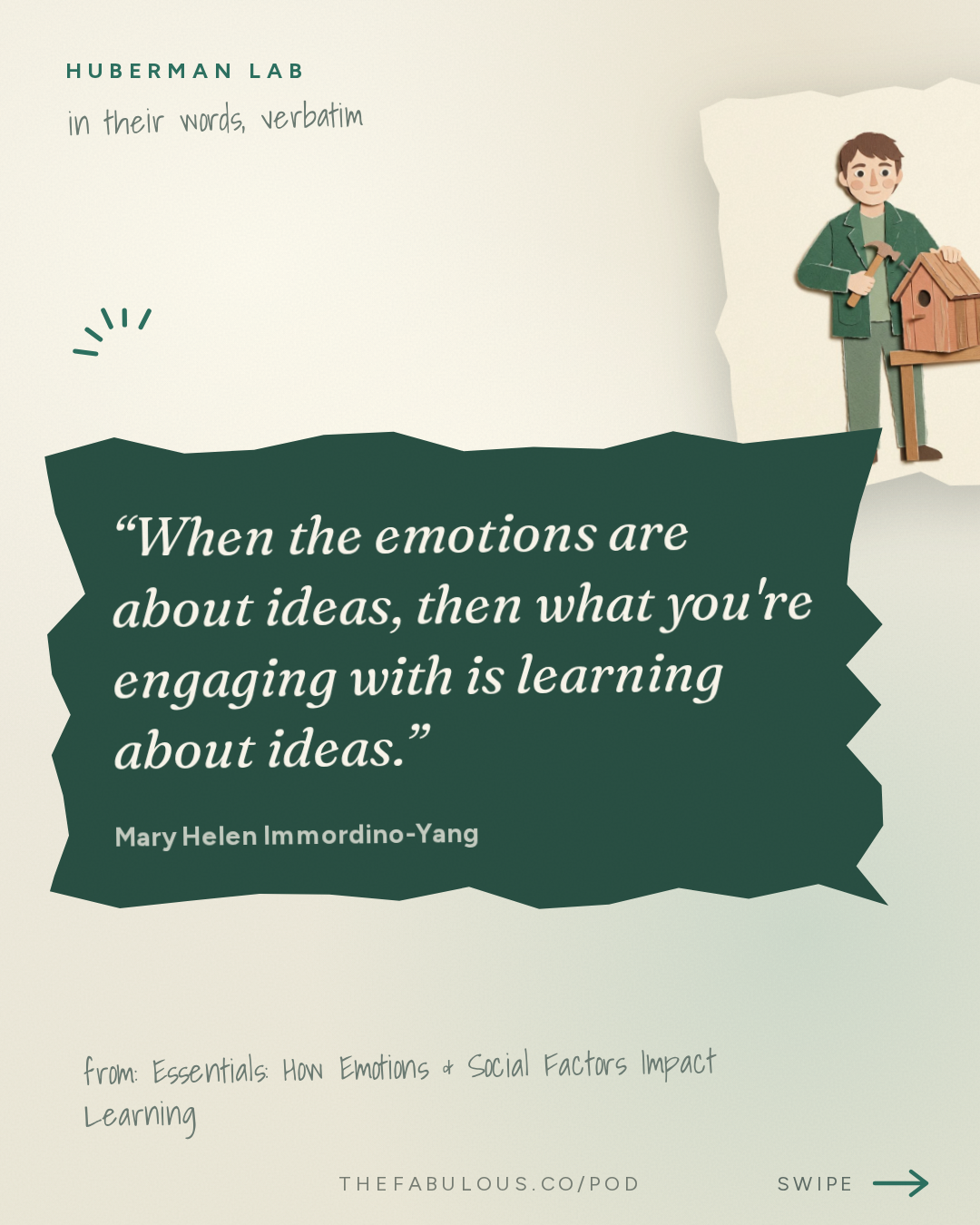
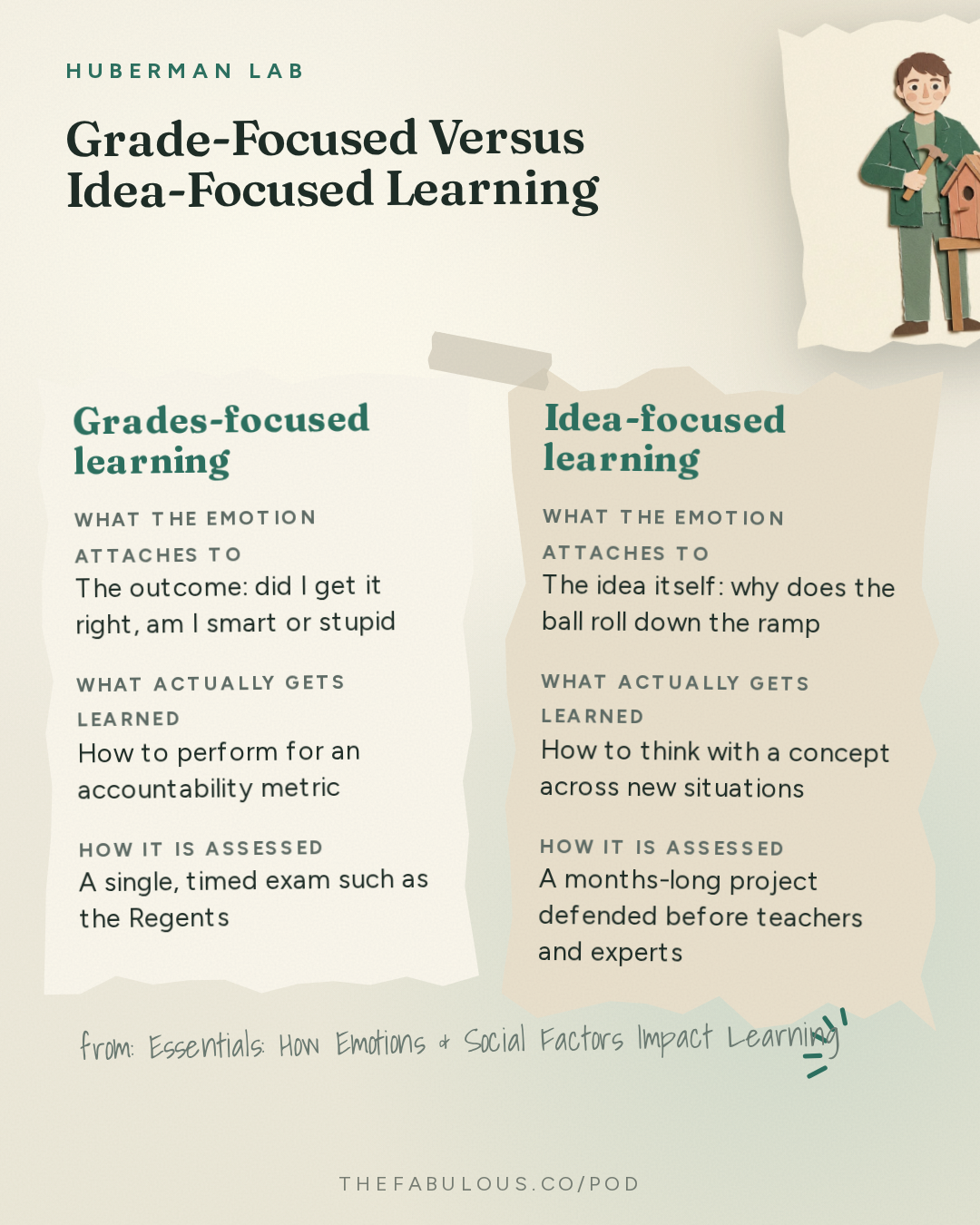
This is where her argument turns toward classrooms. Immordino-Yang's central claim about education is almost embarrassingly simple to state and hard to act on. "Whatever you're having emotion about is what you're thinking about, and whatever you're thinking about, you could hope to learn about," she says (30:40). If a student's emotion is wrapped around the outcome, the grade, the fear of looking stupid, the relief of an A, then the outcome is what gets learned, not the subject. "When the emotions are about ideas, then what you're engaging with is learning about ideas," she says (31:06). By her account, a lot of standardized school accountability does the opposite of what it intends: it trains students to feel something about a score rather than about a concept (31:16).
"Whatever you're having emotion about is what you're thinking about, and whatever you're thinking about, you could hope to learn about." — Mary Helen Immordino-Yang [30:40]
She offers an alternative already running in New York City: the Performance Assessment Consortium, a group of public schools with state permission not to use the Regents exam as a graduation requirement (27:10). Instead, students spend months, sometimes years, building an original, multidisciplinary project: they pick the question themselves, pull in outside experts, and then defend their reasoning in front of teachers, much like a graduate thesis. The format keeps the emotional stakes attached to the actual thinking, because there is no single correct answer to retrieve under time pressure.
The timing of this critique matters developmentally, she argues. Adolescence is exactly when the brain's capacity to infer complex narrative meaning, reading a pair of shoes as a statement about sustainability or belonging, is coming online and peaking (33:53). That is precisely the age at which conventional schooling "gets serious" and narrows toward transactional, single-answer testing. A student who could be asking what a scene in Charles Dickens's novel Great Expectations means for how a society treats servants is instead asked to recall whether the servant was named Molly or Maria (34:23). Immordino-Yang's worry is that this mismatch does not just bore teenagers, it starves the exact cognitive appetite that is strongest at that age, and over years it can produce young adults who have never practiced using their own curiosity as a tool.
Her closing claim reframes the entire purpose of schooling. Learning, she says, is not the destination. It is the vehicle. "The goal of education needs to not... Learning's not the goal. It's not the outcome. It needs to be the development of the person," she says, asking "how is a person changing themselves having learned this" (37:59). Skills, facts, and credentials are what she calls the cargo in the cart; the real metric is the quality of the horse pulling it, meaning the kind of thinker, and the kind of person, the process produces.
What makes this more than an abstract argument about curriculum is how closely it tracks back to Nora's arm and Nora's whisper about daylight. A two-year-old's concrete, bodily love is not replaced by a four-year-old's abstract gratitude; it is built upon it, reused, and extended. Immordino-Yang's larger claim is that this is the lifelong pattern underneath every kind of learning: a felt, bodily state gets elaborated, with the help of language, culture, and other people, into an idea that can travel. School, at its best, would be organized around protecting and extending that process rather than suppressing it in favor of a score.
Ask this episode anything
Pod's AI answers from the episode itself, with the minute mark so you can hear it yourself.
Or start with one of these
Ask this episode
Pod's AI listens to the whole episode to answer, and points you to the minute it comes from.
The rest of this answer, and any question after it
Answers come from the episode itself, never from a summary of it.
ContinueKey takeaways
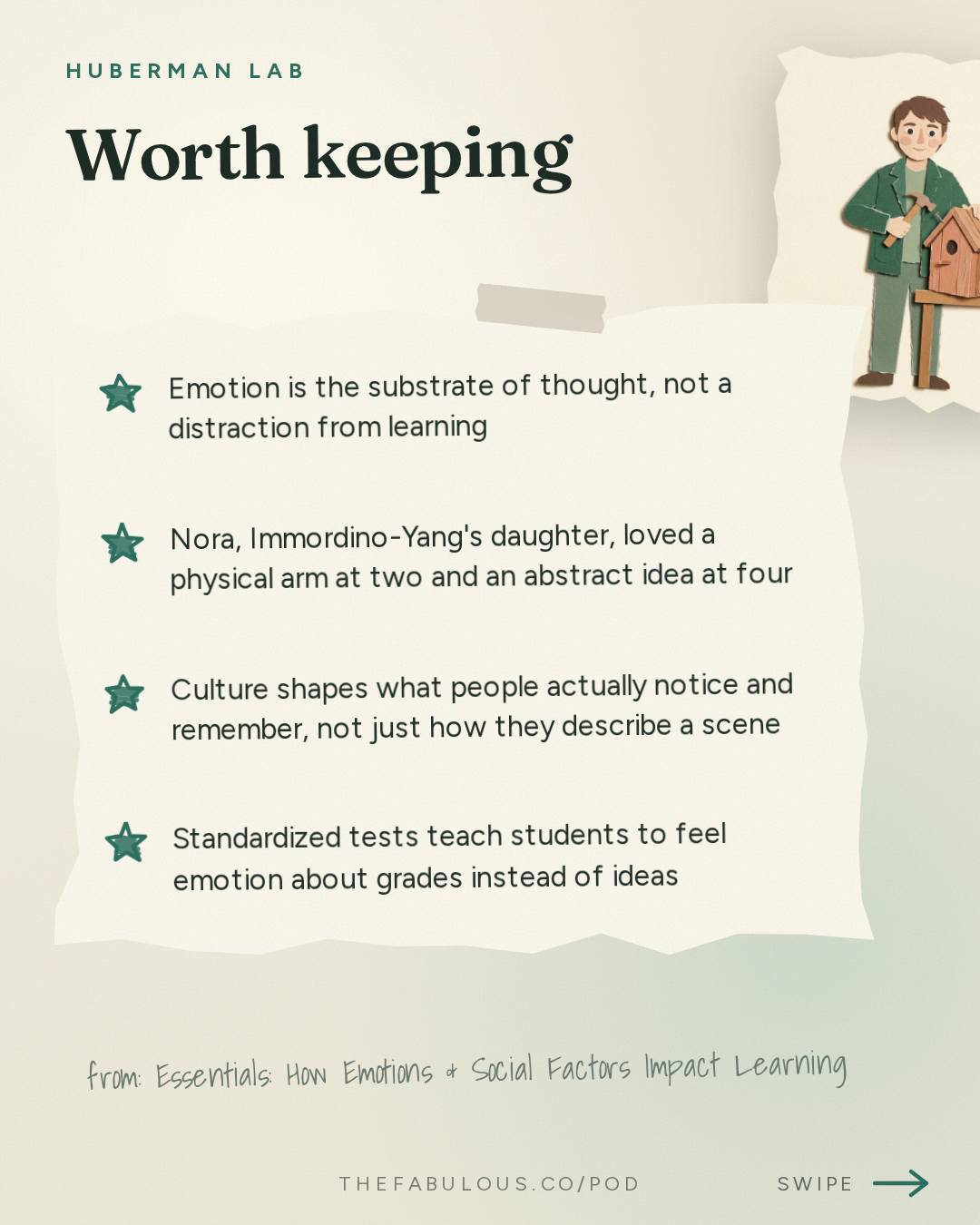
- Emotion is the substrate of thought, not a distraction from learning
- Nora, Immordino-Yang's daughter, loved a physical arm at two and an abstract idea at four
- Culture shapes what people actually notice and remember, not just how they describe a scene
- Standardized tests teach students to feel emotion about grades instead of ideas
- New York's Performance Assessment Consortium swaps the Regents exam for a defended project
The episode in cards

By the numbers
- 100 years time since Jean Piaget described assimilation and accommodation in schema development
In their words
“Our most high level complex brain states, mind states, are also fundamentally hooking themselves into the most basic biological machinery that keeps us alive.”
“We are directly dependent on other people for the formulation of our own sense of self.”
“Whatever you're having emotion about is what you're thinking about, right? And whatever you're thinking about, you could hope to learn about”
“When the emotions are about ideas, then what you're engaging with is learning about ideas.”
“The goal of education needs to not... Learning's not the goal. It's not the outcome. It needs to be the development of the person.”
Protocols
-
Teach Through a Student's Own Interest
Immordino-Yang says teachers should find what a reluctant student already cares about and then use that student's writing, math, or filmmaking skills to explore it, because tying academic skill to a topic the student already feels something about is what turns attention into learning.
per subject, as needed
-
Assess Learning Through Long Projects, Not Single Exams
Immordino-Yang points to New York City's Performance Assessment Consortium, where students spend months to years building an original, multidisciplinary project and defend it before teachers and outside experts instead of taking the Regents exam, because the format keeps emotional stakes attached to the actual thinking rather than to one timed answer.
at graduation
-
Interrogate a Strong Emotional Reaction Before Acting On It
Immordino-Yang recommends routinely questioning whether a strong reaction is justified, by deconstructing the story behind it and actively seeking other people's accounts of the same event, because this habit is the main defense against narratives that lead to bias or dehumanization.
ongoing practice
Questions this episode answers
How does emotion affect learning?
Psychologist Mary Helen Immordino-Yang argues that whatever a person feels emotion about is what they end up thinking about and learning, so if school ties emotion to grades rather than ideas, students learn to chase scores instead of understanding (30:40).
What is the Performance Assessment Consortium?
It is a group of New York City public schools with state permission to skip the Regents exam, replacing it with months-long original student projects defended before teachers and outside experts (27:10).
Does culture change how people perceive things?
A classic cross-cultural study by psychologist Shinobu Kitayama found Japanese and American viewers shown the same underwater scene described and later remembered it differently, the Japanese group noticed the setting first while the American group foregrounded the single large fish, showing perception itself is shaped by culture (15:12).
What did Antonio Damasio teach about the brain and body?
Neuroscientist Antonio Damasio's idea, as relayed by Immordino-Yang, is that an organism's ability to map the internal and external state of its own body is the substrate for consciousness and mind, meaning feeling comes before abstract thought rather than after it (02:38).
Why do standardized tests undermine deep learning?
Immordino-Yang argues that high-stakes accountability systems teach students to attach emotion to the outcome, the grade or score, rather than to the idea itself, which means students practice performing rather than thinking (31:16).
At what age does curiosity-driven learning usually decline in school?
Immordino-Yang says it falls off by adolescence for most students outside progressive schools, which is ironic because that is the same period when the brain's capacity for complex narrative meaning-making is peaking (33:53).
The full read, in cards
Go deeper
- Cross-cultural scene perception study — found Japanese and American viewers perceive and later remember the same underwater scene differently, showing culture shapes perception itself
- Theory of assimilation and accommodation — Jean Piaget's century-old framework for how a mind either bends new information to fit existing schema or revises the schema to fit new information
- Great Expectations — used as an example of how school testing can reduce a novel to trivia recall instead of meaning
Mentioned
Antonio Damasio · Shinobu Kitayama · Jean Piaget · Nora · Performance Assessment Consortium · Great Expectations
More from this show and category

Anna Lembke: Why Addiction Is Really About Control
Stanford psychiatrist Anna Lembke says the deepest addictions are addictions to control, not substances. She explains the brain's pleasure-pain balance, a 30-day protocol for resetting reward pathways, why the periaqueductal gray links threat and spirituality, and how surrender, codependency, ketamine, and GLP-1 drugs fit the same control framework.

The Søberg Principle: Cold Exposure Protocol
Cold and heat exposure activate brown fat, the tissue that burns fuel for heat instead of storing it, improving insulin sensitivity and lowering inflammation. Danish researcher Susanna Søberg found the minimum effective dose is about 11 minutes of cold water weekly and 57 minutes of sauna weekly, always ending on cold (26:47, 27:43, 33:29).
How Robert Greene Accesses the Sublime
Robert Greene, author of Mastery and The 48 Laws of Power, says the sublime is a jolt of awe that breaks open ordinary, filtered perception. In his new book The Law of the Sublime, he offers exercises built on trained attention, slowness, recovered childhood memory, and vulnerability in love to reach it without drugs or travel.

How Smell Secretly Shapes Hormones and Behavior
Dr. Noam Sobel's research shows smell quietly shapes human bonding, fear, and hormones in ways we rarely notice. People secretly sniff their own hand after shaking a stranger's hand, body odor similarity predicts whether strangers click as friends, and sniffing women's odorless emotional tears drops men's free testosterone by 14% within 20 to 30 minutes (23:24).
