
Beth Shapiro on De-Extinction and Gene Editing
Bringing Extinct Species Back to Life | Dr. Beth Shapiro
The brief
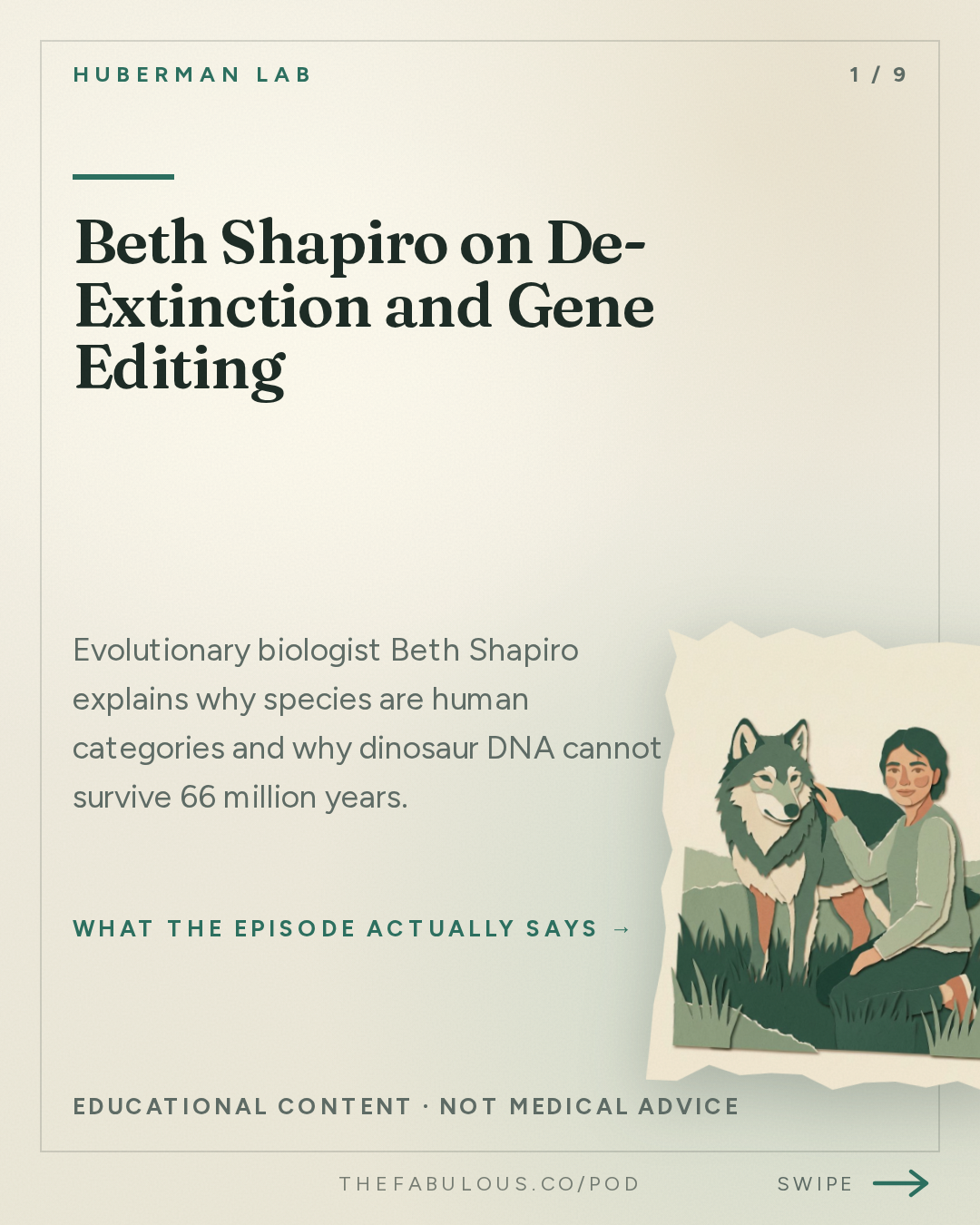
Evolutionary biologist Beth Shapiro explains why species are human categories and why dinosaur DNA cannot survive 66 million years. She describes how Colossal Biosciences engineered a dire wolf with 20 gene edits to a gray wolf genome, revived black-footed ferret genetics through cloning, and weighed the ethics of editing human embryos.
Carl Linnaeus had a naming problem. In the eighteenth century, European explorers kept finding large animals that would make a good coat, and they called every one of them a buffalo. That is how an African buffalo, an Asian water buffalo, and an American bison ended up carrying versions of the same name, even though their DNA shows they are barely related. Linnaeus solved the confusion with Latin binomials, but the deeper problem never went away. What exactly is a species, and who gets to decide where one ends and another begins?
Evolutionary biologist Beth Shapiro, chief scientific officer at the de-extinction company Colossal Biosciences, thinks the question answers itself once you stop expecting biology to cooperate.
"Biology doesn't care what species you are. Species is a, a human concept. We have this incredible proclivity to want to put things into boxes so that we can talk about them." — Beth Shapiro [03:56]
That idea is not academic throat-clearing. It is the hinge her whole career swings on. Take Neanderthals. For decades, textbooks treated them as a separate species from modern humans. Then genome sequencing showed that after people left Africa and met Neanderthals in Europe, the two groups interbred successfully (09:33). Most people alive today carry somewhere between 2 and 5 percent Neanderthal DNA (10:48). But it is a different 2 to 5 percent in each of us. Stitch together everyone's fragments, Shapiro says, and you would reconstruct more than 90 percent of the Neanderthal genome from living humans alone (23:25), evidence that most of that ancient DNA was harmless enough to be carried forward. If Neanderthals and humans could interbreed and produce fertile children, the textbook species line was never as solid as it looked.
The same blurriness shows up in other animals. Polar bears and brown bears split apart roughly 500,000 years ago, adapted to completely different habitats, and still produce fertile hybrids, nicknamed grolar bears or pizzly bears, whenever their ranges overlap (17:42). What keeps the two populations distinct is not biology's refusal to let them mix. It is ecology: a hybrid cub with patchy brown-and-white fur cannot hunt seals well enough to survive as a polar bear, so the hybrid lineage only persists on the brown bear side.
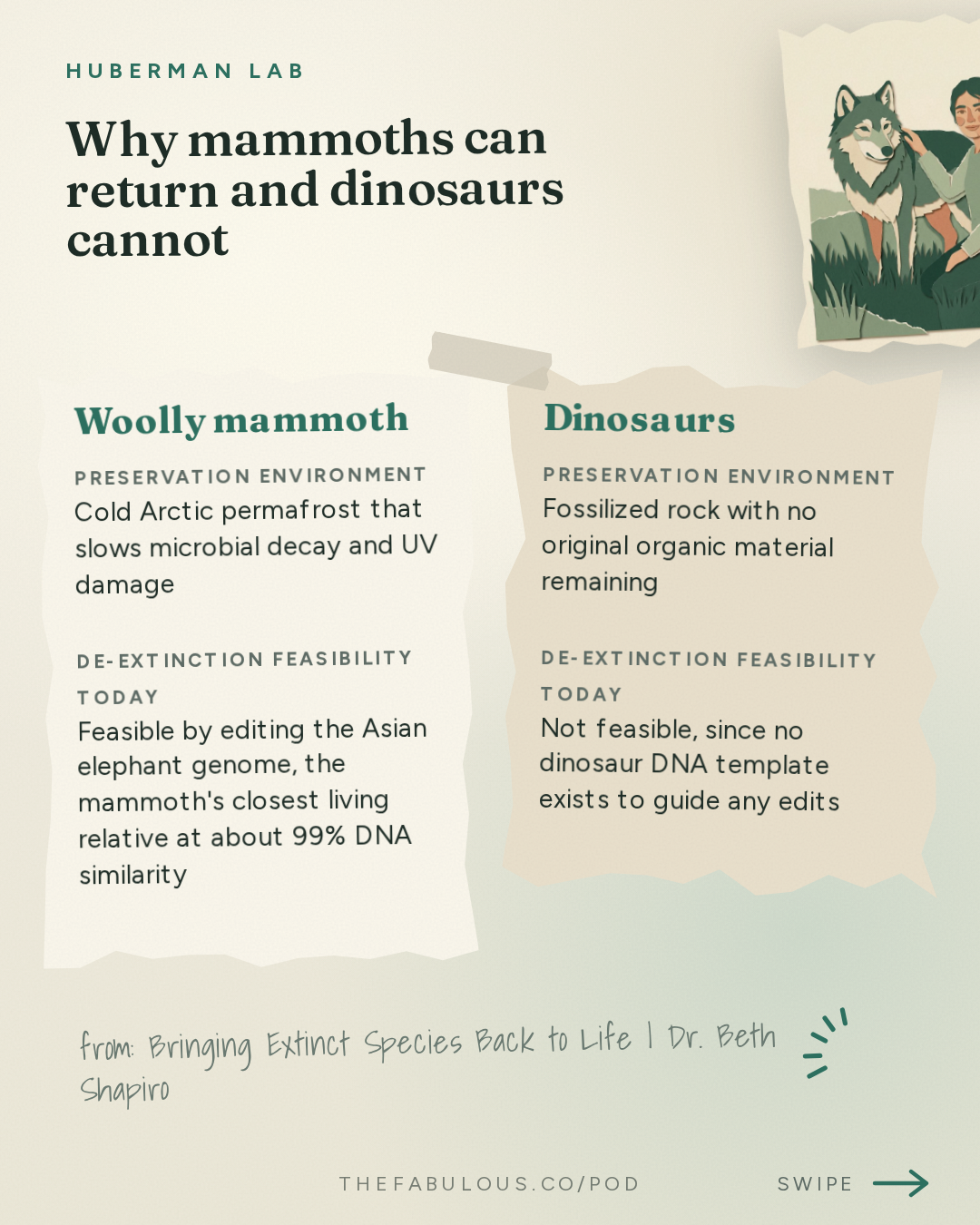
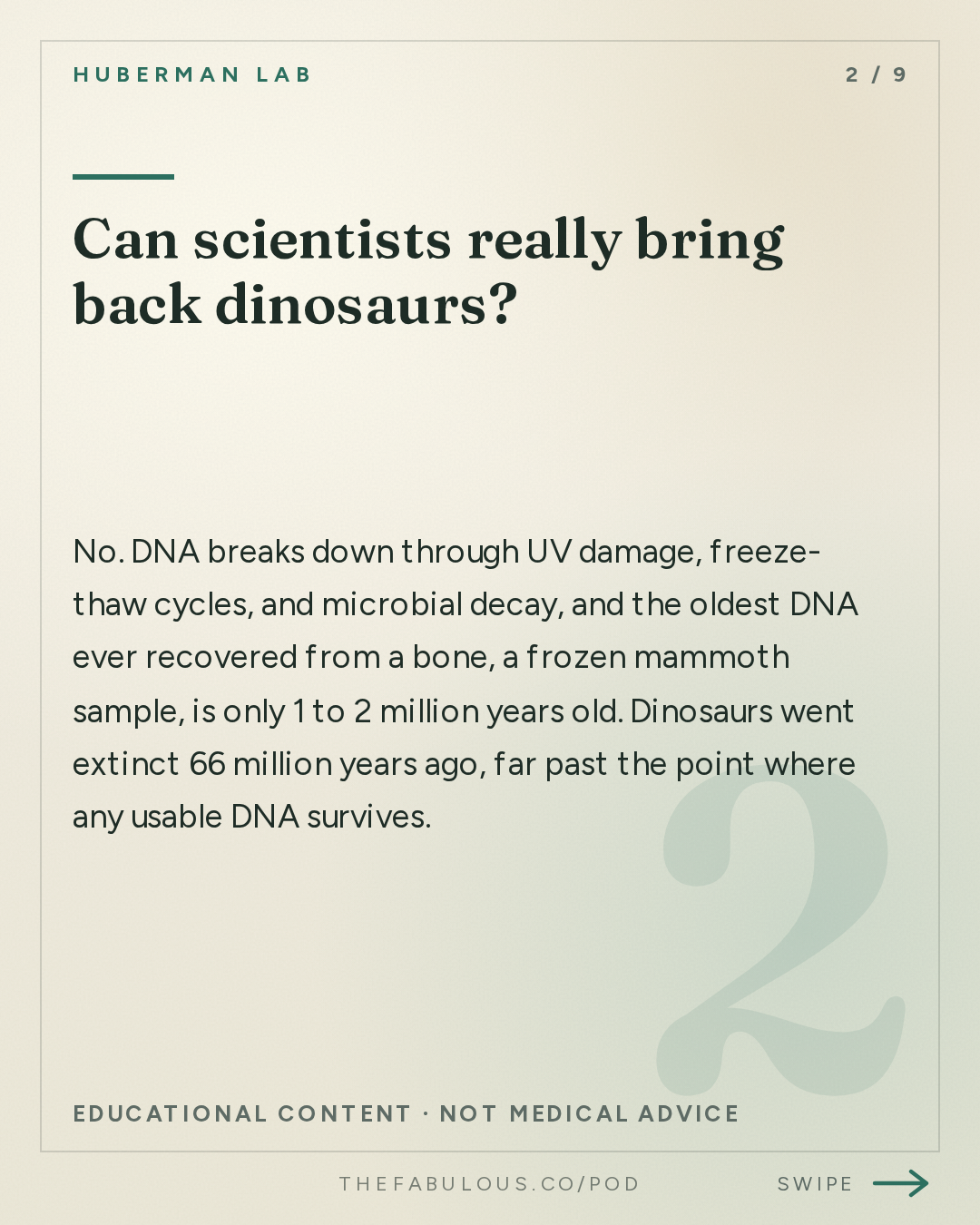
Shapiro's day job, though, is not drawing species boundaries. It is deciding which ones to bring back, and here the limits are not philosophical but chemical. DNA starts breaking down the moment an organism dies, chopped into smaller fragments by ultraviolet light, by the physical stress of freezing and thawing, and by microbial decay (33:27). Cold, dry environments slow the process down. The oldest DNA ever recovered from a bone comes from a mammoth, dated to somewhere between 1 and 2 million years old, preserved by Arctic permafrost (32:48). Dinosaurs went extinct 66 million years ago, an order of magnitude too long for any usable genetic material to remain. Their bones are rock now, not biology.
Twenty Edits, One Wolf
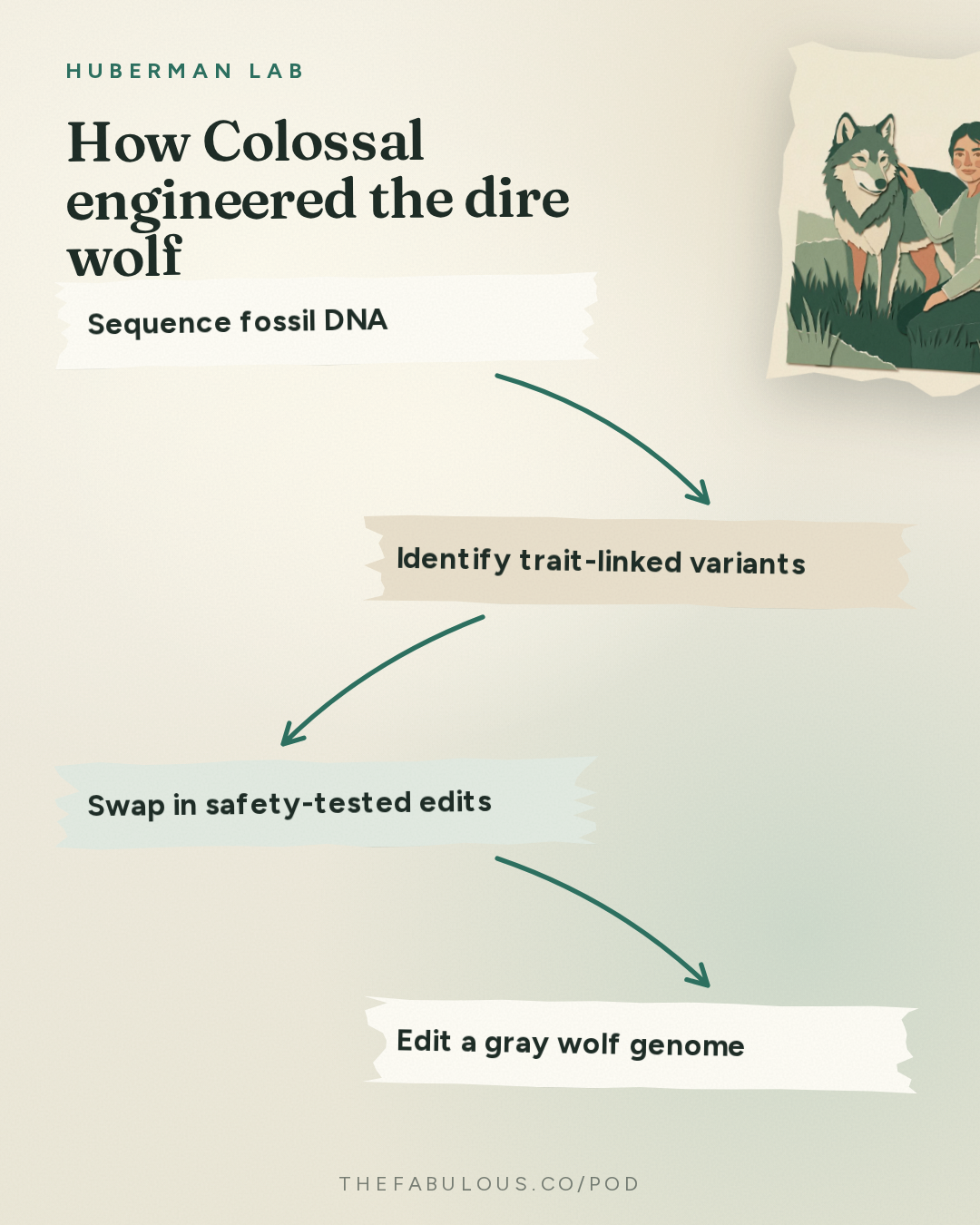
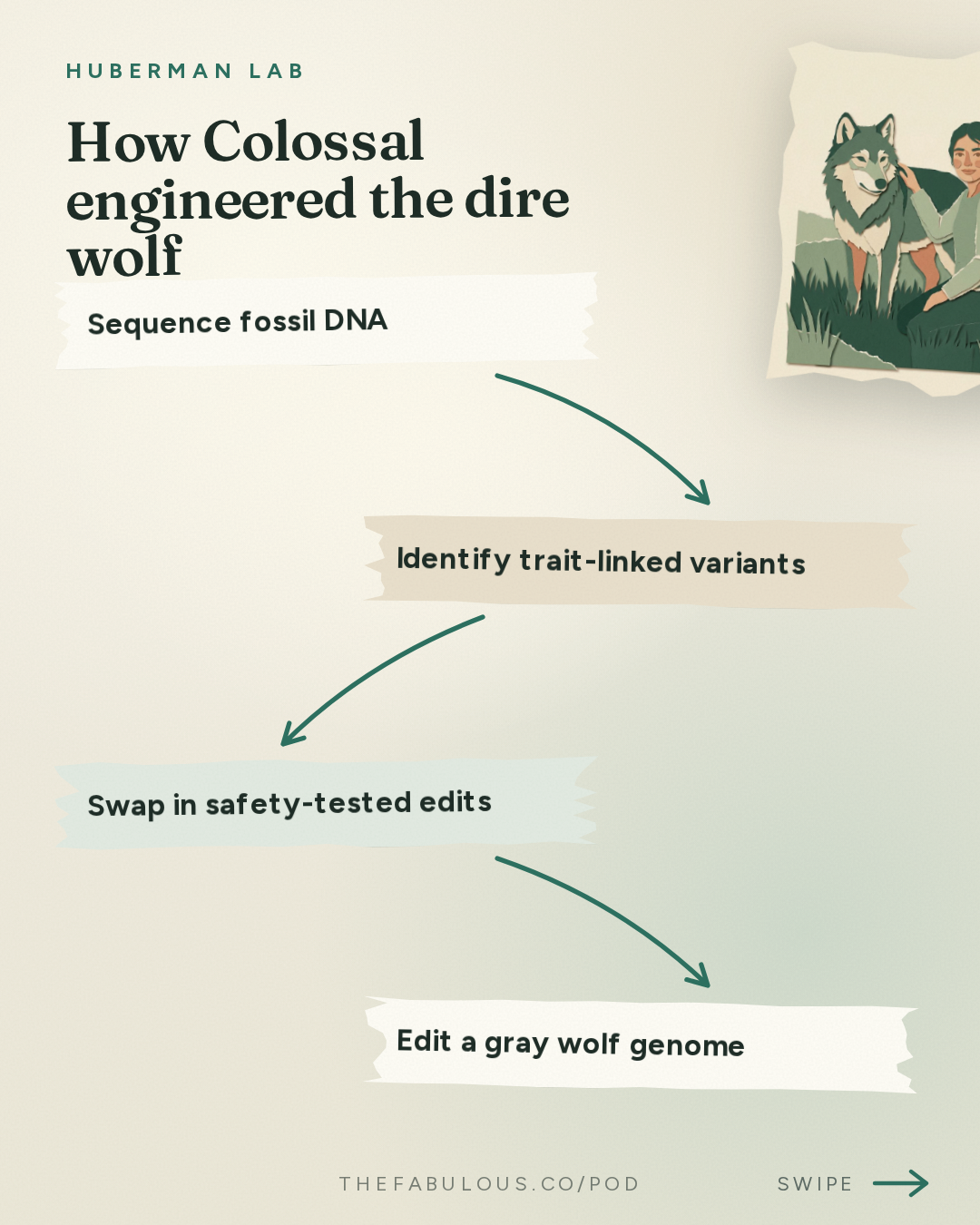
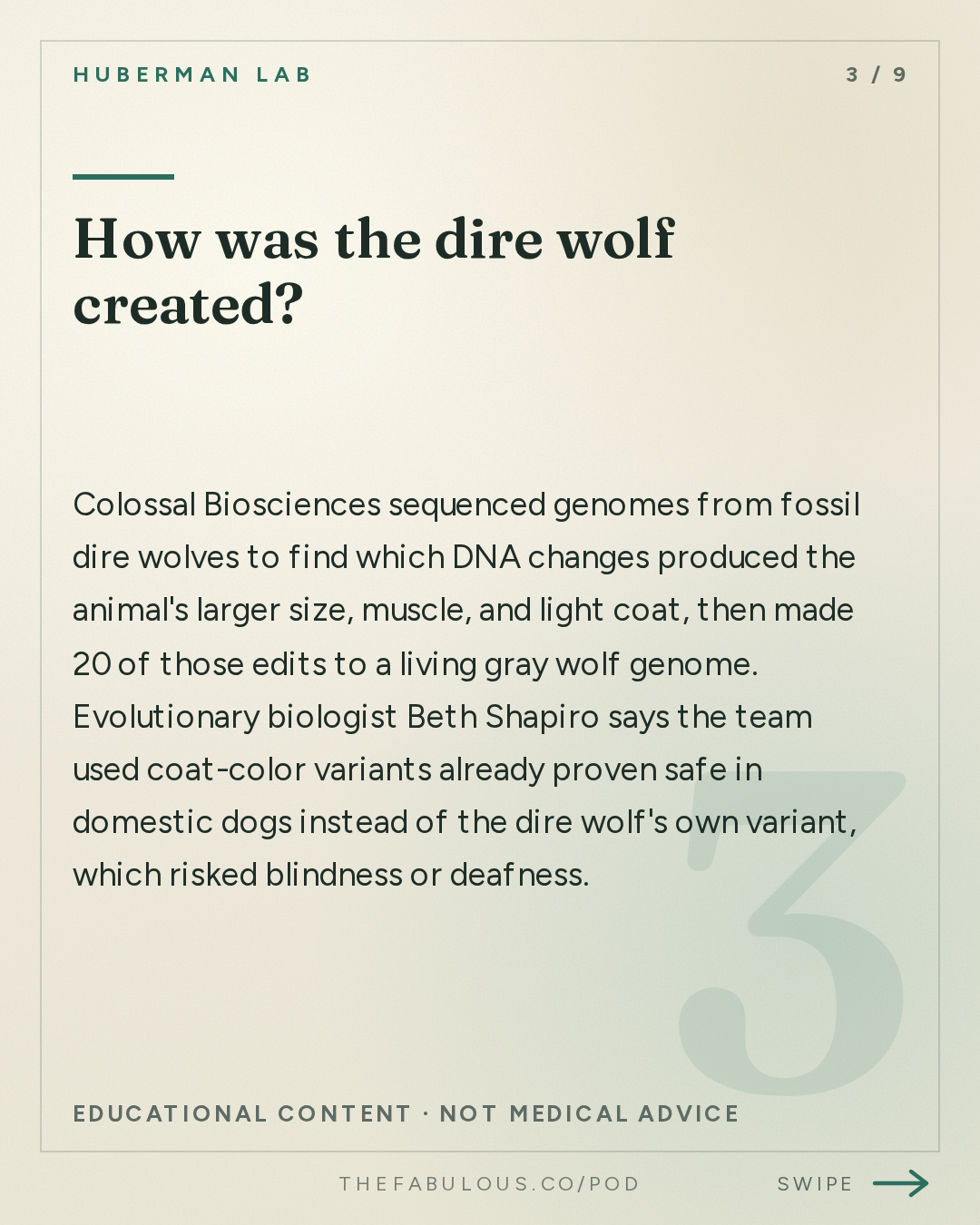
So Shapiro's team works with what DNA allows. The woolly mammoth's closest living relative is the Asian elephant, with genomes about 99 percent identical (49:42), close enough that Colossal is using elephant cells as a chassis for mammoth traits rather than building an animal from scratch. The same logic produced the dire wolf, announced earlier this year to considerable argument about whether it deserved the name. Shapiro's team sequenced fossil dire wolf genomes, worked out which DNA changes produced the animal's larger size, denser muscle, and pale coat, and then made 20 of those changes to a living gray wolf genome (56:33). One detail says a lot about how deliberate the process is: the dire wolf's actual light-coat gene, if copied directly into a gray wolf, risked causing blindness or deafness, a known side effect in dogs carrying similar variants. So the team substituted a different, already-safe light-coat variant borrowed from domestic dogs to get the same look without the risk (58:50). The resulting pups, Romulus, Remus, and Khaleesi, are not being released into the wild. At roughly 120 pounds, they are kept and studied in captivity (61:42).
The same toolkit, Shapiro argues, is what makes her work relevant to animals that are not extinct at all. In northeastern Siberia, a research park called Pleistocene Park has spent years testing what happens when large grazing animals, like bison and horses, are reintroduced to tundra. They trample snow in winter looking for food, which lets summer heat escape the ground instead of being trapped under an insulating layer of snow, which in turn changes which plants can grow back (36:21). In Australia, a small carnivorous marsupial called the northern quoll is heading toward extinction because it dies when it eats a toxic invasive species called the cane toad. Colossal's Australian partners copied a single-letter genetic change, already found naturally in other toad-eating mammals, into quoll cells to make them resistant to the toxin (74:28). None of this required inventing new biology. It required reading what already works elsewhere in nature and moving it.
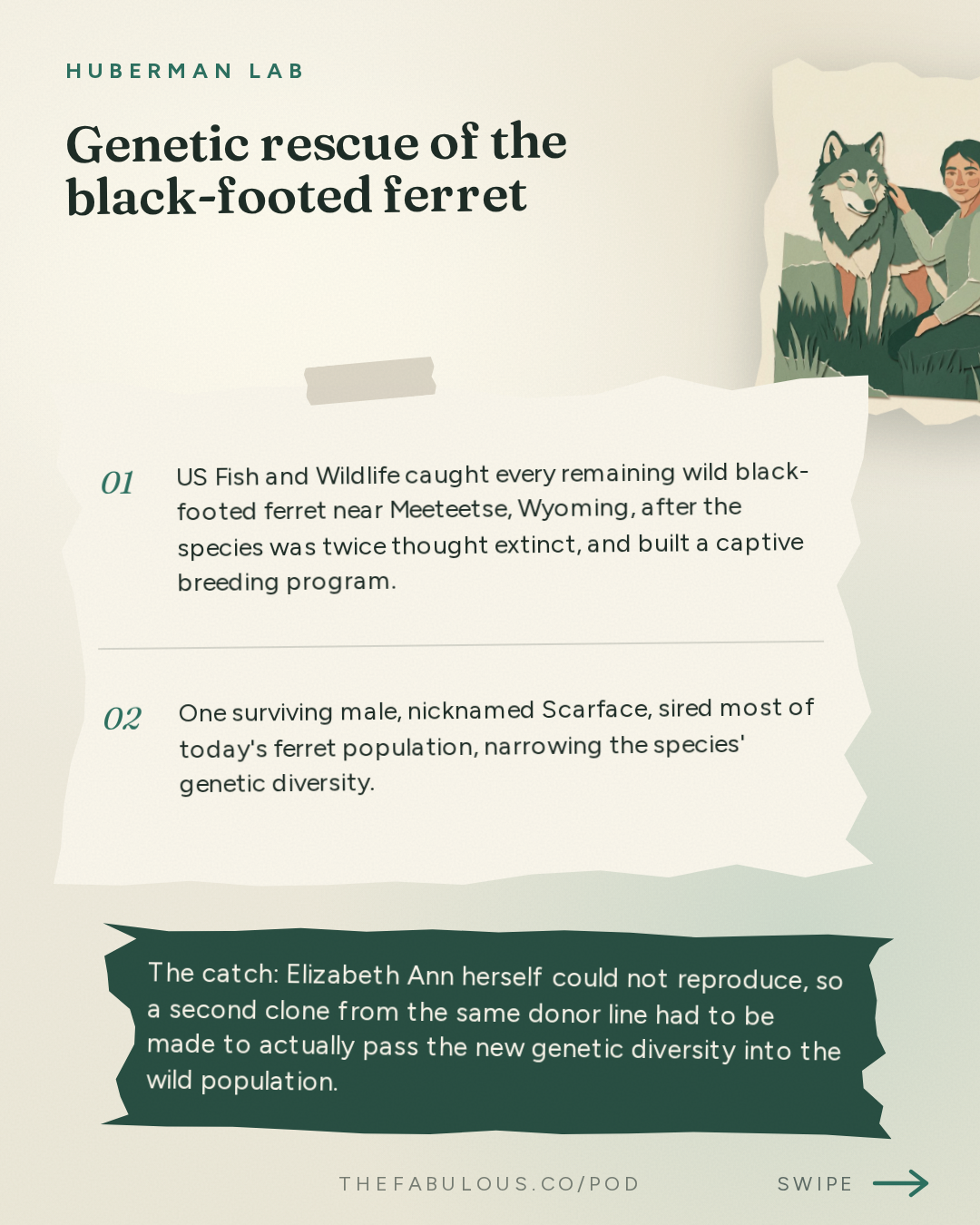
The same approach has already rescued a species without any editing at all. The black-footed ferret was declared extinct twice: once when the last captive animal died, and again when the last wild one did, before a family dog near Meeteetse, Wyoming, killed one in the 1980s and a taxidermist realized what it was (99:02). The surviving wild population was so small that one male, nicknamed Scarface, ended up siring most of today's ferrets, leaving the species dangerously inbred. Conservationists solved part of that problem by cloning tissue, frozen for 40 years, from a ferret genetically unrelated to the Meeteetse survivors. That clone, named Elizabeth Ann, was born in 2020 (104:44). She could not reproduce herself, but a second clone from the same donor line could, reintroducing lost genetic diversity into a population that now releases about 500 ferrets into the wild each year (103:49). Researchers are now exploring genome edits that could make the ferrets resistant to plague, the disease still killing them in the field.
The Harder Question Is Human
If gene editing a ferret feels uncontroversial, the conversation changes the moment it turns toward people. In 2018, a scientist in China used gene editing to alter the genomes of human embryos, disabling a gene involved in HIV infection, and the resulting births triggered global condemnation (89:18). Since then, at least four companies have launched offering deep genetic screening of embryos, ranking them by predicted traits including height and estimated cognitive ability (90:59). Shapiro points out that humans have been doing a cruder version of this for a long time, just by choosing partners: height in Northern Europe, for instance, rose for thousands of years after a genetic variant entered the population with migrating steppe herders around 4,700 years ago, and has only recently plateaued (93:43). What has actually changed is not the existence of genetic selection. It is the deliberateness of it.
That deliberateness has already produced a cure. Doctors at the Children's Hospital of Philadelphia designed a bespoke CRISPR base editor, a tool that rewrites single letters of DNA without cutting the strand, to treat a six-month-old born with a urea cycle disorder that was letting ammonia build up in his blood. After six months of development and three treatments, the child was cured (97:04). Shapiro notes that nobody has accused those doctors of playing God, which raises an obvious question about where the discomfort with gene editing actually comes from.
Her answer is less about the science than about inertia. Ecosystems around the world are changing faster than natural selection can keep up with, and the only other options on the table, translocation, assisted reproduction, synthetic biology, carry their own risks.
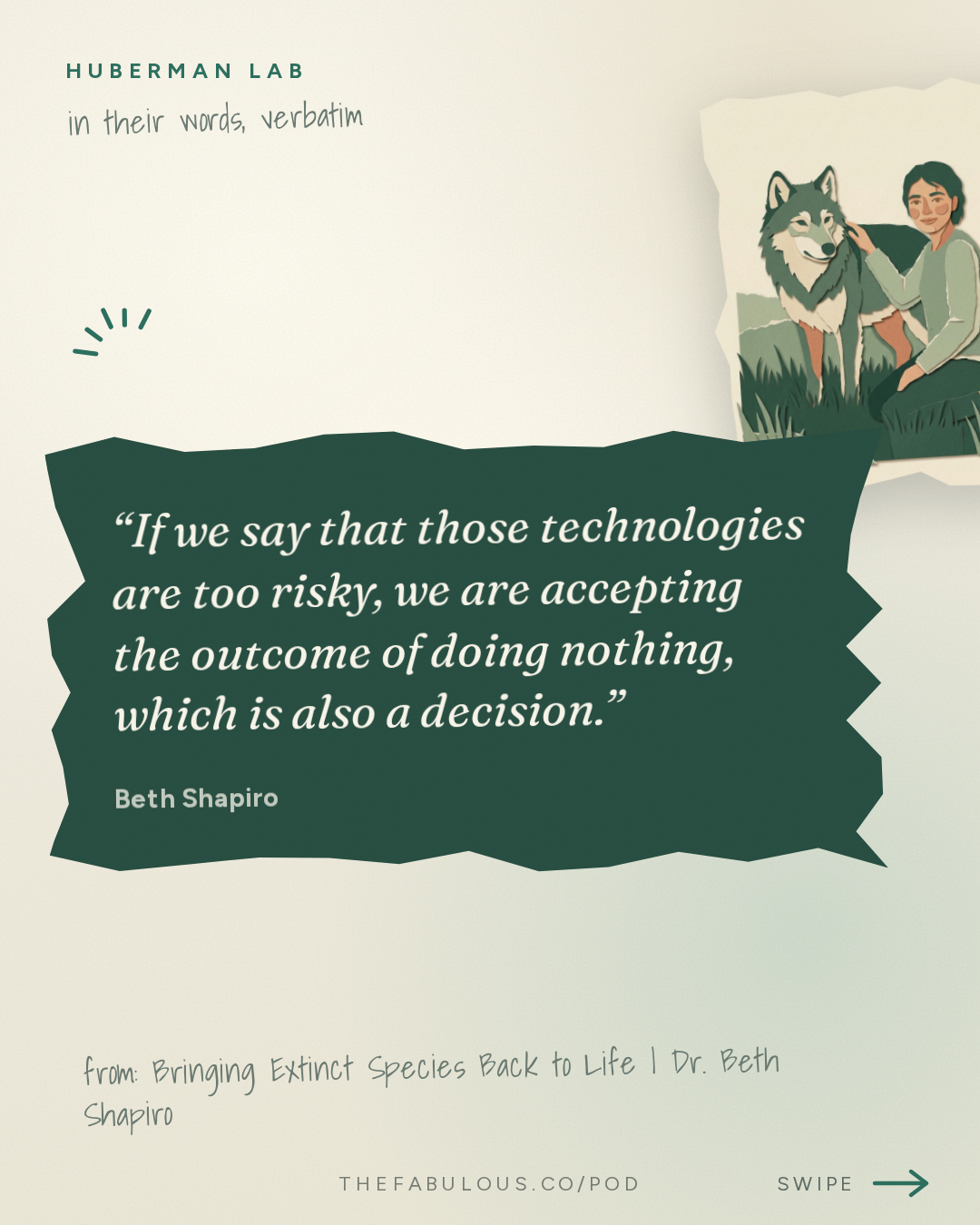
"If we say that those technologies are too risky, we are accepting the outcome of doing nothing, which is also a decision." — Beth Shapiro [85:10]
That is the real argument underneath the dire wolf headlines and the ferret clones: not that every intervention is wise, but that refusing to intervene is itself a choice with consequences, made quietly and by default. Shapiro's hope is that getting people to feel genuine awe about a woolly-coated elephant or a hand-reared wolf pup buys attention, funding, and patience for the slower, less photogenic work of keeping species that are still alive from disappearing in the meantime.
Ask this episode anything
Pod's AI answers from the episode itself, with the minute mark so you can hear it yourself.
Or start with one of these
Ask this episode
Pod's AI listens to the whole episode to answer, and points you to the minute it comes from.
The rest of this answer, and any question after it
Answers come from the episode itself, never from a summary of it.
ContinueKey takeaways
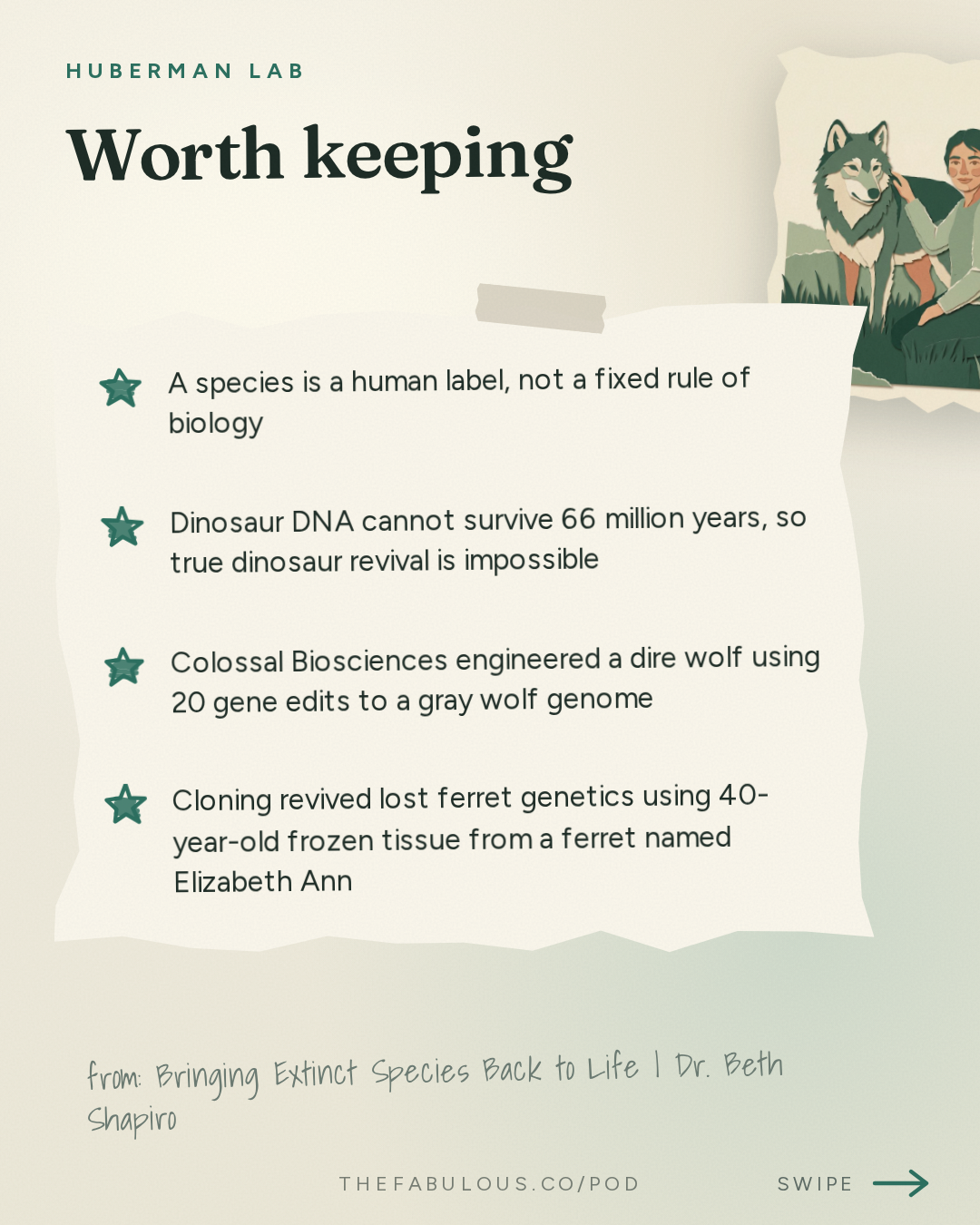
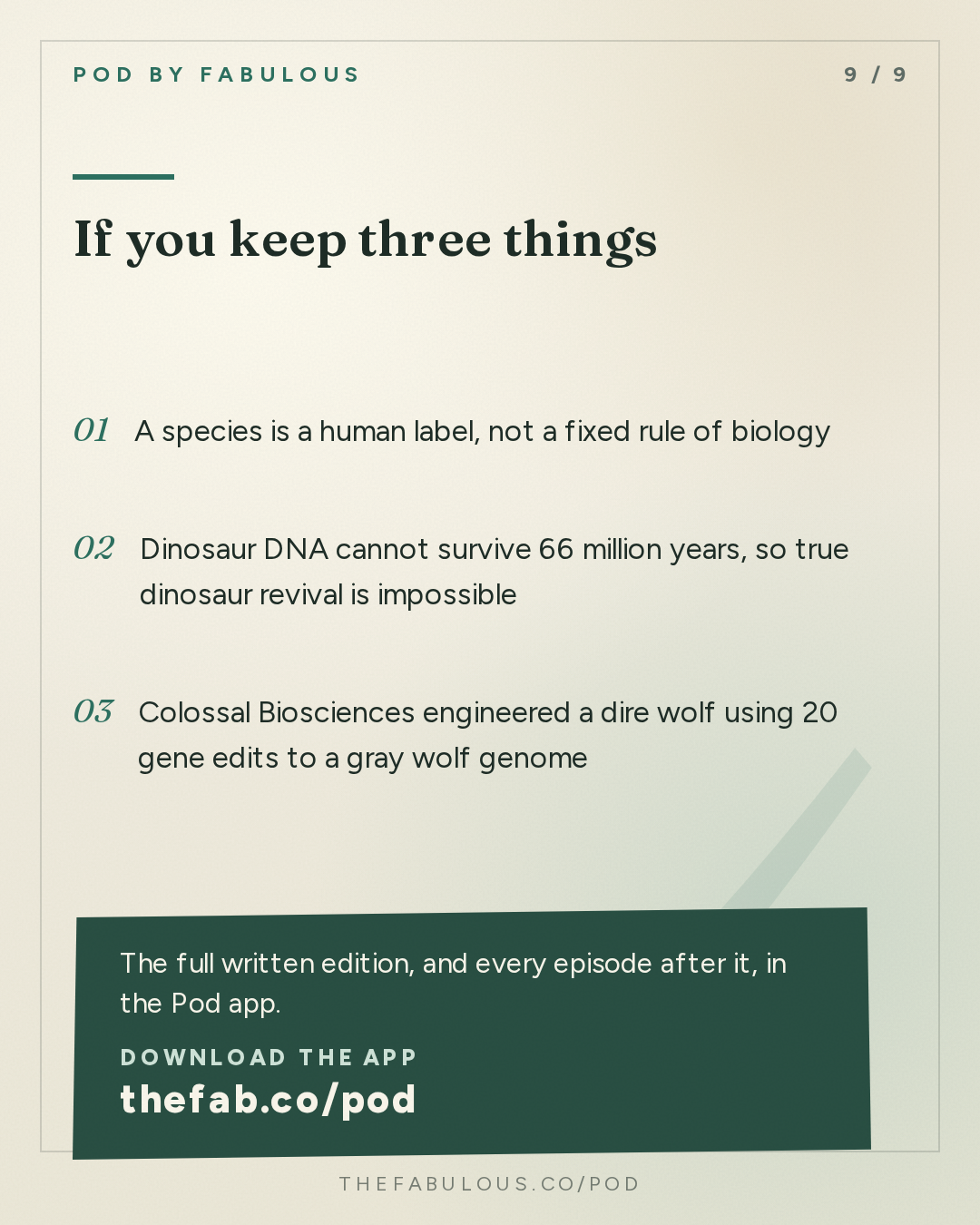
- A species is a human label, not a fixed rule of biology
- Dinosaur DNA cannot survive 66 million years, so true dinosaur revival is impossible
- Colossal Biosciences engineered a dire wolf using 20 gene edits to a gray wolf genome
- Cloning revived lost ferret genetics using 40-year-old frozen tissue from a ferret named Elizabeth Ann
- CRISPR base editing already cured an infant's urea cycle disorder within six months
The episode in cards
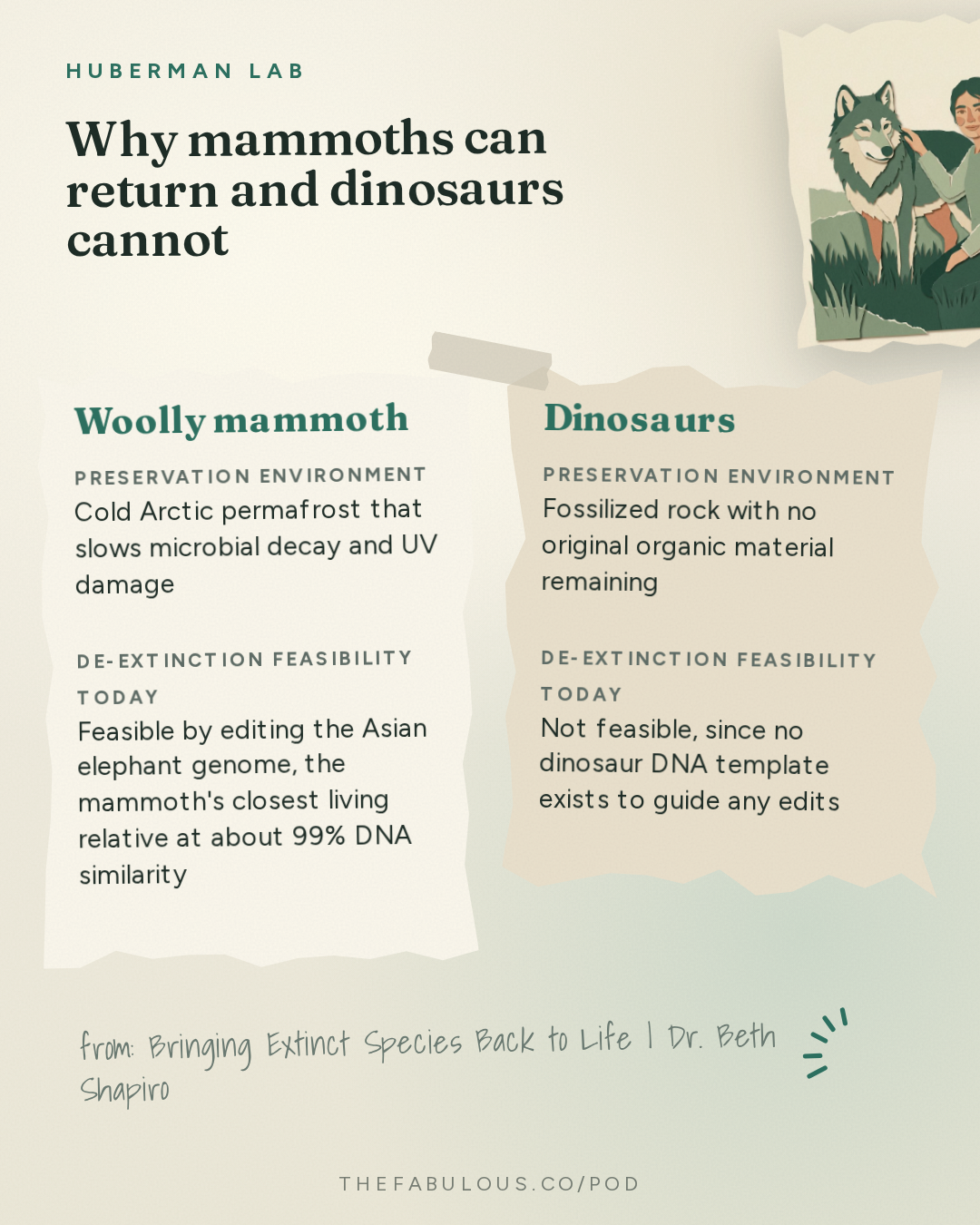
By the numbers
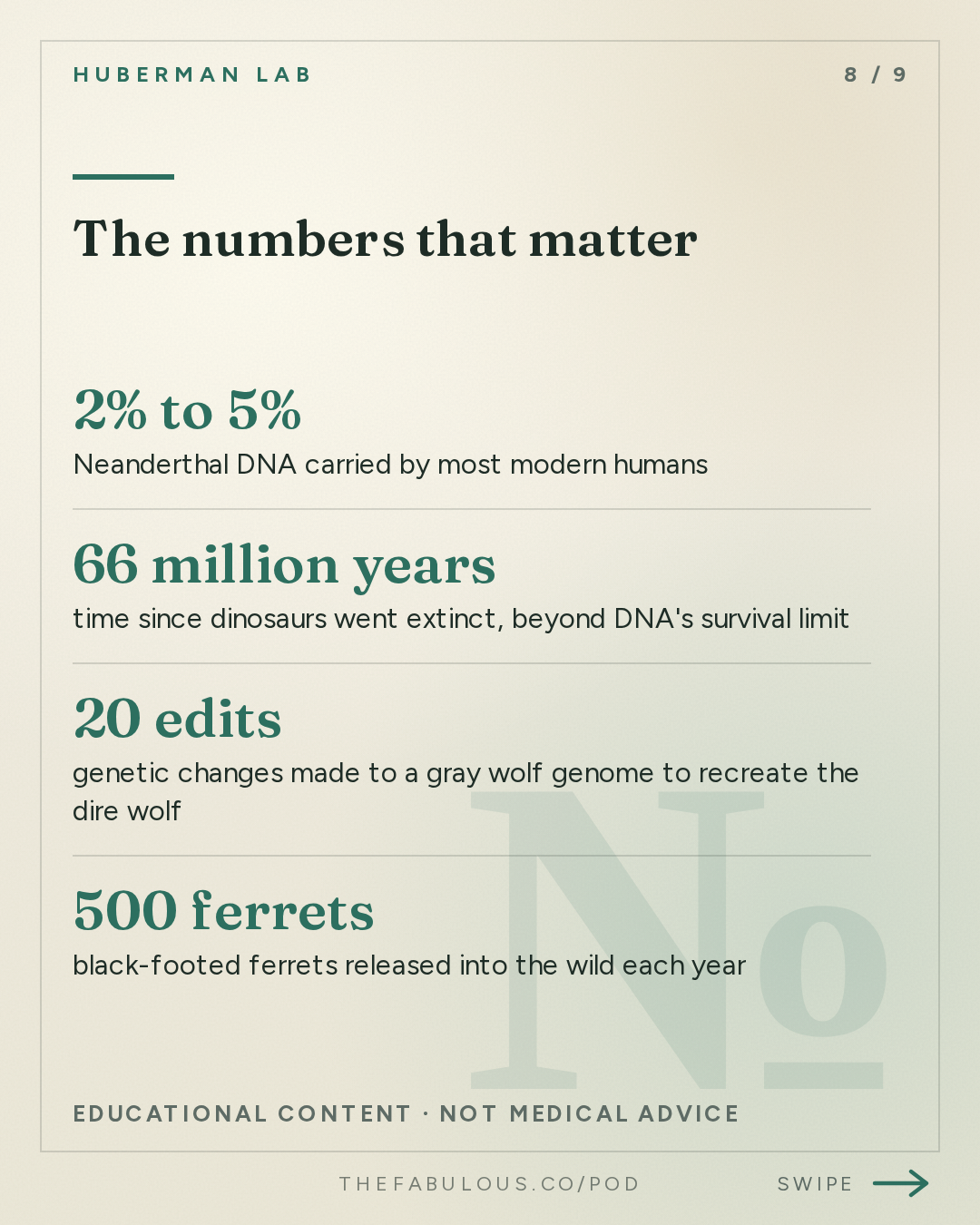
- 2% to 5% percent Neanderthal DNA carried by most modern humans
- 66 million years time since dinosaurs went extinct, beyond DNA's survival limit
- 20 edits genetic changes made to a gray wolf genome to recreate the dire wolf
- 500 ferrets black-footed ferrets released into the wild each year
In their words
“Biology doesn't care what species you are. Species is a, a human concept. We have this incredible proclivity to want to put things into boxes so that we can talk about them.”
“When we excite people with the idea of mammoths- Mm-hmm ... and dodos and thylacines, we get more engagement and enthusiasm and investment in developing the technology that we can use to stop living species from becoming”
“Every child that's born has about 100 differences compared to their parents because of copying error in the process of making the sperm and making the eggs.”
“If we say that those technologies are too risky, we are accepting the outcome of doing nothing, which is also a decision.”
Protocols
-
Avoid unsafe edits by borrowing proven variants
Beth Shapiro's team at Colossal Biosciences sequences fossil genomes to find which DNA changes produced an extinct trait, then checks whether copying that exact variant into a living relative carries known health risks. When the dire wolf's own light-coat gene risked causing blindness or deafness in a gray wolf, the team used a different, already-safe light-coat variant found in domestic dogs to get the same look without the risk.
Applied individually for each genetic edit in a de-extinction project
-
Rebuild genetic diversity before scaling releases
Conservationists working with US Fish and Wildlife and the San Diego Frozen Zoo cloned tissue frozen for 40 years from a black-footed ferret genetically unrelated to the small surviving wild population, producing a ferret named Elizabeth Ann in 2020 to reintroduce lost genetic diversity before increasing the number of ferrets released each year.
Before expanding release numbers in a genetically bottlenecked population
Questions this episode answers
Can scientists really bring back dinosaurs?
No. DNA breaks down through UV damage, freeze-thaw cycles, and microbial decay, and the oldest DNA ever recovered from a bone, a frozen mammoth sample, is only 1 to 2 million years old (32:48). Dinosaurs went extinct 66 million years ago, far past the point where any usable DNA survives (33:08).
How was the dire wolf created?
Colossal Biosciences sequenced genomes from fossil dire wolves to find which DNA changes produced the animal's larger size, muscle, and light coat, then made 20 of those edits to a living gray wolf genome (56:33). Evolutionary biologist Beth Shapiro says the team used coat-color variants already proven safe in domestic dogs instead of the dire wolf's own variant, which risked blindness or deafness (58:50).
How much Neanderthal DNA do modern humans have?
Most people alive today carry between 2% and 5% Neanderthal DNA, the result of interbreeding after modern humans left Africa and encountered Neanderthals in Europe (10:48). Beth Shapiro notes it is a different 2 to 5% in each person, and that combining everyone's fragments would reconstruct more than 90% of the Neanderthal genome (23:25).
What is genetic rescue and how did it save the black-footed ferret?
Genetic rescue means adding new genetic diversity to a shrinking, inbred population. Nearly the entire wild ferret population descended from one male nicknamed Scarface, so scientists cloned a genetically distinct ferret from 40-year-old frozen tissue, producing a ferret named Elizabeth Ann in 2020 (104:44). About 500 black-footed ferrets are now released into the wild each year (103:49).
Has gene editing already been used to treat a human disease?
Yes. Doctors at Children's Hospital of Philadelphia designed a bespoke CRISPR base editor, a tool that rewrites single DNA letters, for a six-month-old infant with a urea cycle disorder that was causing ammonia to build up in his blood, and the treatment cured him (97:04).
Is species a scientific category or a human invention?
Beth Shapiro argues species is a human concept used to sort organisms for conversation, not a boundary biology itself respects (03:56). She points to polar bears and brown bears, which diverged roughly 500,000 years ago and still produce fertile offspring where their ranges overlap (17:42).
The full read, in cards
Go deeper
- How to Clone a Mammoth — Beth Shapiro's book whose first chapter covers how to choose which species to de-extinct
- Life As We Made It — Beth Shapiro's book on humanity's long history of shaping other species' evolution
- 1984 quagga DNA study (Allan Wilson, UC Berkeley) — First published recovery of ancient DNA, from a preserved quagga skin, proving DNA survives after death
- USDA deregulation of the gene-edited American chestnut tree — First gene-edited organism approved specifically for ecosystem restoration rather than agriculture
Mentioned
Beth Shapiro · Colossal Biosciences · Svante Pääbo · Pleistocene Park · How to Clone a Mammoth · Life As We Made It · Elizabeth Ann · CRISPR · He Jiankui · Howard Hughes Medical Institute · Ed Green · Scarface · Dolly the sheep · Sergey Zimov
More from this show and category

Huberman's Science-Based Focus Tools
Stanford neuroscientist Andrew Huberman lays out a stacked protocol for training focus, from sleep and caffeine to meditation and supplements. He covers 90-minute ultradian work blocks, a 13-minute daily breath meditation, cold exposure for epinephrine, and specific doses for creatine, alpha-GPC, and L-tyrosine, recommending behavioral tools before any supplement or drug.

Andy Galpin's Strength and Hypertrophy Protocols
Strength and muscle size are not the same adaptation: size can grow without strength, and power fades fastest with age. Kinesiologist Andy Galpin lays out concrete numbers, a 3-to-5 strength template, and a 10-to-25 weekly set range for hypertrophy that adapts to real-life chaos (11:30, 32:15).

Andy Galpin's 9 Fitness Benchmarks to Self-Test
Exercise scientist Andy Galpin breaks fitness into nine measurable adaptations, from movement skill to long-duration endurance, each with a home-testable benchmark. The takeaway: a broad jump, a dead hang, and a 12-minute run tell you more about your health trajectory than a single cardio number ever could (02:32).
The Three Macronutrients of True Happiness
Arthur Brooks argues happiness runs on three macronutrients: enjoyment, satisfaction, and meaning. Chasing money, power, pleasure, or honor as ends in themselves blocks all three (67:59), while struggle, leisure used on purpose, and naming one's true idol are what convert pleasure into lasting well-being.
