
Huberman's Science-Based Focus Tools
Essentials: Tools to Improve Your Focus & Concentration
The brief
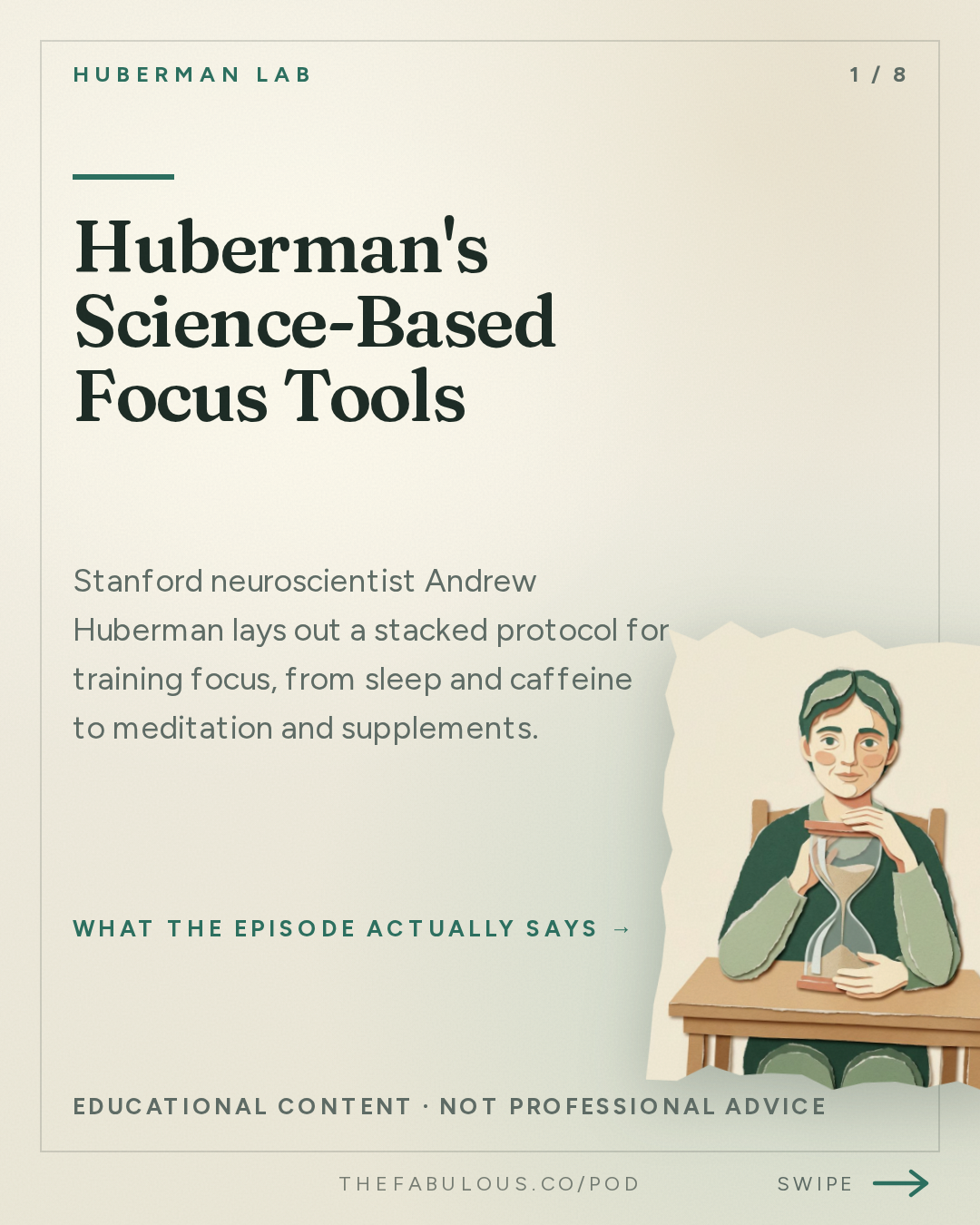
Stanford neuroscientist Andrew Huberman lays out a stacked protocol for training focus, from sleep and caffeine to meditation and supplements. He covers 90-minute ultradian work blocks, a 13-minute daily breath meditation, cold exposure for epinephrine, and specific doses for creatine, alpha-GPC, and L-tyrosine, recommending behavioral tools before any supplement or drug.
Picture an arrow. Andrew Huberman, a professor of neurobiology and ophthalmology at Stanford School of Medicine, uses this image to explain how attention actually works in the brain (01:46). The shaft is epinephrine, the body's alertness chemical, released from a brain structure called the locus coeruleus and from the adrenal glands. It supplies energy, but energy alone does not equal focus (02:15). The arrowhead is acetylcholine, a neurochemical that acts like a spotlight, switching on the specific neurons that matter for the task at hand while leaving the rest dim (02:44). And the shaft needs direction over time, which is dopamine, better understood here as the molecule of motivation than of pleasure (03:38). Put the three together, Huberman says, and attention stops being a mystery and starts being a system with parts that can be trained.
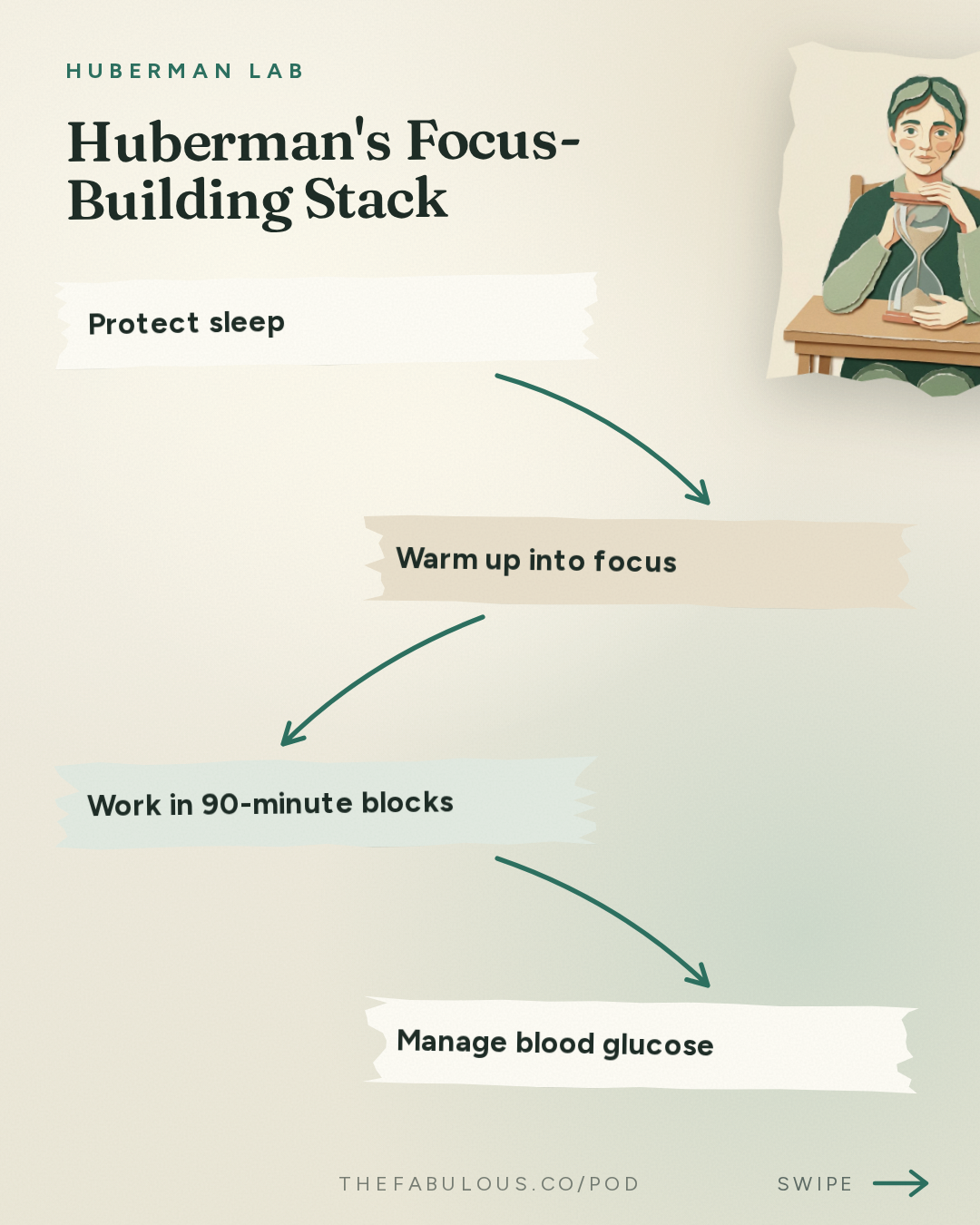
That reframing matters, because it turns an inability to focus from a character flaw into a solvable mechanics problem. Huberman built his toolkit partly around a finding from NYU neuroscientist Wendy Suzuki's lab: a 13-minute daily breathing meditation, repeated for eight weeks, measurably improved people's concentration (00:41). But the real shape of the episode is less about any single trick and more about an order of operations: sleep first, then food timing, then behavioral training, then supplements, and only then, under a doctor's care, medication.
Sleep anchors everything. Huberman doesn't ask for perfection, he asks for optimal-quality sleep roughly 80 percent of nights, since sleep touches nearly every process in the brain and body (04:34). On top of that baseline, white noise or pink noise doesn't make concentration deeper, it shortens the runway into concentration, likely by stirring activity in the prefrontal cortex, the strip of brain tissue behind the forehead that directs attention (05:13). That runway matters because, as Huberman puts it,
None of us, however, should be expected to just sit down and drop directly into a state of focus. (06:09)
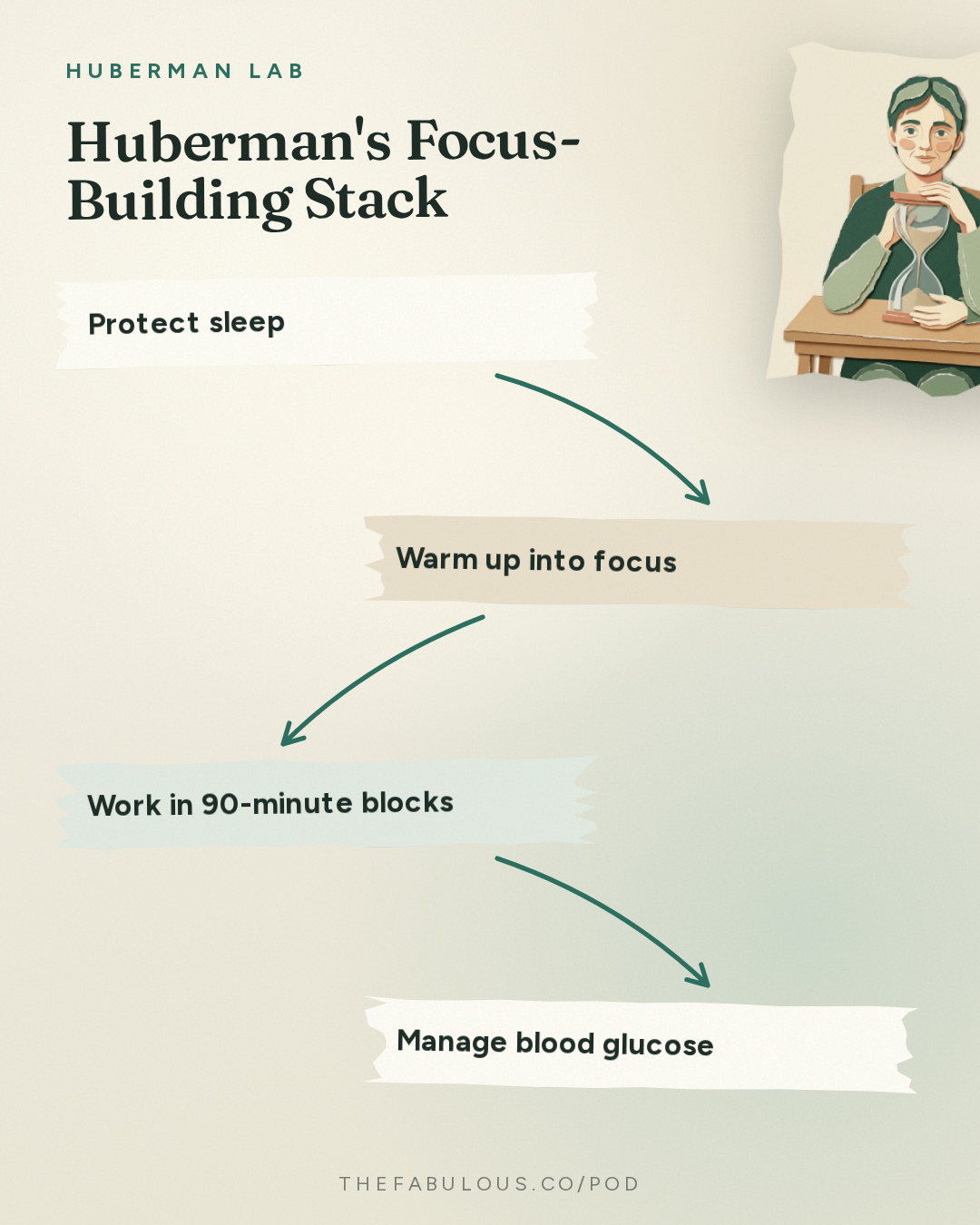
Nobody sprints without warming up, and nobody should expect instant depth from a cold start. The useful unit of work, he argues, is about 90 minutes, a so-called ultradian cycle that also governs sleep stages (09:19), with the first five to ten minutes budgeted as warmup rather than wasted time (10:06).
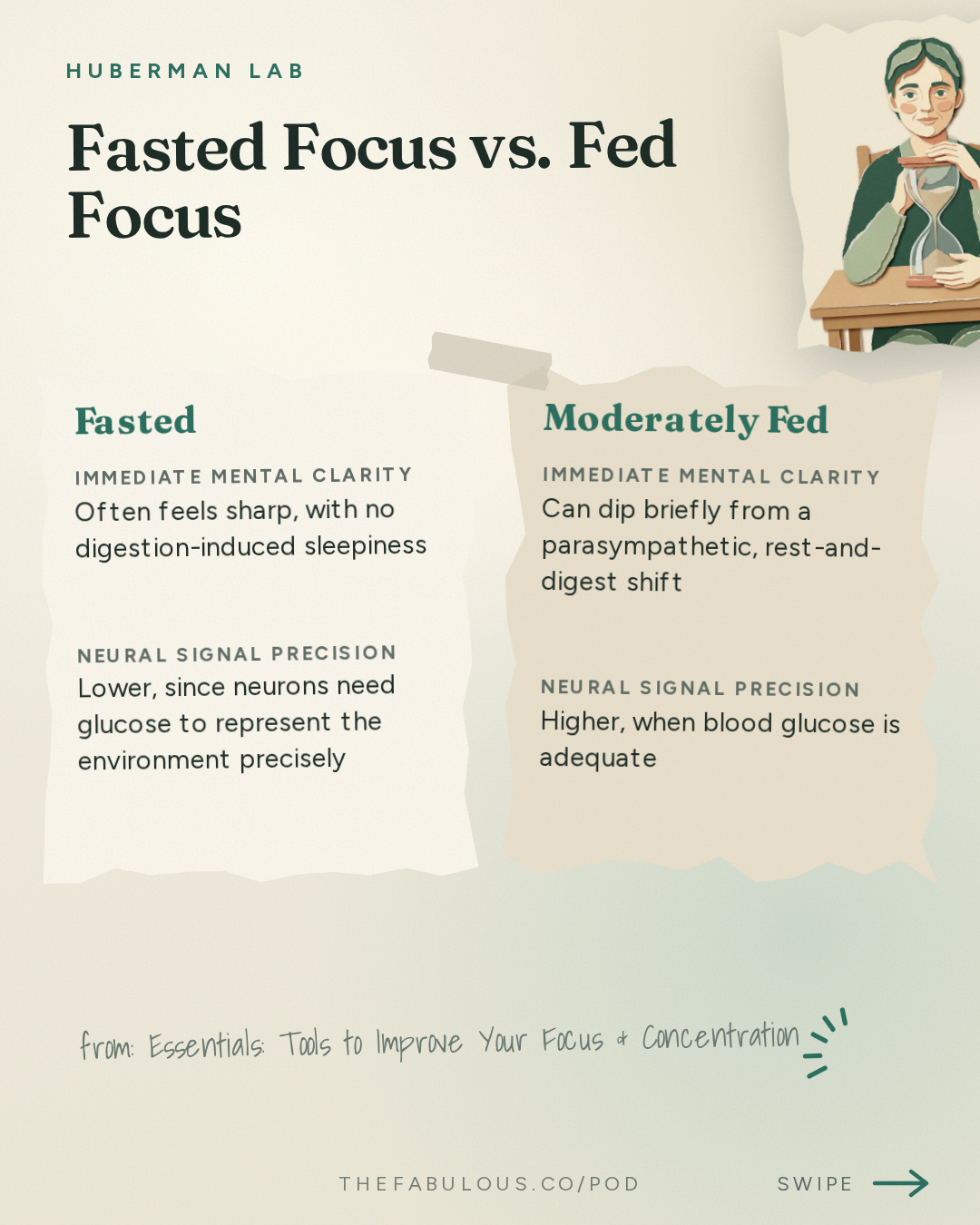
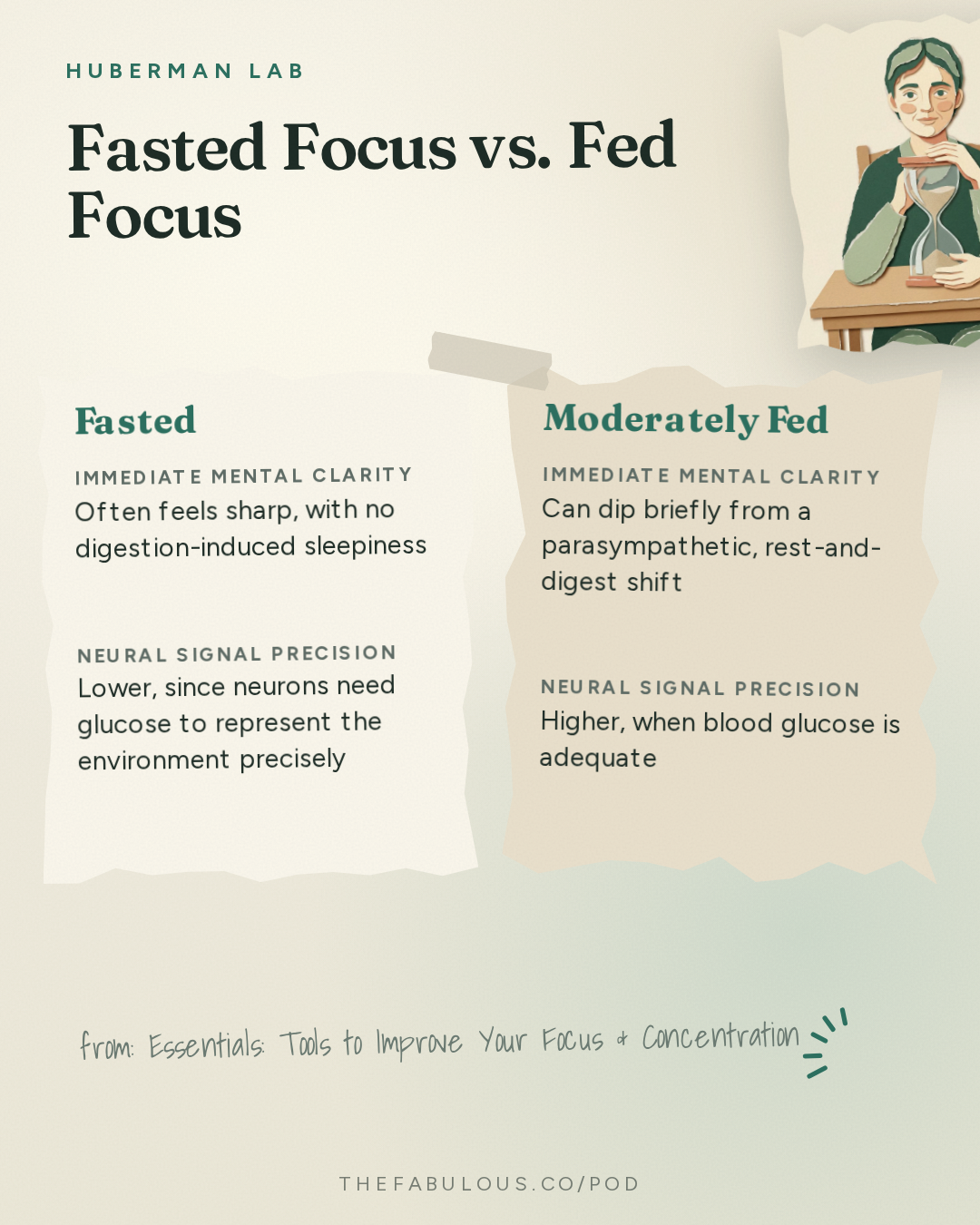
Food timing turns out to be a genuine trade-off, not a hack. A study published in the journal Neuron found that neurons represent the world more precisely when there is enough glucose on board (11:12), yet a large meal shifts the body into a parasympathetic, rest-and-digest mode that routes blood to the gut and induces sleepiness (11:54). The result is a U-shaped curve: fasted people often feel sharp, people who eat a moderate meal also focus well, and the danger zone is the heavy lunch that leaves someone groggy for the afternoon (12:11).
Caffeine and stress work through that same epinephrine lever, just at different intensities. The useful caffeine range, per Huberman, runs from 100 to 400 milligrams, with most people doing best closer to the low end and anyone prone to anxiety advised to go lower still (14:01). Timing matters as much as dose: caffeine should ideally stop 10 to 12 hours before bed to protect sleep architecture, even in people who don't feel it keeping them awake (14:43). Stress, surprisingly, helps rather than hurts in small, acute doses. A 2020 paper in the journal Experimental Psychology, led by researcher De Groote, put subjects through a mock job interview and arithmetic test and found concentration performance more than doubled in the stressed group, likely because epinephrine narrows the visual field into something closer to tunnel vision (15:29, 15:51). Huberman's preferred, cost-free way to summon that same chemical without an actual crisis is deliberate cold exposure: one to five minutes in a cold shower reliably spikes epinephrine and produces a near doubling of dopamine that lasts for hours, according to a study in the European Journal of Physiology (17:27). As he describes it,
Epinephrine is a neurochemical that will place your vision into more of a tunnel mode, which will allow you to focus on cognitive work or physical work in a more specific way. (18:20)
Training the circuit, not just triggering it
The meditation protocol and a companion visual exercise both rest on a single insight: the mind wandering off is not a failure of the practice, it is the practice. In Suzuki's 13-minute protocol, a person sits, breathes through the nose, and tries to hold attention on a point about an inch inside the forehead. The mind will drift every five to twenty seconds, and that is expected (22:21). What builds the circuit is noticing the drift and pulling back, over and over, the behavioral equivalent of a car drifting toward a rumble strip and correcting (23:22). Huberman makes the point directly: the repeated return to focus, by way of neuroplasticity, the brain's ability to rewire itself with repetition, is the mechanism that teaches the neural circuits how to focus for extended periods (24:31). The visual version of the same drill, borrowed from practices used in some schools in China, has a person stare at a fixed point on a wall for 30 seconds up to three minutes, again refocusing each time the gaze slips, which recruits the prefrontal cortex and the frontal eye fields that steer deliberate gaze (26:18, 27:23). Huberman suggests starting at 30 seconds and adding five seconds a day rather than overreaching.
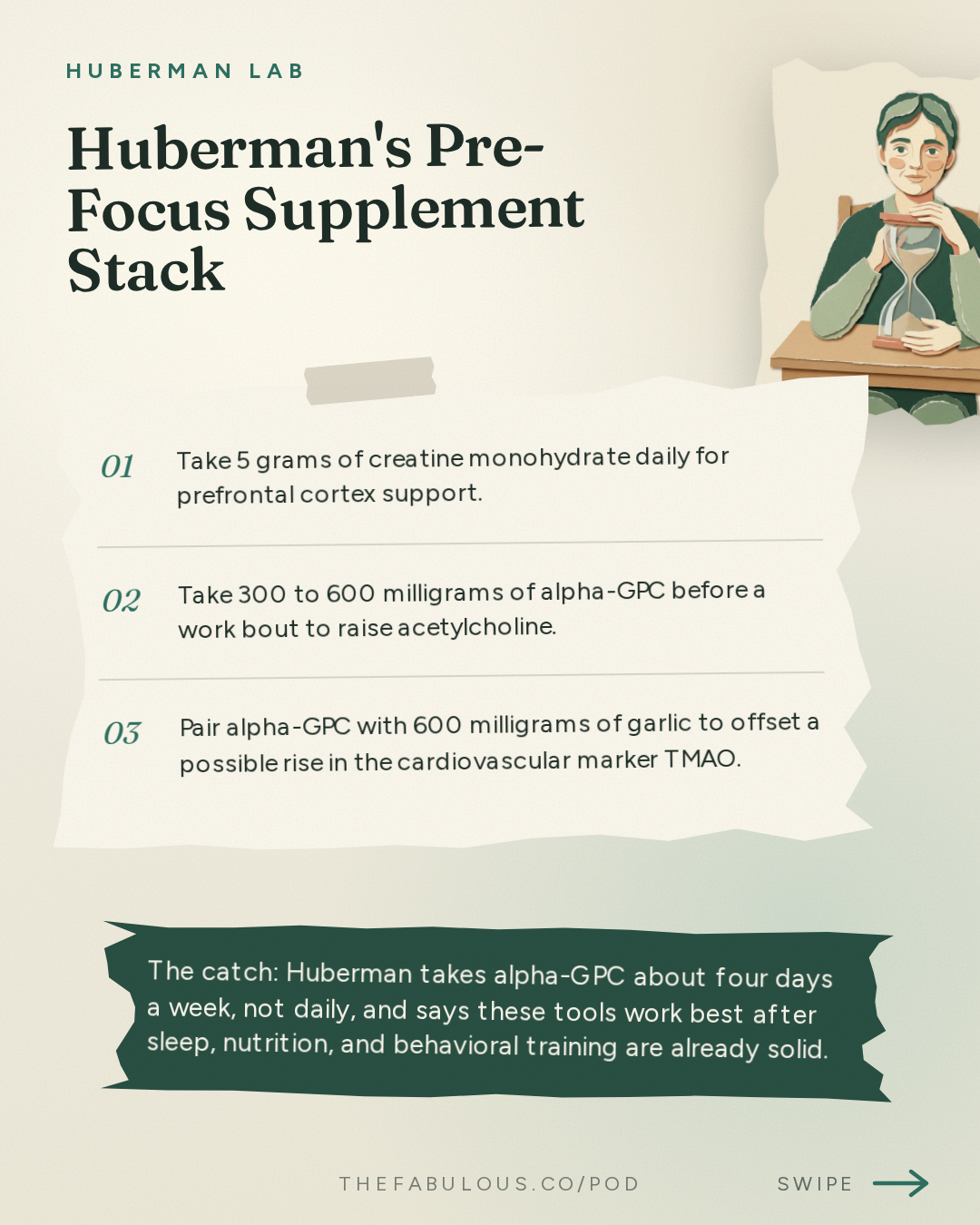
Supplements enter the stack last, and Huberman frames them as training wheels rather than crutches, something to deepen a state the brain will eventually reach on its own. He names specific doses drawn from his own reading of the literature and his personal practice: one to three grams of EPA, an omega-3 fatty acid, for general brain support (31:09); five grams of creatine monohydrate daily, chosen less for muscle than for feeding the creatine phosphate energy system in prefrontal networks (32:30); 300 to 600 milligrams of alpha-GPC before a work bout to raise acetylcholine (33:38), paired, out of caution over a study linking alpha-GPC to a rise in a cardiovascular marker called TMAO, with 600 milligrams of garlic to offset it (34:40); and 500 milligrams of L-tyrosine, an amino acid that feeds dopamine production, often stacked with a cup of coffee (35:10). He is careful to say he never combines more than two or three tools at once, and some days he uses none.
The same stimulant logic, scaled up, explains prescription ADHD medications like Adderall and Ritalin, which raise dopamine and epinephrine the way the supplements do, just more forcefully (36:53). Given to someone with properly diagnosed attention deficit hyperactivity disorder, under psychiatric supervision, the drugs don't simply calm a hyperactive brain; they let its attention circuits practice engaging, with the hope that dosage can shrink over time as the circuits learn the pattern on their own (38:44). Huberman is explicit about the order he follows: behavioral tools first, then nutrition and sleep, then supplementation, and prescription drugs only when the rest has failed to bring someone to the state they need (39:32).
The episode's last turn is the one most people skip: defocusing on purpose. Huberman recommends daydreaming, walking without a phone, letting sensory input drop, precisely because deliberate decompression is what lets the brain focus better when it returns to a bout of concentrated work (41:04). The arrow, in other words, needs to come out of the bow sometimes. A nervous system asked to stay narrow and tense all day doesn't get sharper, it gets tired. The tools in this episode, taken together, describe less a hack than a rhythm: warm up, narrow in, refocus when it drifts, and then, deliberately, let go.
Ask this episode anything
Pod's AI answers from the episode itself, with the minute mark so you can hear it yourself.
Or start with one of these
Ask this episode
Pod's AI listens to the whole episode to answer, and points you to the minute it comes from.
The rest of this answer, and any question after it
Answers come from the episode itself, never from a summary of it.
ContinueKey takeaways
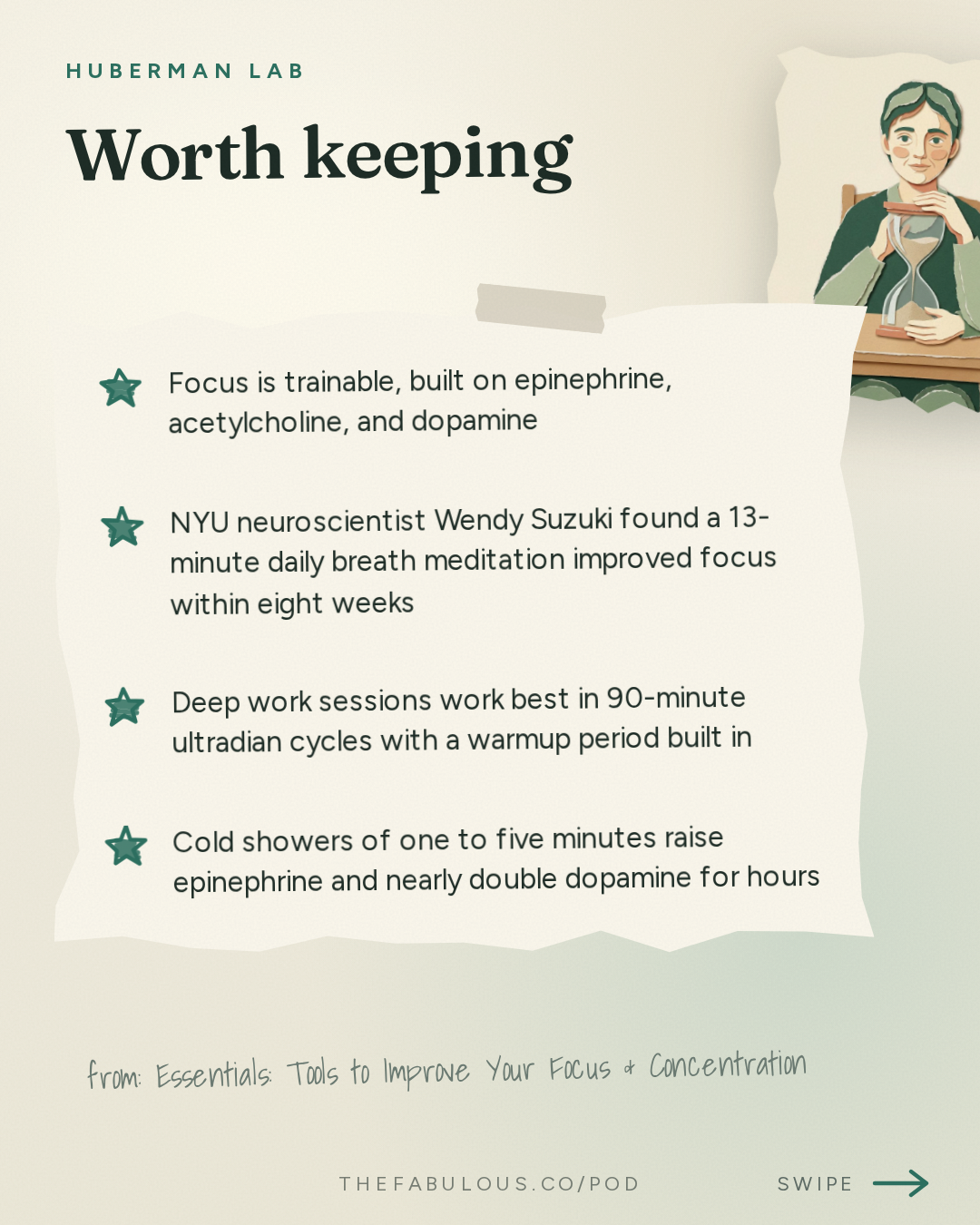
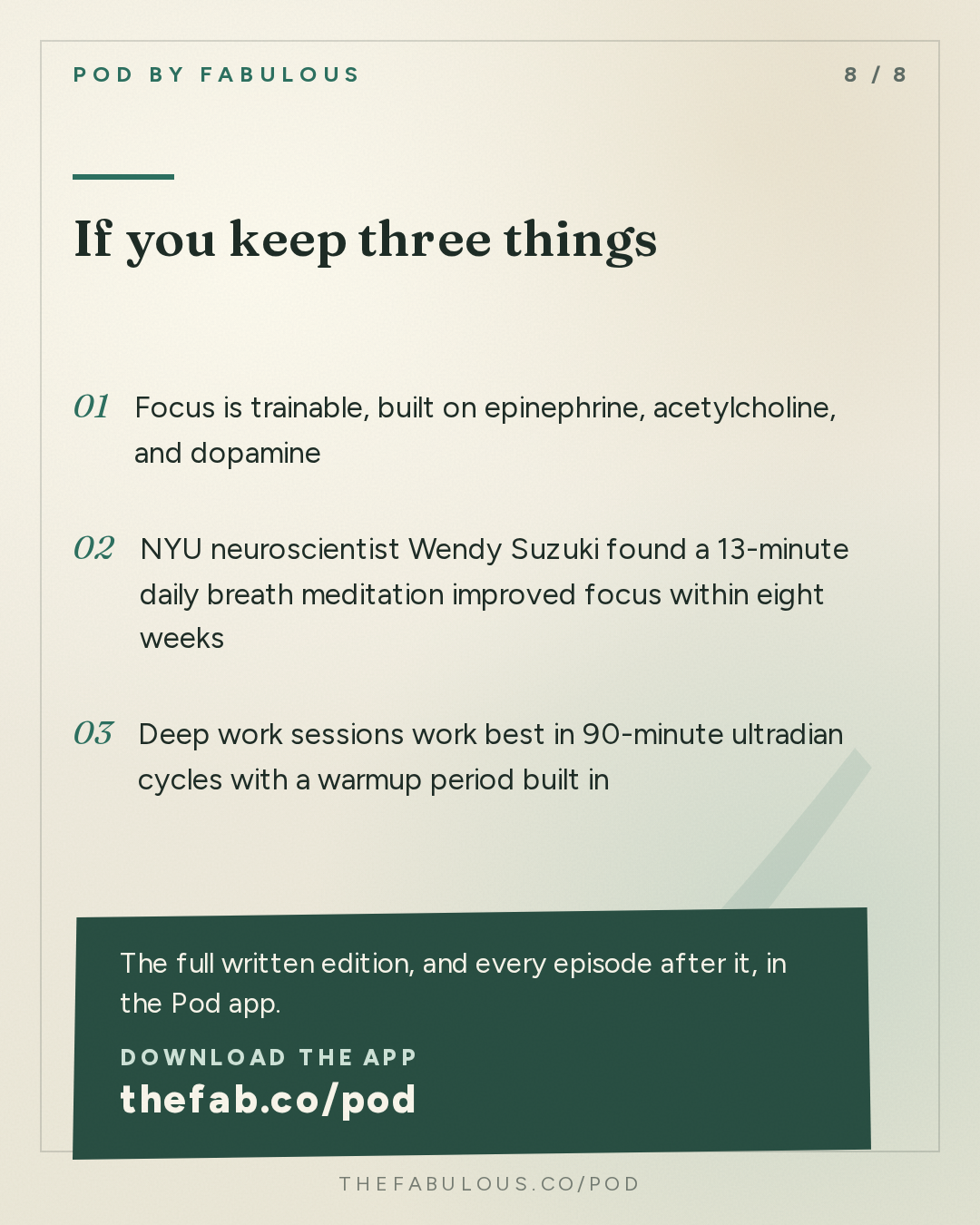
- Focus is trainable, built on epinephrine, acetylcholine, and dopamine
- NYU neuroscientist Wendy Suzuki found a 13-minute daily breath meditation improved focus within eight weeks
- Deep work sessions work best in 90-minute ultradian cycles with a warmup period built in
- Cold showers of one to five minutes raise epinephrine and nearly double dopamine for hours
- Huberman stacks supplements like creatine, alpha-GPC, and L-tyrosine only after sleep and behavior are set
The episode in cards
By the numbers
- 13 minutes daily meditation duration linked to improved focus after eight weeks
- 90 minutes ideal length of a deep focus work block based on ultradian cycles
In their words
“None of us, however, should be expected to just sit down and drop directly into a state of focus.”
“What we repeat gets etched into our nervous system and becomes easier over time.”
“Being fasted is great for focus and concentration, provided you're not thinking about food the entire time”
“Epinephrine is a neurochemical that will place your vision into more of a tunnel mode, which will allow you to focus on cognitive work or physical work in a more specific way.”
Protocols
-
13-minute breath meditation
Huberman recommends sitting or lying down, closing the eyes, breathing through the nose, and holding attention about an inch inside the forehead for 13 minutes, treating every mind-wander as a chance to refocus rather than a failure.
daily, for at least eight weeks
-
90-minute ultradian focus blocks
Huberman suggests working in roughly 90-minute blocks, counting the first five to ten minutes as a warmup rather than wasted time, and adjusting how many blocks are attempted per day based on sleep quality and training level.
per deep work session
-
Caffeine timing for focus
Huberman advises taking 100 to 200 milligrams of caffeine before focused work for most people, staying no higher than 400 milligrams, and cutting off intake 10 to 12 hours before bedtime to protect sleep quality.
before work bouts, none within 10 to 12 hours of bed
-
Deliberate cold exposure
Huberman recommends a one to five minute cold shower that feels uncomfortably cold but safe, done before a work bout, to raise epinephrine and dopamine and narrow attention into a tunnel-like focus.
as needed before focus sessions
-
Pre-focus supplement stack
Huberman personally takes five grams of creatine monohydrate daily, 300 to 600 milligrams of alpha-GPC paired with 600 milligrams of garlic to offset a possible rise in the cardiovascular marker TMAO, and 500 milligrams of L-tyrosine with coffee before demanding work, while limiting any single session to two or three tools.
alpha-GPC about four days a week, creatine daily
Questions this episode answers
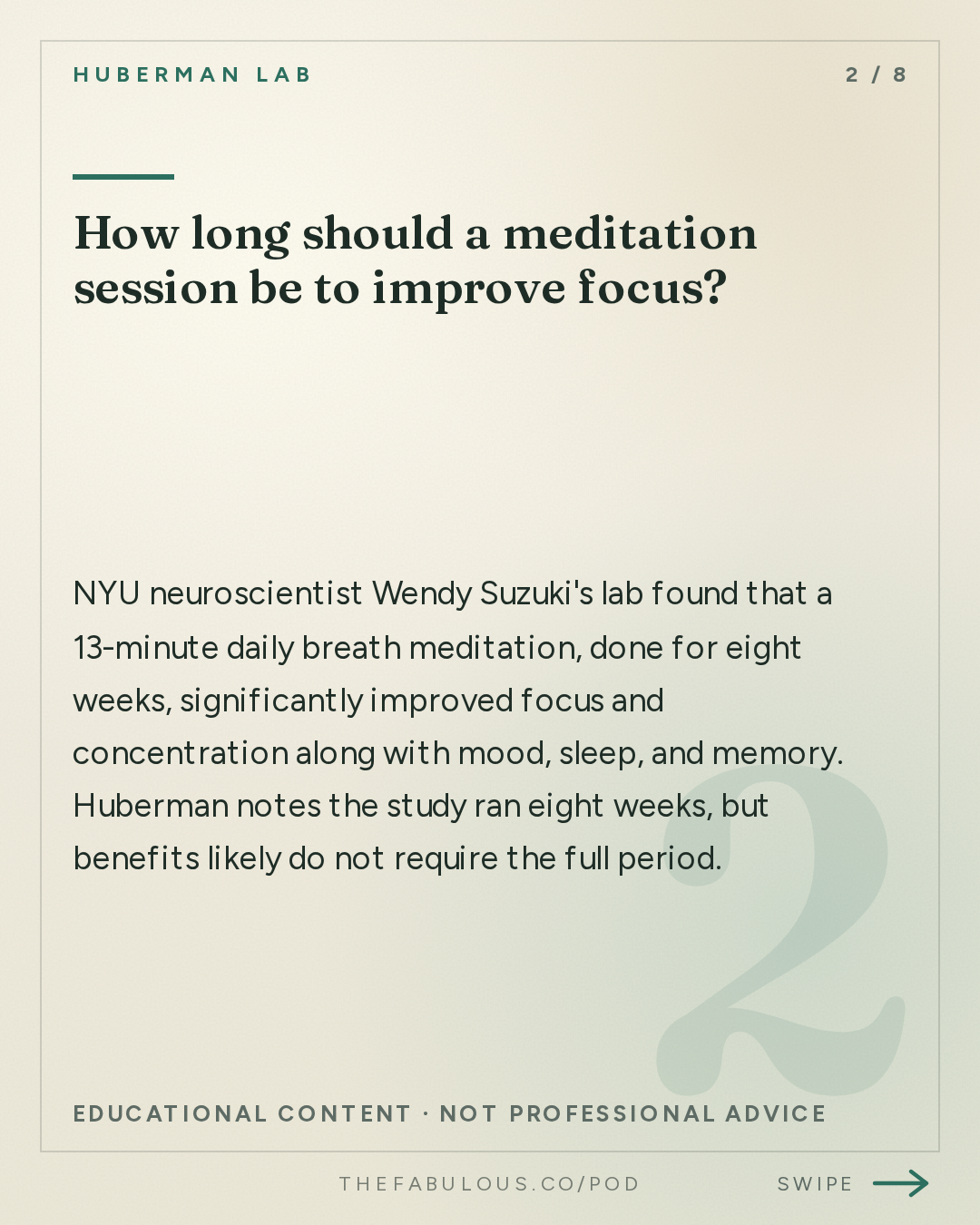
How long should a meditation session be to improve focus?
NYU neuroscientist Wendy Suzuki's lab found that a 13-minute daily breath meditation, done for eight weeks, significantly improved focus and concentration along with mood, sleep, and memory (00:41). Huberman notes the study ran eight weeks, but benefits likely do not require the full period (01:05).
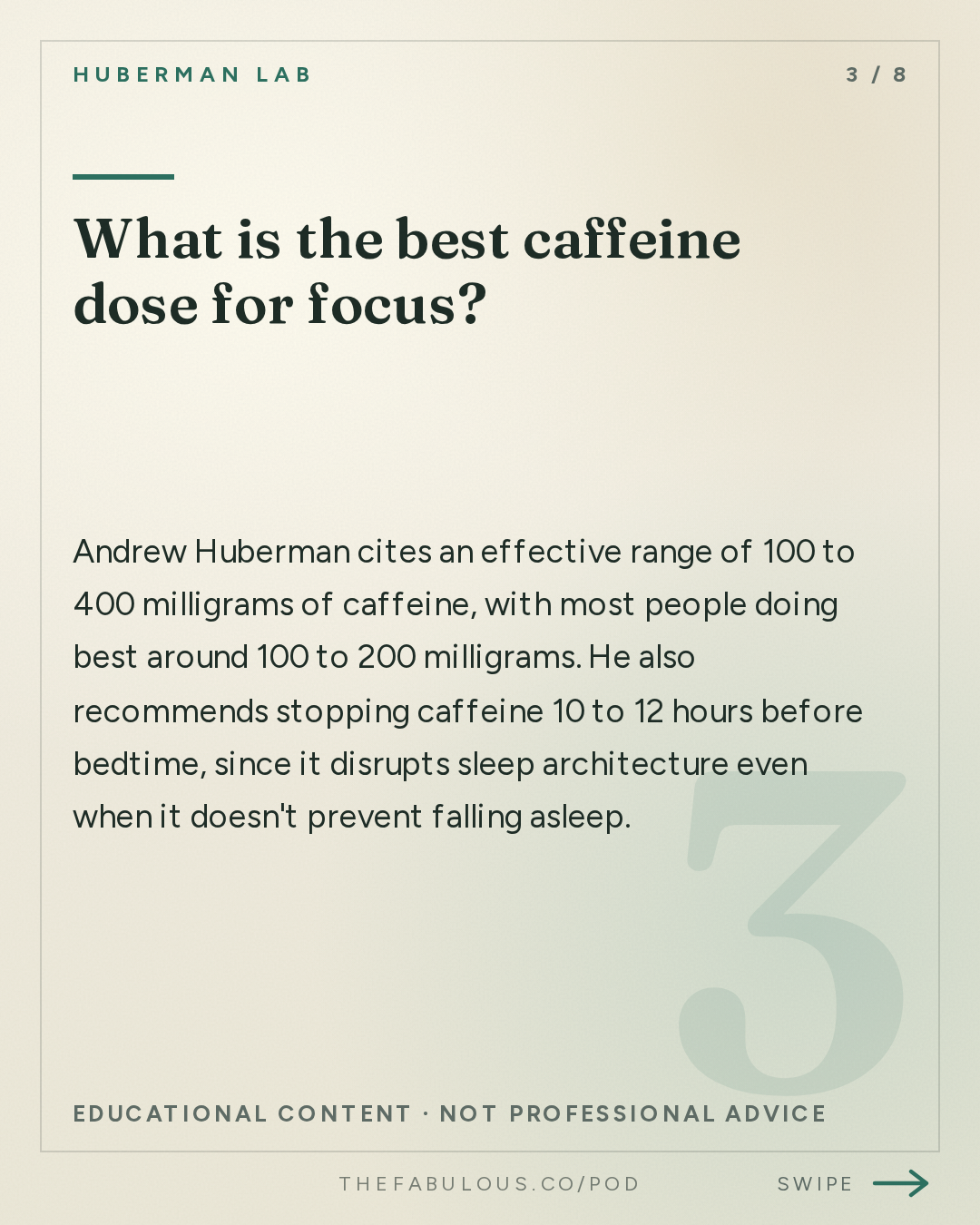
What is the best caffeine dose for focus?
Andrew Huberman cites an effective range of 100 to 400 milligrams of caffeine, with most people doing best around 100 to 200 milligrams (14:01). He also recommends stopping caffeine 10 to 12 hours before bedtime, since it disrupts sleep architecture even when it doesn't prevent falling asleep (14:43).
How long should a deep work session last?
Huberman points to the brain's 90-minute ultradian cycle, the same rhythm that governs sleep stages, as the ideal length for a deep focus bout, with the first five to ten minutes serving as a warmup rather than wasted time (09:19).
Does stress actually help concentration?
A 2020 study in the journal Experimental Psychology, led by researcher De Groote, found that mild acute stress from a mock job interview and arithmetic task more than doubled concentration performance by narrowing vision into a tunnel-like focus (15:51). Huberman notes this works through the same epinephrine pathway as cold exposure or caffeine.
What supplements does Huberman use for focus?
Huberman reports personally taking 1 to 3 grams of EPA fatty acids, 5 grams of creatine monohydrate, 300 to 600 milligrams of alpha-GPC paired with 600 milligrams of garlic, and 500 milligrams of L-tyrosine with coffee, rarely combining more than two or three at once (31:09, 35:10). He treats supplements as training wheels, to be used after sleep, nutrition, and behavioral tools are in place (39:32).
Is fasting good or bad for focus?
It depends on degree. A study published in the journal Neuron found neurons represent the environment more precisely with enough glucose in the brain, but a very full stomach shifts the body into parasympathetic digestion mode and induces sleepiness, producing a U-shaped relationship between eating and focus (11:12, 12:11).
The full read, in cards
Go deeper
- Wendy Suzuki lab meditation study — found a 13-minute daily breath meditation for eight weeks improved focus, mood, sleep, and memory
- Neuron study on glucose and neural tuning — found neurons represent the environment more precisely with sufficient brain glucose
- Acute Stress Improves Concentration Performance (De Groote, Experimental Psychology, 2020) — found mild acute stress more than doubled concentration performance via epinephrine
- European Journal of Physiology cold exposure study — found cold water exposure produced a near doubling of dopamine lasting for hours
Mentioned
Wendy Suzuki · Stanford School of Medicine · NYU · Alpha-GPC · Creatine Monohydrate · L-Tyrosine · Adderall · Ritalin · Locus Coeruleus · Prefrontal Cortex · De Groote
More from this show and category
Andy Galpin's Strength and Hypertrophy Protocols
Strength and muscle size are not the same adaptation: size can grow without strength, and power fades fastest with age. Kinesiologist Andy Galpin lays out concrete numbers, a 3-to-5 strength template, and a 10-to-25 weekly set range for hypertrophy that adapts to real-life chaos (11:30, 32:15).

Andy Galpin's 9 Fitness Benchmarks to Self-Test
Exercise scientist Andy Galpin breaks fitness into nine measurable adaptations, from movement skill to long-duration endurance, each with a home-testable benchmark. The takeaway: a broad jump, a dead hang, and a 12-minute run tell you more about your health trajectory than a single cardio number ever could (02:32).

The Three Macronutrients of True Happiness
Arthur Brooks argues happiness runs on three macronutrients: enjoyment, satisfaction, and meaning. Chasing money, power, pleasure, or honor as ends in themselves blocks all three (67:59), while struggle, leisure used on purpose, and naming one's true idol are what convert pleasure into lasting well-being.

Oded Rechavi: How Memories Pass Across Generations
Neurobiologist Oded Rechavi explains why eye color is inherited but a parent's knowledge is not, then shows the exception: in roundworms, small RNA molecules carry viral immunity and even brain-driven behavior across three generations, hinting at a physical, if limited, channel for inherited experience.
