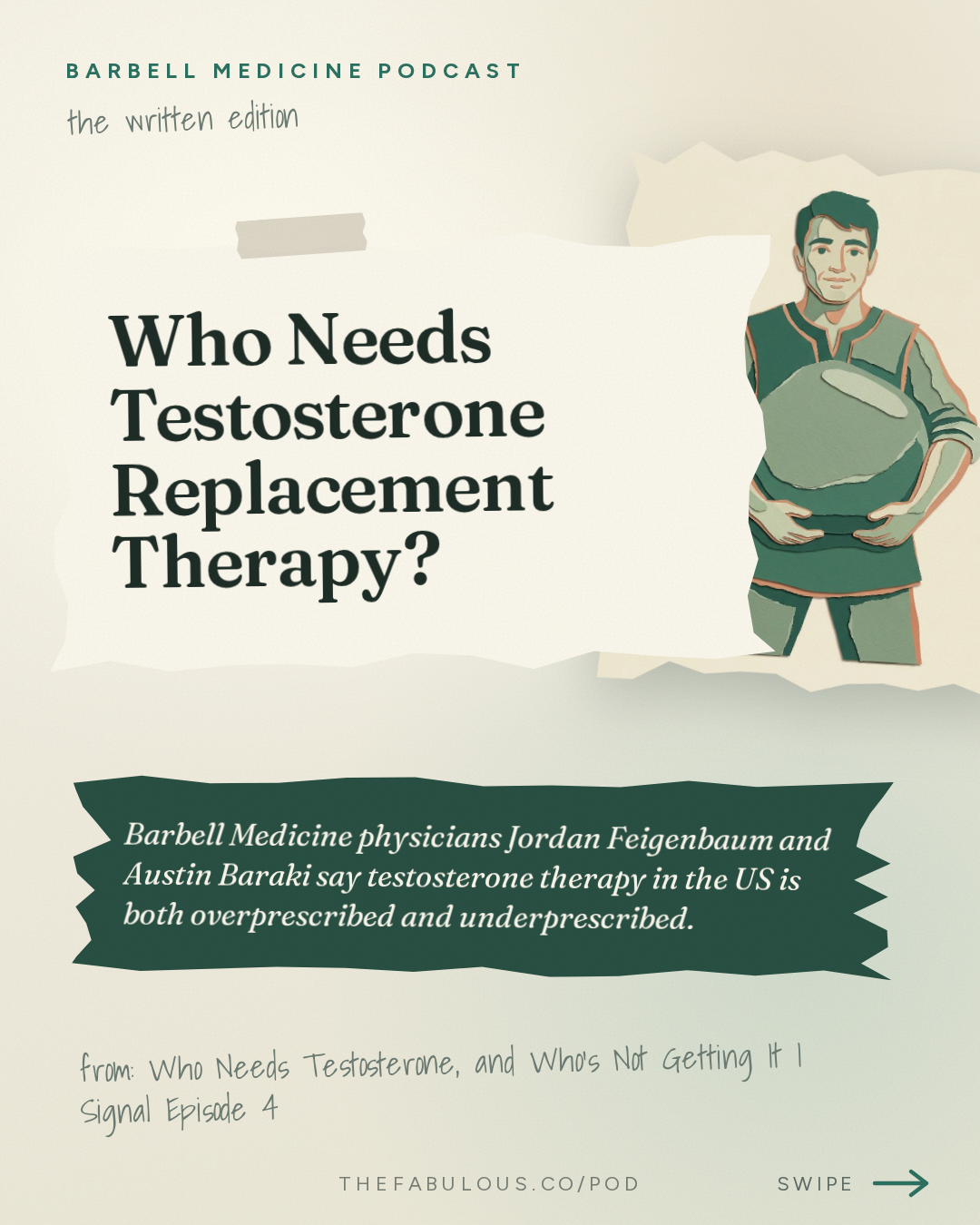
Who Needs Testosterone Replacement Therapy?
Who Needs Testosterone, and Who's Not Getting It I Signal Episode 4
The brief
Barbell Medicine physicians Jordan Feigenbaum and Austin Baraki say testosterone therapy in the US is both overprescribed and underprescribed. They point to a 45-man Sydney trial where raising testosterone from 310 to 510 ng/dL did not beat placebo, and to the Traverse trial's reassuring two-year heart-safety data.
Forty five men walked into a clinic in Sydney tired, quiet in the bedroom, flat in mood, and none of them had a diagnosable disease. No testicular failure, no pituitary damage, just middle aged men whose testosterone sat on the low side of normal (00:00). Researchers gave each man a testosterone gel for six weeks and a look-alike placebo gel for six weeks, in random order, with nobody, not even the researchers, knowing which was which. The gel worked exactly as advertised: it pushed levels from about 310 nanograms per deciliter up to about 510, solidly into the range of a healthy young man (39:22, 39:42). And the men felt exactly the same on both.
That result sits at the center of Barbell Medicine physicians Jordan Feigenbaum and Austin Baraki's four part series on testosterone, based on their book Signal. Energy, libido, and mood showed no real difference between drug and placebo (00:43). The trial ran twenty two separate quality of life measures. Exactly one favored testosterone, which the study's authors chalked up to chance rather than a true effect (40:02). The design had more than 90 percent power to catch even a moderate benefit, so this was not a study too small to find something real (40:24). It just did not find it.
"If you take a guy with low normal testosterone levels and you raise them, his symptoms don't really do anything on testosterone that the placebo also doesn't do." (Jordan Feigenbaum, [41:30])
That single sentence explains a strange paradox running through the whole episode: testosterone therapy in the United States is somehow both overused and underused at the same time. On the overuse side, prescriptions have roughly quadrupled over the past twenty years (10:15). A quarter of men who start therapy never had a testosterone level drawn beforehand (10:25). The landmark HIM study of primary care patients found that nearly 40 percent of middle aged men had a total testosterone below 300 ng/dL, but once symptoms were required alongside the low number, the true prevalence of deficiency dropped to somewhere between 2 and 6 percent (10:57, 11:15). Even among men who did get tested, about one in five received a prescription without meeting the actual criteria.
Part of the confusion is a protein called SHBG, sex hormone binding globulin, which binds testosterone in the blood and makes it biologically inactive. Obesity and insulin resistance tend to push SHBG down, which can make a man's total testosterone number look low while the free, usable fraction is perfectly normal (12:05, 12:27). Baraki describes a common patient: mid-40s, BMI above 30, waist over 40 inches, total testosterone of 240, tired, with a normal free testosterone once it is actually checked (12:48). His advice is not to reach for a prescription first, but to negotiate a plan: address sleep apnea, alcohol, and weight before or alongside any hormone therapy, sometimes with the help of a GLP-1 medication (15:10, 16:24).
On the other side of the ledger, real deficiency gets missed constantly. In the same HIM study, only one in ten men with a genuinely low testosterone level was actually being treated (23:06). Chronic opioid users, who suppress their own testosterone production at high rates, are rarely screened at all (23:21). Baraki recalls working with HIV patients whose testosterone came back at literally zero, a level he says he almost never saw checked in that population before (28:34).
A Decade of Fear, Explained by Money and Lawsuits
Part of the reason doctors got skittish traces back to 2013, when a couple of observational studies suggested a heart risk signal and the FDA issued a warning that testosterone might raise the chance of heart attack and stroke (24:17, 24:39). Prescription rates fell by more than half between 2013 and 2016 (24:39). At the same time, more than 25,000 lawsuits piled up against makers of AndroGel, a topical testosterone product, alleging it caused heart attacks and strokes (25:18). AbbVie, the company behind AndroGel, had spent about 75 million dollars marketing the drug in 2012 alone, part of a testosterone market that peaked around 1.6 billion dollars in 2014 before the warnings and lawsuits hit (25:54, 26:05). The FDA had flagged AbbVie's marketing as misleading as far back as 2000, years before the cardiovascular scare (26:05, 26:17).
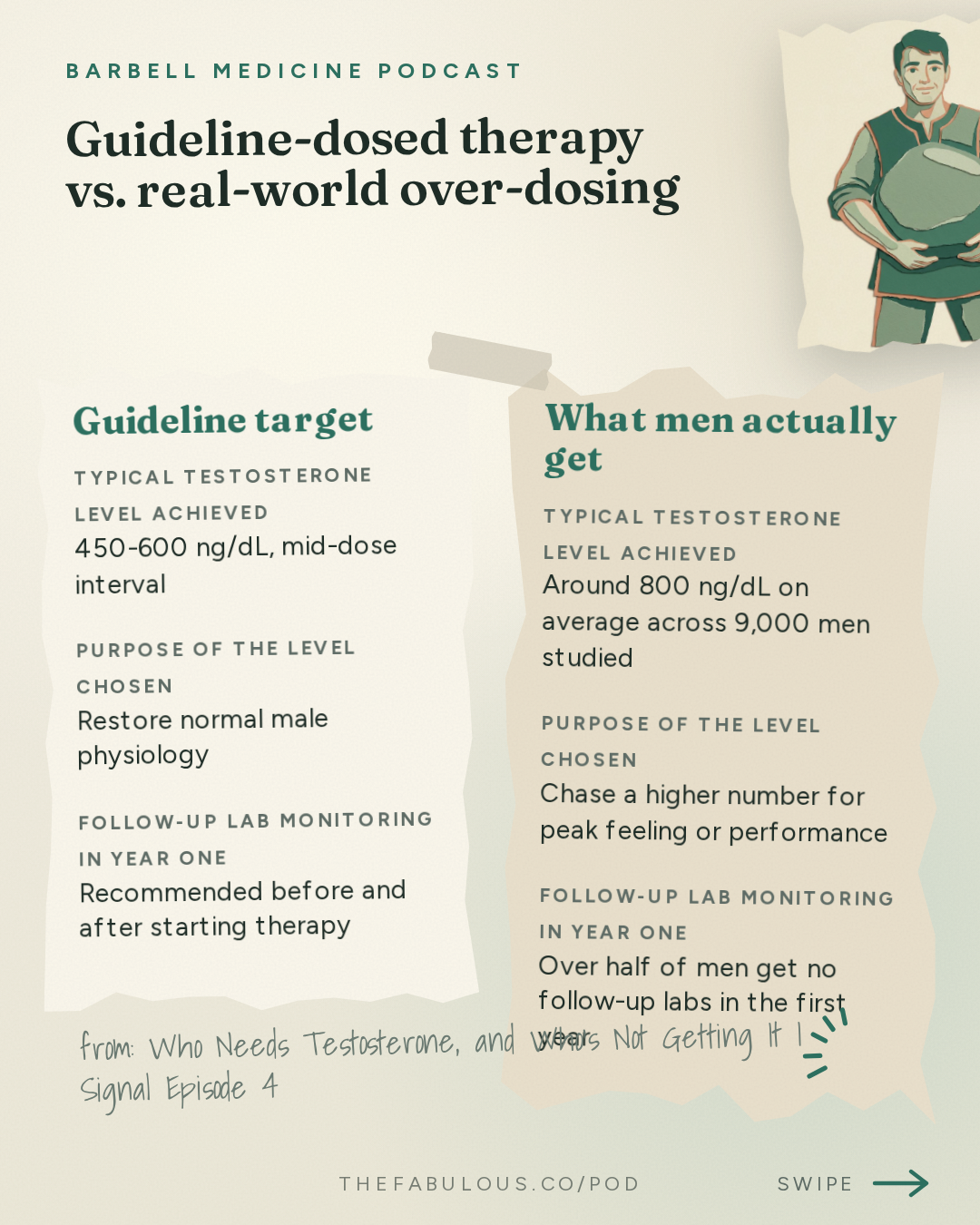
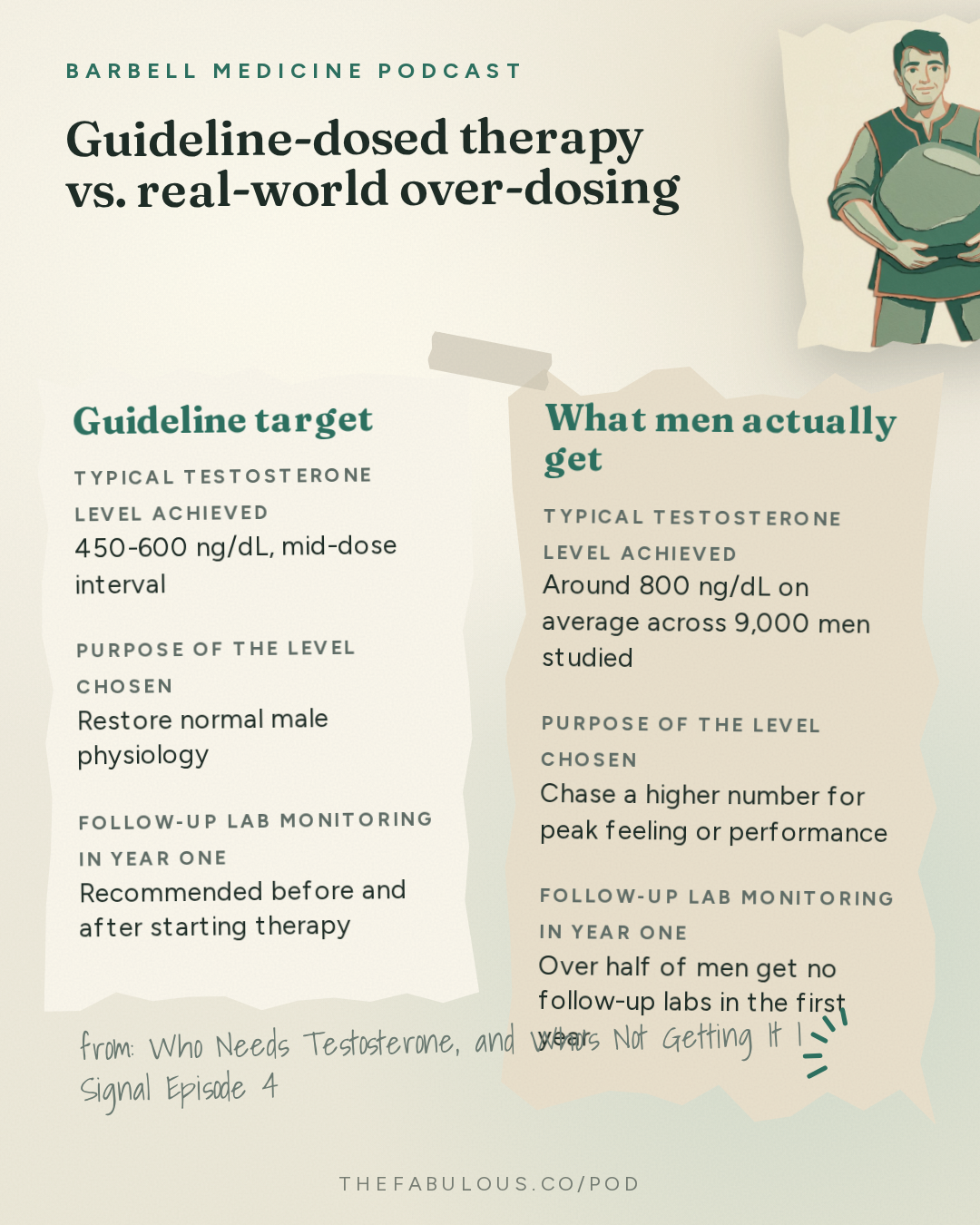
What does correct treatment actually look like, for the man who truly needs it? Current guidelines aim for a testosterone level in the middle of the normal range, roughly 450 to 600 ng/dL, measured halfway between doses (46:00). Feigenbaum draws a sharp line here.
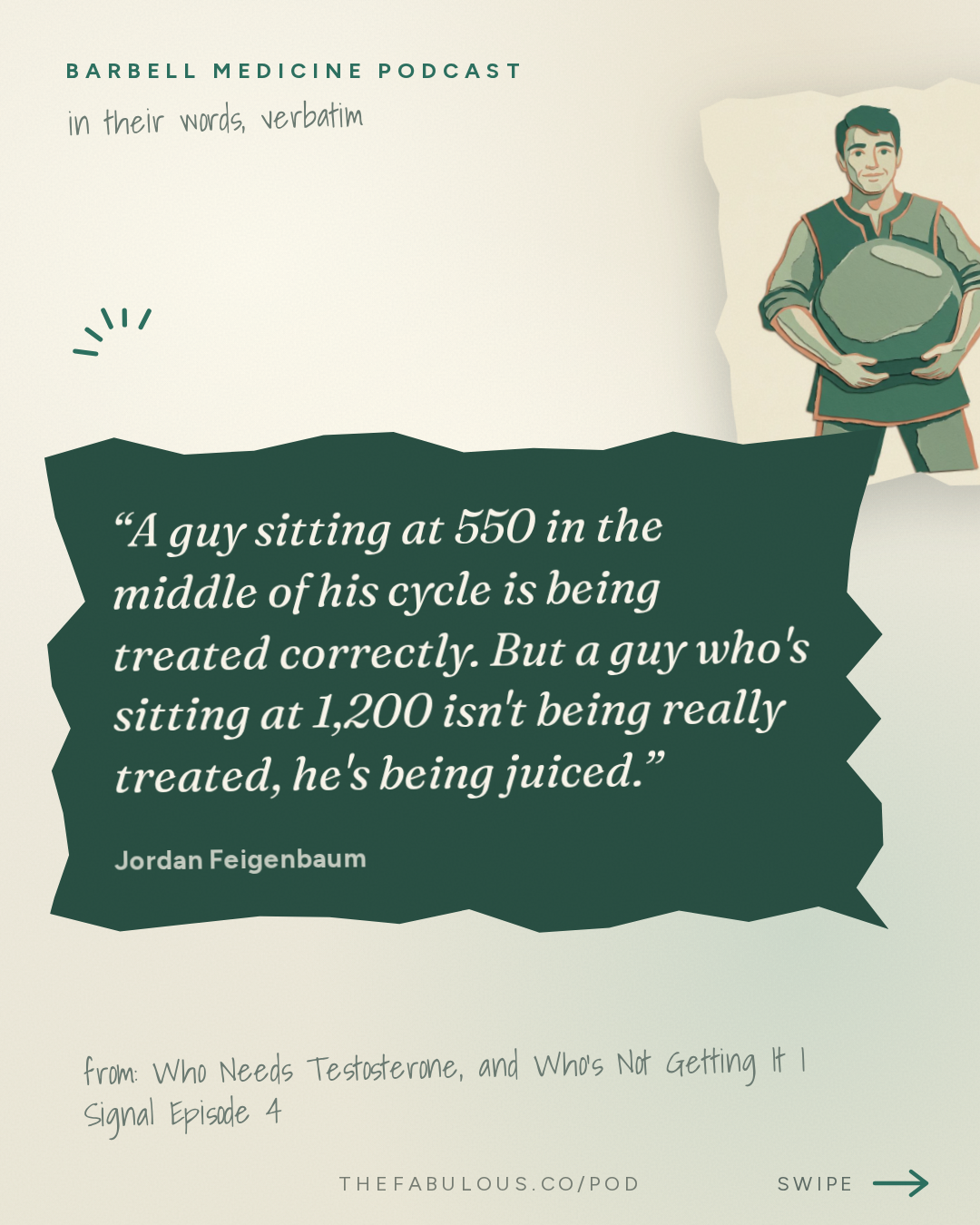
"A guy sitting at 550 in the middle of his cycle is being treated correctly. But a guy who's sitting at 1,200 isn't being really treated, he's being juiced." (Jordan Feigenbaum, [46:04])
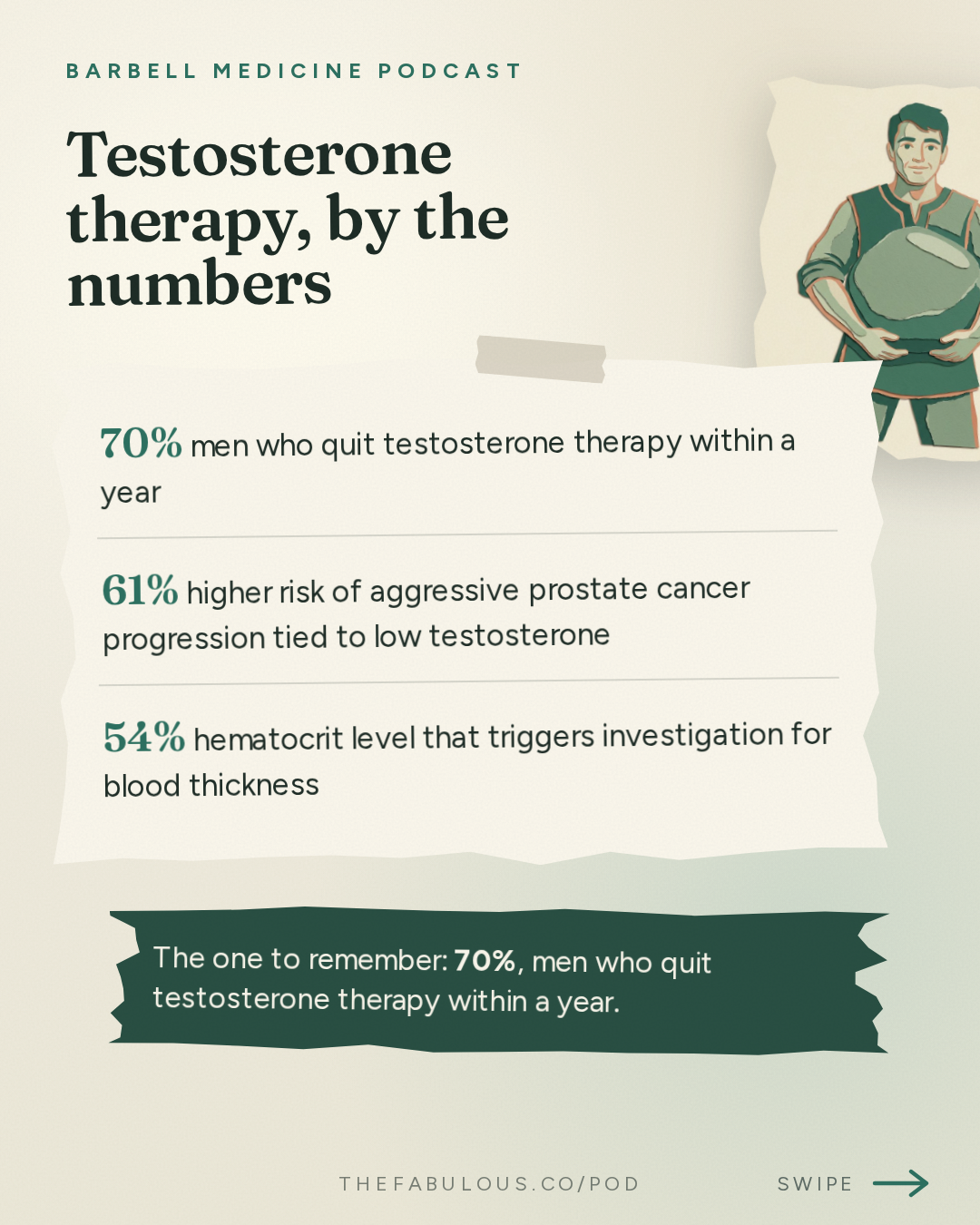
Yet a real world study of more than 9,000 men on testosterone therapy found their average level was around 800 ng/dL, well above the guideline midpoint (47:12). A separate VA analysis found only about 3 percent of men got the full recommended workup before starting treatment, and over half never had follow up labs in the following year (47:23, 47:34). Put those two facts together and a striking number makes more sense: about 70 percent of men who start testosterone therapy quit within a year, usually not because of side effects but because they never felt the improvement they were promised (45:05, 53:16).
Fertility is the risk that gets the least attention and probably deserves the most. Adding testosterone from outside the body tells the brain to stop signaling the testes, which shuts down both testosterone production and sperm production at the same time (57:43, 58:09). In a survey, a quarter of urologists incorrectly believed that testosterone therapy would improve fertility, when in practice it is one of the more common medically caused reasons for male infertility (58:36, 59:02). Recovery after stopping can take six to twelve months, and for some men it never fully returns (59:13). Men who want children can sometimes use HCG or clomiphene instead of, or alongside, testosterone to preserve fertility, a conversation Baraki says needs to happen before the first dose, not after (60:09).
What the Heart and Prostate Data Actually Show
The Traverse trial, published in 2023 in the New England Journal of Medicine, is the best cardiovascular safety data available. Researchers randomized more than 5,000 men, ages 45 to 80, all with testosterone deficiency and either established heart disease or high cardiovascular risk, to topical testosterone or placebo and followed them for two years (62:12, 62:55). Cardiac events landed at about 7 percent in both groups, no meaningful difference (63:06). The catch: the treatment group only reached an average of 375 ng/dL, below the guideline midpoint, using a gel rather than the injections many men actually take, and the trial ran only two years (63:55, 64:00). It is a real reassurance for gently dosed patients on a topical product, not a green light for a 35 year old injecting himself to 900 at a wellness clinic.
The prostate fear traces back to a 1941 study showing castration shrank prostate tumors and testosterone made them grow. The finding was real; the conclusion drawn from it was too simple. The saturation model offers a fix: prostate tissue's androgen receptors seem to saturate at a certain testosterone level, after which PSA, prostate specific antigen, a blood marker used to screen for and monitor prostate cancer, stops climbing even as testosterone keeps rising (67:52, 68:21). A 2026 retrospective study of more than 900 men in active surveillance for prostate cancer found that low baseline testosterone, not high, was linked to a 61 percent higher chance of the cancer progressing to an aggressive, high grade form requiring treatment (71:18, 71:38). And a study of 850 men who had their prostate surgically removed found that those who later went on testosterone therapy had a lower recurrence rate than those who did not (72:12, 72:37).
The one safety issue that is not overblown involves the blood itself. Testosterone tells the kidneys to produce more erythropoietin, the hormone that drives red blood cell production, and up to 20 percent of men on injectable testosterone can develop erythrocytosis, blood that is too thick (74:09, 75:04). A hematocrit above 54 percent is the common threshold doctors use to investigate a dose reduction or look for an underlying cause like untreated sleep apnea (75:24).
The series closes on Mark, a 45 year old architecture firm partner whose focus, energy, and marriage had all been sliding for a year. A wellness clinic drew his blood one afternoon, the wrong time of day for an accurate reading, found a testosterone level of 240 ng/dL, and started him on weekly injections (84:03). By month three he felt worse, with morning headaches and rising blood pressure (84:03). His real problem was severe obstructive sleep apnea, his airway collapsing roughly 60 times an hour, all night, compounded by visceral fat (84:33). A CPAP machine, six weeks of real sleep, a modest training routine, and better food brought his weight and waist down. He eventually came off testosterone entirely, and his own production returned (85:23, 86:01).
"Testosterone is an output. It's a readout of what the rest of your body's doing. And if we can fix the inputs, the output is gonna look a whole lot better." (Jordan Feigenbaum, [83:15])
That is the whole argument in one line. A lab number is a symptom of a system, not a target by itself. For a small number of men, the system really is broken, and replacement is close to a life changing intervention. For a much larger number, the number on the page is just an invitation to look somewhere else first, at sleep, at body fat, at alcohol, before reaching for a syringe.
Ask this episode anything
Pod's AI answers from the episode itself, with the minute mark so you can hear it yourself.
Or start with one of these
Ask this episode
Pod's AI listens to the whole episode to answer, and points you to the minute it comes from.
The rest of this answer, and any question after it
Answers come from the episode itself, never from a summary of it.
ContinueKey takeaways
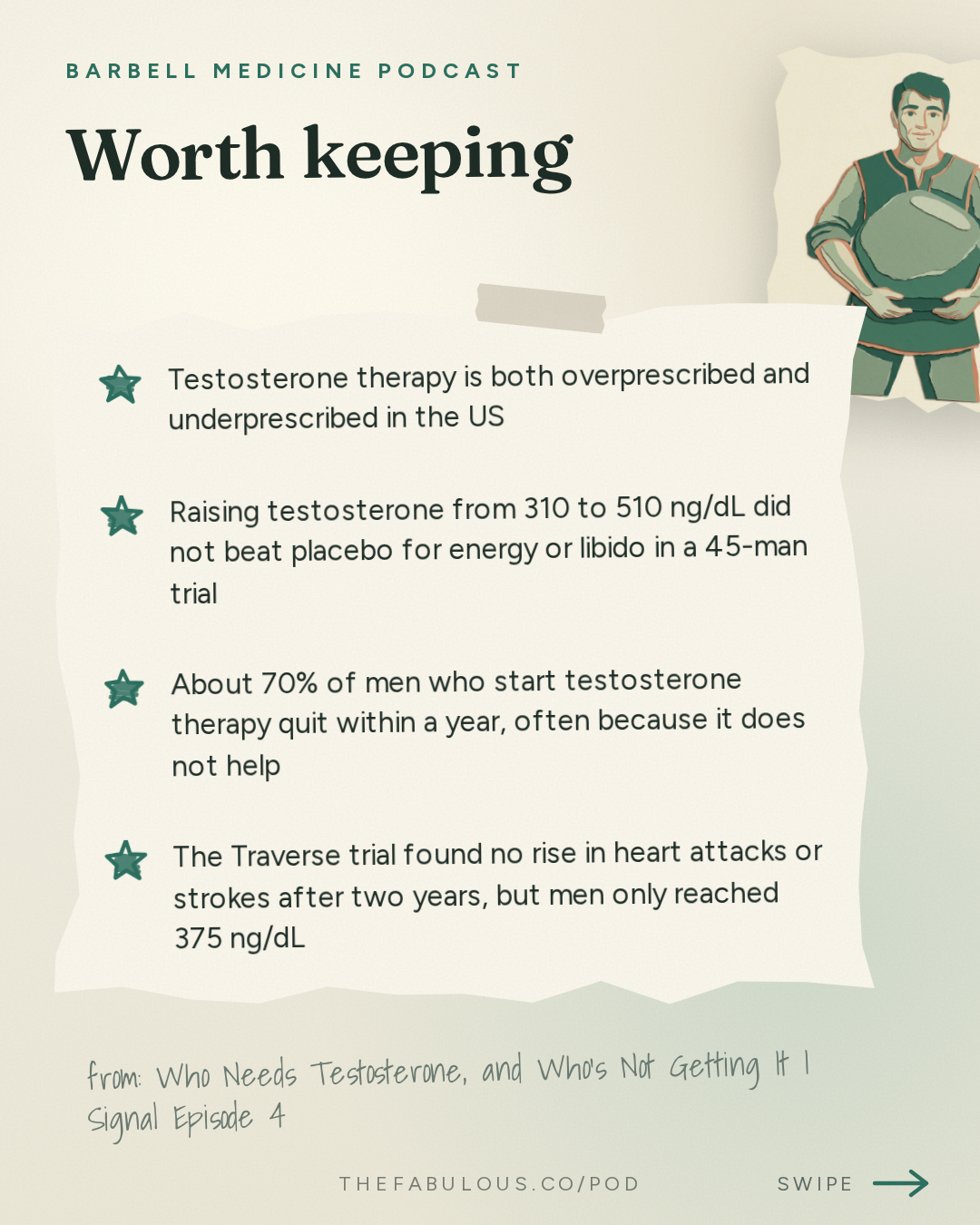
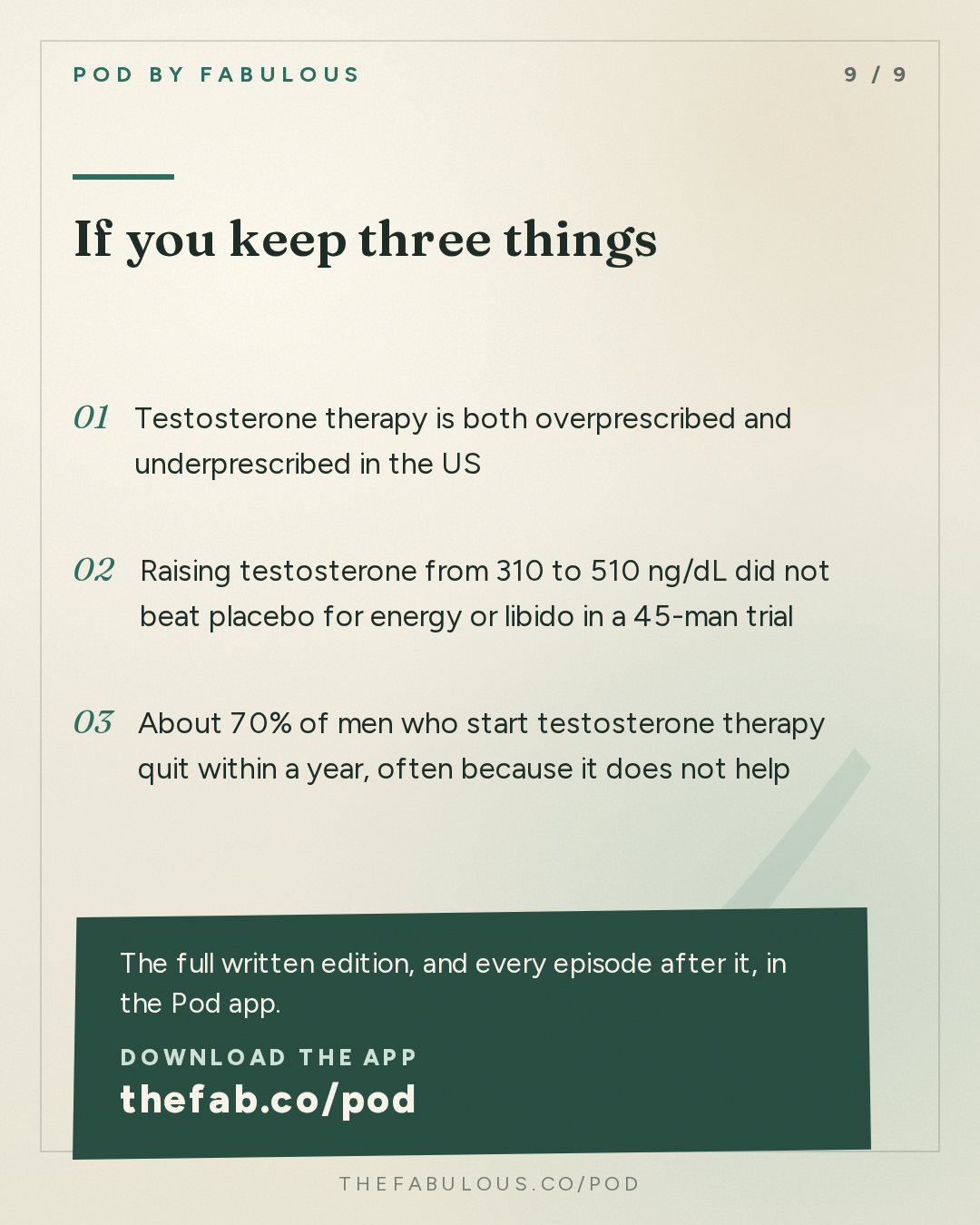
- Testosterone therapy is both overprescribed and underprescribed in the US
- Raising testosterone from 310 to 510 ng/dL did not beat placebo for energy or libido in a 45-man trial
- About 70% of men who start testosterone therapy quit within a year, often because it does not help
- The Traverse trial found no rise in heart attacks or strokes after two years, but men only reached 375 ng/dL
- Low testosterone, not high testosterone, was linked to a 61% higher risk of aggressive prostate cancer progression
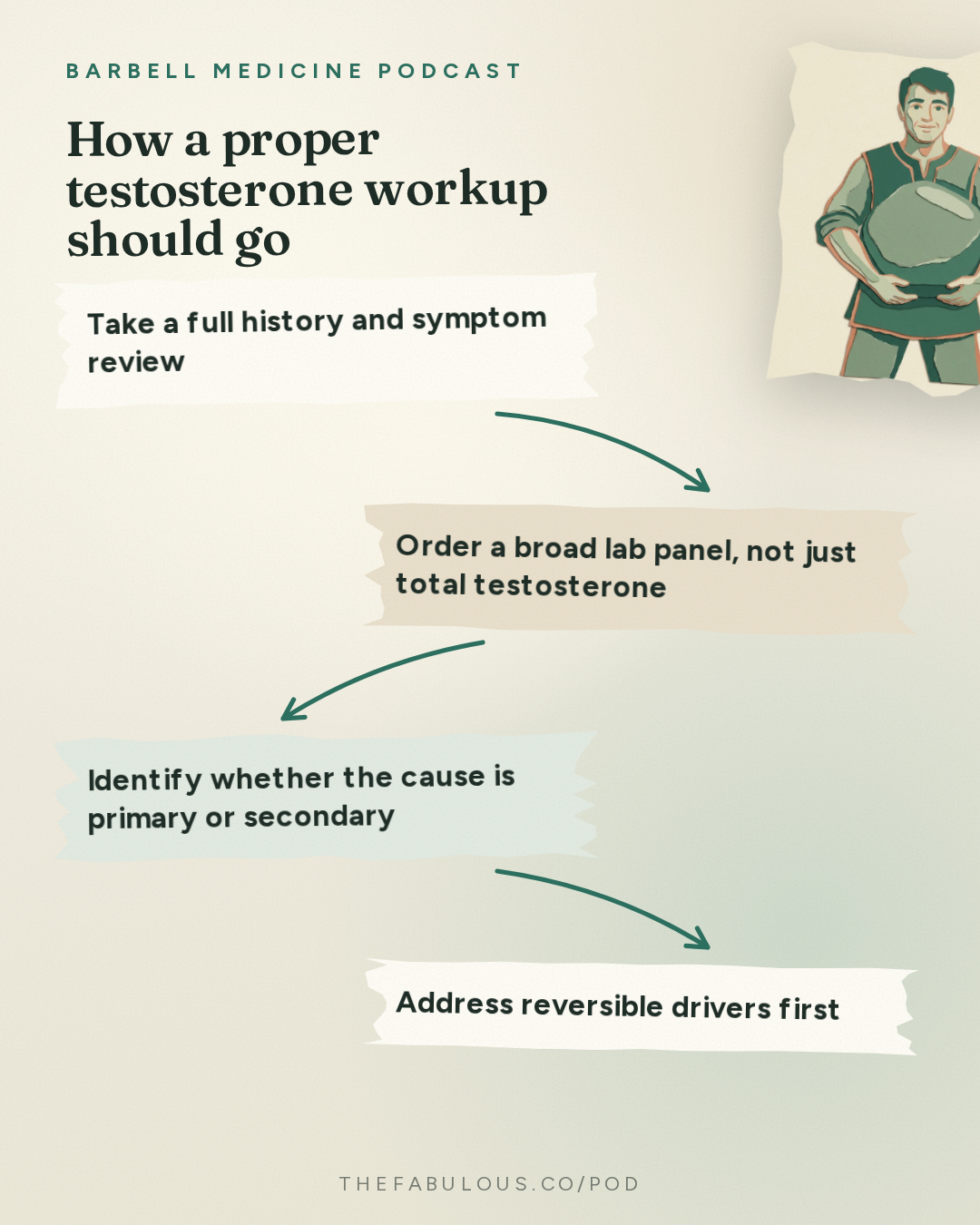
The episode in cards
By the numbers
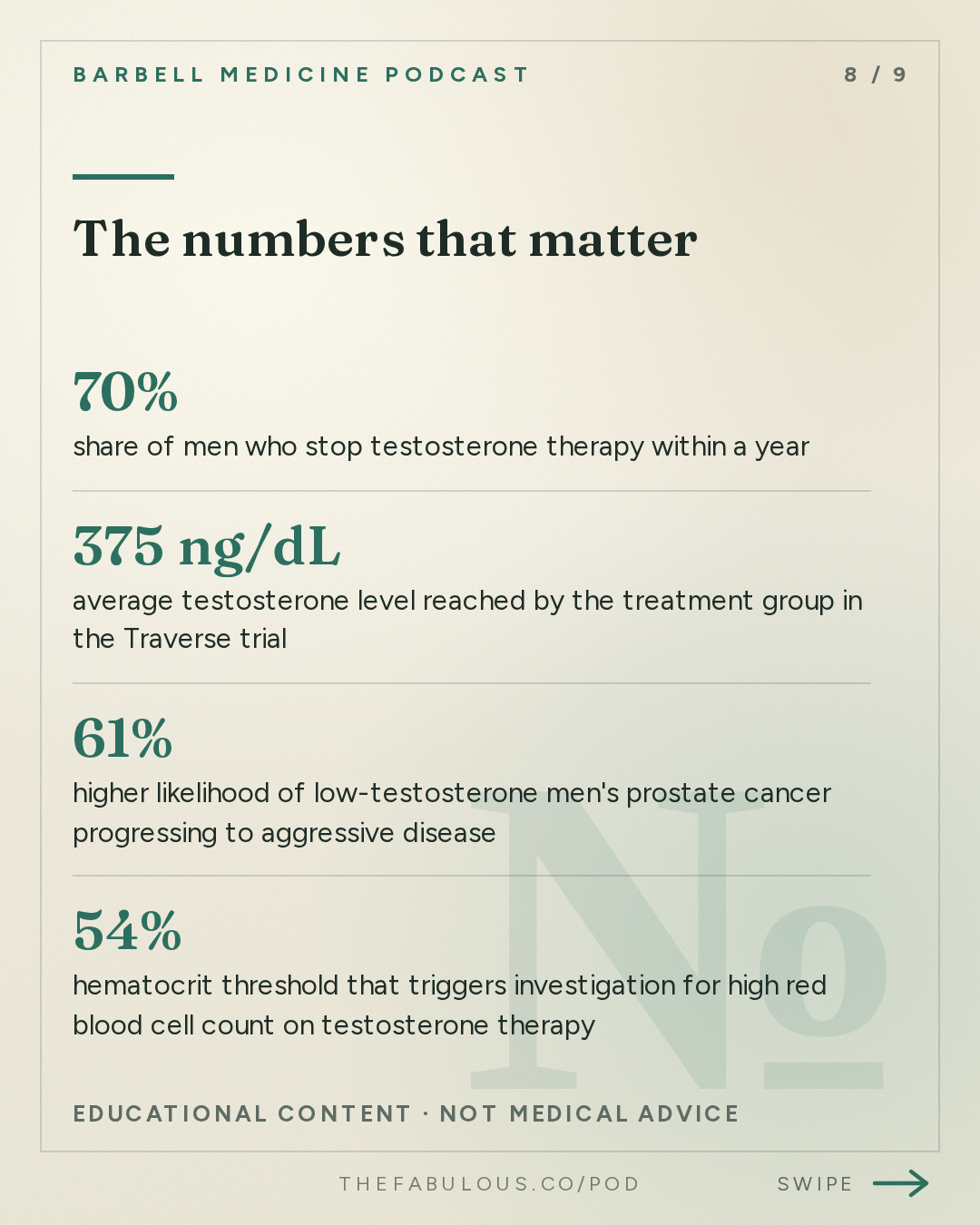
- 70% percent share of men who stop testosterone therapy within a year
- 375 ng/dL average testosterone level reached by the treatment group in the Traverse trial
- 61% percent higher likelihood of low-testosterone men's prostate cancer progressing to aggressive disease
- 54% percent hematocrit threshold that triggers investigation for high red blood cell count on testosterone therapy
- 3% percent share of men in a VA study who got the full recommended workup before starting testosterone therapy
In their words
“If you take a guy with low normal testosterone levels and you raise them, his symptoms don't really do anything on testosterone that the placebo also doesn't do.”
“Of individuals who start on testosterone replacement therapy, 70% will stop using it within a year”
“A guy sitting at 550 in the middle of his cycle is being treated correctly. But a guy who's sitting at 1,200 isn't being really treated, he's being juiced.”
“Testosterone is an output. It's a readout of what the rest of your body's doing. And if we can fix the inputs, the output is gonna look a whole lot better.”
Protocols
-
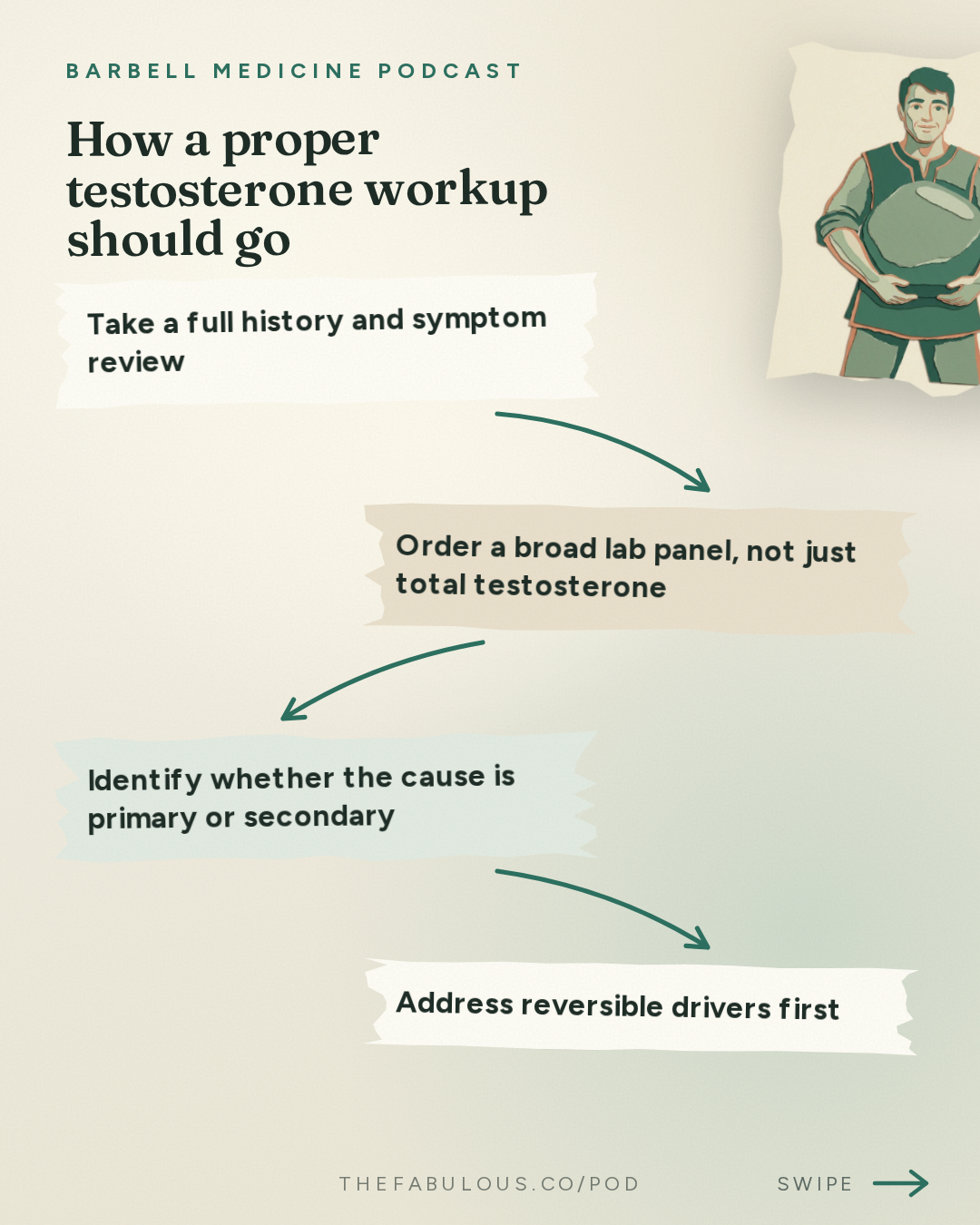
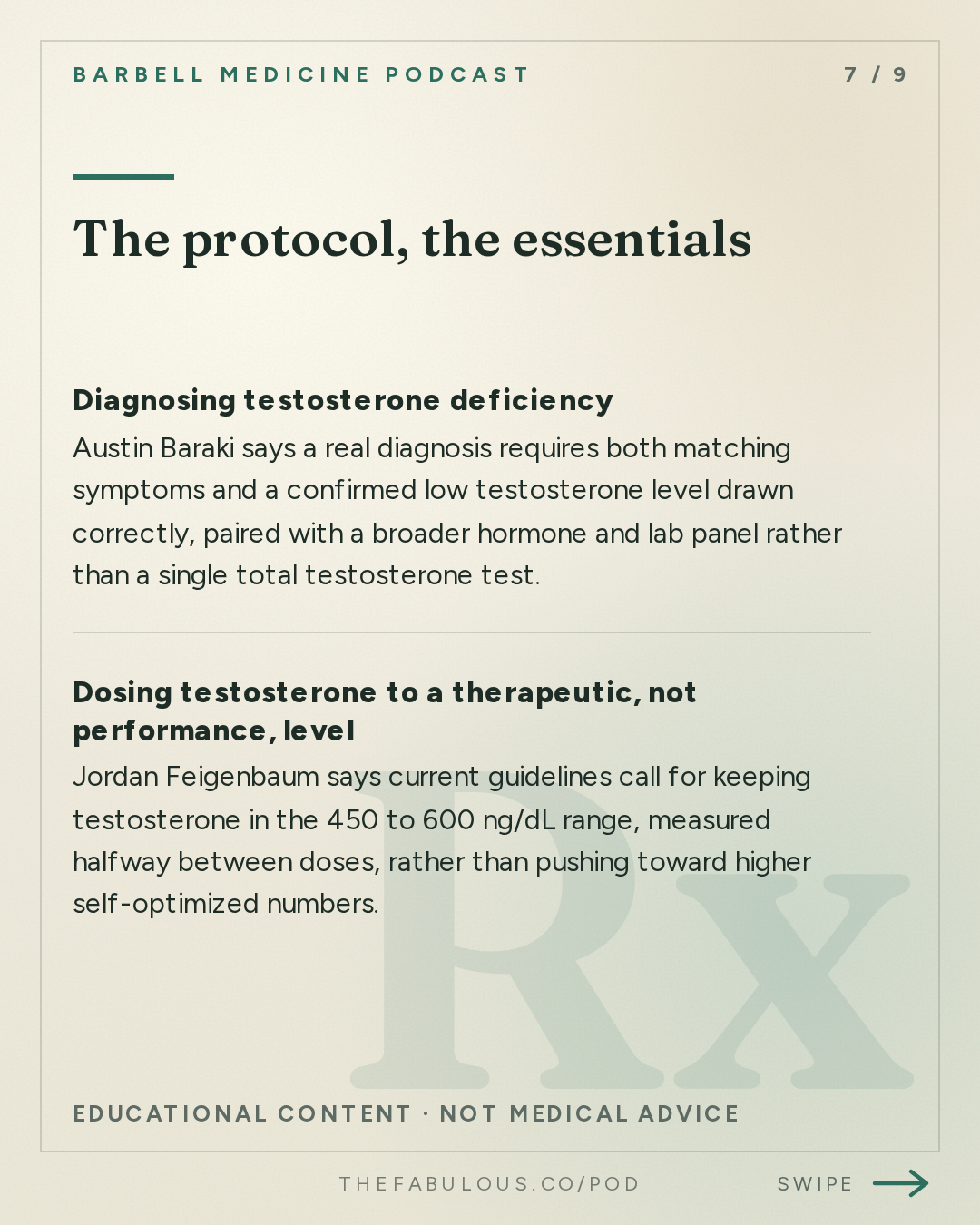
Diagnosing testosterone deficiency
Austin Baraki says a real diagnosis requires both matching symptoms and a confirmed low testosterone level drawn correctly, paired with a broader hormone and lab panel rather than a single total testosterone test.
At initial workup, before any prescription
-
Dosing testosterone to a therapeutic, not performance, level
Jordan Feigenbaum says current guidelines call for keeping testosterone in the 450 to 600 ng/dL range, measured halfway between doses, rather than pushing toward higher self-optimized numbers.
Checked at the midpoint of each dosing interval
-
Monitoring blood thickness on therapy
Austin Baraki says men on testosterone therapy should have hematocrit checked regularly, and a level above 54% warrants investigation for dose reduction or an underlying cause such as untreated sleep apnea.
Regular blood monitoring for the duration of therapy
-
Protecting fertility before starting testosterone
Austin Baraki says men who want to have children should not use testosterone alone, and should instead discuss options like HCG or clomiphene before starting any therapy, not after fertility has already been affected.
Before initiating TRT, if future fertility is a goal
Questions this episode answers
Who actually needs testosterone replacement therapy?
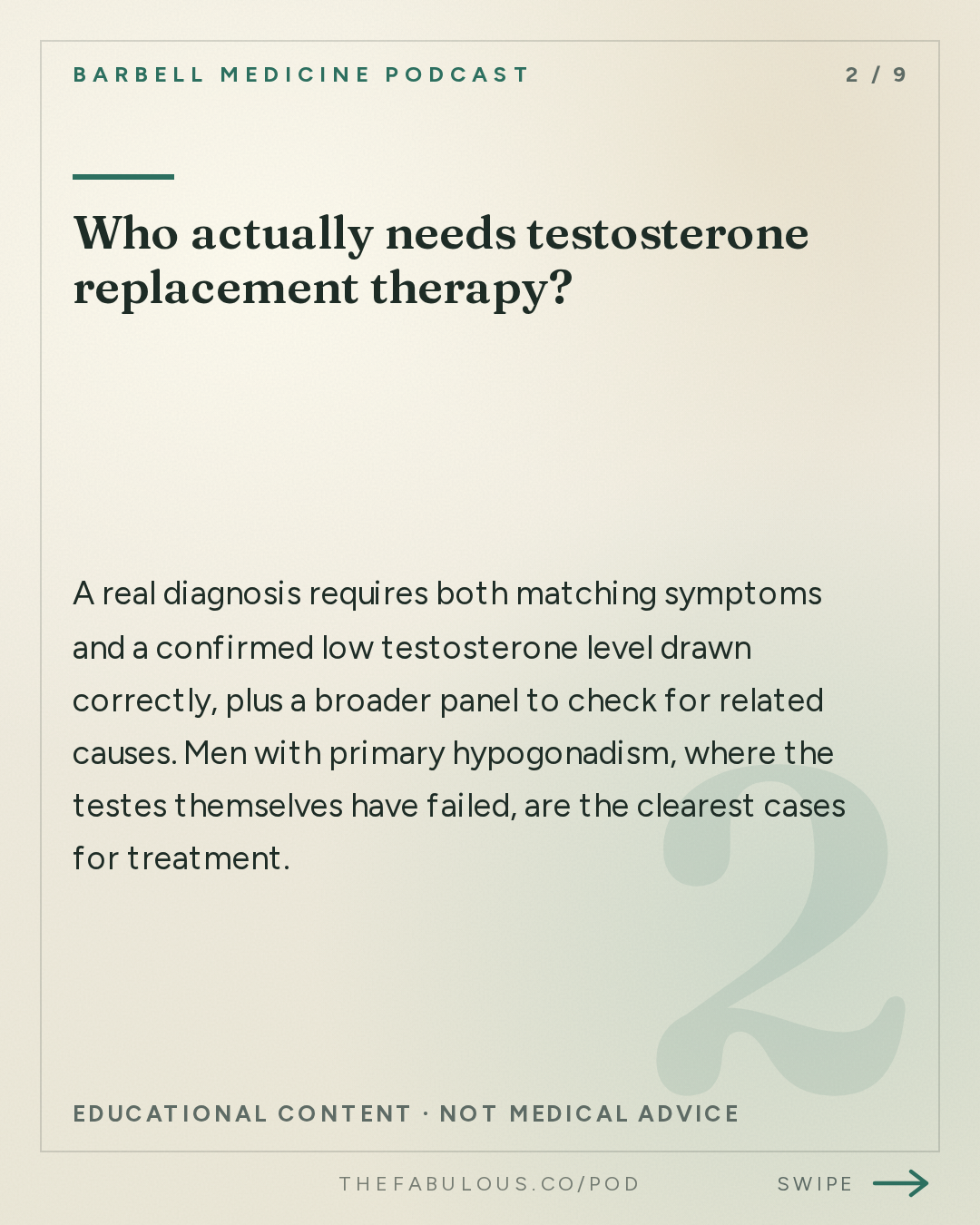
A real diagnosis requires both matching symptoms and a confirmed low testosterone level drawn correctly, plus a broader panel to check for related causes (04:15). Men with primary hypogonadism, where the testes themselves have failed, are the clearest cases for treatment (07:17).
Does raising low-normal testosterone improve energy or libido?
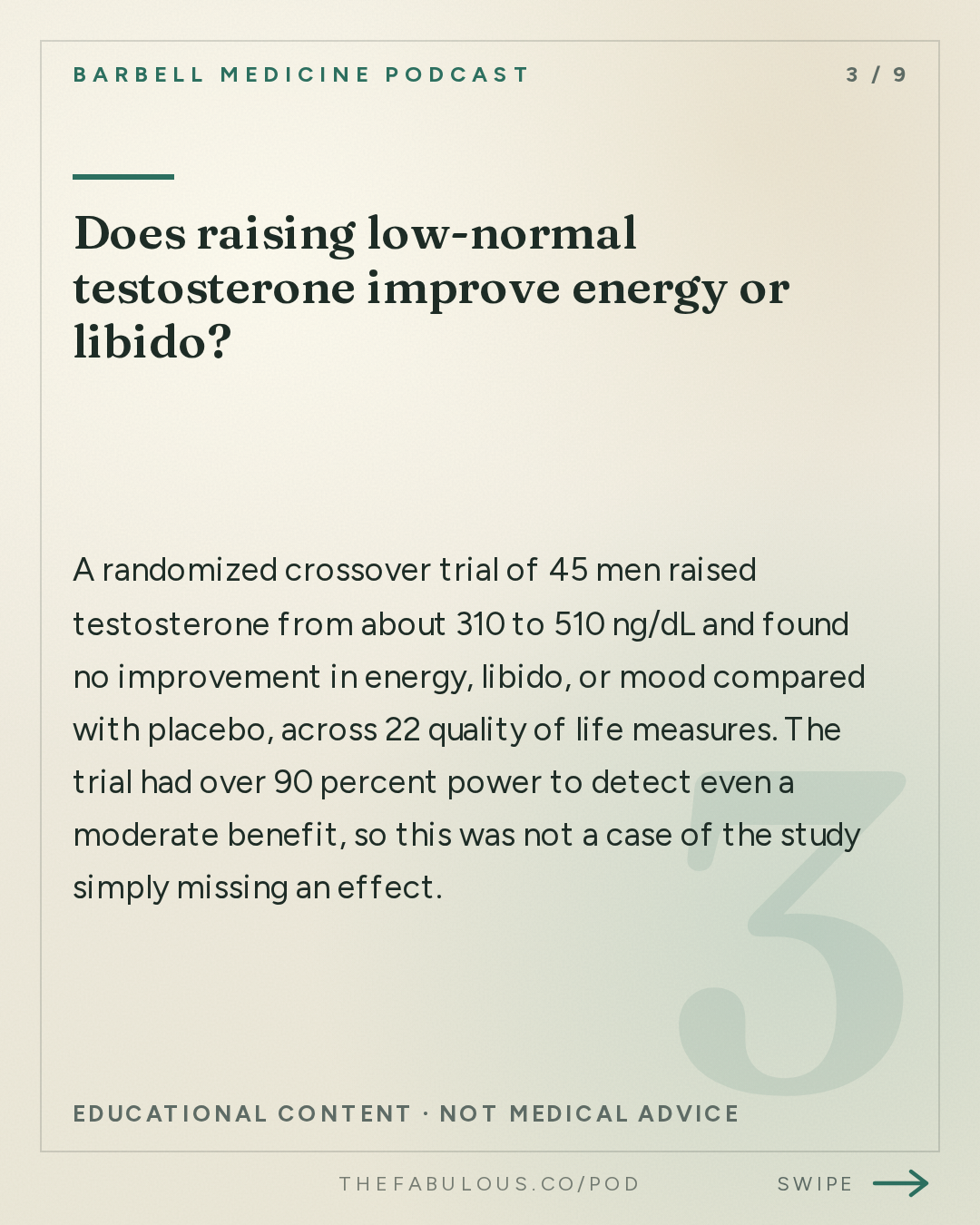
A randomized crossover trial of 45 men raised testosterone from about 310 to 510 ng/dL and found no improvement in energy, libido, or mood compared with placebo, across 22 quality of life measures (00:43, 40:02). The trial had over 90 percent power to detect even a moderate benefit, so this was not a case of the study simply missing an effect (40:24).
Is testosterone therapy safe for the heart?
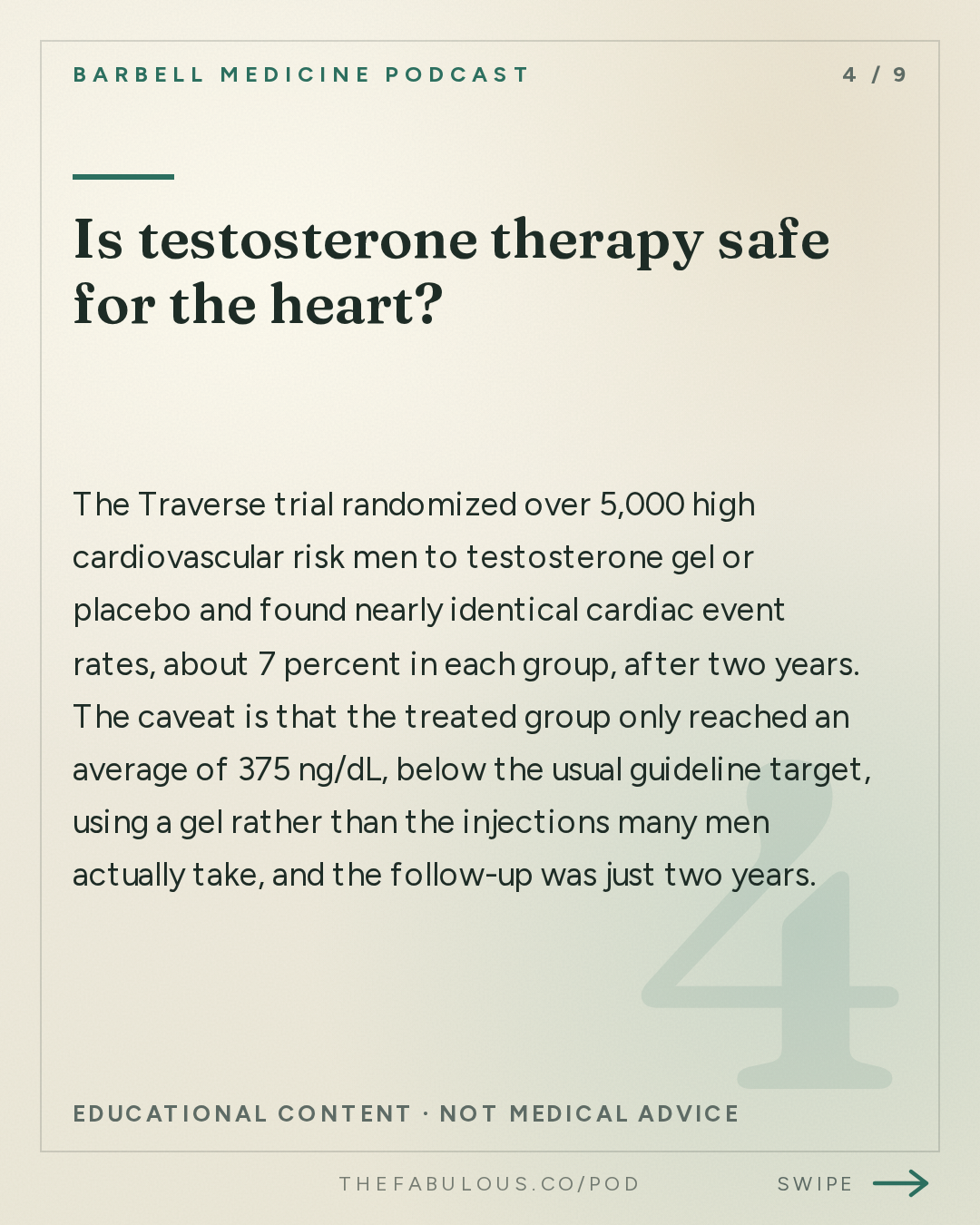
The Traverse trial randomized over 5,000 high cardiovascular risk men to testosterone gel or placebo and found nearly identical cardiac event rates, about 7 percent in each group, after two years (63:06). The caveat is that the treated group only reached an average of 375 ng/dL, below the usual guideline target, using a gel rather than the injections many men actually take, and the follow-up was just two years (63:55).
Does testosterone therapy cause prostate cancer?
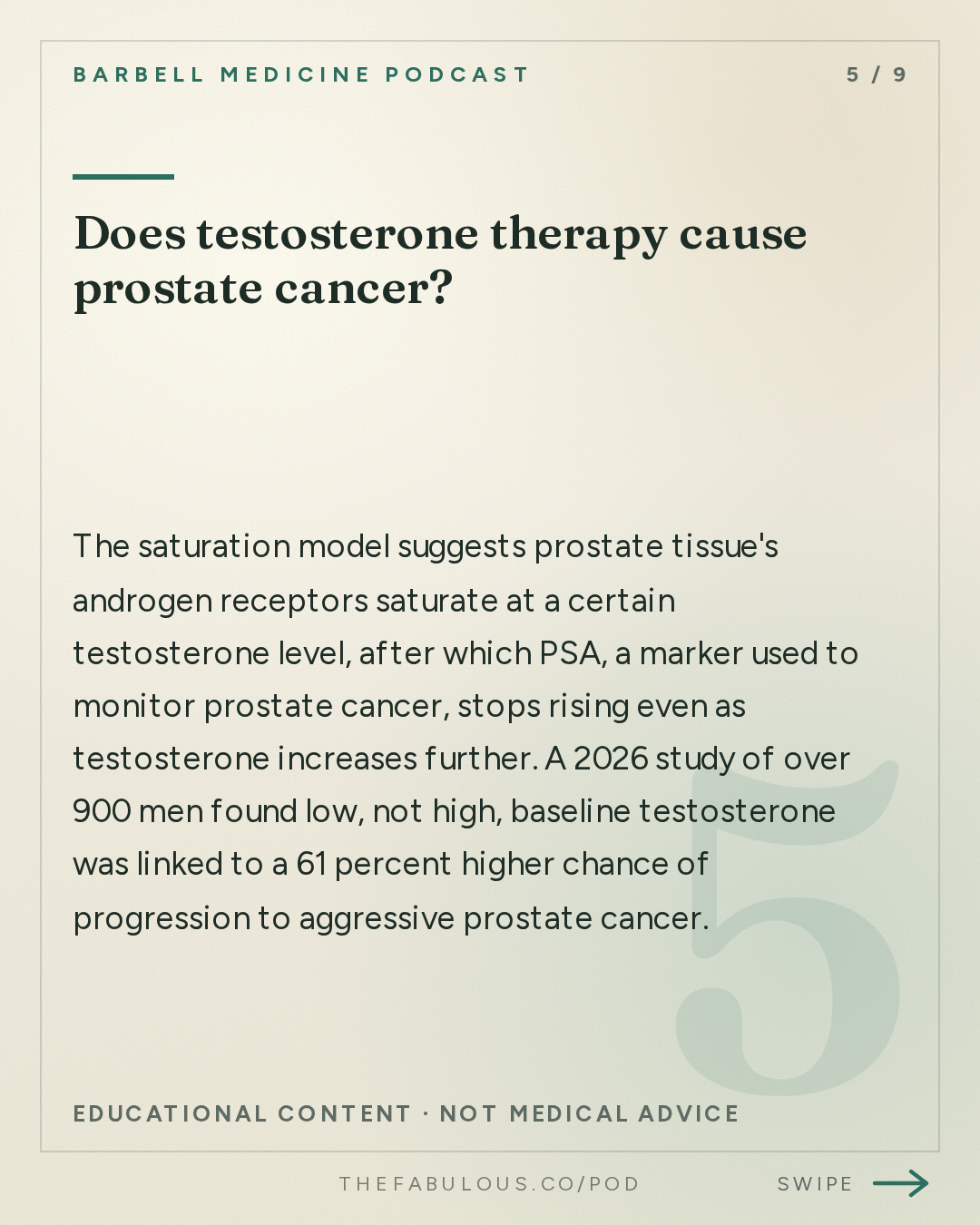
The saturation model suggests prostate tissue's androgen receptors saturate at a certain testosterone level, after which PSA, a marker used to monitor prostate cancer, stops rising even as testosterone increases further (67:52, 68:21). A 2026 study of over 900 men found low, not high, baseline testosterone was linked to a 61 percent higher chance of progression to aggressive prostate cancer (71:18, 71:38).
Does testosterone therapy affect fertility?
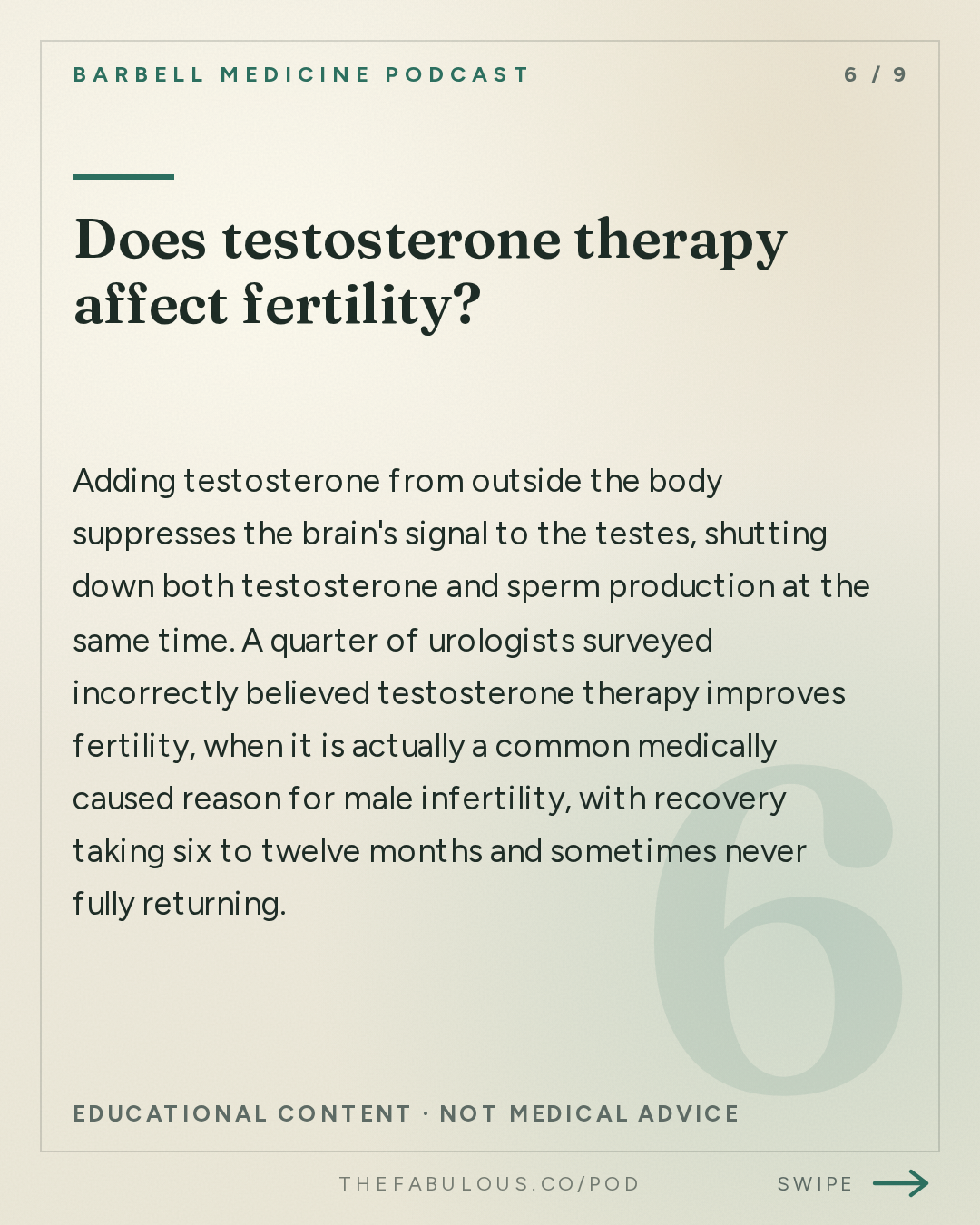
Adding testosterone from outside the body suppresses the brain's signal to the testes, shutting down both testosterone and sperm production at the same time (57:43, 58:09). A quarter of urologists surveyed incorrectly believed testosterone therapy improves fertility, when it is actually a common medically caused reason for male infertility, with recovery taking six to twelve months and sometimes never fully returning (58:36, 59:13).
What testosterone level should treatment target?
Current guidelines aim for 450 to 600 ng/dL, measured halfway between doses, which physician Jordan Feigenbaum calls being treated correctly (46:00, 46:04). A real-world study of over 9,000 men found their average level was around 800 ng/dL, well above that target, showing many men are dosed closer to performance-enhancing levels than therapeutic ones (47:12).
The full read, in cards
Go deeper
- Sydney testosterone gel vs. placebo trial — Randomized crossover trial found testosterone gel raised levels but did not improve symptoms compared with placebo in 45 men
- HIM study — Primary care survey found nearly 40% of middle-aged men had low testosterone, but only 2 to 6% also met symptom criteria
- Traverse trial — Randomized trial of over 5,000 high cardiovascular risk men found no difference in cardiac events between testosterone and placebo over two years
- Signal — Book by Jordan Feigenbaum and Austin Baraki explaining what a testosterone lab value does and does not mean
- 2026 active surveillance prostate cancer study — Retrospective study of over 900 men found low baseline testosterone linked to a 61% higher chance of progression to aggressive prostate cancer
- Post-prostatectomy testosterone study — Study of 850 men after prostate removal found testosterone therapy afterward was linked to lower cancer recurrence than no treatment
Mentioned
Jordan Feigenbaum · Austin Baraki · Signal · Traverse trial · HIM study · AbbVie · AndroGel · FDA · Mark
More from this show and category

How Much Lifting Is Enough for Health?
Public health guidelines recommend lifting twice a week, but the study behind that number found three days worked better. Jordan Feigenbaum argues lifting doesn't hurt the heart, carries lower injury risk than running, and shows no real ceiling for strength, bone density, or metabolic benefits, so most people should train roughly double the current guideline.
Why Lifting Heavy Was Called Dangerous
In 1985 a panel of obstetricians banned pregnant women from raising their heart rate past 140 beats per minute, a number invented by consensus, not data (00:01). The same pattern, rules built on vibes rather than evidence, shaped a century of bans on heavy lifting for women, children, and anyone squatting below parallel, until later studies quietly reversed nearly all of them.

Is Training Safe in Wildfire Smoke?
Exercise still protects health during wildfire smoke, and lifting is safer than cardio because it barely raises breathing rate. Training right at failure isn't required for muscle growth either, since easier sets and even indirect fractional sets still add measurable stimulus, so individual response matters more than hitting an exact rep-in-reserve number.

Do You Need a Calorie Surplus to Build Muscle?
No: men above roughly 20% body fat can build muscle in a modest calorie deficit by spending stored fat as fuel. Sports scientist Eric Helms says below about 12% body fat the reverse happens, so a small surplus helps; in between, calorie balance barely matters if training and protein are dialed in.
