Why Lifting Heavy Was Called Dangerous
Where did the advice to not lift heavy weights come from?
The brief
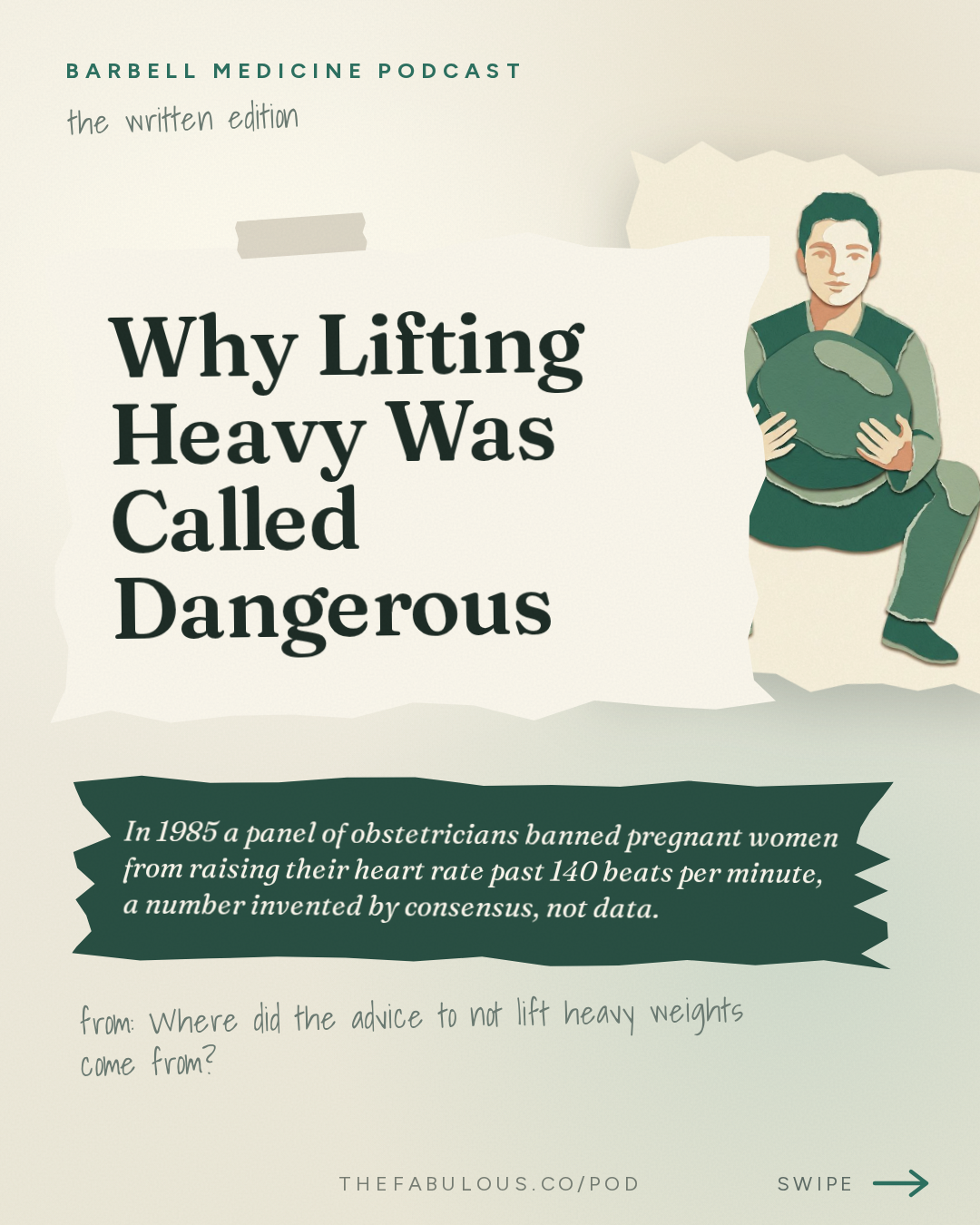
In 1985 a panel of obstetricians banned pregnant women from raising their heart rate past 140 beats per minute, a number invented by consensus, not data (00:01). The same pattern, rules built on vibes rather than evidence, shaped a century of bans on heavy lifting for women, children, and anyone squatting below parallel, until later studies quietly reversed nearly all of them.
In 1985 the American College of Obstetricians and Gynecologists issued its first formal guidance on exercise in pregnancy. It told women to keep their heart rate under 140 beats per minute and to stop strenuous activity after fifteen minutes. Those numbers were not measured. They came from a panel of obstetricians, none of whom had any training in exercise physiology, and one of the authors later admitted the guidance rested on "common sense" (00:01, 00:24). The heart rate ceiling disappeared from the guideline nine years later. The habit that produced it did not.
That habit, inventing a warning first and finding (or not finding) evidence later, is the real subject traced by physician Jordan Feigenbaum on the Barbell Medicine Podcast. He follows it back roughly twenty-five hundred years, through Greek gymnasiums and Roman gladiator schools, where the physician Galen defined exercise as movement vigorous enough to change breathing, a standard that still works today (04:38). Across that whole stretch, nobody wrote down that lifting heavy things would hurt the knees, stunt a child, or endanger a pregnancy. The warnings are a much newer invention, and in the United States they begin with a very specific person.
In 1854 a five-foot, hundred-pound Harvard student named George Barker Winship tried a coin-operated strength tester on a street in Rochester and pulled 420 pounds. He went home, dug a hole in his yard, buried a barrel of rocks, and built his own machine. Over the next several years he worked his way from 700 pounds to 2,007 pounds, eventually carving a wooden yoke for his shoulders to handle the load (06:55, 08:04). He wrote the line that became the slogan of the whole movement:
"Strength is health." — George Barker Winship, quoted by Jordan Feigenbaum [08:50]Winship died at 42, apparently of a stroke, and his own slogan got turned against him. A New York lawyer named William Blaikie, who had lifted heavily himself as a teenager and developed a stiff back, published a rebuttal in 1879 that launched the idea that lifting makes a person slow and bulky:
"He who does the work of the grade suited to a truck horse is far more likely to acquire the heavy and ponderous ways of that worthy animal." — William Blaikie, quoted by Jordan Feigenbaum [11:24]Blaikie, like almost every strongman who followed him, had built his own strength with heavy weights and then sold the public something lighter. Sport historian Terry Todd found a mundane reason why: postage. Iron was expensive to ship, so Eugen Sandow, Bernarr Macfadden, and Charles Atlas all built empires selling five-pound dumbbells and mail-order courses instead of barbells (13:32). Atlas alone sold more than 400,000 courses by 1942 (21:57).
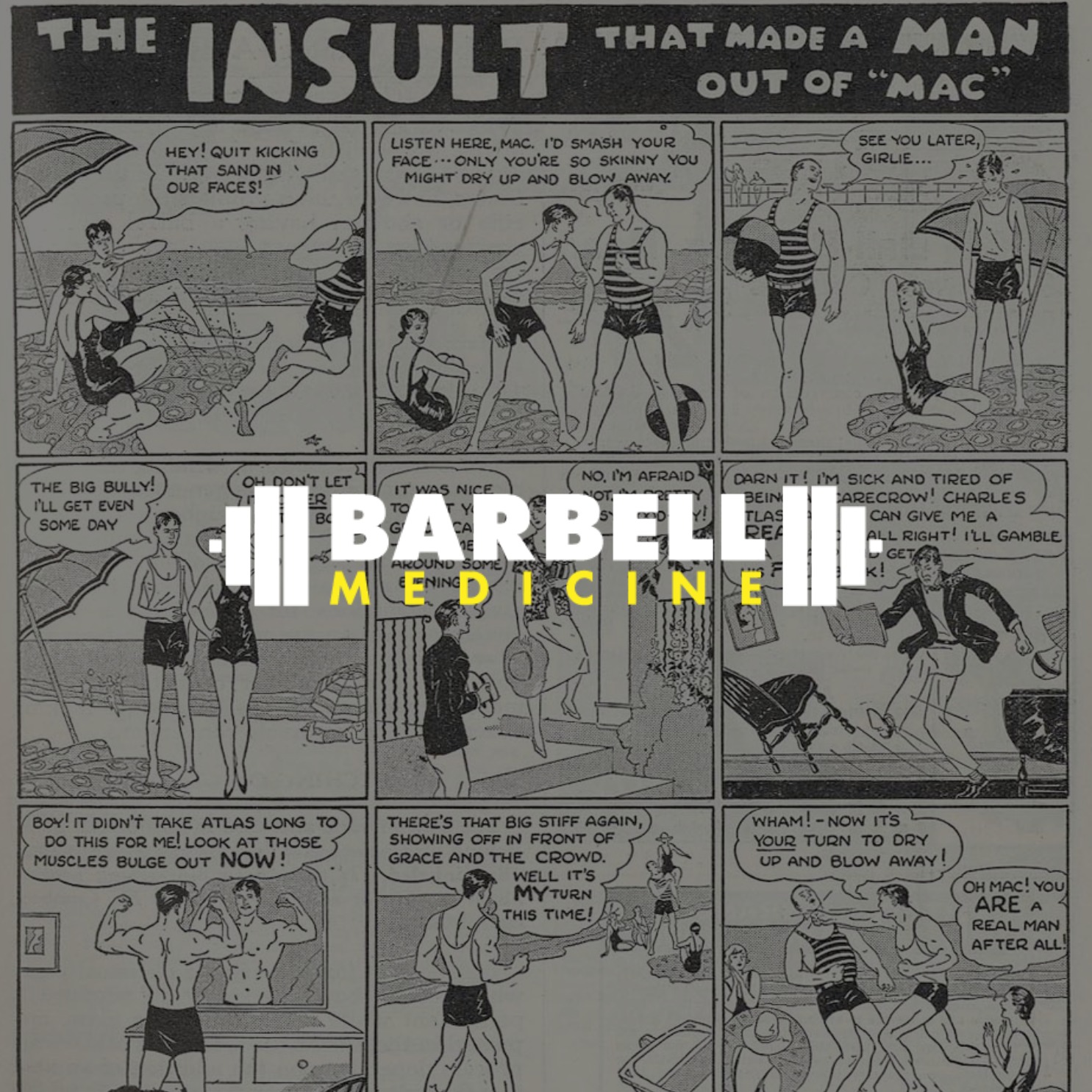
The "muscle-bound" idea calcified for decades until a 1940 showdown at Springfield College, then the country's leading physical-education school. Its chief physiologist, Peter Karpovich, had been calling bodybuilders "quacks," so an undergraduate invited York Barbell's Bob Hoffman to bring two elite lifters to campus. Karpovich asked a lifter to scratch his own back between the shoulder blades, expecting him to fail. He did it easily, then dropped into a full split. Karpovich later admitted,
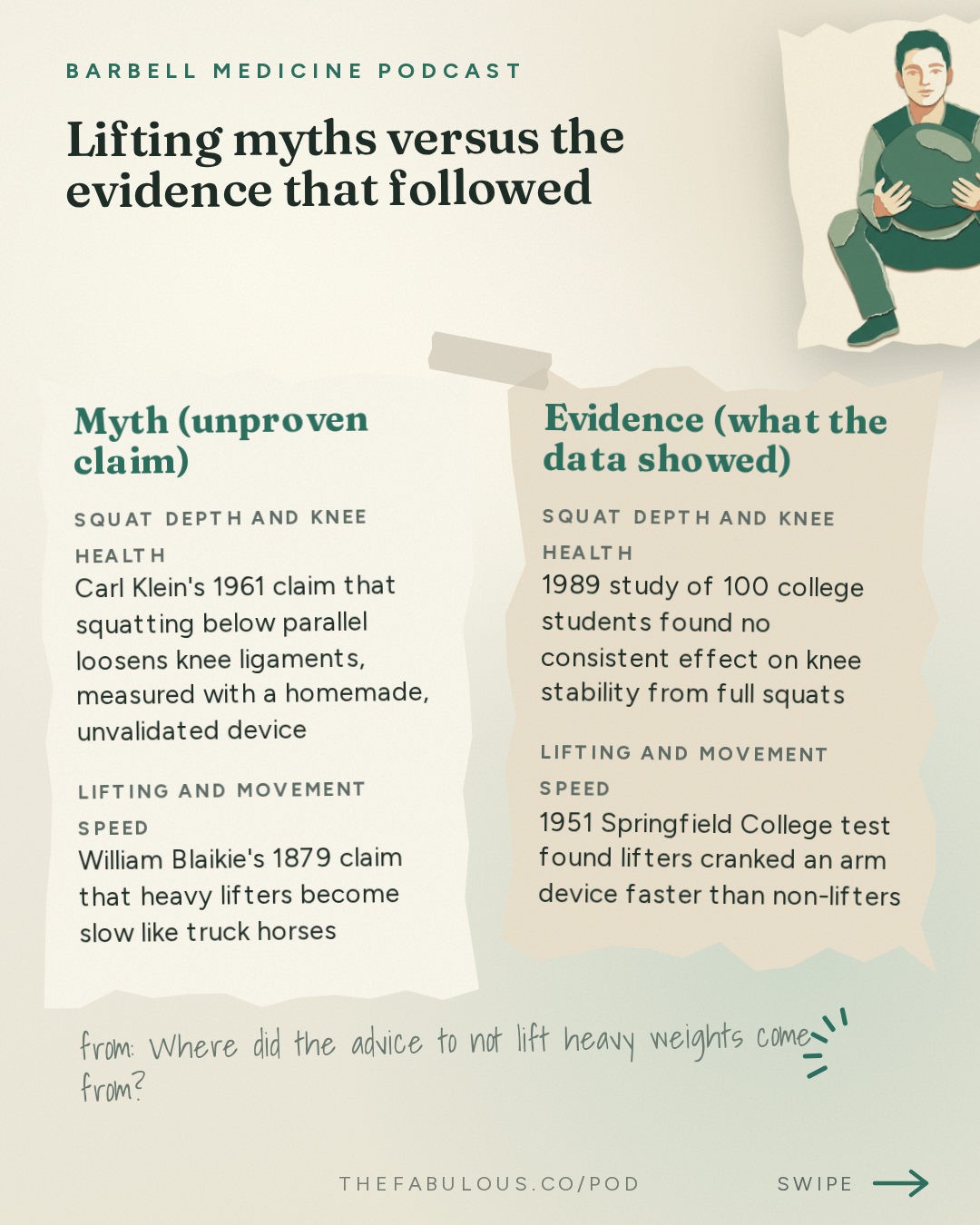
"The audience roared with laughter at my expense." — Peter Karpovich, quoted by Jordan Feigenbaum [24:48]Karpovich changed his mind and spent a decade building a machine to test it properly. In 1951 he and a graduate student timed 600 young men cranking a one-arm device, and the lifters were faster (25:31). It still took until 1963 for some college coaches to abandon the idea, and the myth had already jumped to a new body part: the knee.
How a myth moves from magazine to military
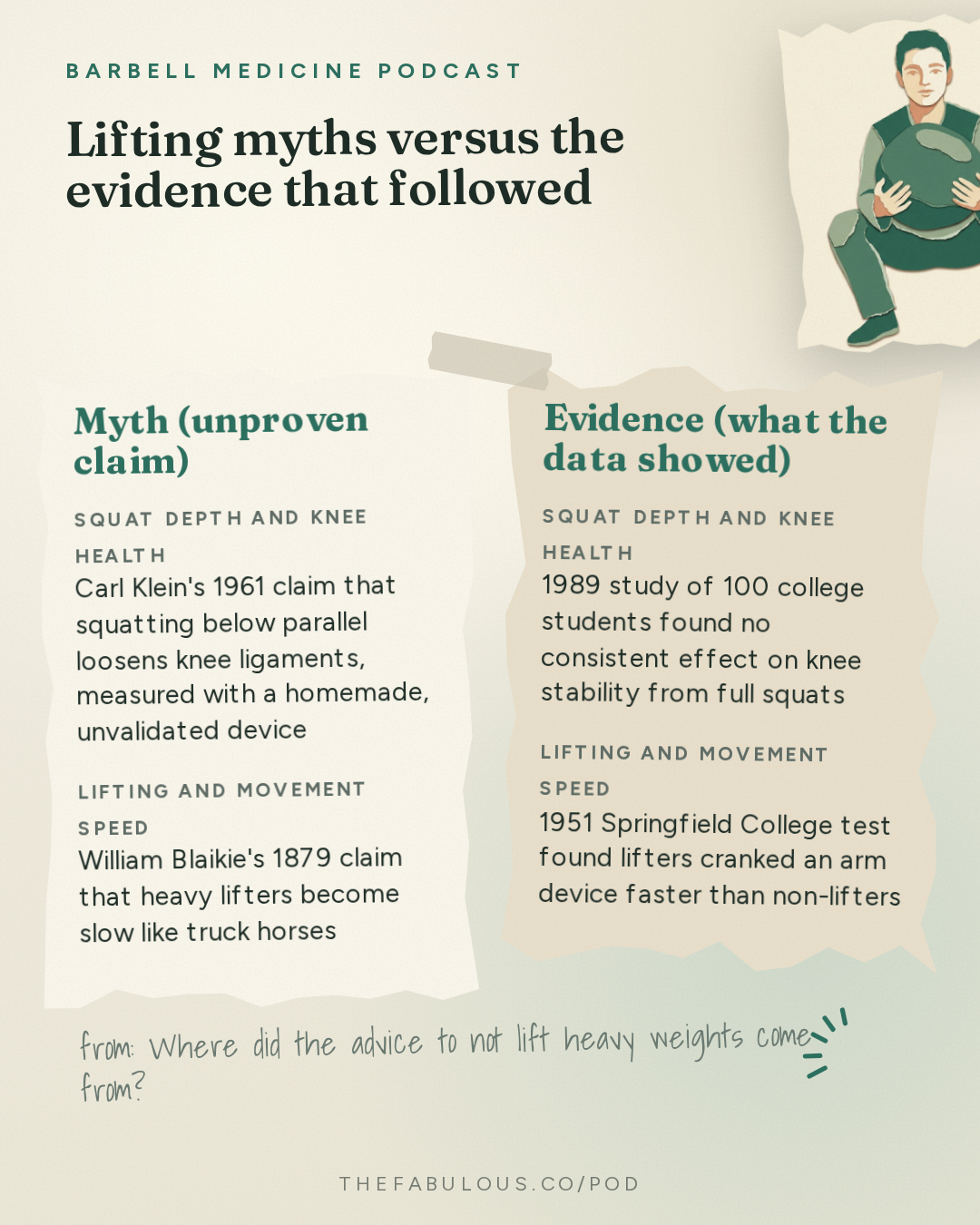
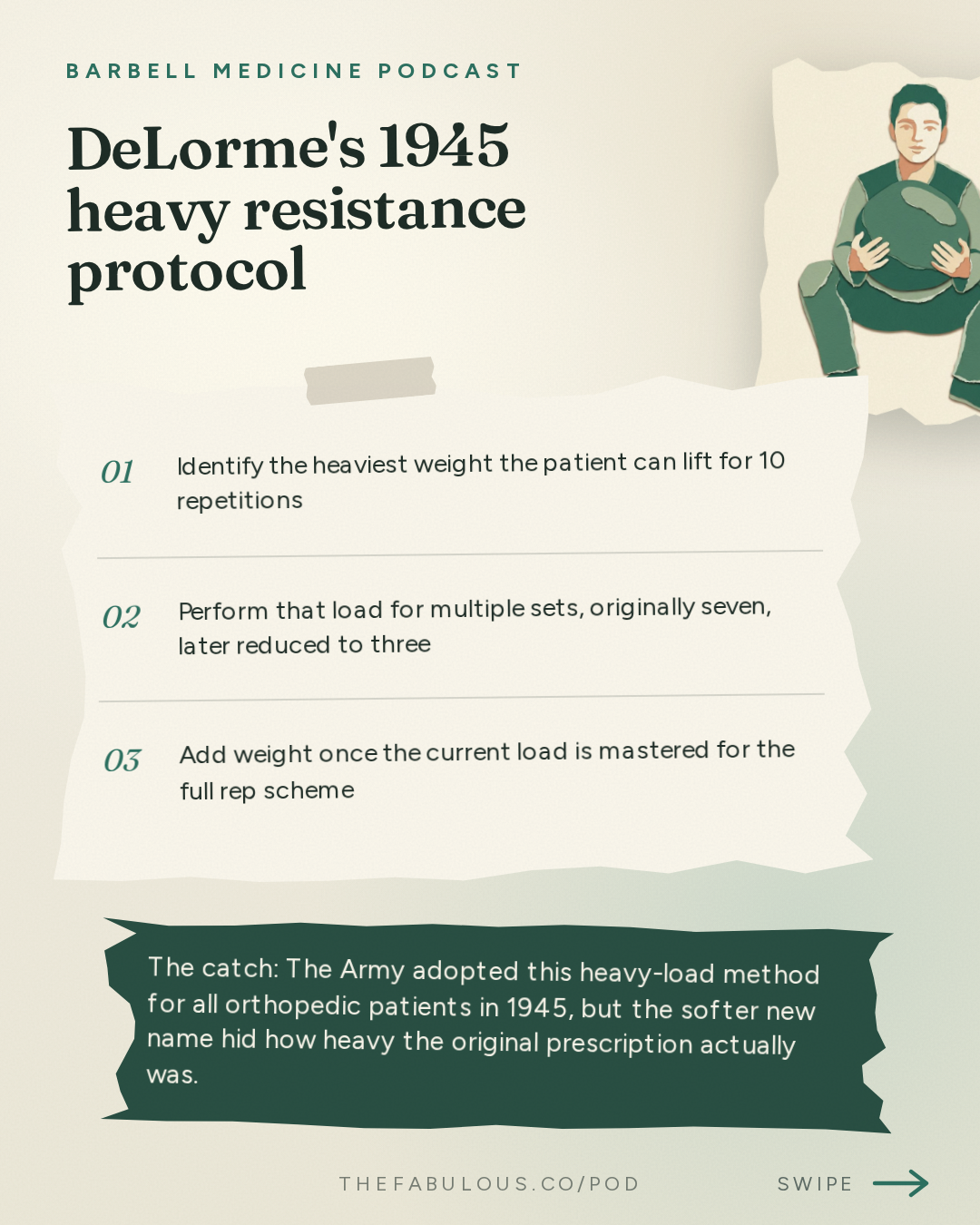
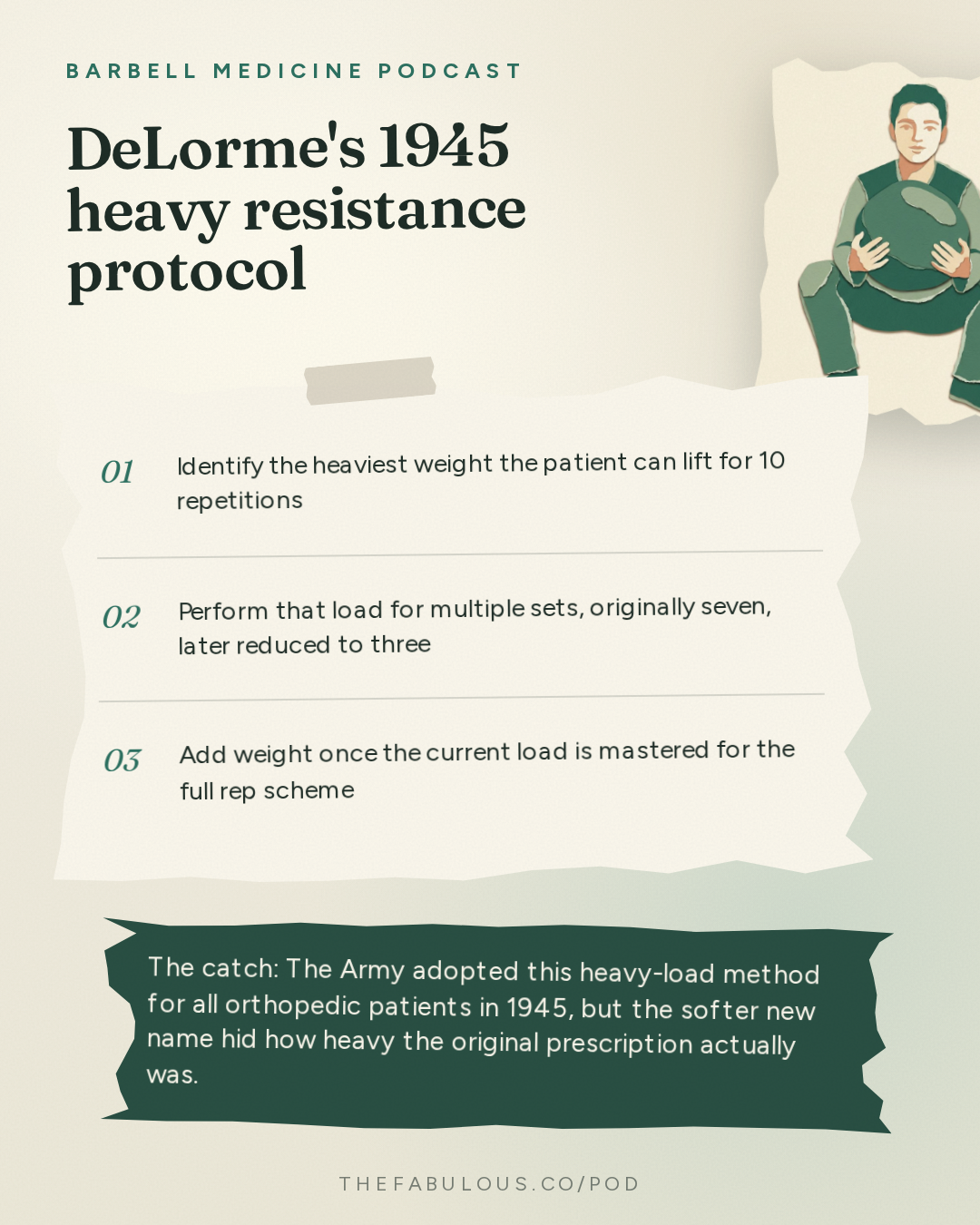
In 1961 a University of Texas professor named Carl Klein reported that lifters who squatted below parallel had looser knee ligaments, using an instrument he built himself that was never validated for the purpose (26:38). Sports Illustrated ran the story in 1962, and every branch of the American military dropped the deep squat from training. It took more than three decades for the correction to arrive: a 1989 study of 100 college students found no consistent effect on knee stability from full squats, and a 1994 study of 32 professional football players found the same after 21 weeks of heavy squatting (27:48, 28:13). The one physician who pushed decisively in the other direction during this era was Thomas DeLorme, who as an army doctor in 1944 had soldiers with knee injuries lift the heaviest weight they could handle for ten reps, repeated across multiple sets. Recovery that used to take six to nine months took weeks (34:42, 35:28). His method was so effective the Army mandated it across its hospital system in 1945. Three years later he cut the volume to three sets of ten, and, worried that doctors would balk at the word "heavy," his wife Eleanor suggested renaming it "progressive resistance exercise" (36:08). The heaviness got quietly edited out of the name, and a generation of coaches inherited a softened version of a protocol built to handle soldiers' torn knees.
Women got a version of the warning that has aged even worse. In 1912 Harvard's head of physical education, Dudley Sargent, wrote that heavy training would make a woman's figure "more masculine," prescribing lighter apparatus to protect her femininity (45:58, 46:20). Sixty years on, Nautilus inventor Arthur Jones insisted women could not build large muscles "if her life depended on it," while in the same breath marketing a machine to shape the thighs women supposedly did not want bigger (46:45, 47:07). A study finally tested the claim directly in the late 1980s: men and women training the same program for sixteen weeks gained the same relative muscle size, about 20 percent, with men simply adding more in absolute terms because male puberty builds a larger starting base (47:49). Few people read that paper. What people did see, through the 1970s and 80s, was women's sport records falling fast, which turned out to be a doping era rather than a training secret (48:09, 48:34), plus a selection effect: unusually muscular, strong women gravitate toward strength sports, the same way unusually tall people gravitate toward basketball, rather than the sport creating the trait (50:11). Institutions lagged accordingly. Men's weightlifting debuted at the first modern Olympics in 1896; women's weightlifting did not arrive until 2000 (52:21, 52:43).
The warning that is still here
Pregnancy carried its own folklore: that exercise would steal blood from the uterus and starve the fetus, a theory a later review notes was "never proven" (53:52, 54:12). A 1949 federal bulletin allowed housework, gardening, and a daily mile-long walk, but not sport (54:19). Textbooks into the 1960s warned against "violent exercise," their examples being tennis, horseback riding, swimming, and cycling (54:19). The 1985 heart-rate guidance that opened this story was simply the medicalized version of the same instinct. Today's official opinion says physical activity in pregnancy is "safe and desirable" and that fears about miscarriage or poor growth have not been substantiated, yet one study found 91 percent of pregnant women who got any counseling at all were never told how often, how hard, or what kind of exercise to do (55:51). A 2025 study put ten pregnant women through barbell squats, bench presses, and deadlifts at 90 percent of a ten-rep max, including a set performed with the Valsalva maneuver, meaning holding the breath against a closed throat under load, which is exactly what old guidelines feared. Fetal heart rate did not drop (56:21, 56:48).
Feigenbaum's closing point is less about lifting than about how caution gets manufactured. Smoking was linked to lung cancer because someone studied it. High blood pressure was linked to artery damage because someone studied that too. The century of warnings against lifting heavy was not built that way:
"None of these warnings were built that way. They were all based on vibes." — Jordan Feigenbaum [58:10]A finding that never existed cannot be formally retracted, which may be why the myths outlive the corrections. By one measure, only about 30 percent of American adults currently lift weights twice a week or more (58:56). The lesson he draws is simple to state and harder to practice: when the next caution about lifting shows up, ask for the study behind it, and ask what the risk of not lifting might be, since for a hundred years almost nobody thought to ask that second question at all.
Ask this episode anything
Pod's AI answers from the episode itself, with the minute mark so you can hear it yourself.
Or start with one of these
Ask this episode
Pod's AI listens to the whole episode to answer, and points you to the minute it comes from.
The rest of this answer, and any question after it
Answers come from the episode itself, never from a summary of it.
ContinueKey takeaways
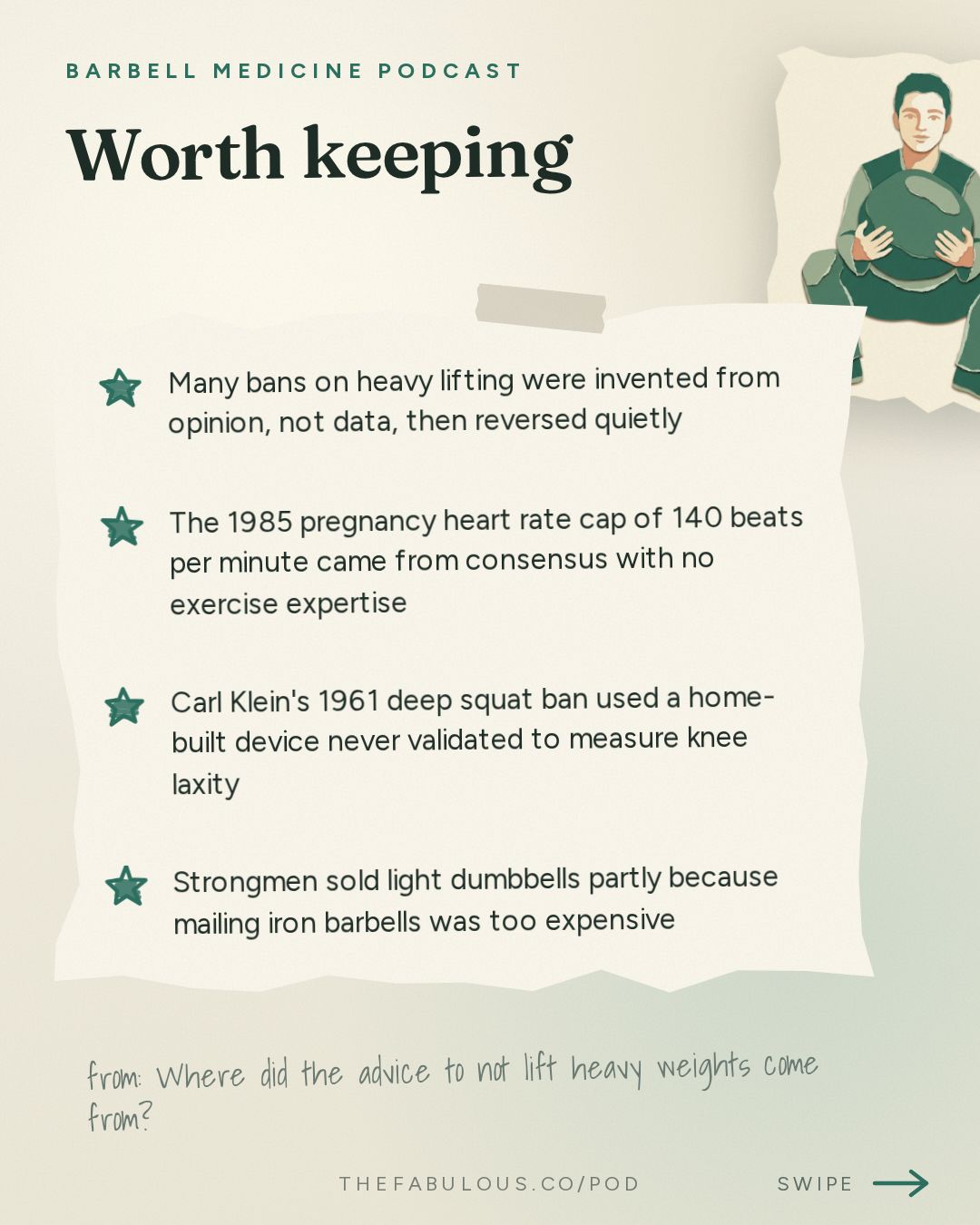
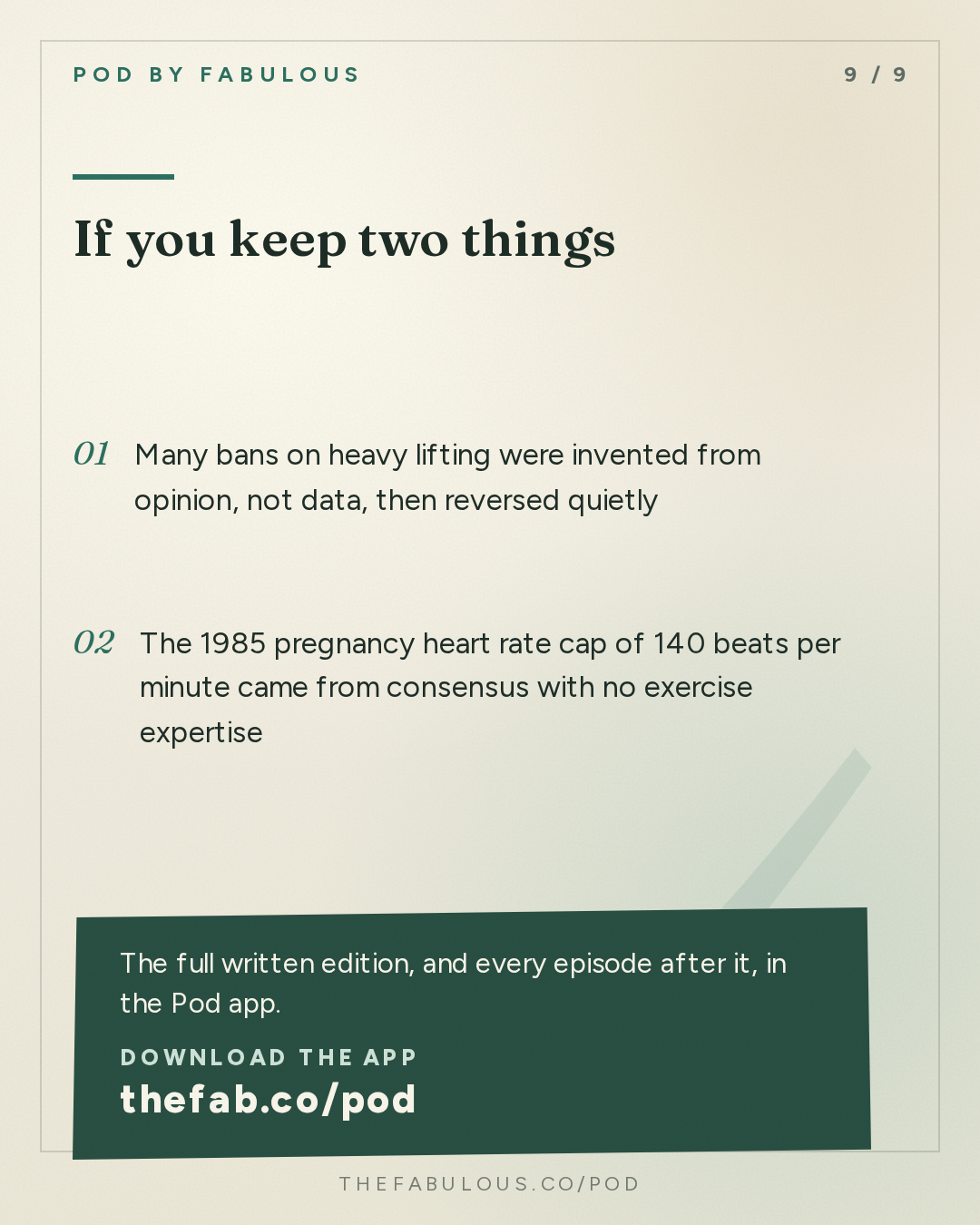
- Many bans on heavy lifting were invented from opinion, not data, then reversed quietly
- The 1985 pregnancy heart rate cap of 140 beats per minute came from consensus with no exercise expertise (00:01)
- Carl Klein's 1961 deep squat ban used a home-built device never validated to measure knee laxity (26:38)
- Strongmen sold light dumbbells partly because mailing iron barbells was too expensive (13:32)
- Men and women gain the same relative percentage of muscle from identical training programs (47:49)
The episode in cards


By the numbers
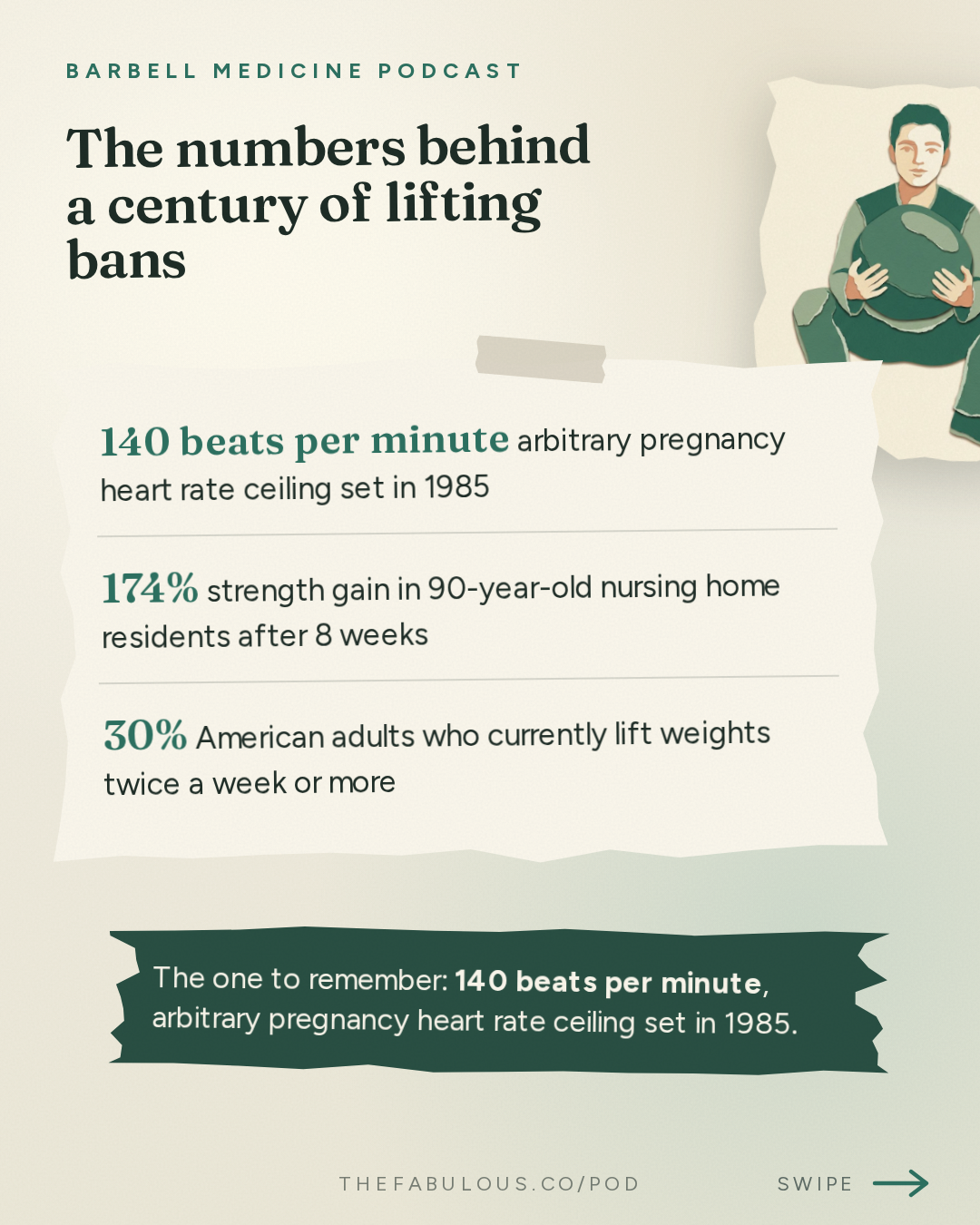
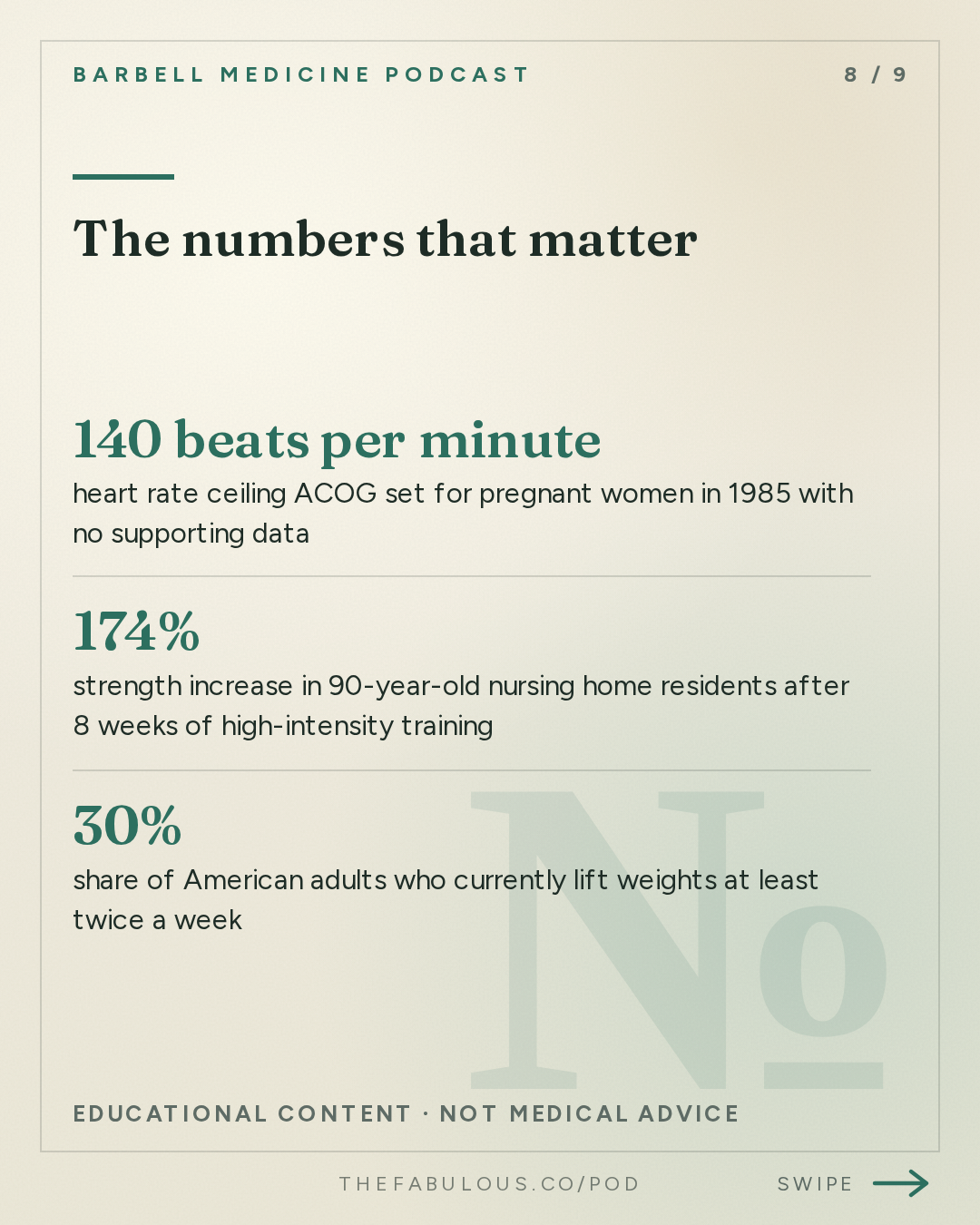
- 140 beats per minute heart rate ceiling ACOG set for pregnant women in 1985 with no supporting data
- 174% percent strength increase in 90-year-old nursing home residents after 8 weeks of high-intensity training
- 30% percent share of American adults who currently lift weights at least twice a week
In their words
“Strength is health.”
“He who does the work of the grade suited to a truck horse is far more likely to acquire the heavy and ponderous ways of that worthy animal.”
“The audience roared with laughter at my expense.”
“None of these warnings were built that way. They were all based on vibes”
Protocols
-
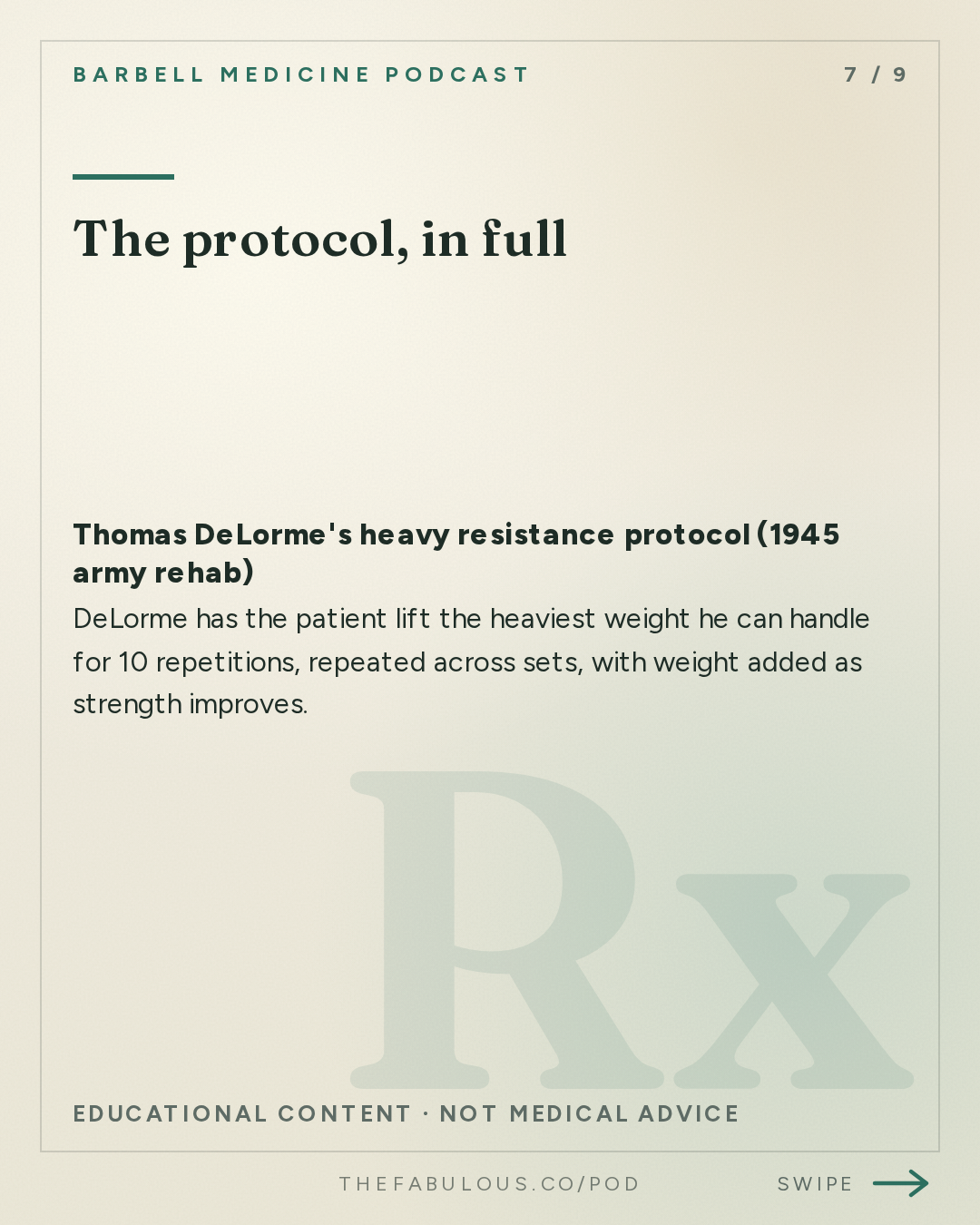
Thomas DeLorme's heavy resistance protocol (1945 army rehab)
DeLorme has the patient lift the heaviest weight he can handle for 10 repetitions, repeated across sets, with weight added as strength improves.
Originally seven sets of 10, later reduced by DeLorme to three sets of 10 to allow heavier loads per set
Questions this episode answers
Does lifting heavy weights stunt a child's growth?
The American Academy of Pediatrics removed this warning in 2020 and labeled it a myth, after writing as early as 2001 that strength training does not appear to adversely affect linear growth (01:07, 40:36). Growth plate injuries do happen but mostly from dropping a weight on a finger or toe rather than from lifting itself (41:46).
Where did the ban on deep squats come from?
University of Texas professor Carl Klein reported in 1961 that deep squats loosened knee ligaments, using a self-built device that was never validated for measuring knee laxity, and the finding was picked up by Sports Illustrated and adopted across the US military (26:38). A 1989 study of 100 college students and a 1994 study of 32 professional football players both found no consistent increase in knee laxity from heavy or deep squatting (27:48, 28:13).
Is it safe to lift heavy weights while pregnant?
A 2025 study had ten pregnant women perform barbell squats, bench presses, and deadlifts at 90% of a 10-rep max, including a set with the Valsalva maneuver (holding the breath under load), and found no drop in fetal heart rate (56:21, 56:48). Current obstetric guidance states physical activity in pregnancy is safe and desirable, though one study found 91% of counseled pregnant women were never given specific frequency or intensity guidance (55:19, 55:51).
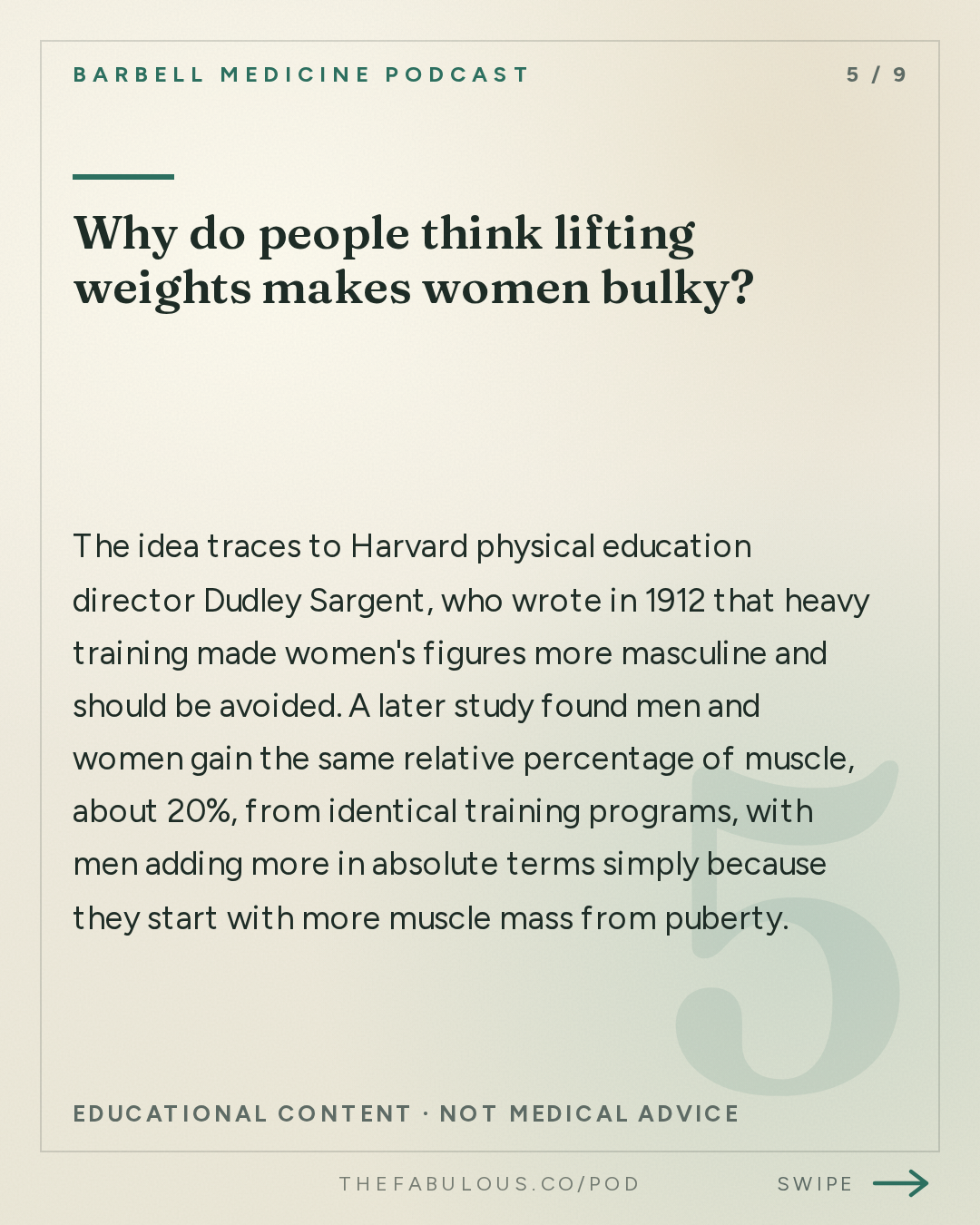
Why do people think lifting weights makes women bulky?
The idea traces to Harvard physical education director Dudley Sargent, who wrote in 1912 that heavy training made women's figures more masculine and should be avoided (45:58, 46:20). A later study found men and women gain the same relative percentage of muscle, about 20%, from identical training programs, with men adding more in absolute terms simply because they start with more muscle mass from puberty (47:49).
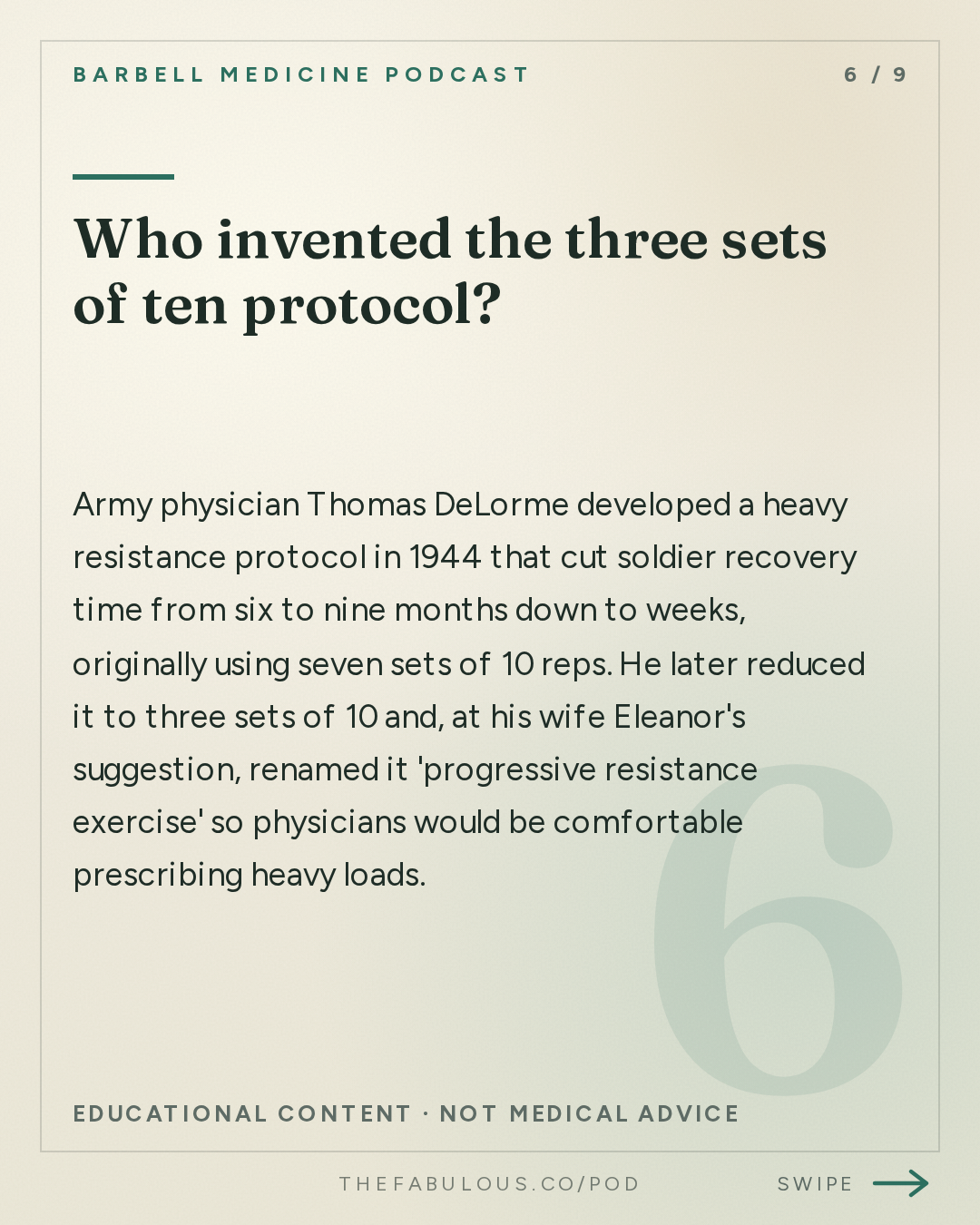
Who invented the three sets of ten protocol?
Army physician Thomas DeLorme developed a heavy resistance protocol in 1944 that cut soldier recovery time from six to nine months down to weeks, originally using seven sets of 10 reps (34:42, 35:28). He later reduced it to three sets of 10 and, at his wife Eleanor's suggestion, renamed it 'progressive resistance exercise' so physicians would be comfortable prescribing heavy loads (36:08).
The full read, in cards
Go deeper
- Carl Klein's 1961 knee laxity study — used a self-built, unvalidated device to claim deep squats loosen knee ligaments, prompting a military-wide ban
- Karpovich and Zorbas arm-crank study — timed 600 young men on a cranking device in 1951 and found lifters were faster than non-lifters, debunking the slow muscle-bound idea
- Terry Todd's methodological takedown of Klein's squat research — published in the Journal of the National Strength and Conditioning Association, challenging Klein's measurements and homemade device
- Hubal et al. 2005 single-arm training study — trained 585 people for 12 weeks and found individual muscle growth ranging from -2% to +59%, showing some people are outlier responders
- 2025 study of heavy resistance training in pregnancy — had pregnant women squat, bench, and deadlift at 90% of a 10-rep max with the Valsalva maneuver and found no fetal heart rate drop
Mentioned
George Barker Winship · Thomas DeLorme · Bernarr Macfadden · Carl Klein · William Blaikie · Terry Todd · Peter Karpovich · American College of Obstetricians and Gynecologists · York Barbell · Physical Culture · Nautilus
More from this show and category
Is Training Safe in Wildfire Smoke?
Exercise still protects health during wildfire smoke, and lifting is safer than cardio because it barely raises breathing rate. Training right at failure isn't required for muscle growth either, since easier sets and even indirect fractional sets still add measurable stimulus, so individual response matters more than hitting an exact rep-in-reserve number.
Do You Need a Calorie Surplus to Build Muscle?
No: men above roughly 20% body fat can build muscle in a modest calorie deficit by spending stored fat as fuel. Sports scientist Eric Helms says below about 12% body fat the reverse happens, so a small surplus helps; in between, calorie balance barely matters if training and protein are dialed in.

Is Obesity Really a Muscle Disease?
Obesity is not simply a muscle shortage: lean mass on a DEXA scan predicts no falls, fractures, or death in 18,800 older adults (21:44). Barbell Medicine host Dr. Jordan Feigenbaum argues the real damage comes from where fat lands, what molecular form it takes, and how fast it moves, drawing on GLUT4 transporter mechanics and GLP-1 trial data.
Personal Fat Threshold Theory Explained
The personal fat threshold theory says obesity begins when a person's fat cells run out of storage room, not at any fixed weight or BMI. Once storage fills up, fatty acids leak into the liver, muscle, and pancreas, causing insulin resistance. Removing fat surgically does not reverse this; restoring storage capacity does.
