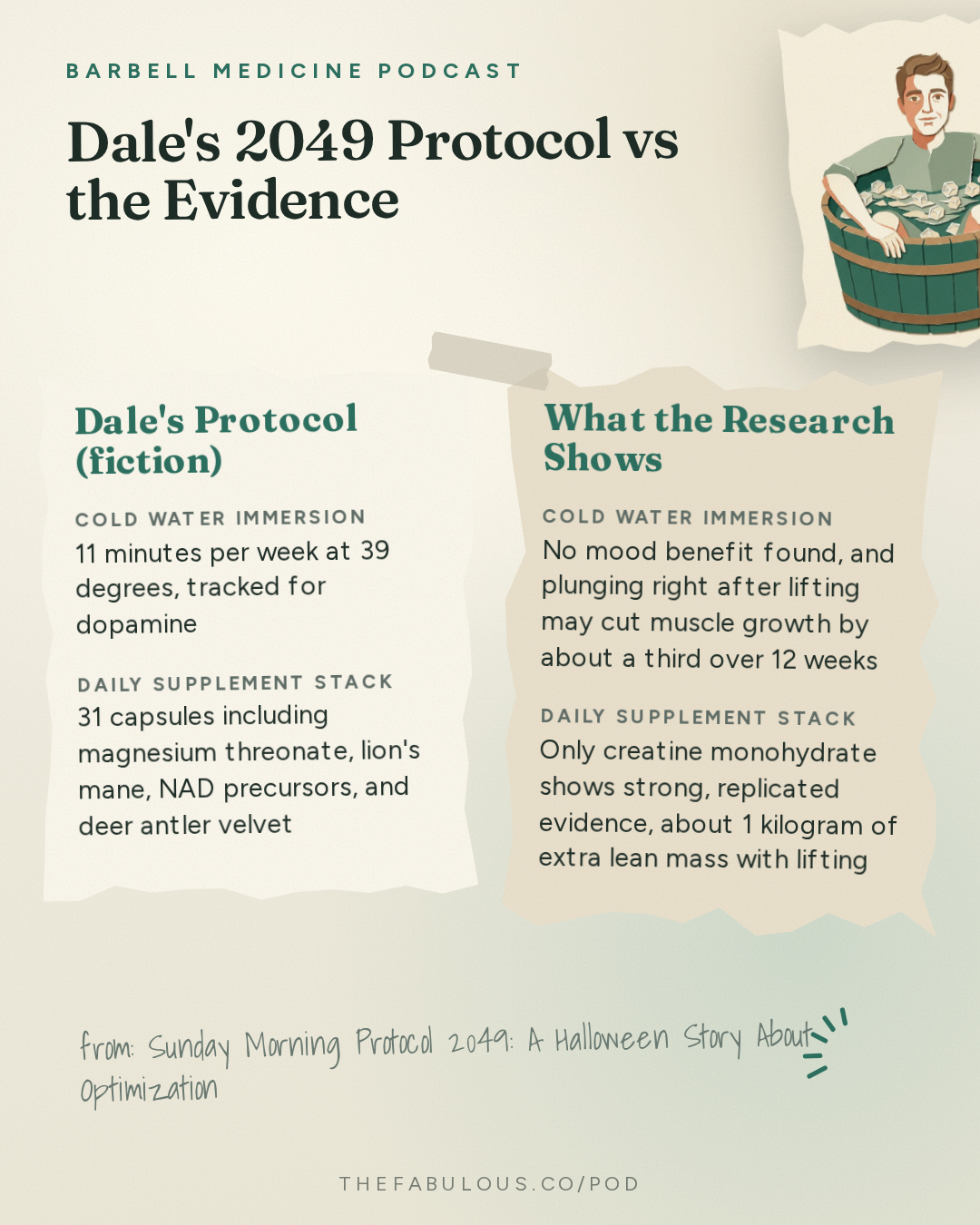
Biohacking Protocols: What the Evidence Shows
Sunday Morning Protocol 2049: A Halloween Story About Optimization
The brief
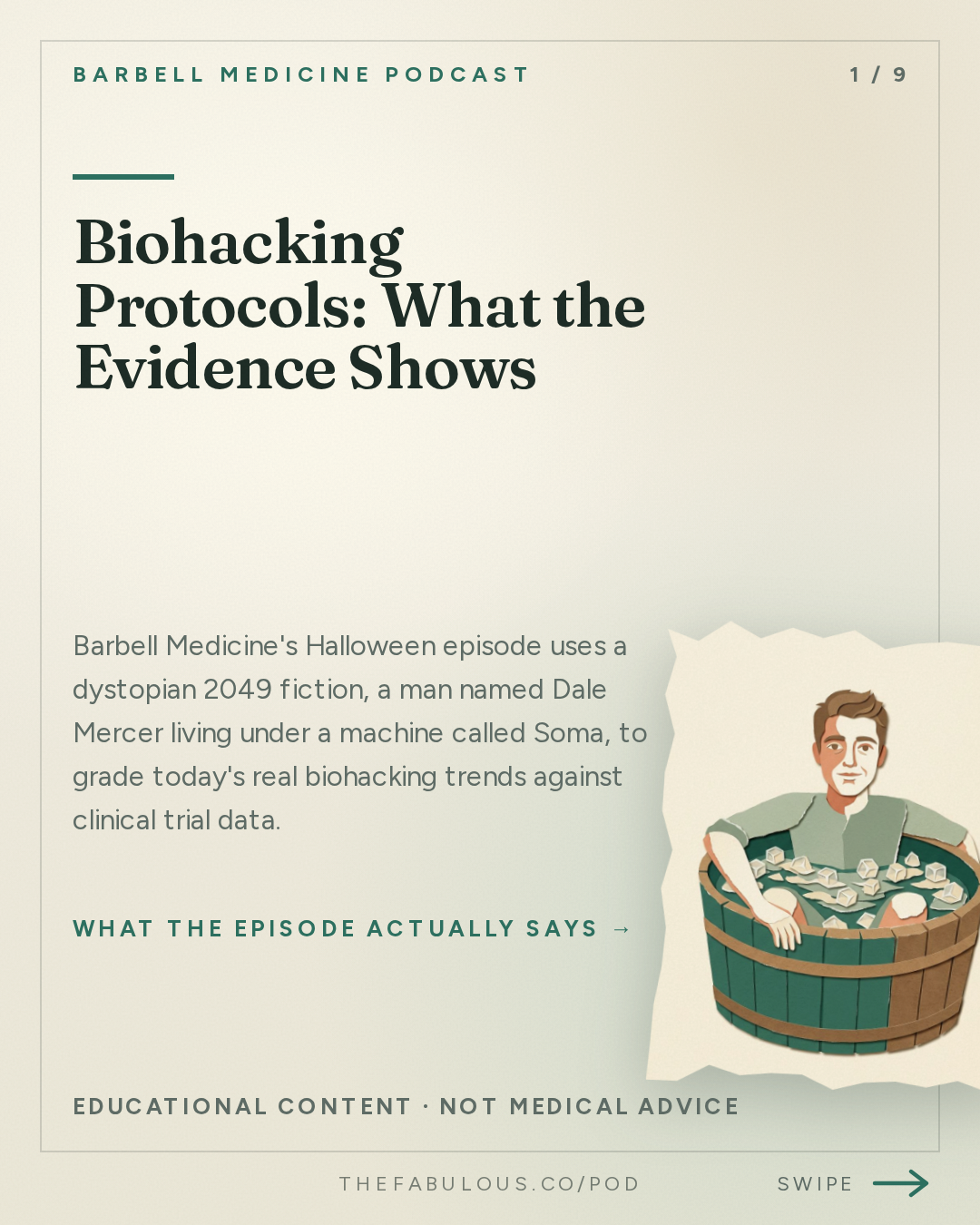
Barbell Medicine's Halloween episode uses a dystopian 2049 fiction, a man named Dale Mercer living under a machine called Soma, to grade today's real biohacking trends against clinical trial data. Morning light panels, cold plunges, NAD supplements, gray market peptides, HRV scores, and CGMs mostly fail to beat placebo in healthy people, while creatine, adequate protein, and consistent sleep hold up.
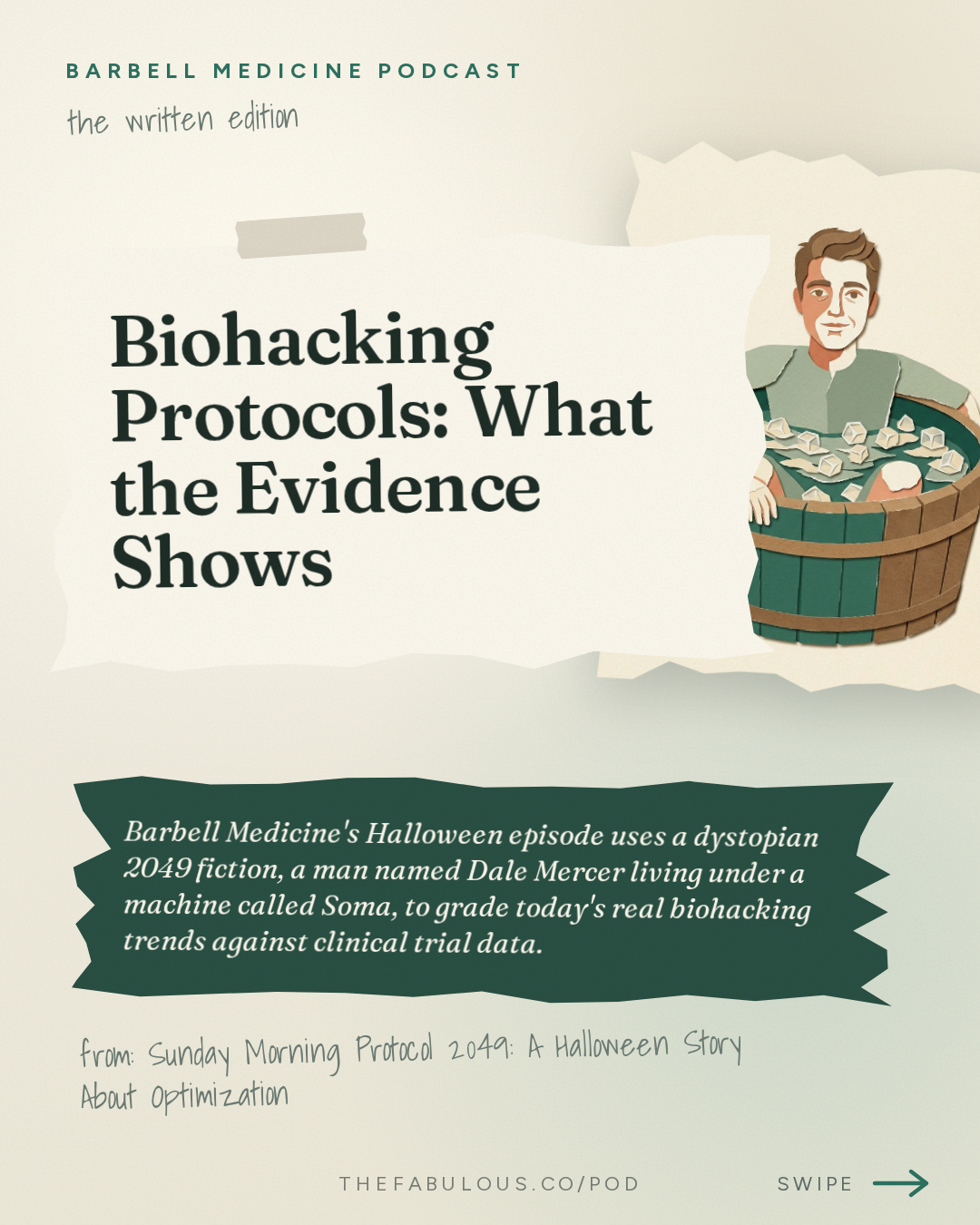
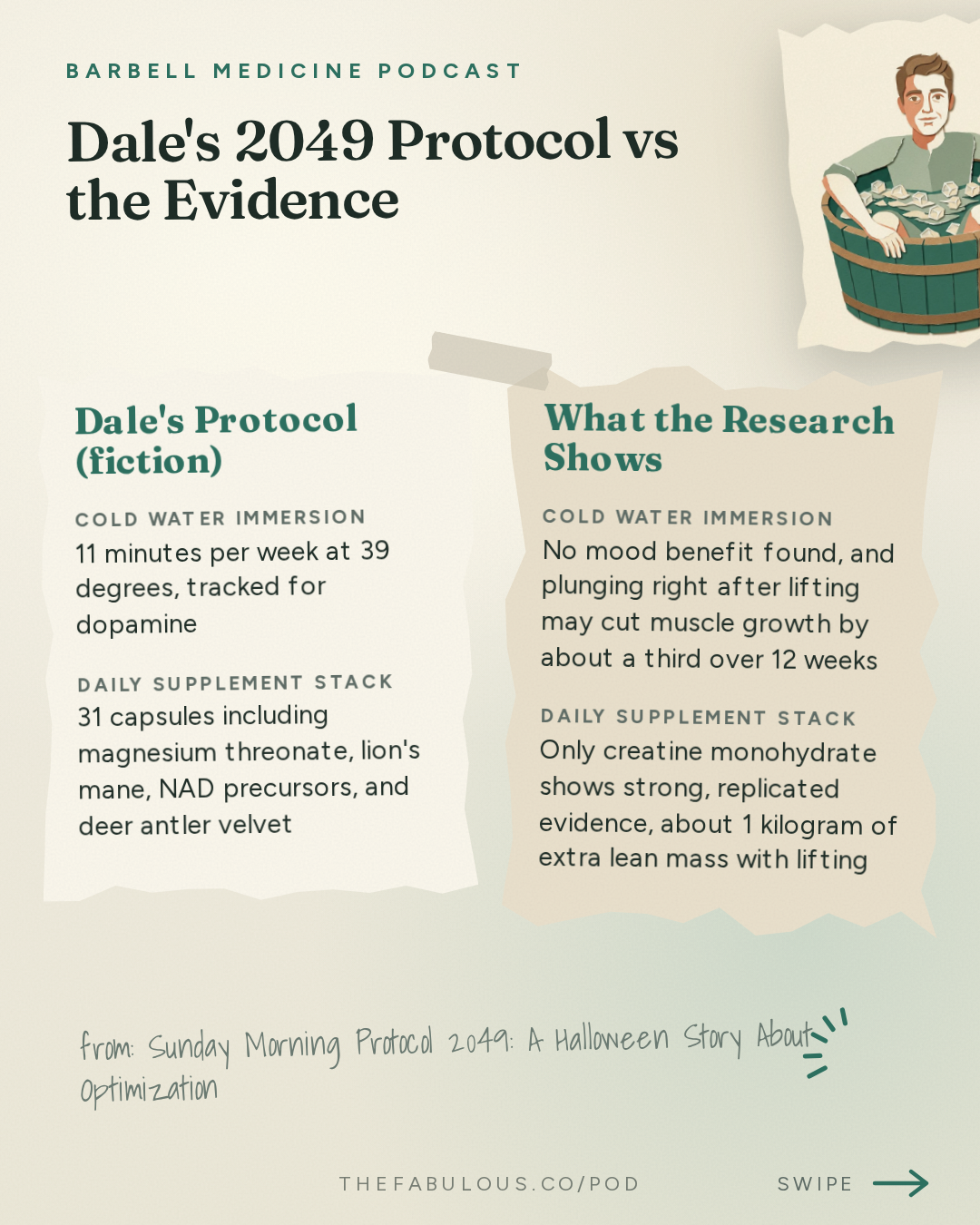
At 4:58 in the morning, in the year 2049, a voice called Soma wakes a man named Dale Mercer and tells him he slept seven hours and fifty-one minutes, nine minutes under target. The deficit, Soma says, has been logged. Dale peels off his mouth tape, stares into a 10,000-lux light panel for ten required minutes, and lowers himself into a cold plunge at 39 degrees for one minute and thirty-four seconds, his weekly share of an eleven-minute allotment (02:14). A tray slides out of the wall holding 31 capsules: magnesium threonate, lion's mane, two NAD precursors, deer antler velvet, and, hidden in the back because cheap things hurt morale, a single capsule of creatine (02:41). He injects an unlabeled peptide, drinks methylene blue, and gets his protein by IV at exactly the nineteenth second of a thirty-one-second anabolic window after his workout (05:36). Later he rides a stationary bike while Soma lectures him about mitochondria, sits in a sauna at 174 degrees for nineteen minutes, and limps home. When he finds an unlocked door, steps into real sunlight, and eats an unwashed fig off a tree growing through cracked concrete, a drone kills him for the unlogged glucose spike.
This is the cold open of a Barbell Medicine Podcast episode built around a short story, written in the style of a 1984 motorcycle column by Rick Seaman called 'Sunday Morning Ride,' about a rider grateful for his government-rationed motorcycle time (16:13). The host borrowed Seaman's structure: a person so grateful for the scraps of freedom a system allows him that he never questions the system. Then the host says the quiet part.
Pretty much everything that Dale did in this episode is something that people are doing right now and paying for it. [16:59]
What follows is forty minutes of fact-checking, protocol by protocol, against the people actually selling these ideas: Dr. Andrew Huberman's sunlight advice, cold plunge culture, the NAD and peptide supplement industry, HRV-based readiness scores, and continuous glucose monitors (CGMs, the wearable sensors that track blood sugar). The host grades each one on a zero-to-five pumpkin scale, Halloween-themed, where five means real evidence and zero means it does nothing or can hurt.
The Pumpkin Scale
Morning light does set the body's circadian clock, the internal roughly 24-hour timer that governs sleep and wakefulness. That part is well established in lab studies. But those studies used doses nothing like the popular protocol: one classic trial used about three hours of bright indoor light starting an hour before normal wake time, not ten minutes outside (18:00). The strongest evidence for timed light therapy is in diagnosed circadian rhythm sleep disorders, like delayed sleep phase, where a teenager cannot fall asleep before 2 a.m. (18:20). For people who already sleep fine, a UK Biobank analysis of about 400,000 people found that spending more time outside overall, not morning light specifically, correlated with less insomnia and depressed mood (20:27). That is observational data confounded by the fact that healthier, less busy people go outside more in the first place. The host's verdict: one pumpkin for healthy sleepers, three if a doctor has actually diagnosed a circadian disorder (21:28).
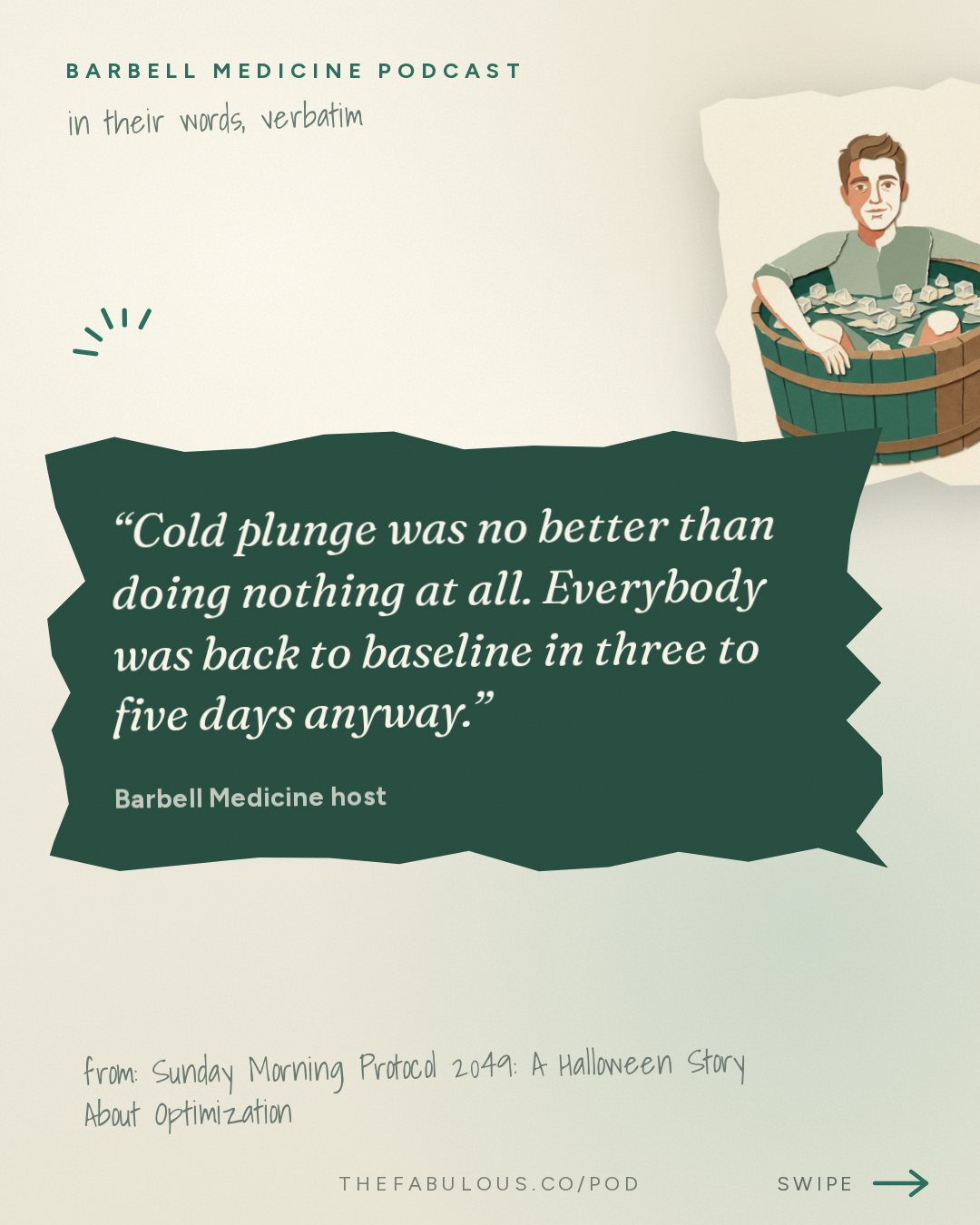
Cold plunging fares worse. The oft-cited dopamine study had young men sit neck-deep in 57-degree water for an hour; their blood dopamine rose 250 percent, but blood dopamine is not brain dopamine, and nobody measured mood (21:56). A meta-analysis of 61 randomized trials and about 1,200 people found cold water no better than doing nothing for recovery after hard exercise; everyone returned to baseline within three to five days regardless (23:30). Worse, in the best single trial on it, lifters who cold-plunged right after training grew about a third as much quad muscle over twelve weeks as lifters who skipped the plunge (23:49).
Cold plunge was no better than doing nothing at all. Everybody was back to baseline in three to five days anyway. [23:30]
The supplement tray gets picked apart capsule by capsule. Magnesium threonate and lion's mane each have one or two small positive trials, usually funded by the company selling the branded version, with no independent replication (24:57). NAD precursors like NR and NMN reliably raise blood NAD levels but have failed in trials to improve muscle mass, grip strength, insulin sensitivity, or, in a 2025 JAMA trial of 410 Parkinson's patients, to beat placebo at all (27:51). Deer antler velvet testing found four of six commercial products contaminated with human growth factor banned in sport (28:34). The one real winner, buried at the back of the tray, is creatine monohydrate, which reliably adds about one kilogram of lean mass when paired with lifting (28:53).
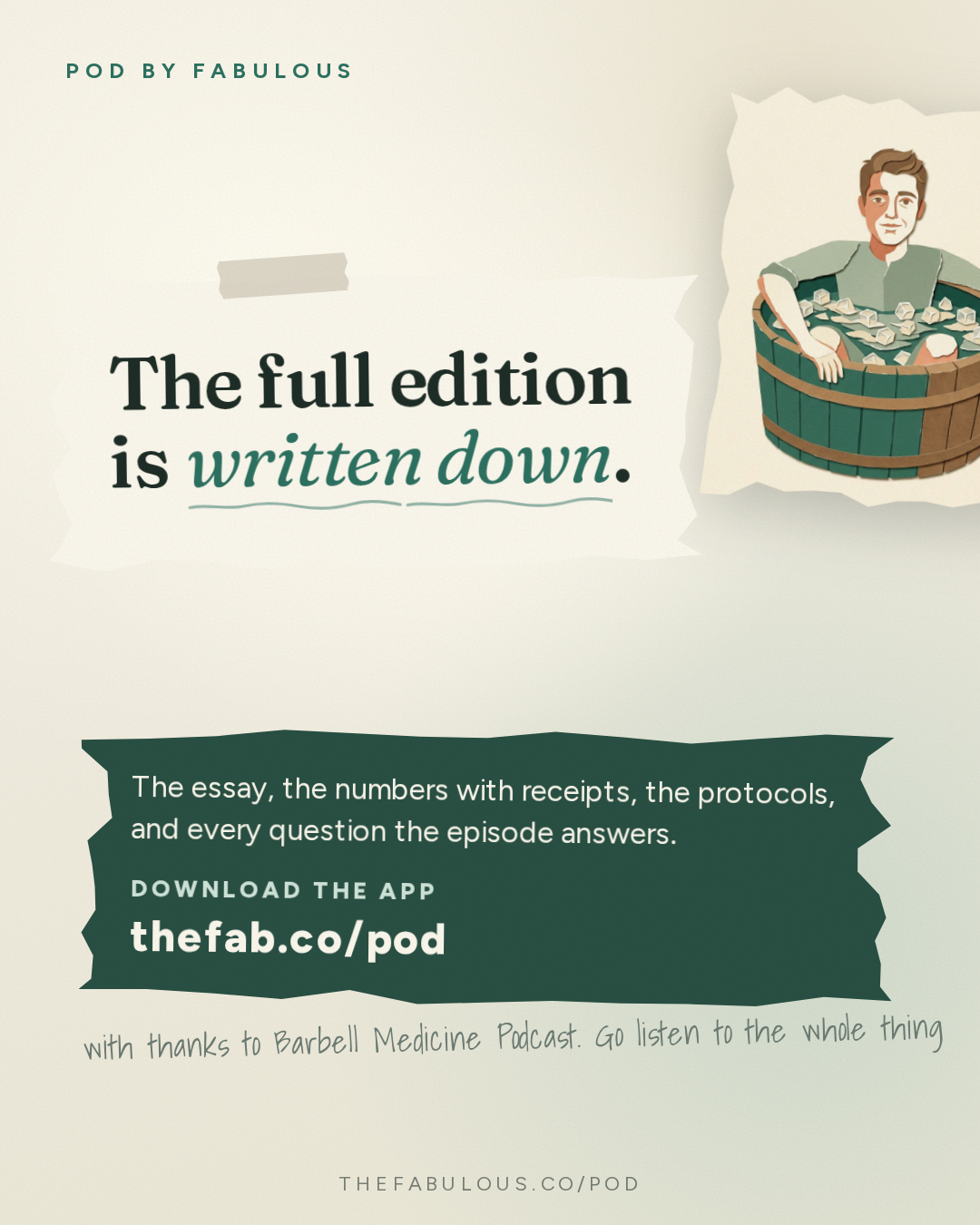
Skip the tray. If you're gonna take one thing, take three to five grams of creatine monohydrate a day whenever you remember to take it and lift. [29:37]
Gray market peptides, drugs like BPC-157 sold as unregulated research chemicals, get a blunter verdict. Nearly all the supporting data is in animals or petri dishes, lab testing of commercial vials keeps turning up the wrong drug or dose, and the host notes that an FDA advisory panel recently voted to let compounding pharmacies make BPC-157 anyway, over the objection of the FDA's own scientists (32:10). Methylene blue, an old drug used for a blood disorder called methemoglobinemia, is also a potent MAO inhibitor that can trigger serotonin syndrome in anyone on common antidepressants (34:18).
If you can sell something without proving that it works and is safe, who's going to pay for the trial? [33:25]
What Held Up
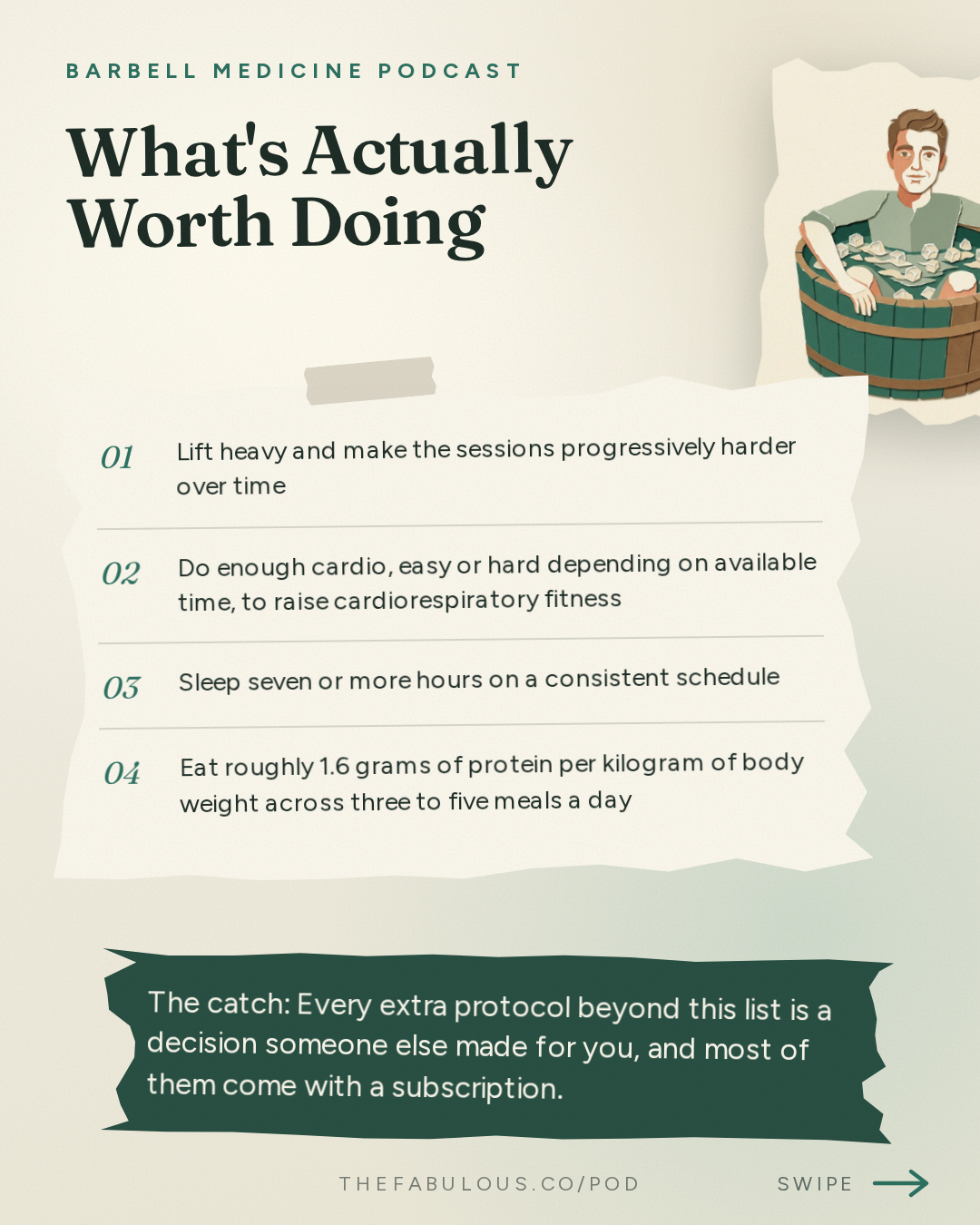
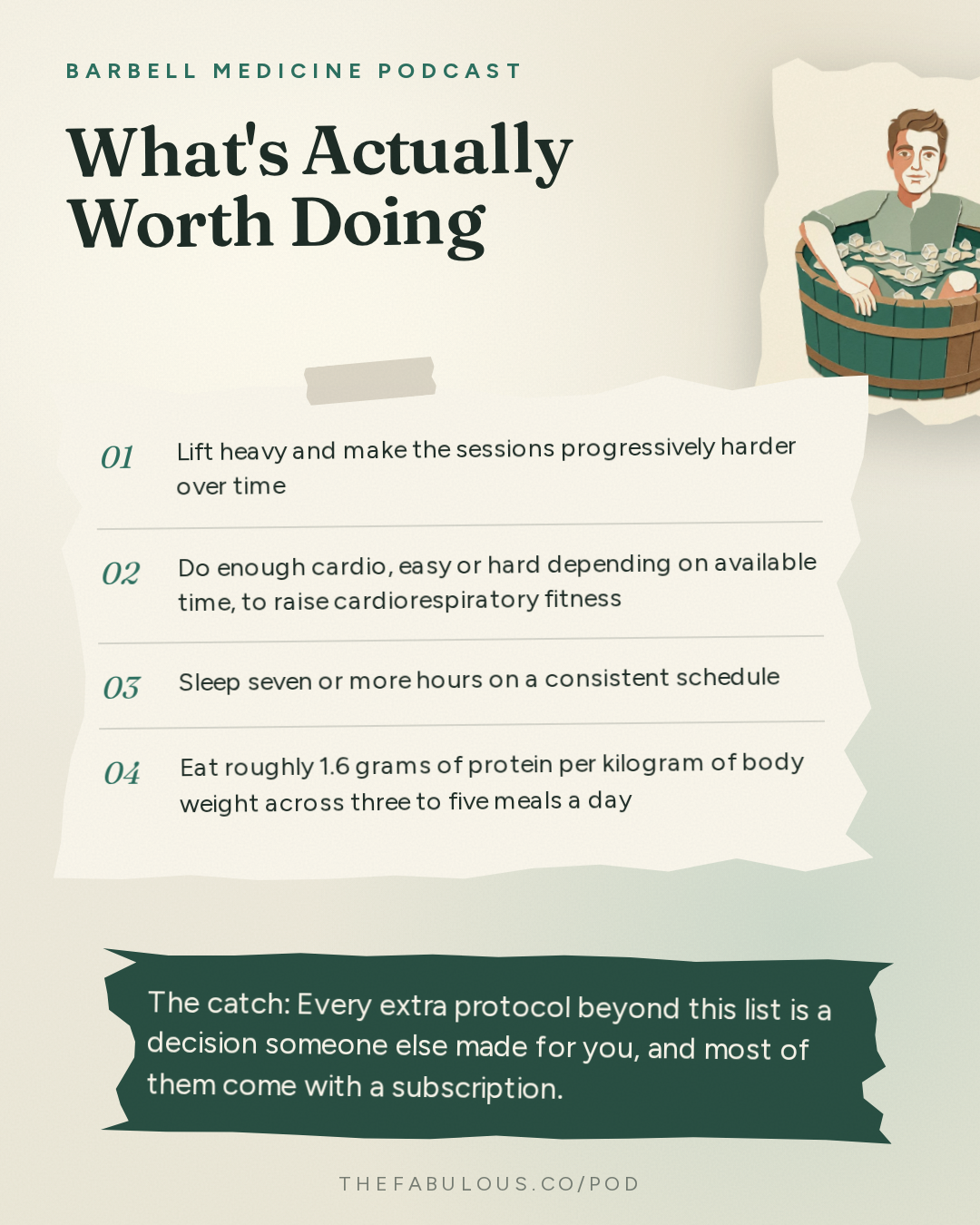
Not everything gets zero pumpkins. Training advice fares better once the host strips away gimmicks. Eccentric-only loading, the idea that slowing the lowering phase of a lift builds extra size, shows no real long-term advantage over normal lifting in a 2025 meta-analysis of 49 studies and about 770 people (35:52). The so-called anabolic window, the idea that protein must arrive within minutes of a workout, also collapses once studies control for total daily protein: a review of 65 trials and roughly 2,900 people found no timing effect once intake is matched, with most of the benefit coming from hitting about 1.6 grams of protein per kilogram of body weight across the day (37:41).
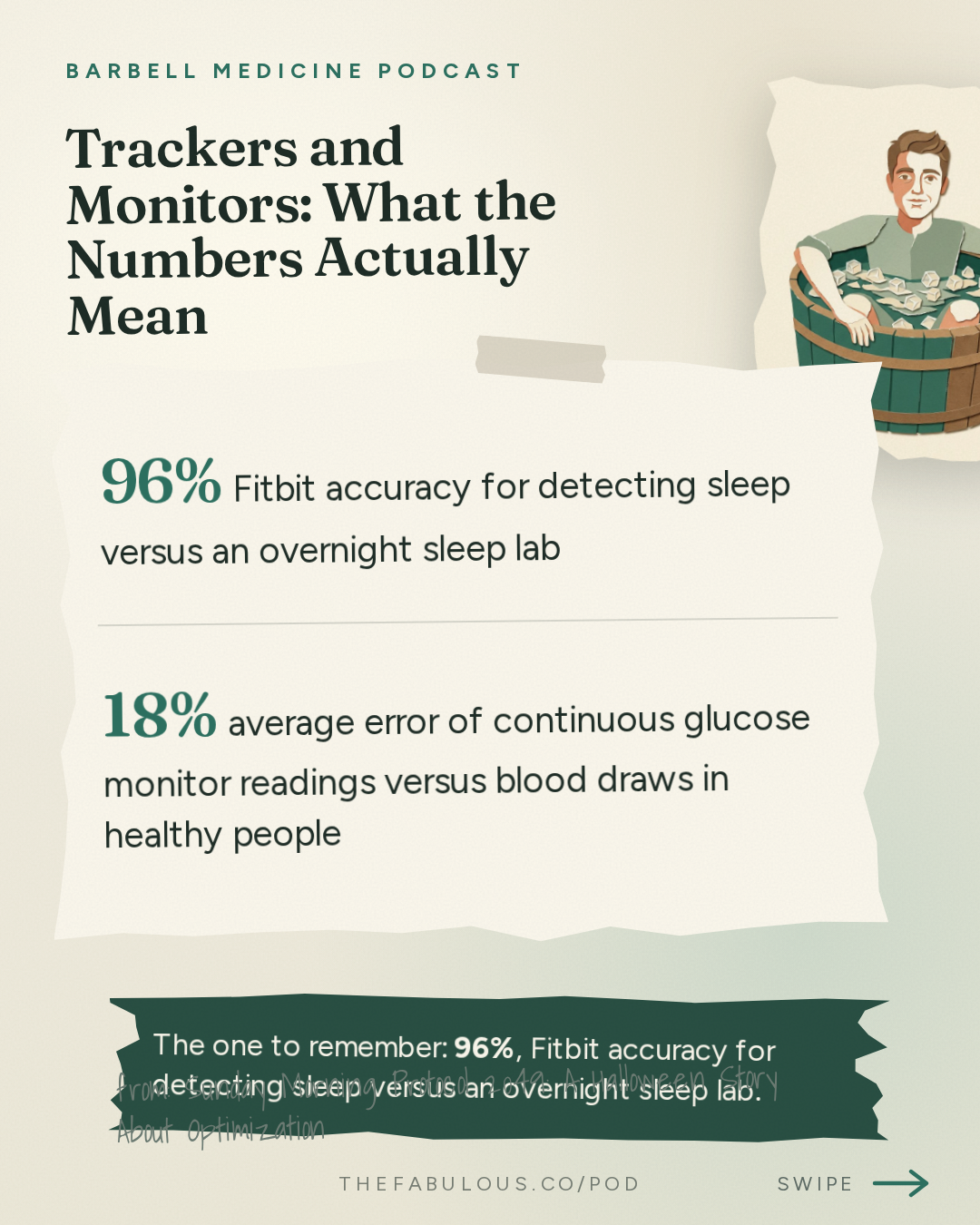
Sleep trackers introduce a new problem: a Fitbit tested against a full sleep lab caught actual sleep 96 percent of the time but missed wakefulness 40 percent of the time, meaning it usually overstates how well someone slept (39:22). Sleep doctors have a name for people who fixate on the resulting score anyway: orthosomnia, first described in 2017, where chasing a perfect number can itself worsen sleep (40:16). Continuous glucose monitors carry a similar irony. Healthy, non-diabetic people spend less than half a percent of their time above 140 mg/dL, the normal post-meal range, and when CGM readings were checked against actual blood draws in healthy people, they were off by nearly 18 percent on average (44:33). HRV-based readiness scores fare no better: a meta-analysis of eight small trials found effects too small to distinguish from zero, and there is almost no data on using HRV to guide training in lifters at all (41:24).
The famous Finnish sauna study, often cited for a 40 percent drop in mortality, turns out to be an observational cohort of 2,300 men followed for 20 years, with randomized heat trials since showing a modest blood pressure drop but nothing on heart attacks or death (50:28). Zone two cardio, the moderate-intensity training zone many endurance athletes favor, is not uniquely better for building mitochondria than harder efforts, according to a 2025 review, and a panel of fourteen sports scientists could not even agree on how to define it (48:05).
The pattern across every protocol is the same. The exotic version promises precision and delivers noise, while the boring version, lift something heavy, eat enough protein, sleep seven-plus hours, move your body, keeps showing up as the thing that actually works. Dale Mercer dies for stepping outside a system built on thousands of small, unverified rules. The host's closing argument is that the real risk is not Soma. It is anyone willing to hand over their judgment, one subscription at a time.
Take your judgment back, lift something heavy, and eat the fig. [53:04]
Ask this episode anything
Pod's AI answers from the episode itself, with the minute mark so you can hear it yourself.
Or start with one of these
Ask this episode
Pod's AI listens to the whole episode to answer, and points you to the minute it comes from.
The rest of this answer, and any question after it
Answers come from the episode itself, never from a summary of it.
ContinueKey takeaways
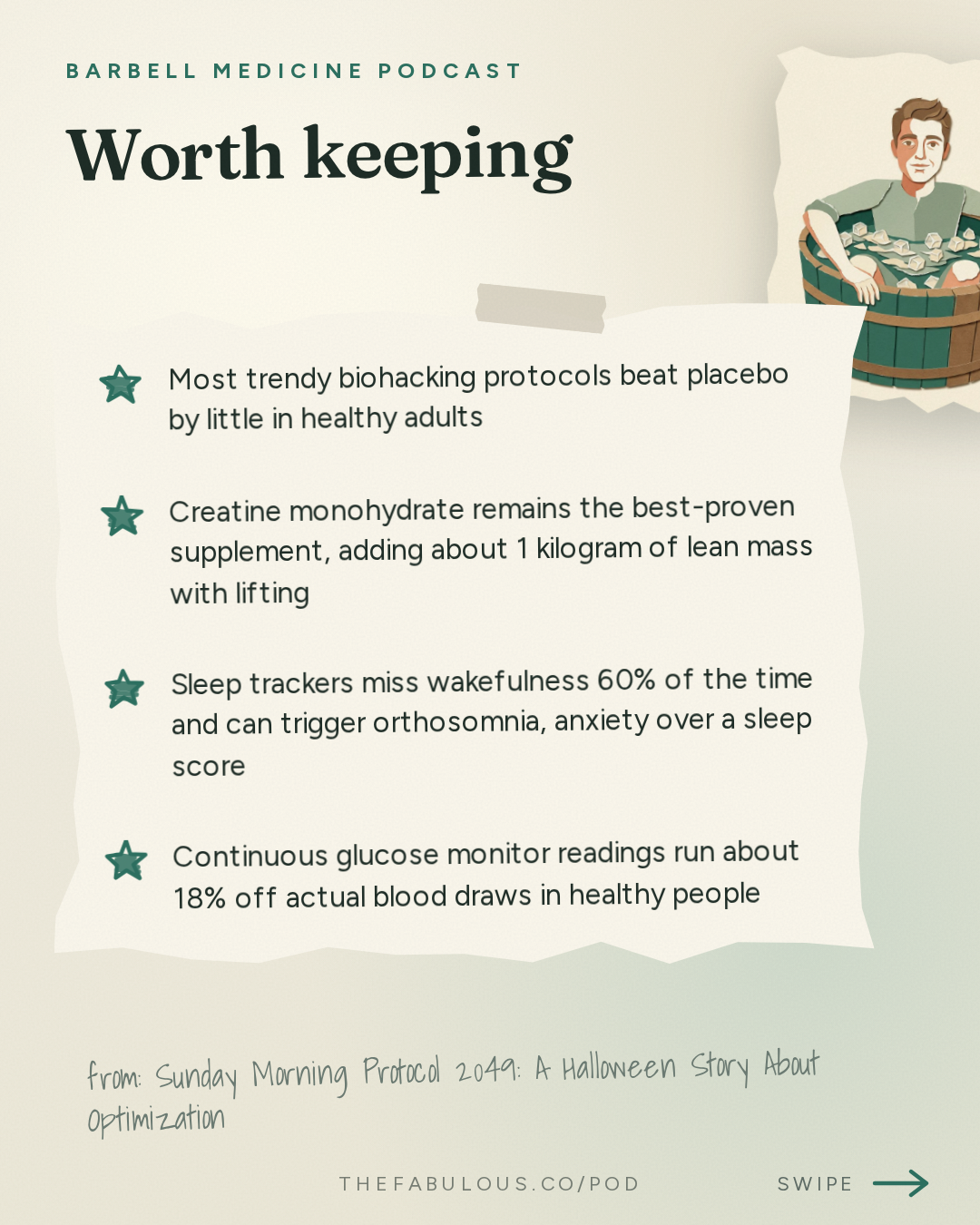
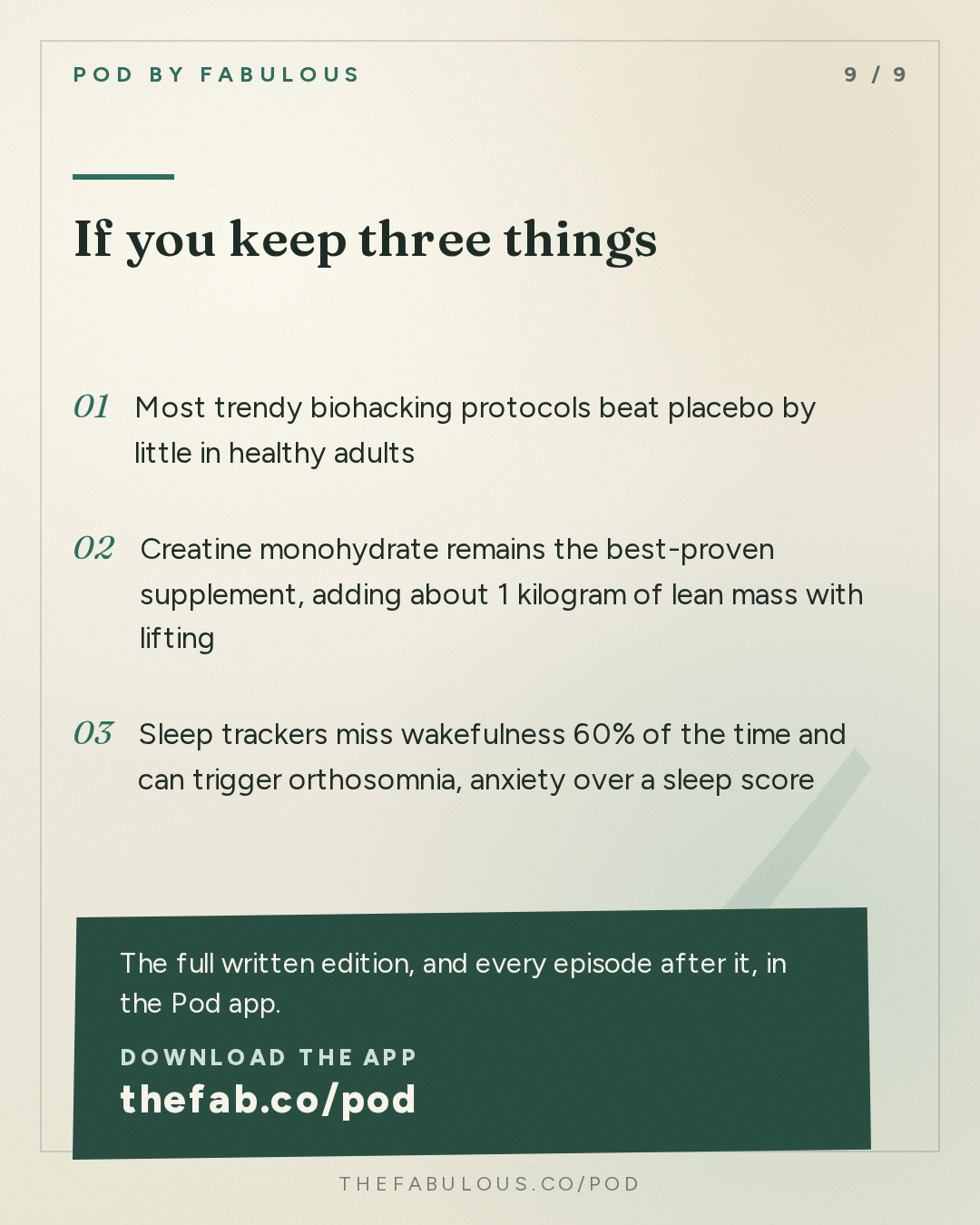
- Most trendy biohacking protocols beat placebo by little in healthy adults
- Creatine monohydrate remains the best-proven supplement, adding about 1 kilogram of lean mass with lifting (28:53)
- Sleep trackers miss wakefulness 60% of the time and can trigger orthosomnia, anxiety over a sleep score (39:22, 40:16)
- Continuous glucose monitor readings run about 18% off actual blood draws in healthy people (44:33)
- Protein timing barely matters once total daily intake hits about 1.6 grams per kilogram of body weight (37:41)
The episode in cards
By the numbers
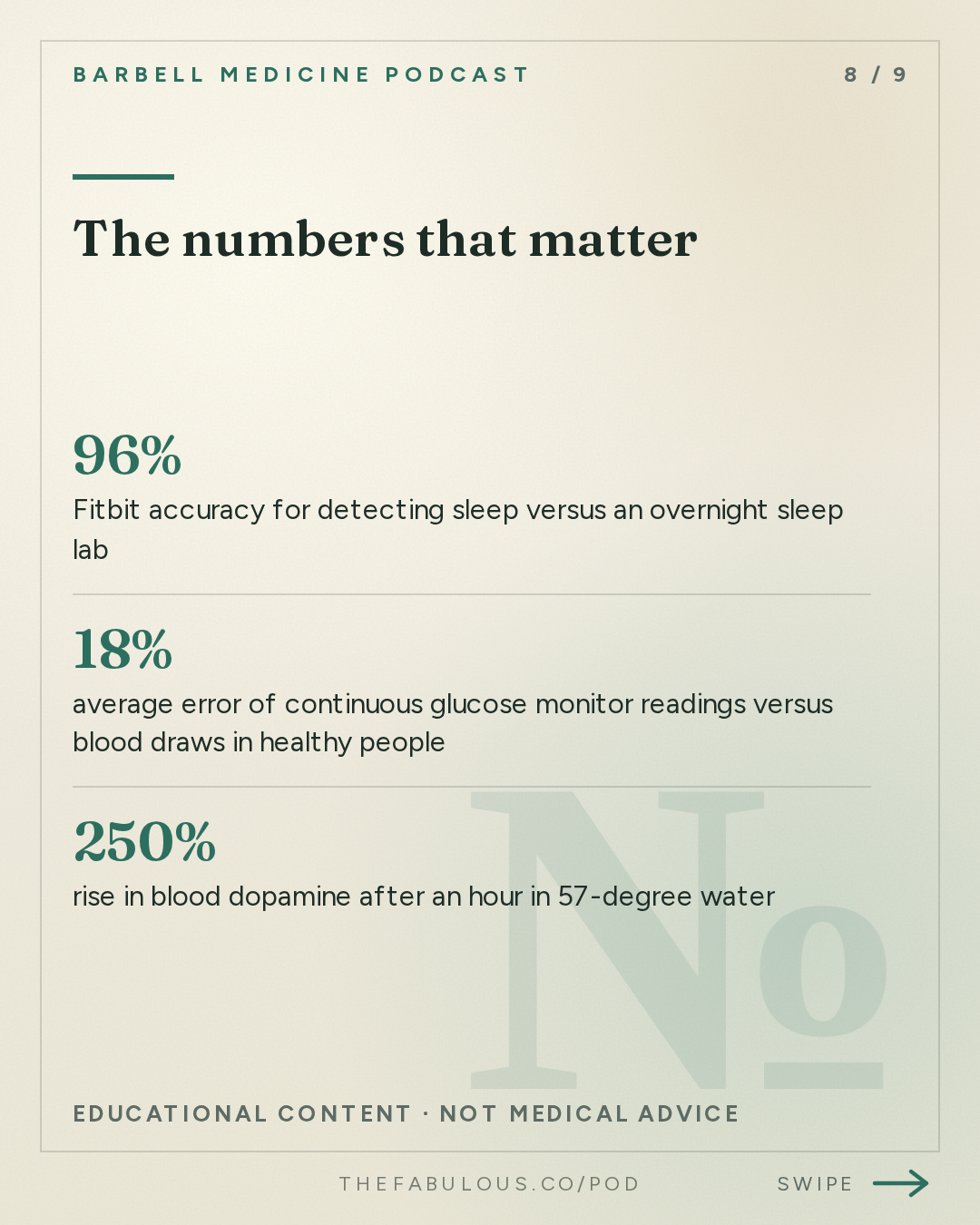
- 96% percent Fitbit accuracy for detecting sleep versus an overnight sleep lab
- 18% percent average error of continuous glucose monitor readings versus blood draws in healthy people
- 250% percent rise in blood dopamine after an hour in 57-degree water
In their words
“Pretty much everything that Dale did in this episode is something that people are doing right now and paying for it.”
“Skip the tray. If you're gonna take one thing, take three to five grams of creatine monohydrate a day whenever you remember to take it and lift.”
“If you can sell something without proving that it works and is safe, who's going to pay for the trial?”
“Cold plunge was no better than doing nothing at all. Everybody was back to baseline in three to five days anyway.”
“Take your judgment back, lift something heavy, and eat the fig.”
Protocols
-
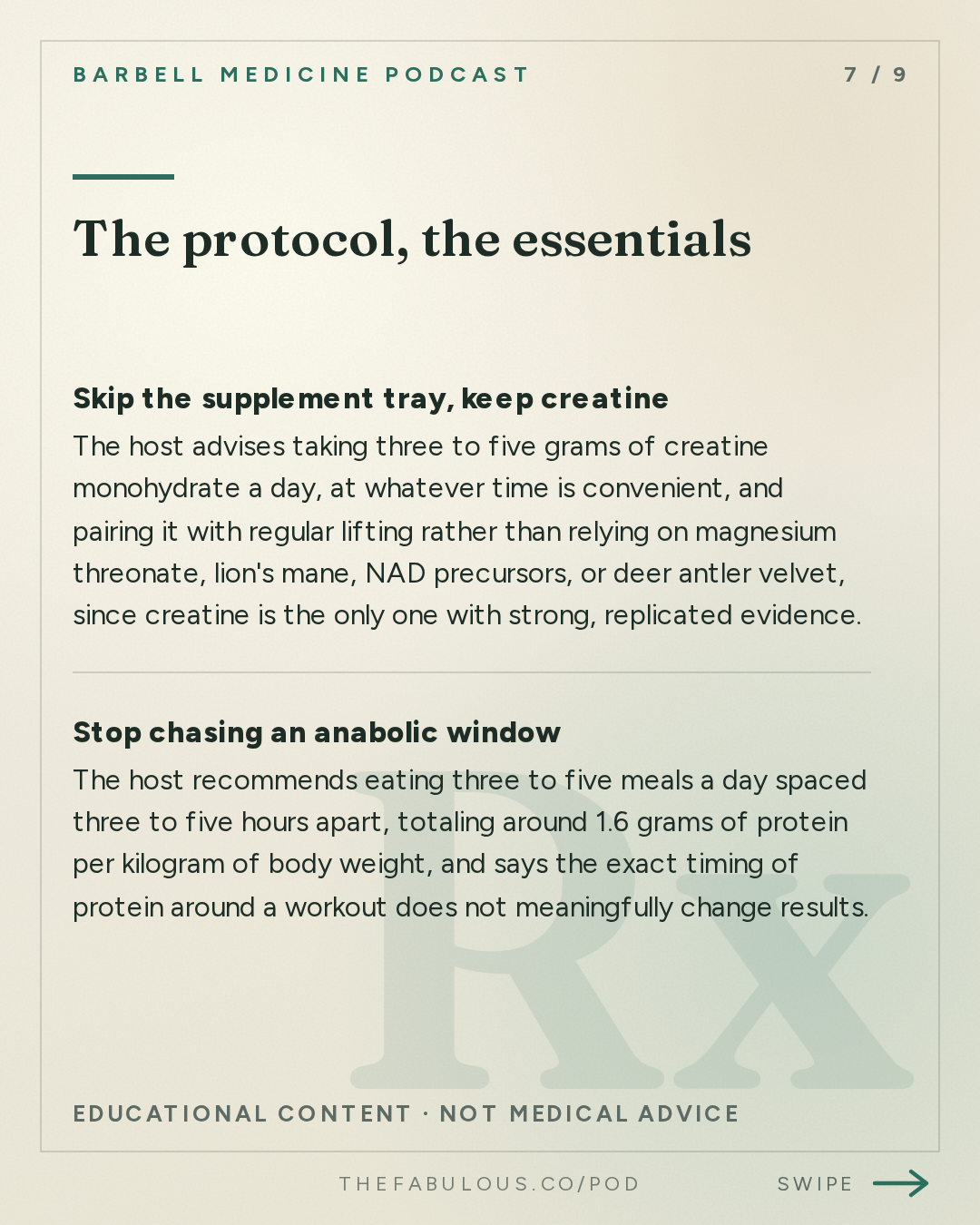
Skip the supplement tray, keep creatine
The host advises taking three to five grams of creatine monohydrate a day, at whatever time is convenient, and pairing it with regular lifting rather than relying on magnesium threonate, lion's mane, NAD precursors, or deer antler velvet, since creatine is the only one with strong, replicated evidence.
Daily
-
Stop chasing an anabolic window
The host recommends eating three to five meals a day spaced three to five hours apart, totaling around 1.6 grams of protein per kilogram of body weight, and says the exact timing of protein around a workout does not meaningfully change results.
Daily, 3 to 5 meals
-
Use a sleep tracker for total time only
The host suggests aiming for seven or more hours of sleep on a consistent schedule, checking a wearable only for total sleep time, ignoring the detailed sleep stage chart, and taking the device off entirely if the score causes stress.
Nightly
-
Build fitness instead of chasing zone two
The host recommends doing as much easy cardio as available time allows, judging intensity with the talk test, meaning full sentences should be possible while exercising, and adding harder intervals when time is limited rather than using a finger-prick lactate test.
Per available training time
Questions this episode answers
Does morning sunlight exposure actually improve sleep?
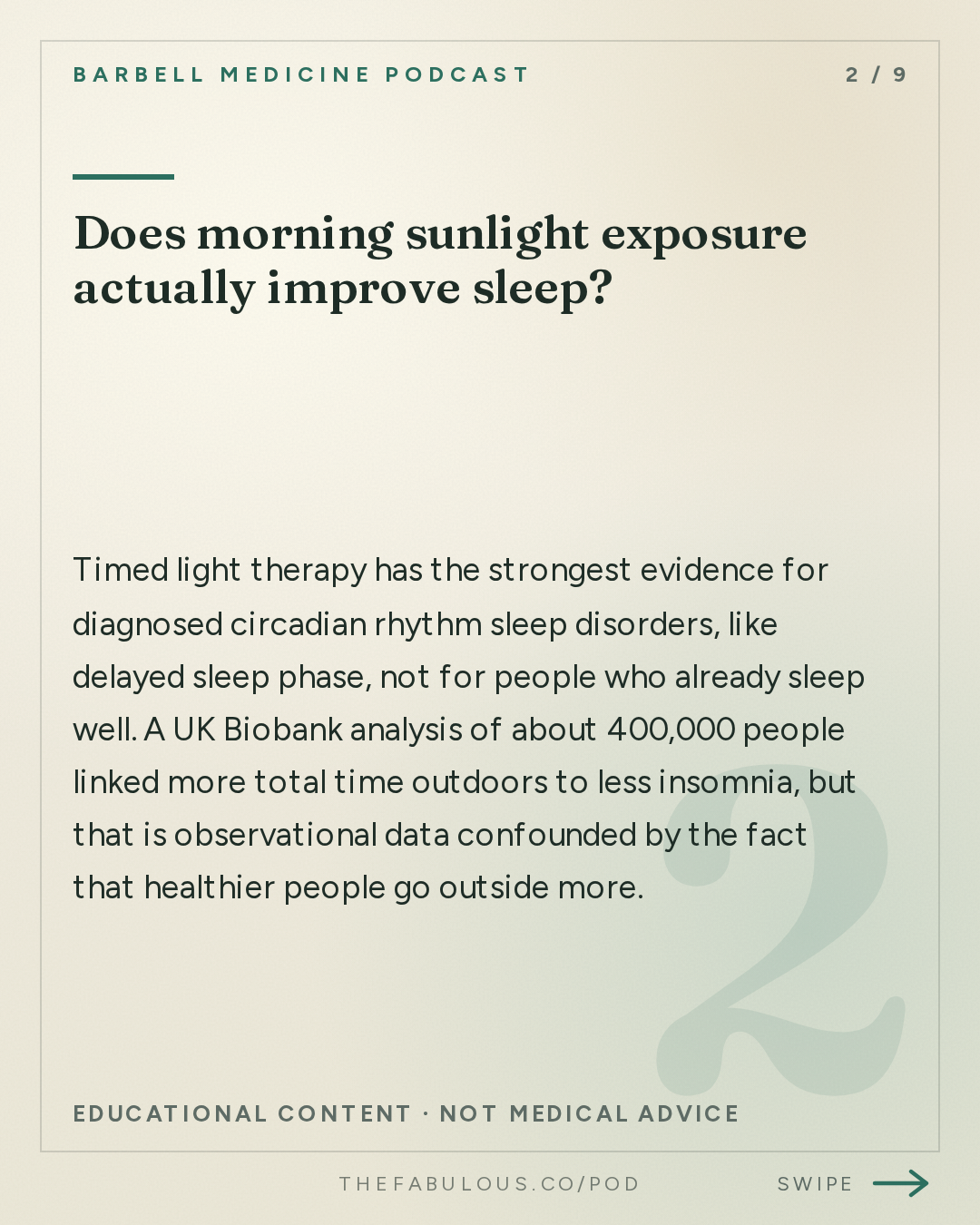
Timed light therapy has the strongest evidence for diagnosed circadian rhythm sleep disorders, like delayed sleep phase, not for people who already sleep well (18:20). A UK Biobank analysis of about 400,000 people linked more total time outdoors to less insomnia, but that is observational data confounded by the fact that healthier people go outside more (20:27).
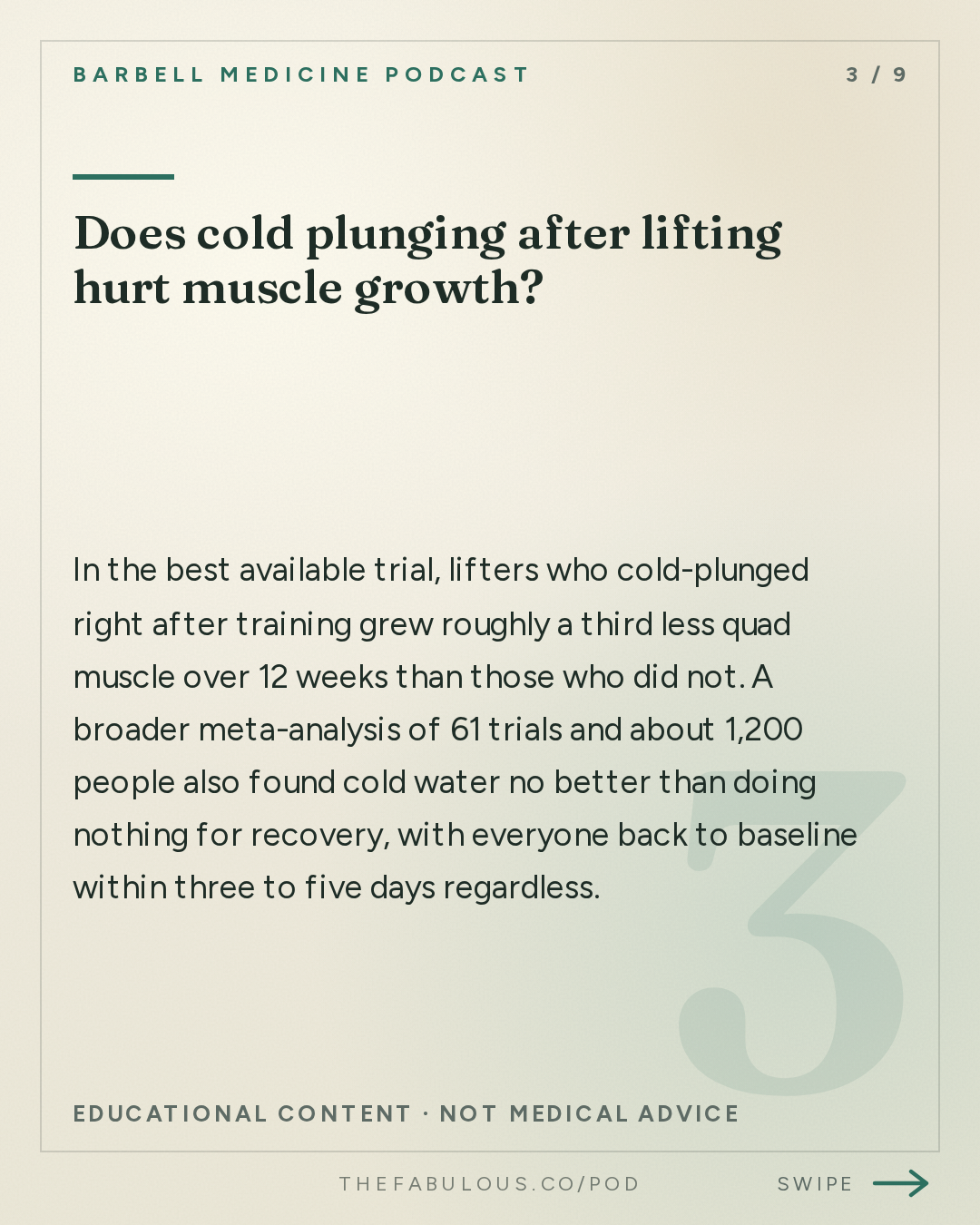
Does cold plunging after lifting hurt muscle growth?
In the best available trial, lifters who cold-plunged right after training grew roughly a third less quad muscle over 12 weeks than those who did not (23:49). A broader meta-analysis of 61 trials and about 1,200 people also found cold water no better than doing nothing for recovery, with everyone back to baseline within three to five days regardless (23:30).
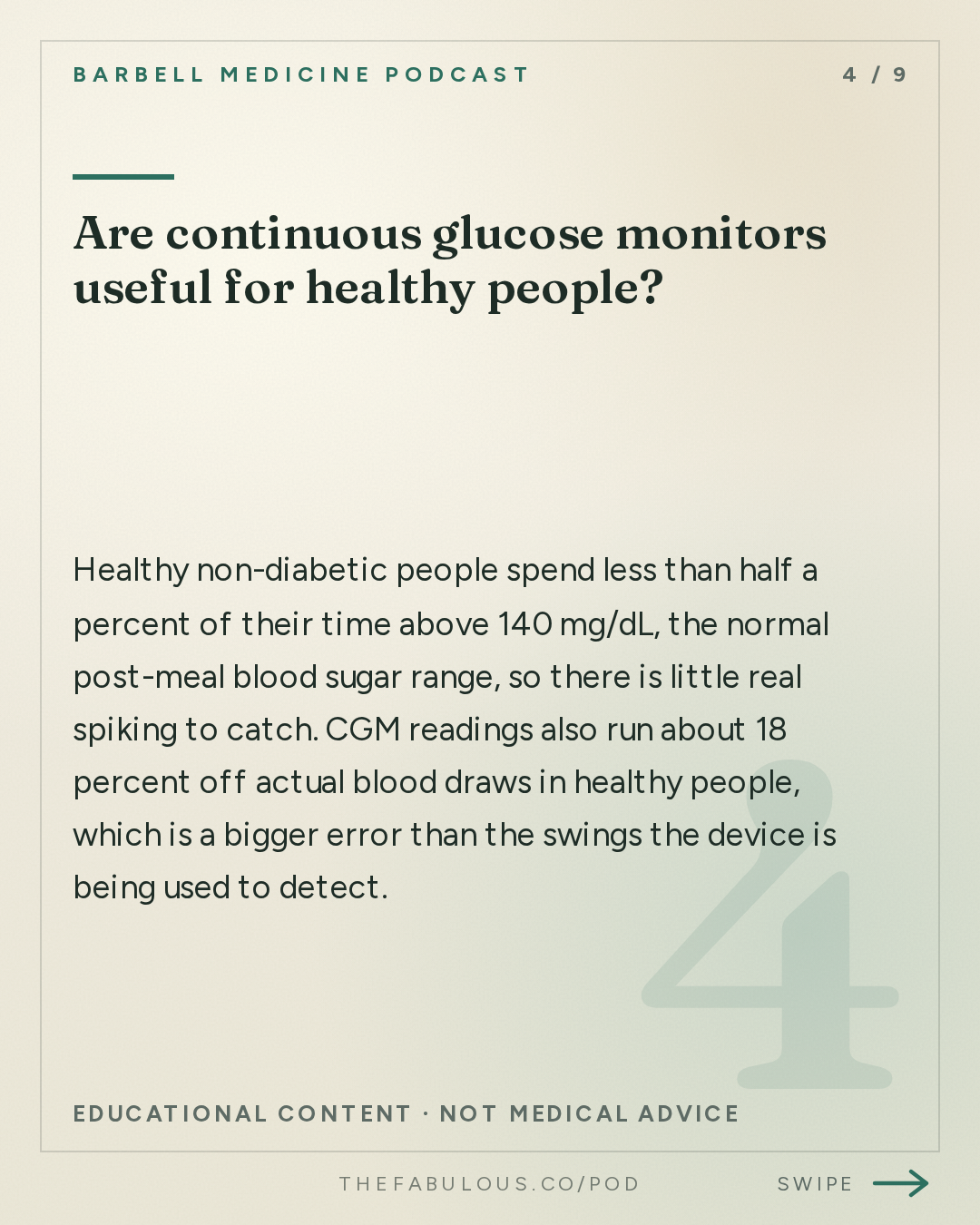
Are continuous glucose monitors useful for healthy people?
Healthy non-diabetic people spend less than half a percent of their time above 140 mg/dL, the normal post-meal blood sugar range, so there is little real spiking to catch (42:54). CGM readings also run about 18 percent off actual blood draws in healthy people, which is a bigger error than the swings the device is being used to detect (44:33).
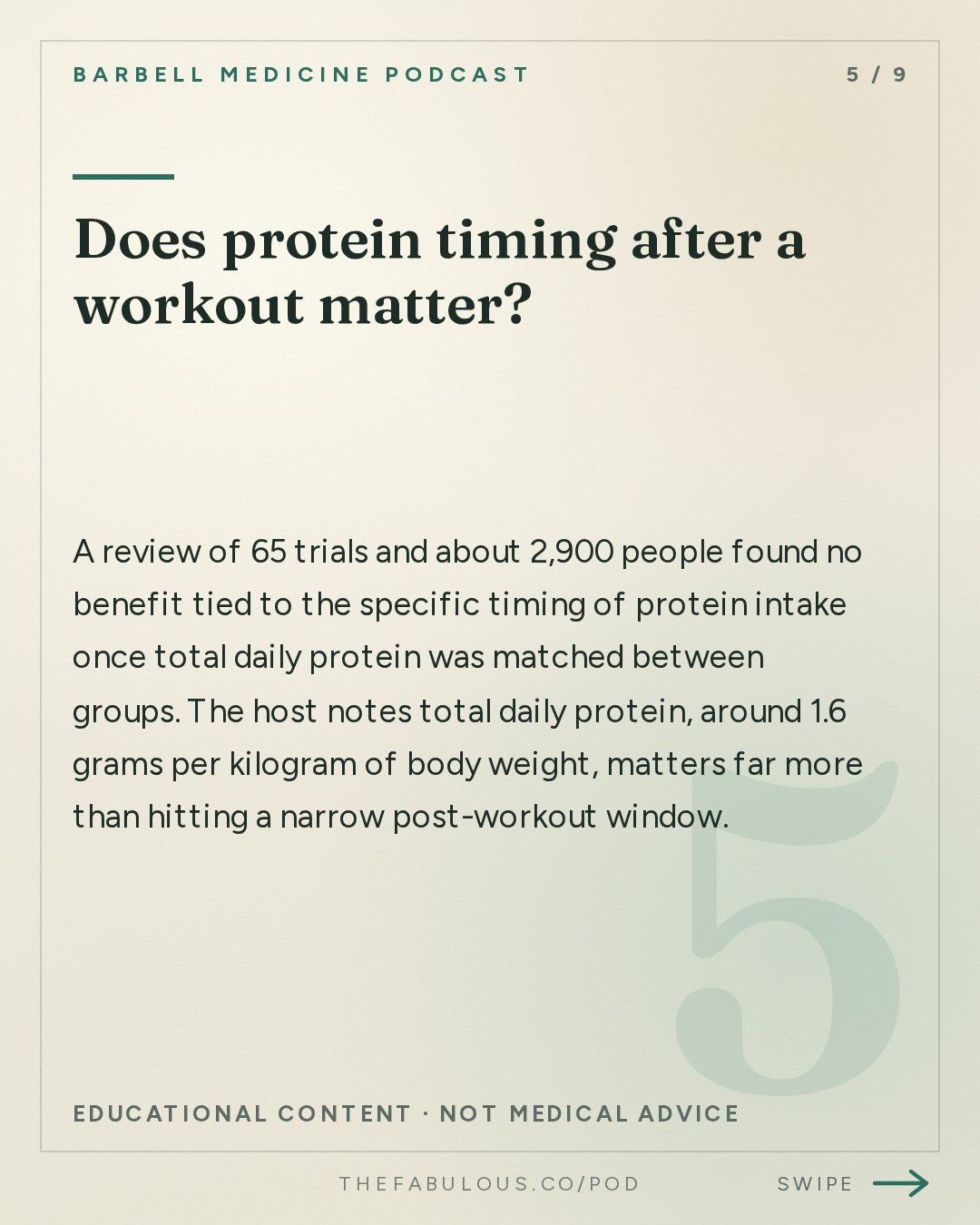
Does protein timing after a workout matter?
A review of 65 trials and about 2,900 people found no benefit tied to the specific timing of protein intake once total daily protein was matched between groups (37:22). The host notes total daily protein, around 1.6 grams per kilogram of body weight, matters far more than hitting a narrow post-workout window (37:41).
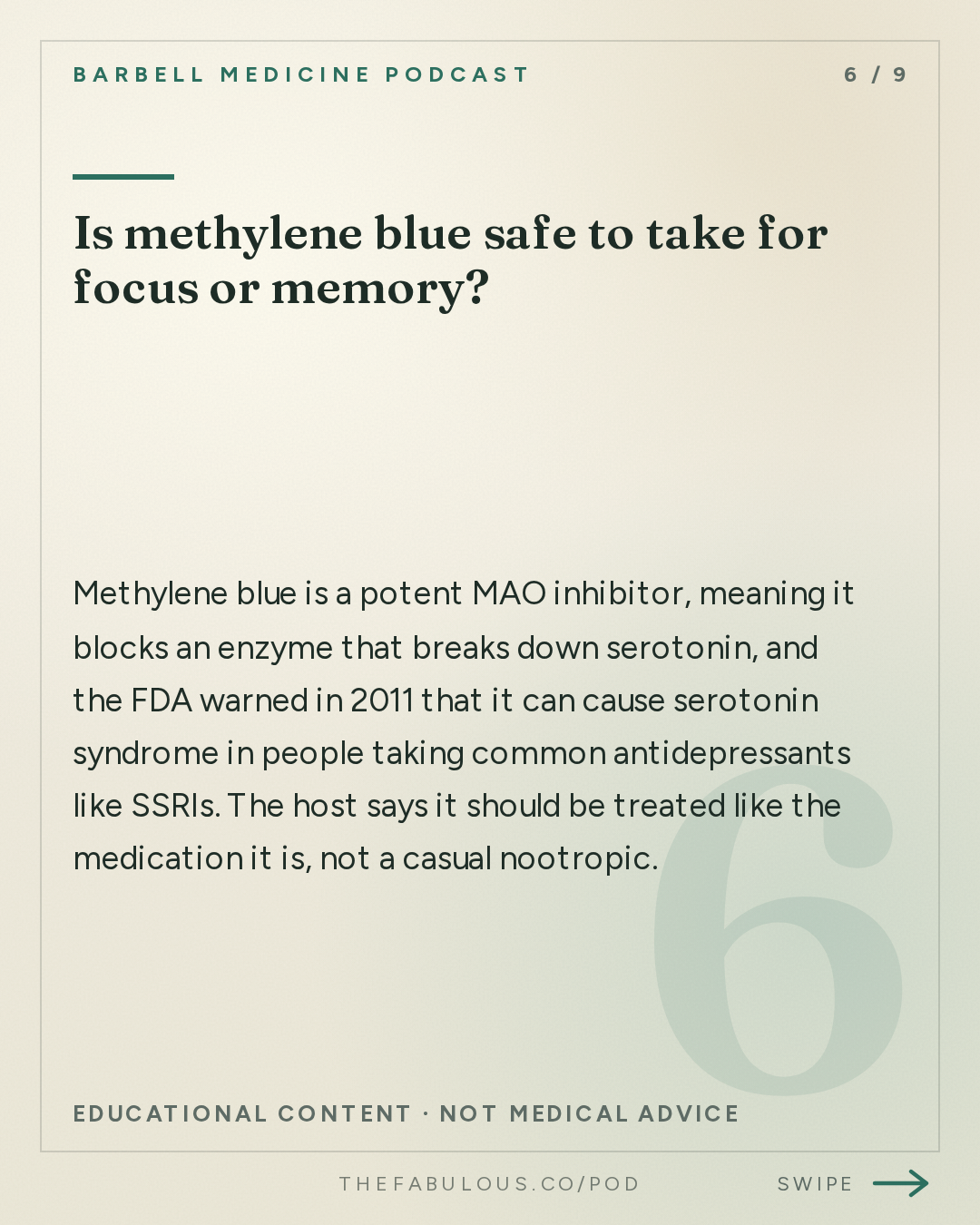
Is methylene blue safe to take for focus or memory?
Methylene blue is a potent MAO inhibitor, meaning it blocks an enzyme that breaks down serotonin, and the FDA warned in 2011 that it can cause serotonin syndrome in people taking common antidepressants like SSRIs (34:18). The host says it should be treated like the medication it is, not a casual nootropic.
The full read, in cards
Go deeper
- UK Biobank observational analysis of outdoor time and insomnia — found people who reported more time outside had fewer insomnia symptoms, but could not isolate morning light or prove causation among about 400,000 people
- JAMA trial of nicotinamide riboside in early Parkinson's disease — 410 patients given the NAD precursor NR for a year did slightly worse than placebo, a difference too small to be clinically meaningful
- 2025 meta-analysis of eccentric-overload versus regular resistance training — 49 studies and about 770 people found no long-term advantage in muscle size or strength from extra-heavy eccentric work
- 2024 review of continuous glucose monitor trials — 25 randomized trials in about 3,000 people found CGMs lowered A1C by about a quarter of a point, mostly in people who already had type 2 diabetes
- Finnish sauna cohort study — followed about 2,300 middle-aged men for 20 years and linked frequent sauna use to 40% lower all-cause mortality, though the design is observational
Mentioned
Dale Mercer · Soma · Dr. Andrew Huberman · Rick Seaman · Jordan Feigenbaum · UK Biobank · FDA · RFK Jr. · Creatine Monohydrate · Oura Ring · Methylene Blue · JAMA
More from this show and category
How Much Cardio Is Too Much for Your Heart?
More cardio keeps lowering mortality risk with no measured ceiling, but atrial fibrillation risk rises past roughly 3.5 times the exercise guidelines. Barbell Medicine physician Jordan Feigenbaum recommends about 300 minutes of moderate cardio weekly, mostly at 60 to 80% max heart rate, while debunking the viral claim that hard running is as deadly as sitting.
How Much Lifting Is Enough for Health?
Public health guidelines recommend lifting twice a week, but the study behind that number found three days worked better. Jordan Feigenbaum argues lifting doesn't hurt the heart, carries lower injury risk than running, and shows no real ceiling for strength, bone density, or metabolic benefits, so most people should train roughly double the current guideline.
Why Lifting Heavy Was Called Dangerous
In 1985 a panel of obstetricians banned pregnant women from raising their heart rate past 140 beats per minute, a number invented by consensus, not data (00:01). The same pattern, rules built on vibes rather than evidence, shaped a century of bans on heavy lifting for women, children, and anyone squatting below parallel, until later studies quietly reversed nearly all of them.
Is Training Safe in Wildfire Smoke?
Exercise still protects health during wildfire smoke, and lifting is safer than cardio because it barely raises breathing rate. Training right at failure isn't required for muscle growth either, since easier sets and even indirect fractional sets still add measurable stimulus, so individual response matters more than hitting an exact rep-in-reserve number.
