
How Much Cardio Is Too Much for Your Heart?
How Much Cardio Should You Do? How Much is Too Much?
The brief
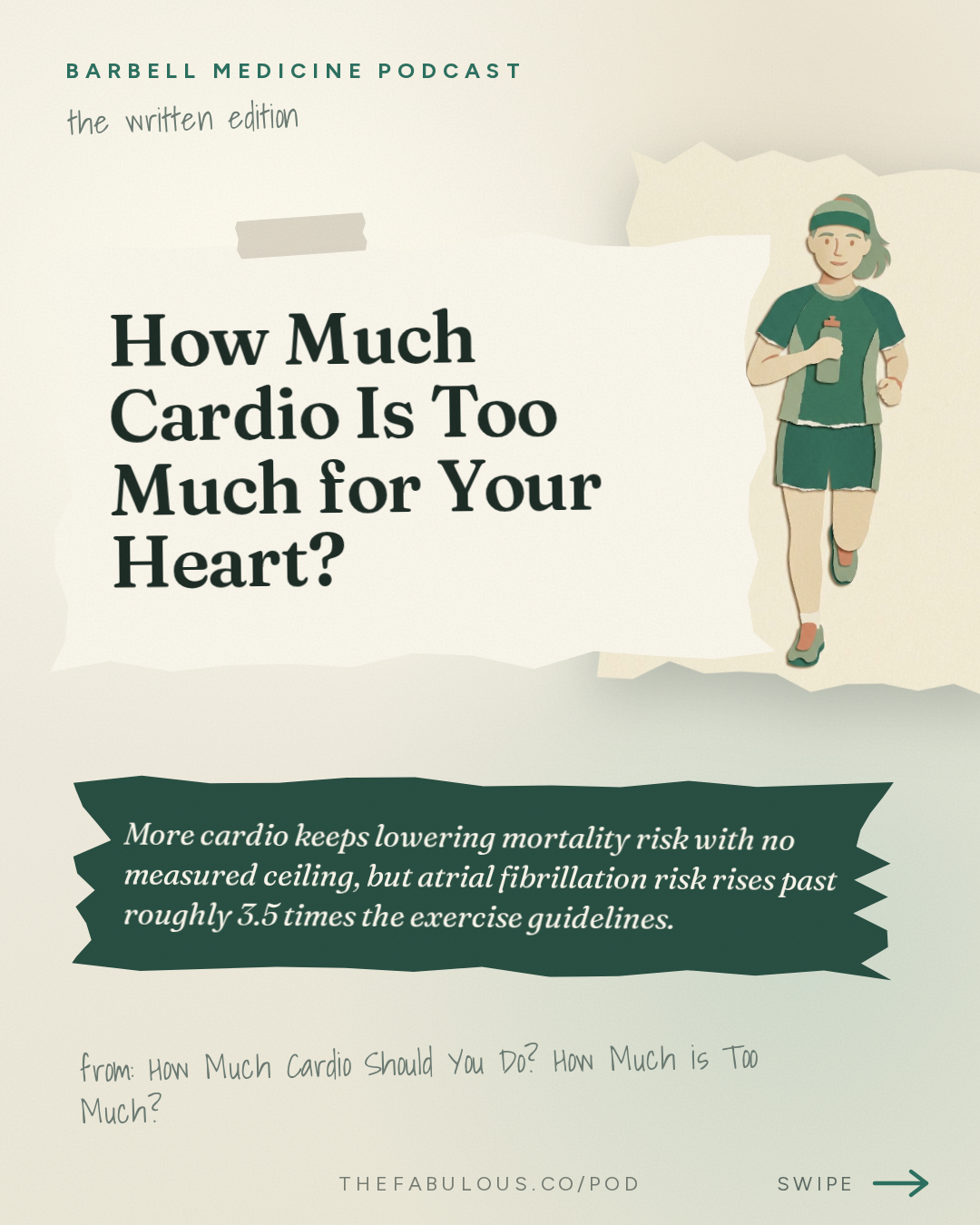
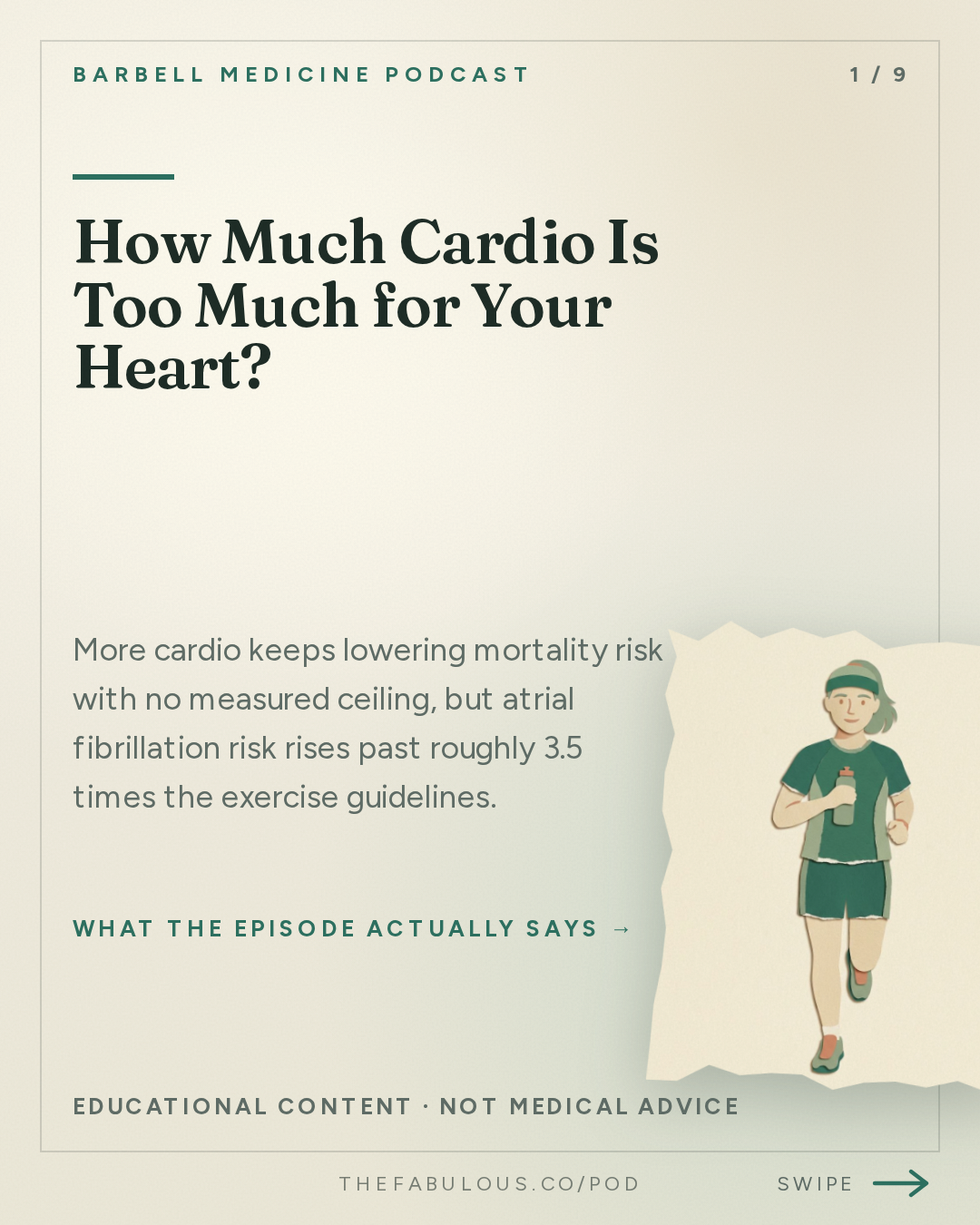
More cardio keeps lowering mortality risk with no measured ceiling, but atrial fibrillation risk rises past roughly 3.5 times the exercise guidelines. Barbell Medicine physician Jordan Feigenbaum recommends about 300 minutes of moderate cardio weekly, mostly at 60 to 80% max heart rate, while debunking the viral claim that hard running is as deadly as sitting.
A headline needs a villain, and in 2015 cardio got one. "Fast running is as deadly as sitting on the couch," The Telegraph announced. The BBC ran its own version. The source was a Danish study that had tracked joggers for about a decade and found that the hardest-running group died at roughly the same rate as people who did not jog at all. It became the jogging J-curve: good, then better, then suddenly bad again. What never made it into the headline was the size of that doomed group. It had 40 people in it, and two of them died (01:58). A result built on two deaths cannot tell anyone much of anything, and the study's own authors said so in print. The finding was not even statistically significant, and four separate research groups wrote letters to the journal objecting to how the paper was being read.
Two deaths is not enough to tell you anything, and the authors of the paper even say so. [02:15]
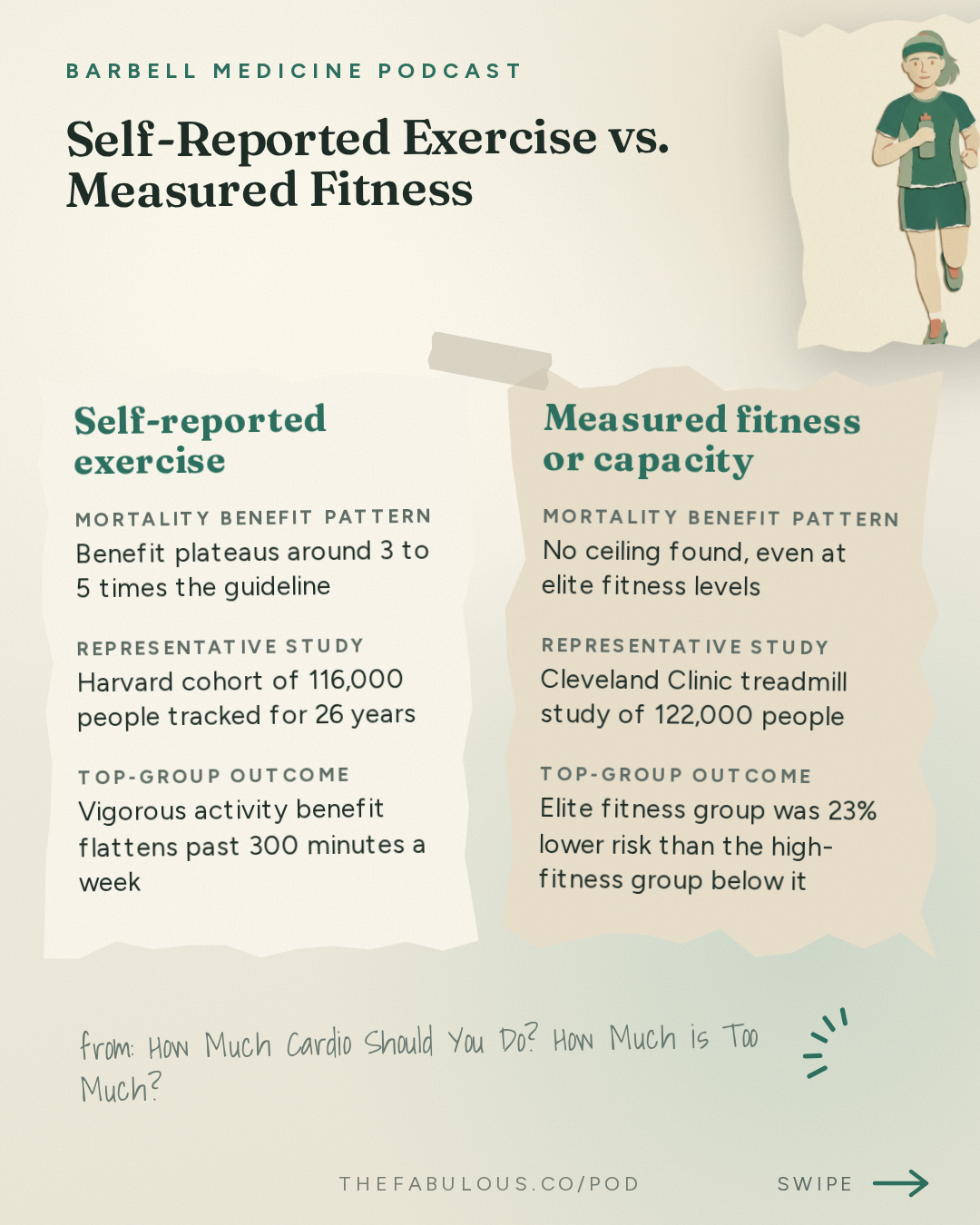
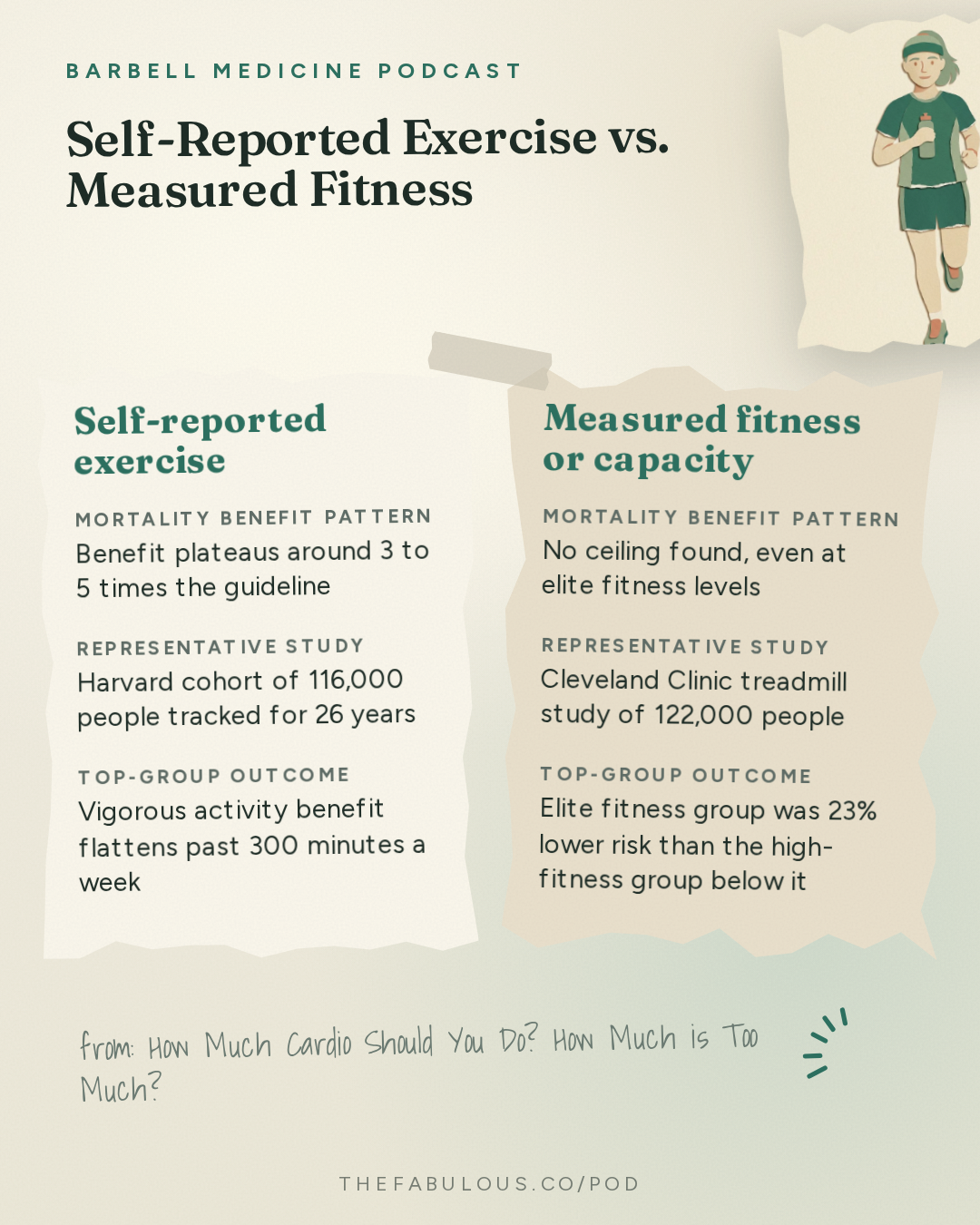
So what happens when the sample is not 40 people but 661,000, or 116,000 followed for three decades? The pattern changes entirely. A 2015 pooling of six studies covering 661,000 adults found that mortality risk kept dropping as exercise increased, flattening out only around three to five times the standard activity guideline, at about a 39% lower risk of dying (06:42). A 2022 Harvard study went further: it asked 116,000 people about their exercise 15 separate times across 26 years instead of once, and when all 15 answers were averaged, the relationship was a straight line. More exercise meant less dying, all the way out past 300 minutes of vigorous activity a week, with no U-turn in sight (09:43). Ask people only once, the way most studies do, and a false U-shape reappears. The measurement itself was creating the illusion of harm.
The Measurement Problem
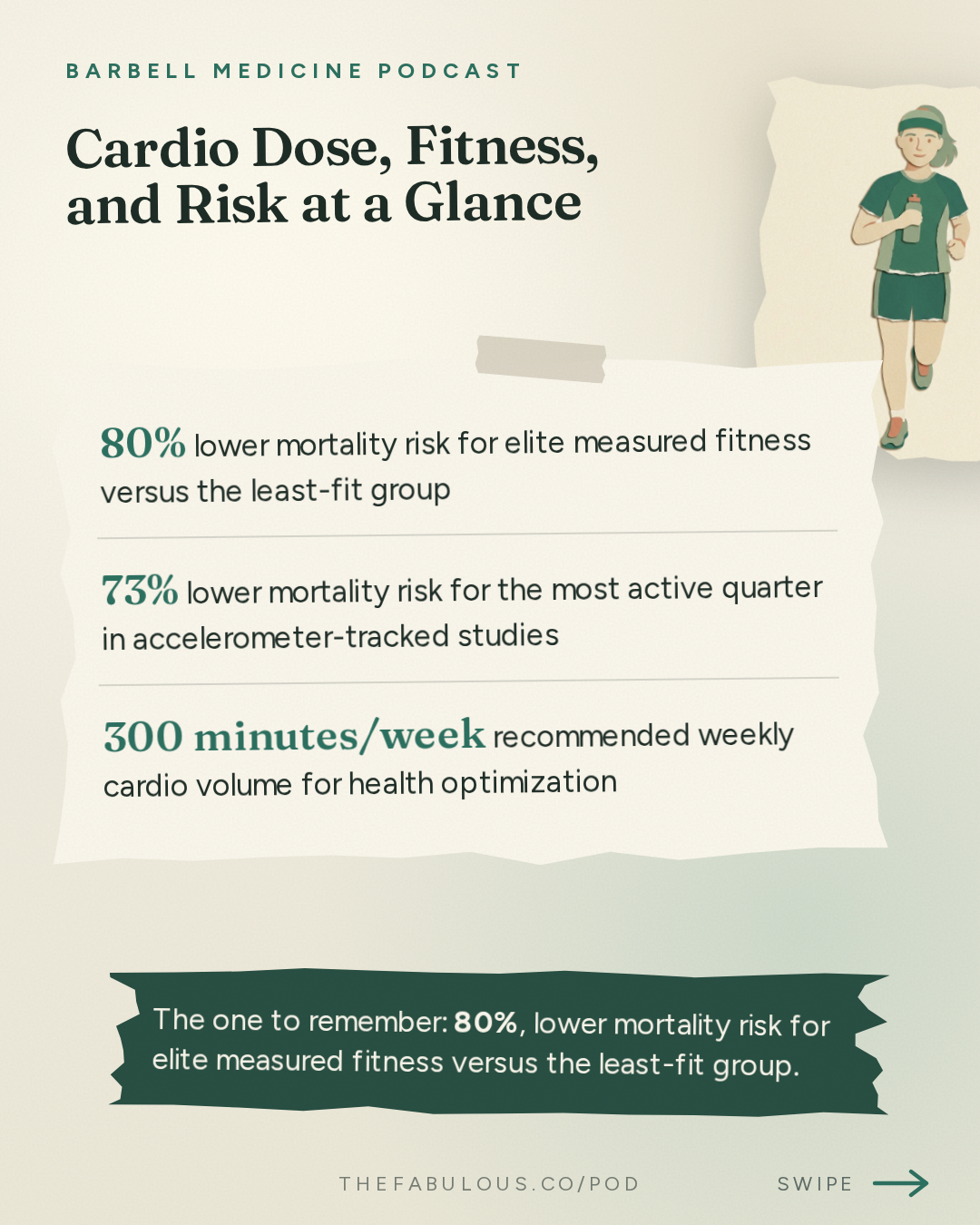
Self-report has another flaw: it cannot tell anyone how fit a person actually became. A Cleveland Clinic study fixed that by putting 122,000 people on a treadmill and measuring exercise capacity directly, in METs, a unit anchored to the energy cost of sitting still, where one MET is about one calorie per kilogram of body weight per hour (07:54). People with elite measured fitness had an 80% lower risk of dying than the least fit group, and even compared with the merely "high fitness" group just below them, the elite group was still 23% better off (11:45). The authors wrote plainly that they had not found an upper limit of benefit. A separate analysis using accelerometers, which track movement objectively rather than relying on memory, found the most active quarter of 36,000 people had a 73% lower risk of dying, with the single biggest drop in risk coming from the smallest possible jump: going from zero exercise to about five extra minutes a day (12:06).
There is, however, one dose-dependent harm from cardio that holds up, and it is not the one the headlines chased. It is atrial fibrillation, a condition where the heart's upper chambers stop contracting in an organized way and start quivering instead, which lets blood pool and clot, raising stroke risk. A meta-analysis that came out this year, led by Kai Davies and a research group out of the UK, combining 37 studies and 1.3 million people found that moderate exercise lowers the odds of atrial fibrillation by about 22%, yet athletes as a group carry 2.7 times higher odds of having it than the general population (19:56). The curve bends: protection peaks around 26 MET-hours a week, roughly three and a half times the standard guideline, and only crosses back above sedentary-level risk at about 78 MET-hours, or roughly ten hours of easy running weekly (20:22). Lifetime hours tell the same story. In a Barcelona study, more than 2,000 lifetime hours of high-intensity endurance training carried about four times the odds of atrial fibrillation in people with no other heart risk factors, while anything under that threshold was protective (21:20).
The popular explanation is that decades of training scar the heart's atrium and scarred tissue conducts electricity unevenly. It is a tidy story, and it is probably wrong. The VENTO AF study used cardiac MRI with a contrast agent that lights up scar tissue in 39 endurance athletes over 50 with atrial fibrillation, 94 athletes with the same training history and a normal rhythm, and 33 sedentary people with the condition. Scarring covered 7.6% of the atrium in both groups of athletes, whether or not they had the arrhythmia, and only 2.9% in the sedentary group with it (22:40). What did separate the two athlete groups was blood pressure during exercise, not at rest: systolic pressure hit 208 in the athletes with atrial fibrillation versus 192 in those without it (24:03), though no one agrees on what cutoff during exercise should count as abnormal. And oddly, having the condition seems less dangerous for athletes than for everyone else. A Norwegian study of older male athletes found more atrial fibrillation among them, 28% versus 18% in non-athletes, yet fewer strokes, 5% versus 10% (26:23). Within each group, the condition raised stroke risk about four times for non-athletes but only raised it two and a half times for athletes, about half as much.
If you're gonna have atrial fibrillation, you're better off getting it as somebody who trains. [27:19]
What Actually Limits the Benefit
Two other heart worries mostly dissolve on closer inspection. A London study scanned 152 masters endurance athletes, people who had trained an average of 30 years and run a median of 13 marathons, and compared them against 92 matched but sedentary controls. Lifelong athletes were not more likely to have a perfect calcium score of zero, 60% versus 63% in controls, but when plaque did show up in athletes, about three-quarters of it was the stable, calcified kind rather than the soft, unstable kind more common in sedentary men (28:54). Over a 2010 to 2023 span, 29 million marathon and half-marathon finishers produced 170 cardiac arrests, about one in every 185,000 runners, and the leading cause was ordinary coronary artery disease that the race simply happened to expose (32:27).
Cardio also does not appear to rob strength or muscle. The so-called interference effect, where endurance work was thought to blunt lifting gains through competing cellular signals, shows up briefly at the molecular level but not in actual outcomes. Three separate meta-analyses found that adding conditioning to a strength program does not compromise strength or hypertrophy gains when overall training load, meaning the combined volume and difficulty someone can actually recover from, is managed (39:59). Even the idea of a true "non-responder" to cardio looks shaky: in one study, men who showed no fitness improvement at one, two, or three weekly sessions all improved once given two more sessions, suggesting under-dosing rather than biological immunity (44:19).
Weight loss is where cardio disappoints most people, and the reason is not willpower. A Dutch study used doubly labeled water, a gold-standard method that measures real energy expenditure rather than relying on diet logs, on 32 previously sedentary adults training for a half marathon over 44 weeks. Their daily calorie burn rose about 30% early on, then plateaued, even as they doubled their training time from 20 to 40 minutes a day (52:29). A separate analysis found that only about 30% of the calories supposedly burned through added exercise actually show up as extra daily energy expenditure, because the body compensates elsewhere, likely by becoming more efficient in ways researchers do not fully understand (54:27). Cardio still helps reduce harmful fat stored in the liver and around organs, independent of weight loss (47:35), but the scale itself is a diet problem, not a cardio problem.
Bone is the one place cardio can genuinely cause harm, but only under a specific combination of conditions. Masters cyclists, who load almost nothing through their skeleton while pedaling, showed lower bone density than matched non-athletes, and in a seven-year follow-up, six of 19 progressed from osteopenia to osteoporosis versus one of 18 controls (56:50). The real driver was not the cycling itself but insufficient energy intake relative to training: cyclists under-fueling for their workload had far lower spine bone density scores than those eating enough (58:24). Add years of inadequate fuel to zero skeletal loading and the risk compounds, but for someone also lifting weights and eating enough, which is the baseline assumption of this podcast, it is not a meaningful worry at ordinary training volumes.
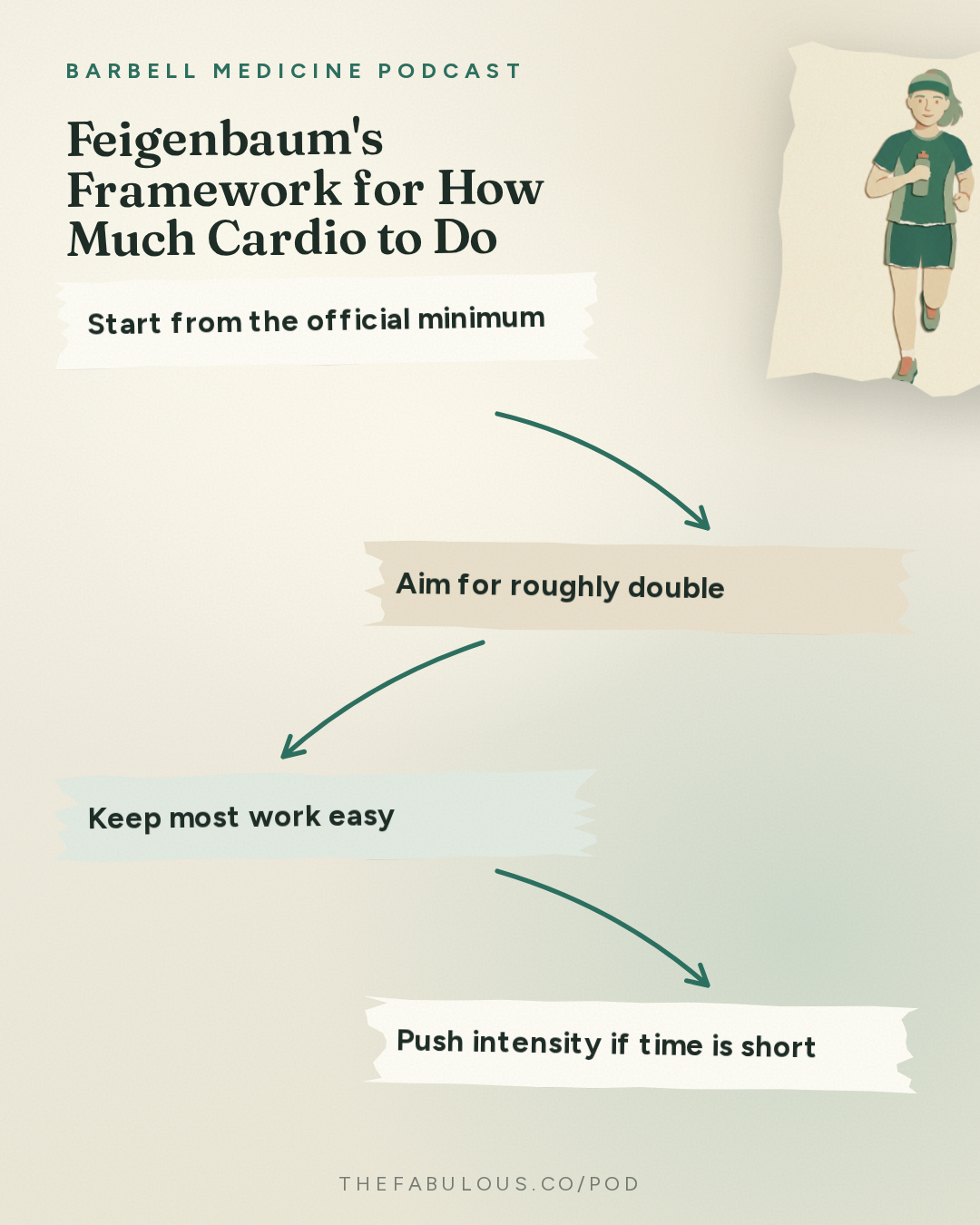
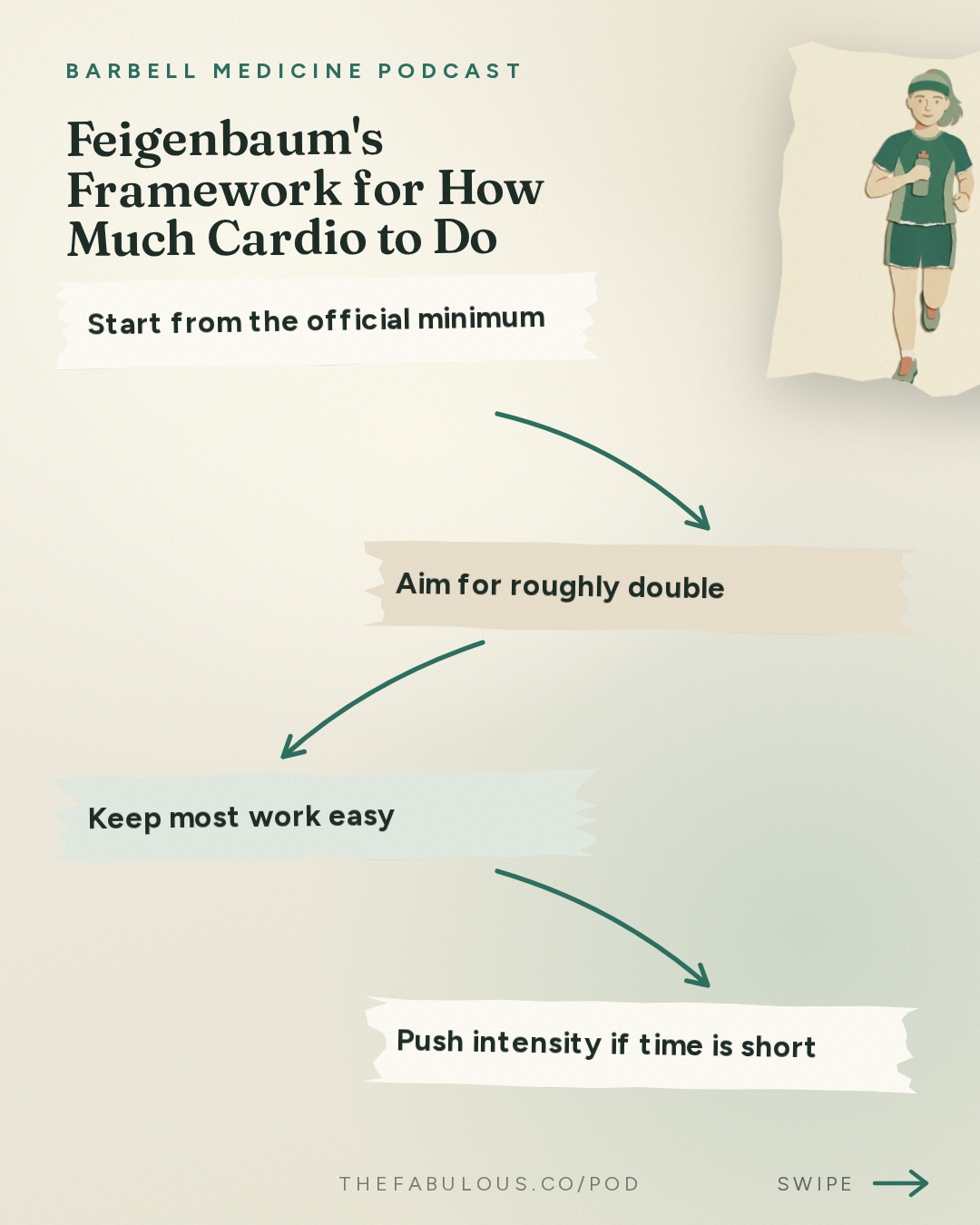
The thread running through all of it is that cardio keeps paying off in ways no study has found the edge of, except for one narrow, well-defined risk that arrives at a dose most people will never approach. The practical number offered here is roughly double the standard guideline, about 300 minutes of moderate cardio a week, mostly easy, with intensity added only as fitness allows.
You earn the privilege to go faster by getting fitter, same as adding weight to the bar once you've gotten stronger. [68:23]
Ask this episode anything
Pod's AI answers from the episode itself, with the minute mark so you can hear it yourself.
Or start with one of these
Ask this episode
Pod's AI listens to the whole episode to answer, and points you to the minute it comes from.
The rest of this answer, and any question after it
Answers come from the episode itself, never from a summary of it.
ContinueKey takeaways
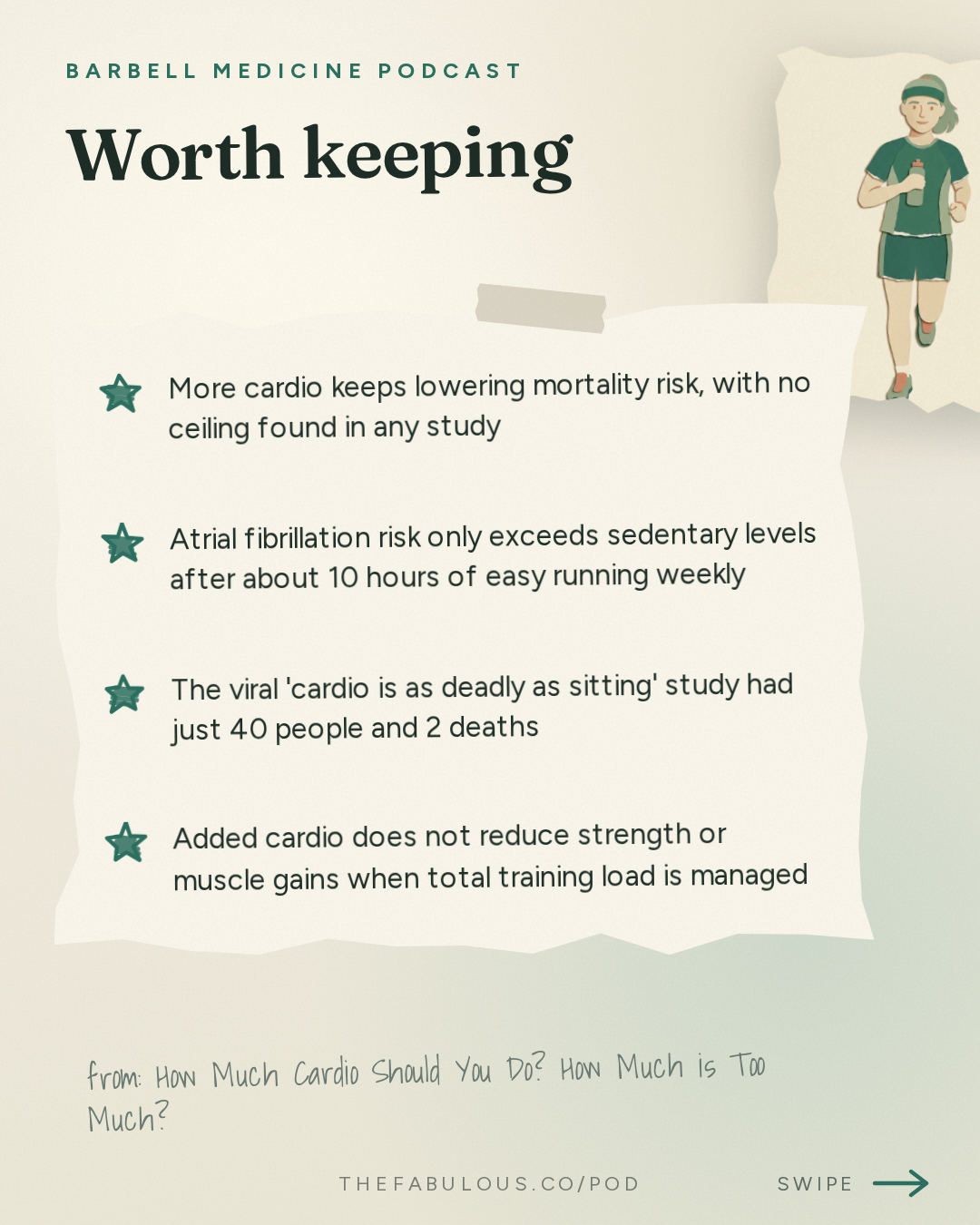
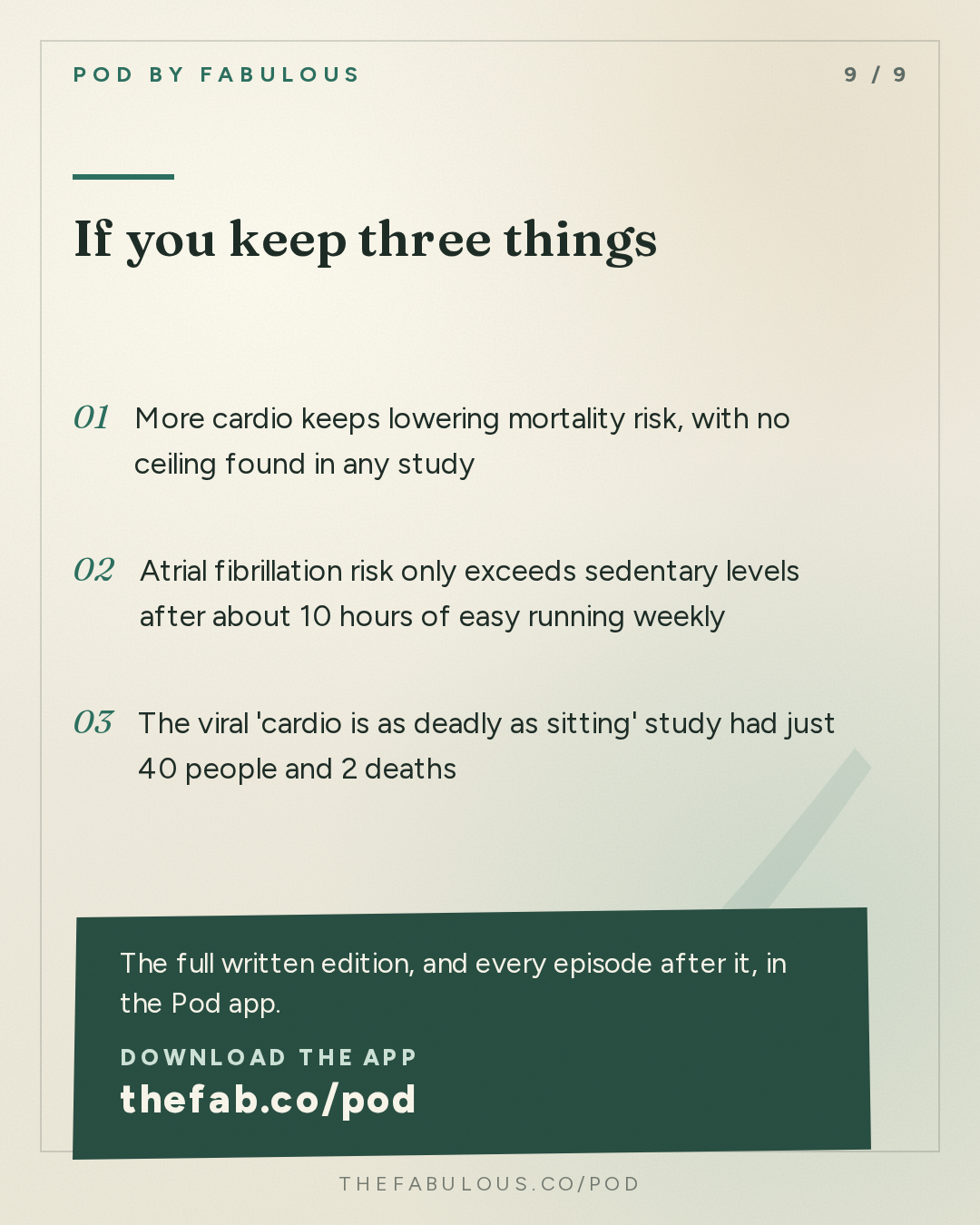
- More cardio keeps lowering mortality risk, with no ceiling found in any study
- Atrial fibrillation risk only exceeds sedentary levels after about 10 hours of easy running weekly
- The viral 'cardio is as deadly as sitting' study had just 40 people and 2 deaths
- Added cardio does not reduce strength or muscle gains when total training load is managed
- Exercise calories barely move weight loss because the body offsets about 30% of them
The episode in cards
By the numbers
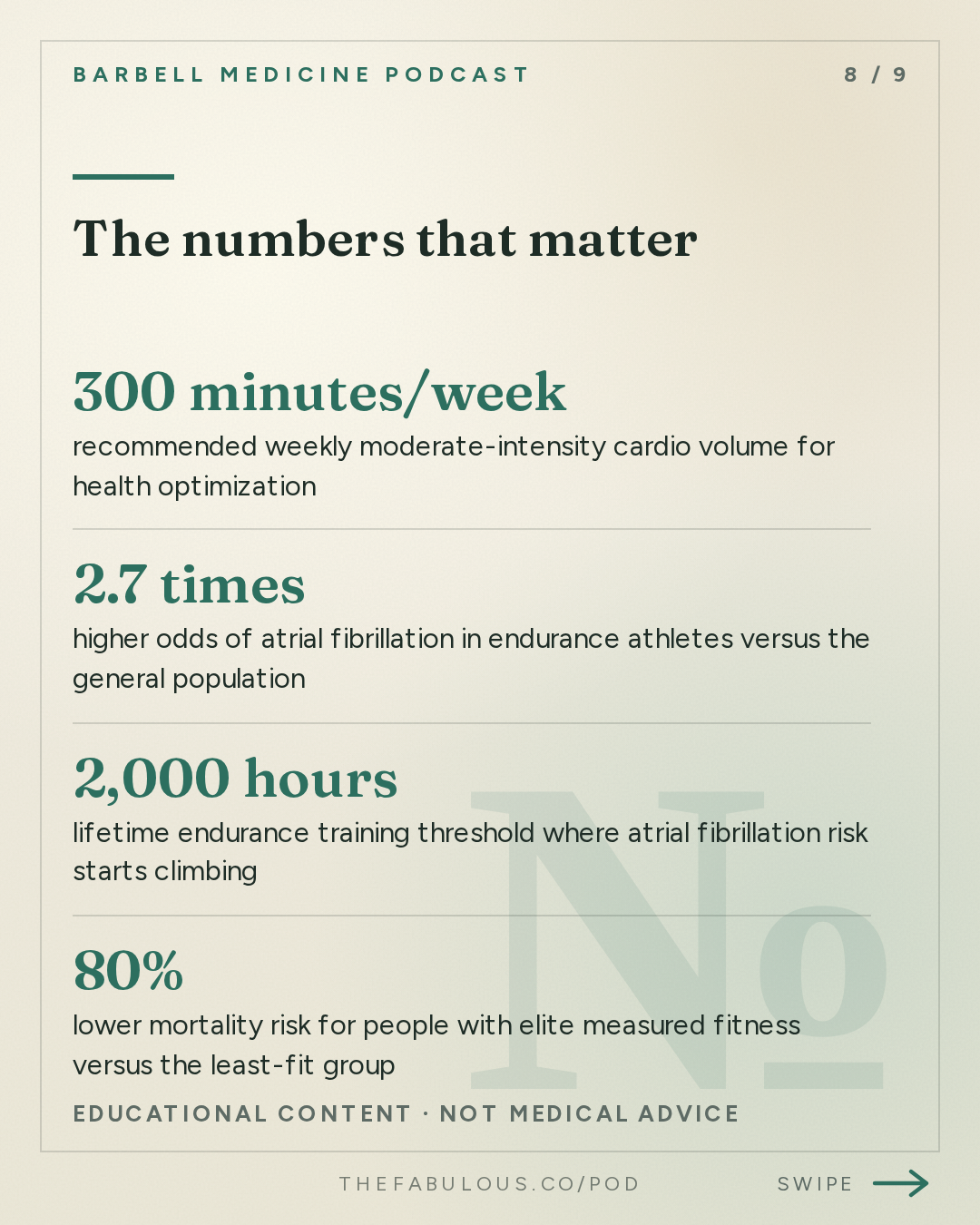
- 300 minutes/week recommended weekly moderate-intensity cardio volume for health optimization
- 2.7 times higher odds of atrial fibrillation in endurance athletes versus the general population
- 2,000 hours lifetime endurance training threshold where atrial fibrillation risk starts climbing
- 80% percent lower mortality risk for people with elite measured fitness versus the least-fit group
- 30% percent actual rise in daily calorie burn from added exercise after the body compensates
In their words
“Two deaths is not enough to tell you anything, and the authors of the paper even say so.”
“If you're gonna have atrial fibrillation, you're better off getting it as somebody who trains.”
“You earn the privilege to go faster by getting fitter, same as adding weight to the bar once you've gotten stronger.”
Protocols
-
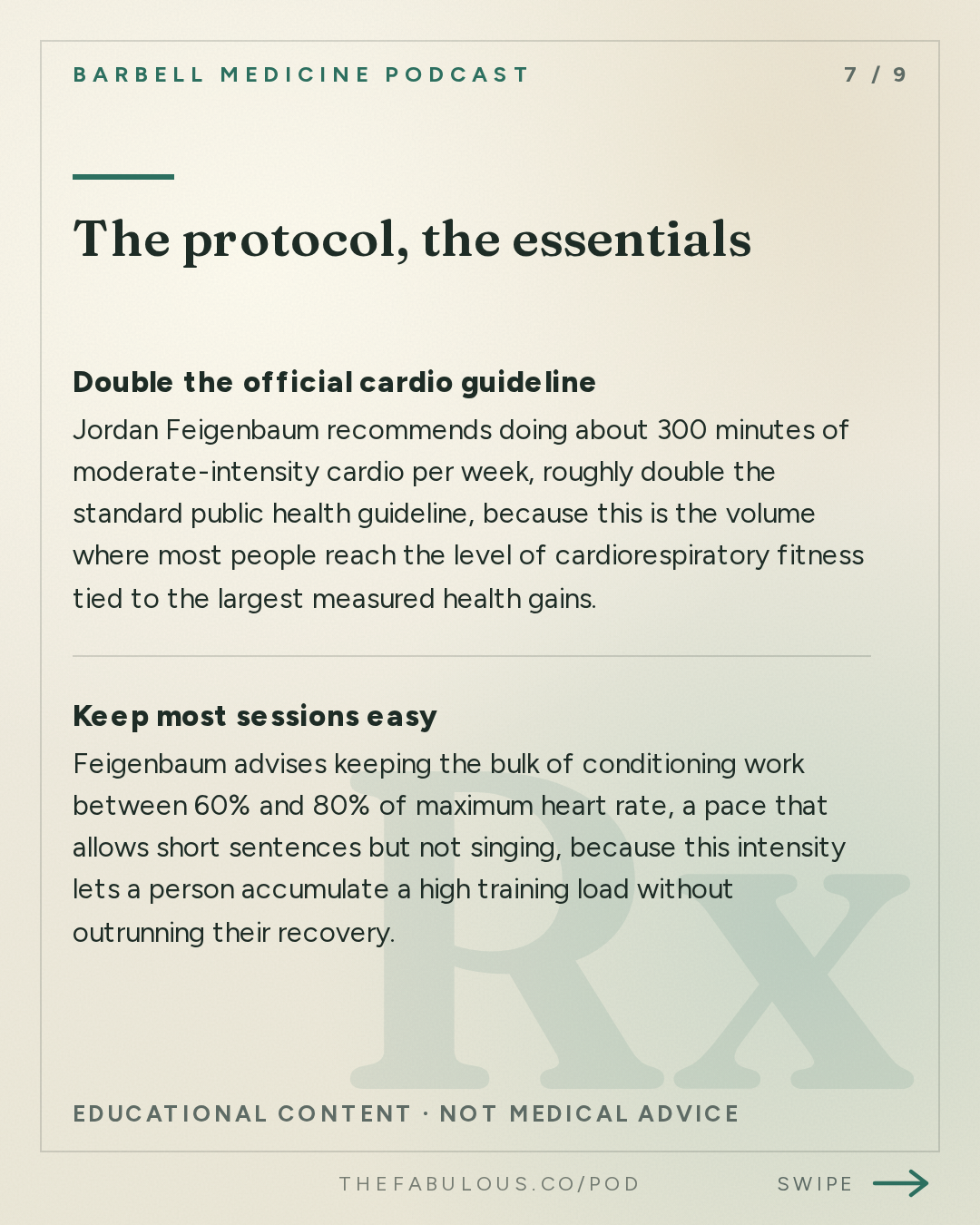
Double the official cardio guideline
Jordan Feigenbaum recommends doing about 300 minutes of moderate-intensity cardio per week, roughly double the standard public health guideline, because this is the volume where most people reach the level of cardiorespiratory fitness tied to the largest measured health gains.
weekly
-
Keep most sessions easy
Feigenbaum advises keeping the bulk of conditioning work between 60% and 80% of maximum heart rate, a pace that allows short sentences but not singing, because this intensity lets a person accumulate a high training load without outrunning their recovery.
most sessions, several times weekly
-
Go harder if time is short
Feigenbaum suggests that anyone with less than two and a half hours a week available for cardio should push intensity above 80% of maximum heart rate instead of adding more volume, using efforts hard enough that talking becomes difficult.
when weekly cardio time is under 2.5 hours
-
Sequence cardio after lifting
Feigenbaum recommends doing cardio after a lifting session or on a separate day and increasing conditioning volume gradually, because the interference effect on strength and muscle gains shows up mainly when total training load outpaces recovery rather than from the underlying molecular signaling conflict itself.
per training week
Questions this episode answers
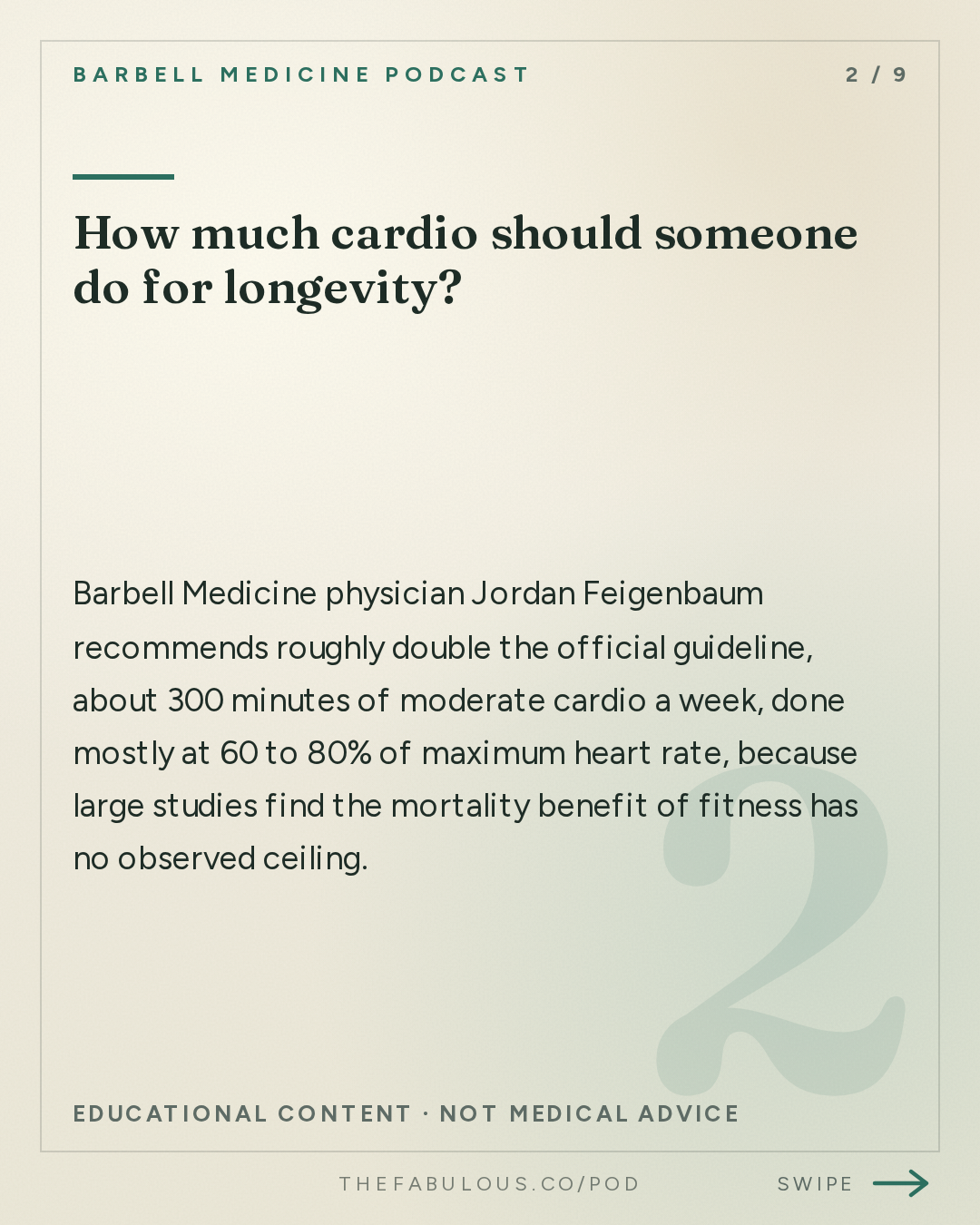
How much cardio should someone do for longevity?
Barbell Medicine physician Jordan Feigenbaum recommends roughly double the official guideline, about 300 minutes of moderate cardio a week, done mostly at 60 to 80% of maximum heart rate, because large studies find the mortality benefit of fitness has no observed ceiling (66:34, 11:58).
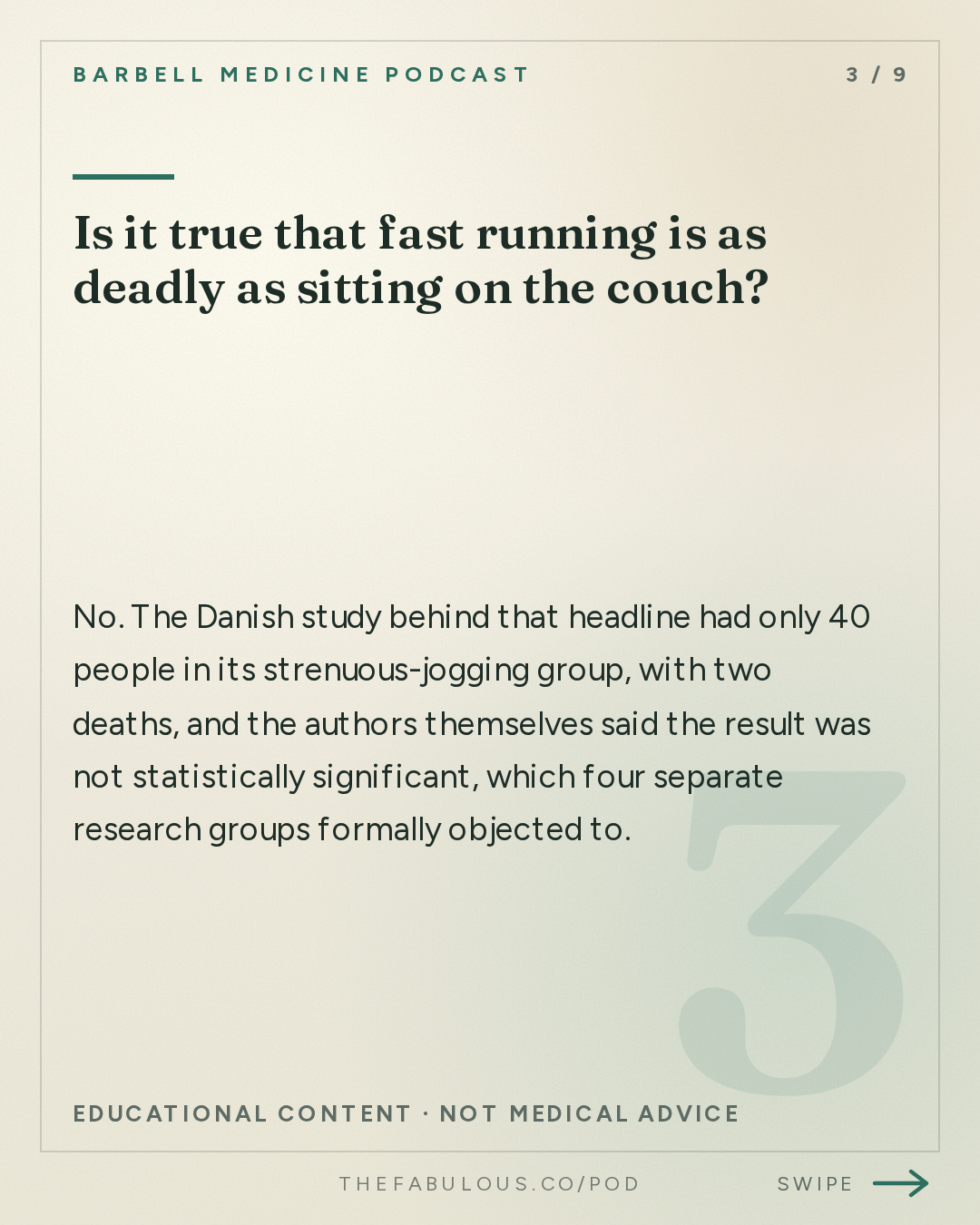
Is it true that fast running is as deadly as sitting on the couch?
No. The Danish study behind that headline had only 40 people in its strenuous-jogging group, with two deaths, and the authors themselves said the result was not statistically significant, which four separate research groups formally objected to (01:58).
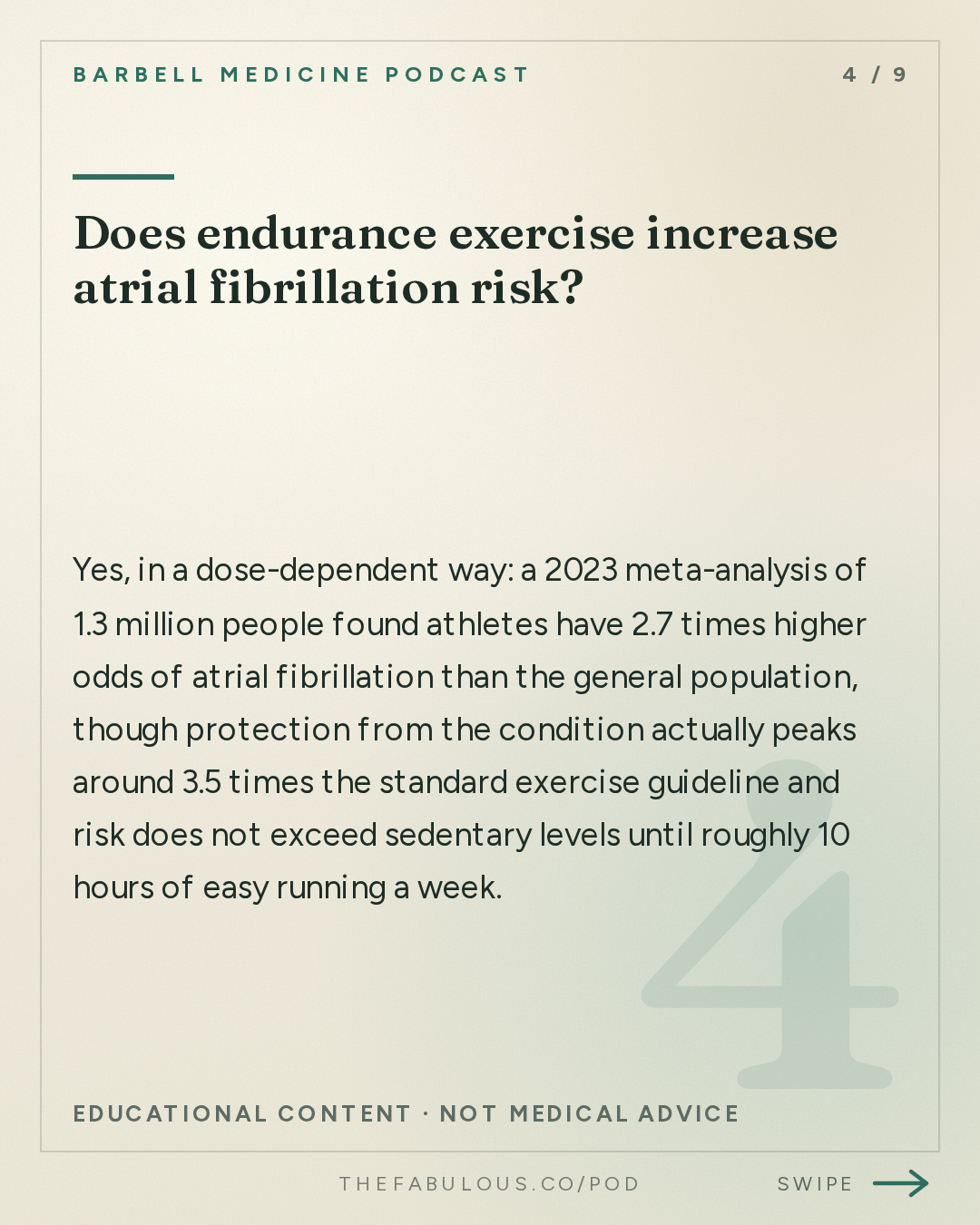
Does endurance exercise increase atrial fibrillation risk?
Yes, in a dose-dependent way: a 2023 meta-analysis of 1.3 million people found athletes have 2.7 times higher odds of atrial fibrillation than the general population, though protection from the condition actually peaks around 3.5 times the standard exercise guideline and risk does not exceed sedentary levels until roughly 10 hours of easy running a week (19:56, 20:22).
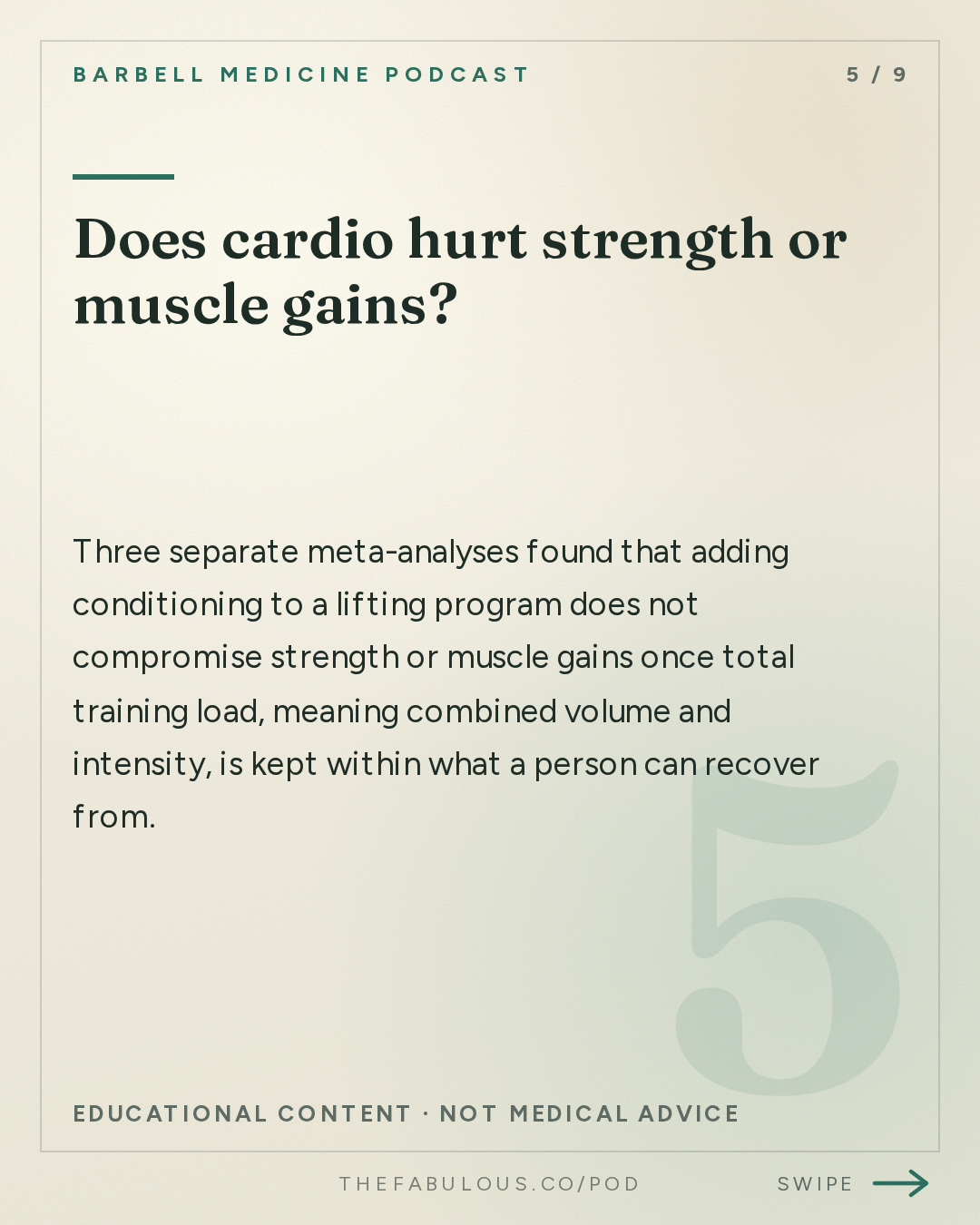
Does cardio hurt strength or muscle gains?
Three separate meta-analyses found that adding conditioning to a lifting program does not compromise strength or muscle gains once total training load, meaning combined volume and intensity, is kept within what a person can recover from (39:59, 40:48).
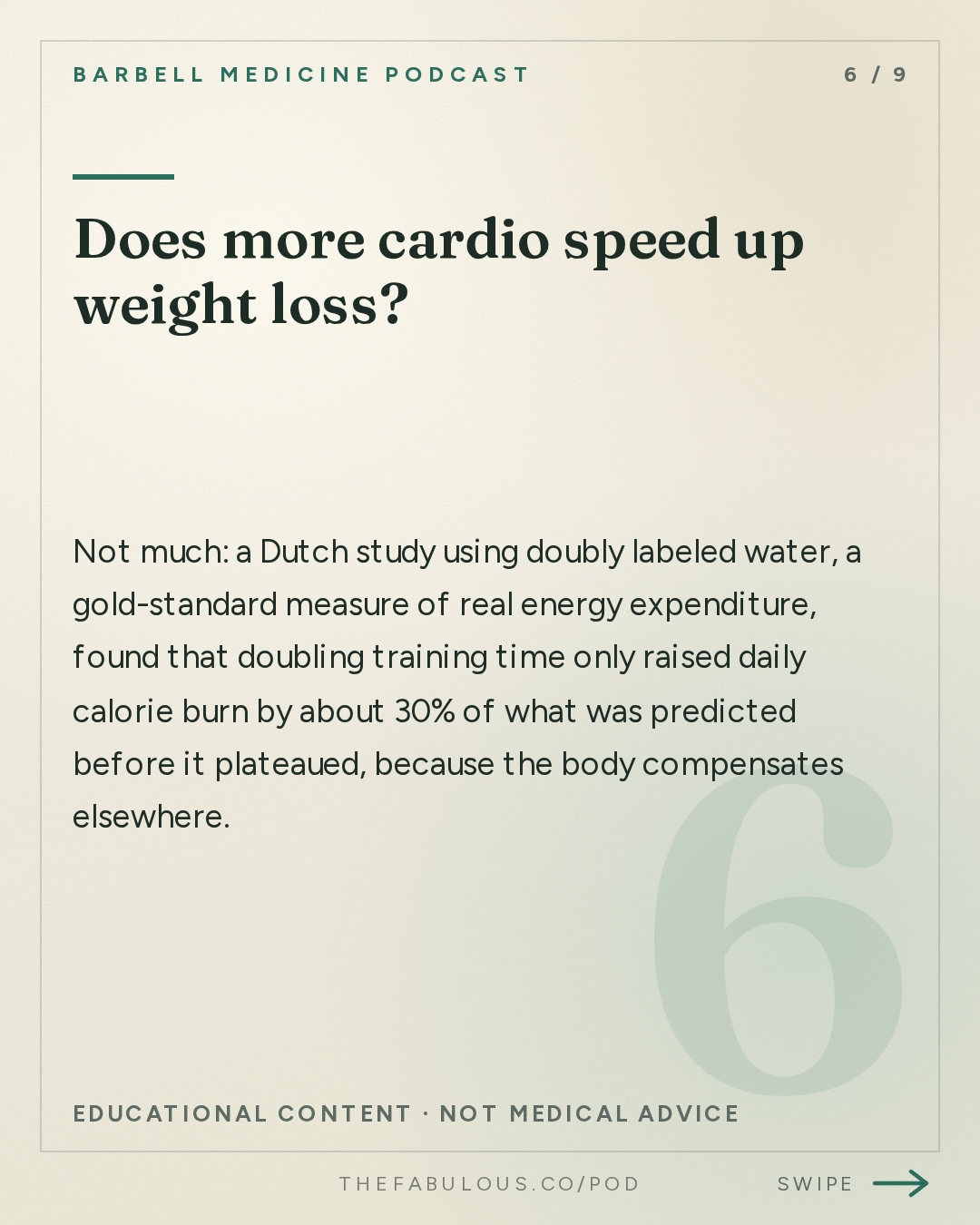
Does more cardio speed up weight loss?
Not much: a Dutch study using doubly labeled water, a gold-standard measure of real energy expenditure, found that doubling training time only raised daily calorie burn by about 30% of what was predicted before it plateaued, because the body compensates elsewhere (52:29, 54:49).
Can cardio reduce bone density?
Only under a specific combination: years of non-weight-bearing sport like cycling or swimming plus insufficient calorie intake relative to training load, as seen in masters cyclists who progressed to osteoporosis far more often than non-athlete controls (56:50, 58:24).
The full read, in cards
Go deeper
- Dose of Jogging and Long-Term Mortality — Danish study whose strenuous-jogger finding of doubled mortality risk was based on two deaths and was not statistically significant
- Aune et al. pooled analysis of six cohort studies (2015) — 661,000 adults showed mortality benefit plateauing around 3 to 5 times the standard exercise guideline
- Harvard 26-year repeated-measures cohort study (2022) — 116,000 people surveyed 15 times showed a straight-line mortality benefit instead of the U-shape seen with single measurements
- Cleveland Clinic treadmill fitness study (Mandsager et al.) — 122,000 people with directly measured exercise capacity showed no upper limit to the mortality benefit of fitness
- Davies et al. atrial fibrillation meta-analysis — 37 studies and 1.3 million people found athletes have 2.7 times higher AFib odds despite exercise lowering AFib risk overall
- VENTO AF study — Cardiac MRI found equal atrial scarring in endurance athletes with and without atrial fibrillation, challenging the scar-based explanation
- London masters athlete calcium score study — 152 lifelong endurance athletes had no higher rate of zero calcium scores than matched controls, though more of their plaque was the stable calcified type
- Dutch doubly labeled water half-marathon training study — 32 previously sedentary adults who doubled their jogging time over 44 weeks saw daily energy expenditure plateau rather than keep rising
Mentioned
Dr. Jordan Feigenbaum · Peter Schnoor · Cleveland Clinic · Journal of American College of Cardiology · Dr. Herman Pontzer · Burn · Dr. Eric Trexler · DREW study · VENTO AF study · IOC
More from this show and category

How Much Lifting Is Enough for Health?
Public health guidelines recommend lifting twice a week, but the study behind that number found three days worked better. Jordan Feigenbaum argues lifting doesn't hurt the heart, carries lower injury risk than running, and shows no real ceiling for strength, bone density, or metabolic benefits, so most people should train roughly double the current guideline.
Why Lifting Heavy Was Called Dangerous
In 1985 a panel of obstetricians banned pregnant women from raising their heart rate past 140 beats per minute, a number invented by consensus, not data (00:01). The same pattern, rules built on vibes rather than evidence, shaped a century of bans on heavy lifting for women, children, and anyone squatting below parallel, until later studies quietly reversed nearly all of them.

Is Training Safe in Wildfire Smoke?
Exercise still protects health during wildfire smoke, and lifting is safer than cardio because it barely raises breathing rate. Training right at failure isn't required for muscle growth either, since easier sets and even indirect fractional sets still add measurable stimulus, so individual response matters more than hitting an exact rep-in-reserve number.

Do You Need a Calorie Surplus to Build Muscle?
No: men above roughly 20% body fat can build muscle in a modest calorie deficit by spending stored fat as fuel. Sports scientist Eric Helms says below about 12% body fat the reverse happens, so a small surplus helps; in between, calorie balance barely matters if training and protein are dialed in.
