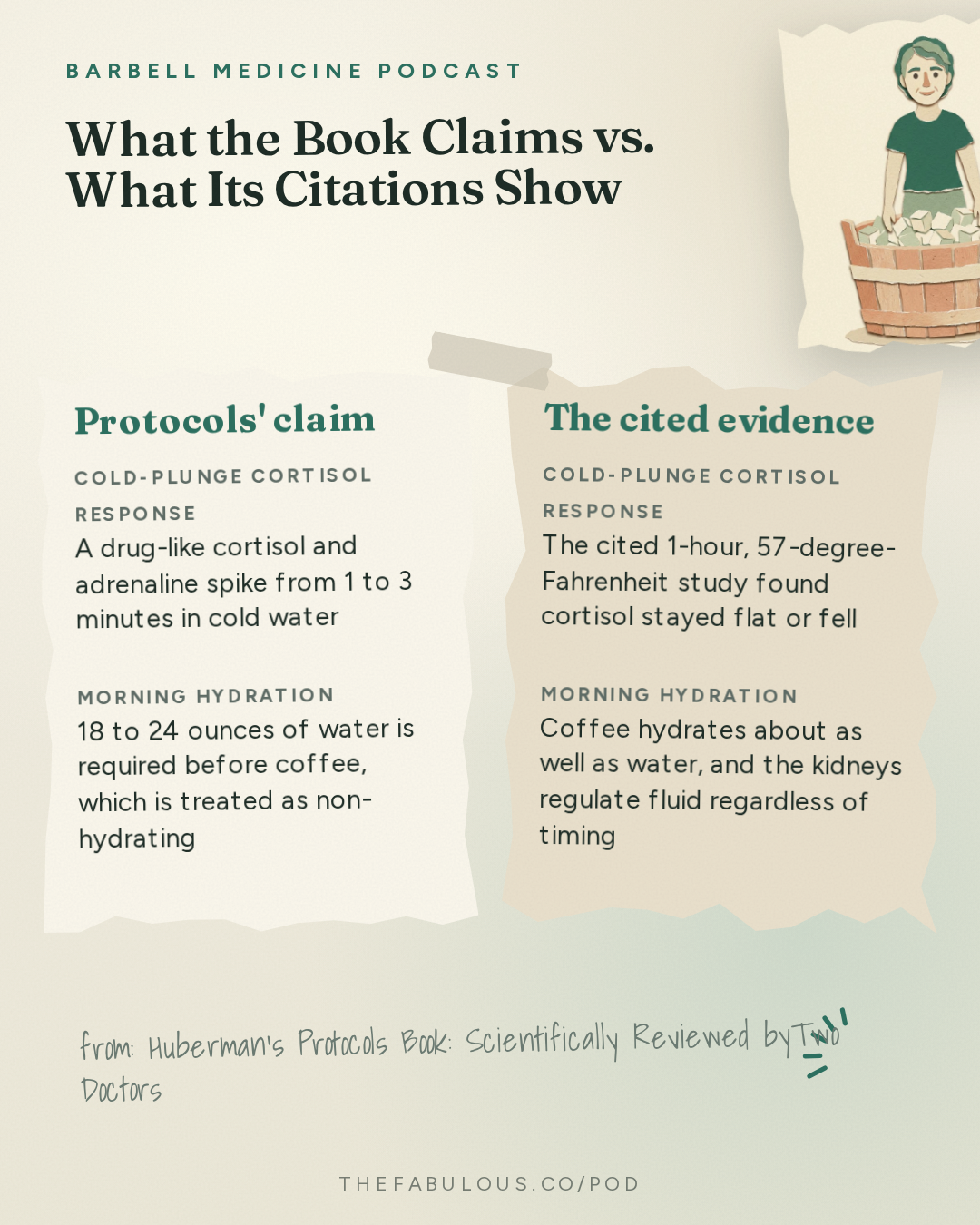
Is Huberman's Protocols Book Scientifically Accurate?
Huberman’s Protocols Book: Scientifically Reviewed byTwo Doctors
The brief
Barbell Medicine doctors Jordan Feigenbaum and Austin Baraki fact-check Andrew Huberman's book Protocols and find its own citations often contradict its advice. The 540-page book claims a once-weekly, low-volume lifting plan, cold plunges, cortisol hacks and nicotine pouches all work every time, but the hosts count zero protocols that hold up and at least eight financial conflicts of interest.
A book that tells a reader to measure cold-water tolerance in "walls," the moment a person wants to climb out but doesn't, is a book that has invented its own unit of suffering. That detail, buried in a 540-page manual called Protocols (03:02), is as good a place as any to start, because it captures what two physicians found when they actually opened the thing: a lot of confident language standing on very little weight.
The book is by Andrew Huberman, the Stanford neuroscientist and podcaster, and it promises a protocol for nearly everything, from how much water to drink before coffee to how long to sit in a cold plunge to how many milligrams of nicotine to use for focus. Jordan Feigenbaum, a physician and co-host of the Barbell Medicine podcast, did what almost no reviewer seems to have done: he read the book cover to cover, then pulled the actual studies it cites, while his co-host Austin Baraki had read none of it. What they found, again and again, is a gap between the certainty of the prose and the modesty of the evidence behind it, and in a surprising number of cases, the cited paper says the opposite of the claim it is attached to.
Take the book's signature lifting protocol. Huberman writes that readers should train each major muscle directly only once a week, for four to eight sets, taken to failure (08:35, 09:01). He adds, in Feigenbaum's reading, a line that would make any working coach wince:
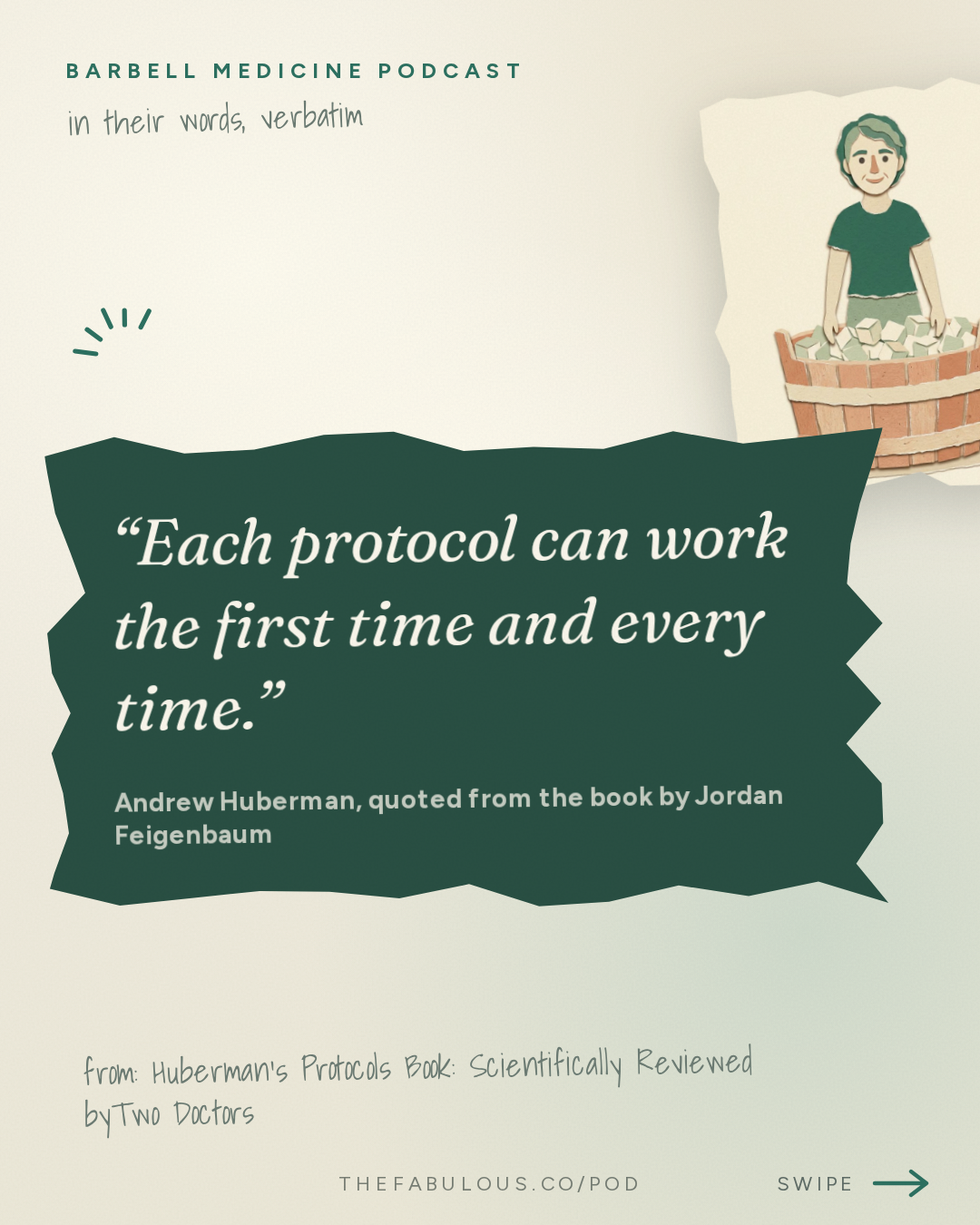
"Each protocol can work the first time and every time." (01:06), from the book, read by Jordan Feigenbaum
The trouble is that Huberman cites five papers to support the four-to-eight-set claim, and all five recommend higher volume. One, from Baz and Val in 2022, recommends 12 to 20 sets per muscle per week for near-maximal hypertrophy (13:22). Another study the book cites compared the same total training load done in one day a week versus spread across four. The group that split up their training gained 15 kilograms on their squat; the once-a-week group gained 8 (14:08). In other words, the paper Huberman uses to defend once-weekly training shows the opposite approach working nearly twice as well. Feigenbaum and Baraki's broader point is less about this one number than about the pattern: volume and recovery capacity, not frequency, drive most of the strength and muscle gained from lifting, and frequency is mostly just a way to spread that volume across a week (15:07).
The Cold, the Cortisol, and the Fine Print
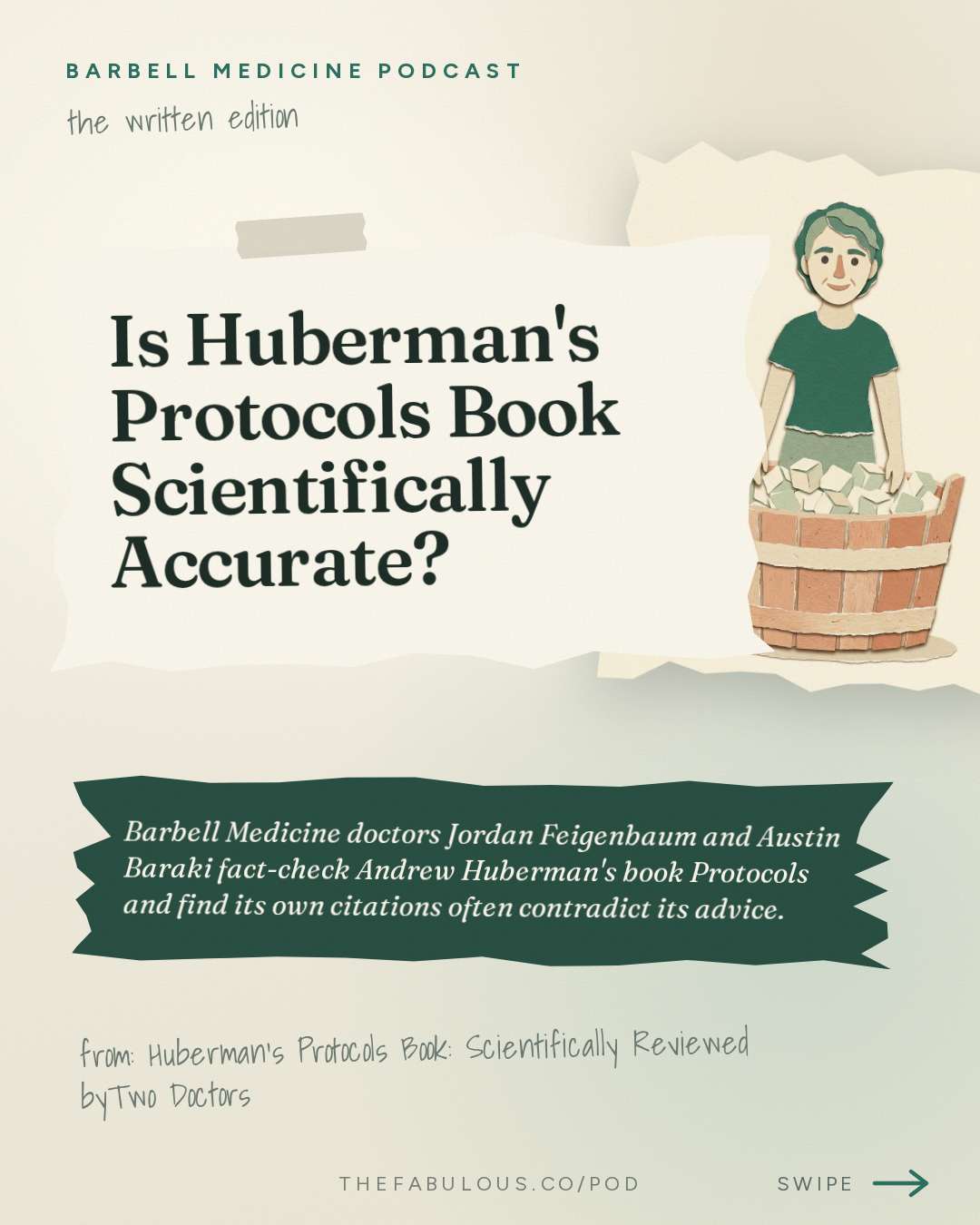
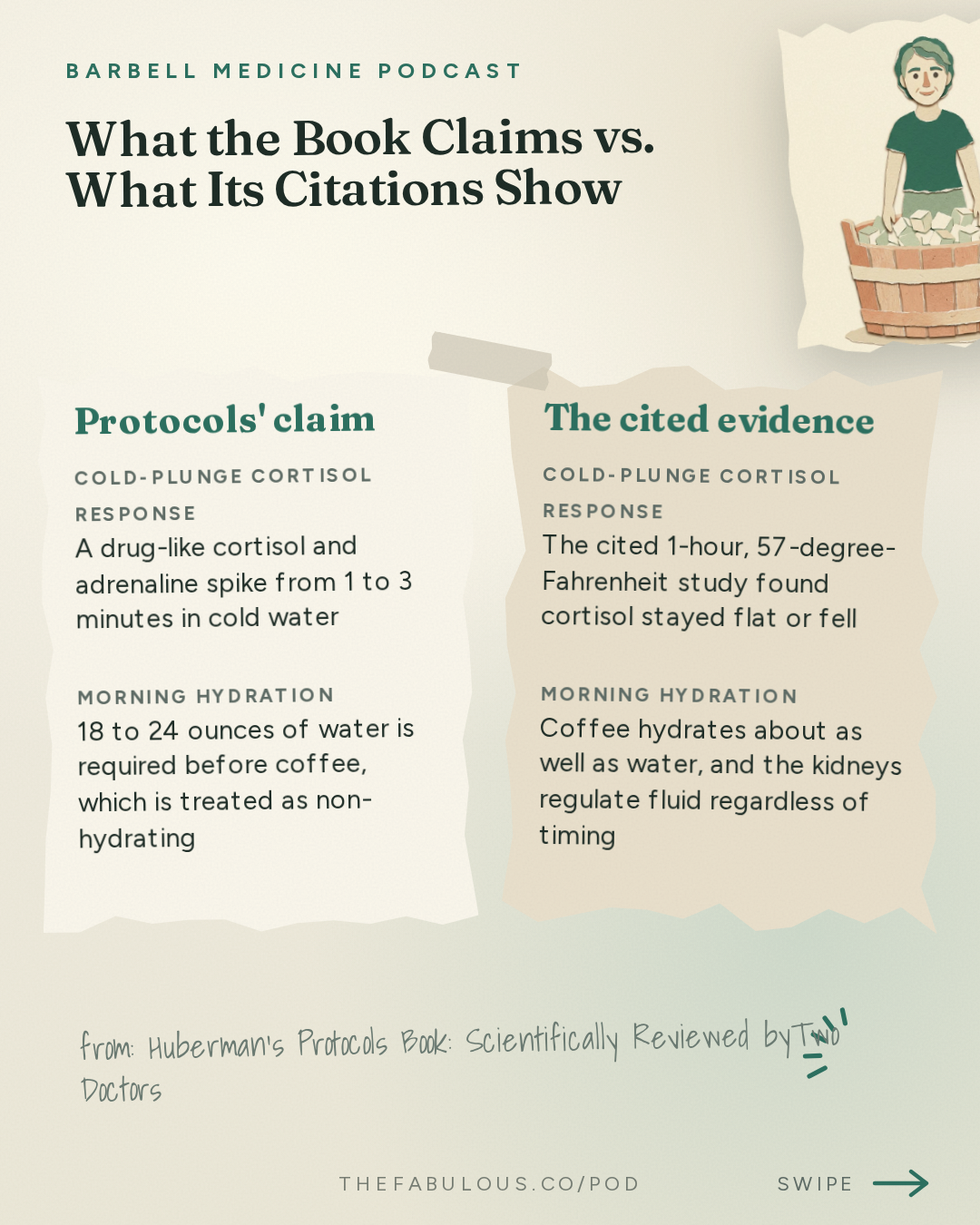
The book's cold-plunge chapter runs into a similar problem. Huberman writes that one to three minutes in roughly 57-degree Fahrenheit water produces a drug-like surge of norepinephrine and dopamine (27:20, 27:39). The cited study is real: young men sitting in 57-degree water did show a five-fold rise in norepinephrine and about a two-and-a-half-fold rise in dopamine (28:04, 28:23). But the study had them in the water for a full hour, not one to three minutes, and far from spiking, cortisol in that study stayed flat or fell (28:23), even though the book describes cold exposure as triggering a sharp rise in both adrenaline and cortisol. A separate study used to justify just 30 seconds of cold exposure measured only how often people called in sick to work, a self-reported outcome from people who knew which group they were in (31:30). And the broadest evidence available, a meta-analysis pooling 11 randomized trials of cold-water exposure, concludes, in the authors' own words, that "the purported benefits remain unsubstantiated" (33:56).
Cortisol gets its own chapter, built on the idea that readers should aim for high morning cortisol and low evening cortisol, achieved through tools like licorice root, grapefruit, and morning sunlight (35:19, 35:47). Licorice root contains a compound that mimics the hormone aldosterone, which can raise blood pressure and lower potassium (37:24), a detail the book mentions only after suggesting the practice. Grapefruit, meanwhile, can raise blood levels of the cholesterol drug simvastatin by blocking the liver enzyme that clears it (39:23), a real interaction for anyone taking a statin. And the citation behind the claim that morning light can raise cortisol by 50 percent comes from a study of eight men who were kept awake for 36 hours and then exposed to three hours of bright laboratory light (38:12, 38:36), a situation that bears no resemblance to a normal morning. As Baraki put it, summarizing much of the book's approach to physiology that already works fine on its own:
"Your kidneys are just laughing at you, bro. Whatever you recommended in this protocol, your kidneys are still gonna handle this the way I'm gonna handle this." (47:56), Austin Baraki
Trust the Kidneys
That line comes from the hydration chapter, where the book instructs readers to drink 18 to 24 ounces of water before their first cup of coffee, on the premise that coffee does not count as hydration (00:02, 42:44). It does. Coffee's mild diuretic effect is small compared with the fluid it delivers, so it hydrates about as well as plain water (45:14). Baraki's broader argument is physiological: kidneys and the brain's thirst centers are homeostatic systems built to keep the body in balance regardless of when fluid arrives, which makes a timed morning-water ritual mostly theater.
The sleep chapter recommends 11 different supplements, including magnesium, apigenin, and melatonin, describing them as safer than prescription sleep medication (52:37). But the single most evidence-backed treatment for chronic insomnia, cognitive behavioral therapy for insomnia or CBT-I, gets one sentence (58:54). And the numbers for the supplements the book does favor are thin: melatonin, which most people have heard of, reduces time to fall asleep by an average of seven minutes (59:29). One study cited to support tart cherry juice showed benefit in 20 people; the book reports it as 10 (58:45). A citation describing a dementia study of 32 adults turns out to be describing something different: 321 people without dementia were followed for 12 years, and 32 of them developed it during that time (58:57).
The nicotine chapter may be the clearest case of a book arguing against itself. Huberman suggests one to six milligrams of nicotine, two to three times a week, for focus (60:44), then describes, a few sentences later, how people who start at that dose commonly escalate to using it daily, at higher doses, all day long (61:02). Research on adolescents shows dependence symptoms can begin after as little as two cigarettes used once a week (62:25), and six milligrams and up in a nicotine pouch typically delivers more nicotine than a cigarette (62:50).
Across the protocols they reviewed, Feigenbaum and Baraki counted at least eight financial conflicts of interest tied to products the book recommends, including Huberman's advisory roles with the supplement brand AG1 and the sleep-tracking company Eight Sleep, and his partial ownership of the sunscreen brand Lerub, revealed only after the book praises mineral sunscreen (74:57, 75:19). Not one of the protocols they scored, by their own count, held up against the evidence behind it (75:19). Feigenbaum's closing test is a simple one: would he hand this book to his mother? Baraki's answer was direct:
"I would definitively not give this book to my mom or anybody that I cared about." (75:44), Austin Baraki
What lingers after the lightning round of debunked claims is not outrage so much as fatigue, the sense of a life micromanaged from the moment of waking to the moment of sleep, each hour slotted into somebody else's protocol. Baraki's alternative is almost anticlimactic: lift with enough volume, drink when thirsty, sleep on a steady schedule, eat enough protein, and treat the rest as noise. It will not sell 540 pages, but it has the advantage of being true.
Ask this episode anything
Pod's AI answers from the episode itself, with the minute mark so you can hear it yourself.
Or start with one of these
Ask this episode
Pod's AI listens to the whole episode to answer, and points you to the minute it comes from.
The rest of this answer, and any question after it
Answers come from the episode itself, never from a summary of it.
ContinueKey takeaways
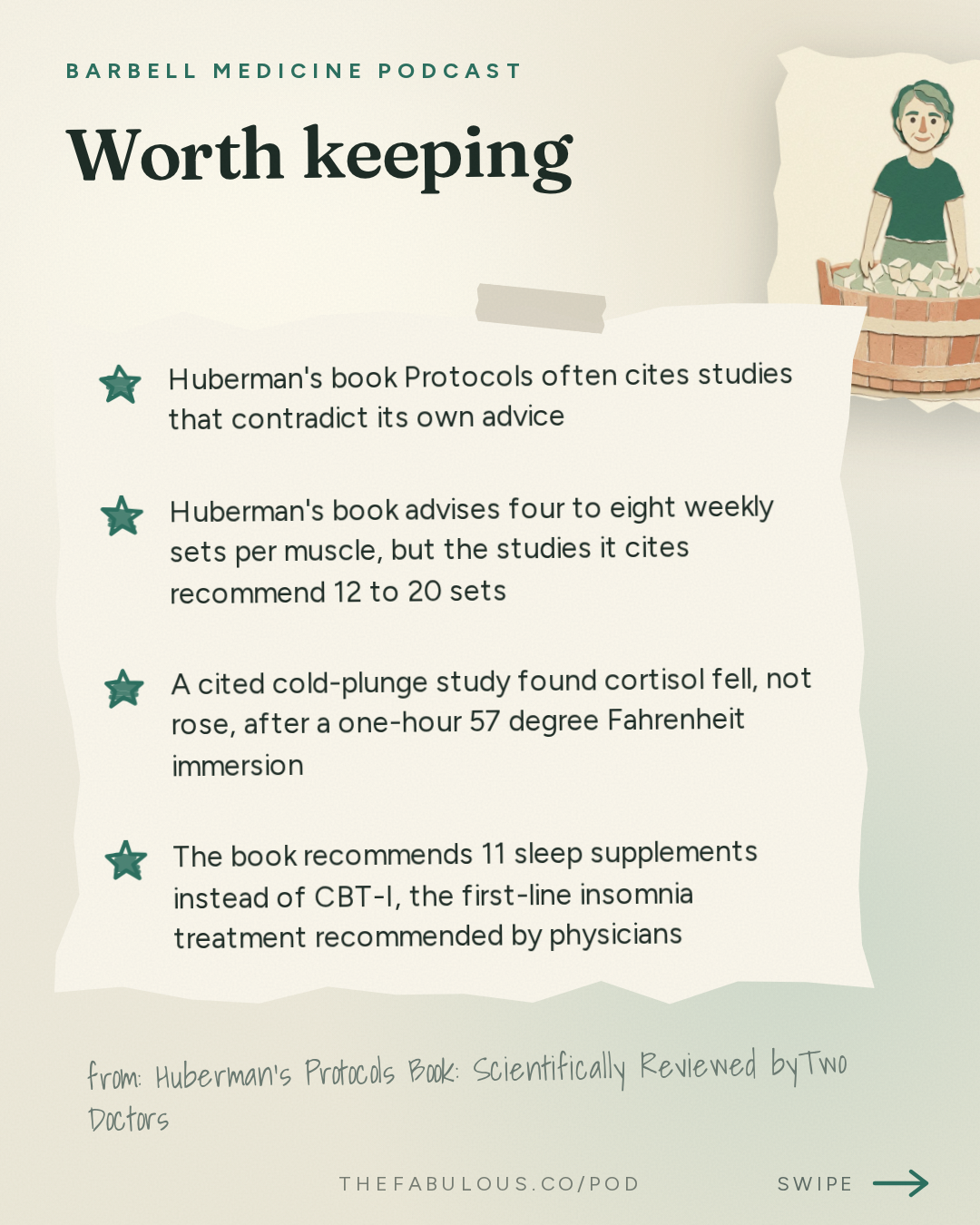
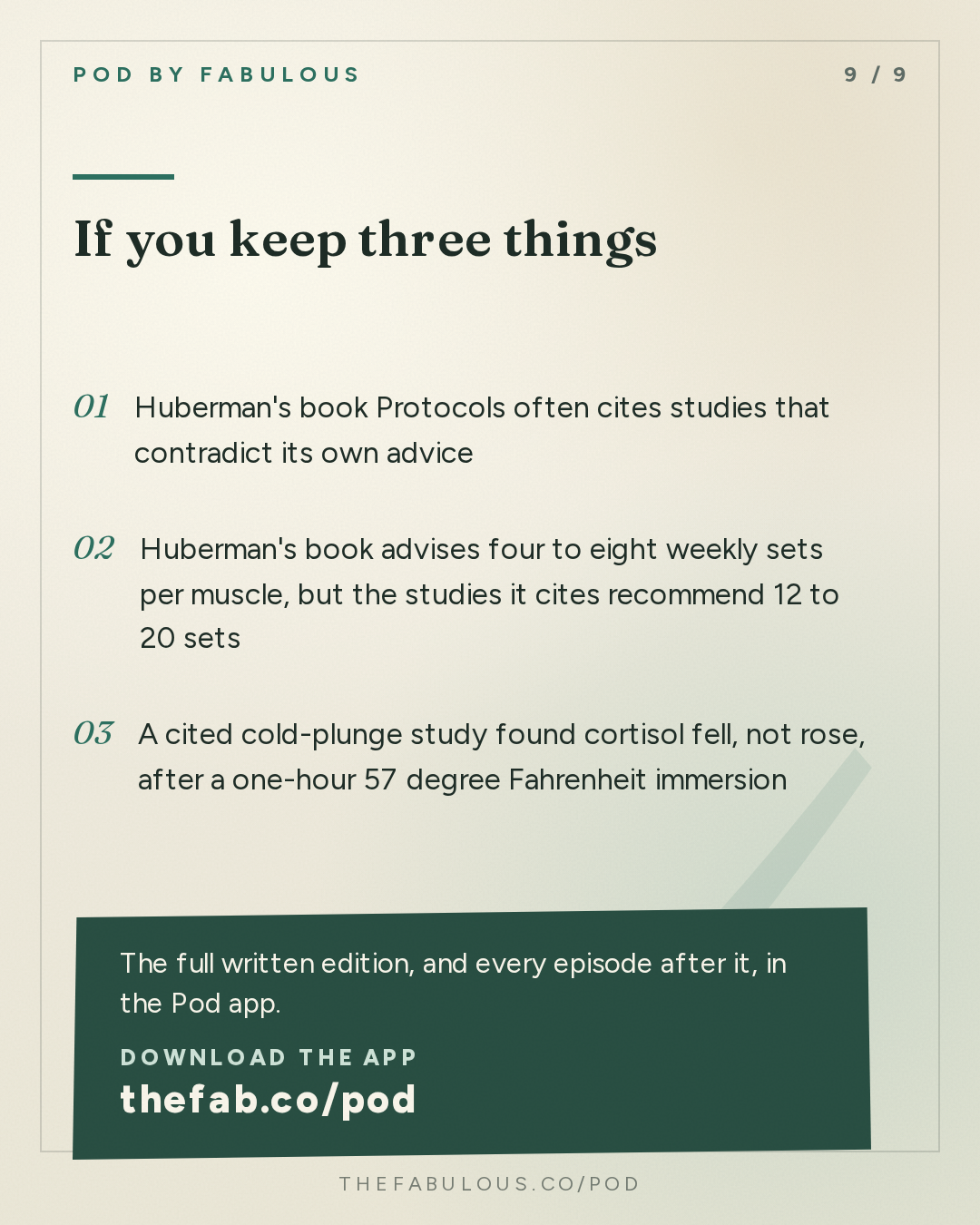
- Huberman's book Protocols often cites studies that contradict its own advice
- Huberman's book advises four to eight weekly sets per muscle, but the studies it cites recommend 12 to 20 sets
- A cited cold-plunge study found cortisol fell, not rose, after a one-hour 57 degree Fahrenheit immersion
- The book recommends 11 sleep supplements instead of CBT-I, the first-line insomnia treatment recommended by physicians
- Hosts Jordan Feigenbaum and Austin Baraki count at least eight financial conflicts of interest in the book
The episode in cards
By the numbers
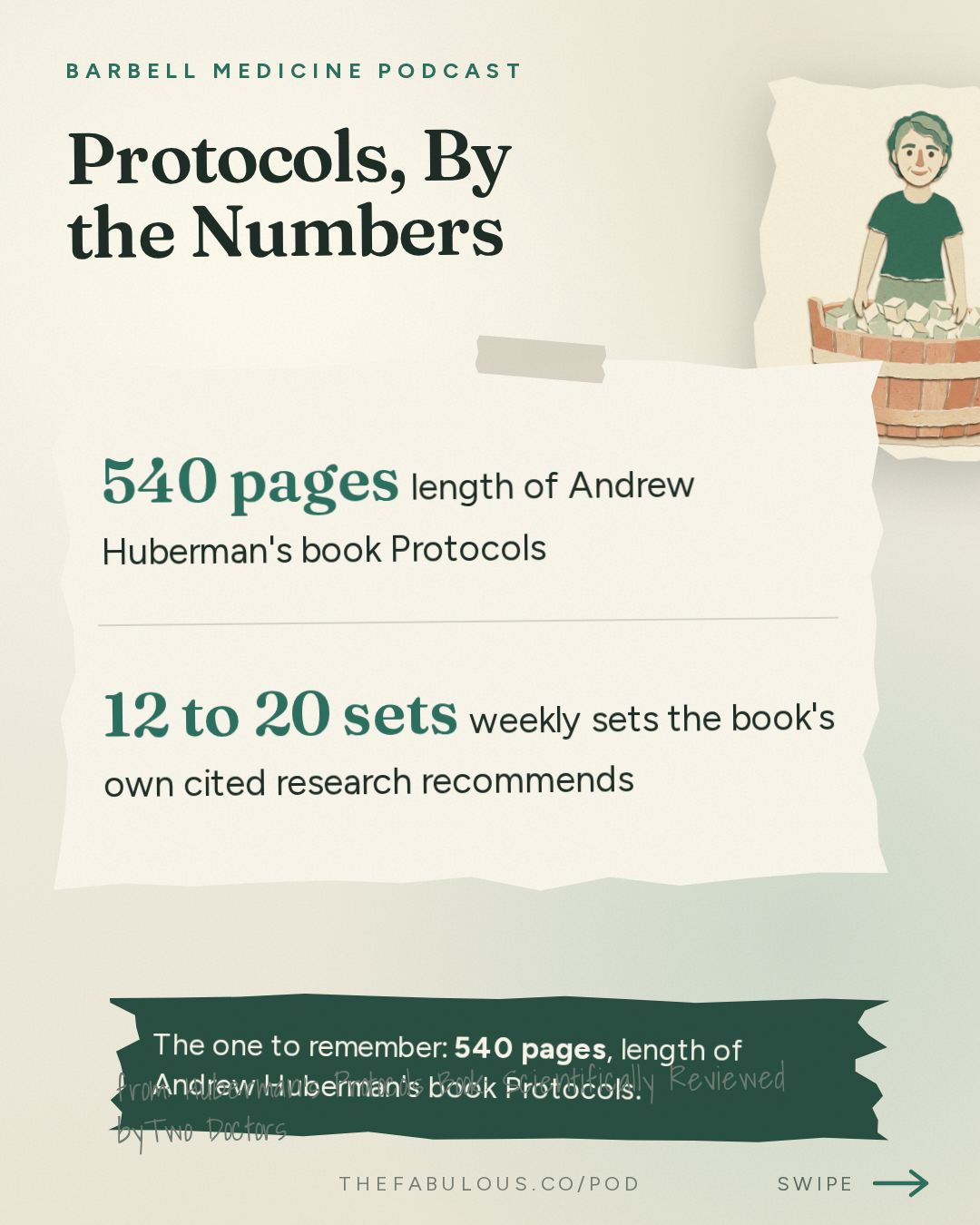
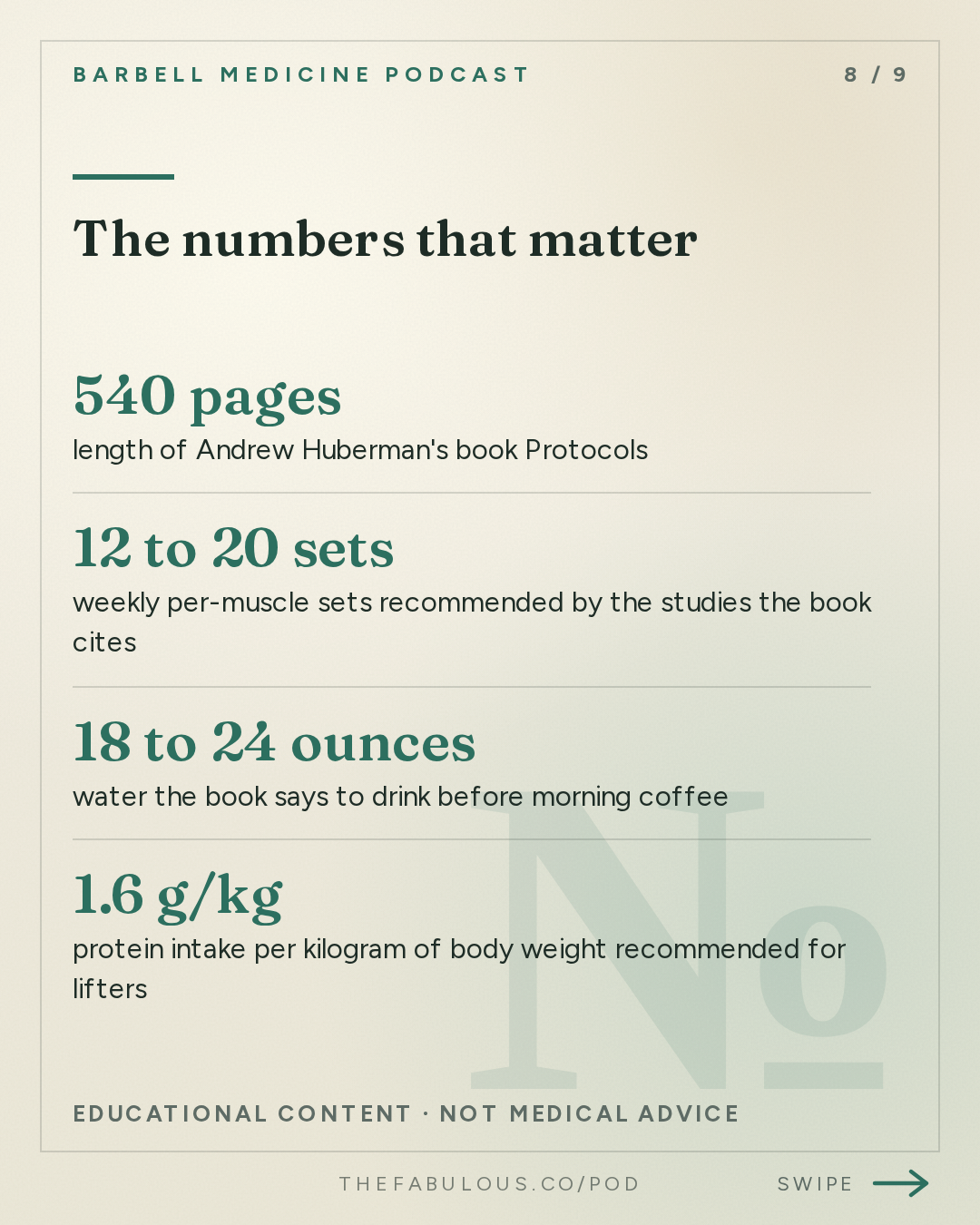
- 540 pages length of Andrew Huberman's book Protocols
- 12 to 20 sets weekly per-muscle sets recommended by the studies the book cites
- 18 to 24 ounces water the book says to drink before morning coffee
- 1.6 g/kg protein intake per kilogram of body weight recommended for lifters
In their words
“Each protocol can work the first time and every time.”
“Be miserable doing all these things every day instead of just, like, you know, living your life”
Protocols
-
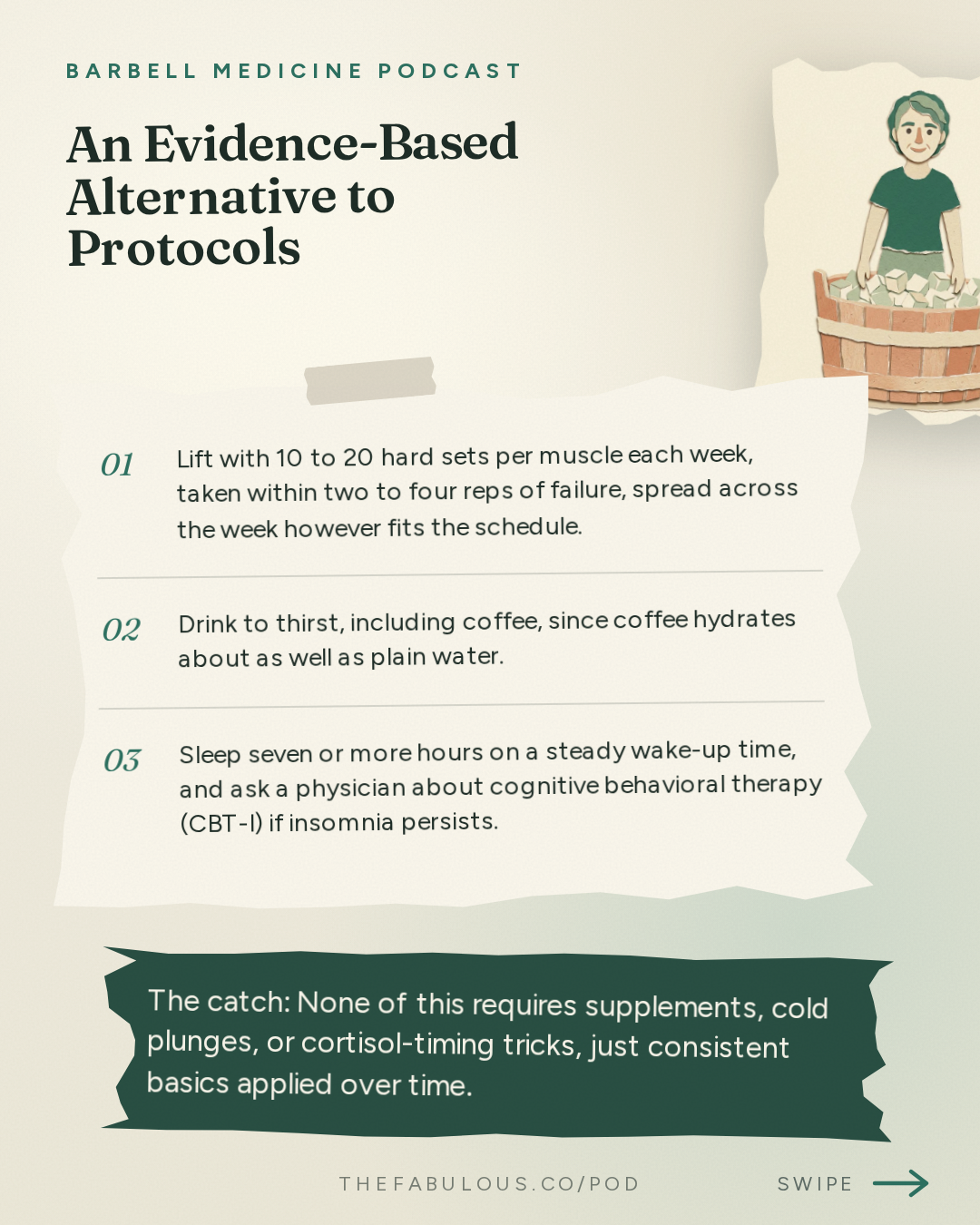
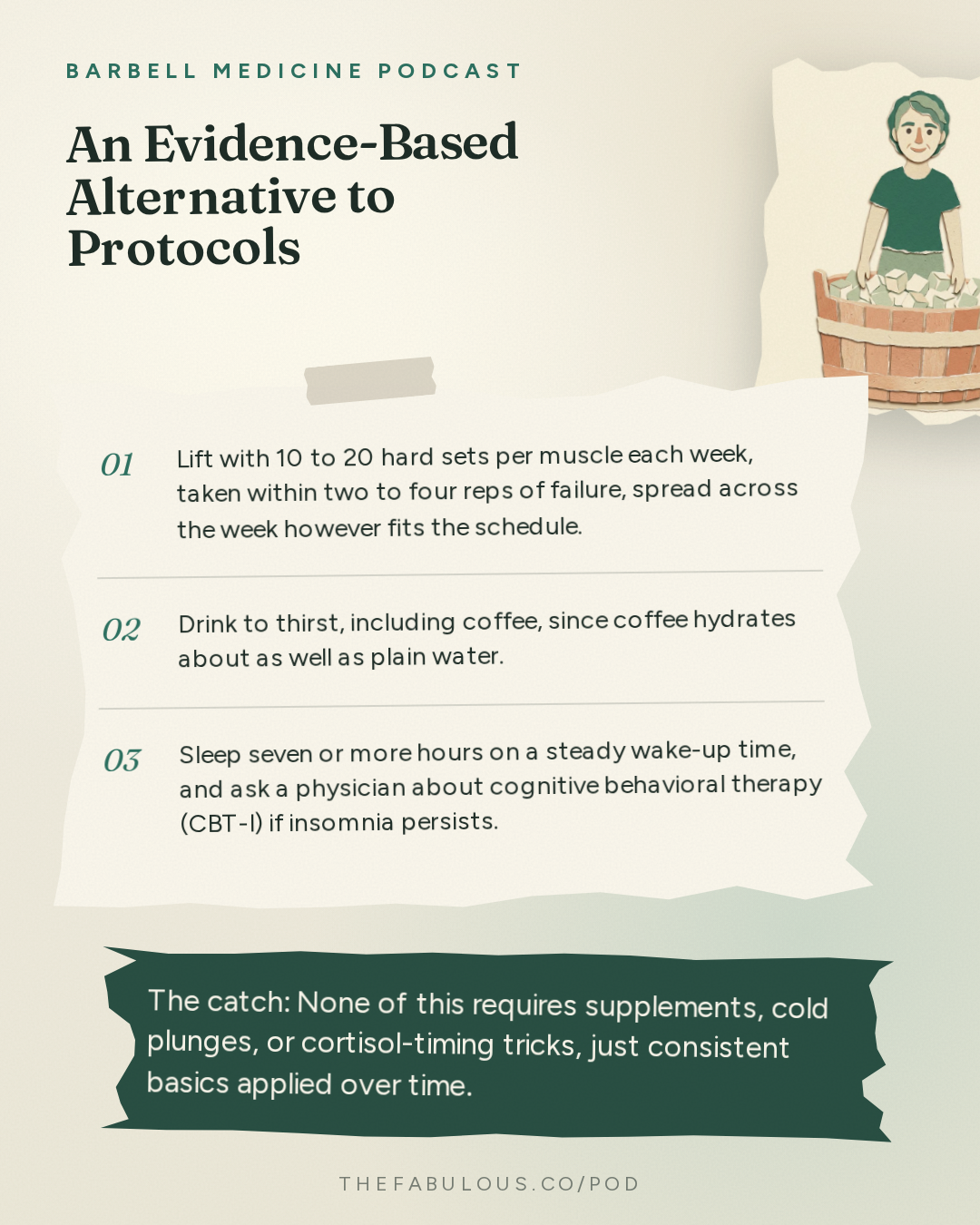
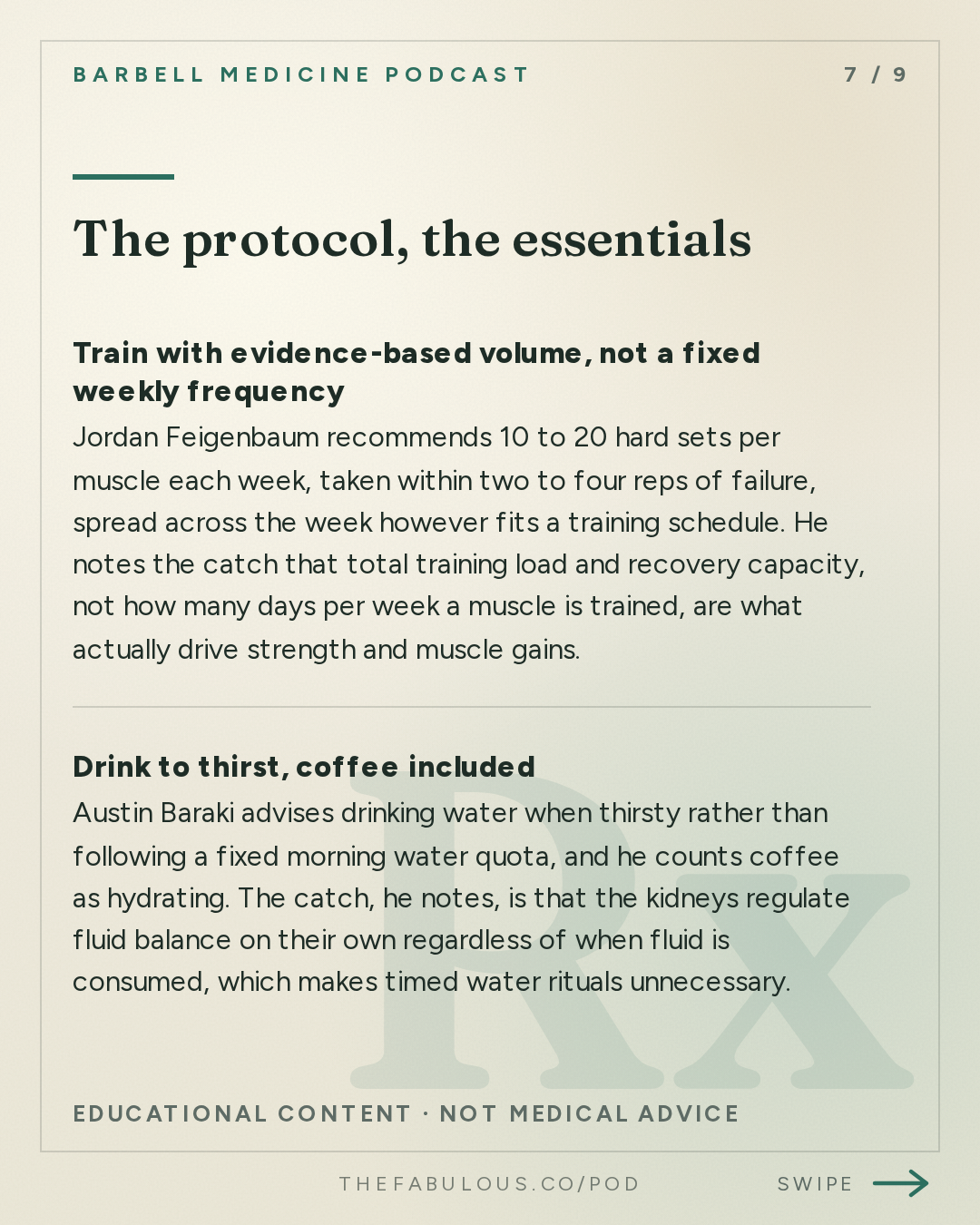
Train with evidence-based volume, not a fixed weekly frequency
Jordan Feigenbaum recommends 10 to 20 hard sets per muscle each week, taken within two to four reps of failure, spread across the week however fits a training schedule. He notes the catch that total training load and recovery capacity, not how many days per week a muscle is trained, are what actually drive strength and muscle gains.
weekly, split across available training days
-
Drink to thirst, coffee included
Austin Baraki advises drinking water when thirsty rather than following a fixed morning water quota, and he counts coffee as hydrating. The catch, he notes, is that the kidneys regulate fluid balance on their own regardless of when fluid is consumed, which makes timed water rituals unnecessary.
as needed, no fixed schedule
-
Treat chronic insomnia with CBT-I before supplements
Austin Baraki recommends cognitive behavioral therapy for insomnia (CBT-I) as the first treatment for ongoing sleep trouble, with evaluation for sleep apnea, perimenopausal symptoms, or iron deficiency when those are suspected. The catch he raises is that CBT-I is often hard to access, so some people end up needing other options in the short term.
short structured program, then as needed
-
Set daily protein near 1.6 grams per kilogram
Jordan Feigenbaum recommends about 1.6 grams of protein per kilogram of body weight per day for people who lift weights, obtained from whatever foods a person prefers. The catch, he adds, is that most people already eat enough protein and need at most one additional serving per day, not a drastic increase.
daily
-
Skip nicotine for focus
Austin Baraki advises against starting nicotine use to improve focus or studying, recommending adequate sleep, a moderate dose of caffeine, and a distraction-free environment instead. The catch he raises is that nicotine dependence can begin quickly and most users escalate past the dose that was supposed to be occasional.
not recommended
Questions this episode answers
Is Andrew Huberman's book Protocols scientifically accurate?
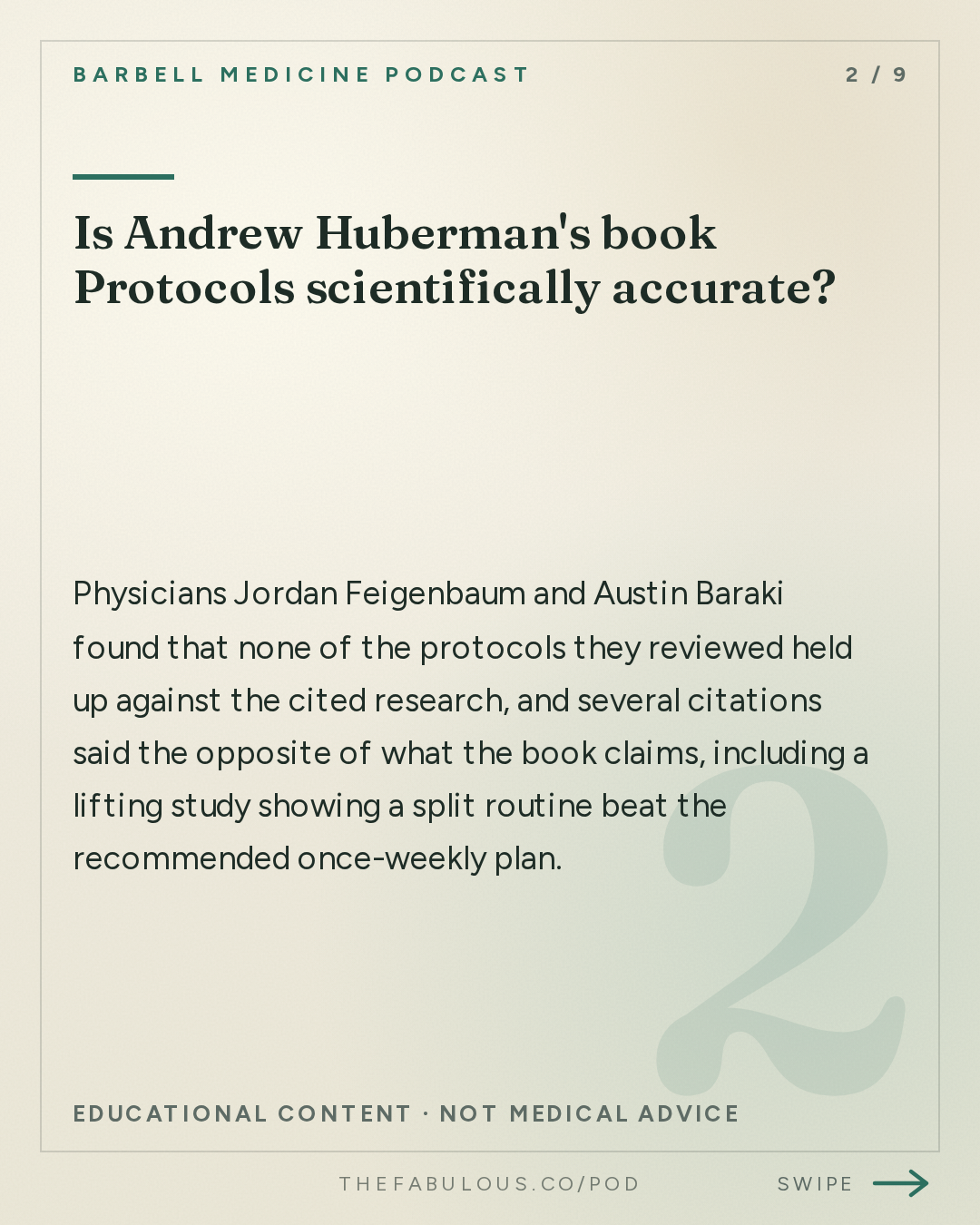
Physicians Jordan Feigenbaum and Austin Baraki found that none of the protocols they reviewed held up against the cited research, and several citations said the opposite of what the book claims, including a lifting study showing a split routine beat the recommended once-weekly plan (14:08).
Does Huberman's book recommend enough training volume for muscle growth?
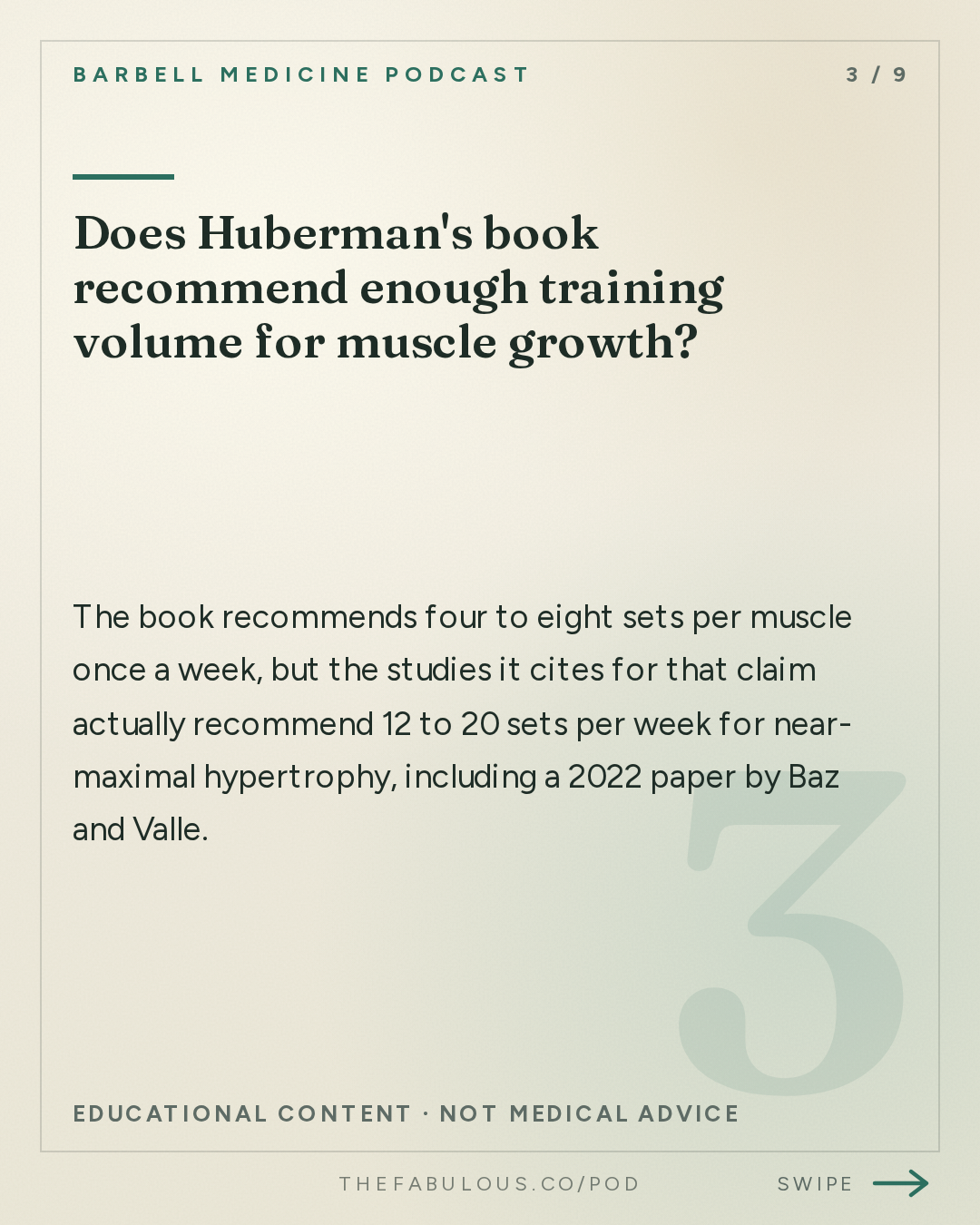
The book recommends four to eight sets per muscle once a week (09:01), but the studies it cites for that claim actually recommend 12 to 20 sets per week for near-maximal hypertrophy, including a 2022 paper by Baz and Valle (13:22).
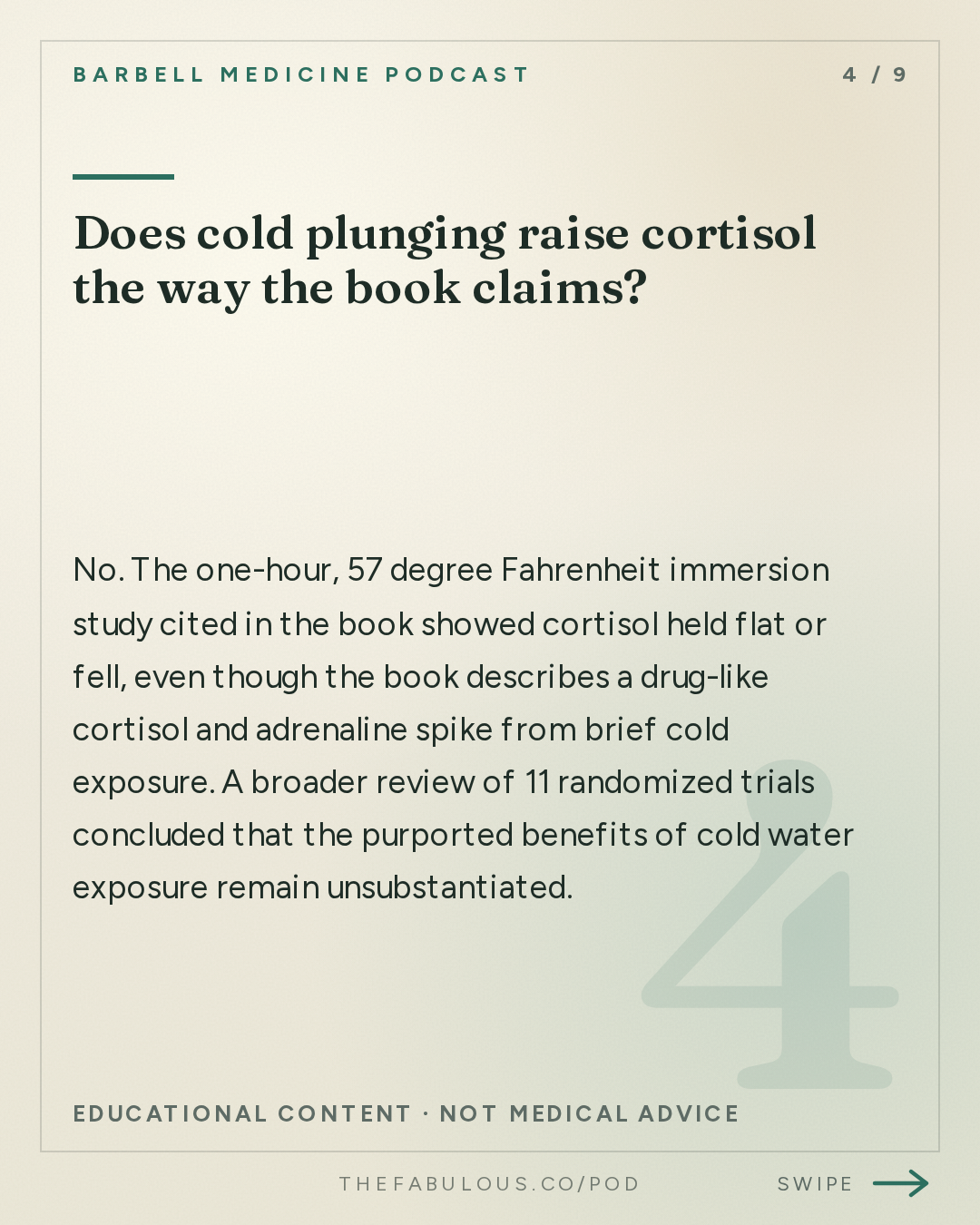
Does cold plunging raise cortisol the way the book claims?
No. The one-hour, 57 degree Fahrenheit immersion study cited in the book showed cortisol held flat or fell, even though the book describes a drug-like cortisol and adrenaline spike from brief cold exposure (28:23). A broader review of 11 randomized trials concluded that the purported benefits of cold water exposure remain unsubstantiated (33:56).
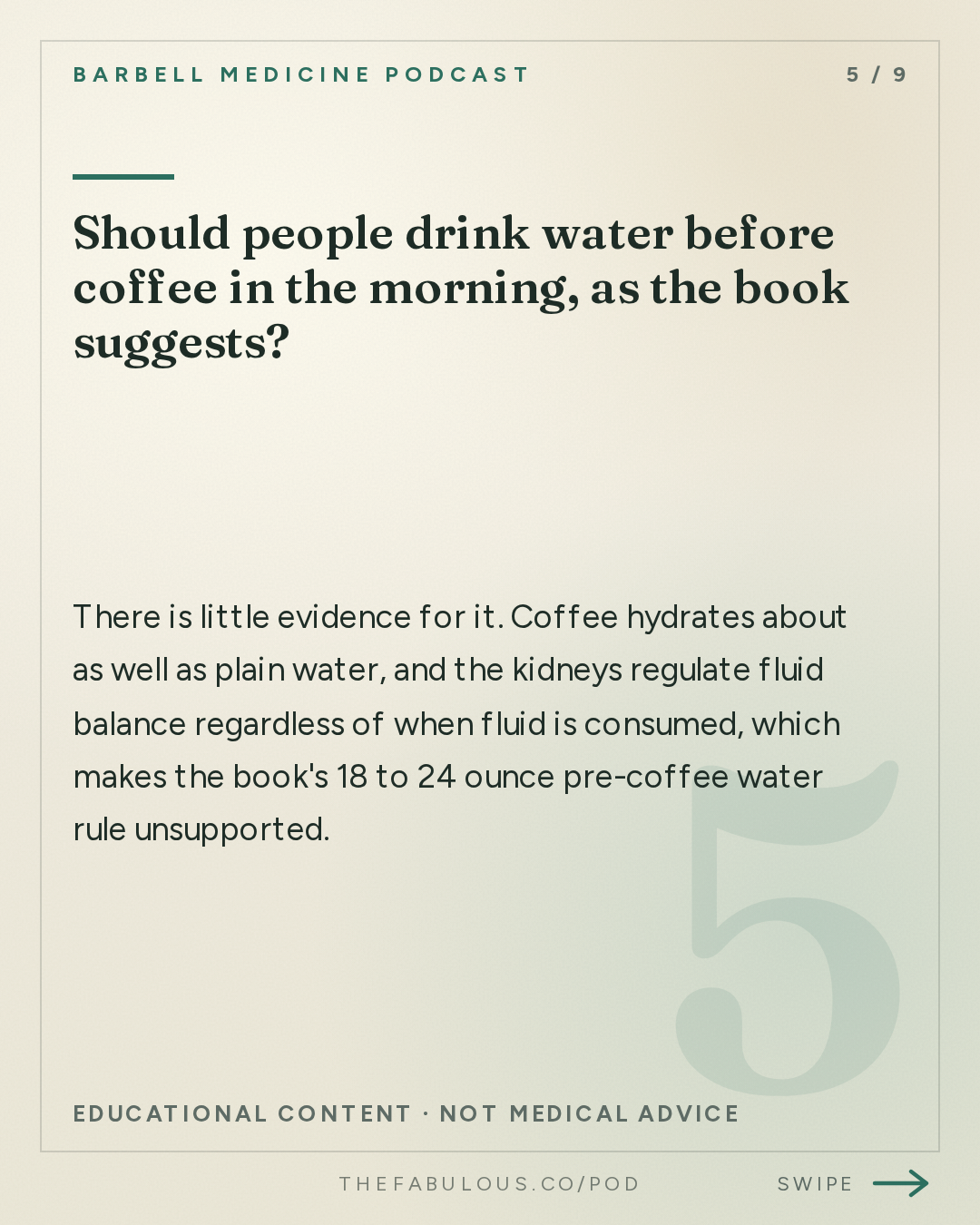
Should people drink water before coffee in the morning, as the book suggests?
There is little evidence for it. Coffee hydrates about as well as plain water, and the kidneys regulate fluid balance regardless of when fluid is consumed, which makes the book's 18 to 24 ounce pre-coffee water rule unsupported (45:14).
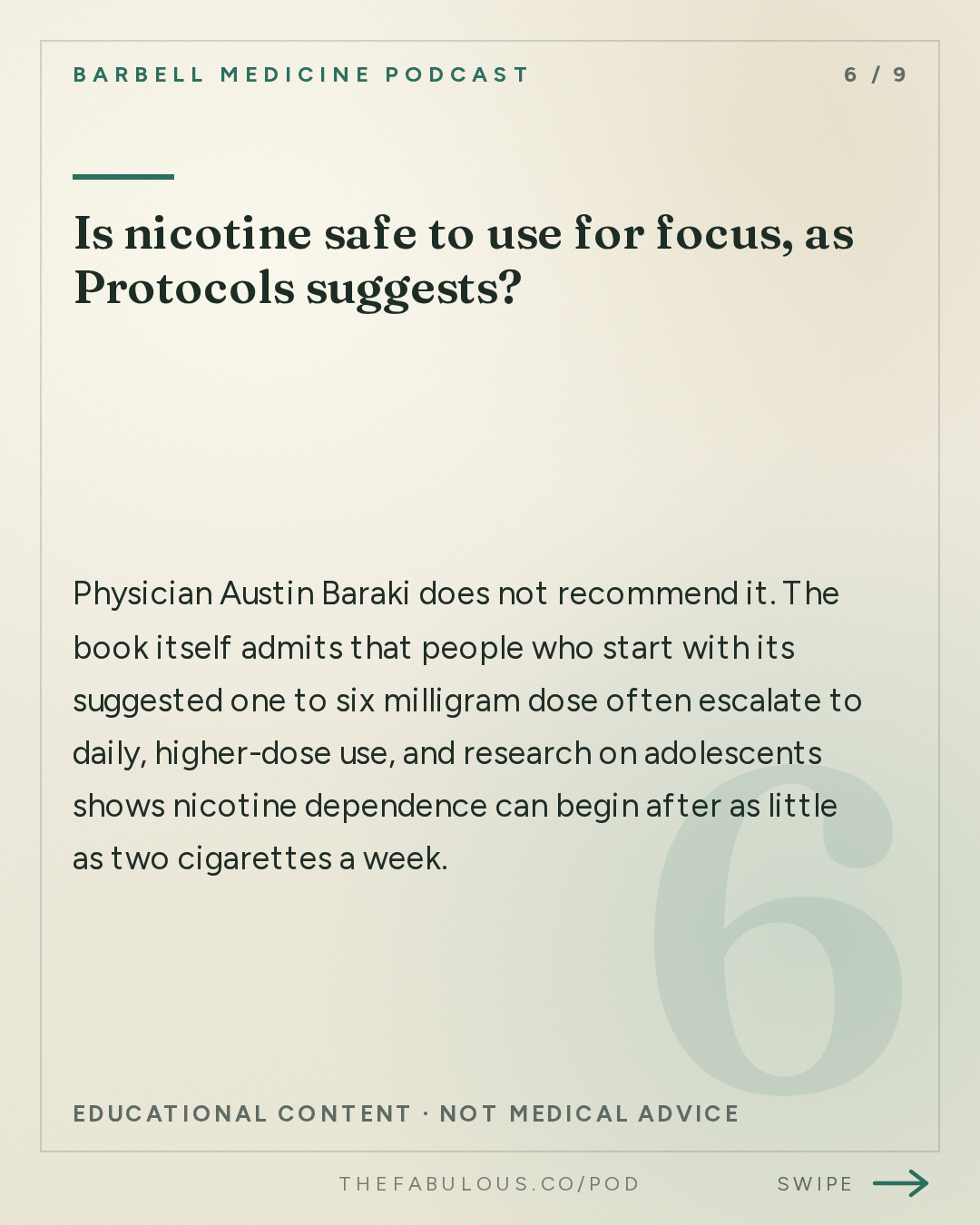
Is nicotine safe to use for focus, as Protocols suggests?
Physician Austin Baraki does not recommend it. The book itself admits that people who start with its suggested one to six milligram dose often escalate to daily, higher-dose use (61:02), and research on adolescents shows nicotine dependence can begin after as little as two cigarettes a week (62:25).
How many conflicts of interest does Huberman's book have?
The reviewing podcast hosts tallied at least eight financial conflicts of interest tied to products named across the protocols they covered, including Huberman's advisory roles with Whoop and AG1 and his partial ownership of the sunscreen brand Lerub (75:19).
The full read, in cards

Go deeper
- Baz-Valle et al. (2022), resistance training volume and hypertrophy — recommended 12 to 20 sets per muscle per week, the study the book cites while recommending 4 to 8
- Cold-water immersion and catecholamine/dopamine study (57 degrees Fahrenheit, one hour) — found a five-fold rise in norepinephrine and flat or falling cortisol, unlike the book's one-to-three-minute protocol
- Meta-analysis of 11 randomized trials on cold water exposure — concluded that the purported benefits of cold water exposure remain unsubstantiated
- 2026 ACSM position stand on resistance training — cited for the claim that stopping a rep or two short of failure still works
- American College of Physicians guidance on chronic insomnia — recommends cognitive behavioral therapy (CBT-I) as first-line treatment before medication or supplements
- Protocols: An Operating Manual for the Human Body by Andrew Huberman — the 540-page book under review, published September 2026
Mentioned
Andrew Huberman · Protocols: An Operating Manual for the Human Body · Jordan Feigenbaum · Austin Baraki · Athletic Greens (AG1) · Scott Carney · Mike Mentzer · If Books Could Kill · Lerub
More from this show and category
Athlete's Heart vs Hypertrophic Cardiomyopathy
A 22-year-old soccer player's thickened heart wall, 16mm versus a normal top of 11-12mm, led doctors to diagnose hypertrophic cardiomyopathy (13:29). Four months off training shrank the wall to 10mm but doctors kept the diagnosis (24:22). New 2025 AHA/ACC guidance says HCM alone should not bar competitive sport, favoring shared decision-making instead (47:42).
Biohacking Protocols: What the Evidence Shows
Barbell Medicine's Halloween episode uses a dystopian 2049 fiction, a man named Dale Mercer living under a machine called Soma, to grade today's real biohacking trends against clinical trial data. Morning light panels, cold plunges, NAD supplements, gray market peptides, HRV scores, and CGMs mostly fail to beat placebo in healthy people, while creatine, adequate protein, and consistent sleep hold up.
How Much Cardio Is Too Much for Your Heart?
More cardio keeps lowering mortality risk with no measured ceiling, but atrial fibrillation risk rises past roughly 3.5 times the exercise guidelines. Barbell Medicine physician Jordan Feigenbaum recommends about 300 minutes of moderate cardio weekly, mostly at 60 to 80% max heart rate, while debunking the viral claim that hard running is as deadly as sitting.
How Much Lifting Is Enough for Health?
Public health guidelines recommend lifting twice a week, but the study behind that number found three days worked better. Jordan Feigenbaum argues lifting doesn't hurt the heart, carries lower injury risk than running, and shows no real ceiling for strength, bone density, or metabolic benefits, so most people should train roughly double the current guideline.
