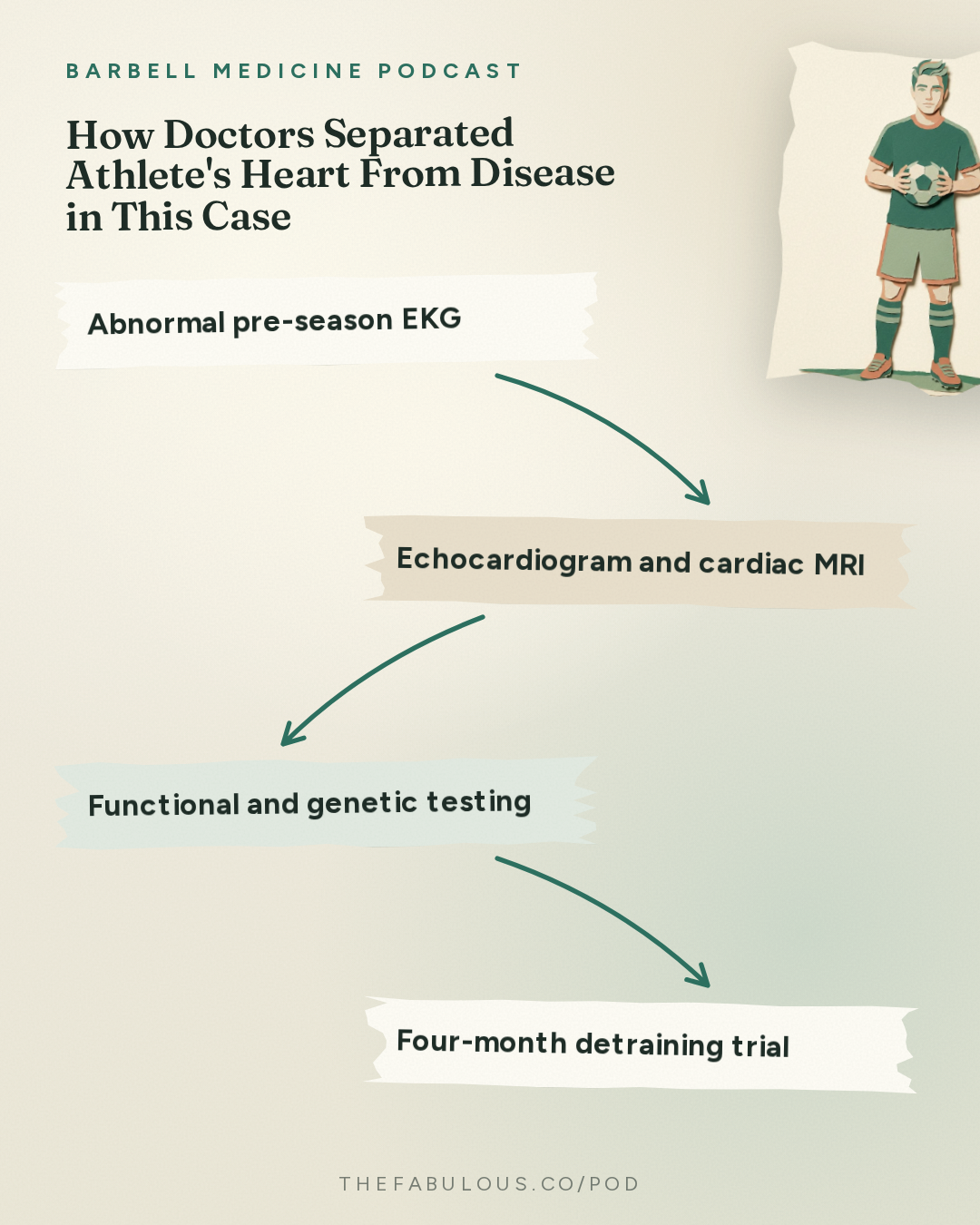
Athlete's Heart vs Hypertrophic Cardiomyopathy
A 22-Year-Old Athlete and a Form Nobody Would Sign (Mystery Case)
The brief
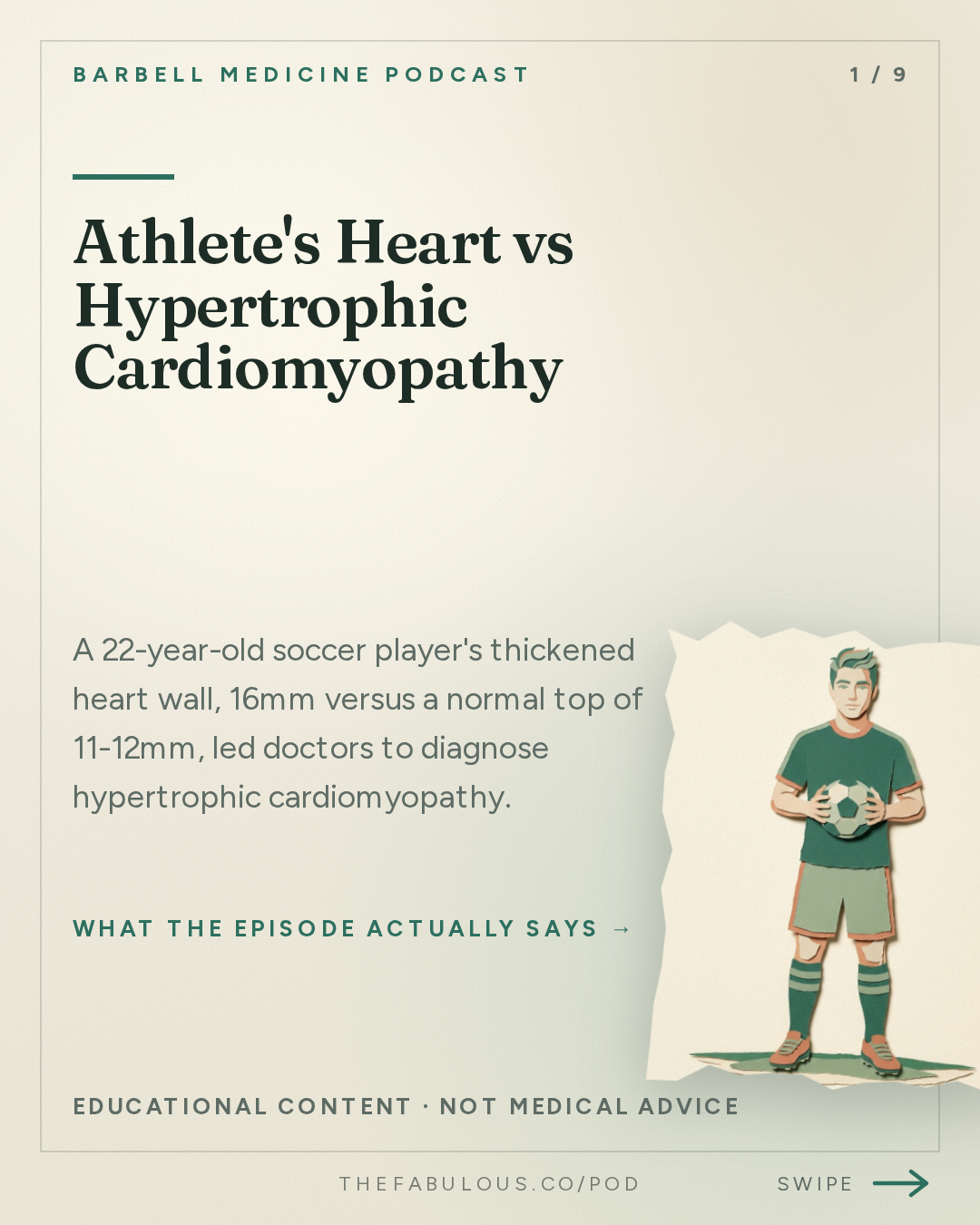
A 22-year-old soccer player's thickened heart wall, 16mm versus a normal top of 11-12mm, led doctors to diagnose hypertrophic cardiomyopathy (13:29). Four months off training shrank the wall to 10mm but doctors kept the diagnosis (24:22). New 2025 AHA/ACC guidance says HCM alone should not bar competitive sport, favoring shared decision-making instead (47:42).
A twenty-two-year-old college soccer player walks into a clinic for a form. He needs a doctor's signature to play this season. He has no chest pain, no fainting spells, no family history of heart trouble, and a normal exam. By every obvious measure he is a healthy young man asking for a routine stamp of approval. He leaves instead with an order to stop playing, because an electrical tracing of his heart looked wrong (00:04).
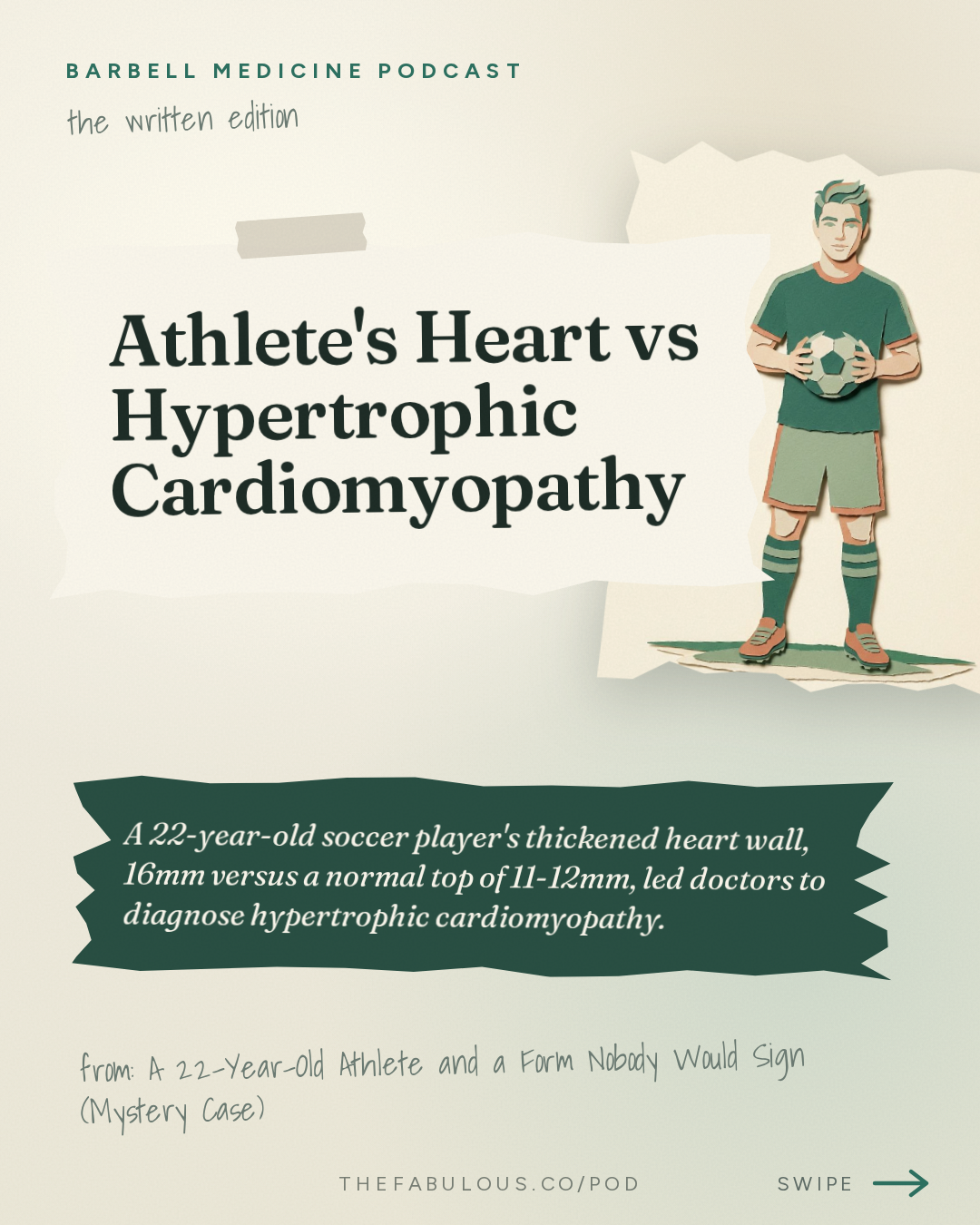
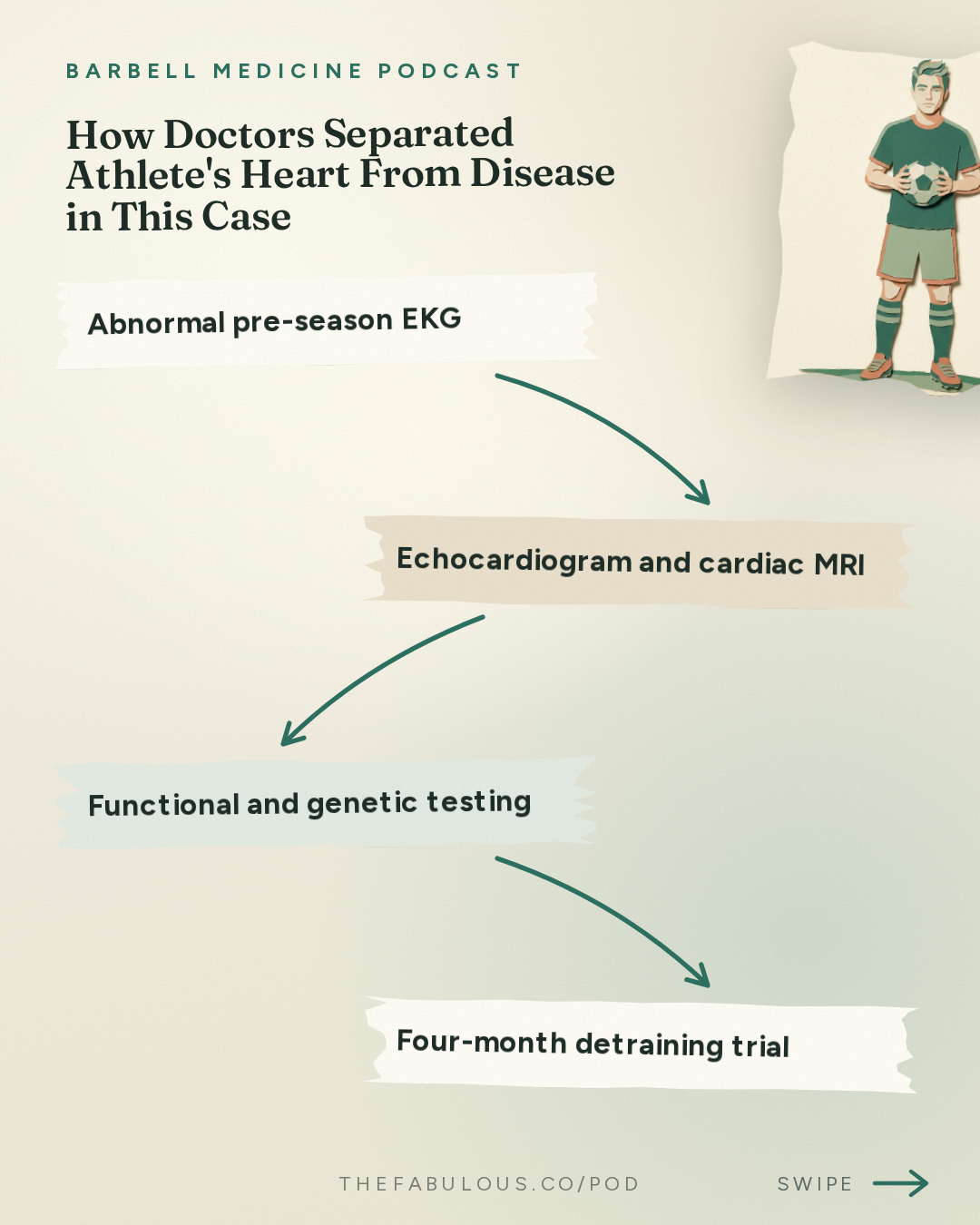
That tracing is an electrocardiogram, or EKG, a recording of the heart's electrical signal from pads on the chest and limbs. His college required one before the season, and his came back showing extra voltage, a sign that often means extra heart muscle, plus inverted T waves (the part of the signal that shows the heart resetting between beats) and a depressed segment where the line should sit flat (05:50). None of this hurt. None of it showed up on exam. But hosts Jordan Feigenbaum and Austin Baraki walk through the case like a detective story, because that kind of abnormal tracing shows up in roughly 3 to 5 percent of all athletes, and when researchers once worked up 155 athletes with inverted T waves like his, they found real heart disease in almost half of them (12:39).
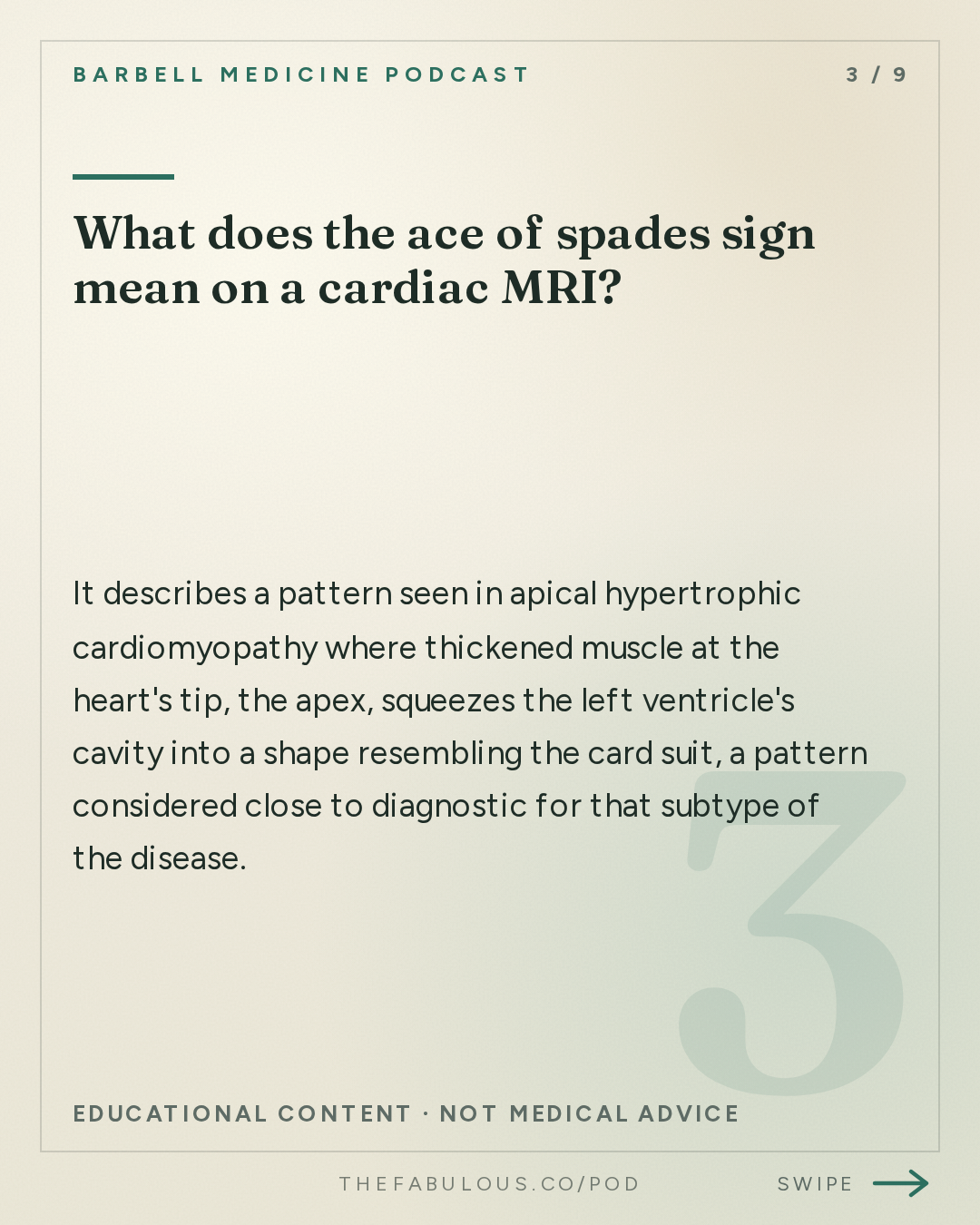
So the workup continued. An echocardiogram, an ultrasound of the heart, showed his left ventricle's wall measuring 16 millimeters at its thickest point, well above the normal ceiling of 11 to 12 millimeters (13:29). A cardiac MRI confirmed it and showed something more specific: the thickened muscle bunched at the tip of the heart, the apex, squeezing the chamber into a shape doctors call the ace of spades, a pattern closely tied to one form of hypertrophic cardiomyopathy, a genetic disease of the heart muscle that can, in its worst form, block blood flow and trigger sudden cardiac arrest (14:03). Everything else, oddly, looked fine: normal pumping strength, no blockage, a stress test where he reached 16 METs (a MET is a multiple of the energy burned at rest, and anything above 10 counts as very fit) with no symptoms, and a genetic panel of ten common HCM genes that came back negative, though more than 1,500 genes have been linked to the disease, so a negative panel does not mean a clear heart (18:03, 20:14).
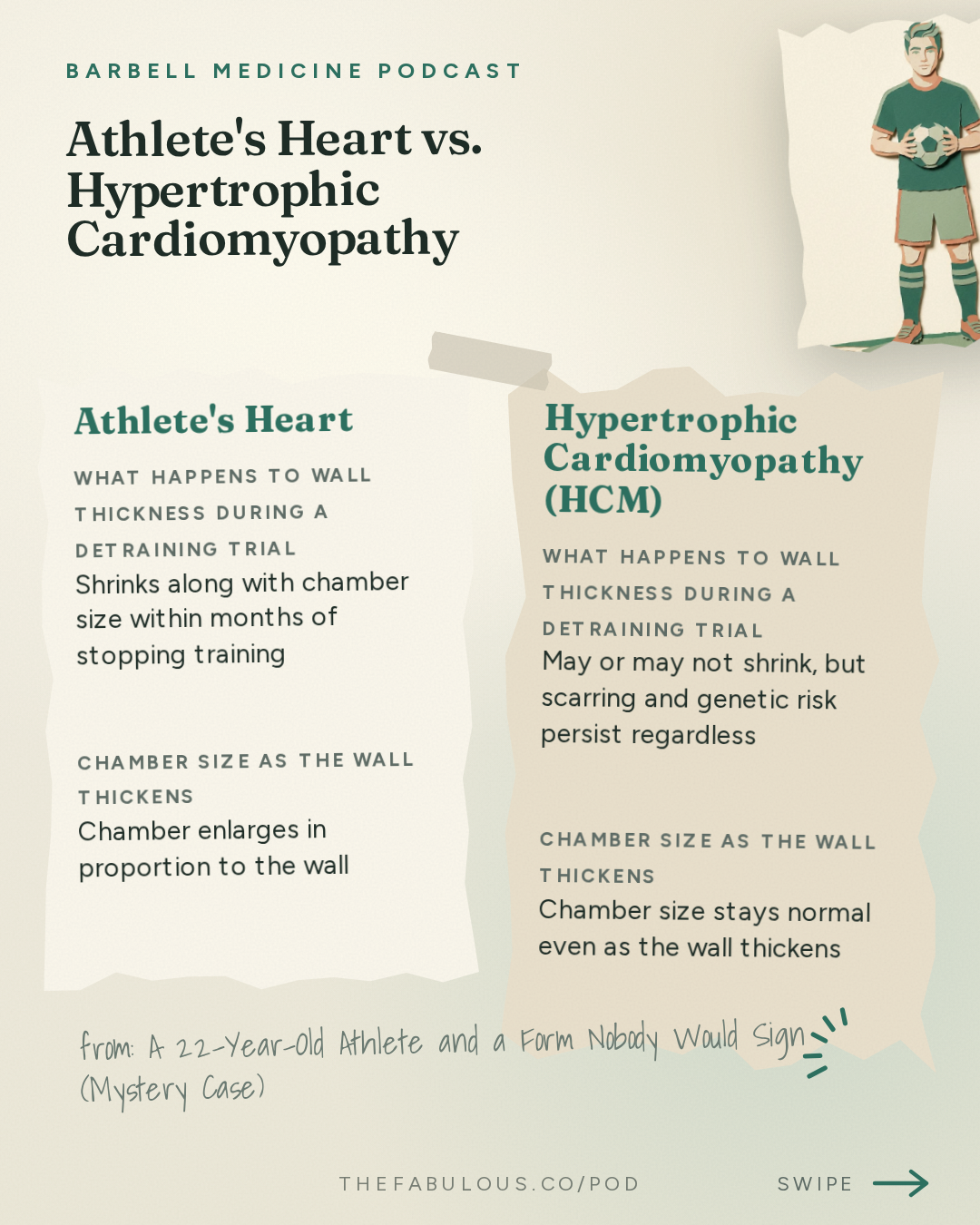
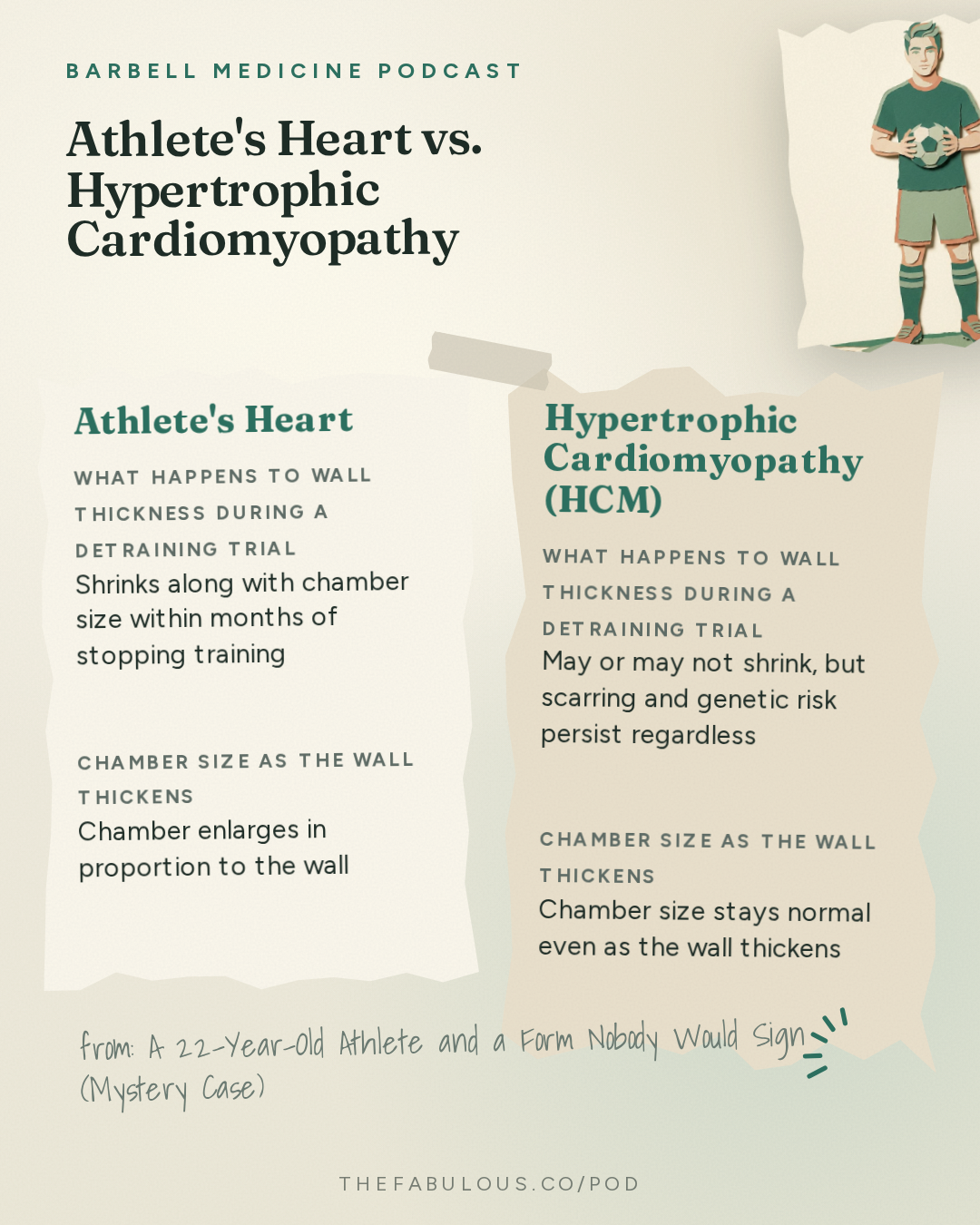
Here is the problem that makes this more than a strange case report. A heart can thicken for two very different reasons. Train hard for years and the heart adapts: the chambers enlarge and the walls thicken together to handle more blood per beat. That is athlete's heart, a normal, reversible change (33:00). Hypertrophic cardiomyopathy also thickens the wall, but without enlarging the chamber, and it does not reverse, because it is not an adaptation, it is a disease written into the muscle's genes. The two can look identical on a single scan. Baraki put the dilemma plainly.
"We're operating in this bigger picture gray zone of probabilities and trying to find like what characteristics are abnormal enough to make us concerned about some risk that we need to try to modify versus what abnormalities might be otherwise explainable and not as risky." (Austin Baraki, [36:42])
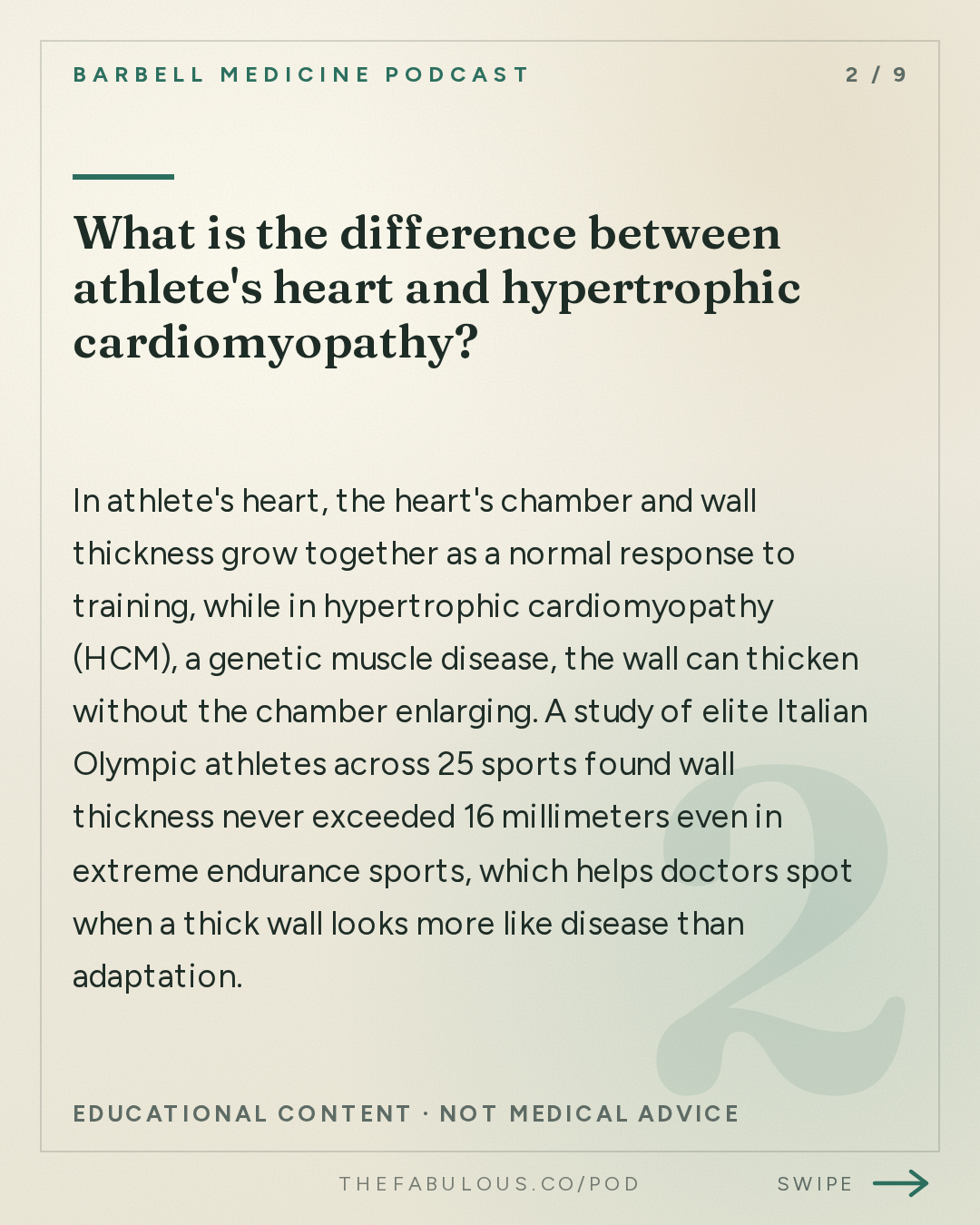
Doctors lean on reference data to narrow that gray zone. A study of elite Italian athletes across 25 Olympic sports found that no wall was ever thicker than 16 millimeters, and the handful who reached 13 millimeters or above, almost all rowers and canoeists, also had enlarged chambers (34:00). This patient had neither of those features: a wall at the very top of that range, no chamber enlargement, asymmetrical thickening at the apex, and a sport that produces far less cardiac stress than rowing. Four signs pointed the same direction. But that Italian reference group was overwhelmingly white, and heart thickness varies by ancestry. Black athletes run thicker walls than white athletes as a group: in some studies about one in ten African American and Caribbean athletes exceed 12 millimeters, and a few percent exceed 15 millimeters, ranges almost never seen among white athletes in the same studies, while athletes from North or East Africa do not show the same pattern once body size is factored in (38:33). A chart built on one population can mislead when applied to someone it was never built to describe.
Doctors also tried detraining, meaning they stopped the patient's exercise and rechecked his heart later, on the logic that an adaptation should shrink once training disappears while a disease should not care. After four months away from soccer, his wall dropped from 16 to 10 millimeters and his EKG improved (24:22). That sounds like a vindication of athlete's heart. His doctors disagreed, because a true physiological heart shrinks in both wall and chamber together, and his chamber never changed size, only the wall did. They kept the diagnosis of apical hypertrophic cardiomyopathy.
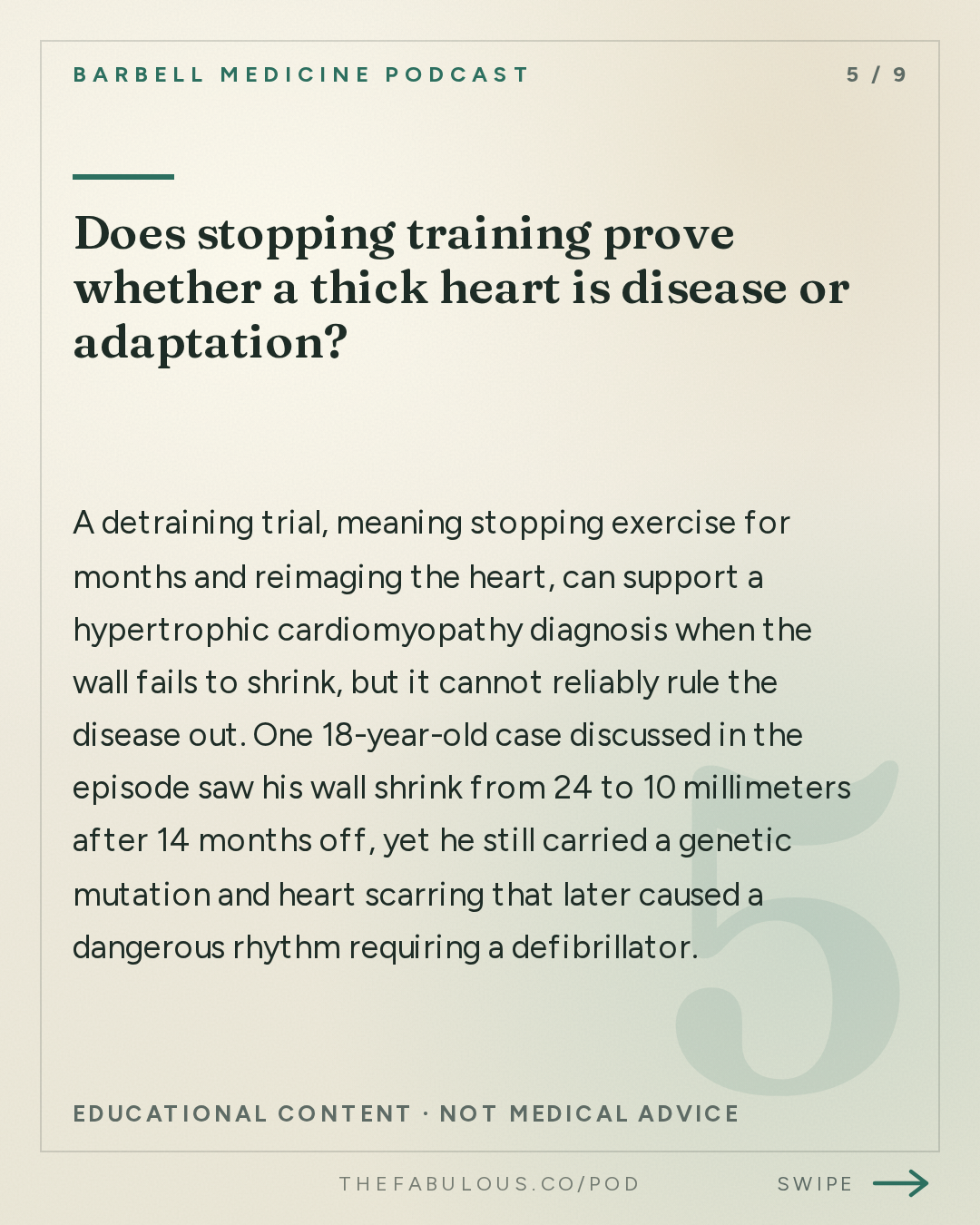
A second case in the episode shows why that caution matters. An eighteen-year-old hockey prospect, flagged at a scouting event, had a wall measuring 24 millimeters, visible scarring on MRI, and a genetic mutation tied to the disease. After fourteen months without training his wall fell to 10 millimeters and his EKG nearly normalized, a result that looks like a full reversal. The scar tissue on his MRI never went away. Two months later he felt dizzy during exercise, a monitor caught a dangerous heart rhythm, and he received an implanted defibrillator. Detraining can rule a disease in, when the heart refuses to shrink, but it cannot reliably rule one out, because scarring and genetic risk do not regress just because a patient stops playing (42:59).
What the 2025 guidelines actually changed
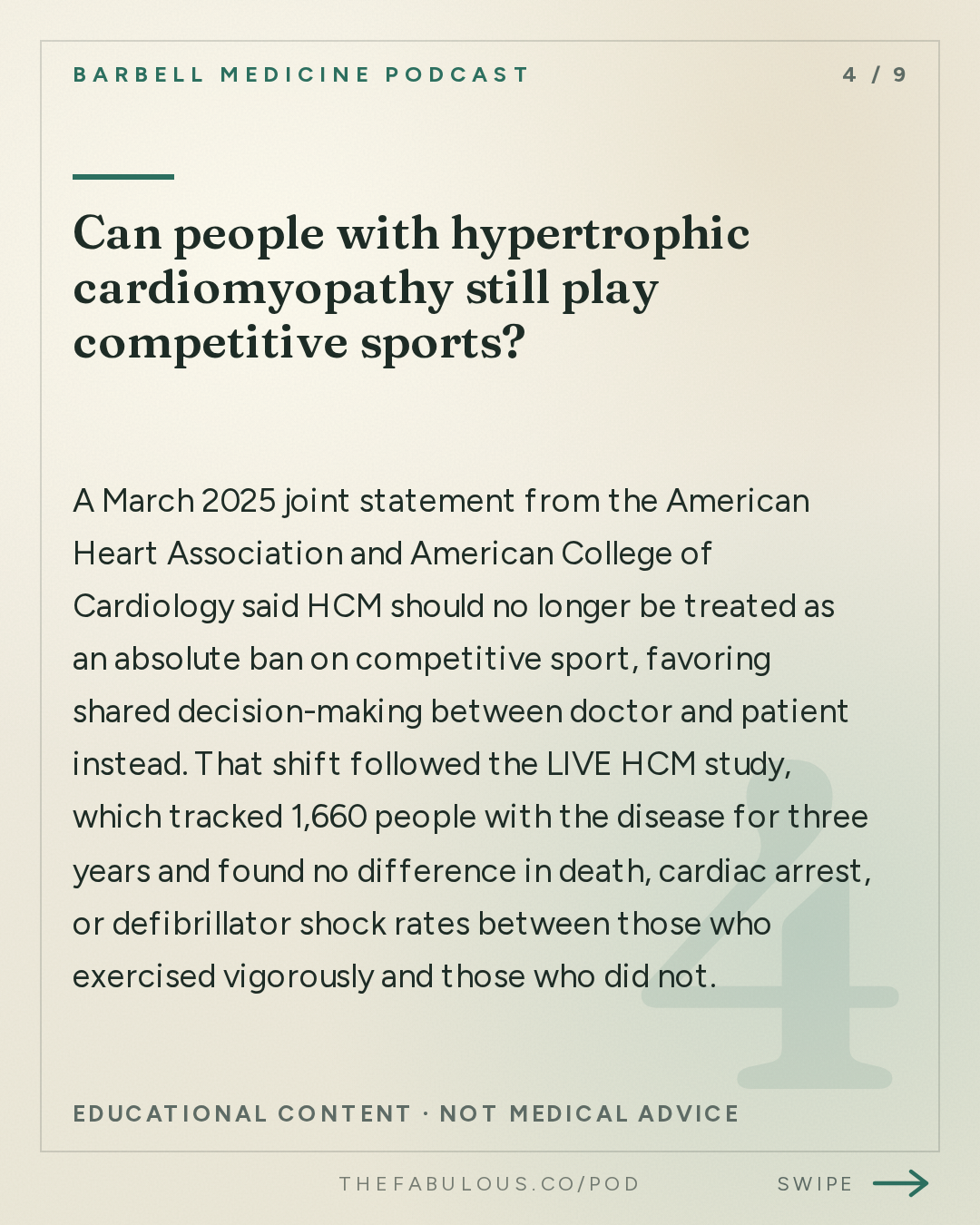
For four decades the standard advice for anyone diagnosed with hypertrophic cardiomyopathy was simple and blunt: stop competing. That rule is being revised. A study called LIVE HCM followed 1,660 people with the disease for three years, many of them exercising hard or still competing against medical advice, and found the rate of death, cardiac arrest, and defibrillator shocks was essentially the same whether they exercised vigorously or not (46:06). A separate seven-year study of 88 adult athletes with the disease found the same pattern: those who kept competing and those who scaled back had statistically indistinguishable outcomes (46:33). In March 2025 the American Heart Association and the American College of Cardiology, the two major U.S. cardiology professional organizations, issued a joint statement reflecting that evidence.
"A diagnosis of hypertrophic cardiomyopathy should not be an absolute contraindication to sport or vigorous exercise." (Jordan Feigenbaum, quoting the 2025 AHA/ACC statement, [47:42])
In its place is a murkier standard called shared decision-making, meaning the patient and clinician weigh an uncertain risk together rather than following a blanket rule. Feigenbaum argues that applied to this soccer player, the newer framework would likely have cleared him to keep playing, given his lack of symptoms, lack of scarring, and strong stress test result. Instead, his actual doctors told him to stop, and according to the case report he did, with no further symptoms but no soccer either (28:19).
The screening question nobody wants to answer with a price tag
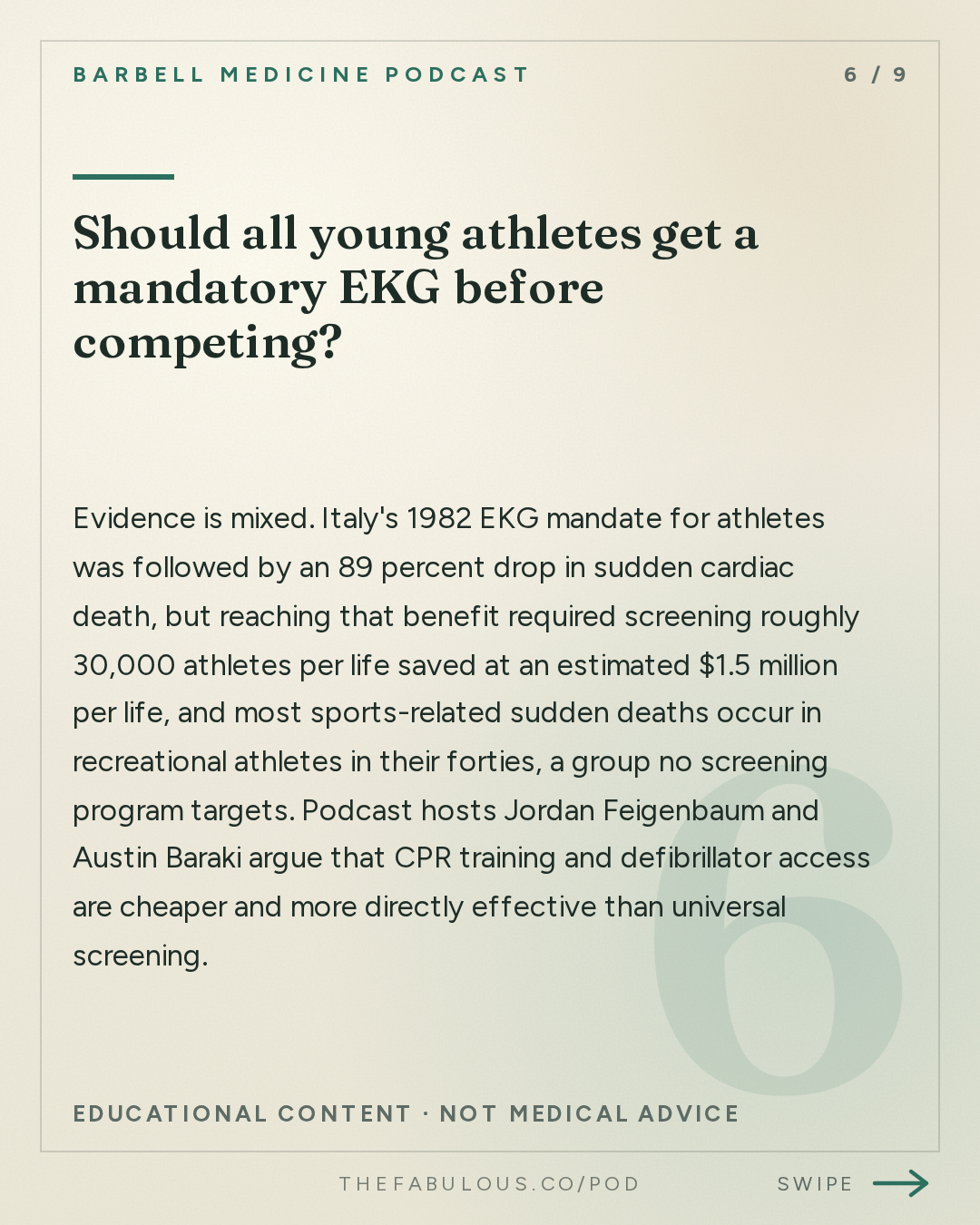
The episode's last turn is about policy, not this one patient. Should every young athlete get an EKG before competing, the way U.S. pro leagues require and the way Italian law has required since 1982? The case for it: EKGs catch roughly nine in ten of the conditions screening aims to find, compared with about one in ten for a physical exam alone, and the standard history questionnaire used in American college sports produces false positives roughly a third of the time in NCAA athletes, ten times the false positive rate of the EKG itself (50:21). After Italy's 1982 mandate, researchers reported an 89 percent drop in sudden death among competitive athletes; Israel passed a similar law in 1997 and saw a comparable 87 percent drop (51:11).
The case against a blanket mandate is arithmetic. Reaching that one saved life takes screening roughly 30,000 athletes, at an estimated cost of 1.5 million dollars per life, before paying for any follow-up testing triggered by an abnormal reading (52:03). Only about 6 percent of sports-related sudden cardiac deaths happen in competitive athletes in the first place; most occur in recreational athletes in their forties, a group no screening program targets. In roughly 40 percent of sudden deaths in younger people, the autopsy finds no structural problem at all, meaning an EKG would have found nothing to catch (52:33).
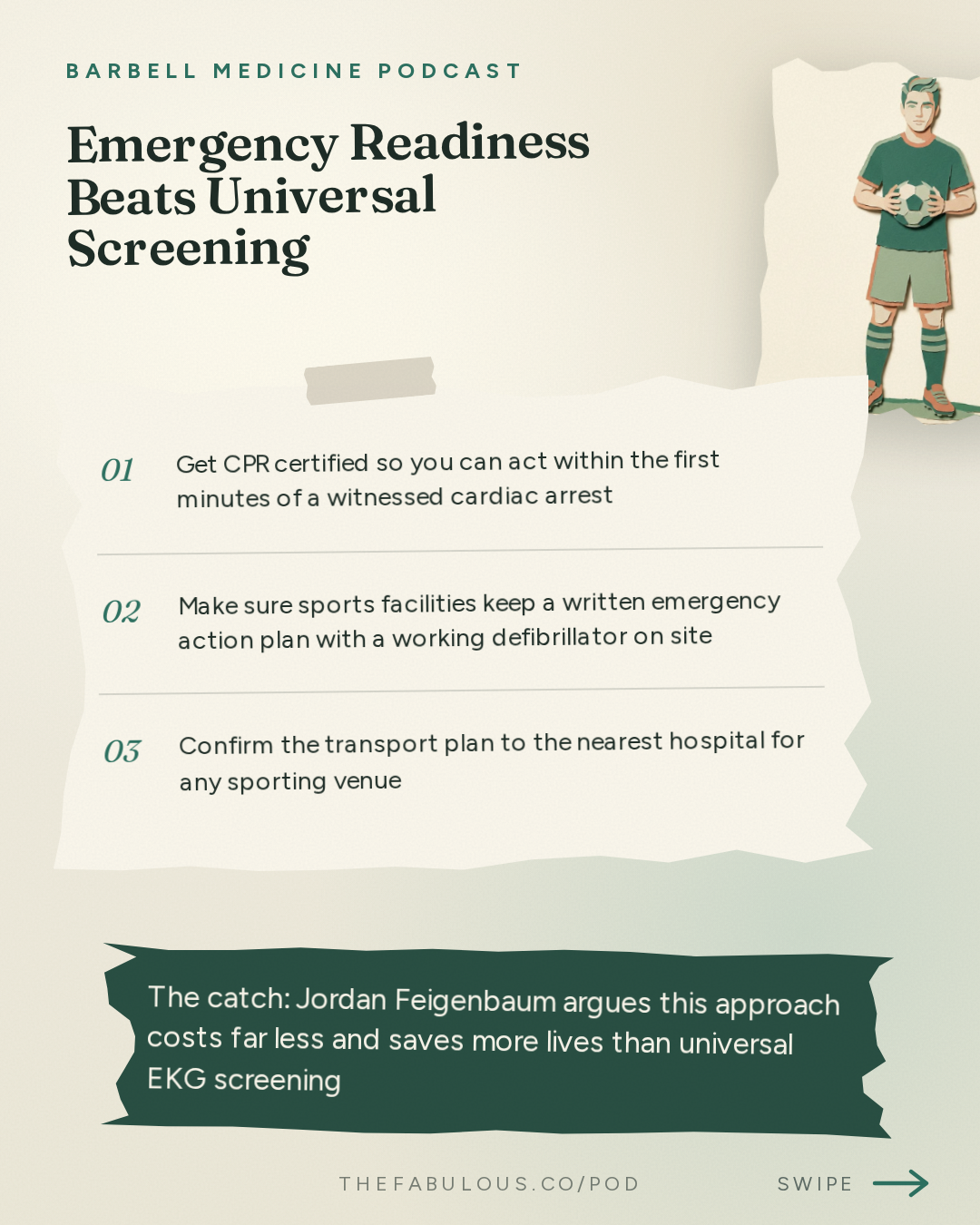
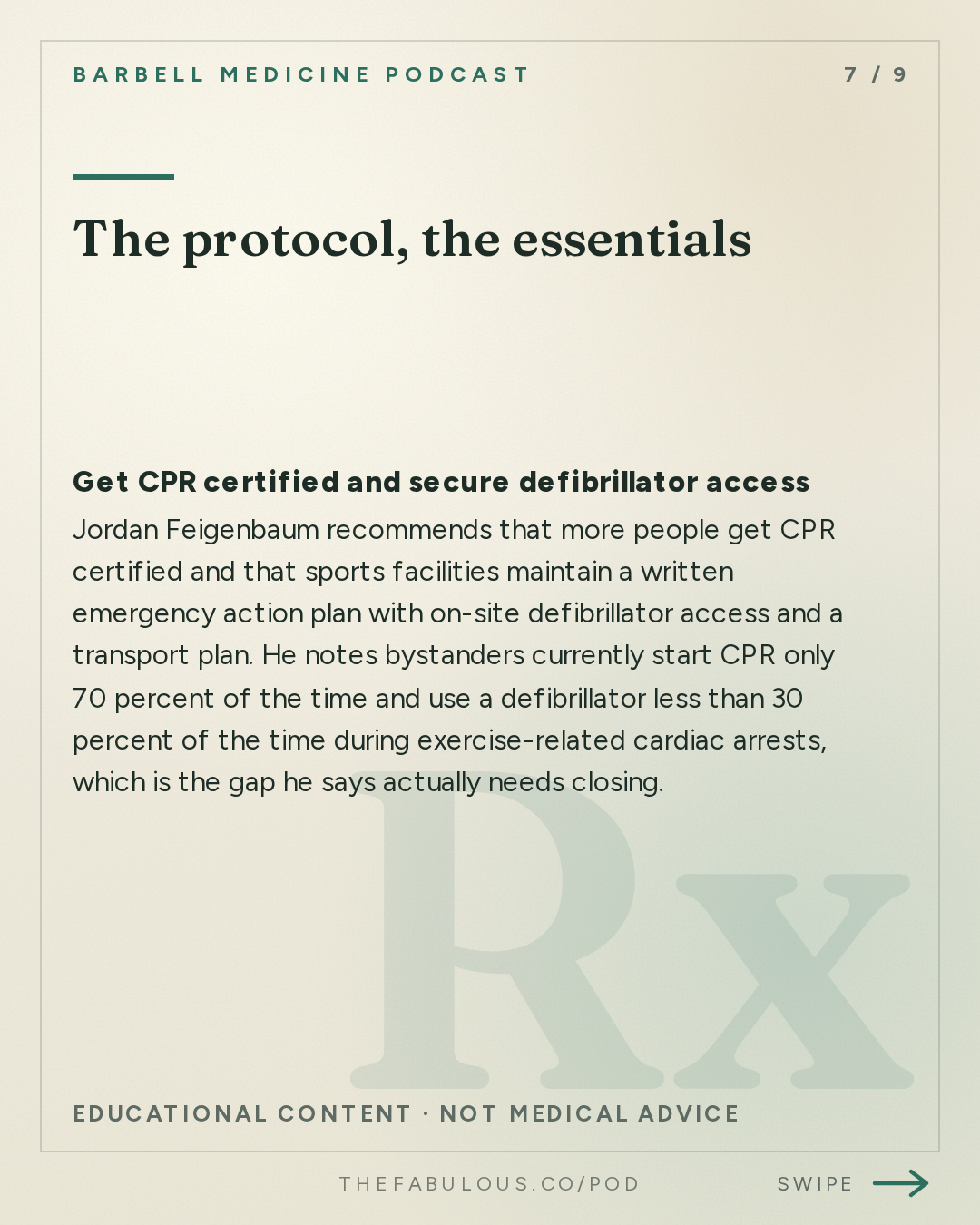
Baraki and Feigenbaum land somewhere more modest, and they argue more effective: fix the emergency response instead of chasing a perfect test. Studies of exercise-related cardiac arrest found bystanders start CPR only 70 percent of the time and reach for a defibrillator less than 30 percent of the time, while U.S. high schools with defibrillator programs in place saw survival rates near two-thirds when someone did go into arrest (60:05).
"More people should be CPR certified. I feel pretty confident in saying that, particularly having an emergency action plan in place." (Jordan Feigenbaum, [59:37])
That closing argument reframes the whole episode. The soccer player's case is genuinely hard, a gray zone where careful doctors can defensibly disagree about what a sixteen-millimeter wall means. But the thing most likely to save a stranger's life on a soccer field is not a better MRI reading. It is whether the person standing next to them knows how to do chest compressions and where the defibrillator is kept.
Ask this episode anything
Pod's AI answers from the episode itself, with the minute mark so you can hear it yourself.
Or start with one of these
Ask this episode
Pod's AI listens to the whole episode to answer, and points you to the minute it comes from.
The rest of this answer, and any question after it
Answers come from the episode itself, never from a summary of it.
ContinueKey takeaways
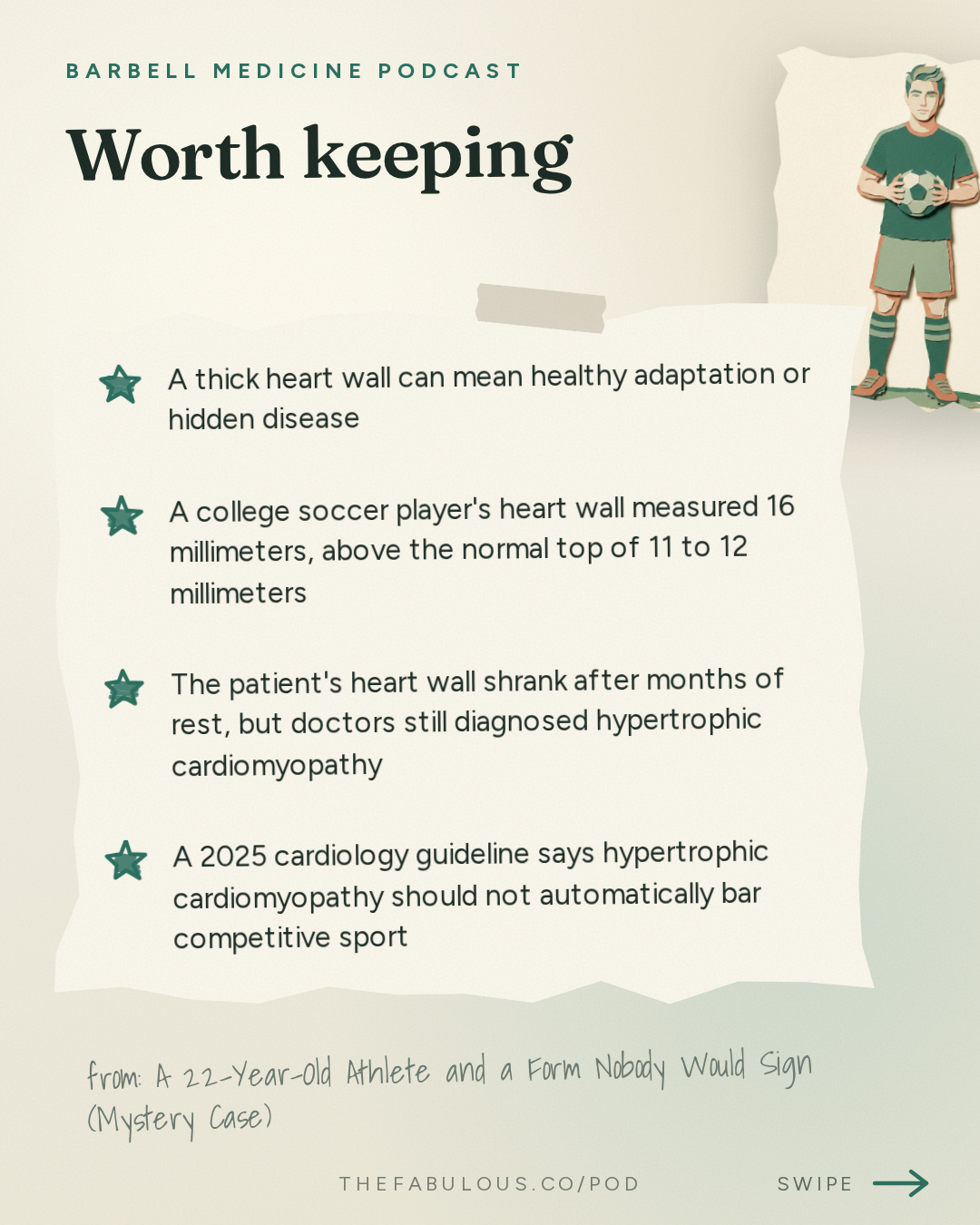
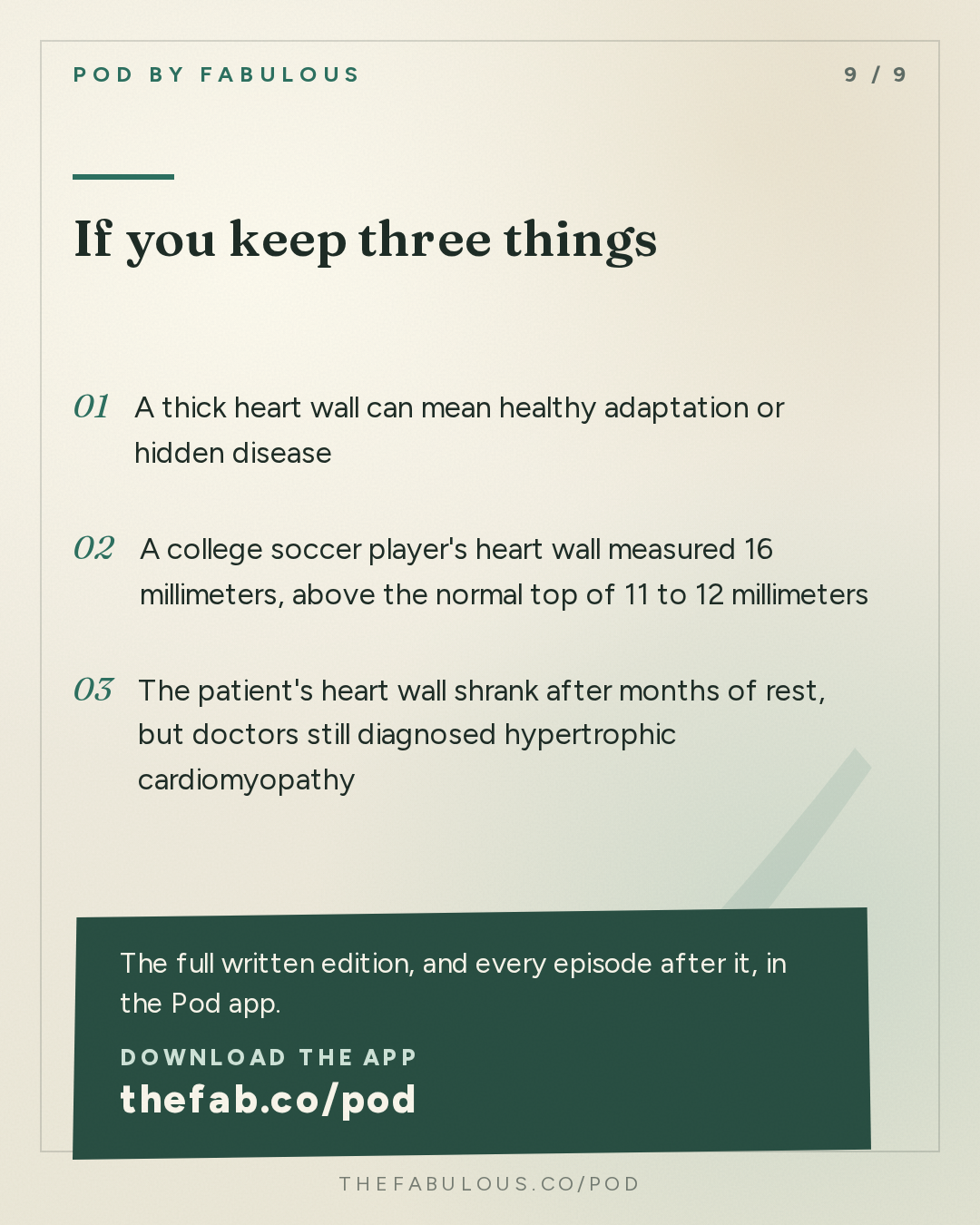
- A thick heart wall can mean healthy adaptation or hidden disease
- A college soccer player's heart wall measured 16 millimeters, above the normal top of 11 to 12 millimeters
- The patient's heart wall shrank after months of rest, but doctors still diagnosed hypertrophic cardiomyopathy
- A 2025 cardiology guideline says hypertrophic cardiomyopathy should not automatically bar competitive sport
- CPR training and defibrillator access may prevent more deaths than universal athlete EKG screening
The episode in cards

By the numbers
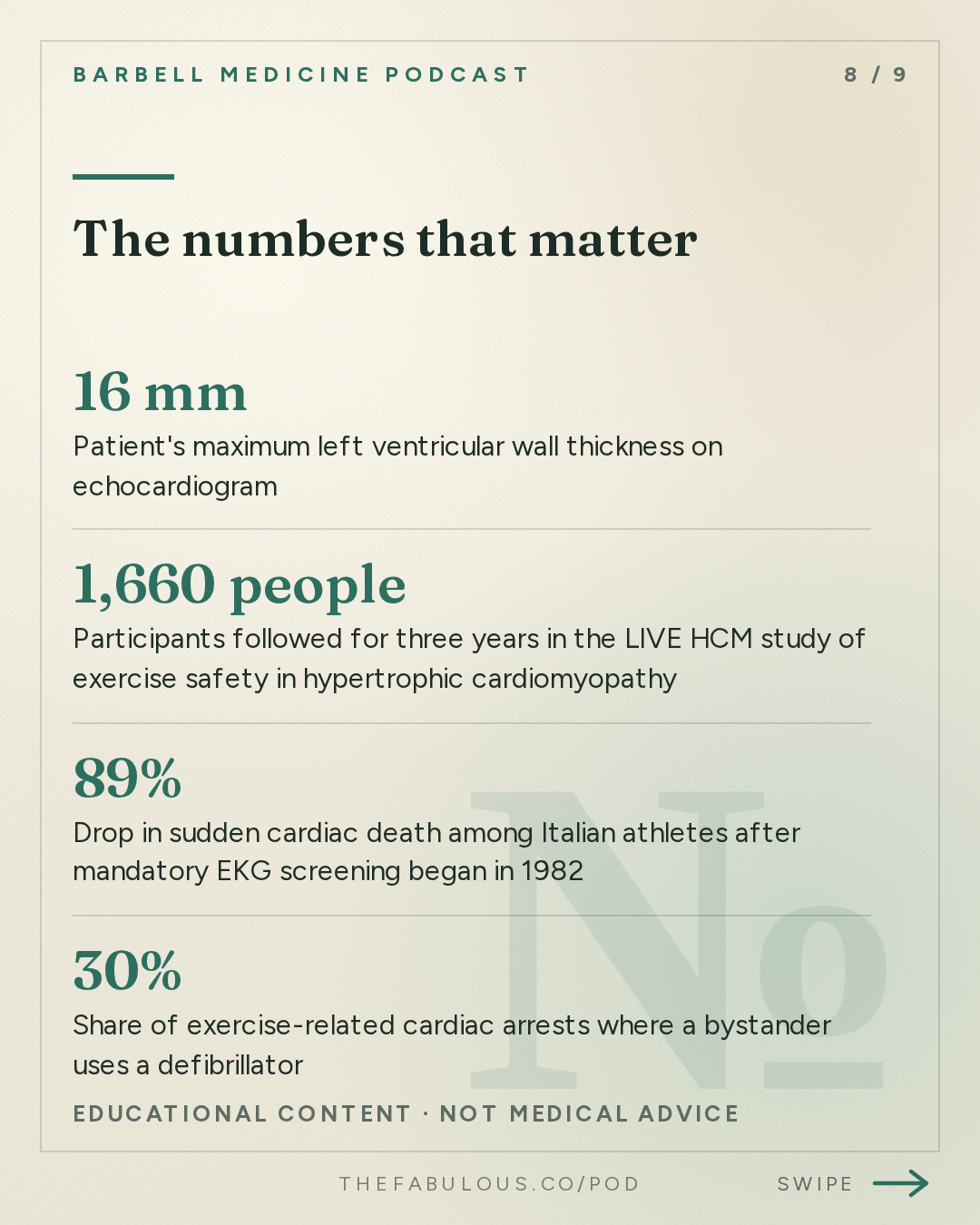
- 16 mm Patient's maximum left ventricular wall thickness on echocardiogram
- 1,660 people Participants followed for three years in the LIVE HCM study of exercise safety in hypertrophic cardiomyopathy
- 89% percent Drop in sudden cardiac death among Italian athletes after mandatory EKG screening began in 1982
- 30% percent Share of exercise-related cardiac arrests where a bystander uses a defibrillator
In their words
“Telling a healthy 22-year-old to stop exercising is a weird medical intervention, so today you get to decide, was this the right call?”
“We're operating in this bigger picture gray zone of probabilities and trying to find like what characteristics are abnormal enough to make us concerned about some risk that we need to try to modify versus what abnormalities might be otherwise explainable and not as risky.”
“Detraining really can only rule in sort of hypertrophic cardiomyopathy, but it can't rule it out.”
“A diagnosis of hypertrophic cardiomyopathy should not be an absolute contraindication to sport or vigorous exercise.”
“More people should be CPR certified. Um, I feel pretty confident in saying that, particularly having an emergency action plan in place”
Protocols
-
Get CPR certified and secure defibrillator access
Jordan Feigenbaum recommends that more people get CPR certified and that sports facilities maintain a written emergency action plan with on-site defibrillator access and a transport plan. He notes bystanders currently start CPR only 70 percent of the time and use a defibrillator less than 30 percent of the time during exercise-related cardiac arrests, which is the gap he says actually needs closing.
ongoing, with facility plans kept current
-
Monitor low-risk apical HCM instead of banning sport outright
Austin Baraki says a clinician can clear a low-risk hypertrophic cardiomyopathy phenotype, meaning no scarring, no dangerous rhythms, and strong exercise capacity, for competition through shared decision-making, then recheck the heart by echocardiogram every six to twelve months. He cautions this monitoring plan is not a guarantee, since the disease can still progress to a higher-risk pattern over time.
echocardiogram every 6 to 12 months
-
Use a detraining trial to help separate athlete's heart from disease
Baraki and Feigenbaum describe a detraining trial, which means stopping sport for several months and then reimaging the heart, as a way to help confirm hypertrophic cardiomyopathy when wall thickness fails to shrink. The same test cannot reliably rule the disease out, because scarring and genetic risk can persist even if the wall thickness drops.
4 months or longer, case by case
Questions this episode answers
What is the difference between athlete's heart and hypertrophic cardiomyopathy?
In athlete's heart, the heart's chamber and wall thickness grow together as a normal response to training, while in hypertrophic cardiomyopathy (HCM), a genetic muscle disease, the wall can thicken without the chamber enlarging (33:00). A study of elite Italian Olympic athletes across 25 sports found wall thickness never exceeded 16 millimeters even in extreme endurance sports, which helps doctors spot when a thick wall looks more like disease than adaptation (34:00).
What does the ace of spades sign mean on a cardiac MRI?
It describes a pattern seen in apical hypertrophic cardiomyopathy where thickened muscle at the heart's tip, the apex, squeezes the left ventricle's cavity into a shape resembling the card suit, a pattern considered close to diagnostic for that subtype of the disease (14:03).
Can people with hypertrophic cardiomyopathy still play competitive sports?
A March 2025 joint statement from the American Heart Association and American College of Cardiology said HCM should no longer be treated as an absolute ban on competitive sport, favoring shared decision-making between doctor and patient instead (47:42). That shift followed the LIVE HCM study, which tracked 1,660 people with the disease for three years and found no difference in death, cardiac arrest, or defibrillator shock rates between those who exercised vigorously and those who did not (46:06).
Does stopping training prove whether a thick heart is disease or adaptation?
A detraining trial, meaning stopping exercise for months and reimaging the heart, can support a hypertrophic cardiomyopathy diagnosis when the wall fails to shrink, but it cannot reliably rule the disease out. One 18-year-old case discussed in the episode saw his wall shrink from 24 to 10 millimeters after 14 months off, yet he still carried a genetic mutation and heart scarring that later caused a dangerous rhythm requiring a defibrillator (41:02).
Should all young athletes get a mandatory EKG before competing?
Evidence is mixed. Italy's 1982 EKG mandate for athletes was followed by an 89 percent drop in sudden cardiac death, but reaching that benefit required screening roughly 30,000 athletes per life saved at an estimated $1.5 million per life, and most sports-related sudden deaths occur in recreational athletes in their forties, a group no screening program targets (51:11, 52:33). Podcast hosts Jordan Feigenbaum and Austin Baraki argue that CPR training and defibrillator access are cheaper and more directly effective than universal screening (59:37).
The full read, in cards
Go deeper
- LIVE HCM study — followed 1,660 people with hypertrophic cardiomyopathy for three years and found no difference in death or cardiac arrest rates between vigorous exercisers and non-exercisers
- 1980s study of elite Italian Olympic athletes — found wall thickness never exceeded 16 millimeters across 25 sports, establishing a reference range for athlete's heart
- Case series of 155 athletes with T-wave inversion on EKG — found identifiable cardiac disease in almost half of the athletes who showed this EKG pattern
- 2025 AHA/ACC scientific statement on hypertrophic cardiomyopathy and sport — stated HCM should no longer be an absolute contraindication to competitive sport
- NCAA athlete screening comparison study — found the AHA 12-point questionnaire had a 33 percent false positive rate versus under 4 percent for EKG
Mentioned
Jordan Feigenbaum · Austin Baraki · Hypertrophic Cardiomyopathy · LIVE HCM · American Heart Association · American College of Cardiology
More from this show and category

Biohacking Protocols: What the Evidence Shows
Barbell Medicine's Halloween episode uses a dystopian 2049 fiction, a man named Dale Mercer living under a machine called Soma, to grade today's real biohacking trends against clinical trial data. Morning light panels, cold plunges, NAD supplements, gray market peptides, HRV scores, and CGMs mostly fail to beat placebo in healthy people, while creatine, adequate protein, and consistent sleep hold up.

How Much Cardio Is Too Much for Your Heart?
More cardio keeps lowering mortality risk with no measured ceiling, but atrial fibrillation risk rises past roughly 3.5 times the exercise guidelines. Barbell Medicine physician Jordan Feigenbaum recommends about 300 minutes of moderate cardio weekly, mostly at 60 to 80% max heart rate, while debunking the viral claim that hard running is as deadly as sitting.

How Much Lifting Is Enough for Health?
Public health guidelines recommend lifting twice a week, but the study behind that number found three days worked better. Jordan Feigenbaum argues lifting doesn't hurt the heart, carries lower injury risk than running, and shows no real ceiling for strength, bone density, or metabolic benefits, so most people should train roughly double the current guideline.
Why Lifting Heavy Was Called Dangerous
In 1985 a panel of obstetricians banned pregnant women from raising their heart rate past 140 beats per minute, a number invented by consensus, not data (00:01). The same pattern, rules built on vibes rather than evidence, shaped a century of bans on heavy lifting for women, children, and anyone squatting below parallel, until later studies quietly reversed nearly all of them.
