
Peter Attia on Liver Health and Metabolic Disease
#405 ‒ AMA #88: Metabolic liver health: how to assess risk, catch dysfunction early, and prevent or reverse liver disease
▶ Listen to the full episode More from The Peter Attia Drive
The brief
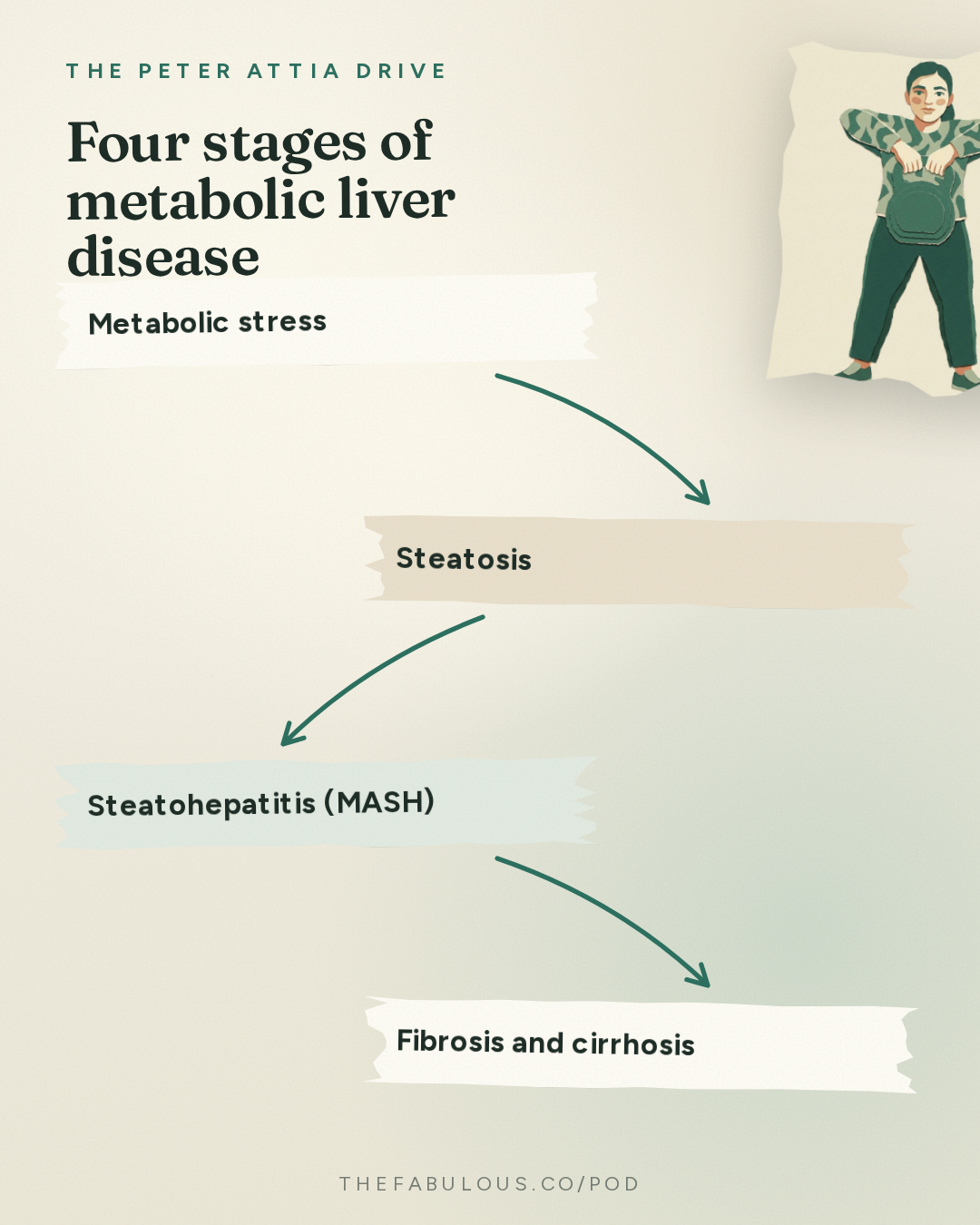
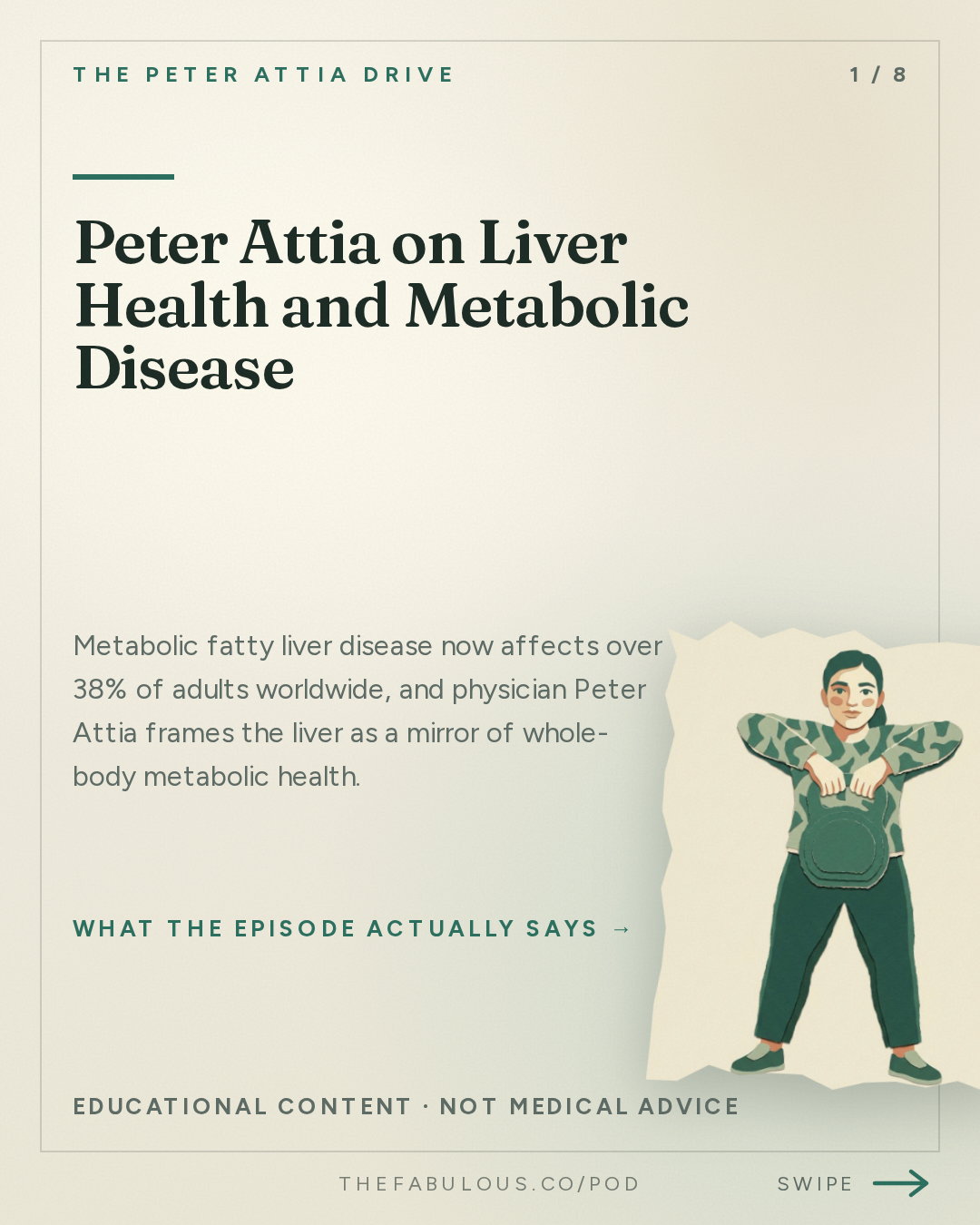
Metabolic fatty liver disease now affects over 38% of adults worldwide, and physician Peter Attia frames the liver as a mirror of whole-body metabolic health. The disease moves through four stages, from metabolic stress to steatosis, steatohepatitis, and fibrosis, and the first three stages are largely reversible through weight loss, muscle gain, and cutting alcohol and liquid sugar calories.
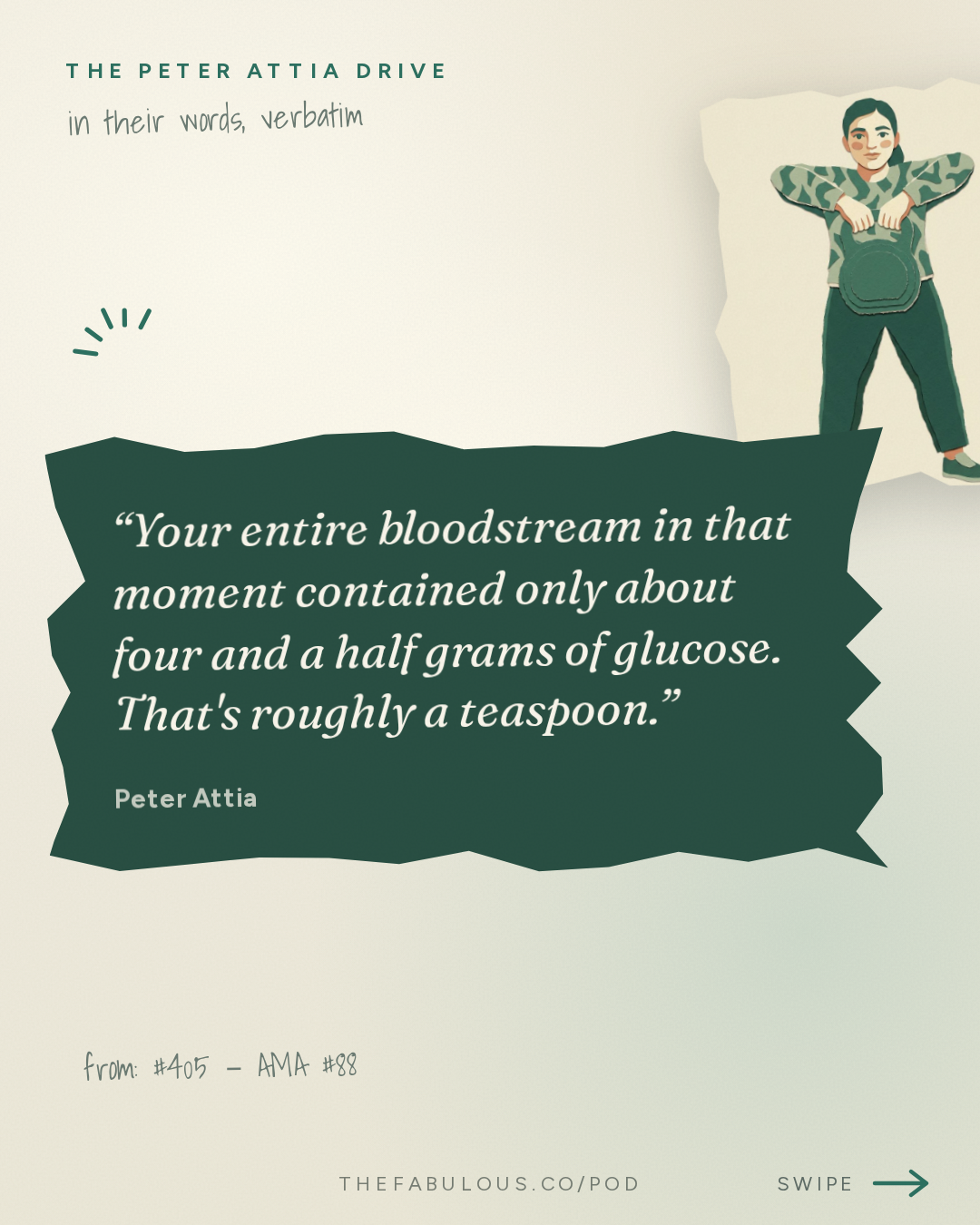
Draw blood from a healthy person first thing in the morning and measure the sugar in it, and the number that comes back represents something almost absurdly small. According to physician Peter Attia, a fasting glucose reading of 90 milligrams per deciliter means the entire bloodstream, all of it, holds about four and a half grams of glucose (08:03). That is roughly a teaspoon. A single meal can deliver twenty times that amount, yet a healthy body rarely lets blood sugar rise more than a teaspoon above baseline. Attia calls this a monumental feat of homeostasis, the body's ability to keep internal conditions stable. The organ doing most of that work, quietly, is the liver.
Attia has long described the liver as a canary in the coal mine for metabolic dysfunction, an early warning system for problems that will eventually show up everywhere else in the body. The metaphor holds up under scrutiny. The liver sits at the center of how the body handles glucose, fat, protein, and cholesterol, and it is one of the first organs to both cause and absorb metabolic stress. When circulating triglycerides climb, the liver is involved. When blood sugar regulation slips, the liver is involved. When ApoB, a protein that marks the cholesterol-carrying particles linked to heart disease, starts climbing, the liver made those particles in the first place. Attia's clinical framing is blunt.
Dysfunction of the liver is more of a parallel expression of systemic metabolic dysfunction. Peter Attia [03:41]
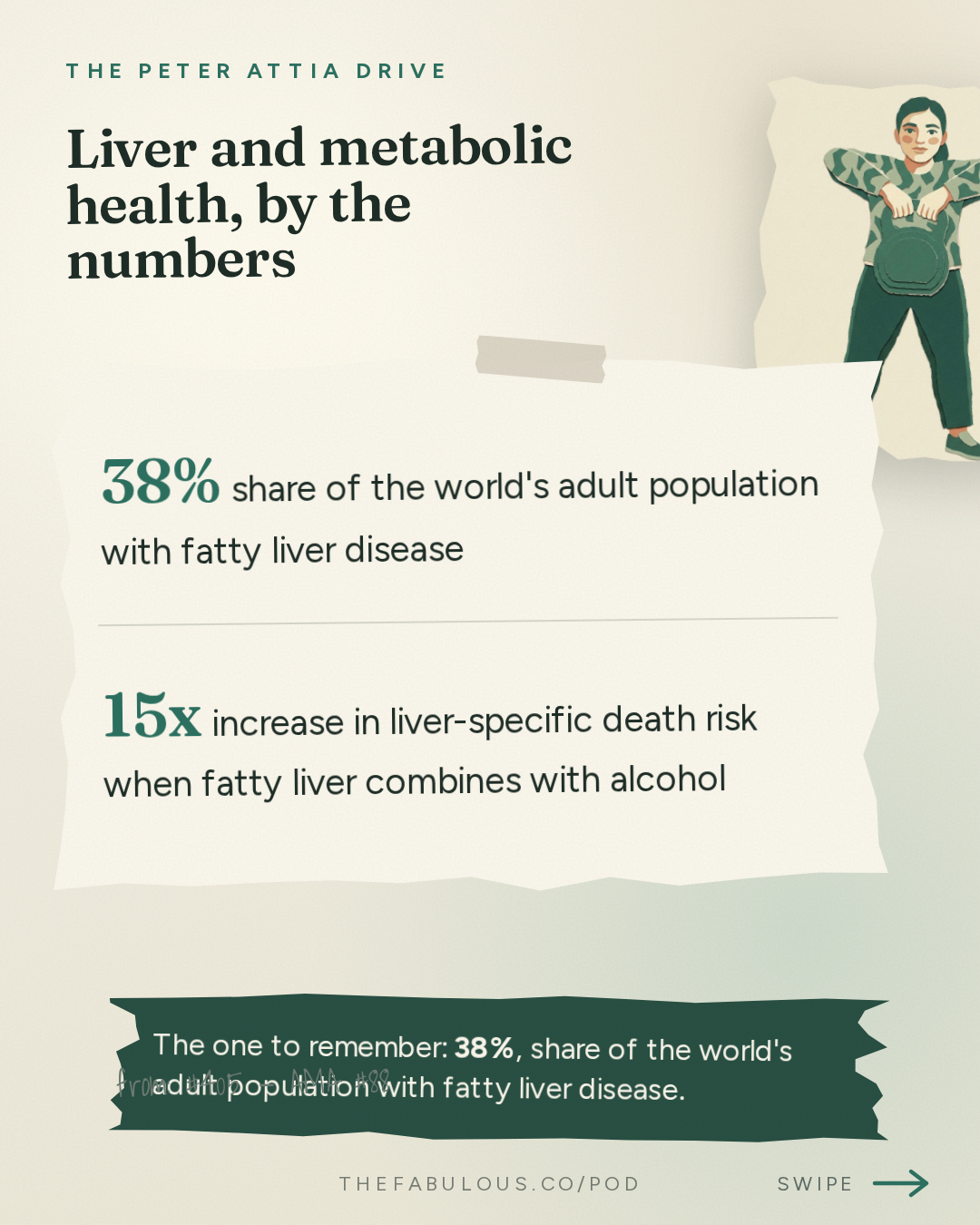
That reframing matters because it changes what patients should worry about. The leading cause of death in people with liver disease is not liver failure. It is cardiovascular disease, because a stressed liver overproduces the particles that drive plaque buildup in arteries (03:41). This is not a rare problem. Fatty liver disease, now estimated to affect more than 38% of the world's adult population, is not confined to heavy drinkers or the visibly overweight (04:12). Most public conversation about the liver still centers on detox teas and cleanses, while the organ itself has more than 300 distinct jobs, from clotting factors to immune surveillance of gut bacteria to manufacturing the proteins that carry fat through blood (05:03).
Four Stages, Three Reversible
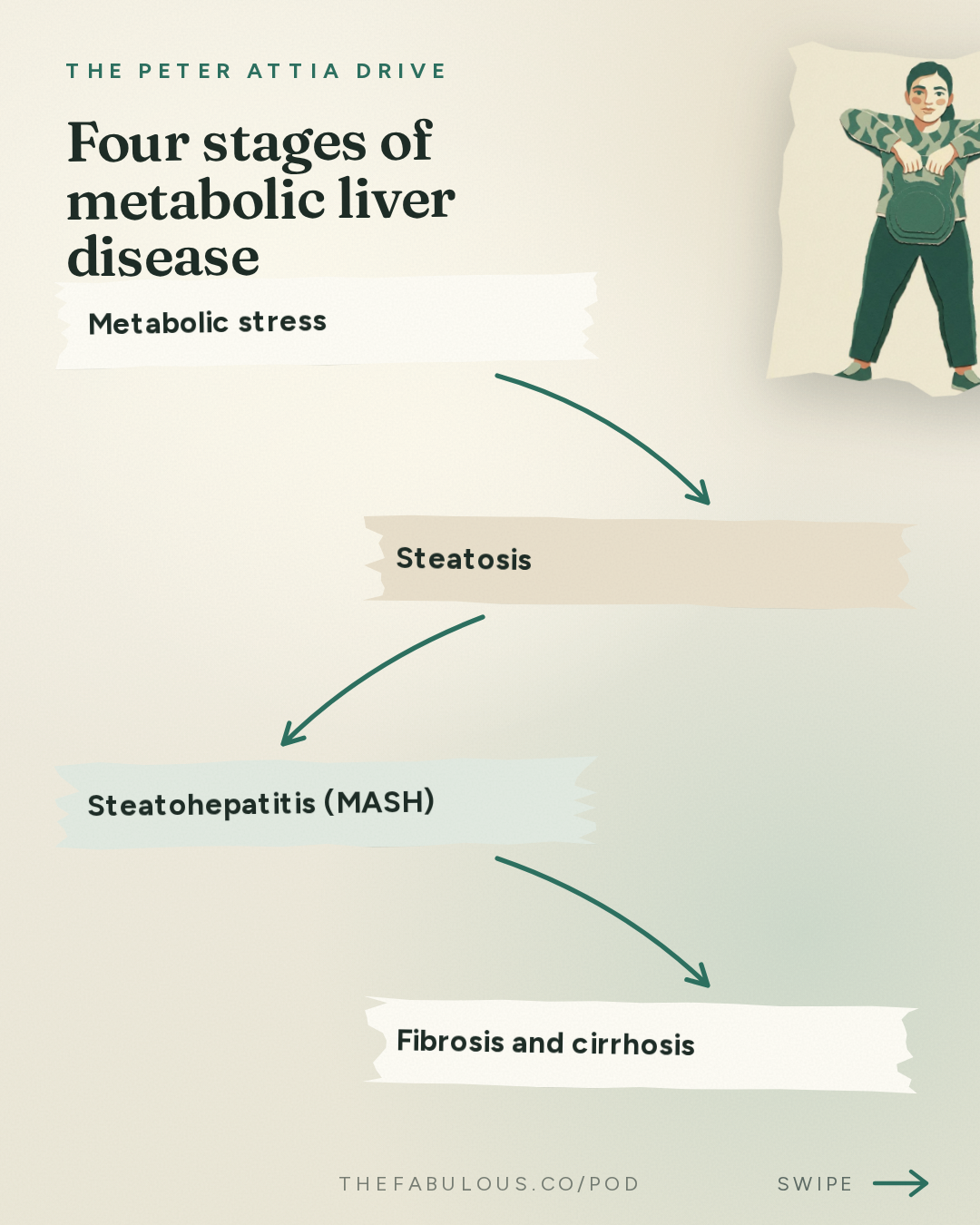
Attia organizes metabolic liver disease into four stages, and the order matters because it tells patients how much room they have to act. In the first stage, the liver becomes metabolically stressed as a chronic calorie surplus forces fat cells to overfill; once full, those fat cells resist insulin's signal to keep storing fat and start leaking fatty acids back into the blood, adding to the liver's burden (10:05). In the second stage, called steatosis, the liver's capacity to package and export fat as triglycerides falls behind the rate fat is arriving, so fat accumulates inside liver cells (15:28). In the third stage, steatohepatitis, overloaded liver cells begin to die, and their death recruits immune cells that spread inflammation and insulin resistance to neighboring cells in a feed-forward loop (19:15). The fourth stage is fibrosis, the liver's scar-tissue response to repeated injury, which can progress to cirrhosis, the point at which so much functioning tissue is replaced that the organ can no longer do its job (19:47).
The good news, according to Attia, is that the first three stages are largely reversible (10:42). Fibrosis is trickier. It can be reversed to varying degrees if caught early, but once scarring disrupts the liver's architecture, the damage becomes permanent, and it is fibrosis, not fat content alone, that predicts the outcomes clinicians care about most: cardiovascular disease, cancer, and liver-specific death.
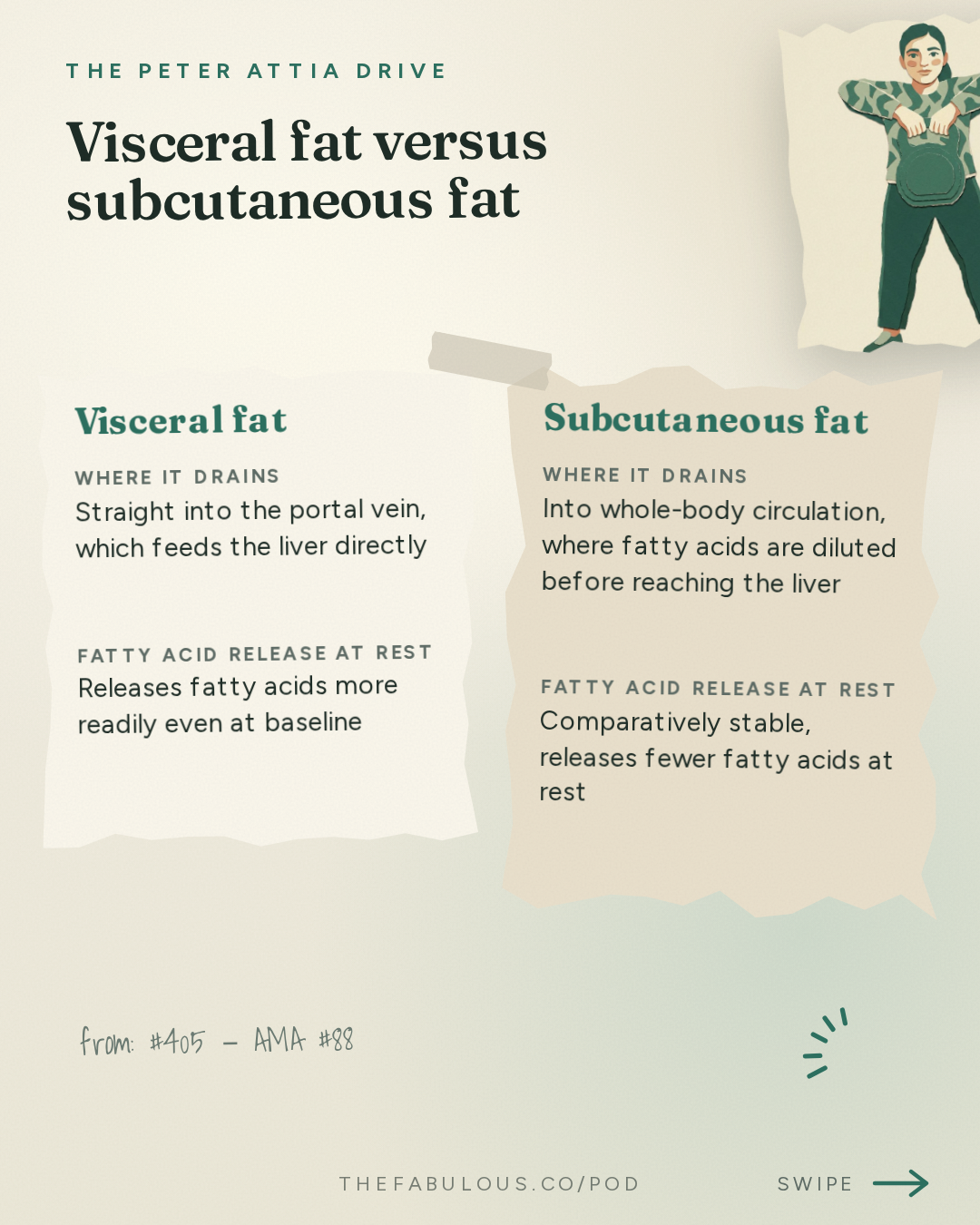
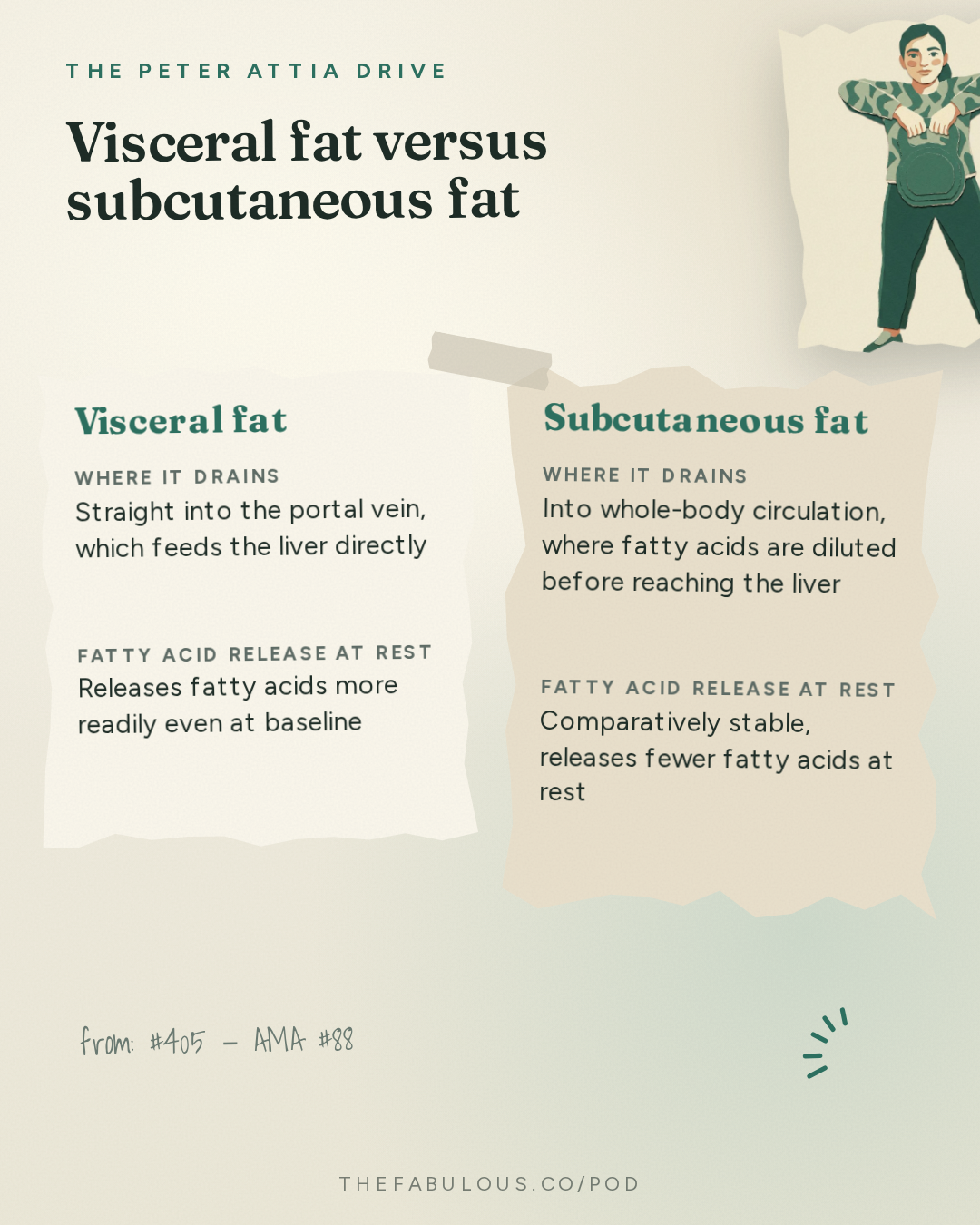
Two structural facts shape who ends up in that fourth stage. The first is where body fat sits. Fat stored around the abdominal organs, called visceral fat, drains directly into the portal vein, the blood vessel that carries everything absorbed from the gut straight to the liver (20:35). Subcutaneous fat, by contrast, releases fatty acids into the general circulation, where they get diluted before reaching the liver. In one cohort Attia cites, people with more than 200 square centimeters of visceral fat, measured by CT scan, had roughly seven and a half times the rate of liver steatosis compared with people under 100 square centimeters, independent of BMI (21:25).
The second structural fact is muscle. Skeletal muscle, not the liver, is the body's largest glucose sink, holding about three-quarters of the body's total capacity to store glucose as glycogen, a stored form of sugar (22:48). Less muscle means less buffering capacity, which pushes more of the glucose burden onto the liver. This is why people with normal body weight but low muscle mass, a condition sometimes called skinny fat, can still develop fatty liver disease. In a seven-year Korean cohort, people who gained the most muscle resolved their metabolic fatty liver disease at more than four times the rate of those who gained the least (23:40). Resistance training, in Attia's view, is not optional for anyone trying to prevent or reverse this disease.
Sugar, Alcohol, and the Math That Actually Matters
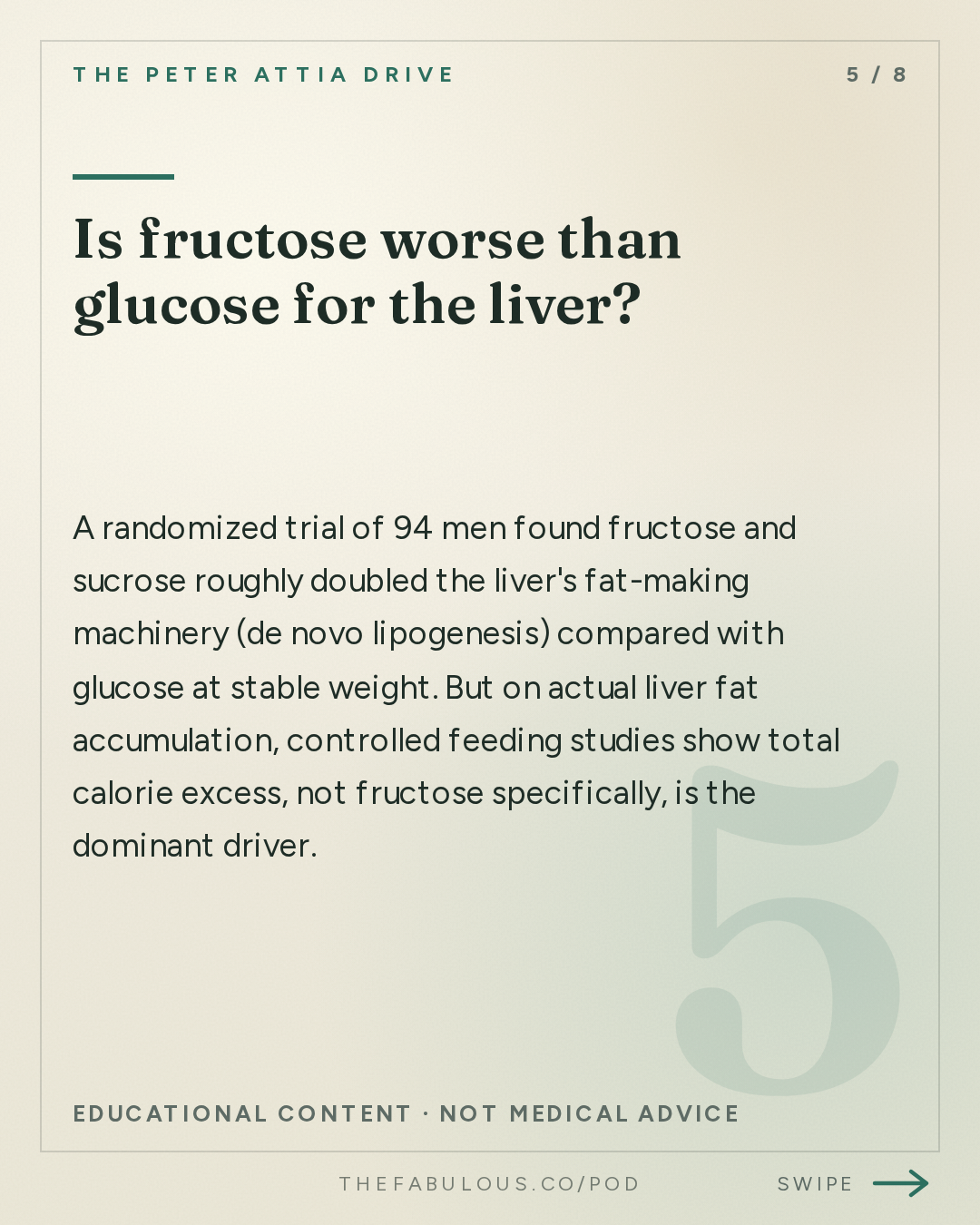
The question of whether fructose, the sugar in fruit and in high-fructose corn syrup, is worse than glucose for the liver has a nuanced answer. In a randomized trial of 94 healthy men who drank fructose, sucrose, or glucose beverages for seven weeks at stable body weight, fructose and sucrose roughly doubled the liver's fat-making machinery, a process called de novo lipogenesis, while glucose did not (24:58). But on the outcome that actually matters, measurable liver fat, controlled feeding studies show the dominant driver is total caloric excess, not fructose specifically; swap fructose for other carbohydrates at equal calories and liver fat barely moves (25:29).
Calorie for calorie, the honest fructose specific signal is on lipogenesis, which is an intermediate measure but not the final outcome. Peter Attia [25:29]
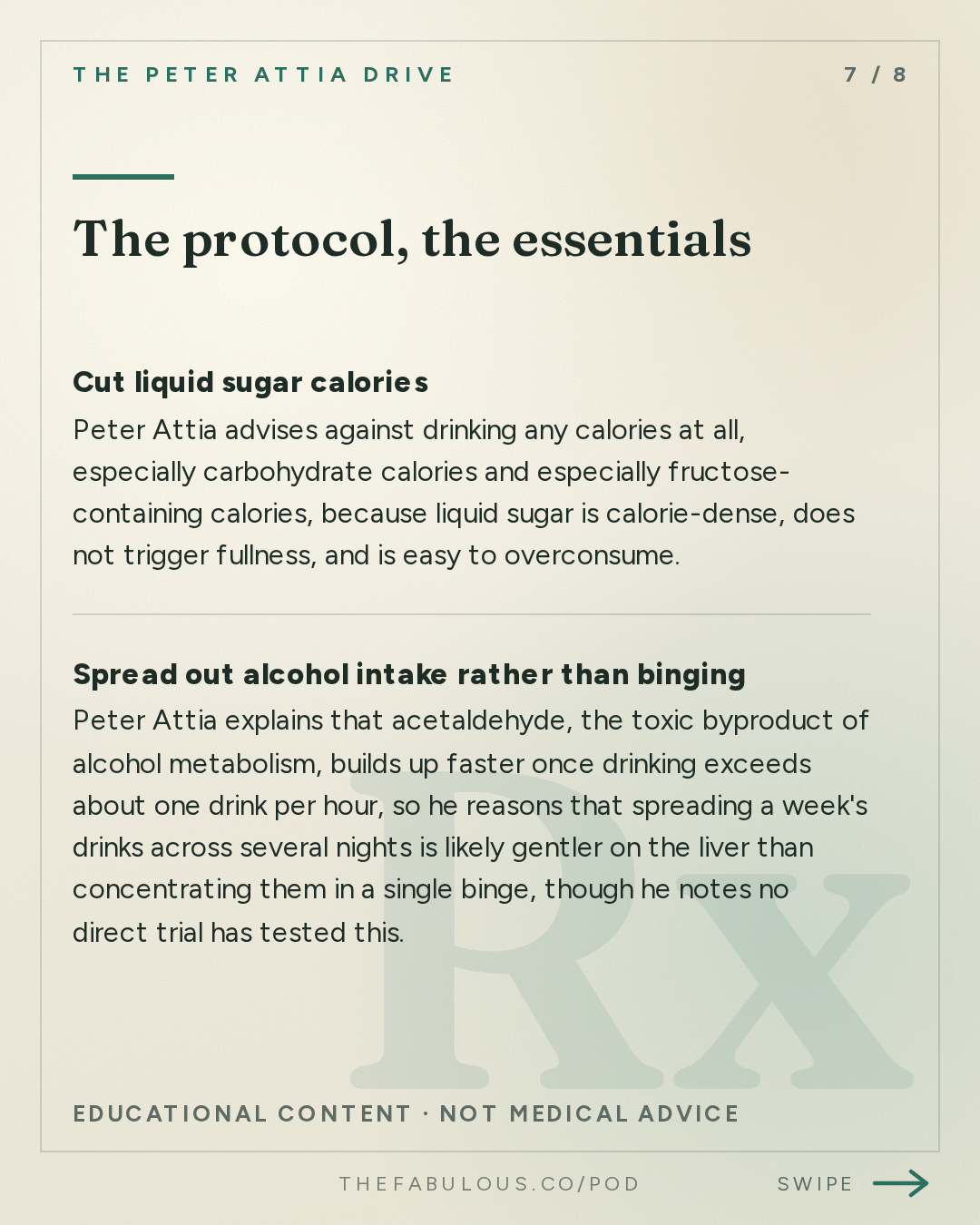
Where fructose earns its bad reputation is in how it typically arrives: as liquid sugar in soda and sweetened drinks, which is calorie-dense, does not trigger fullness, and is easy to overconsume. That is why Attia's practical advice is unambiguous.
Don't drink calories at all, and especially don't drink carbohydrate calories, and especially don't drink fructose-containing calories. Peter Attia [26:26]
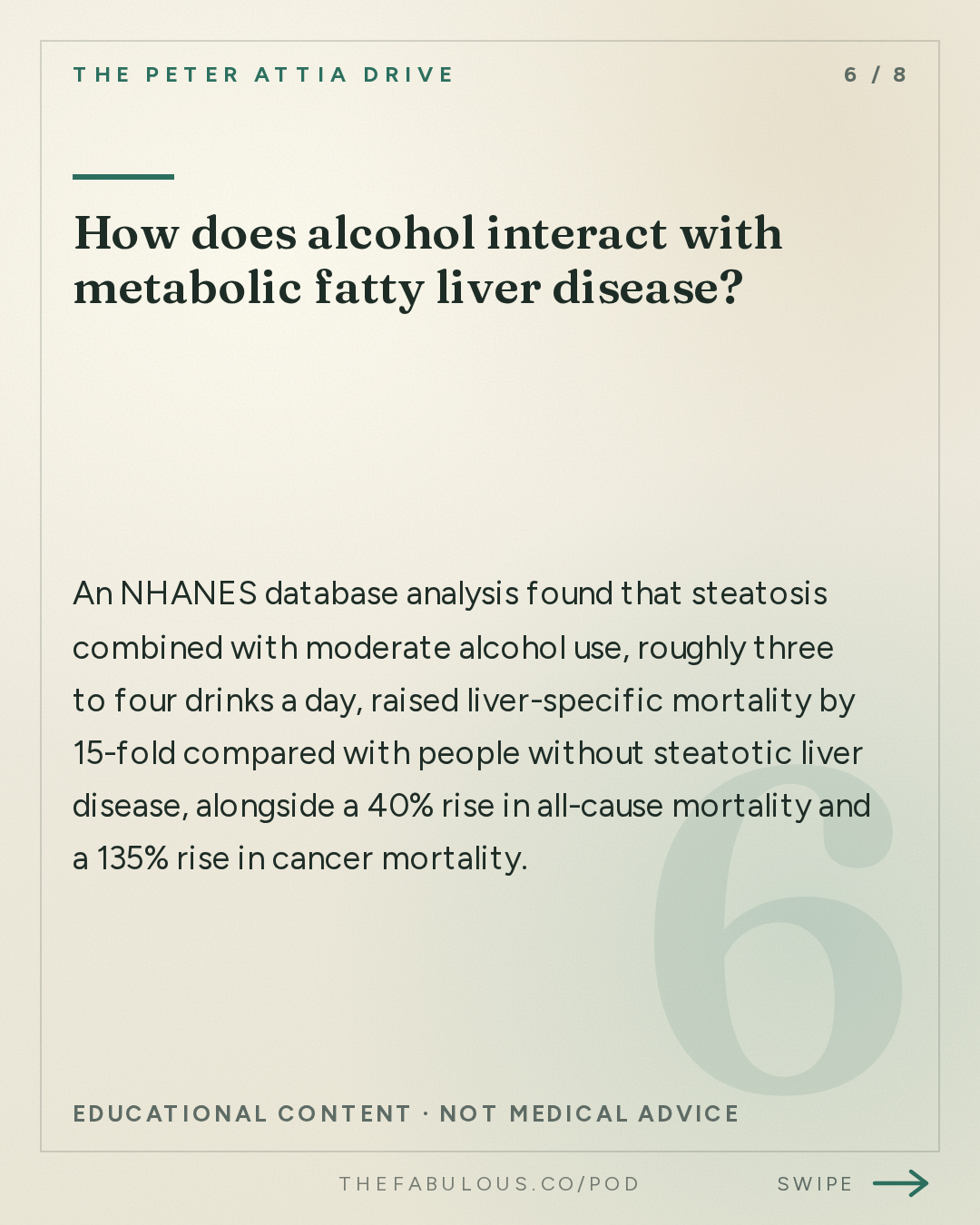
Alcohol tells a related but separate story. It damages the liver through a different mechanism than caloric excess, but it produces nearly the same downstream sequence, from steatosis to fibrosis. The real danger is combining the two. In an analysis of the NHANES database, a large United States health survey, patients who already had cardiometabolic risk factors and steatosis alone did not show increased all-cause mortality; but steatosis plus moderate alcohol consumption, roughly three to four drinks a day, raised the risk of death from any cause by 40%, from cancer by 135%, and from liver-specific causes by 1,400%, a 15-fold increase (28:45). Mechanistically, this tracks with acetaldehyde, the toxic byproduct of alcohol metabolism, which accumulates faster once drinking exceeds about one drink per hour (30:06). Attia suggests, without direct trial evidence, that seven drinks spread across seven nights is probably gentler on the liver than seven drinks in one sitting.
Not everyone starts from the same baseline. A gene variant called PNPLA3 roughly doubles the likelihood of accumulating liver fat in people who carry two copies, while a separate variant in a gene called HSD17B13 appears to partially offset that risk (32:18). Ancestry shapes population-level risk too: the PNPLA3 variant is more common in people of Hispanic ancestry and less common in people of African ancestry, though Attia is careful to call this a predisposition, not a destiny for any individual. Hormones matter as well. Premenopausal women appear relatively protected from visceral and liver fat accumulation, an effect attributed to estrogen, and that protection fades quickly after menopause (35:07).
Taken together, the episode's real argument is less about the liver as an isolated organ and more about the liver as an early, honest report card on how the rest of the body is handling energy. The organ that keeps a moving meal's worth of sugar down to a teaspoon of variance is not going to fail quietly. It shows up in the numbers first, if anyone bothers to look in the right place.
Ask this episode anything
Pod's AI answers from the episode itself, with the minute mark so you can hear it yourself.
Or start with one of these
Ask this episode
Pod's AI listens to the whole episode to answer, and points you to the minute it comes from.
The rest of this answer, and any question after it
Answers come from the episode itself, never from a summary of it.
ContinueKey takeaways
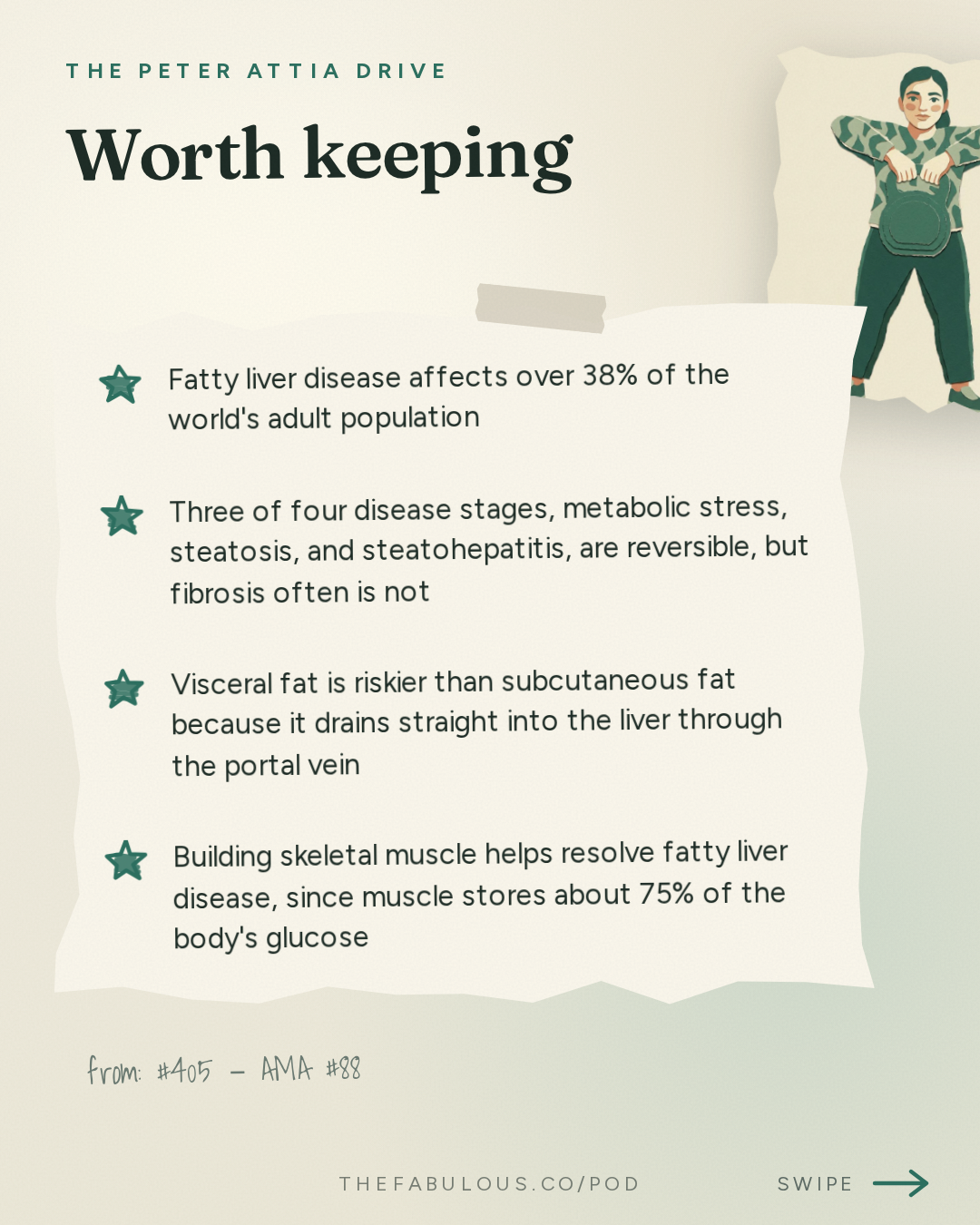
- Fatty liver disease affects over 38% of the world's adult population
- Three of four disease stages, metabolic stress, steatosis, and steatohepatitis, are reversible, but fibrosis often is not
- Visceral fat is riskier than subcutaneous fat because it drains straight into the liver through the portal vein
- Building skeletal muscle helps resolve fatty liver disease, since muscle stores about 75% of the body's glucose
- Combining alcohol with existing fatty liver disease raises liver-specific death risk by 15 times
The episode in cards

By the numbers
- 38% percent share of the world's adult population with metabolic fatty liver disease
- 15x multiplier increase in liver-specific mortality when steatosis is combined with moderate alcohol use
In their words
“Dysfunction of the liver is more of a parallel expression of systemic metabolic dysfunction.”
“Your entire bloodstream in that moment contained only about four and a half grams of glucose. That's roughly a teaspoon.”
“Calorie for calorie, the honest fructose specific signal is on lipogenesis, which is an intermediate measure but not the final outcome.”
“Don't drink calories at all, and especially don't drink carbohydrate calories, and especially don't drink fructose-containing calories.”
Protocols
-
Cut liquid sugar calories
Peter Attia advises against drinking any calories at all, especially carbohydrate calories and especially fructose-containing calories, because liquid sugar is calorie-dense, does not trigger fullness, and is easy to overconsume.
Daily habit
-
Spread out alcohol intake rather than binging
Peter Attia explains that acetaldehyde, the toxic byproduct of alcohol metabolism, builds up faster once drinking exceeds about one drink per hour, so he reasons that spreading a week's drinks across several nights is likely gentler on the liver than concentrating them in a single binge, though he notes no direct trial has tested this.
Per drinking occasion
-
Build skeletal muscle through resistance training
Peter Attia recommends resistance training to build muscle mass because muscle is the body's largest glucose sink, storing roughly three-quarters of the body's glucose as glycogen, and he cites a seven-year Korean cohort in which people who gained the most muscle resolved metabolic fatty liver disease at more than four times the rate of those who gained the least.
Ongoing
Questions this episode answers
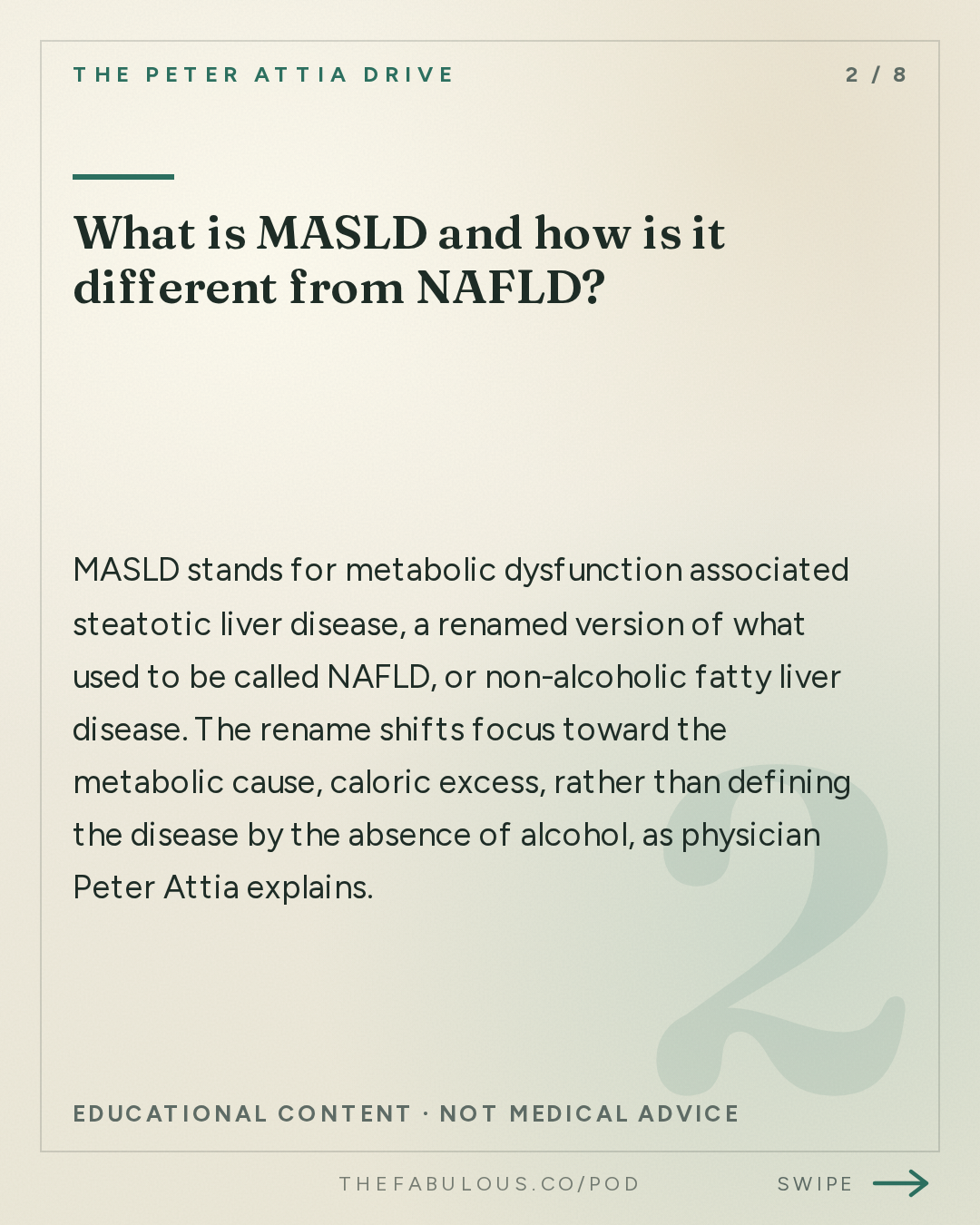
What is MASLD and how is it different from NAFLD?
MASLD stands for metabolic dysfunction associated steatotic liver disease, a renamed version of what used to be called NAFLD, or non-alcoholic fatty liver disease. The rename shifts focus toward the metabolic cause, caloric excess, rather than defining the disease by the absence of alcohol, as physician Peter Attia explains (15:58).
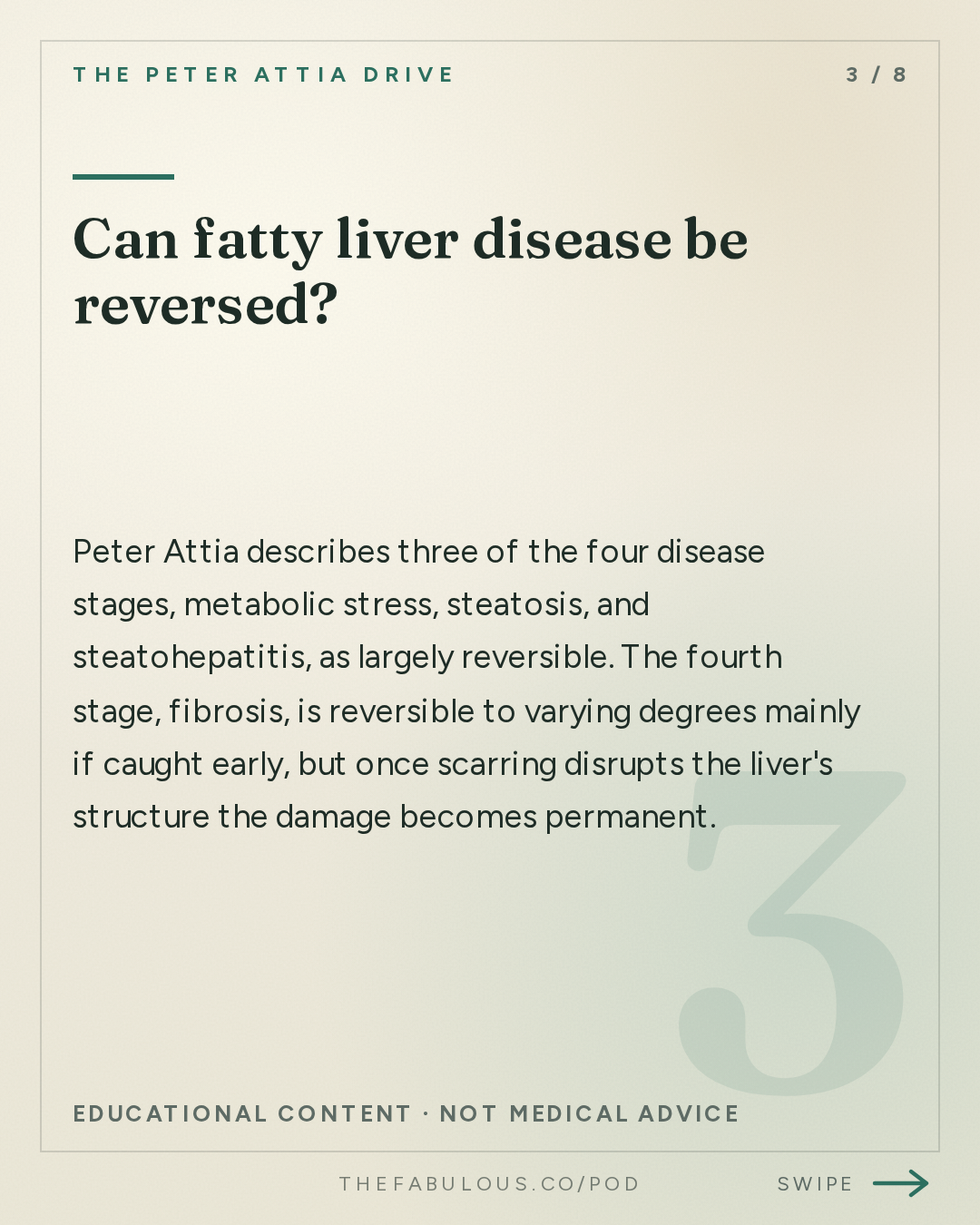
Can fatty liver disease be reversed?
Peter Attia describes three of the four disease stages, metabolic stress, steatosis, and steatohepatitis, as largely reversible. The fourth stage, fibrosis, is reversible to varying degrees mainly if caught early, but once scarring disrupts the liver's structure the damage becomes permanent (10:42).
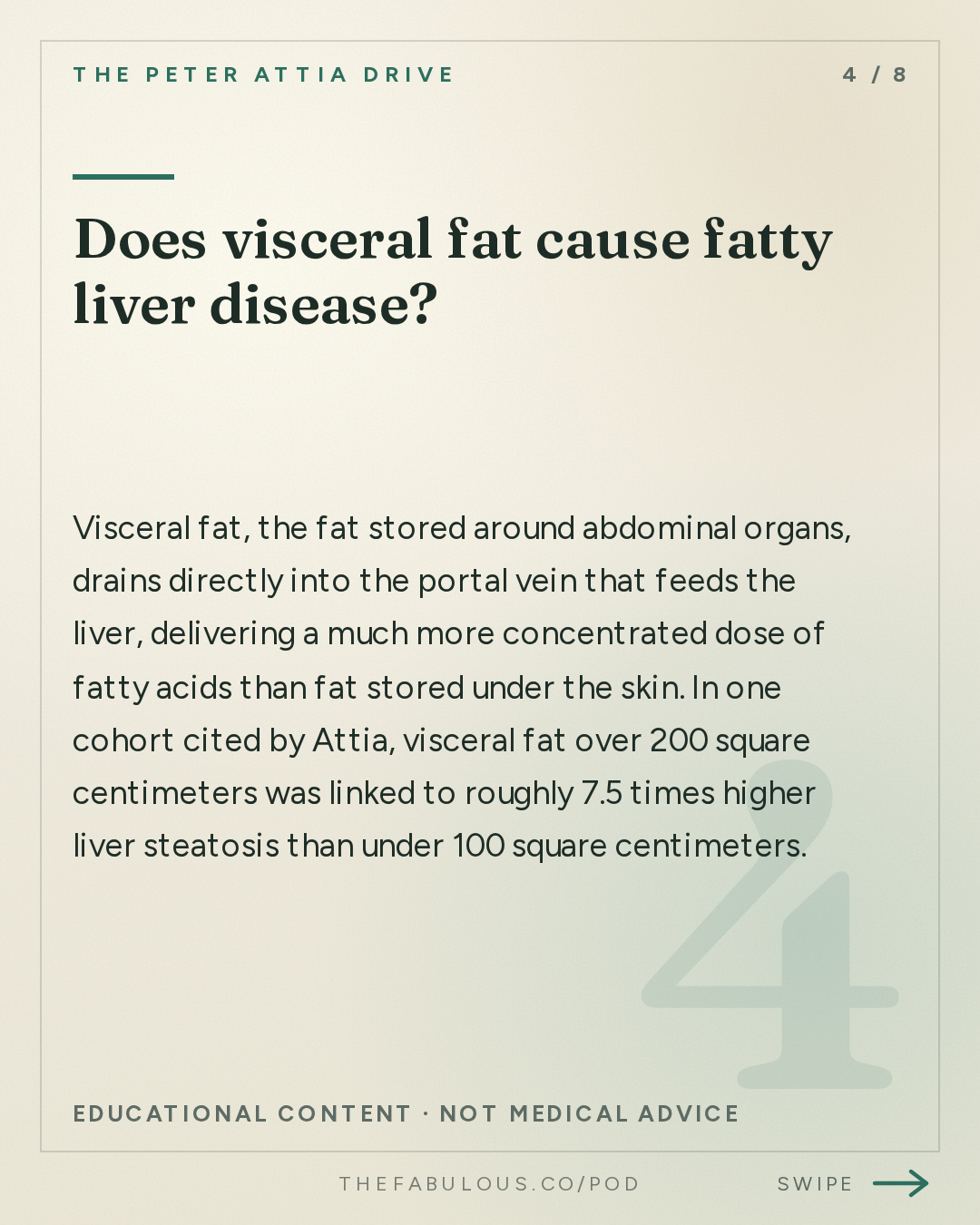
Does visceral fat cause fatty liver disease?
Visceral fat, the fat stored around abdominal organs, drains directly into the portal vein that feeds the liver, delivering a much more concentrated dose of fatty acids than fat stored under the skin. In one cohort cited by Attia, visceral fat over 200 square centimeters was linked to roughly 7.5 times higher liver steatosis than under 100 square centimeters (21:25).
Is fructose worse than glucose for the liver?
A randomized trial of 94 men found fructose and sucrose roughly doubled the liver's fat-making machinery (de novo lipogenesis) compared with glucose at stable weight (24:58). But on actual liver fat accumulation, controlled feeding studies show total calorie excess, not fructose specifically, is the dominant driver (25:29).
How does alcohol interact with metabolic fatty liver disease?
An NHANES database analysis found that steatosis combined with moderate alcohol use, roughly three to four drinks a day, raised liver-specific mortality by 15-fold compared with people without steatotic liver disease, alongside a 40% rise in all-cause mortality and a 135% rise in cancer mortality (28:45).
The full read, in cards
Go deeper
- NHANES cohort analysis of visceral fat and liver steatosis — found visceral fat area over 200 cm squared linked to about 7.5 times higher liver steatosis than under 100 cm squared, independent of BMI
- Seven-year Korean cohort on muscle mass and MASLD resolution — found people who gained the most muscle resolved metabolic fatty liver disease at more than four times the rate of those who gained the least
- Randomized trial of fructose, sucrose, and glucose beverages in 94 men — found fructose and sucrose roughly doubled liver de novo lipogenesis compared with glucose at stable body weight
- NHANES analysis of steatosis, alcohol use, and mortality — found steatosis combined with moderate alcohol use raised liver-specific mortality by 15-fold versus no steatotic liver disease
Mentioned
Peter Attia · Julia Wattacheril · Ralph DeFronzo · ApoB · MASLD · MASH · PNPLA3 · HSD17B13 · NHANES
More from this show and category
Siddhartha Mukherjee on Cancer's New Science
Oncologist Siddhartha Mukherjee tells Peter Attia that cancer's old "bad luck" story is being replaced by a more precise one: inflammation acts as the trigger that wakes dormant, mutation-carrying "sleeper cells" into tumors, which reframes prevention, treatment, and how we think about aging itself.
Why Peter Attia Changed His Mind on Keto
Peter Attia now says keto works by curbing energy intake, not lowering insulin, while he still requires 1.4 g/kg of protein (09:42, 11:44). He also walks back his extended fasting protocol, once seven to ten days quarterly, after weighing autophagy evidence against the practical cost (12:36, 15:09).
Preeclampsia and Long-Term Heart Risk Explained
Pregnancy stresses the heart, kidneys, and metabolism so hard that its complications predict a woman's cardiovascular and diabetes risk decades later. Maternal-fetal medicine specialist Kathryn Gray explains how plasma volume surges 50%, how preeclampsia's placental biology works, and why half of gestational diabetes cases become type 2 diabetes.
Lloyd Klickstein on How New Drugs Get Made
Physician-scientist Lloyd Klickstein maps the full arc of drug development, from spotting an unmet need to FDA approval, using the muscle drug bimagrumab as his case study. Paired with semaglutide, it cut body fat by 45.7% over 72 weeks (125:28), rivaling bariatric surgery, while exposing the economics of patents, manufacturing, and phase one risk.
