
Lloyd Klickstein on How New Drugs Get Made
#409 ‒ Inside modern drug development: the science, economics, and regulatory hurdles behind bringing new medicines to patients | Lloyd Klickstein, M.D., Ph.D.
▶ Listen to the full episode More from The Peter Attia Drive
The brief
Physician-scientist Lloyd Klickstein maps the full arc of drug development, from spotting an unmet need to FDA approval, using the muscle drug bimagrumab as his case study. Paired with semaglutide, it cut body fat by 45.7% over 72 weeks (125:28), rivaling bariatric surgery, while exposing the economics of patents, manufacturing, and phase one risk.
Ask this episode anything
Pod's AI answers from the episode itself, with the minute mark so you can hear it yourself.
Or start with one of these
Ask this episode
Pod's AI listens to the whole episode to answer, and points you to the minute it comes from.
The rest of this answer, and any question after it
Answers come from the episode itself, never from a summary of it.
Continue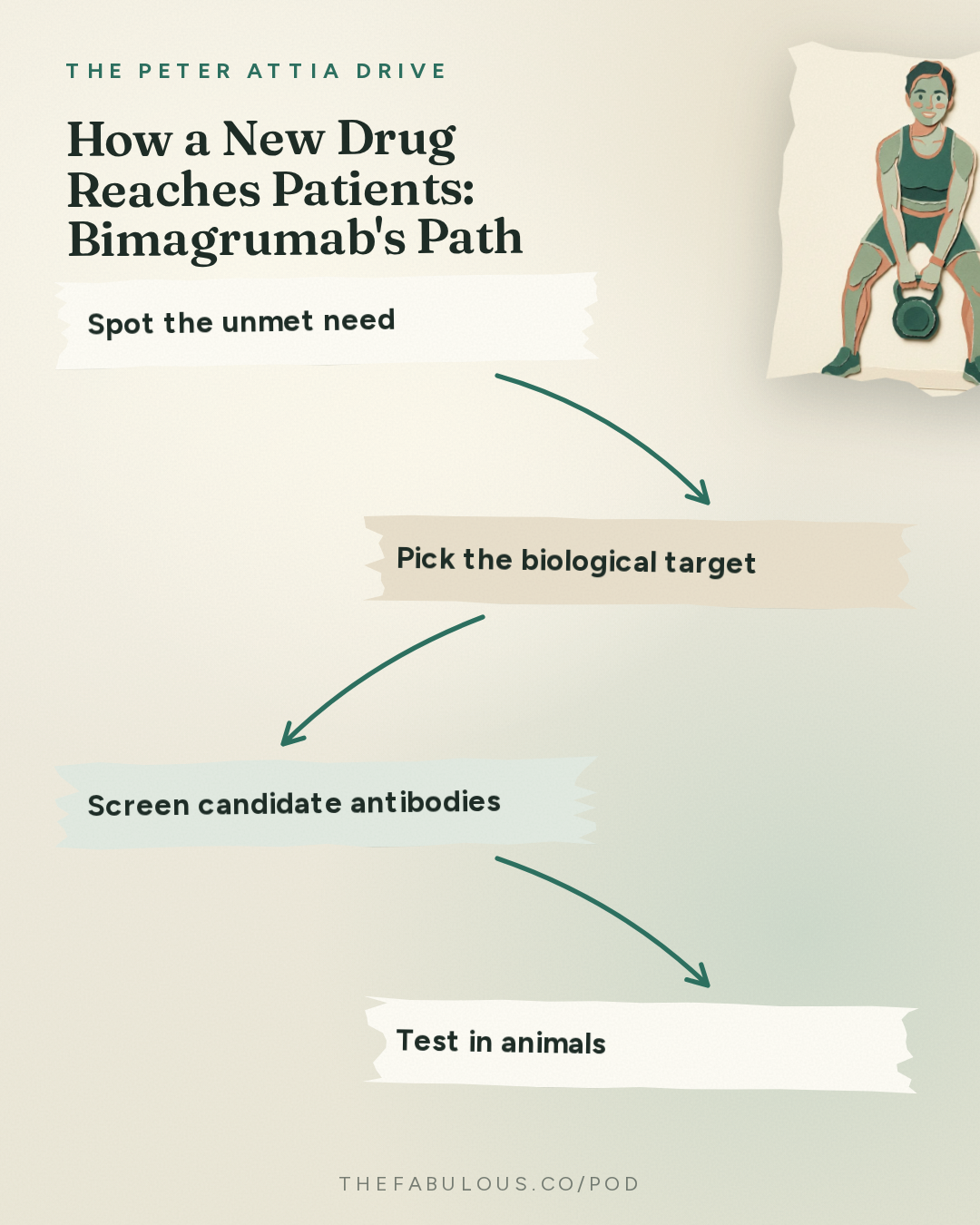
Key takeaways
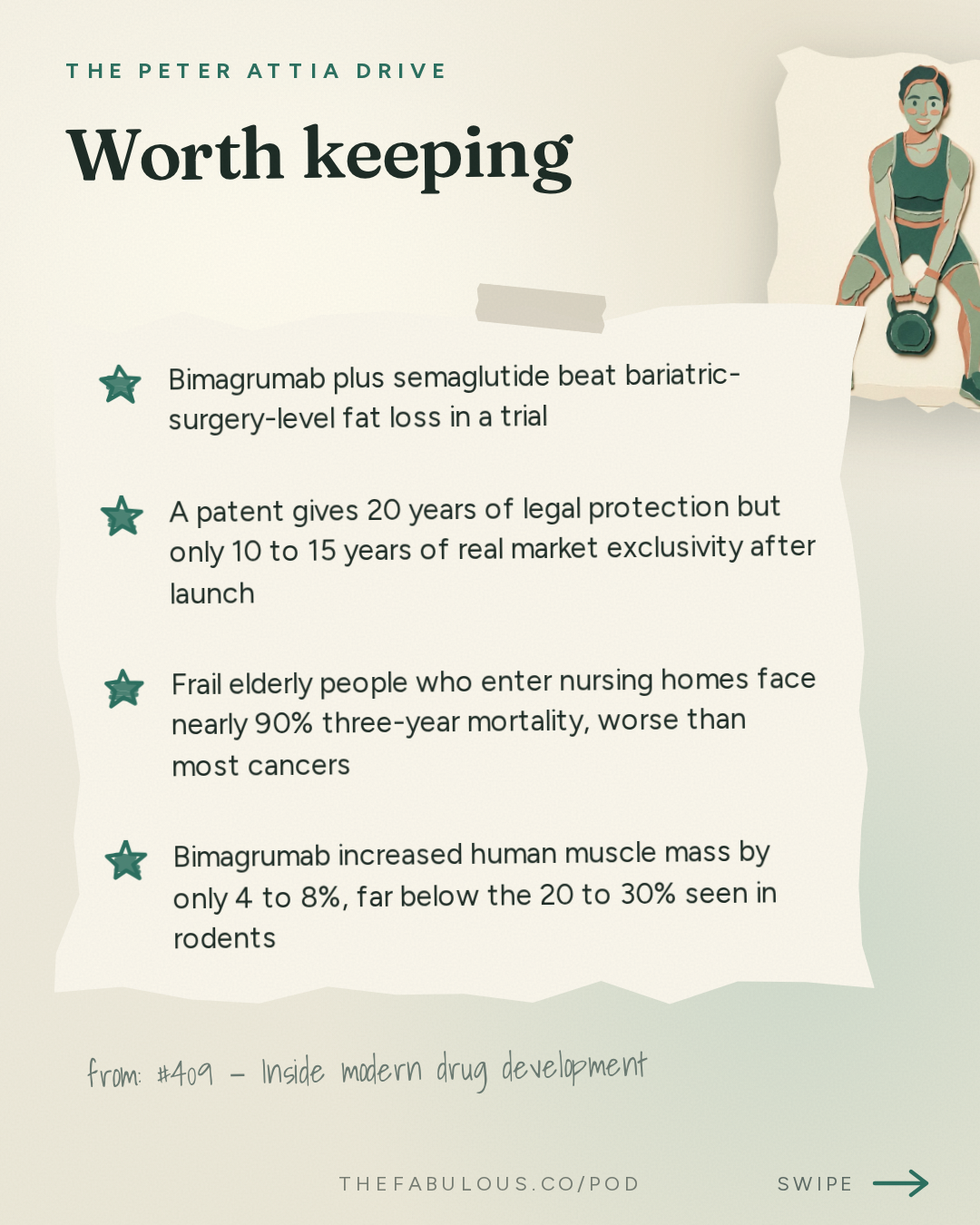
- Bimagrumab plus semaglutide beat bariatric-surgery-level fat loss in a trial
- A patent gives 20 years of legal protection but only 10 to 15 years of real market exclusivity after launch
- Frail elderly people who enter nursing homes face nearly 90% three-year mortality, worse than most cancers
- Bimagrumab increased human muscle mass by only 4 to 8%, far below the 20 to 30% seen in rodents
- Only about 30% of biologic drug candidates make it from lab discovery into human testing
The episode in cards

At a cocktail party three decades ago, a guest asked oncologist Steve Rosenberg how new cancer drugs get made. Do scientists just walk into a kitchen and grab things? Peter Attia retells that story near the start of this conversation with Lloyd Klickstein (05:48) because it captures something true: even smart people have almost no picture of how a molecule becomes a medicine. Klickstein has spent more than two decades filling in that picture, first at the drugmaker Novartis, then across a string of biotech startups, and this conversation uses one drug, bimagrumab, as a guide through the whole process, from a spreadsheet of unmet medical needs to a combination trial that beat bariatric surgery.
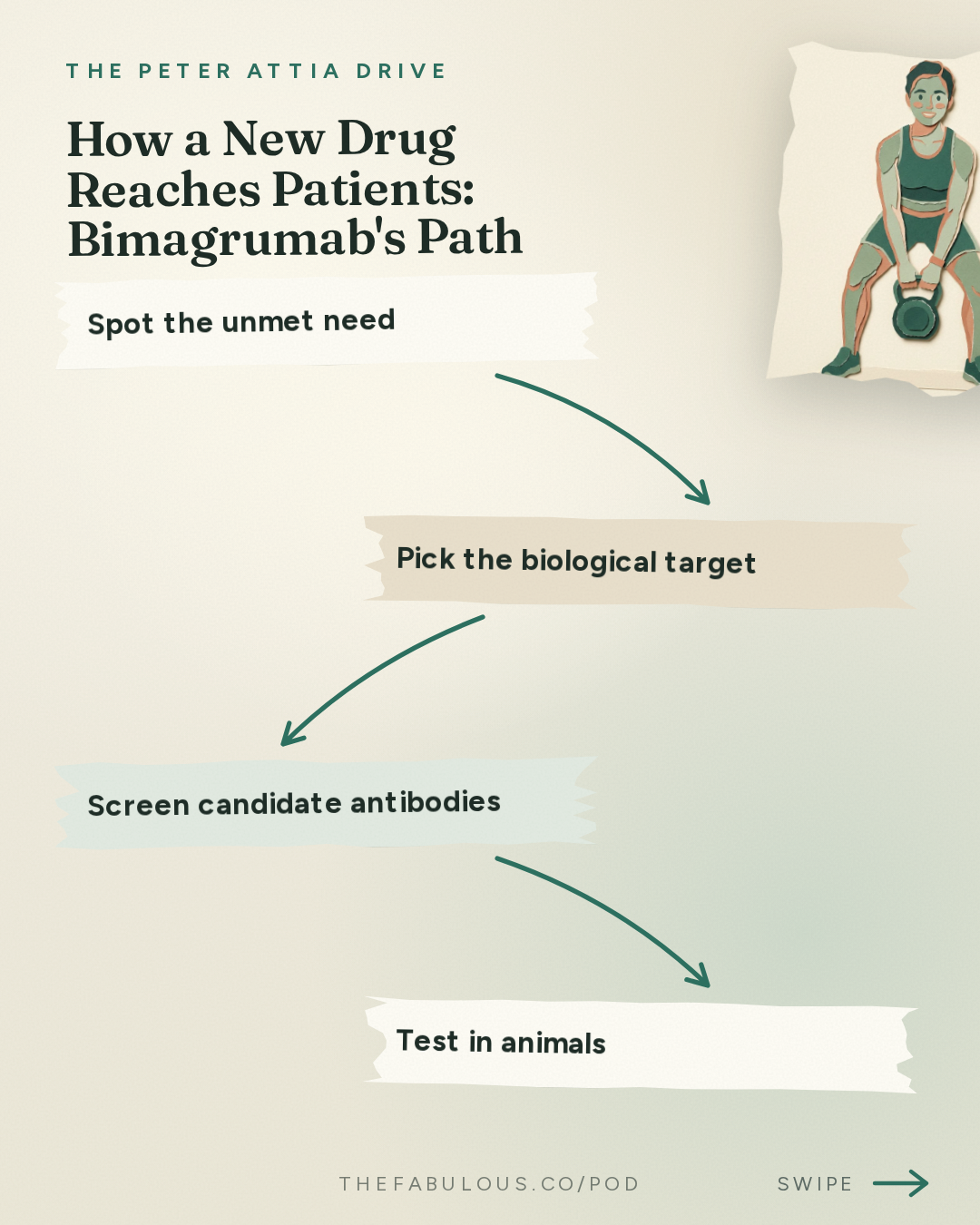
The starting point was not a molecule. It was a list. At Novartis, Klickstein and colleagues built a catalogue of roughly 7,000 unmet clinical indications, diseases nobody yet had a good drug for (09:04). One bucket was frailty in older adults. Klickstein, who saw these patients as a practicing rheumatologist, cites a statistic that still stops him: once a frail older adult is forced into a nursing home, the three-year mortality rate approaches 90 percent (10:59).
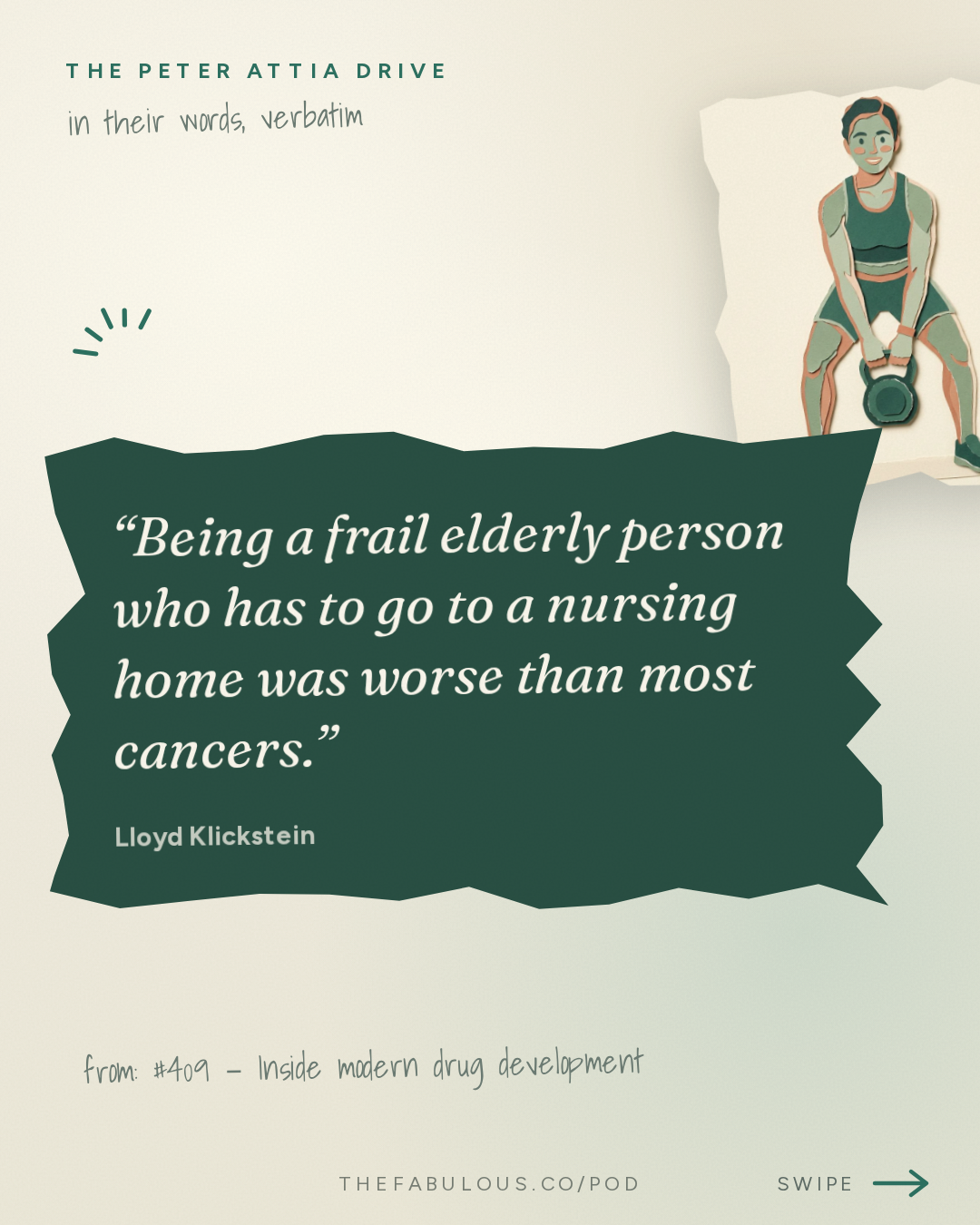
"Being a frail elderly person who has to go to a nursing home was worse than most cancers." (Lloyd Klickstein, [10:59])
That number set off a research program aimed at sarcopenia, the medical term for muscle loss paired with weakness. But before Klickstein's team could treat it, they had to measure it, and the first attempt failed outright. They fitted nursing-home residents with pendant accelerometers meant to detect falls automatically. Over six months, 60 residents produced 117 confirmed falls, and the device caught only 17 percent of them (34:11). Attia suggests an obvious workaround, just ask residents to self-report, and Klickstein's answer is a small lesson in humility: recall bias, device unfamiliarity, and residents' fear of losing their independence all made self-report unreliable too. The team eventually shelved the whole falls-prevention program because they could not measure the outcome they wanted to change.
What a Patent Actually Buys
Before any biology, there is arithmetic. A drug patent lasts 20 years from filing, but because years disappear into research and trials before a drug ever reaches a pharmacy, the real payoff window, called market exclusivity, is usually just 10 to 15 years from launch (17:01). That clock is why large drug companies stagger separate patents on formulation, dose, delivery device, and manufacturing process, stretching protection well past the original patent on the drug itself, a practice Klickstein says can be abused (21:01). Not every drug takes the patent route. Klickstein describes two older medicines protected by trade secret instead of patent: Armour Thyroid, a desiccated animal-thyroid hormone whose exact composition was never disclosed, and Acthar Gel, an ACTH extract purified from pig pituitaries that Klickstein once used in the emergency room for gout attacks, until it was pulled from the market during the mad cow scare and later relaunched at up to a thousand times the price (18:39).
This economic logic explains why Klickstein is blunt about gray market research peptides, the compounds sold online labeled not for human use that mimic drugs like semaglutide or the experimental peptide BPC-157. What a buyer is actually paying for when they choose an approved drug, he says, is GMP, short for good manufacturing process, the documented, inspected chain of custody that guarantees what is on the label is what is in the bottle (76:48). BPC-157, he notes, has never been reproduced outside the lab of the single scientist who first described it, has no known human receptor, and is not encoded in the human genome. He calls it the platform for the greatest grift in the wellness industry (80:28).
From Mouse Miracle to Modest Human Gain
The middle of the conversation turns to the biology behind bimagrumab. In the 1990s, geneticist Se-Jin Lee discovered myostatin, a protein that restrains muscle growth; block it in mice and the animal builds like a bodybuilder. But myostatin alone does not explain human muscle regulation. Klickstein's team at Novartis, working with researchers David Glass and Chris Liu, found that a second molecule, activin A, shares the job, and blocking both together, by targeting their shared receptor, is necessary for maximal hypertrophy in humans (39:22). Because the receptor needed binding at extremely high affinity, in the low picomolar range, small-molecule chemistry could not do the job precisely enough, so the team built an antibody instead, screening thousands of candidates for the stickiest binder (47:52).
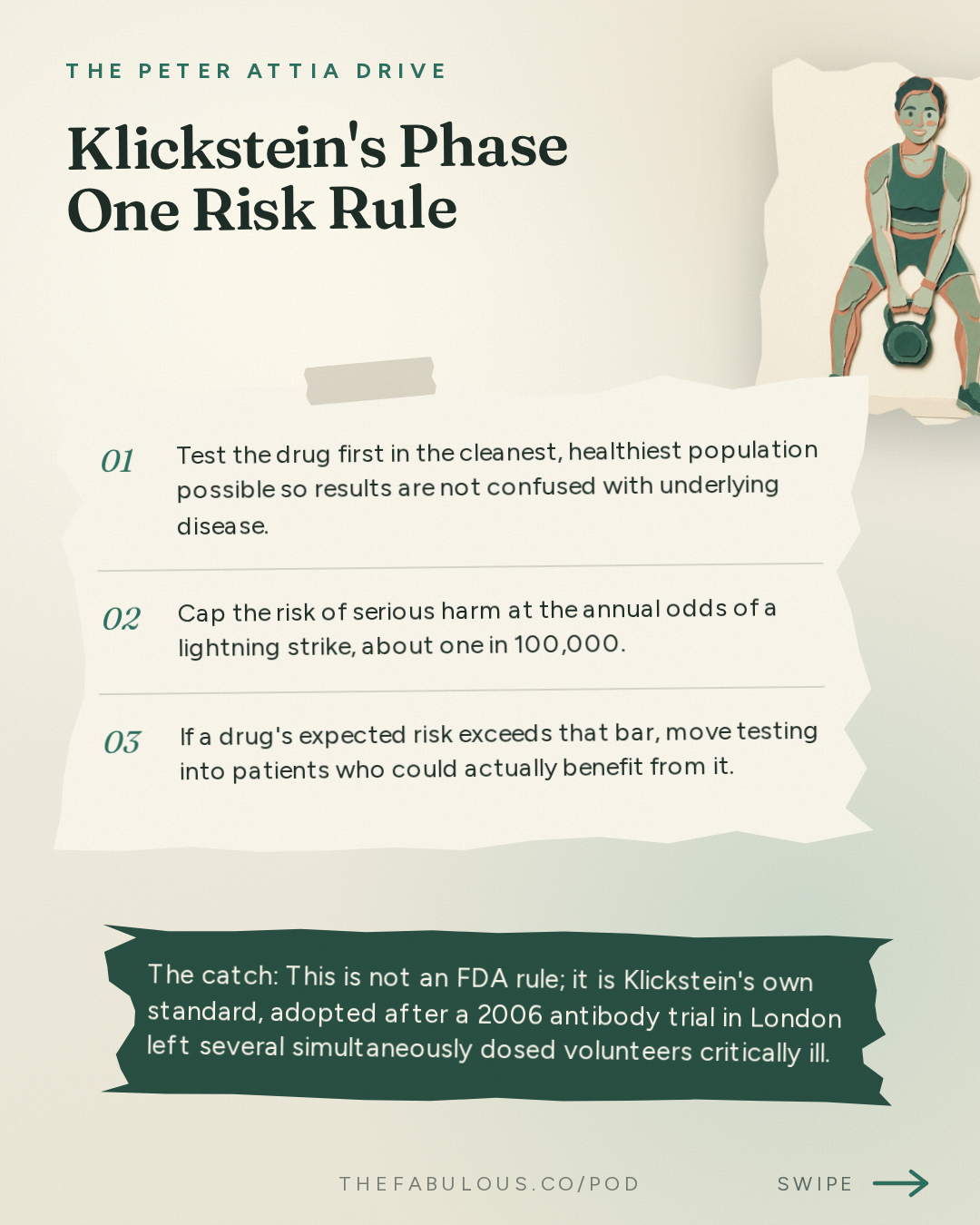
Before any of this reached patients, Klickstein had to decide how much risk was acceptable in a healthy volunteer. His personal rule, borrowed from a mentor named Bob Schmauder: never expose a healthy volunteer to a serious risk greater than the annual odds of being struck by lightning, about one in 100,000 (85:58). If a drug's risk exceeds that bar, move testing into patients who stand to benefit, so risk is balanced by potential reward. It is not an FDA regulation, just Klickstein's own standard, and he notes that across three decades in the industry, something seriously wrong happens to healthy volunteers roughly once every ten years, most notoriously the Tegenero antibody trial in London, where six volunteers were dosed simultaneously with a T-cell-activating antibody and several nearly died (87:49).
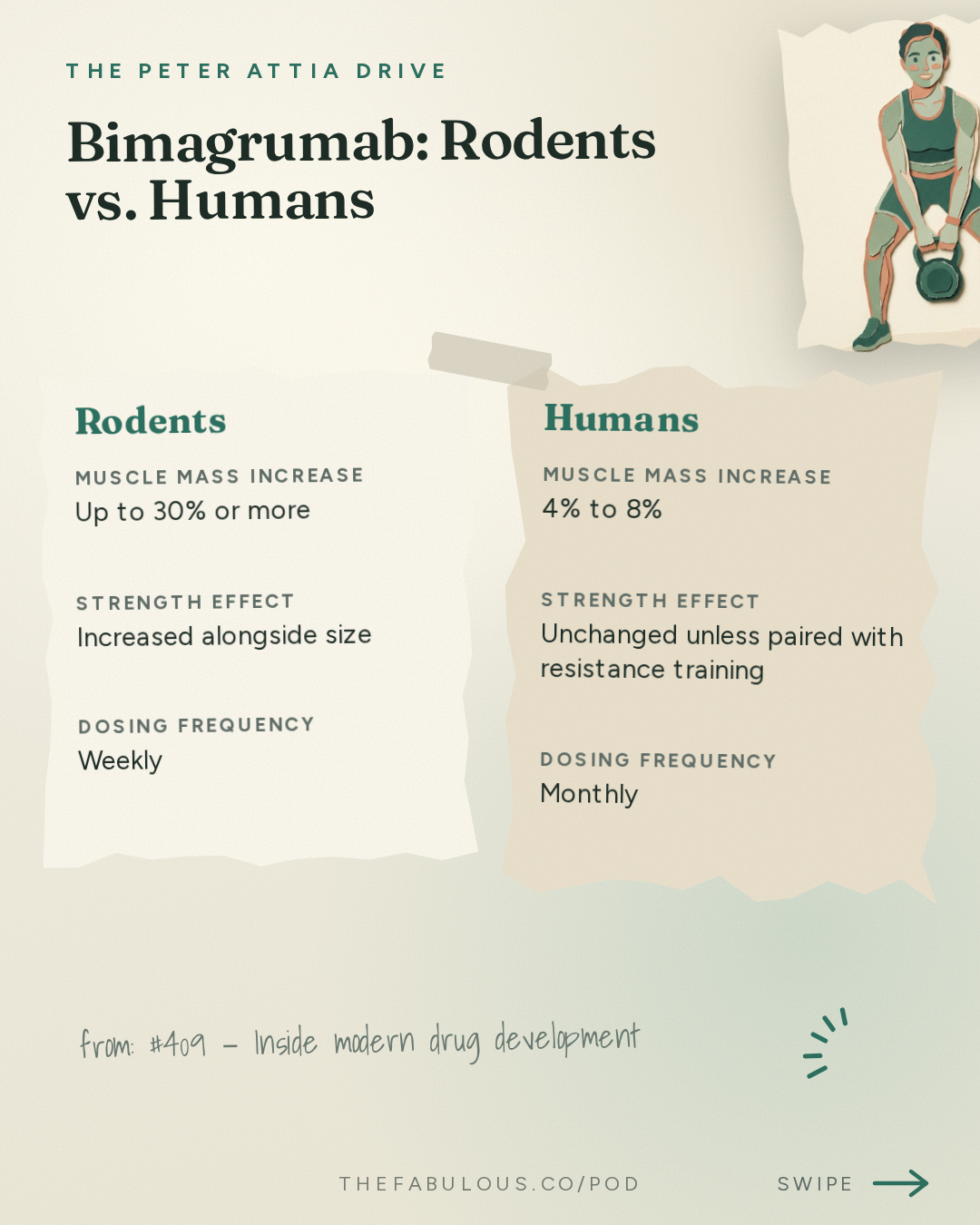
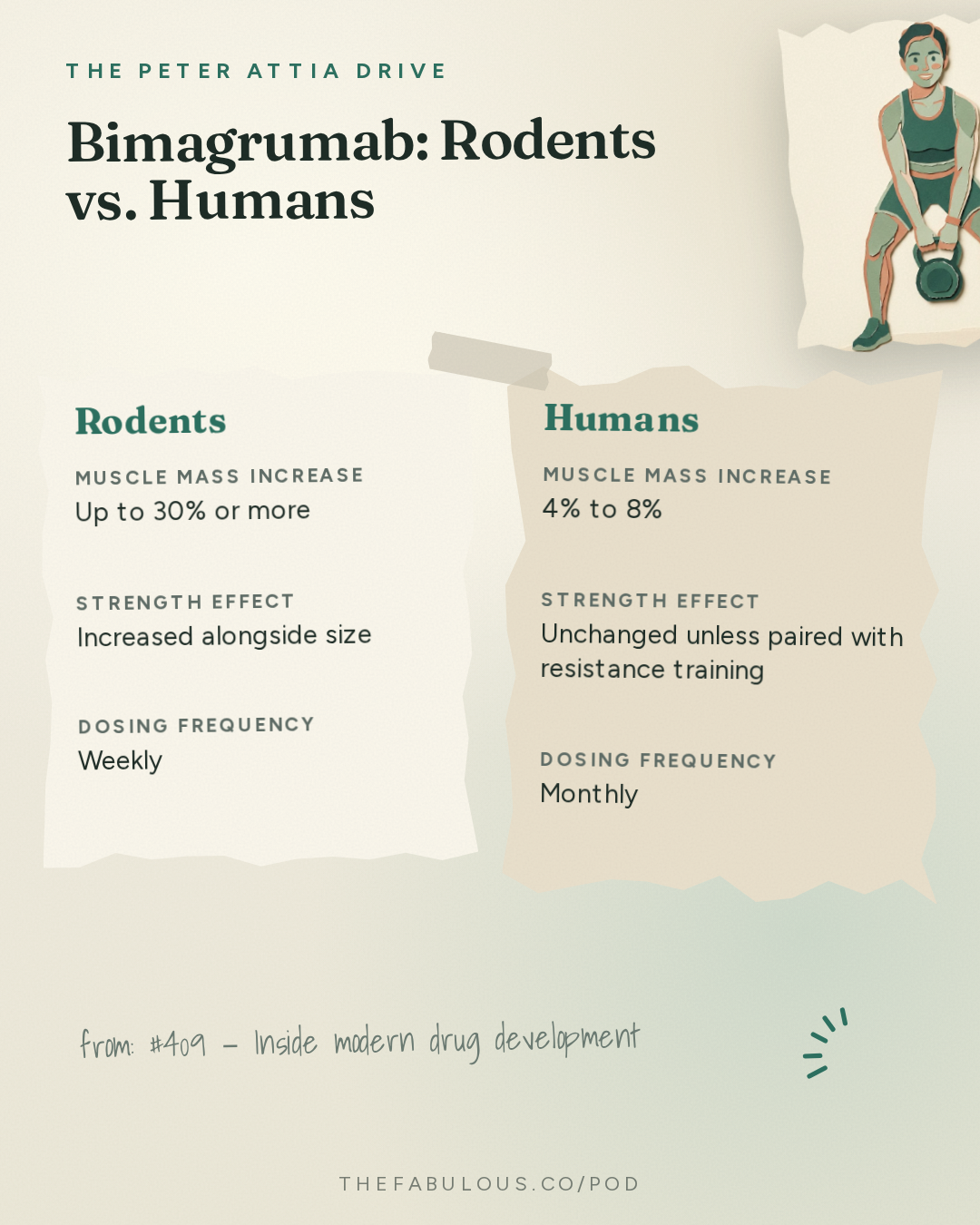
The mouse results for bimagrumab were dramatic, producing more hypertrophy than even myostatin knockout animals. The human results were not. Bimagrumab increases human muscle mass by only 4 to 8 percent, far short of the 20 to 30 percent gains seen in rodents (61:11), and Klickstein is candid that biology, not dosing, explains the gap. Worse, bigger muscles did not translate into meaningfully better function: a meta-analysis of Novartis's sarcopenia trials found only a nine-meter improvement in six-minute walk distance, not enough, in Klickstein's own judgment, to prevent falls. And in a pattern he says is common to anabolic agents generally, muscles got larger but not stronger without resistance training layered on top of the drug (109:08).
Novartis eventually licensed bimagrumab out. Klickstein helped found Versanis Bio to redevelop it, initially for sarcopenic obesity, a hard sell in 2021: of 53 investors approached, almost none wanted anything to do with obesity drugs, a field littered with commercial failures (114:55). Then Novo Nordisk's semaglutide data landed, and the calculation changed overnight. Versanis pivoted to testing bimagrumab as a partner drug for GLP-1 therapies. The resulting BELIEVE trial ran nine treatment arms combining two doses of bimagrumab with two doses of semaglutide, plus placebo, over 72 weeks of treatment. In the highest-dose combination group, patients lost 22 to 23 percent of starting body weight, and 45.7 percent of starting body fat (125:28), a figure Klickstein compares directly to bariatric surgery.
"This, to me, this is the first medical therapy that gives fat loss equivalent to or superior than bariatric surgery." (Lloyd Klickstein, [125:28])
The trial was not without cost. LDL cholesterol rose about 20 percent in treated patients, an effect Klickstein attributes to activin receptors acting directly in the liver rather than an off-target reaction (127:53). Eli Lilly acquired the company before Versanis could run its planned phase three trial, and the drug's future, according to public trial registries, is now Lilly's to write.
Klickstein closes on two forward bets. One is selective inhibition of mTOR, short for mechanistic target of rapamycin, a nutrient-sensing pathway that extends life in yeast, worms, flies, and mice when dialed down; the trouble is that current rapamycin-class drugs also suppress a second complex, mTORC2, with side effects nobody wants over decades (133:29). The other is his newest company, built on an odd clue: certain cancer drugs that inhibit a stress-signaling pathway cause skin cancer as a side effect in about 10 percent of older patients (138:06). Klickstein's bet is that gently activating that same pathway, rather than blocking it, could prevent cancer instead of causing it, starting with patients who have already had five or more skin cancers and face a 50 percent chance of another within a year (139:59). It is a strange, backward way to find a drug, reading a side effect for what it implies about the biology it interrupted. It is also, in miniature, the whole method this conversation describes: start with the patients nobody is treating well, and let the biology tell you what is missing.
By the numbers
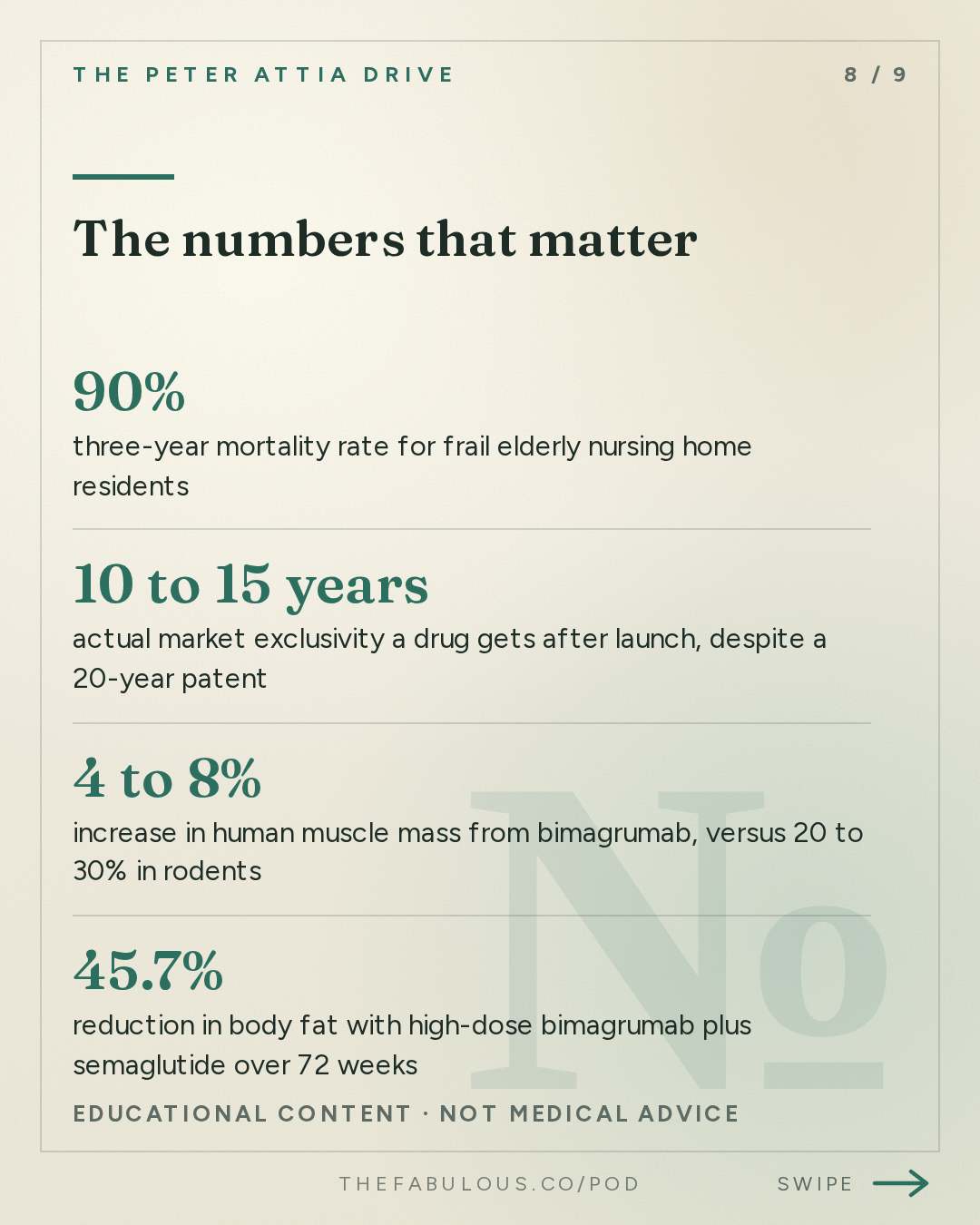
- 90% percent three-year mortality rate for frail elderly nursing home residents
- 10 to 15 years actual market exclusivity a drug gets after launch, despite a 20-year patent
- 4 to 8% percent increase in human muscle mass from bimagrumab, versus 20 to 30% in rodents
- 45.7% percent reduction in body fat with high-dose bimagrumab plus semaglutide over 72 weeks
- 20% percent increase in LDL cholesterol seen with bimagrumab treatment
In their words
“Being a frail elderly person who has to go to a nursing home was worse than most cancers.”
“The worst outcome in drug development is failing in phase three. Ugh, yeah. Actually, that's probably not true. The worst outcome is succeeding in phase three and failing”
“This, to me, this is the first medical therapy that gives fat loss- Yeah ... equivalent to or superior than bariatric surgery”
Protocols
-
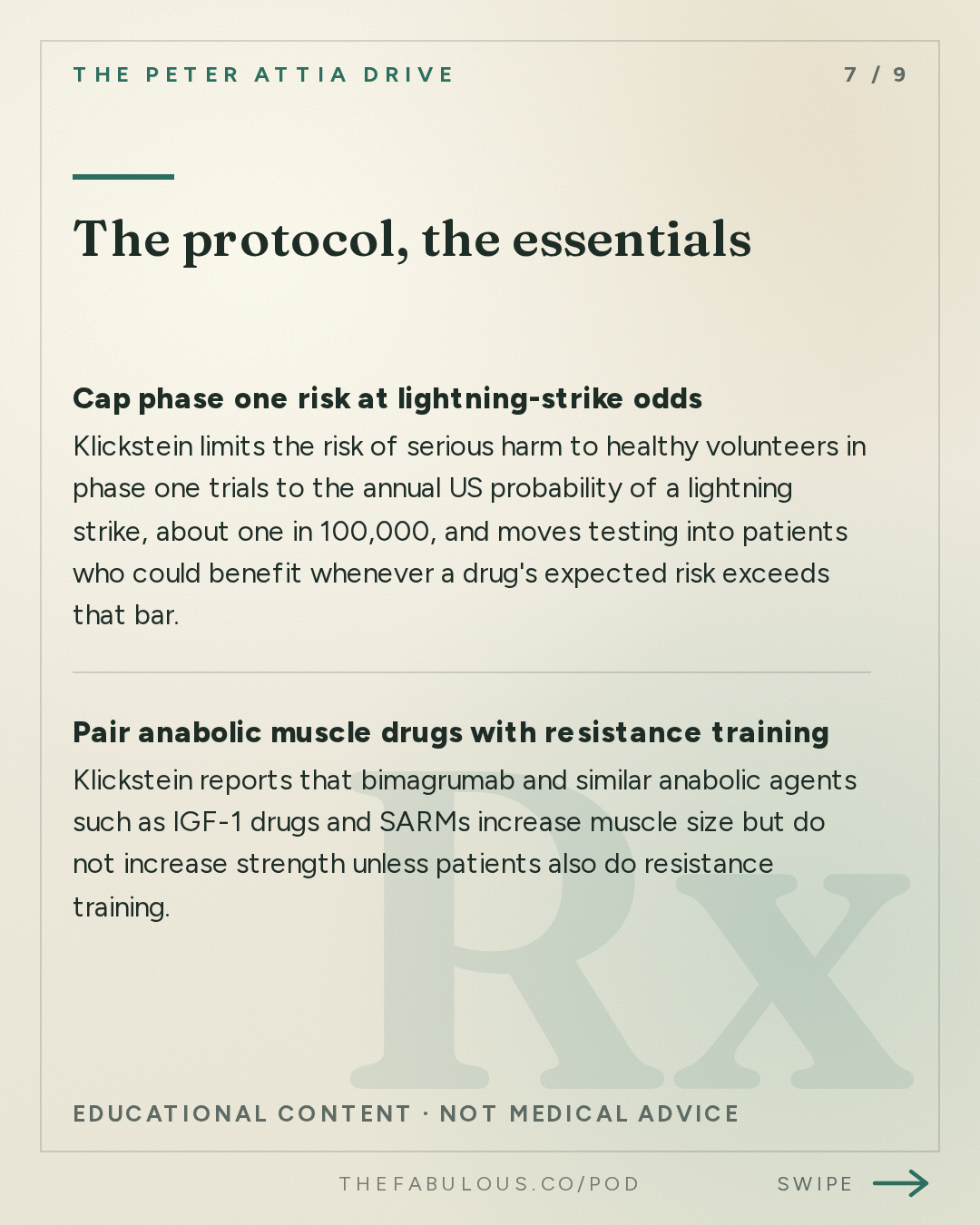
Cap phase one risk at lightning-strike odds
Klickstein limits the risk of serious harm to healthy volunteers in phase one trials to the annual US probability of a lightning strike, about one in 100,000, and moves testing into patients who could benefit whenever a drug's expected risk exceeds that bar.
Applied at every phase one dose-escalation decision
-
Pair anabolic muscle drugs with resistance training
Klickstein reports that bimagrumab and similar anabolic agents such as IGF-1 drugs and SARMs increase muscle size but do not increase strength unless patients also do resistance training.
Throughout any course of anabolic muscle therapy
-
Verify GMP manufacturing before buying peptide drugs
Klickstein advises against buying research-only peptides such as BPC-157 or gray-market retatrutide because they are not made under GMP, good manufacturing process, so buyers cannot confirm purity, potency, or contamination.
Before any purchase of an unregulated peptide
Questions this episode answers
How does bimagrumab work with semaglutide for weight loss?
In the BELIEVE trial, the highest-dose combination of bimagrumab and semaglutide produced a 45.7% loss of starting body fat over 72 weeks, a result physician-scientist Lloyd Klickstein compares to bariatric surgery (125:28). The combination also raised LDL cholesterol by about 20%, an effect Klickstein attributes to activin receptors acting in the liver (127:53).
What is the difference between a small molecule and a biologic drug?
A small molecule is a manufactured chemical, while a biologic is a protein-based drug such as an antibody, peptide, or soluble receptor. Klickstein explains that biologics become necessary when a target needs binding affinity in the low picomolar range, a precision small-molecule chemistry usually cannot achieve (48:44).
How long does drug patent protection actually last?
A patent lasts 20 years from filing, but because years are consumed by research and clinical trials before launch, the real period of market exclusivity is usually 10 to 15 years (17:01). Companies often stagger separate patents on formulation, dose, and manufacturing process to extend protection further, according to Klickstein (21:01).
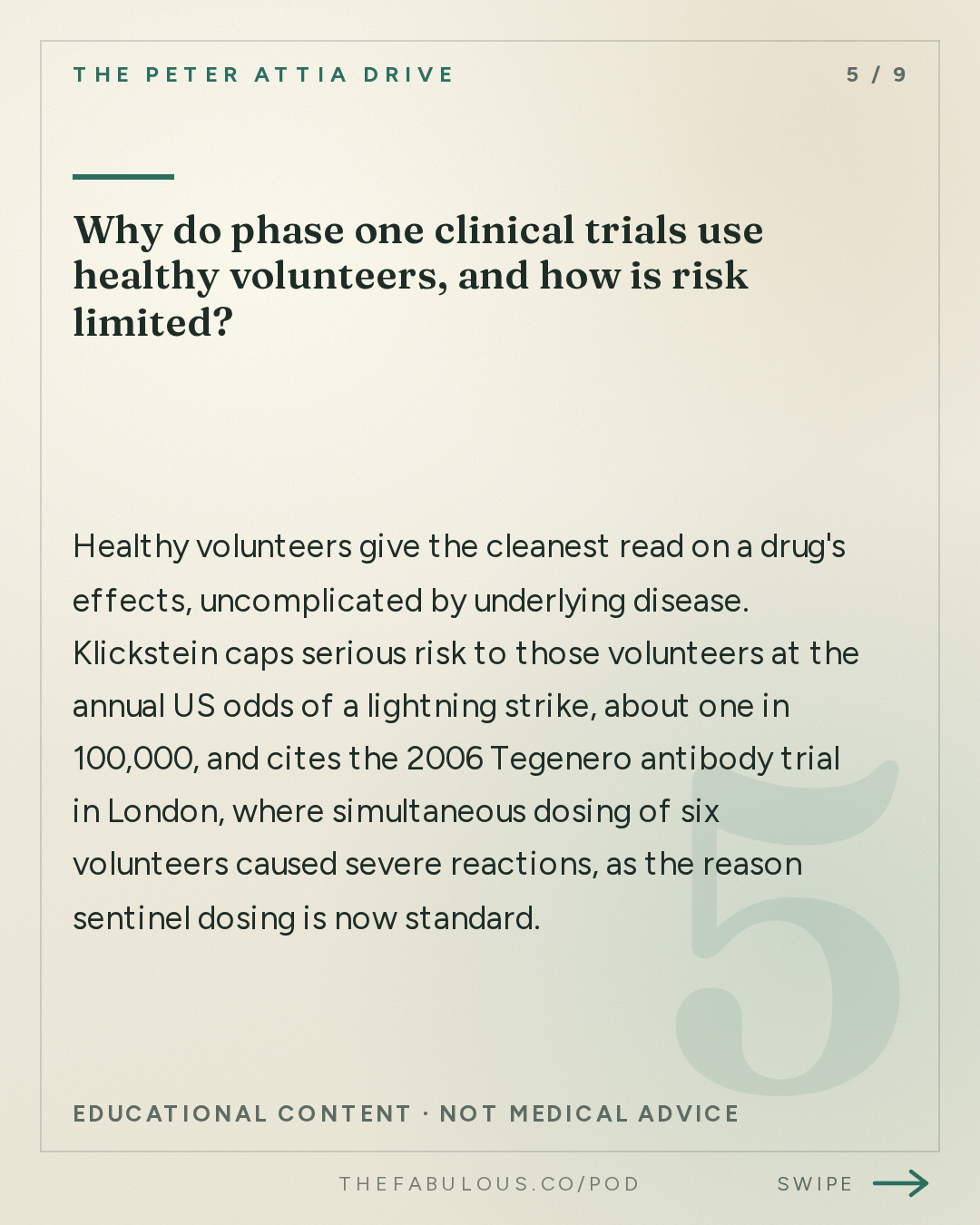
Why do phase one clinical trials use healthy volunteers, and how is risk limited?
Healthy volunteers give the cleanest read on a drug's effects, uncomplicated by underlying disease. Klickstein caps serious risk to those volunteers at the annual US odds of a lightning strike, about one in 100,000, and cites the 2006 Tegenero antibody trial in London, where simultaneous dosing of six volunteers caused severe reactions, as the reason sentinel dosing is now standard (85:58, 87:49).
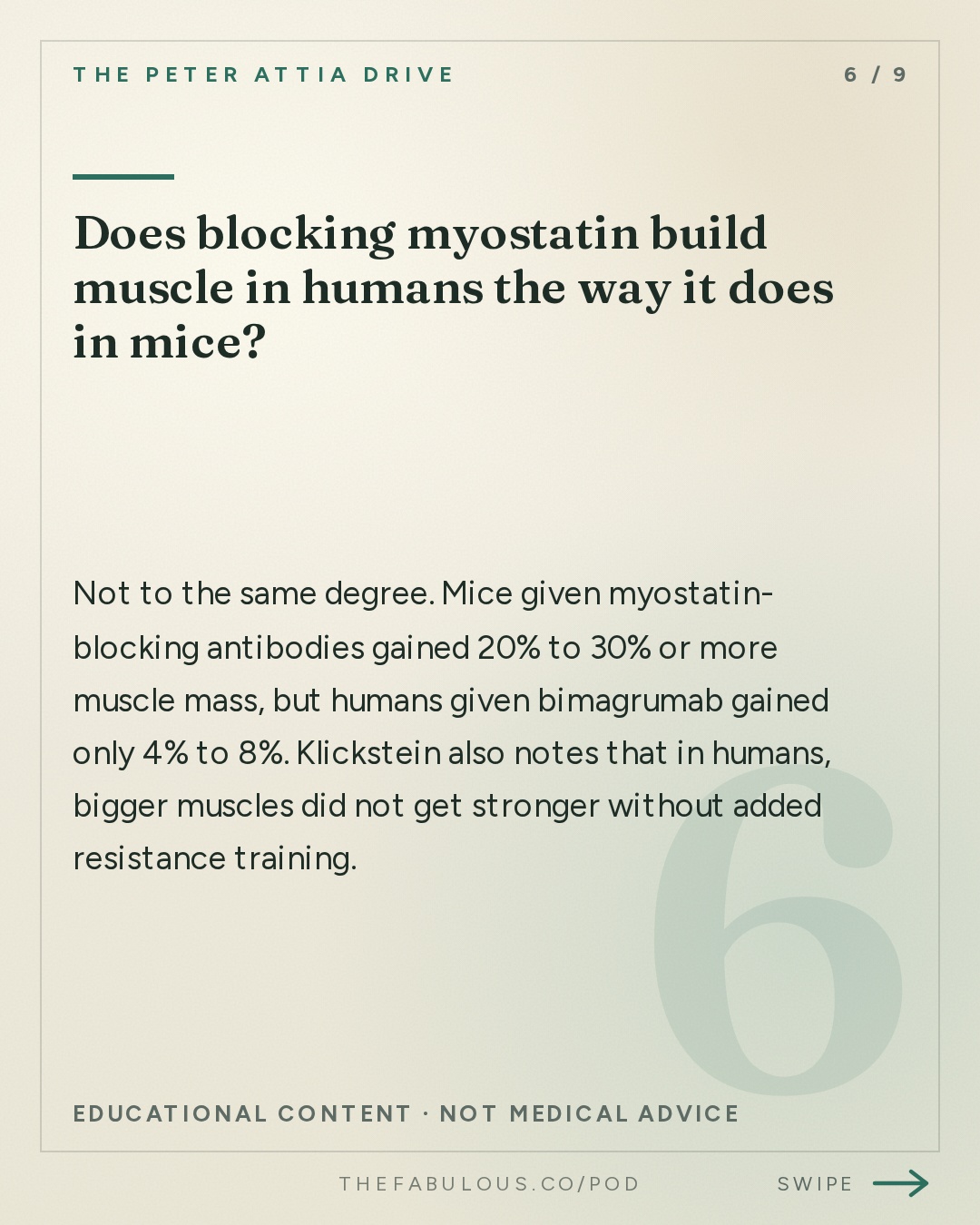
Does blocking myostatin build muscle in humans the way it does in mice?
Not to the same degree. Mice given myostatin-blocking antibodies gained 20% to 30% or more muscle mass, but humans given bimagrumab gained only 4% to 8% (61:11). Klickstein also notes that in humans, bigger muscles did not get stronger without added resistance training (109:08).
Are gray market research peptides like BPC-157 the same as pharmaceutical drugs?
No. Klickstein warns that peptides sold online for research use only are not manufactured under GMP, good manufacturing process, so there is no guarantee of purity or dose accuracy (76:48). He points out that BPC-157 specifically has never been reproduced by an independent lab and has no known human receptor (80:28).
The full read, in cards
Go deeper
- The Transformed Cell — Steve Rosenberg's memoir framing how cancer drug discovery actually happens
- BELIEVE study — Phase two trial combining bimagrumab and semaglutide, published in Nature Medicine
- Swedish Obesity Study — Long-term cohort of bariatric surgery patients showing reduced cancer incidence
- Tufts Center for the Study of Drug Development — Estimated cost to bring one approved drug to market at two to four billion dollars
Mentioned
Lloyd Klickstein · Bimagrumab · Novartis · Eli Lilly · Semaglutide · The Transformed Cell · David Glass · FDA · mTOR · Se-Jin Lee · Chris Liu · Steve Rosenberg · Versanis Bio · Coslab Therapeutics · WADA
More from this show and category
Peter Attia on Thyroid Health: Diagnosis and Risks
Peter Attia says thyroid problems are hard to diagnose because T4, the hormone the gland secretes, is inactive until tissues convert it locally into T3. TSH only shows how hard the gland is being told to work, not what's happening inside organs, so both under-treating real disease and over-treating borderline labs, common in functional medicine, cause real harm.
Obeticholic Acid for Heart Disease and Alzheimer's
Cardiologist Michael Davidson argues heart disease and Alzheimer's share a root cause: cholesterol mismanaged over decades, not years. His new CETP-inhibitor drug, obeticholic acid, cuts LDL by up to 50%, raises HDL 150%, and shows early signals of slowing Alzheimer's biomarkers in ApoE4 carriers (68:43).
Peter Attia's Blood Pressure Protocol Explained
High blood pressure above 120/80 doubles cardiovascular death risk with each 20 mmHg rise in systolic pressure, physician Peter Attia explains. He breaks down what the SPRINT and STEP trials proved about aggressive treatment, how to measure blood pressure correctly at home, and why weight loss, exercise, sleep, and sodium timing can lower it as much as medication.
Peter Attia on Liver Health and Metabolic Disease
Metabolic fatty liver disease now affects over 38% of adults worldwide, and physician Peter Attia frames the liver as a mirror of whole-body metabolic health. The disease moves through four stages, from metabolic stress to steatosis, steatohepatitis, and fibrosis, and the first three stages are largely reversible through weight loss, muscle gain, and cutting alcohol and liquid sugar calories.
