
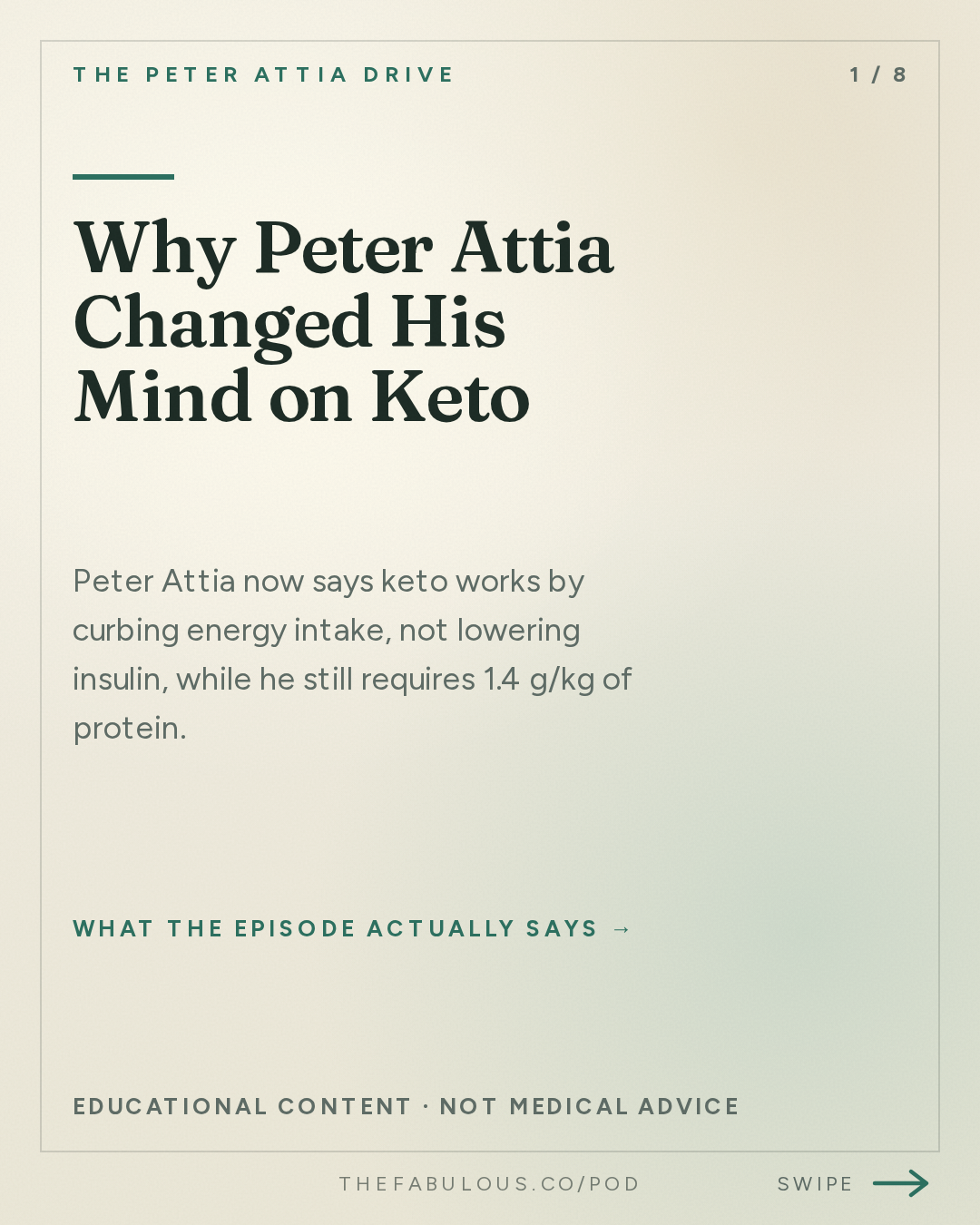
Why Peter Attia Changed His Mind on Keto
#411 ‒ AMA #90: Strong convictions, loosely held: how Peter's views on fasting, keto, metformin, rapamycin, whole-body MRI, and exercise have changed
▶ Listen to the full episode More from The Peter Attia Drive
The brief
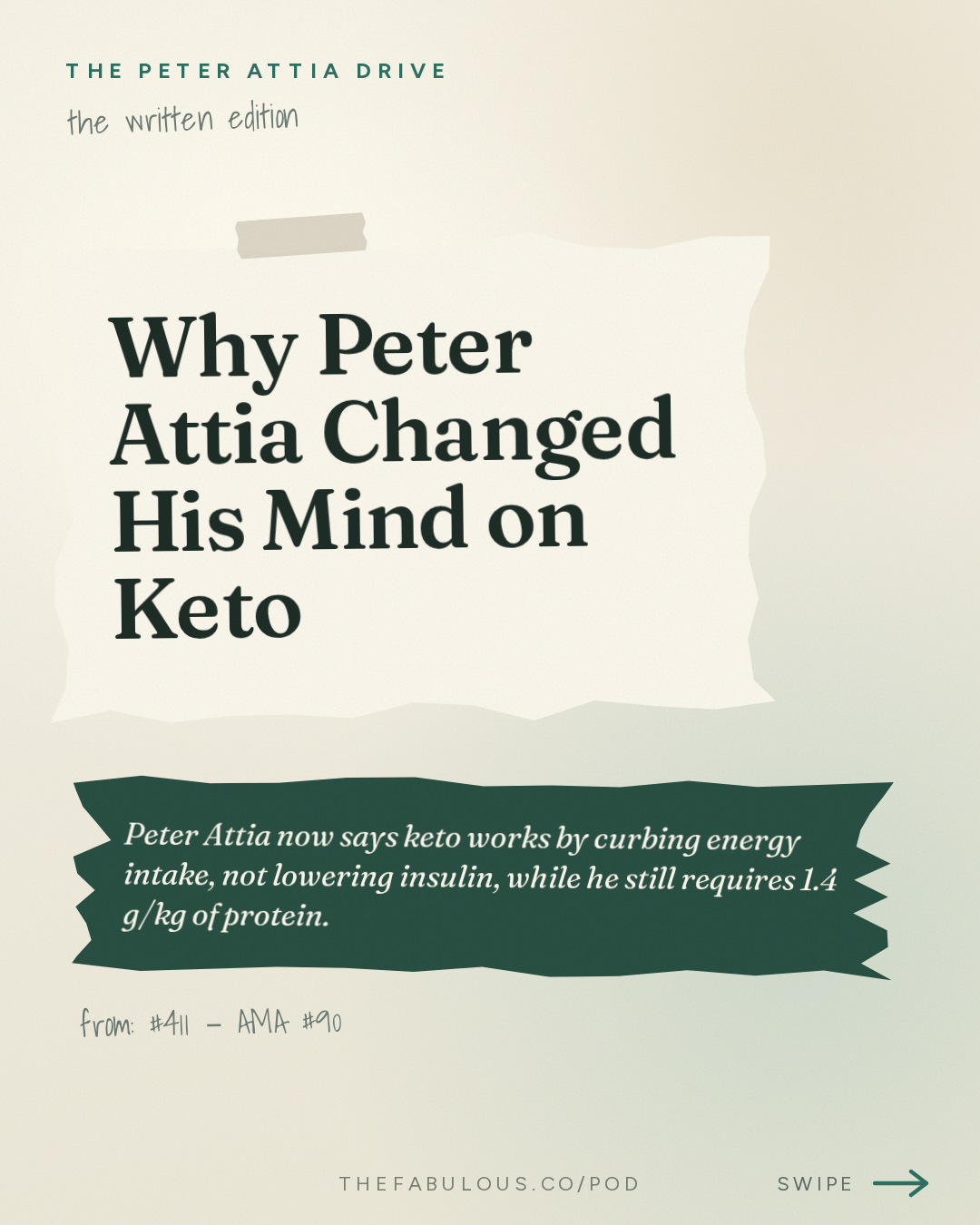
Peter Attia now says keto works by curbing energy intake, not lowering insulin, while he still requires 1.4 g/kg of protein (09:42, 11:44). He also walks back his extended fasting protocol, once seven to ten days quarterly, after weighing autophagy evidence against the practical cost (12:36, 15:09).
A hedge fund manager once handed Peter Attia a phrase that has outlasted most of his trades: strong convictions, loosely held. The idea is simple. Put real money, or a real clinical opinion, behind a thesis, but hold it loosely enough that the moment new evidence shows up, you can let it go without grief (02:50). On this episode of his podcast The Drive, marking roughly eight years and 400 episodes, Attia, a physician known for his long-form interviews on longevity and for his book Outlive, uses that phrase to revisit two of his most public positions: the ketogenic diet and extended fasting. What he finds is less a story of being wrong than a story of having had an incomplete explanation.
Attia says his book should not read the same way a decade from now. If it did, he argues, that would mean either he had stopped learning or the science had stopped moving, and neither option sits well with him (03:48). Medical opinion, in his view, should not update smoothly. It lurches.
Scientific progress is, you know, by its very nature, somewhat glacial and episodic. It doesn't just progress at the same rate. [04:43]
Three forces push him to revise a position, he says: the published literature, conversations with experts he interviews on the podcast, and his own patients, who he calls teachers (05:11). Sometimes those three sources converge and reinforce what he already believed. Sometimes they add nuance and carve out exceptions. And sometimes, as with nutrition, they change his mind completely (05:37).
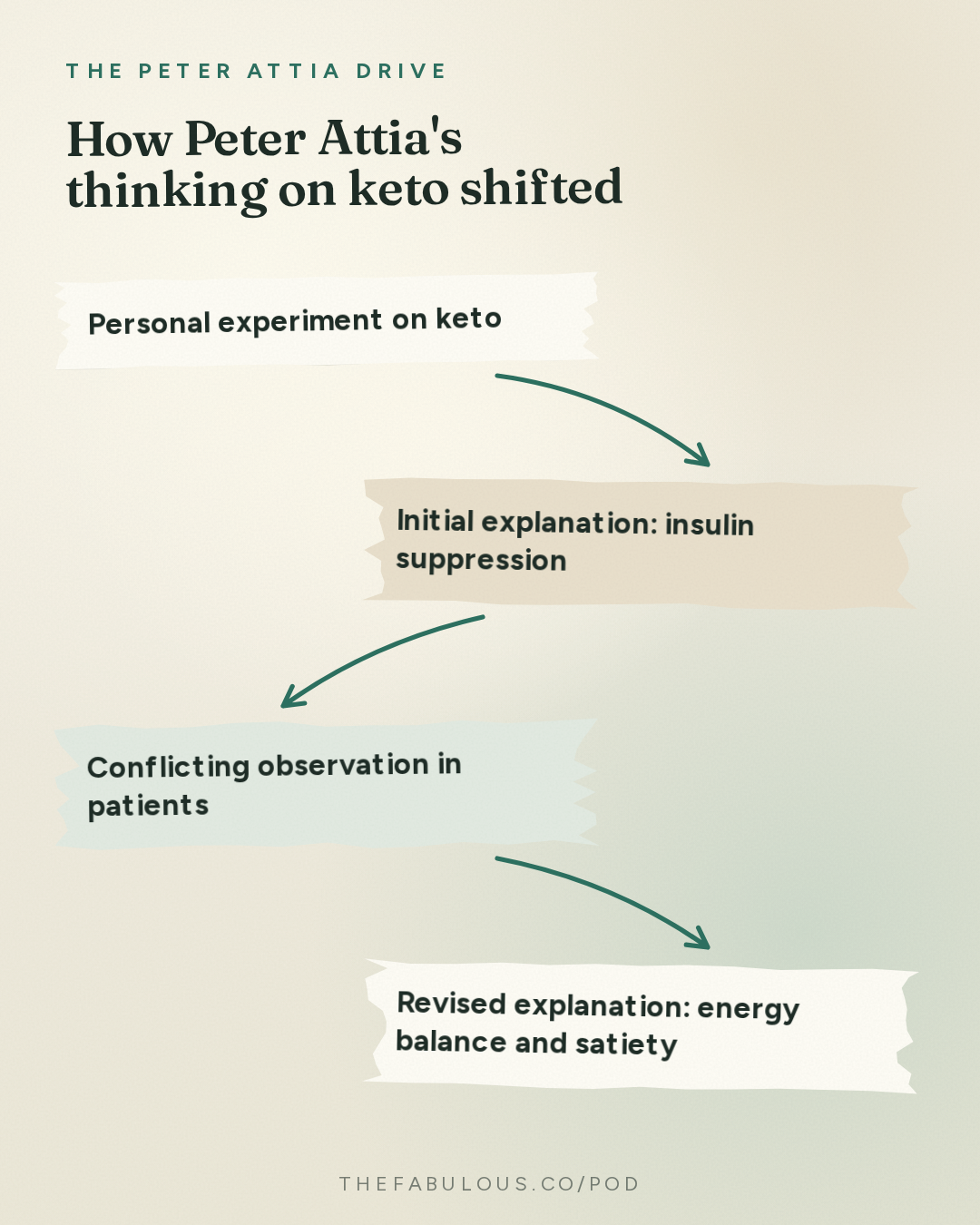
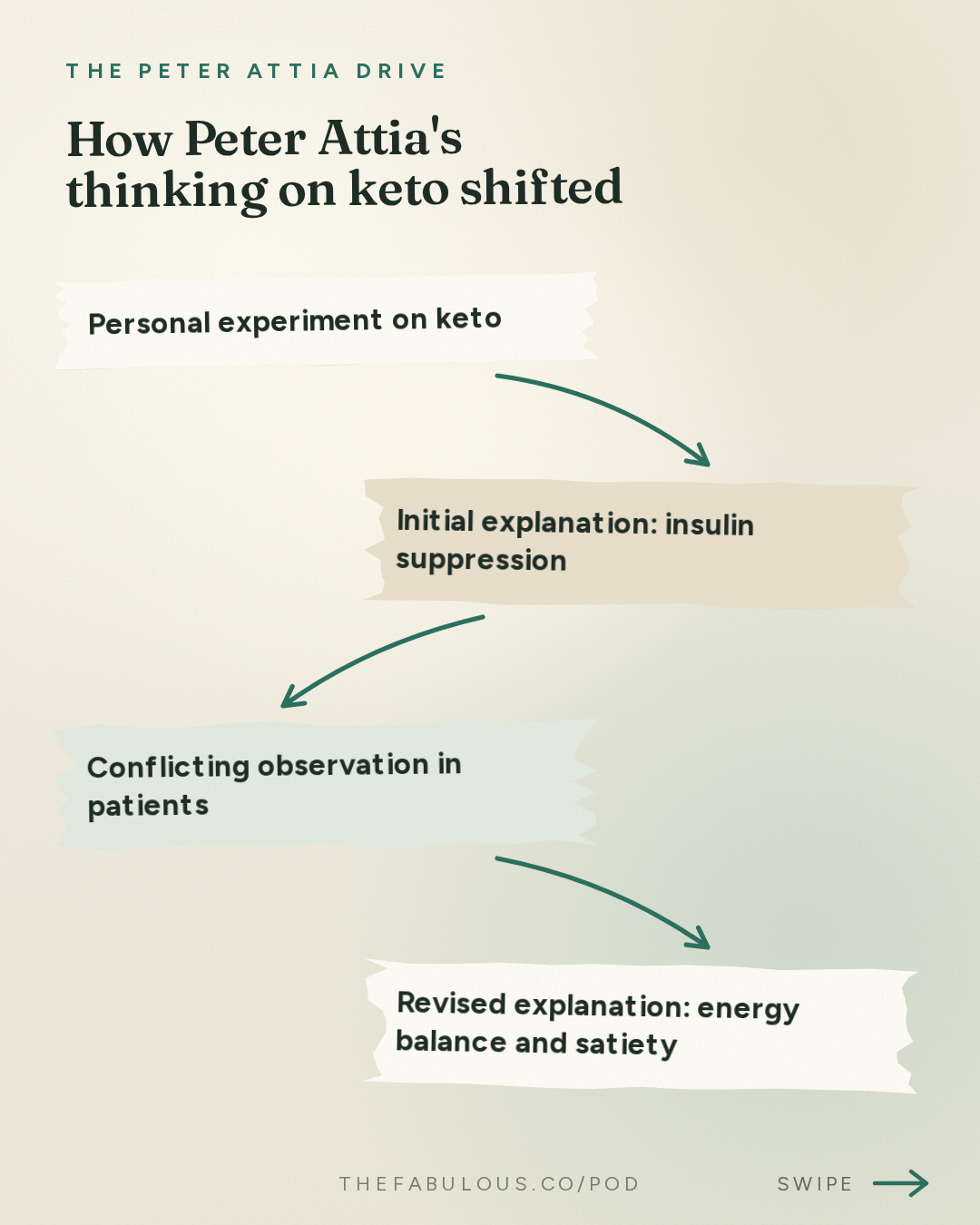
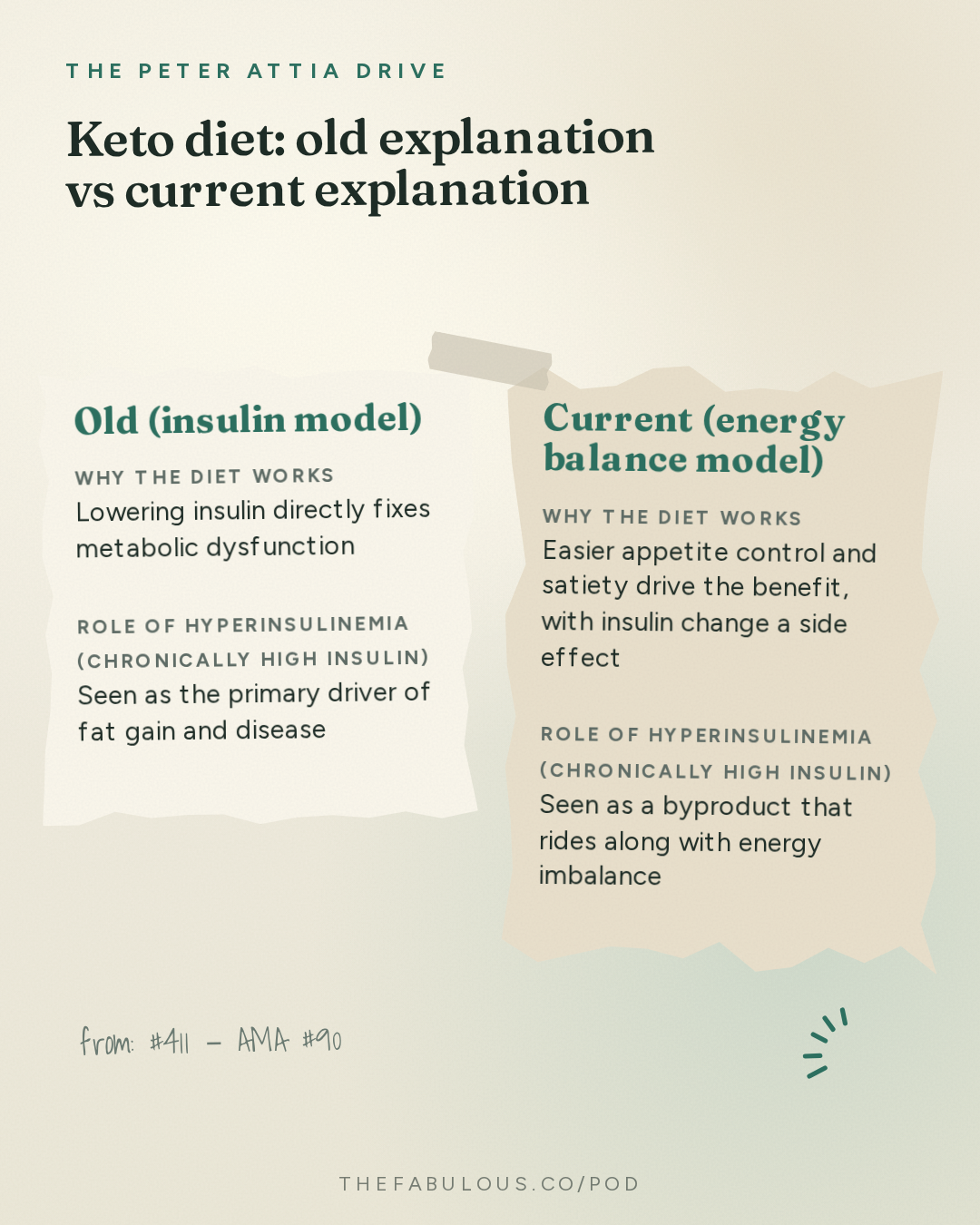
From insulin to energy balance
Attia's original thinking on diet started with the insulin model of obesity, the idea that carbohydrate intake drives insulin, insulin drives fat storage, and fat storage drives metabolic disease, the condition he calls the foundational problem behind nearly every other chronic illness (06:43). Cutting carbohydrates step by step eventually forces a choice: go all the way into ketosis, a metabolic state where the body burns fat for fuel and produces ketone bodies, or stay in a middle zone that feeds neither the brain's glucose needs nor its ketone needs well (07:13). Attia chose to go all the way. He stayed in ketosis for three years, logging extensive personal data, with an average morning fasting beta-hydroxybutyrate (a ketone body used to measure depth of ketosis) of 1.8 to 2 millimoles per liter, rising higher through the day as he ate mostly fat (09:14). He calls it the best he ever felt.
I abandoned the ketogenic diet basically because I was just tired of being that restrictive in my eating. [08:50]
That line matters because it separates two questions people tend to merge: did the diet fail, and did he quit it. He quit it. It did not fail. To this day he calls ketogenic eating effective. What changed is his explanation for why.
I used to believe that the diet worked through insulin suppression, but today, I don't think that's the case. [09:42]
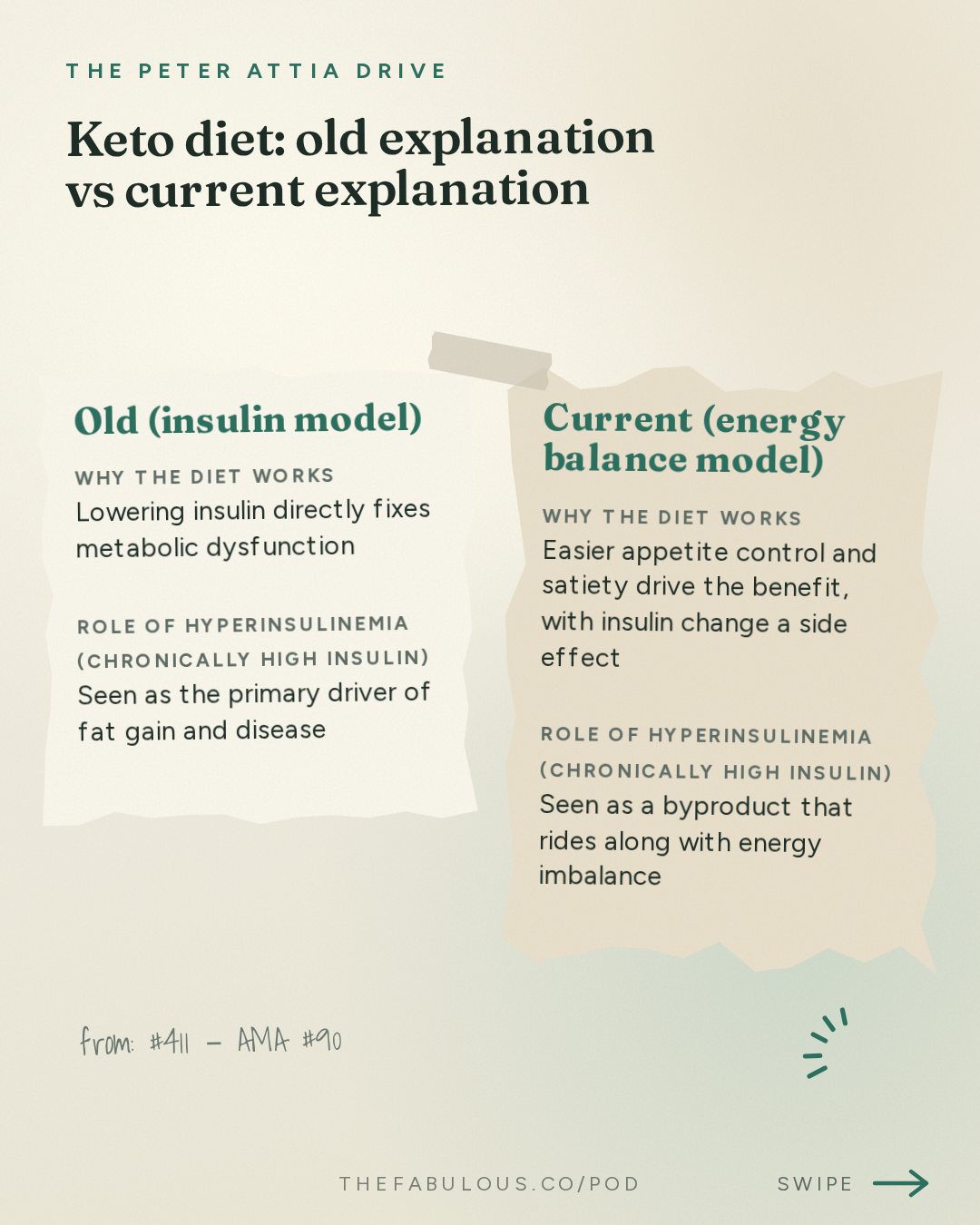
The insulin model predicted that lowering insulin should, on its own, fix metabolic dysfunction: less visceral fat, better insulin sensitivity, resolved liver fat. Attia now reads the data differently. He thinks metabolic dysfunction, visceral fat accumulation, and declining insulin sensitivity are downstream results of energy imbalance, meaning eating more energy than the body uses, and that chronically elevated insulin, or hyperinsulinemia, simply rides along with that imbalance rather than causing it (10:30). The clearest evidence, he says, is watching someone on a ketogenic diet who is still eating in surplus. Their insulin drops, as expected, but they do not lose weight. Some even gain it (11:18). If suppressed insulin were the actual lever for fat loss, that should not be possible.
So why does keto work when it does work? Attia now credits satiety. Many people find the foods allowed on a ketogenic diet, heavy in fat and protein, more filling than carbohydrate-dense foods, which makes it easier to eat in a deficit without consciously counting anything (09:42). There may also be something to burning fatty acids for fuel directly supplying energy during a weight-loss phase (10:30). The mechanism changed. The usefulness of the diet, for the right person, did not.
One consequence of this shift is that Attia has become far less dogmatic about which diet a patient should choose. He no longer has a strong preference between ketogenic, low-fat, or mostly pescatarian eating patterns, as long as one line holds: a minimum of 1.4 grams of protein per kilogram of body weight, regardless of what else is on the plate (11:44).
I really am pretty adamant about people maintaining the right amount of protein, and at a minimum, I want them hitting one point four grams per kilogram of body weight. [11:44]
Fasting and the analog nature of autophagy
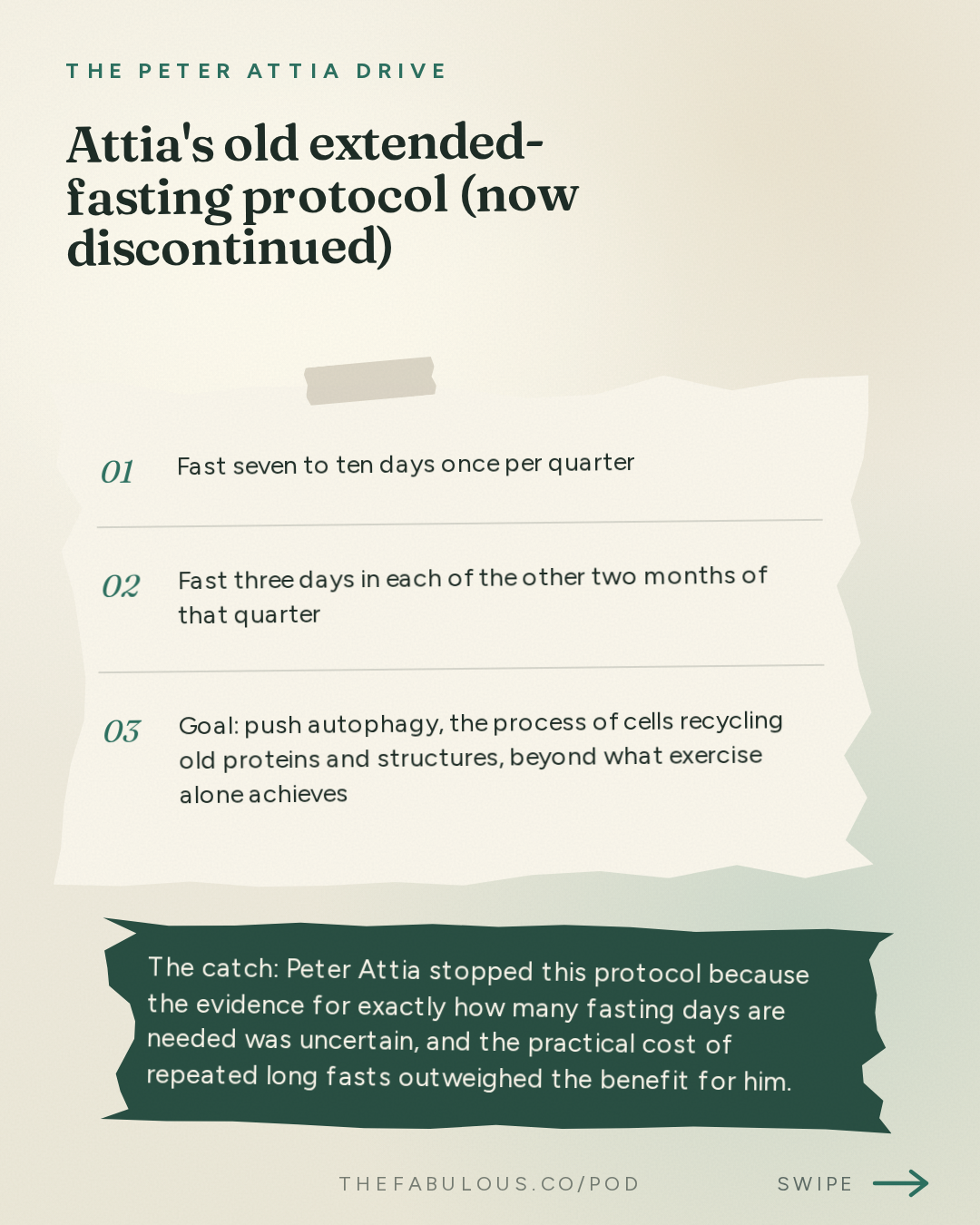
A parallel story runs through his views on extended fasting. For about three years, Attia ran a personal protocol: a fast of seven to ten days once a quarter, and a three-day fast in each of the other two months of that quarter (12:36). He was not trying to lose weight, he says; his weight was already where he wanted it. He was chasing autophagy, the process by which cells break down and recycle old intracellular proteins and structures, literally self-eating in order to reuse worn-out parts (13:10). The theory, well supported in preclinical, animal-based research, is that under nutrient scarcity the body recycles its worst material first: cells heading toward senescence, meaning they have stopped dividing and lost normal function, or cells carrying mutations (13:37).
The trouble is dosing. Ketosis has a rough, agreed-upon threshold: somewhere between 0.5 and 1 millimole of beta-hydroxybutyrate at rest marks the entry point (14:43). Autophagy has no comparable blood marker and no clean switch.
Autophagy is not digital, it's analog. It's not like you have no autophagy and then you cross a threshold. [14:19]
Based on conversations with researchers and preclinical data, Attia now estimates that roughly three days of fasting is where autophagy rises meaningfully beyond what exercise alone produces (14:43). That is an approximation drawn from animal studies and expert opinion, not a measured human cutoff, and he says plainly that he has not reviewed this literature in a couple of years, so the estimate could be out of date.
Given that uncertainty, why stop a protocol he once ran for three years straight? Attia points to two things together: the ambiguous evidence for exactly how much fasting is needed, and the practical cost of repeatedly going without food for a week or more at a time (15:09). The fuller answer, along with his updated thinking on metformin, rapamycin, whole-body MRI, and strength training, is reserved for paying subscribers; this preview ends just as he starts to unpack it.
What carries across both stories, keto and fasting, is not regret. Attia still eats low-carbohydrate at times. He still thinks fasting promotes autophagy. The thing that moved is the explanation underneath the behavior, and the confidence with which he holds any single mechanism as the whole answer. That is the actual content of strong convictions, loosely held: keep the practice that works, and be willing to rewrite the theory behind it the moment the data ask you to.
Ask this episode anything
Pod's AI answers from the episode itself, with the minute mark so you can hear it yourself.
Or start with one of these
Ask this episode
Pod's AI listens to the whole episode to answer, and points you to the minute it comes from.
The rest of this answer, and any question after it
Answers come from the episode itself, never from a summary of it.
ContinueKey takeaways
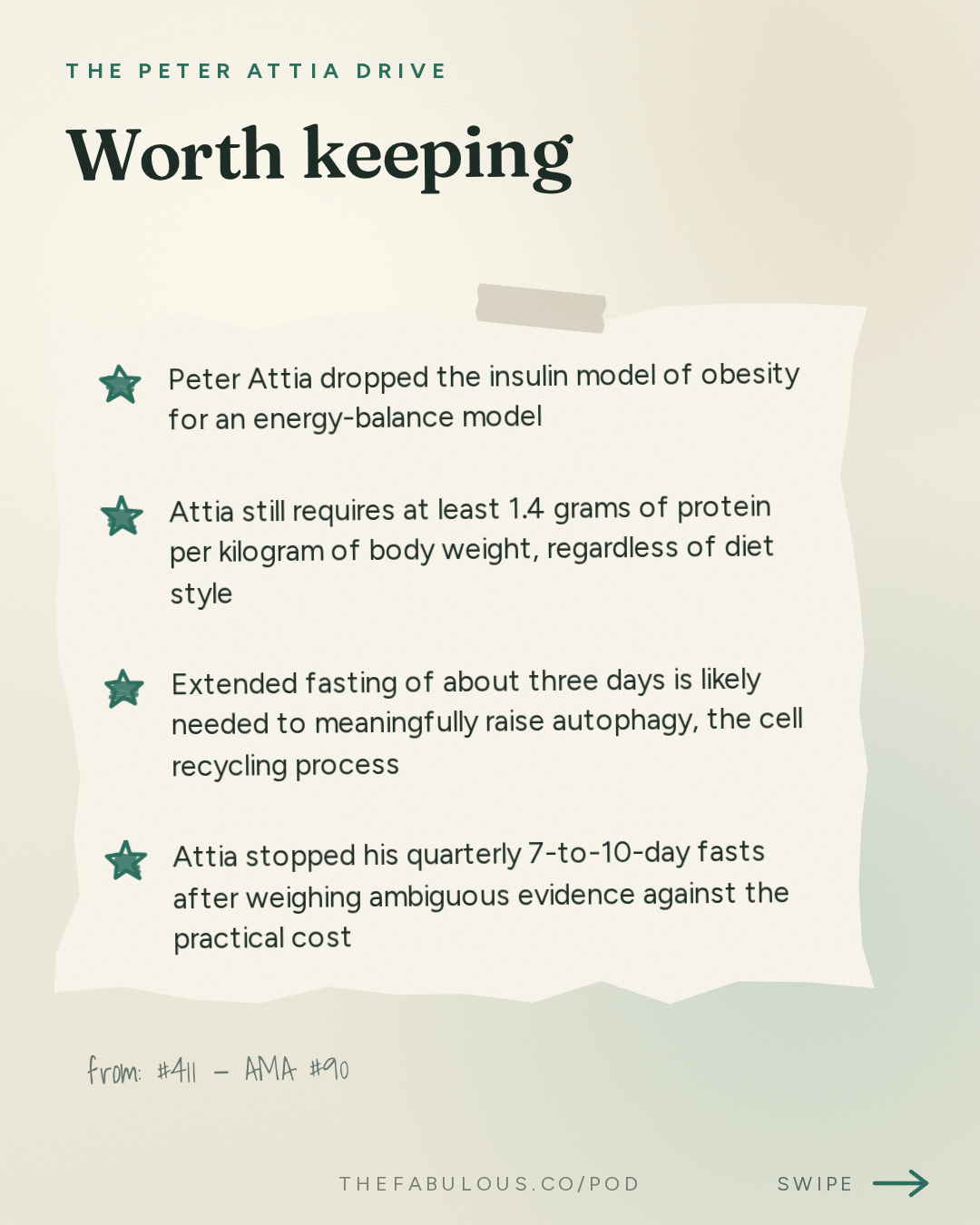
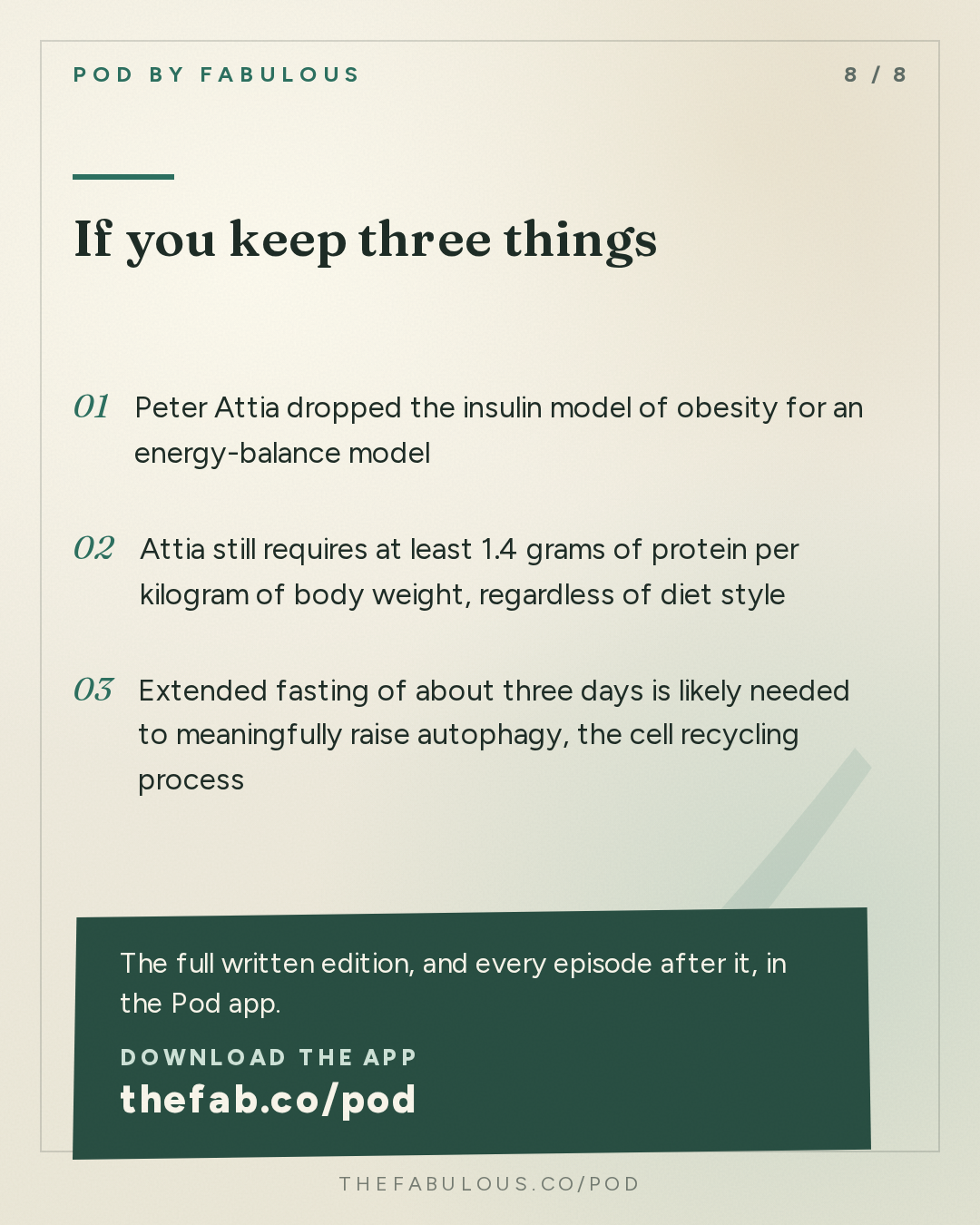
- Peter Attia dropped the insulin model of obesity for an energy-balance model
- Attia still requires at least 1.4 grams of protein per kilogram of body weight, regardless of diet style (11:44)
- Extended fasting of about three days is likely needed to meaningfully raise autophagy, the cell recycling process (14:43)
- Attia stopped his quarterly 7-to-10-day fasts after weighing ambiguous evidence against the practical cost (12:36, 15:09)
- Attia says scientific opinion should change because research moves in uneven, glacial bursts, not steadily (04:43)
The episode in cards
In their words
“I abandoned the ketogenic diet basically because I was just tired of being that restrictive in my eating.”
“I used to believe that the diet worked through insulin suppression, but today, I, I don't think that's the case”
“Autophagy is not digital, it's analog. It's not like you have no autophagy and then you cross a threshold.”
Protocols
-
Protein floor regardless of diet style
Peter Attia tells patients to hit a minimum of 1.4 grams of protein per kilogram of body weight, whether they follow a ketogenic, low-fat, or mostly pescatarian diet.
daily
-
Former extended-fasting protocol (discontinued)
Peter Attia used to fast for seven to ten days once a quarter and for three days in each of the other two months, aiming to push autophagy, the process of cells recycling old proteins and structures, beyond what exercise alone produces; he has since stopped this routine because the evidence for the required fasting length was uncertain and the practical cost of repeated long fasts was too high.
discontinued, previously quarterly
Questions this episode answers
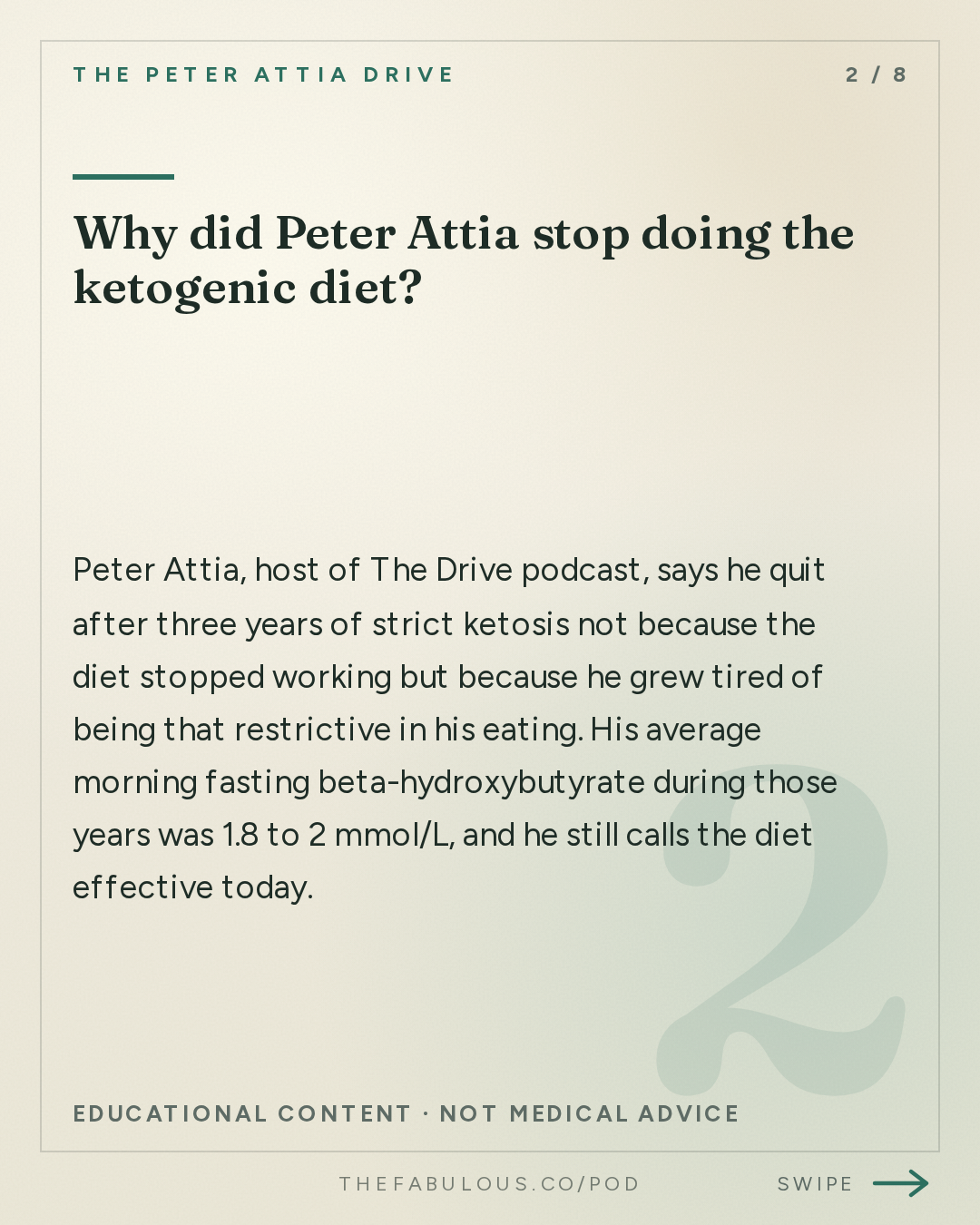
Why did Peter Attia stop doing the ketogenic diet?
Peter Attia, host of The Drive podcast, says he quit after three years of strict ketosis not because the diet stopped working but because he grew tired of being that restrictive in his eating (08:50). His average morning fasting beta-hydroxybutyrate during those years was 1.8 to 2 mmol/L, and he still calls the diet effective today (09:14).
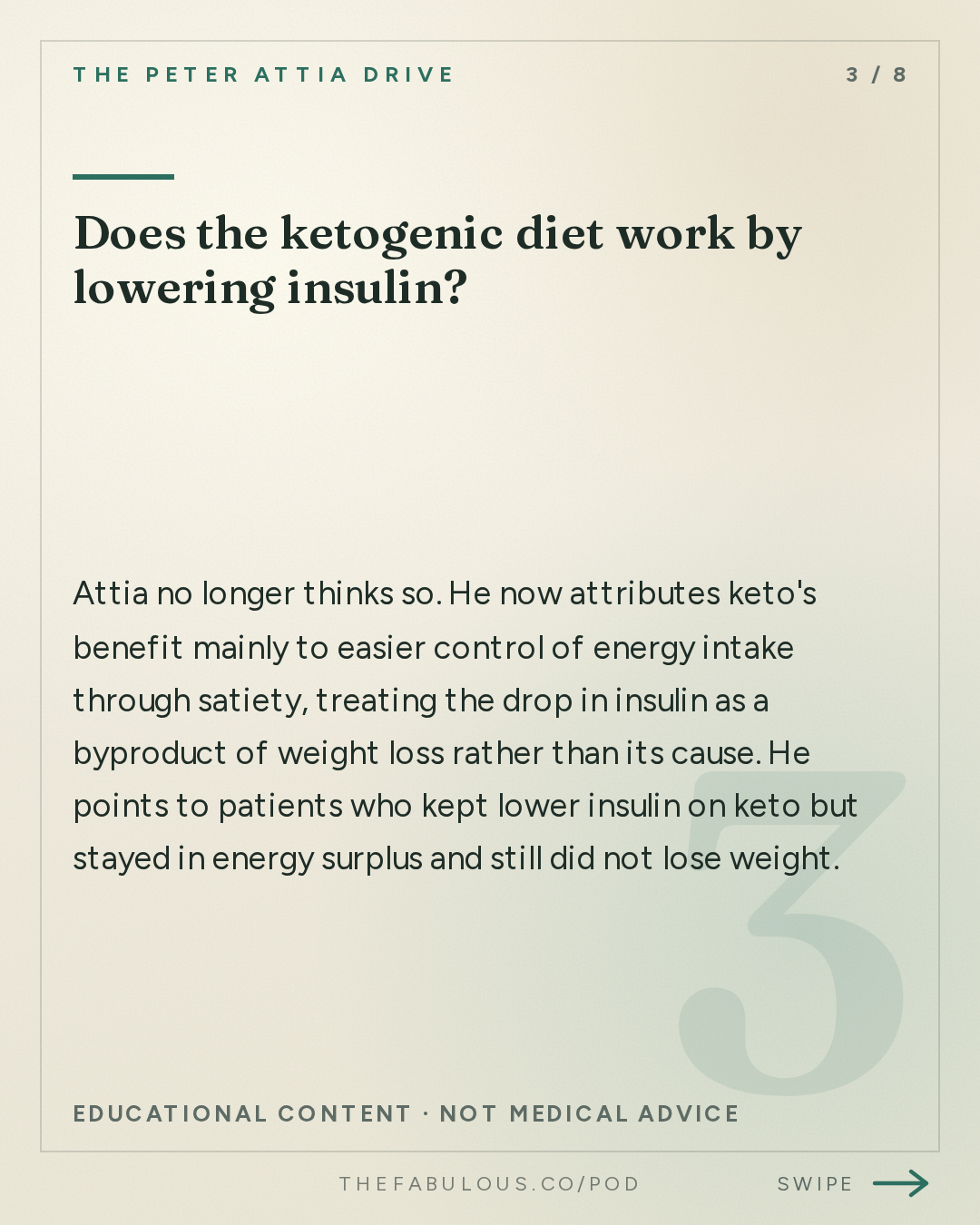
Does the ketogenic diet work by lowering insulin?
Attia no longer thinks so. He now attributes keto's benefit mainly to easier control of energy intake through satiety, treating the drop in insulin as a byproduct of weight loss rather than its cause (09:42). He points to patients who kept lower insulin on keto but stayed in energy surplus and still did not lose weight (11:18).
How much protein does Peter Attia recommend?
Attia tells patients to hit a floor of 1.4 grams of protein per kilogram of body weight, regardless of whether they eat ketogenic, low-fat, or mostly pescatarian (11:44).
How many days of fasting are needed to boost autophagy?
Based on preclinical data and conversations with researchers, Attia estimates roughly three days of fasting is needed to meaningfully raise autophagy, the process by which cells recycle old proteins and structures (13:10, 14:43). He cautions that autophagy behaves as a gradient, not a switch that flips at a fixed point (14:19).
What does 'strong convictions loosely held' mean?
Attia borrowed the phrase from a friend who ran a hedge fund: hold a position firmly enough to act on it, but be ready to abandon it the moment new data contradicts it (02:50). He applies this to medicine, arguing that scientific progress moves in uneven bursts rather than at a steady rate (04:43).
The full read, in cards
Go deeper
- Outlive — Peter Attia's book on longevity, used as his own benchmark for whether his views have changed over time
Mentioned
Peter Attia · Outlive · Metformin · Rapamycin · The Drive · Nick
More from this show and category
Preeclampsia and Long-Term Heart Risk Explained
Pregnancy stresses the heart, kidneys, and metabolism so hard that its complications predict a woman's cardiovascular and diabetes risk decades later. Maternal-fetal medicine specialist Kathryn Gray explains how plasma volume surges 50%, how preeclampsia's placental biology works, and why half of gestational diabetes cases become type 2 diabetes.
Lloyd Klickstein on How New Drugs Get Made
Physician-scientist Lloyd Klickstein maps the full arc of drug development, from spotting an unmet need to FDA approval, using the muscle drug bimagrumab as his case study. Paired with semaglutide, it cut body fat by 45.7% over 72 weeks (125:28), rivaling bariatric surgery, while exposing the economics of patents, manufacturing, and phase one risk.
Peter Attia on Thyroid Health: Diagnosis and Risks
Peter Attia says thyroid problems are hard to diagnose because T4, the hormone the gland secretes, is inactive until tissues convert it locally into T3. TSH only shows how hard the gland is being told to work, not what's happening inside organs, so both under-treating real disease and over-treating borderline labs, common in functional medicine, cause real harm.
Obeticholic Acid for Heart Disease and Alzheimer's
Cardiologist Michael Davidson argues heart disease and Alzheimer's share a root cause: cholesterol mismanaged over decades, not years. His new CETP-inhibitor drug, obeticholic acid, cuts LDL by up to 50%, raises HDL 150%, and shows early signals of slowing Alzheimer's biomarkers in ApoE4 carriers (68:43).
