
BETTER! with Dr. Stephanie Estima
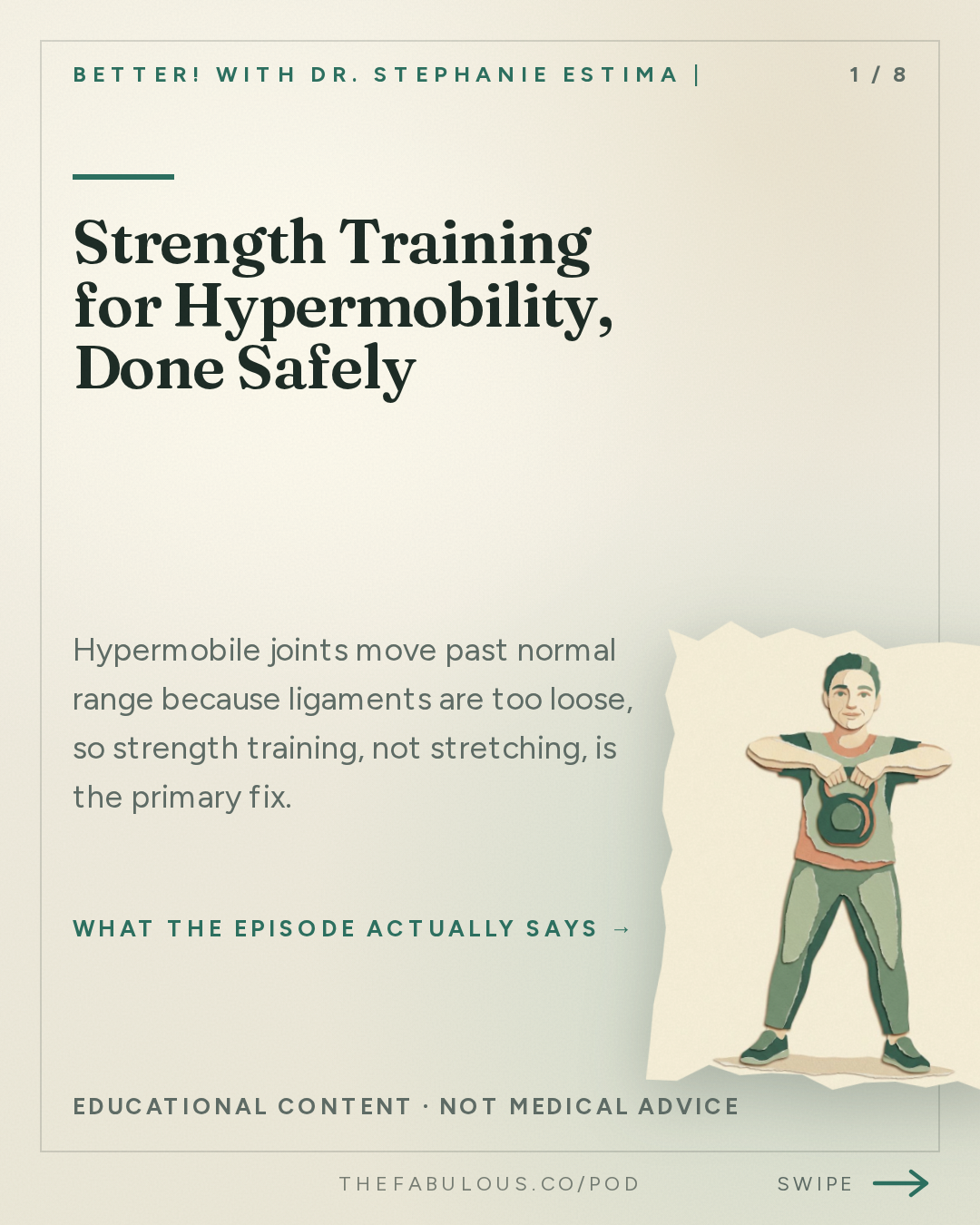
Strength Training for Hypermobility, Done Safely
Hypermobile? Yes, You Can Strength Train (Here's How to Do It Safely)
▶ Listen to the full episode More from BETTER! with Dr. Stephanie Estima
The brief
Hypermobile joints move past normal range because ligaments are too loose, so strength training, not stretching, is the primary fix. Dr. Stephanie Estima recommends training within 80% of available range of motion, using slow eccentrics and isometric holds, plus adequate protein and vitamin C to support connective tissue repair.
Ask this episode anything
Pod's AI answers from the episode itself, with the minute mark so you can hear it yourself.
Or start with one of these
Ask this episode
Pod's AI listens to the whole episode to answer, and points you to the minute it comes from.
The rest of this answer, and any question after it
Answers come from the episode itself, never from a summary of it.
Continue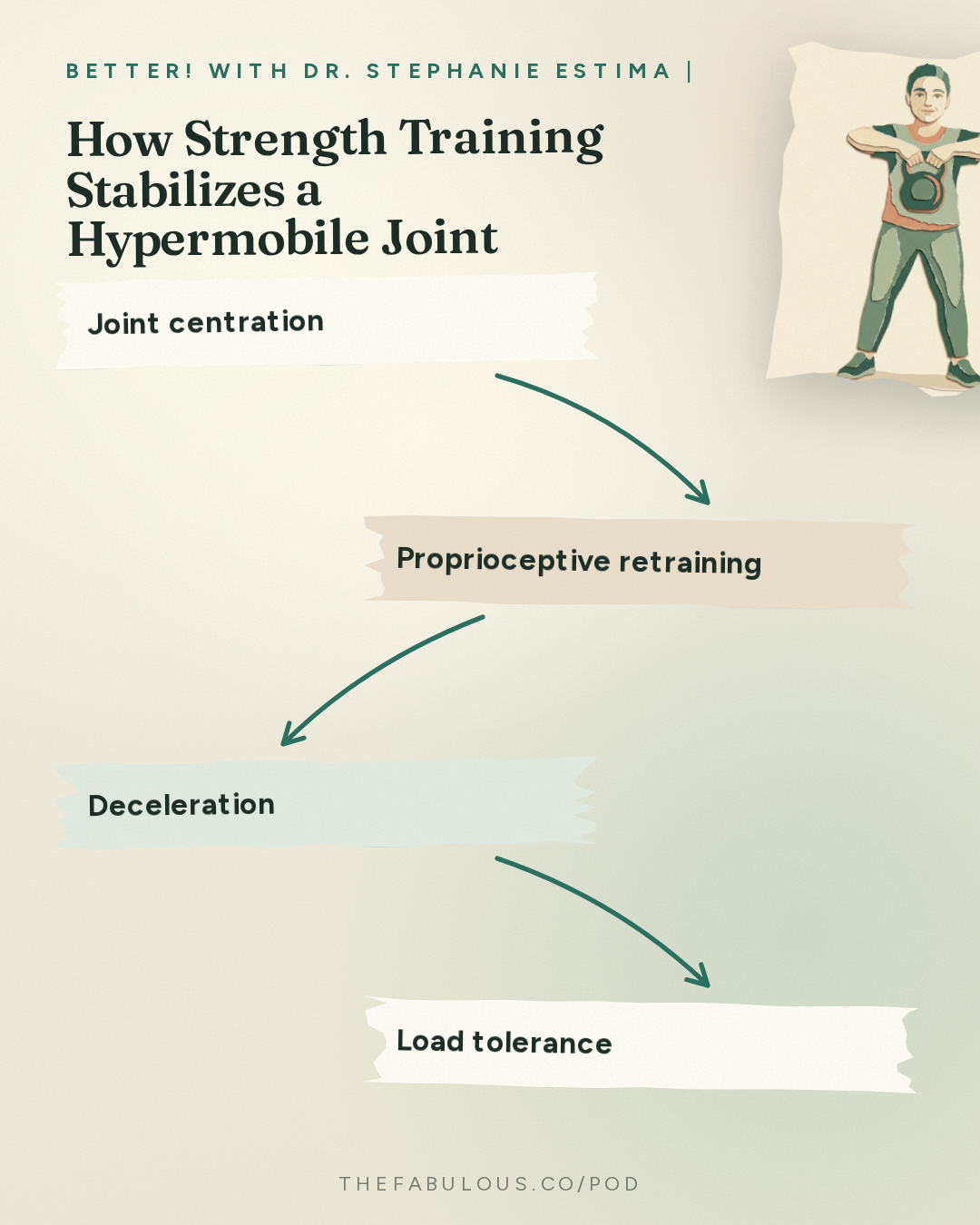
Key takeaways
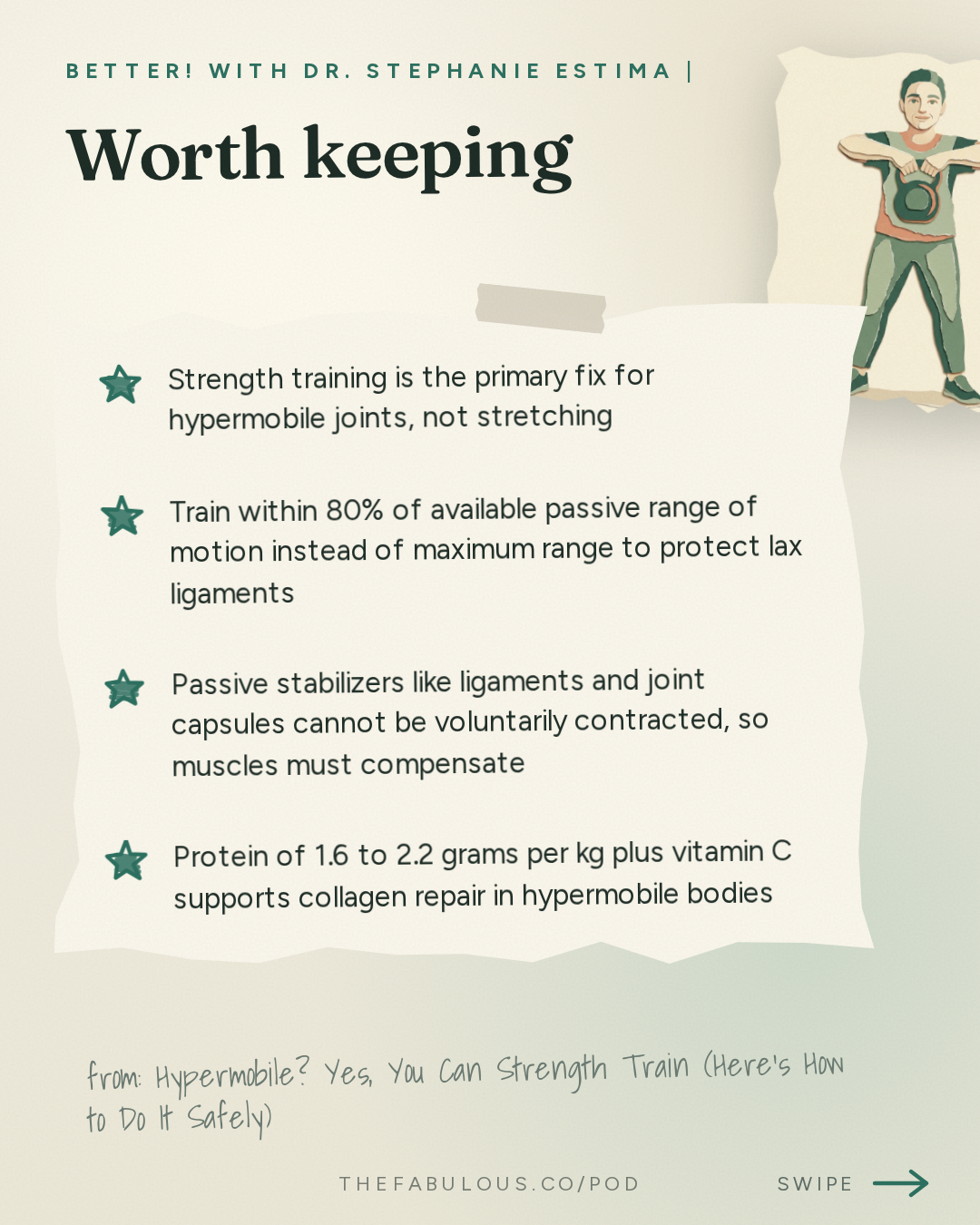
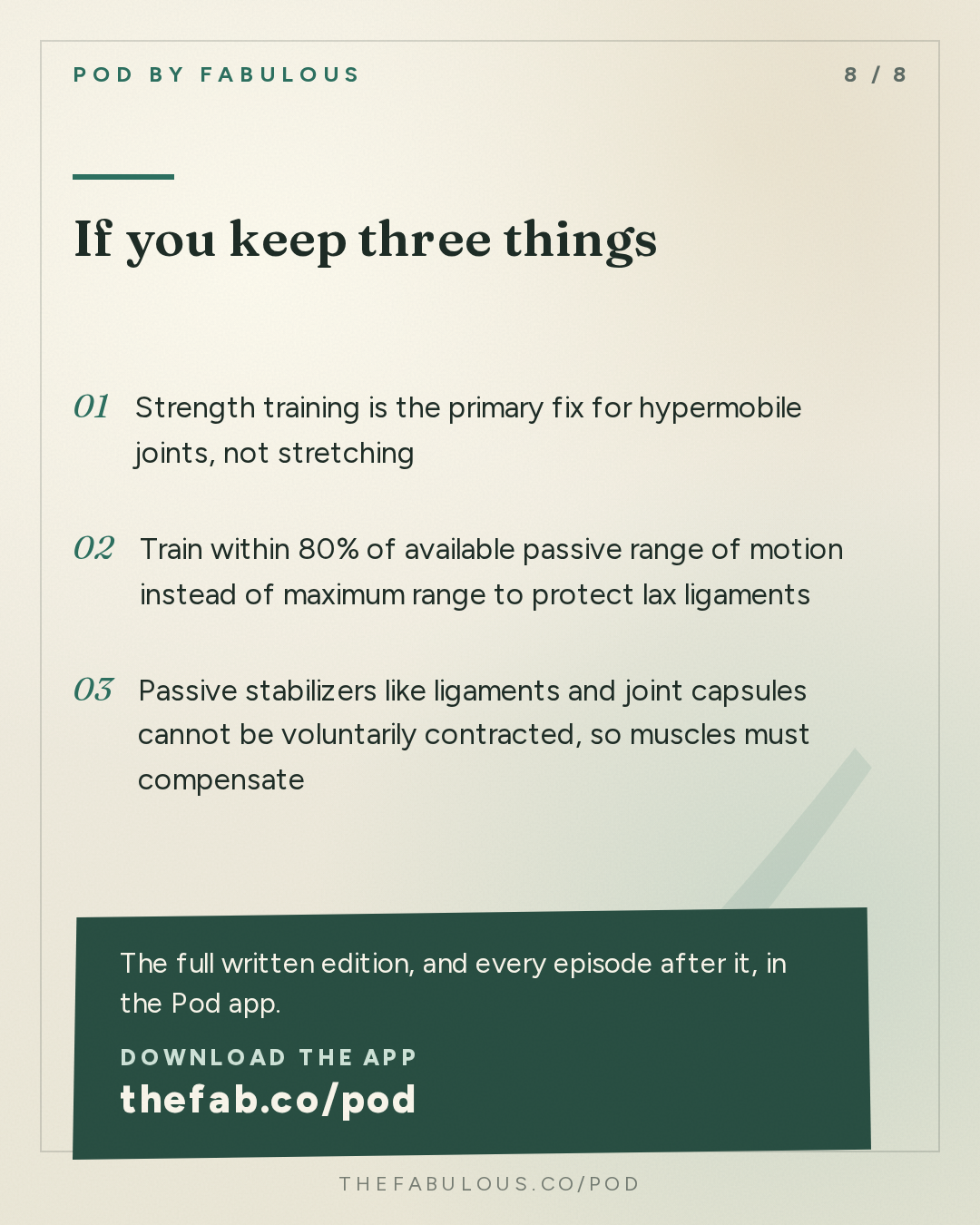
- Strength training is the primary fix for hypermobile joints, not stretching
- Train within 80% of available passive range of motion instead of maximum range to protect lax ligaments
- Passive stabilizers like ligaments and joint capsules cannot be voluntarily contracted, so muscles must compensate
- Protein of 1.6 to 2.2 grams per kg plus vitamin C supports collagen repair in hypermobile bodies
- Severe caloric deficits strip protective muscle and can worsen hypermobility symptoms
The episode in cards
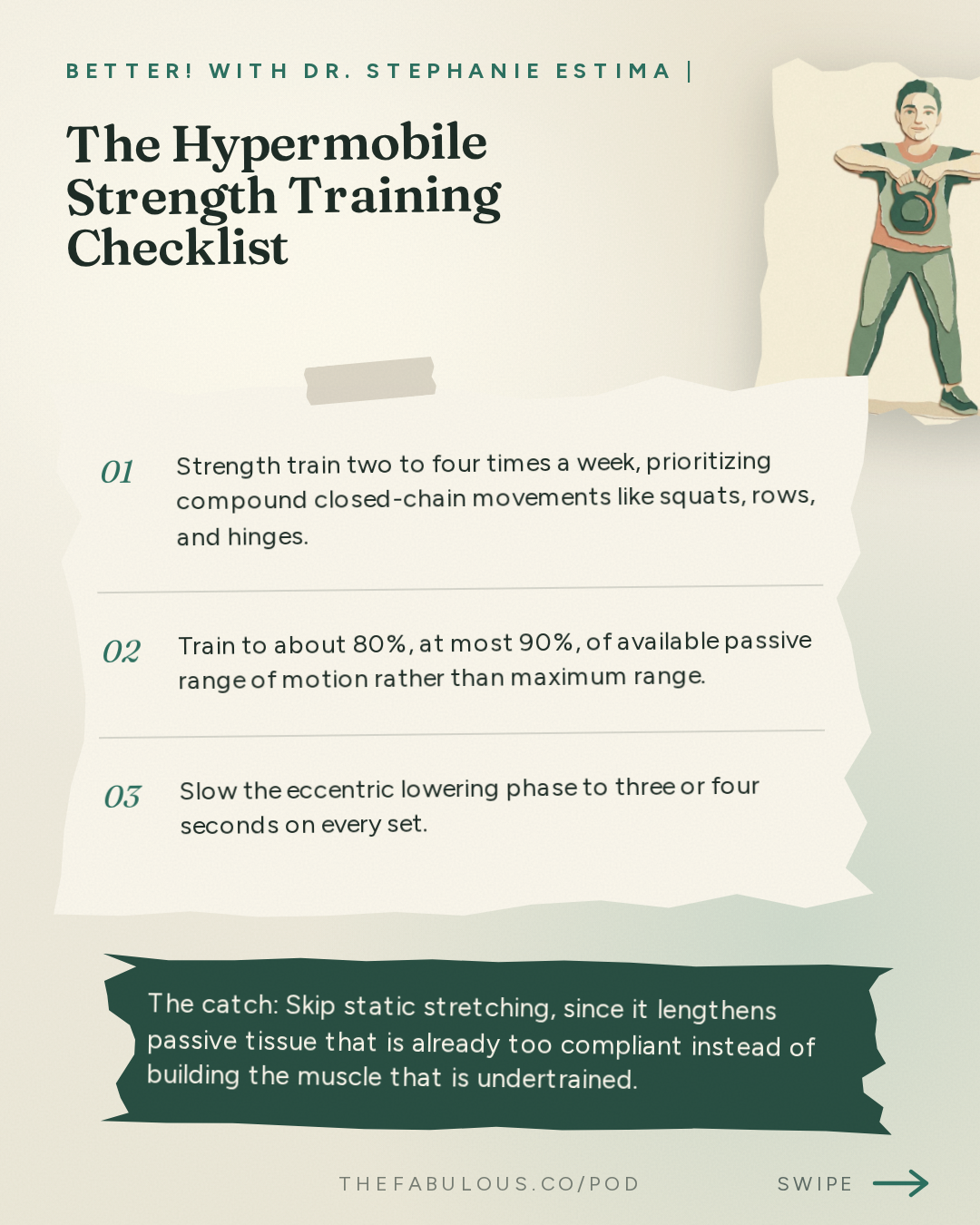

A lot of people learn they are "double jointed" as a party trick: bend the thumb back to the forearm, lock the elbow past straight, fold flat over straight legs, and wait for the laughter. Chiropractor Dr. Stephanie Estima spends this episode arguing that the laughter is misplaced. For a meaningful slice of women, that party trick is the visible edge of a real physiological problem, and the standard fitness advice they get, stretch more, take it easy, is close to the opposite of what actually helps (00:37).
Estima starts with a definition. Hypermobility means a joint moves beyond what counts as a normal range of motion, in one joint or many. Clinicians screen for it with the Beighton score, a nine-point test that checks the thumbs, the pinkies, the elbows, the knees, and how far someone can forward fold (04:26). It is a screening tool, not a diagnosis, and Estima is careful to say so. Above it sits a three-tier spectrum. At the bottom is simple joint hypermobility: flexible joints, no symptoms, the territory where many dancers, gymnasts, and yogis live comfortably. In the middle is hypermobility spectrum disorder, or HSD, the same loose joints plus pain, instability, and fatigue. At the top is hypermobile Ehlers-Danlos syndrome, or hEDS, a genetic connective tissue condition where joint looseness is one feature of a wider picture that can include skin, gut, and cardiovascular symptoms (04:50). Estima is explicit that hEDS needs a geneticist or a rheumatologist, not a podcast. What she wants listeners to take from the spectrum is a single idea: the looseness itself is not the danger. The instability it can create is.
Women land on this spectrum far more often than men, and the reason is hormonal rather than mysterious. Estrogen increases ligament laxity, loosening the collagen-based tissue that normally checks a joint's range (06:48). It is why women are, on average, more flexible than men, and why women subluxate shoulders and ache in hips that everyone else is busy admiring in a deep yoga pose (07:18).
Two Systems, One Job
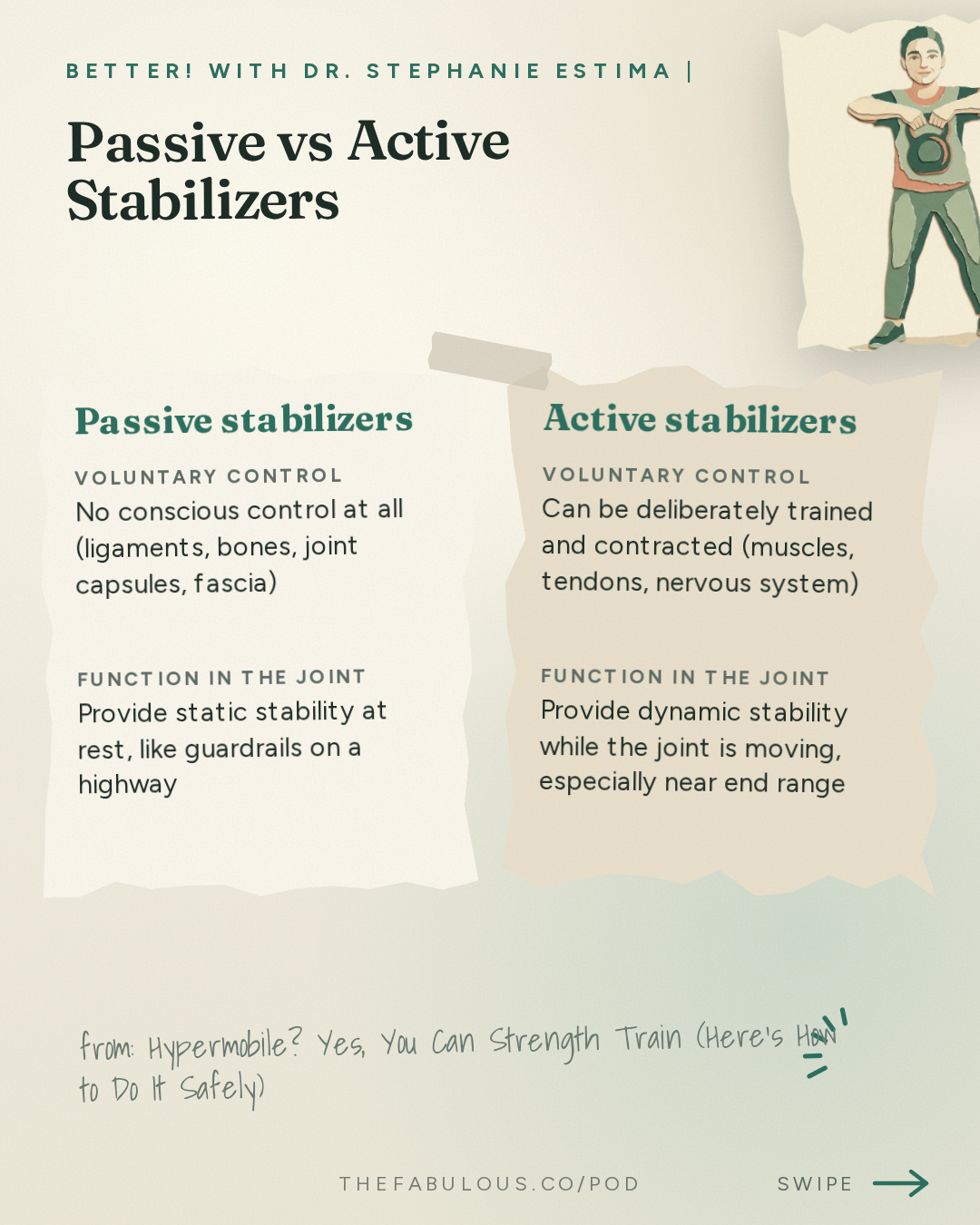
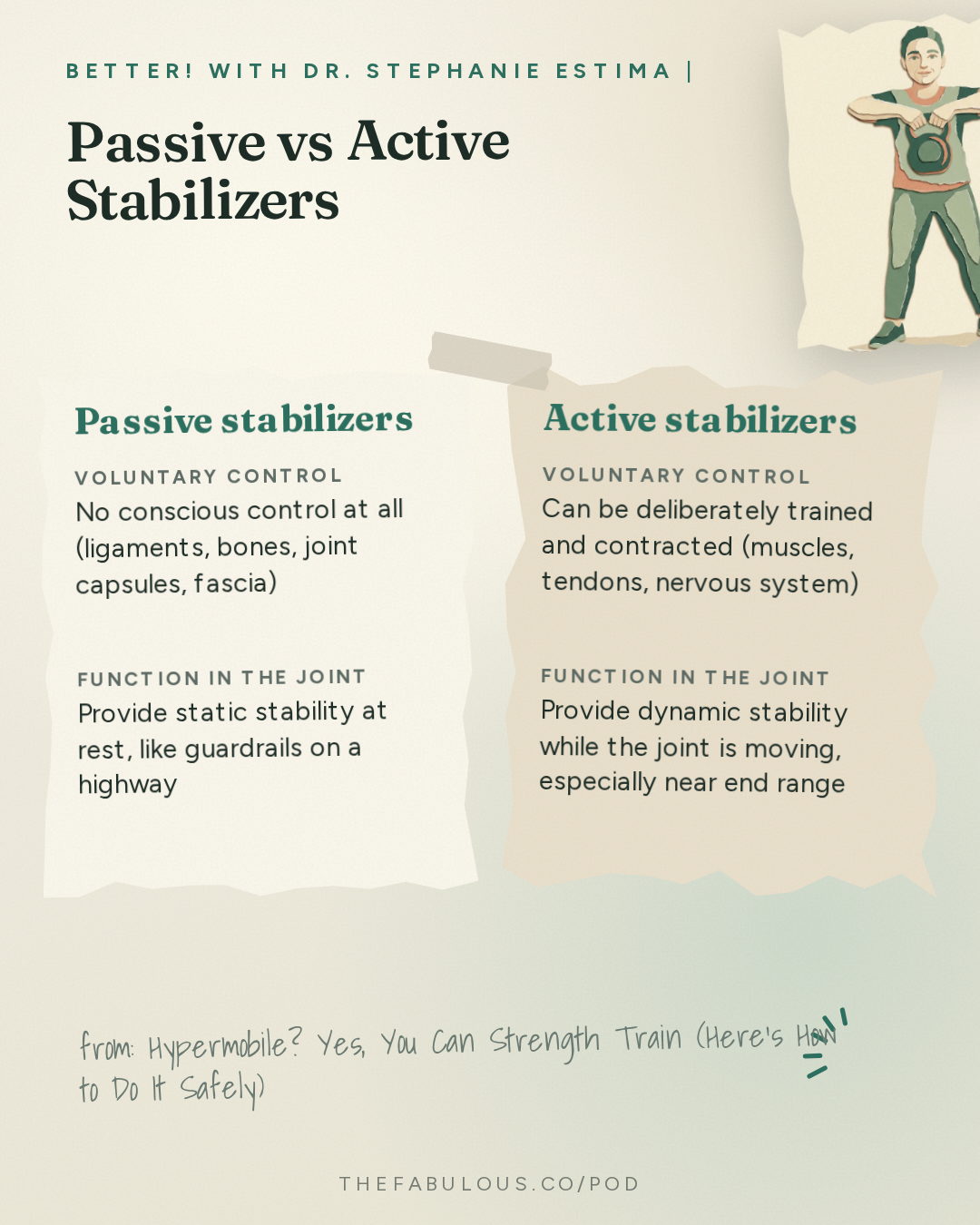
The most useful piece of anatomy in the episode is a distinction most people never hear: passive stabilizers versus active stabilizers. Passive stabilizers are structures the body cannot voluntarily contract, including ligaments, bones, joint capsules, cartilage, and fascia. They hold a joint together at rest, without any conscious effort, the way guardrails line a highway without steering the car (08:02). In a hypermobile body these passive structures tend to be more extensible, partly because of how collagen, the structural protein in tendons, ligaments, and skin, is built and ratioed in that person's tissue, though Estima notes the exact mechanism differs from person to person (08:34).
Active stabilizers are the opposite: muscles, tendons, and the nervous system, all of which can be trained and voluntarily controlled. Their job is dynamic stability, controlling a joint while it moves, especially near its end range (11:59). When the guardrails are set too far apart, in other words when the ligaments are too compliant, the driver has to be sharper. The muscles have to pick up the slack the ligaments were supposed to catch (14:08).
That extra work runs through the nervous system too. Embedded in muscle and tendon are muscle spindles and Golgi tendon organs, sensors that tell the brain where a joint is in space without needing to look at it, a sense physiologists call proprioception. Estima says people with joint hypermobility often have blunted versions of this sense: a reduced feel for where a joint is, especially at the end of its range (12:50). That is her explanation for the woman who keeps rolling her ankle or tweaking her knee for no obvious reason: there is no internal alarm going off before the joint has already gone too far (13:32).
"Your brain is, like, literally constantly running this stabilization algorithm every single second of your life." — Dr. Stephanie Estima [12:50]
Put those two facts together, weak guardrails and a dulled internal compass, and the conclusion writes itself: for a hypermobile joint, muscle is not optional. It is standing in for two systems at once. That is why Estima calls strength training a primary treatment strategy for symptomatic hypermobility rather than a nice addition to physical therapy (15:02).
Train the Range That Can Be Controlled
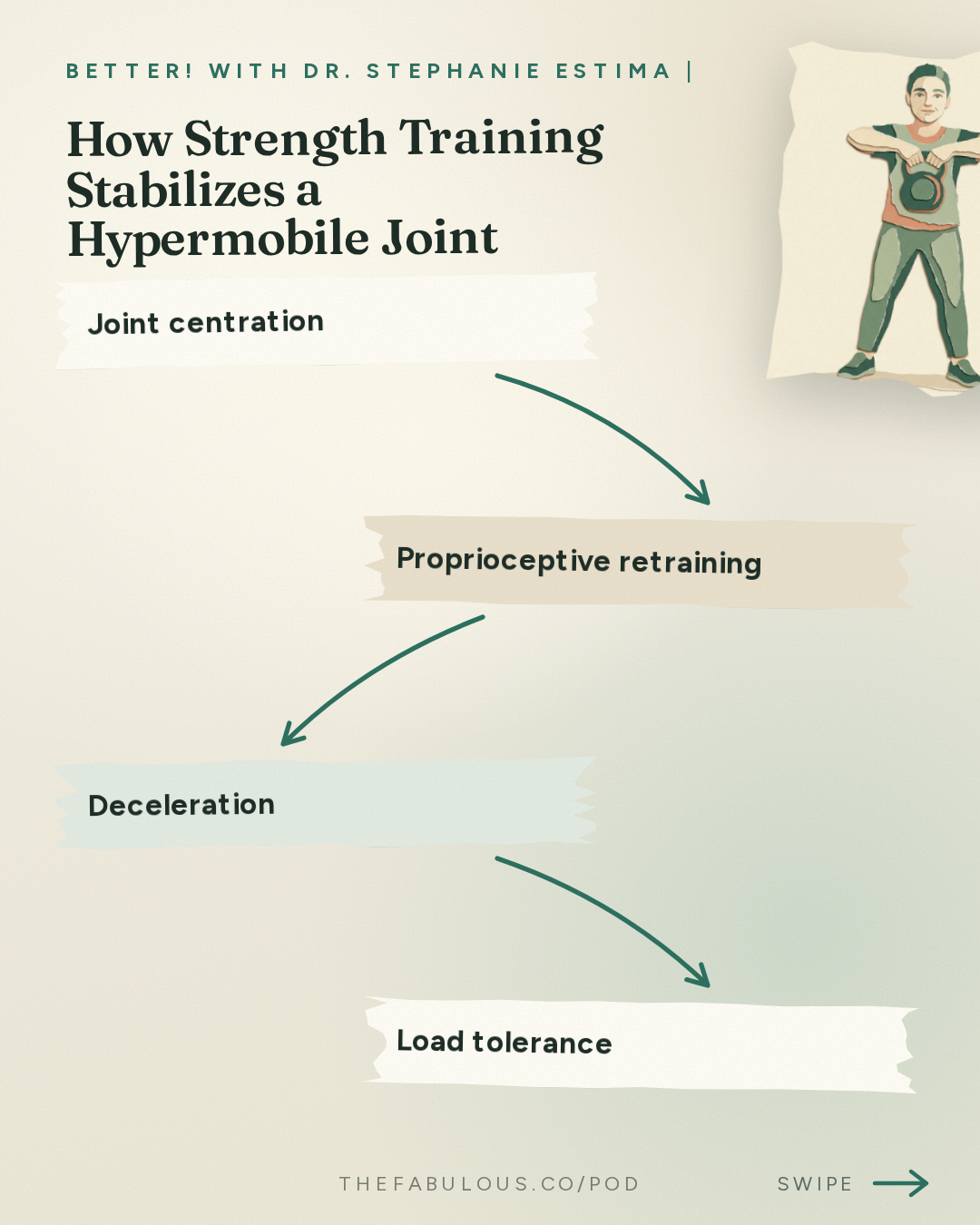
The mechanism she gives for why lifting helps is called joint centration, essentially keeping a joint aligned in the middle of its socket instead of letting it drift to the edges where the lax passive structures are doing all the work (19:25). Stronger muscles around a joint pull it back toward center. Strength training with a slow, controlled tempo also seems to rebuild some of the missing proprioceptive feedback, retraining the brain's internal map of where a joint sits (20:38). And well-conditioned muscle can decelerate a movement, meaning it can slow down and stop a joint before it reaches its structural limit, sparing the ligaments from the repeated overstretching that would otherwise reinforce their laxity (21:03).
This leads to the episode's central reframe.
"For a hypermobile body specifically, strength is the mobility program." — Dr. Stephanie Estima [22:15]
The catch is that standard strength advice, train through a full range of motion, needs an asterisk here, because a hypermobile person's full range is already past where the joint is structurally supported (23:59). Estima's fix is to train in a controlled range rather than a maximum range: roughly 80 percent, and at most 90 percent, of someone's available passive range of motion (25:33). In a squat that means stopping at a depth where the pelvis stays neutral and the lifter can pause and reverse the movement smoothly, not necessarily hitting rock bottom. In an overhead press it means keeping a slight, active bend in the elbow instead of locking it into hyperextension under load (26:02). Static stretching, by contrast, mostly worsens the imbalance, because it lengthens tissue that is already too compliant instead of building the muscle that is undertrained (27:46).
From there the episode turns into something close to a checklist. Train two to four times a week, favoring compound, closed-chain movements like squats, rows, and hinges, which give the body more contact points and more sensory feedback (29:29). Slow the eccentric, the lowering phase of a lift, to three or four seconds, which Estima says builds the neuromuscular control a hypermobile joint is missing (30:24). Add isometric holds, wall sits, planks, static lunge holds, which build tendon stiffness and joint stability without ever approaching a risky end range (30:52). Layer in balance and proprioceptive work, single-leg stances, eyes closed if tolerated, unstable surfaces like a BOSU ball, to directly retrain the position sense that hypermobile joints tend to lack (31:21). Program joint by joint rather than movement by movement, since shoulders and hips, which have the most degrees of freedom, account for something like 70 to 80 percent of hypermobility-related problems, with knees and ankles picking up the rest depending on where a person's laxity actually sits (32:42).
Nutrition and recovery round out the picture, in a smaller but still specific way. Protein intake in the range of 1.6 to 2.2 grams per kilogram of body weight, or roughly one gram per pound, supports the extra muscle protein synthesis a hypermobile body needs, since its muscles are doing stabilization work that other people's ligaments handle for free (33:33). Vitamin C is a required cofactor for collagen synthesis, so getting enough of it through food matters for connective tissue repair, and Estima also likes collagen peptides taken 30 to 60 minutes before training, while noting plainly that the research behind that timing is not as settled as the case for protein and muscle (33:59). On the recovery side, she argues for pacing over pushing: frequent, moderate sessions rather than occasional maximal ones, since a boom-bust pattern of overdoing it tends to end in a flare and then a full stop (37:05). Deep sleep matters because that is when growth hormone releases and tissue repairs. And the signal to actually stop a session is specific: normal muscle soreness is fine, but joint swelling, a feeling of a joint giving way, or sharp localized pain means back off immediately (38:04).
The last idea in the episode is aimed most directly at a culture that still prizes thinness. Estima warns that a severe, prolonged caloric deficit does not discriminate between fat and the muscle that a hypermobile body depends on for structural support, so chasing thinness can directly worsen symptoms by stripping away the very tissue that was compensating for a person's lax ligaments in the first place (39:34).
"Being hypermobile does not mean you are fragile. It does not mean you should stretch." — Dr. Stephanie Estima [40:48]
Estima's real target across the hour is a piece of received wisdom: that flexible bodies are fragile bodies, and that the fix for tightness and looseness alike is more stretching. Her case, built joint by joint and system by system, points the other way. A hypermobile joint is not overworked because someone lifted something heavy. It is overworked because nothing around it has been trained to catch what the ligaments cannot. The fix is not less load. It is more muscle, applied with more control, in a range the lifter actually owns.
By the numbers
- 80% percent recommended ceiling for training range as a share of available passive range of motion
In their words
“For a hypermobile body specifically, strength is the mobility program.”
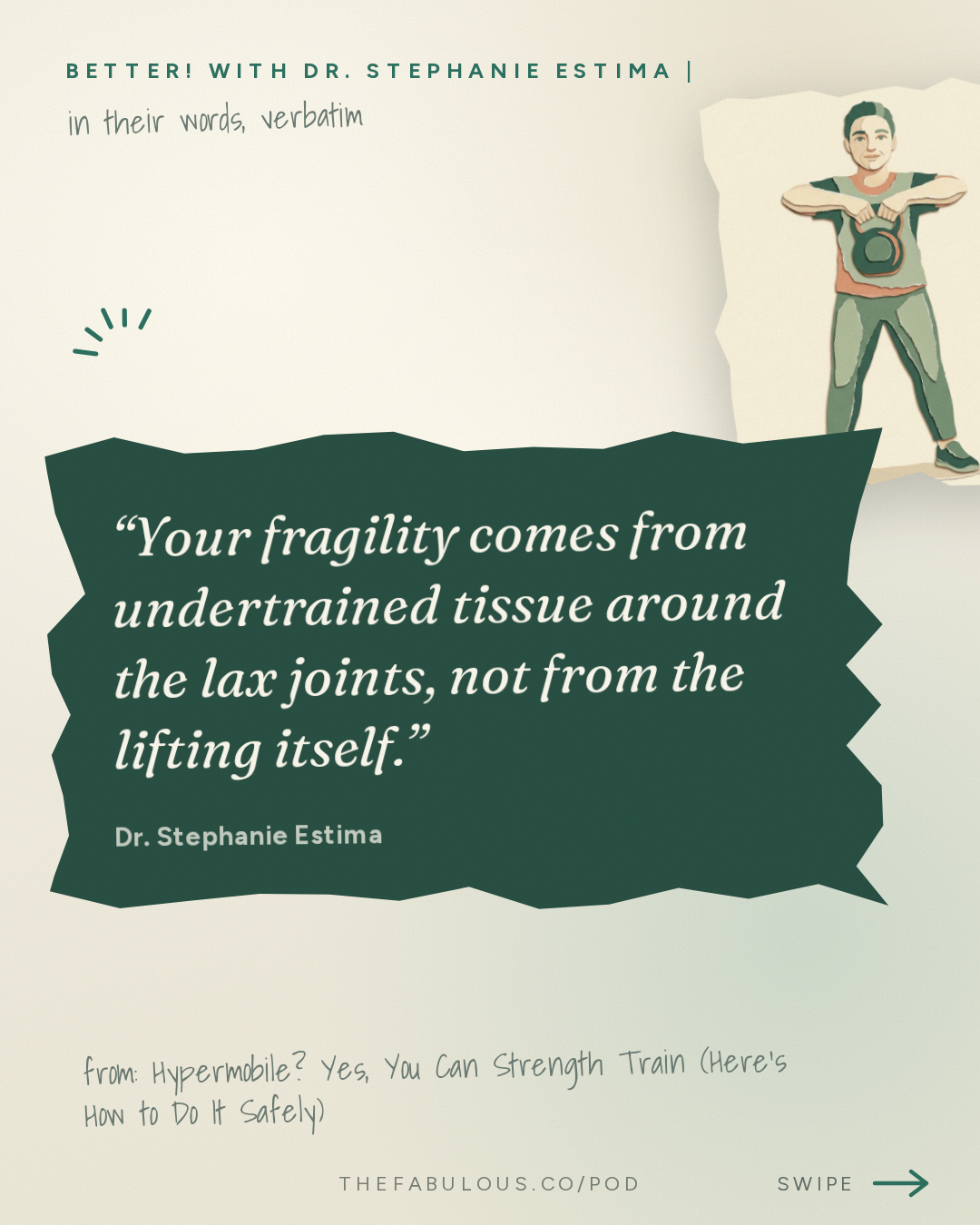
“Your fragility comes from undertrained tissue around the lax joints, not from the lifting itself.”
“Passive stabilizers are things that you cannot contract. You have no voluntary control over them.”
“Being hypermobile does not mean you are fragile. It does not mean you should stretch.”
Protocols
-
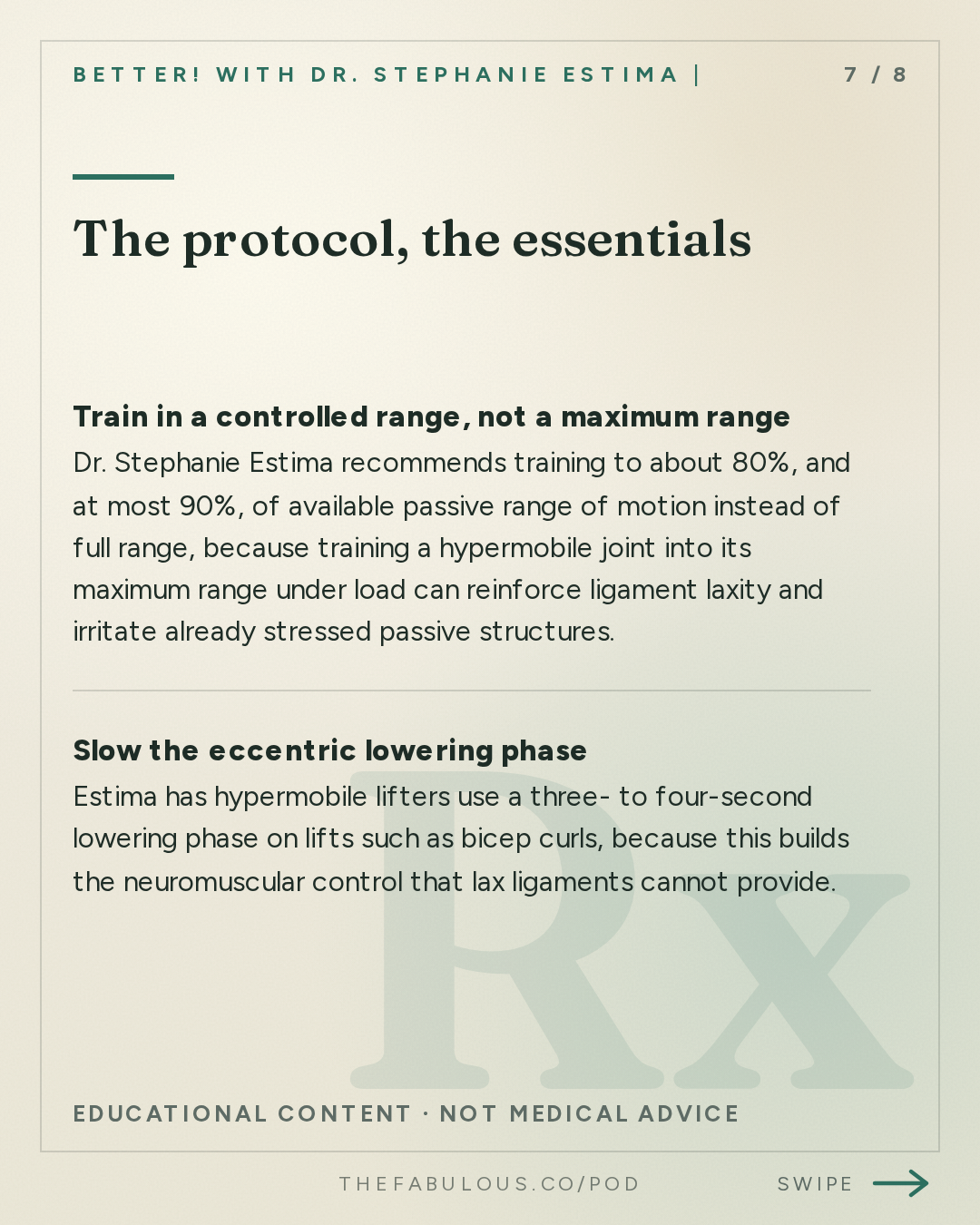
Train in a controlled range, not a maximum range
Dr. Stephanie Estima recommends training to about 80%, and at most 90%, of available passive range of motion instead of full range, because training a hypermobile joint into its maximum range under load can reinforce ligament laxity and irritate already stressed passive structures.
every training session
-
Slow the eccentric lowering phase
Estima has hypermobile lifters use a three- to four-second lowering phase on lifts such as bicep curls, because this builds the neuromuscular control that lax ligaments cannot provide.
every working set
-
Add isometric holds
Estima includes wall sits, planks, and static lunge holds in hypermobile training programs, because these build tendon stiffness and joint stability without approaching risky end ranges.
within 2-4 weekly sessions
-
Time collagen and vitamin C around training
Estima takes collagen peptides alongside vitamin C 30 to 60 minutes before training to support connective tissue adaptation, and she notes that this evidence is less established than protein's role in muscle protein synthesis.
before each training session
-
Stop at joint pain, not muscle soreness
Estima tells hypermobile trainees that normal muscle soreness is acceptable, but sharp localized joint pain, swelling, or a sensation of a joint giving way are signals to back off the session immediately.
as needed, every session
Questions this episode answers
Can you strength train if you are hypermobile?
Yes, and Dr. Stephanie Estima argues it should be a primary treatment strategy, not an optional add-on, because muscle and the nervous system have to compensate for ligaments that are too loose to stabilize a joint on their own (15:02). She frames strength training as the mobility program itself for a hypermobile body (22:15).
What range of motion should hypermobile people train in?
Estima recommends a controlled range of about 80%, and at most 90%, of a person's available passive range of motion rather than their full range, since a hypermobile joint's maximum range is already beyond what is structurally supported (25:33).
Is stretching bad for hypermobile joints?
Static stretching is generally a lower priority or counterproductive for symptomatic hypermobile joints, because it lengthens passive structures like ligaments that are already too compliant instead of building the muscle that is undertrained (27:46).
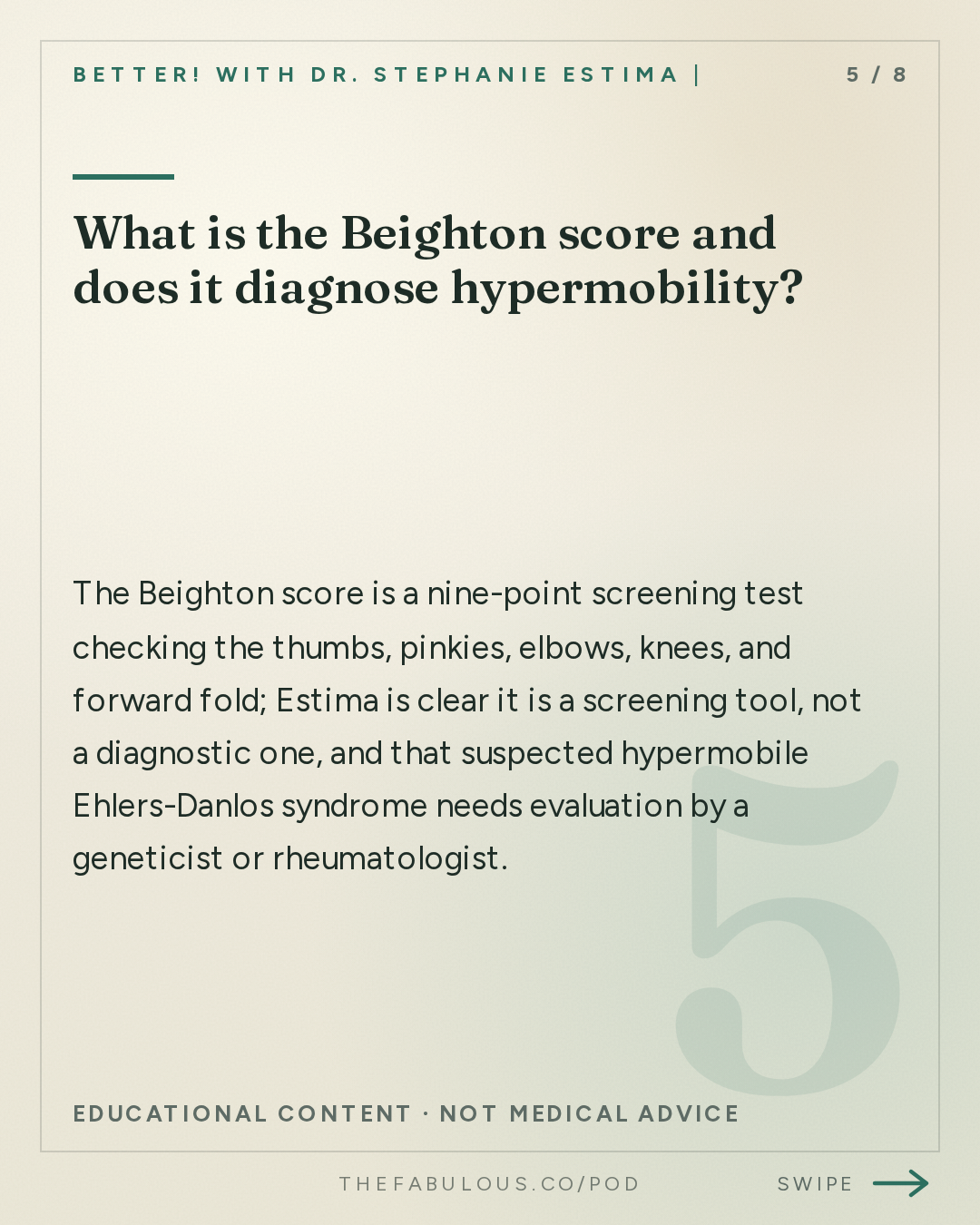
What is the Beighton score and does it diagnose hypermobility?
The Beighton score is a nine-point screening test checking the thumbs, pinkies, elbows, knees, and forward fold; Estima is clear it is a screening tool, not a diagnostic one, and that suspected hypermobile Ehlers-Danlos syndrome needs evaluation by a geneticist or rheumatologist (04:26).
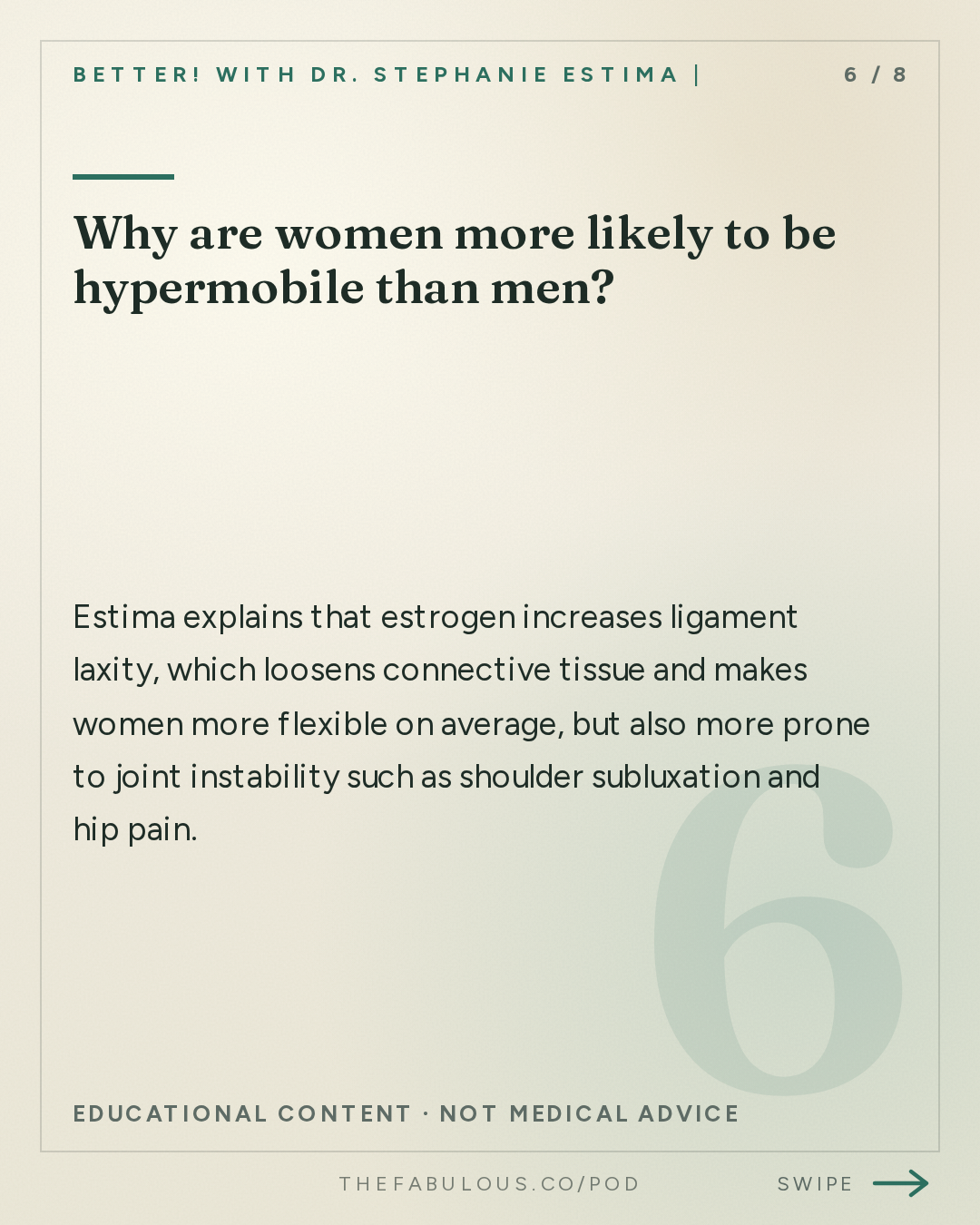
Why are women more likely to be hypermobile than men?
Estima explains that estrogen increases ligament laxity, which loosens connective tissue and makes women more flexible on average, but also more prone to joint instability such as shoulder subluxation and hip pain (06:48).
What should hypermobile people eat to support joints?
Estima recommends protein intake of 1.6 to 2.2 grams per kilogram of body weight to support the extra muscular stabilization work, adequate vitamin C since it is a required cofactor for collagen synthesis, and collagen peptides taken 30 to 60 minutes before training, while noting that last piece of evidence is less settled (33:33, 33:59).
The full read, in cards
Mentioned
Dr. Stephanie Estima · Beighton score · Ehlers-Danlos syndrome · Hypermobility Spectrum Disorder · Lyft
More from this show and category

Physiology of Grief and Heart Attack Risk
Grief is not just an emotion, it is a measurable physiological event: a 21-times spike in heart attack risk in the first 24 hours after a loss, elevated cortisol for months, and a brain that keeps treating the dead as still out there somewhere.

Katy Bowman: Movement as Nutrition, Not Exercise
Biomechanist Katy Bowman argues movement is a nutrient the body requires daily, not a scheduled workout, and that modern convenience saves movement rather than time. She maps a movement pyramid from floor-sitting to sprinting, links bone strength to changing direction, and traces midlife foot pain to decades of repeated gait patterns.

Lloyd Klickstein on How New Drugs Get Made
Physician-scientist Lloyd Klickstein maps the full arc of drug development, from spotting an unmet need to FDA approval, using the muscle drug bimagrumab as his case study. Paired with semaglutide, it cut body fat by 45.7% over 72 weeks (125:28), rivaling bariatric surgery, while exposing the economics of patents, manufacturing, and phase one risk.

ED as an Early Predictor of Heart Attack Risk
Erectile dysfunction predicts a future heart attack better than chest pain does, especially in younger men (11:11). Urologist Tobias Kohler describes two cheap early-warning tests, a coronary calcium scan and a Mayo Clinic ceramide blood test, plus the cardiac damage caused by high-dose testosterone abuse (12:49, 44:55).
