BETTER! with Dr. Stephanie Estima
Katy Bowman: Movement as Nutrition, Not Exercise
No Time for the Gym? How to Rack Up Movement Minutes and Protect Your Bone Density with Katy Bowman
▶ Listen to the full episode More from BETTER! with Dr. Stephanie Estima
The brief
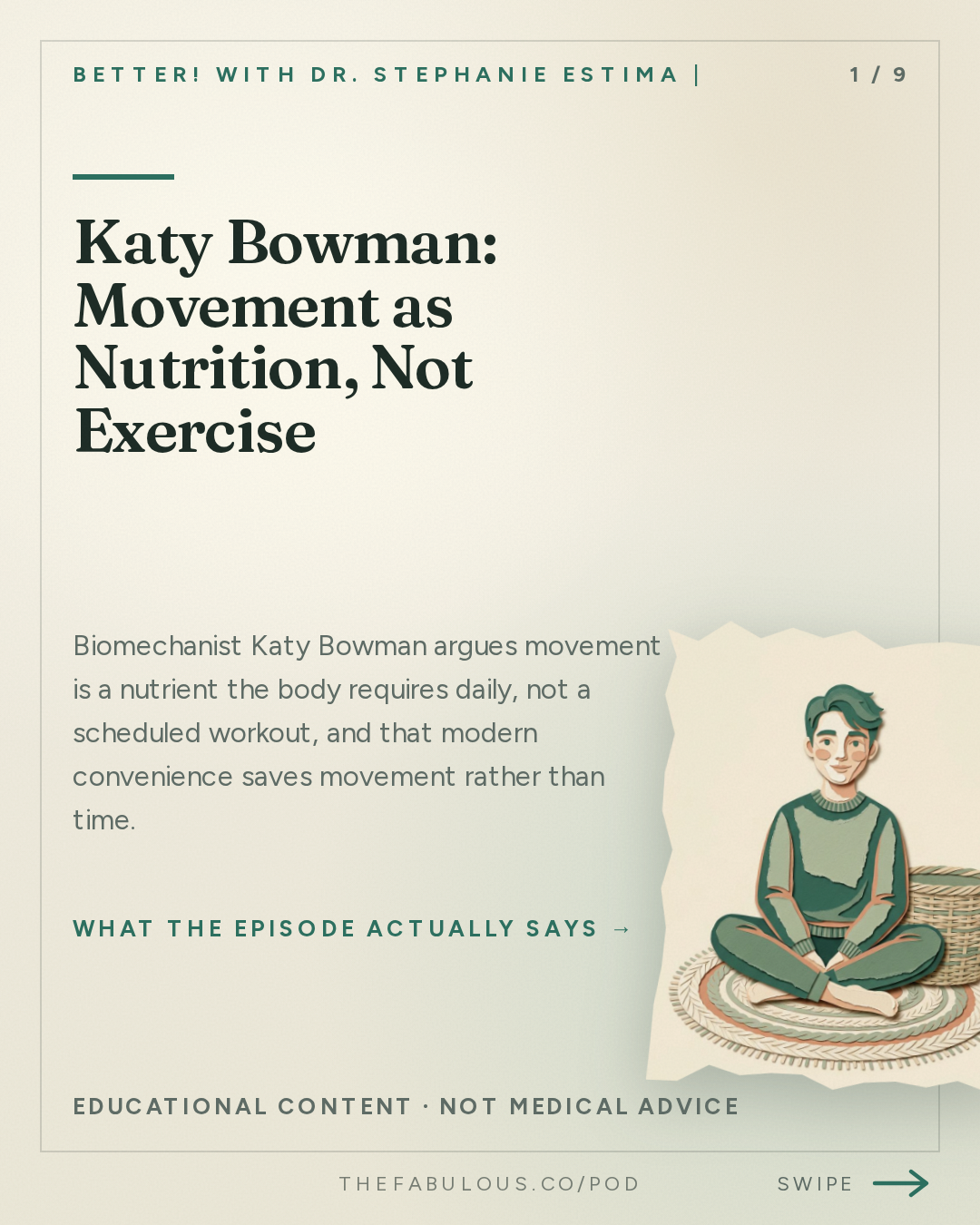
Biomechanist Katy Bowman argues movement is a nutrient the body requires daily, not a scheduled workout, and that modern convenience saves movement rather than time. She maps a movement pyramid from floor-sitting to sprinting, links bone strength to changing direction, and traces midlife foot pain to decades of repeated gait patterns.
Ask this episode anything
Pod's AI answers from the episode itself, with the minute mark so you can hear it yourself.
Or start with one of these
Ask this episode
Pod's AI listens to the whole episode to answer, and points you to the minute it comes from.
The rest of this answer, and any question after it
Answers come from the episode itself, never from a summary of it.
Continue
Key takeaways
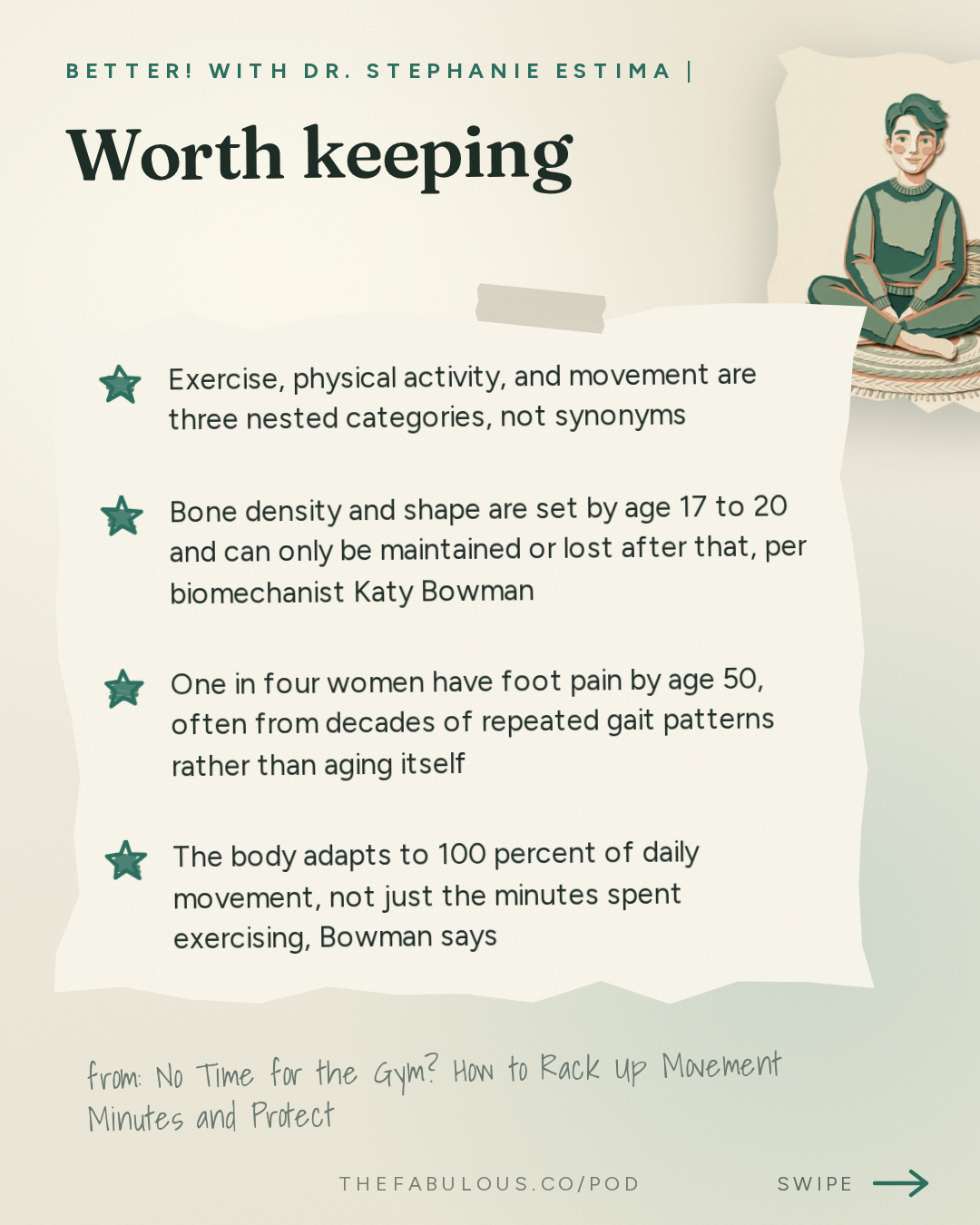
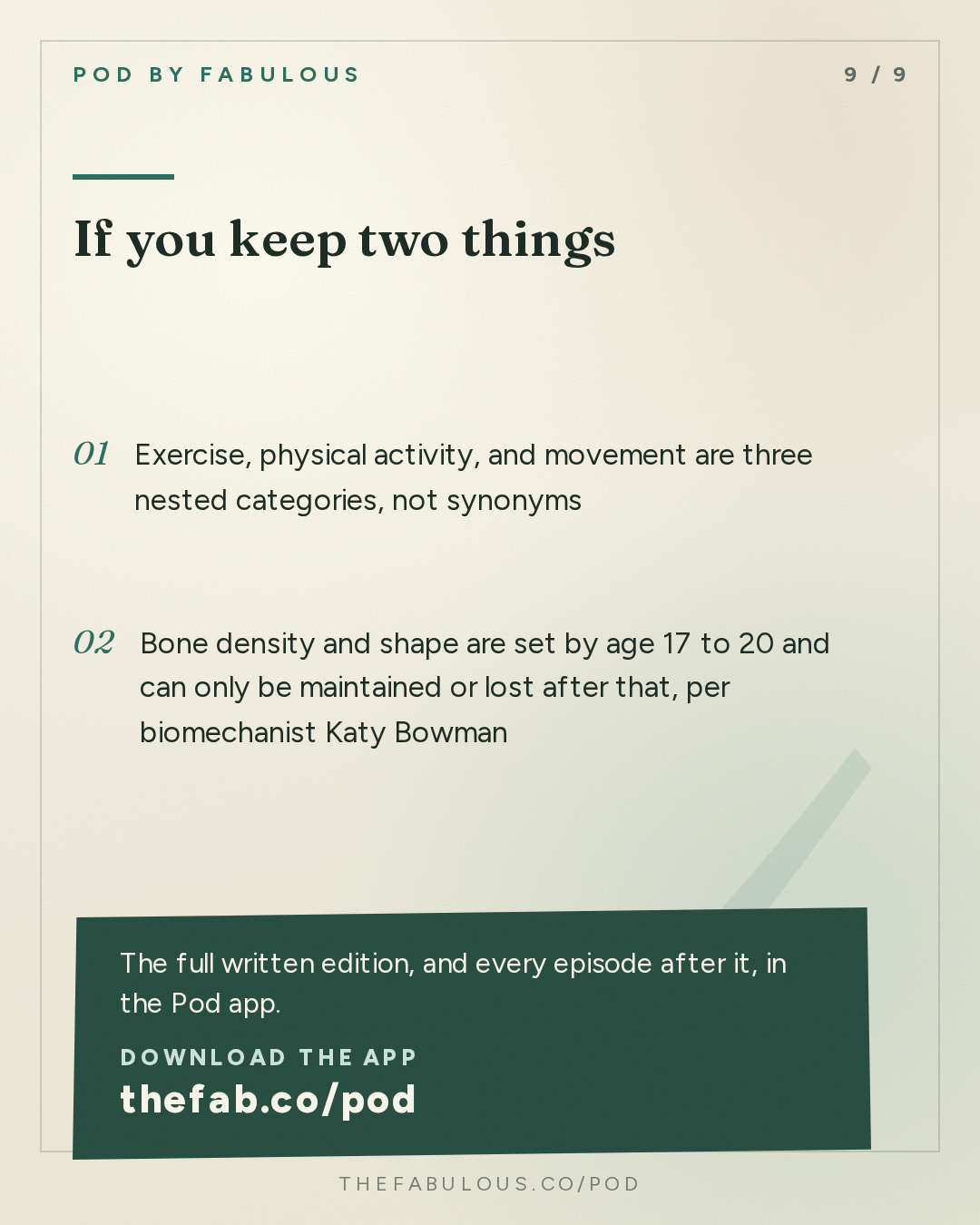
- Exercise, physical activity, and movement are three nested categories, not synonyms
- Bone density and shape are set by age 17 to 20 and can only be maintained or lost after that, per biomechanist Katy Bowman
- One in four women have foot pain by age 50, often from decades of repeated gait patterns rather than aging itself
- The body adapts to 100 percent of daily movement, not just the minutes spent exercising, Bowman says
- Modern convenience saves movement rather than time, according to Bowman, which creates a kind of movement debt
The episode in cards
Look down at an office chair, a car seat, a bed frame, and a kitchen counter. They are all built to nearly the same height. Biomechanist Katy Bowman, founder of the movement education company Nutritious Movement, points out that as a result most adult hips, knees, and ankles never travel below knee height in an ordinary day (00:27). That small observation about furniture opens this episode of Better! with Dr. Stephanie Estima, and it sets up the argument Bowman spends the next ninety minutes building: exercise and movement are not the same thing, and treating them as interchangeable is quietly costing people their joints, their bones, and their adherence to any fitness plan at all.
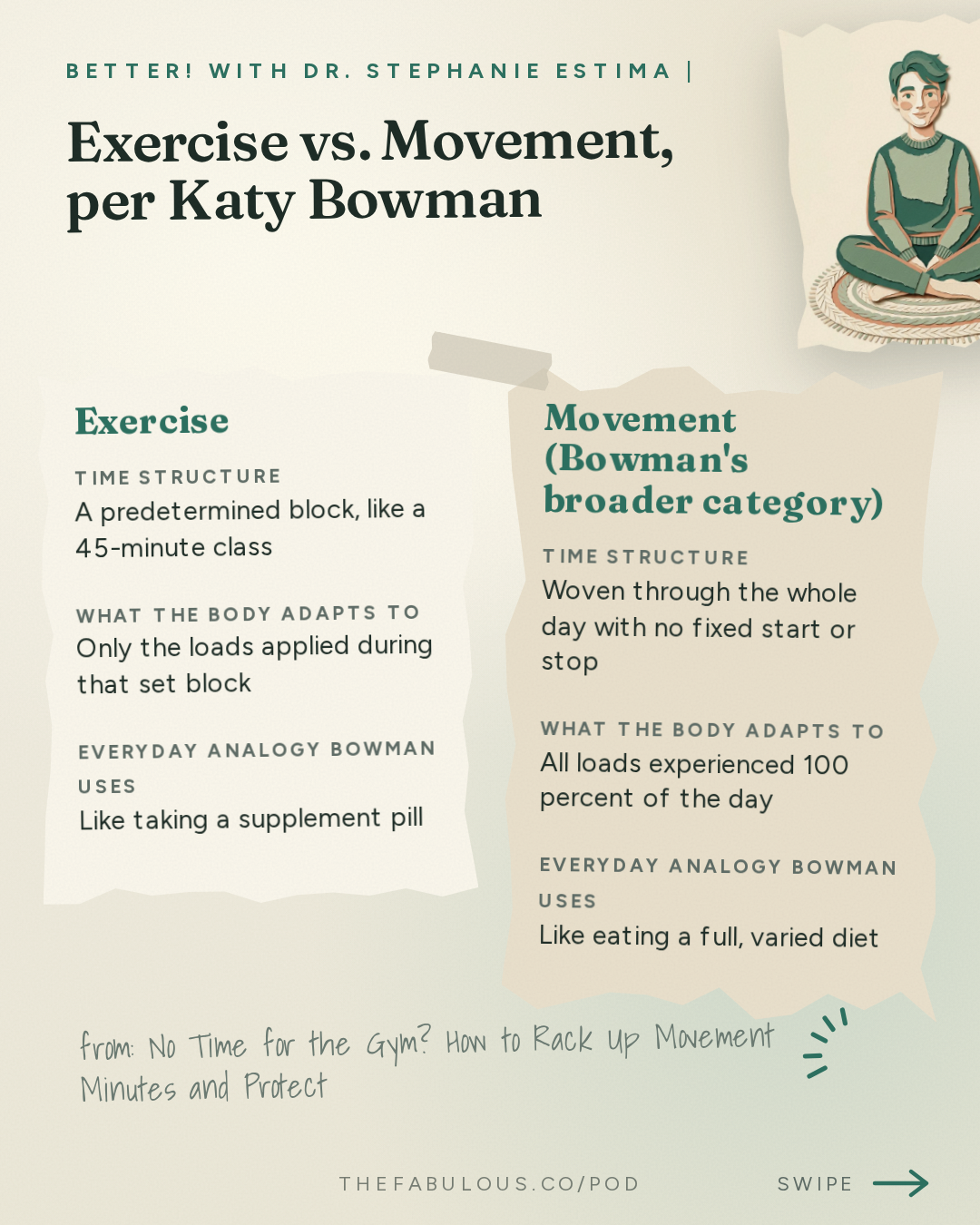
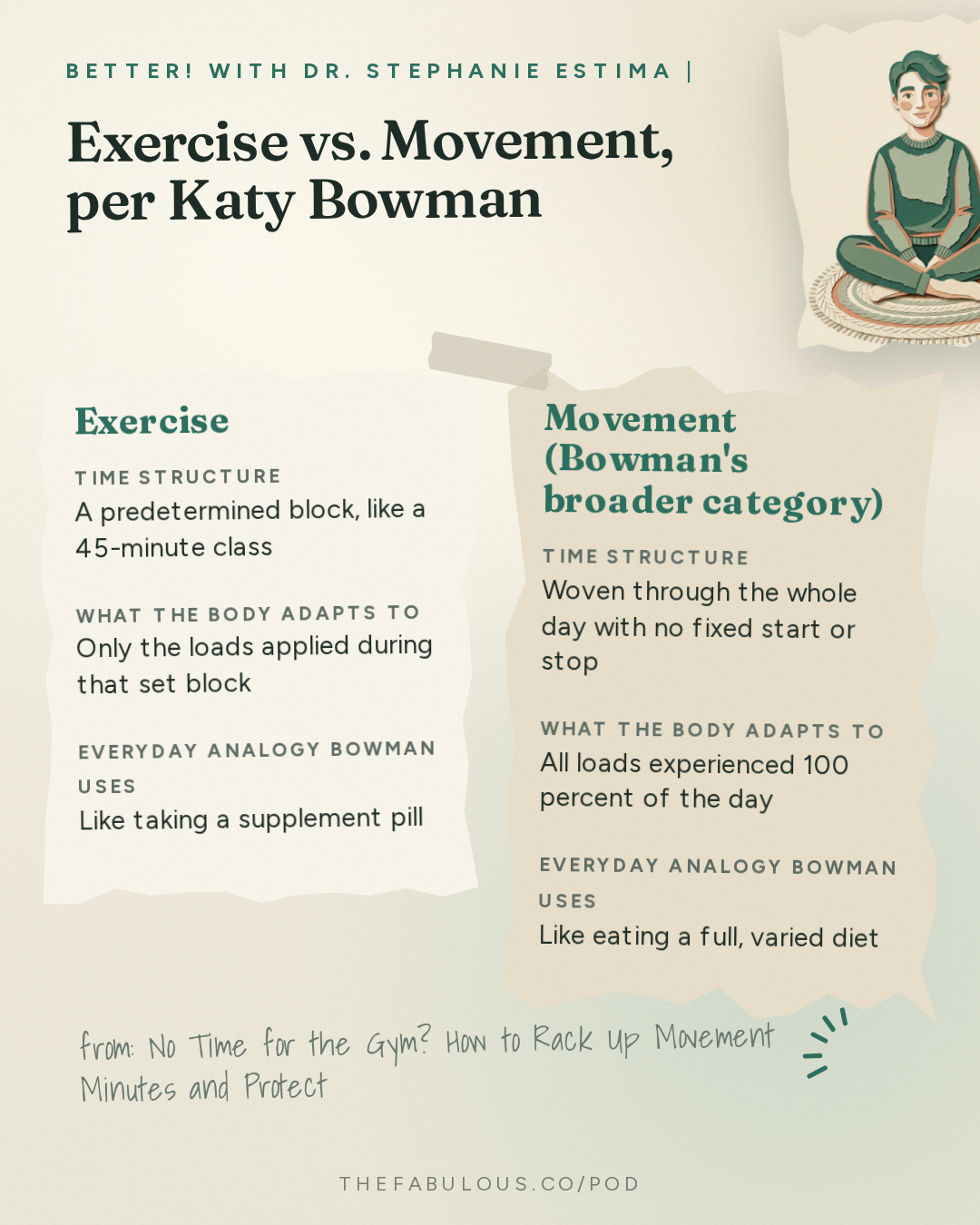
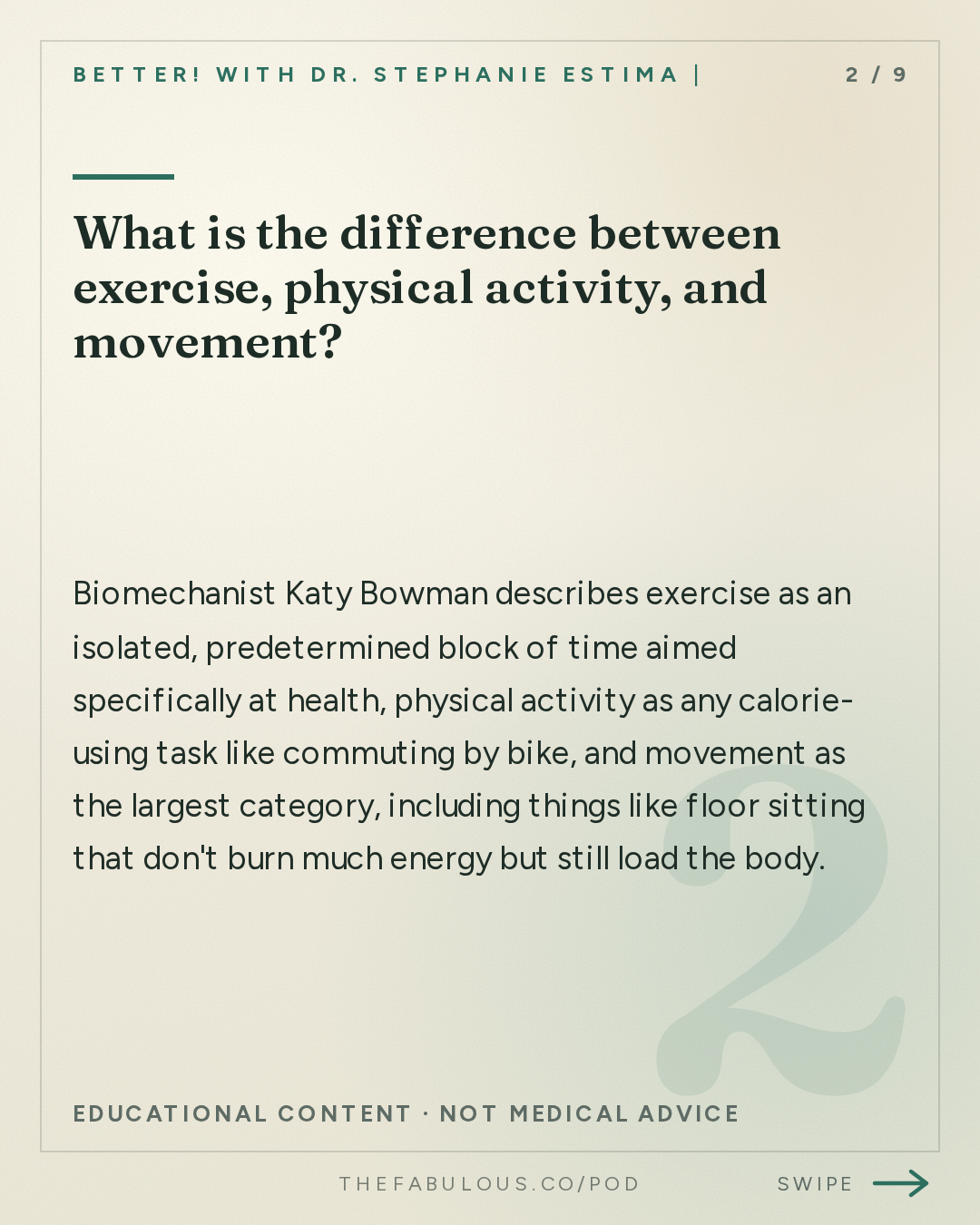
Bowman starts by drawing a Venn diagram in words. Exercise, she says, is a small circle: a period of movement with a predetermined length, intensity, and mode, done specifically to improve health (06:32). It sits inside a larger circle called physical activity, which includes anything that uses the musculoskeletal system for a purpose, like biking to work or scrubbing a floor (08:02). And that circle sits inside an even larger one called movement, which includes things like lying on the floor that load the body without burning much in the way of calories (09:46). The trouble, Bowman argues, is that modern life has convinced people the smallest circle is the only one that counts.
"It is a period of movement that has been predetermined how long you're gonna do it." — Katy Bowman [06:55]
From there she builds what she calls movement nutrition. A nutrient, by definition, is something the body requires, not something it can take or leave (17:04). Bowman applies the same logic used for food, macronutrients like protein and carbohydrate, micronutrients like vitamin D, to physical movement. Most people, she says, treat their one exercise session the way a person might treat a multivitamin: a concentrated supplement meant to cover for a day spent almost entirely still.
"Our relationship with exercise is much more akin to relating to supplements rather than relating to eating a more nutritious diet." — Katy Bowman [18:26]
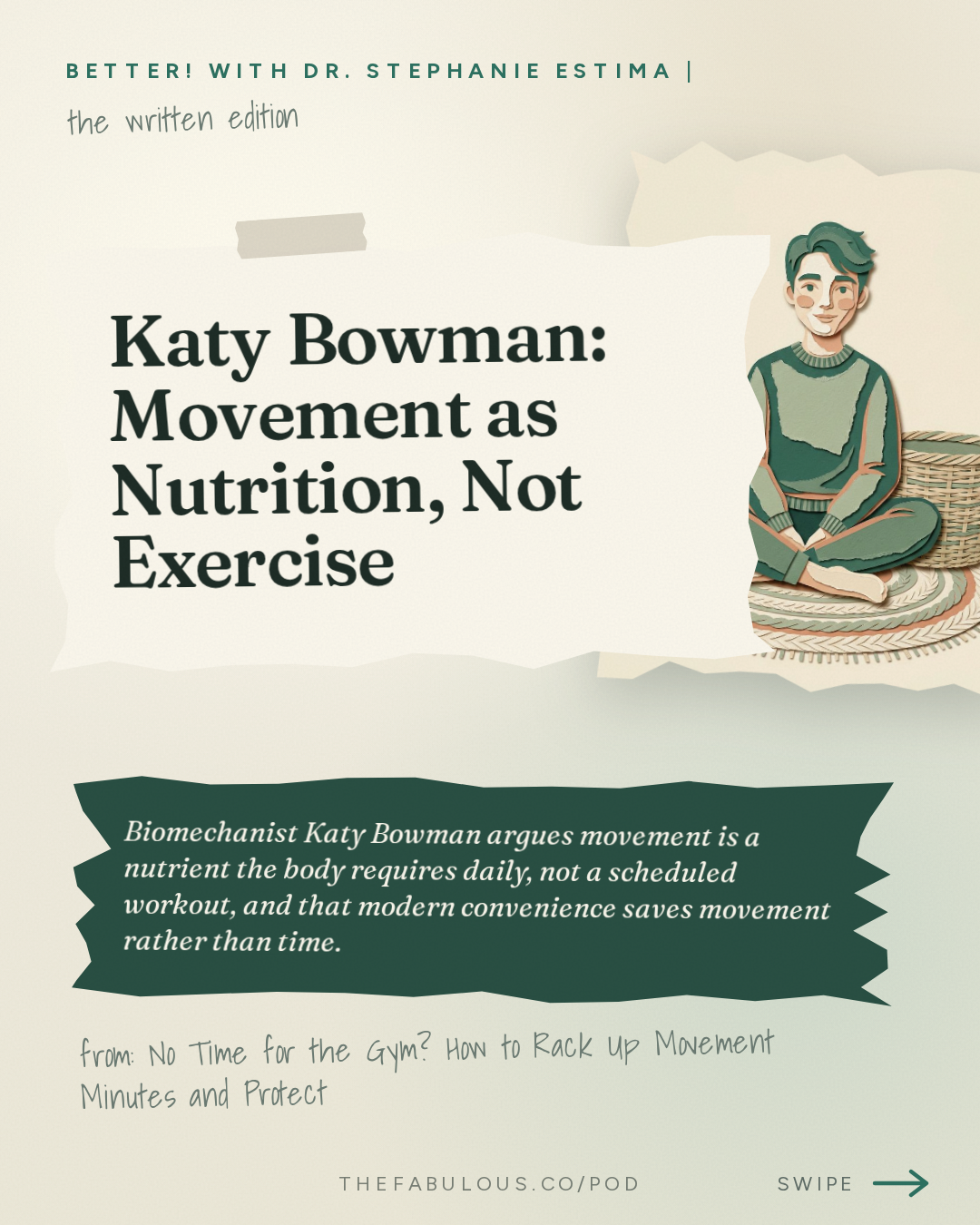
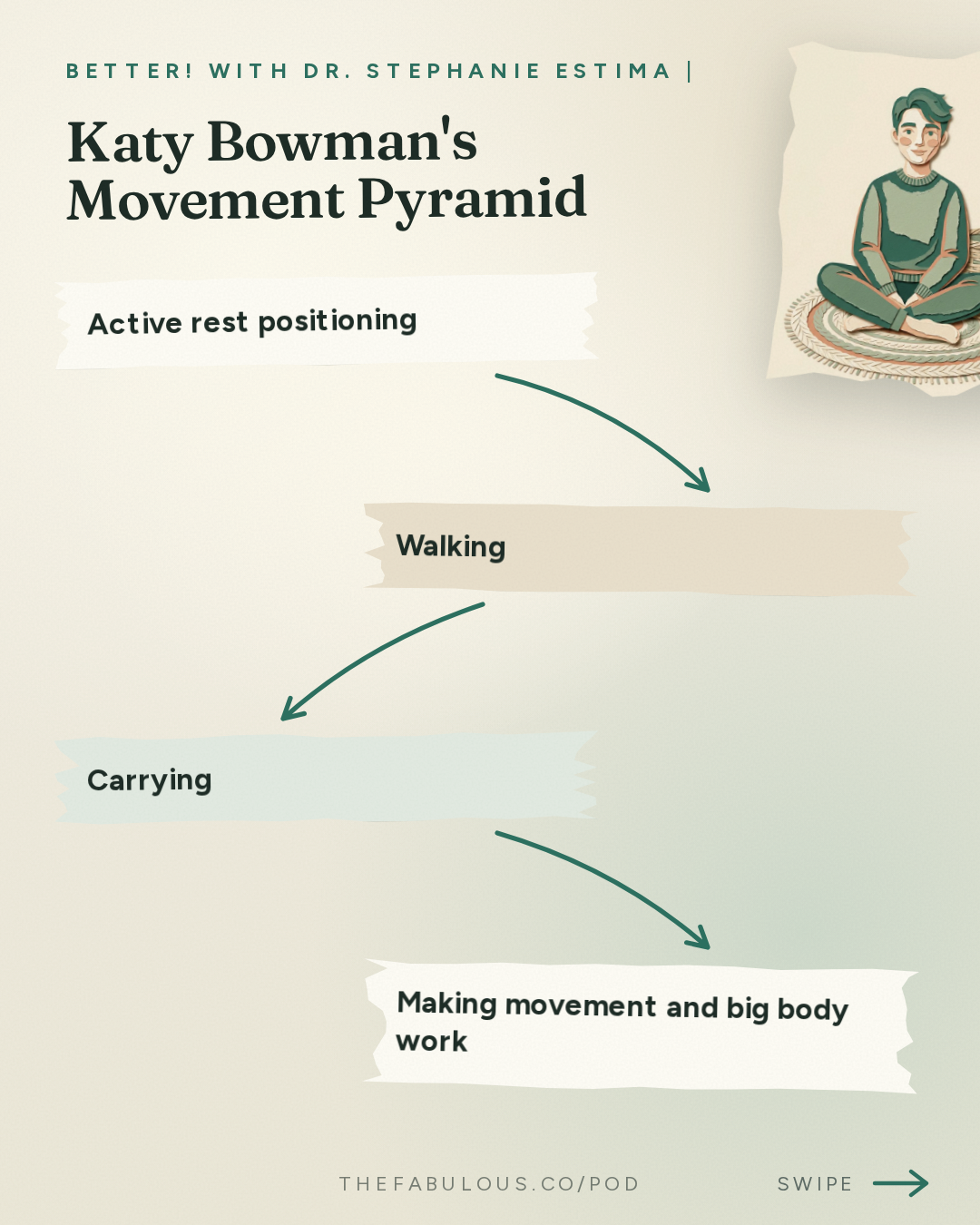
To replace the multivitamin approach, Bowman offers a pyramid modeled loosely on the Hadza, a modern hunter-gatherer group in Tanzania she cites as having very low rates of cardiovascular disease despite minimal formal exercise (24:18). At the base sits active rest positioning: sitting on the floor in changing shapes instead of always folding into the same 90-90-90 chair position. Above that comes walking in high volume, then carrying, then hands-on hobbies like cooking and gardening, then heavy but stationary "big body" work like moving furniture, then daily climbing and clambering that loads the wrists and shoulders. Only at the very tip does she place peak, vigorous effort, sprinting, dancing, sport, and she says the body needs remarkably little of it, roughly nine minutes total, to get most of the cardiovascular benefit (27:36).
What Bones Actually Need
Bone health is where the framework gets concrete. Bowman says bone strength is not just density, it is also robusticity, meaning the actual shape and girth of the bone (51:11). And there is a hard biological deadline: peak bone density and shape are locked in by around age 17 to 20, shortly after puberty, and cannot be increased beyond that ceiling afterward, only maintained or lost within it (51:55). What builds robust bone in the years before that ceiling, and what preserves it after, is not simply lifting weight in a straight line. It is agility: cutting, changing direction, and absorbing odd-angle impact, the kind of loading seen in youth soccer players compared with youth runners, or in adult sports like pickleball (52:46). Feet carry a lot of this story. Bowman has written two books on foot pain, and she cites a statistic that one in four women will have foot pain by the time they turn 50 (32:52), a problem she says radiates upward into the knees, hips, and spine rather than staying contained in the foot.
She frames the fix as a matter of pattern, not fate. Gait, she says, develops the way an accent develops: everyone has the same muscles in the foot and ankle, but how a person learns to load those muscles while walking is shaped by what they watched growing up, much like a child raised in a French-speaking house develops different mouth muscles than one raised speaking Spanish (71:50). She describes a client whose limp matched her father's, a man who lost his leg to an amputation when she was an infant. The daughter had simply absorbed his gait as her own template for walking. Bunions, in this reading, are not random growths. They are the bone's adaptive response to being struck in the same spot step after step, and cutting the bony growth away without changing the loading pattern just brings it back (78:40).
The Price of Convenience
The middle of the conversation turns to why modern life makes all of this so hard to notice. Bowman points out that 97 percent of cars sold last year were automatic (36:25), which means most drivers use only one foot for the pedals, repeating the same ankle motion for the length of a daily commute that, in a city like Toronto, averages 45 minutes each way (37:13). The official public health guideline is 150 minutes of moderate to intense activity per week (40:12), but Bowman argues that number misses the point, because the body adapts to everything it does across 100 percent of the day, not just the block of time labeled exercise (38:20). An hour of commuting in one seated position, repeated for years, shapes the body more than 45 minutes at the gym.
"Convenience isn't really saving you very much time. It's saving you movement." — Katy Bowman [66:57]
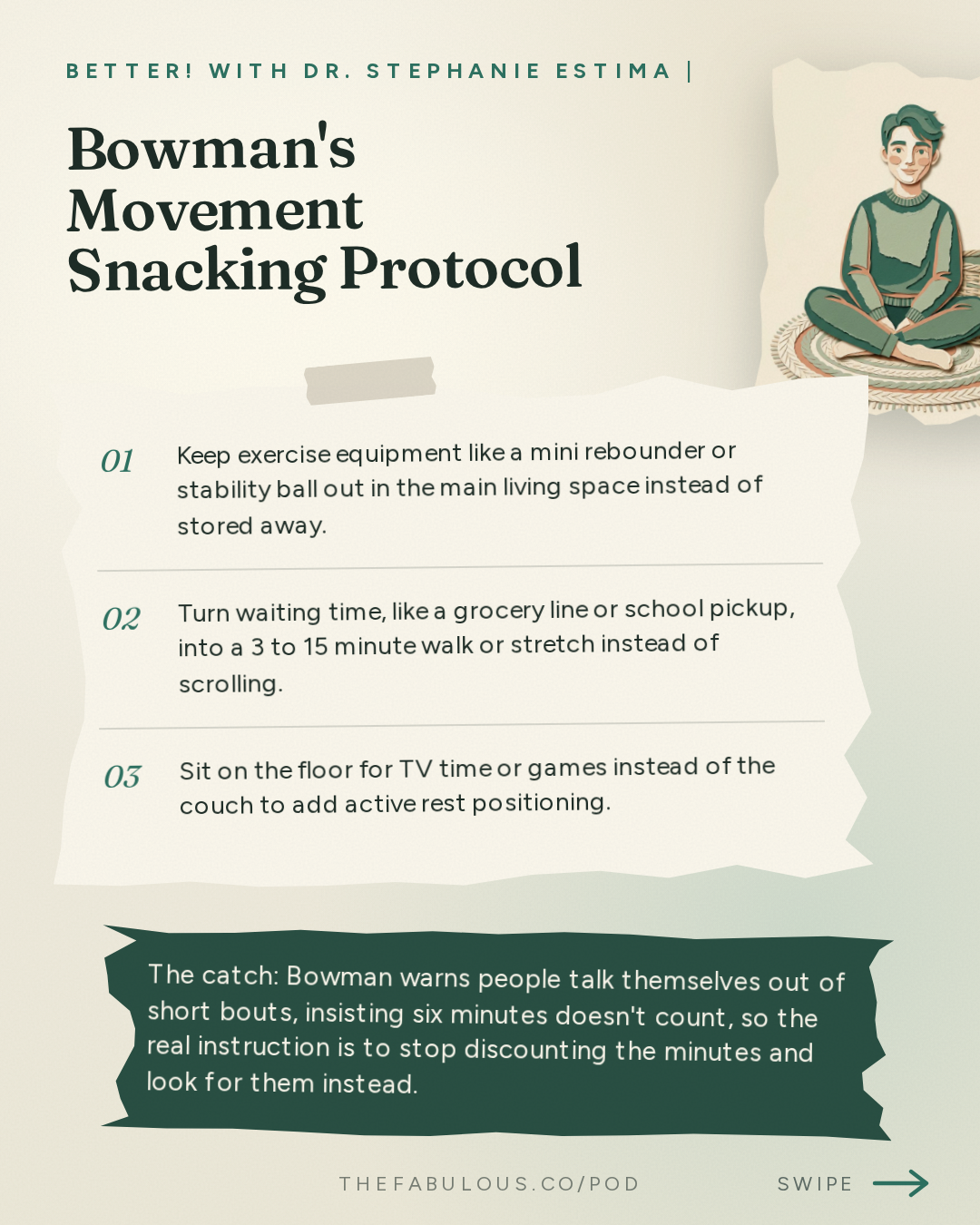
That line reframes almost every modern shortcut: food delivery, automatic transmissions, dating apps, all of them trade physical effort for time, and Bowman argues the effort was doing quiet work the person never noticed. Her counter-advice is not to overhaul life, but to "look for the minutes": a three-minute walk while waiting in a grocery line, standing up instead of scrolling in a parked car, taking six minutes to walk in from a farther parking spot instead of idling in the drop-off lane (44:10). She keeps exercise equipment, a mini rebounder, a stability ball, in the main living space rather than a separate gym room, so that visitors and children alike are pulled toward using it.
Bowman closes with a reframe of aging itself. She defines it plainly: aging is getting less physiological effect for the same input, which is why the same row on the water that felt manageable last year now takes more effort to produce the same benefit (80:54). The response she recommends is not to make life generally harder, but to deliberately choose the physically harder option while keeping the mentally easier one, taking the stairs, parking farther away, playing a real game of tag instead of an app.
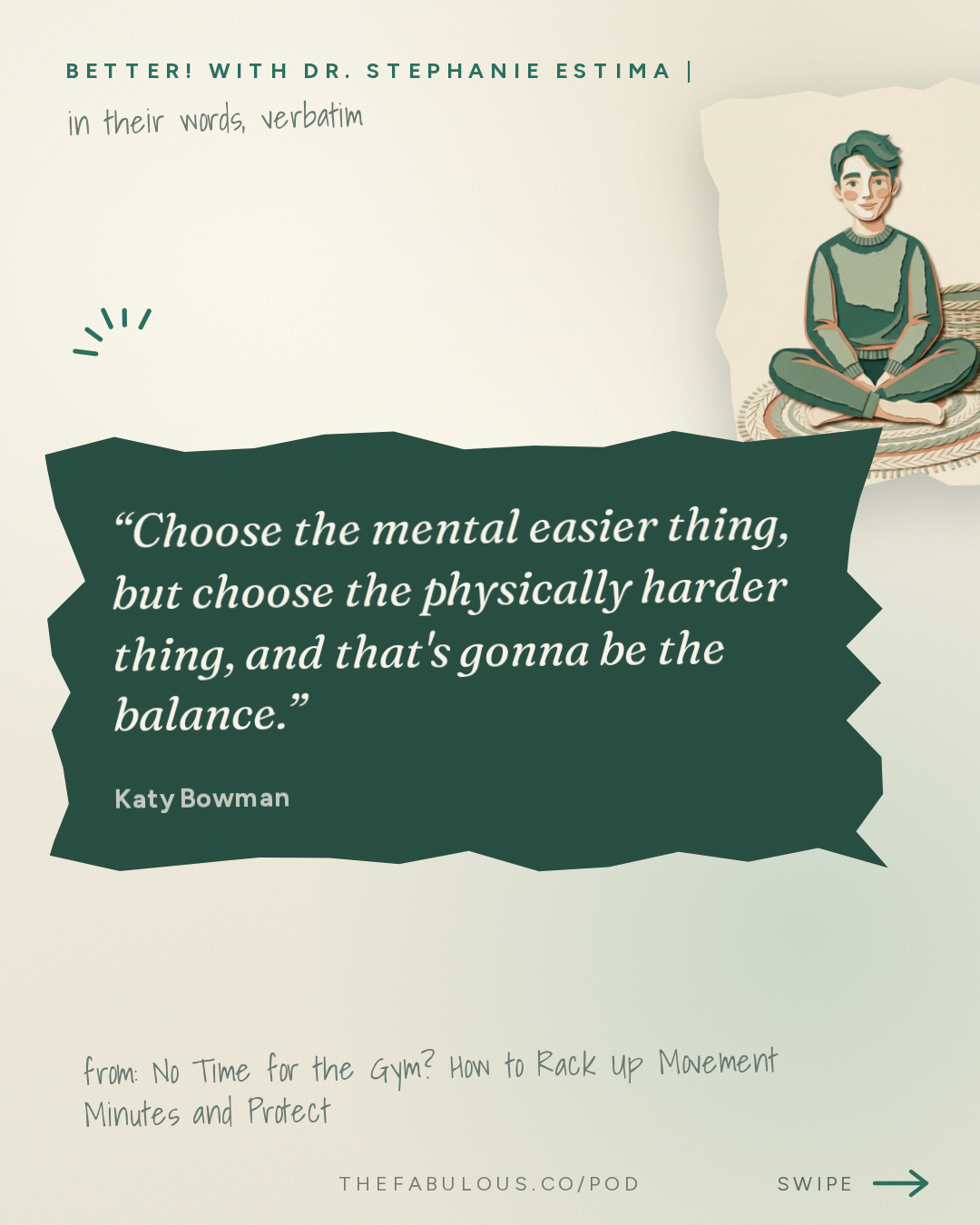
"Choose the mental easier thing, but choose the physically harder thing, and that's gonna be the balance." — Katy Bowman [84:09]
It is a small, almost domestic kind of ambition, closer to rearranging furniture than to any fitness regimen. But that is the whole point of Bowman's pyramid: the body cannot tell the difference between a barbell and a bag of groceries, a treadmill and a flight of stairs taken twice. It only knows what it was asked to do, all day, for years. Change what gets asked, and the chair-height world starts to look less like a life sentence and more like a set of defaults waiting to be moved.
By the numbers
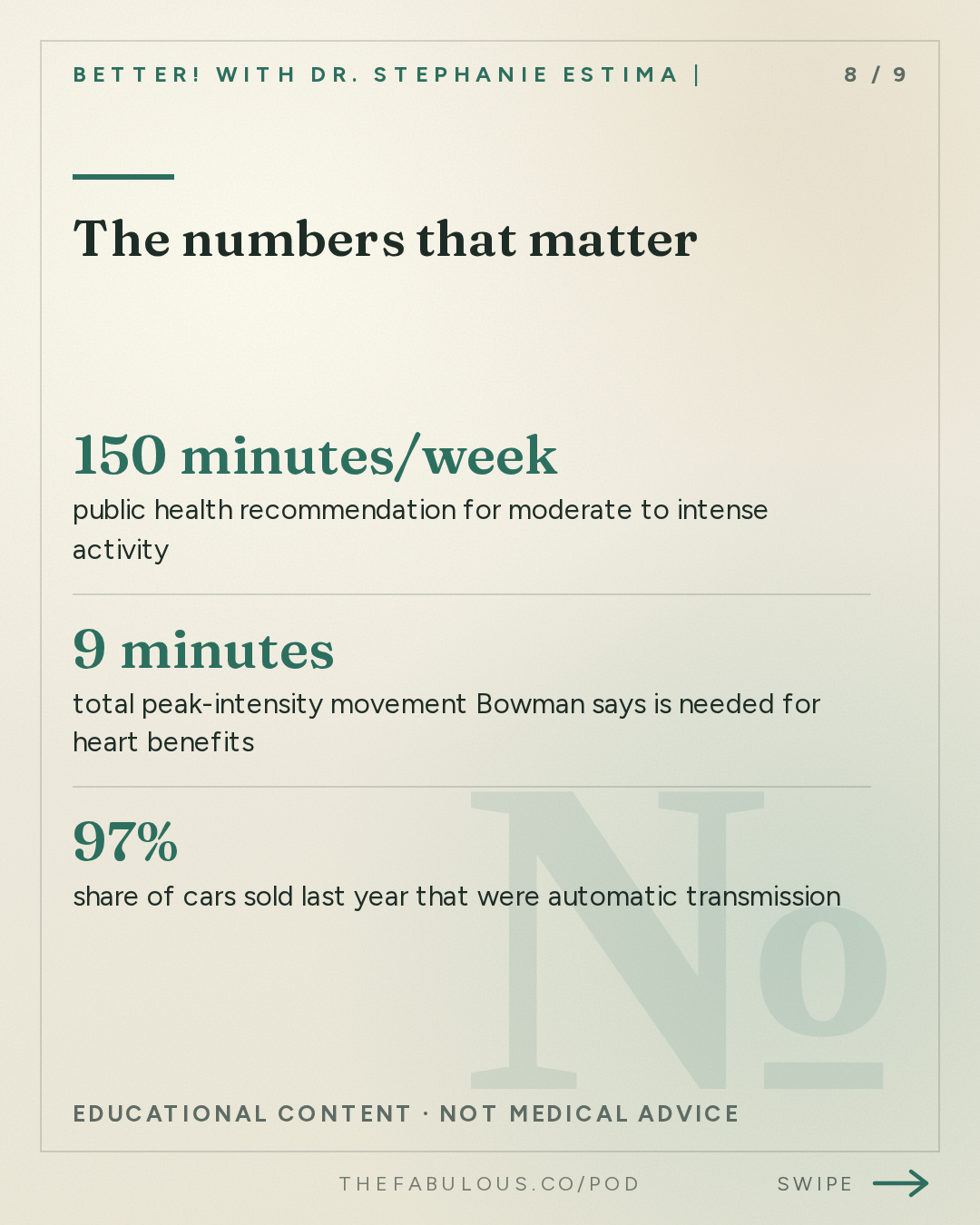
- 150 minutes/week public health recommendation for moderate to intense activity
- 9 minutes total peak-intensity movement Bowman says is needed for heart benefits
- 97% percent share of cars sold last year that were automatic transmission
In their words
“It is a period of movement that has been predetermined how long you're gonna do it.”
“So right now, our relationship with exercise is much more akin to relating to supplements rather than relating to eating a more nutritious diet.”
“Convenience isn't really saving you very much time. It's saving you movement.”
“Choose the mental easier thing, but choose the physically harder thing, and that's gonna be the balance.”
Protocols
-
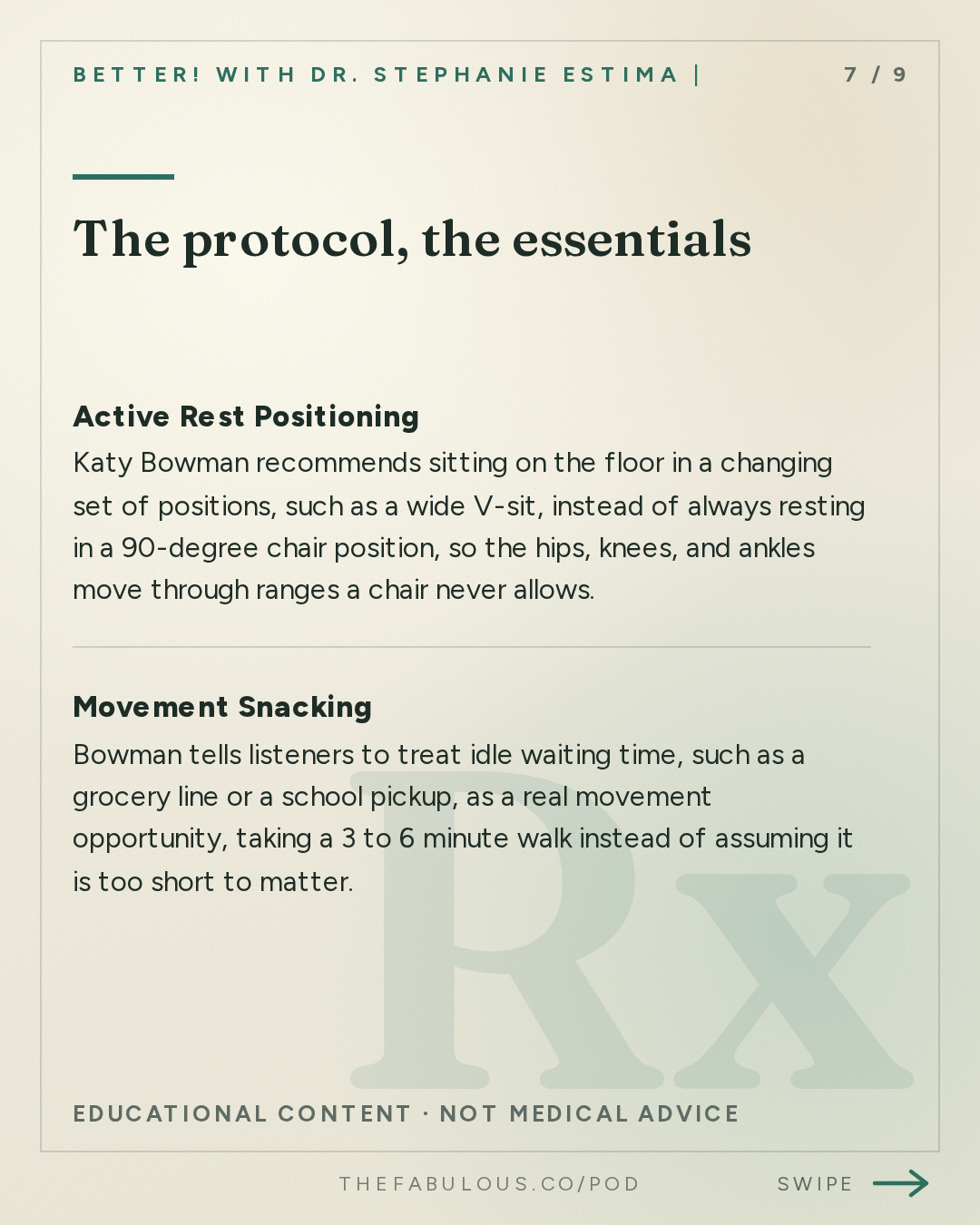
Active Rest Positioning
Katy Bowman recommends sitting on the floor in a changing set of positions, such as a wide V-sit, instead of always resting in a 90-degree chair position, so the hips, knees, and ankles move through ranges a chair never allows.
Any time rest would normally mean sitting in a chair, several times a day
-
Movement Snacking
Bowman tells listeners to treat idle waiting time, such as a grocery line or a school pickup, as a real movement opportunity, taking a 3 to 6 minute walk instead of assuming it is too short to matter.
Multiple short bouts scattered across the day
-
Peak Moves Through Play
Bowman suggests getting the roughly nine minutes of vigorous movement the body needs through playful activity, like racing a child or a dog, rather than a formal sprint session on a track.
A few short vigorous bursts most days
-
Choose Uphill
Bowman advises picking the physically harder version of a daily task, such as parking farther away or taking the stairs, while still allowing the mentally easier choice elsewhere, so the body keeps receiving the harder loads it needs to adapt.
Ongoing, built into daily decisions
Questions this episode answers
What is the difference between exercise, physical activity, and movement?
Biomechanist Katy Bowman describes exercise as an isolated, predetermined block of time aimed specifically at health (06:55), physical activity as any calorie-using task like commuting by bike (08:02), and movement as the largest category, including things like floor sitting that don't burn much energy but still load the body (09:46).
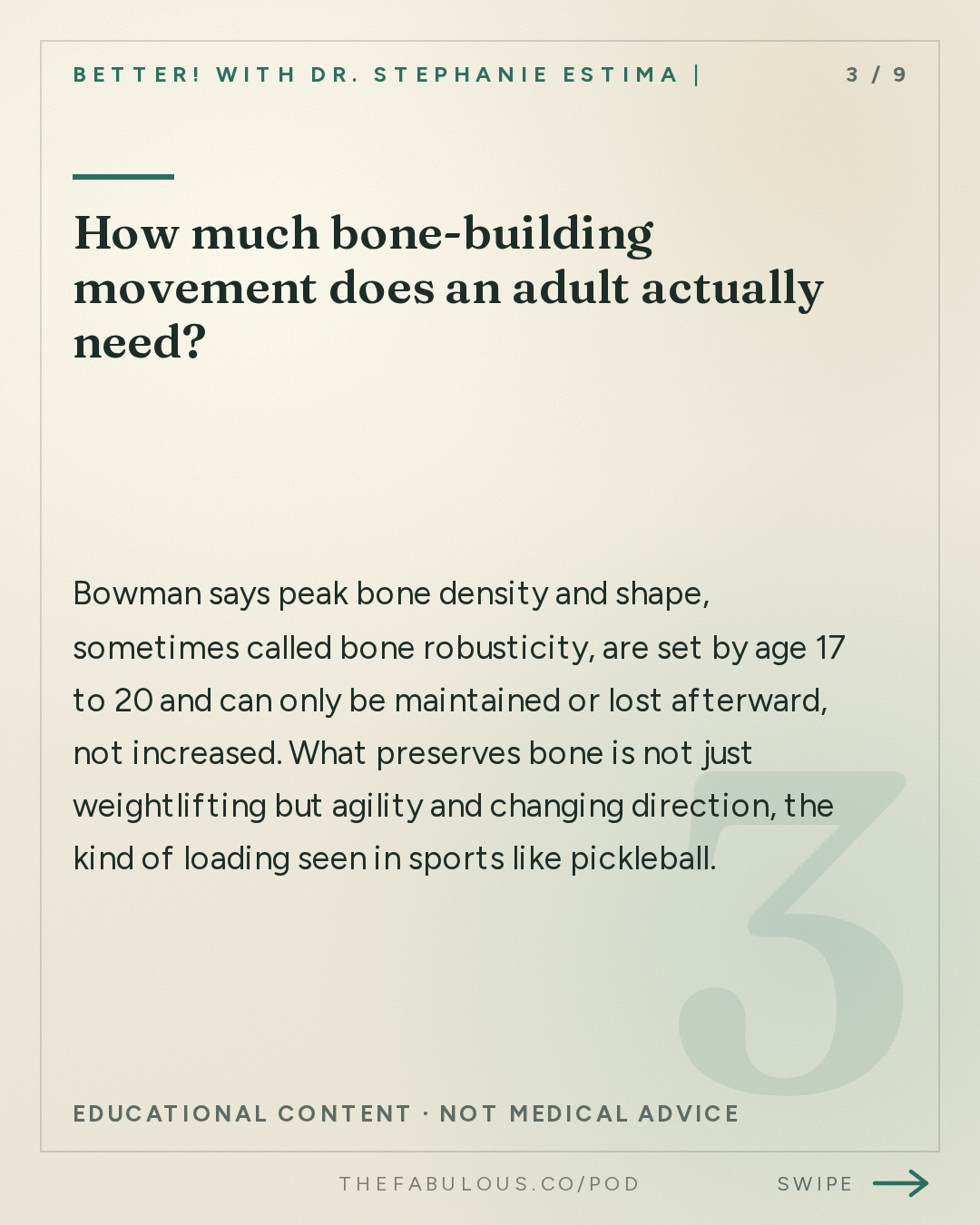
How much bone-building movement does an adult actually need?
Bowman says peak bone density and shape, sometimes called bone robusticity, are set by age 17 to 20 and can only be maintained or lost afterward, not increased (51:55). What preserves bone is not just weightlifting but agility and changing direction, the kind of loading seen in sports like pickleball (52:46).
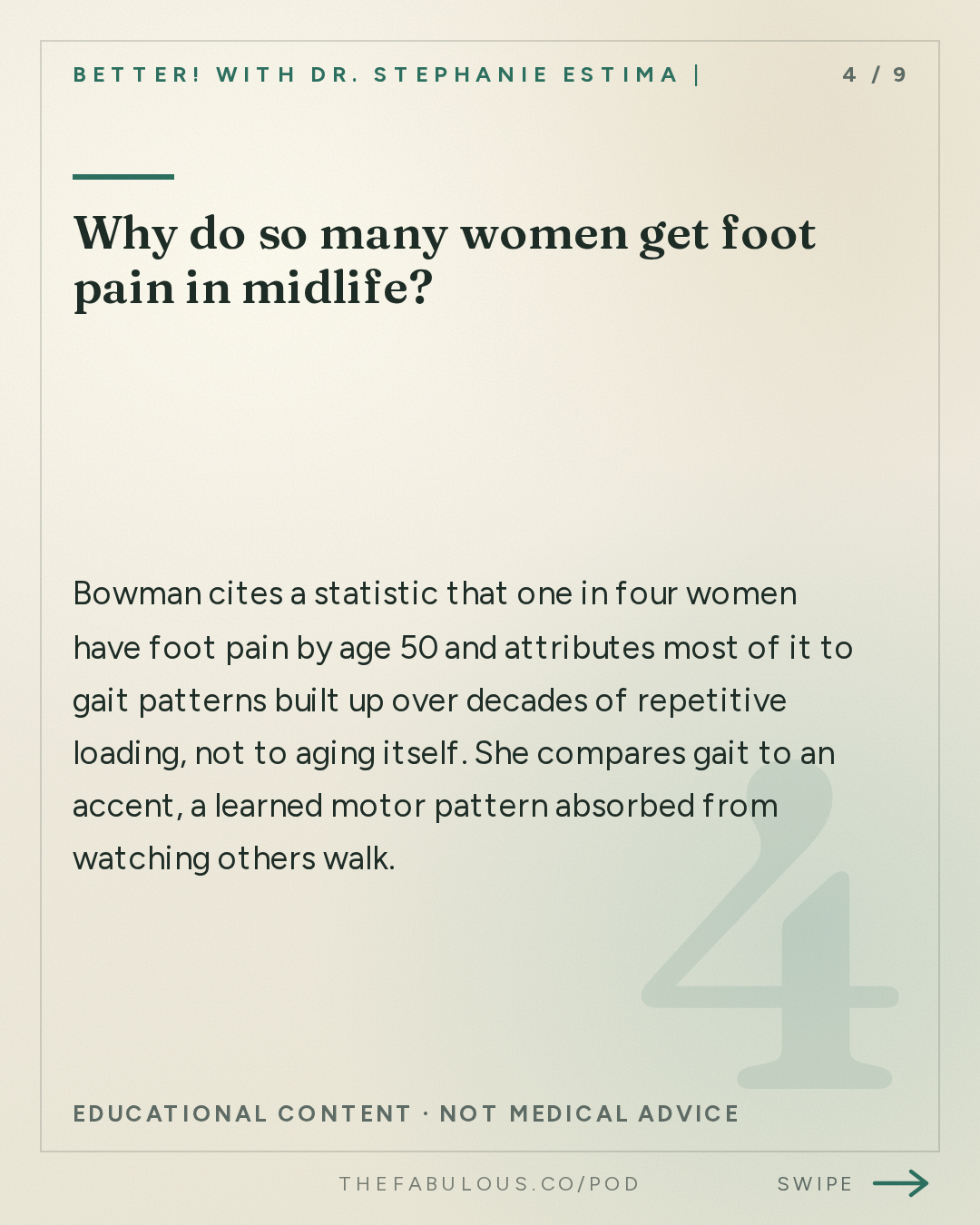
Why do so many women get foot pain in midlife?
Bowman cites a statistic that one in four women have foot pain by age 50 (32:52) and attributes most of it to gait patterns built up over decades of repetitive loading, not to aging itself. She compares gait to an accent, a learned motor pattern absorbed from watching others walk (71:50).
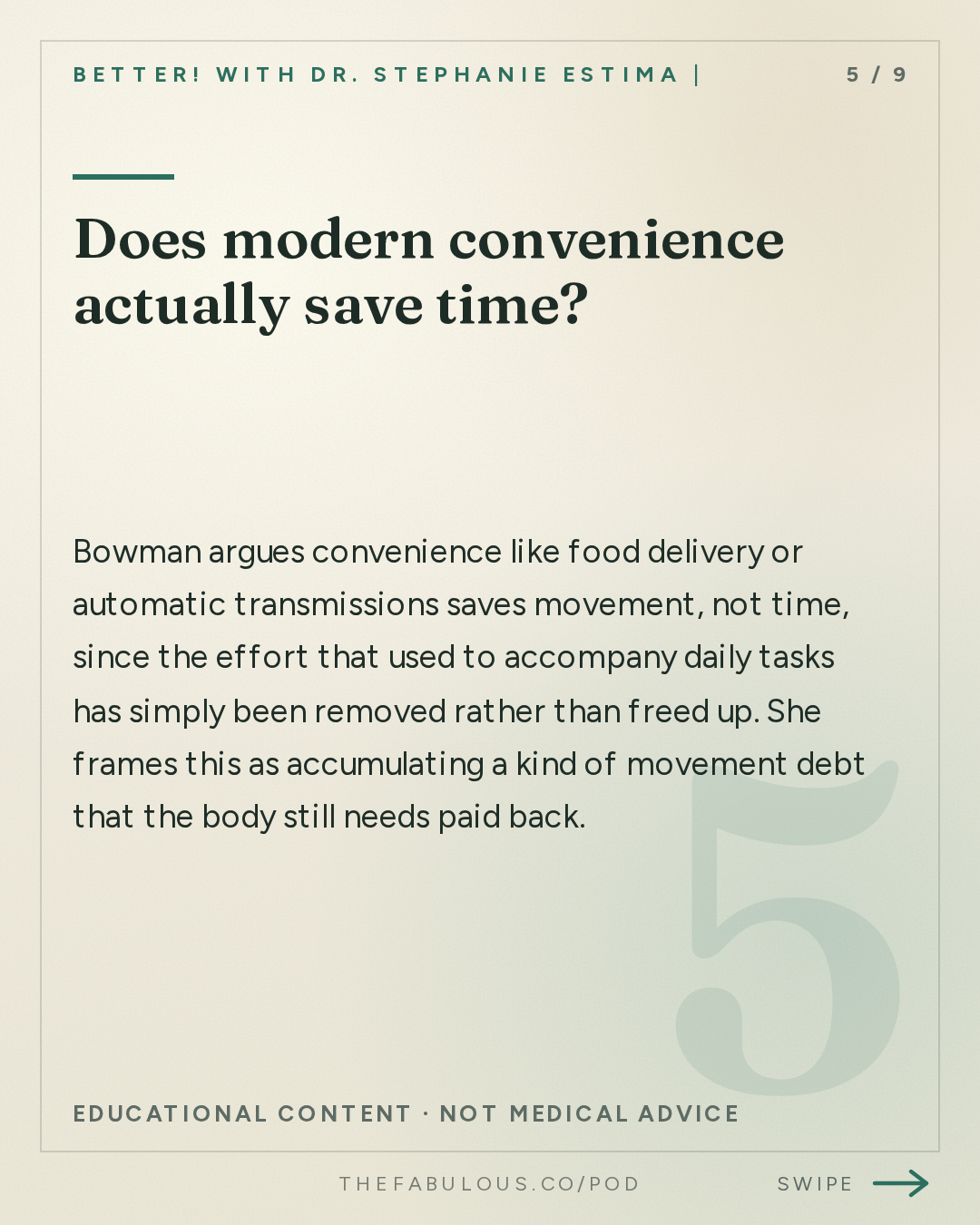
Does modern convenience actually save time?
Bowman argues convenience like food delivery or automatic transmissions saves movement, not time, since the effort that used to accompany daily tasks has simply been removed rather than freed up (66:57). She frames this as accumulating a kind of movement debt that the body still needs paid back.
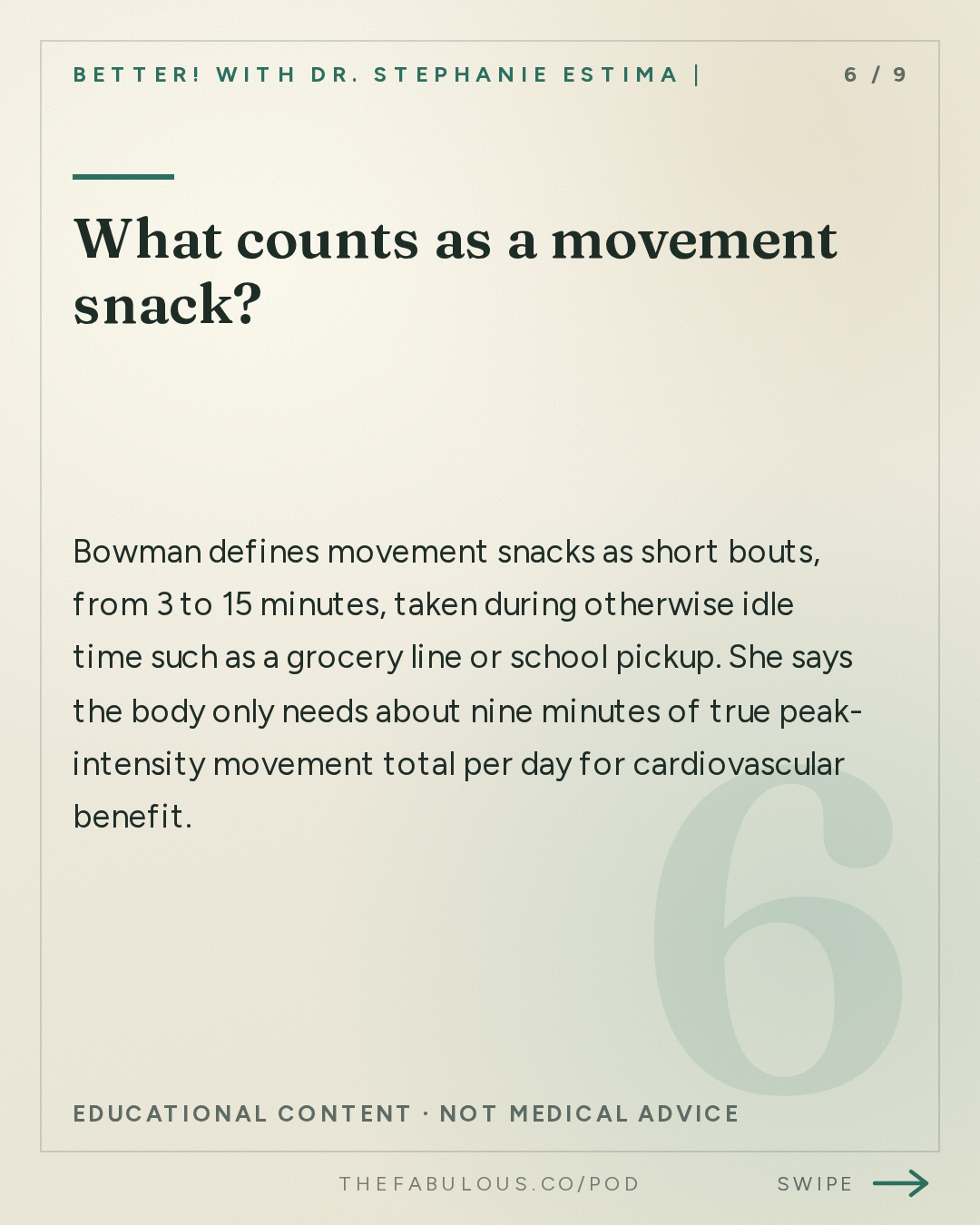
What counts as a movement snack?
Bowman defines movement snacks as short bouts, from 3 to 15 minutes, taken during otherwise idle time such as a grocery line or school pickup (44:10, 65:45). She says the body only needs about nine minutes of true peak-intensity movement total per day for cardiovascular benefit (27:36).
The full read, in cards
Go deeper
- Move Your DNA — Katy Bowman's book and podcast explaining biomechanics beyond gym-based exercise
- Night Bitch — novel about a new mother who feels herself turning feral, cited as the inspiration for a late-night walking ritual among the host's friend group
Mentioned
Katy Bowman · Dr. Stephanie Estima · Nutritious Movement · Hadza · Dr. Belinda Beck · Move Your DNA · Night Bitch · California State University
More from this show and category
Physiology of Grief and Heart Attack Risk
Grief is not just an emotion, it is a measurable physiological event: a 21-times spike in heart attack risk in the first 24 hours after a loss, elevated cortisol for months, and a brain that keeps treating the dead as still out there somewhere.

ED as an Early Predictor of Heart Attack Risk
Erectile dysfunction predicts a future heart attack better than chest pain does, especially in younger men (11:11). Urologist Tobias Kohler describes two cheap early-warning tests, a coronary calcium scan and a Mayo Clinic ceramide blood test, plus the cardiac damage caused by high-dose testosterone abuse (12:49, 44:55).
Vaginal Estrogen for UTI Prevention
Urologist Dr. Kelly Casperson explains that genitourinary syndrome of menopause (GSM) affects 50% to 90% of postmenopausal women. Vaginal estrogen cuts recurrent urinary tract infections by half, lowers hospitalization and death risk, and is safe for most breast cancer survivors, yet only 9% of women diagnosed with GSM get a prescription.

Gabrielle Lyon: Muscle Is the Longevity Organ
Dr. Gabrielle Lyon argues that skeletal muscle, not body fat, is the organ that determines how well women age. She explains that muscle drives glucose disposal, releases hormone-like myokines, and needs at least 100 grams of daily protein plus resistance training to stay healthy after midlife.
