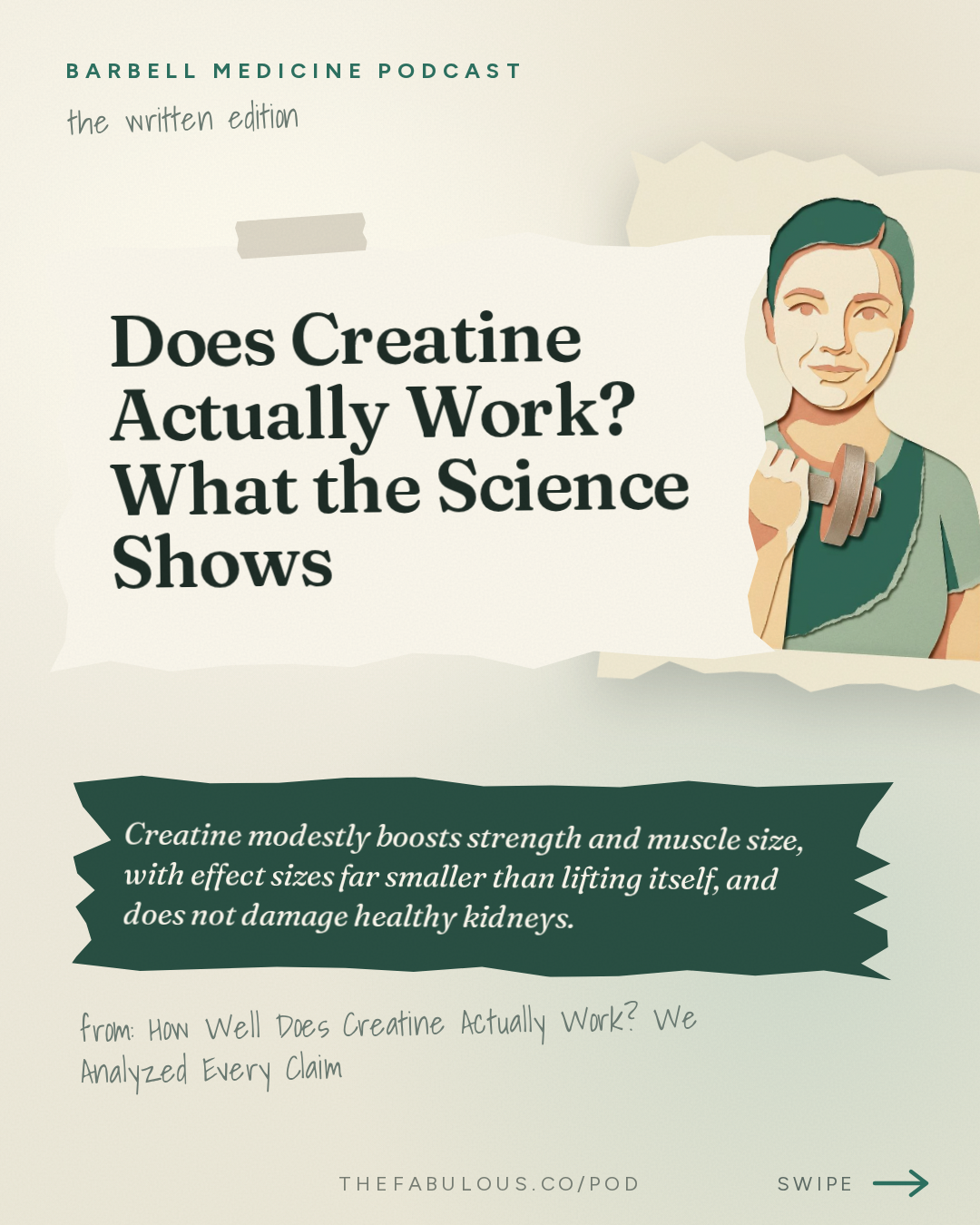
Does Creatine Actually Work? What the Science Shows
How Well Does Creatine Actually Work? We Analyzed Every Claim and the New Law
The brief
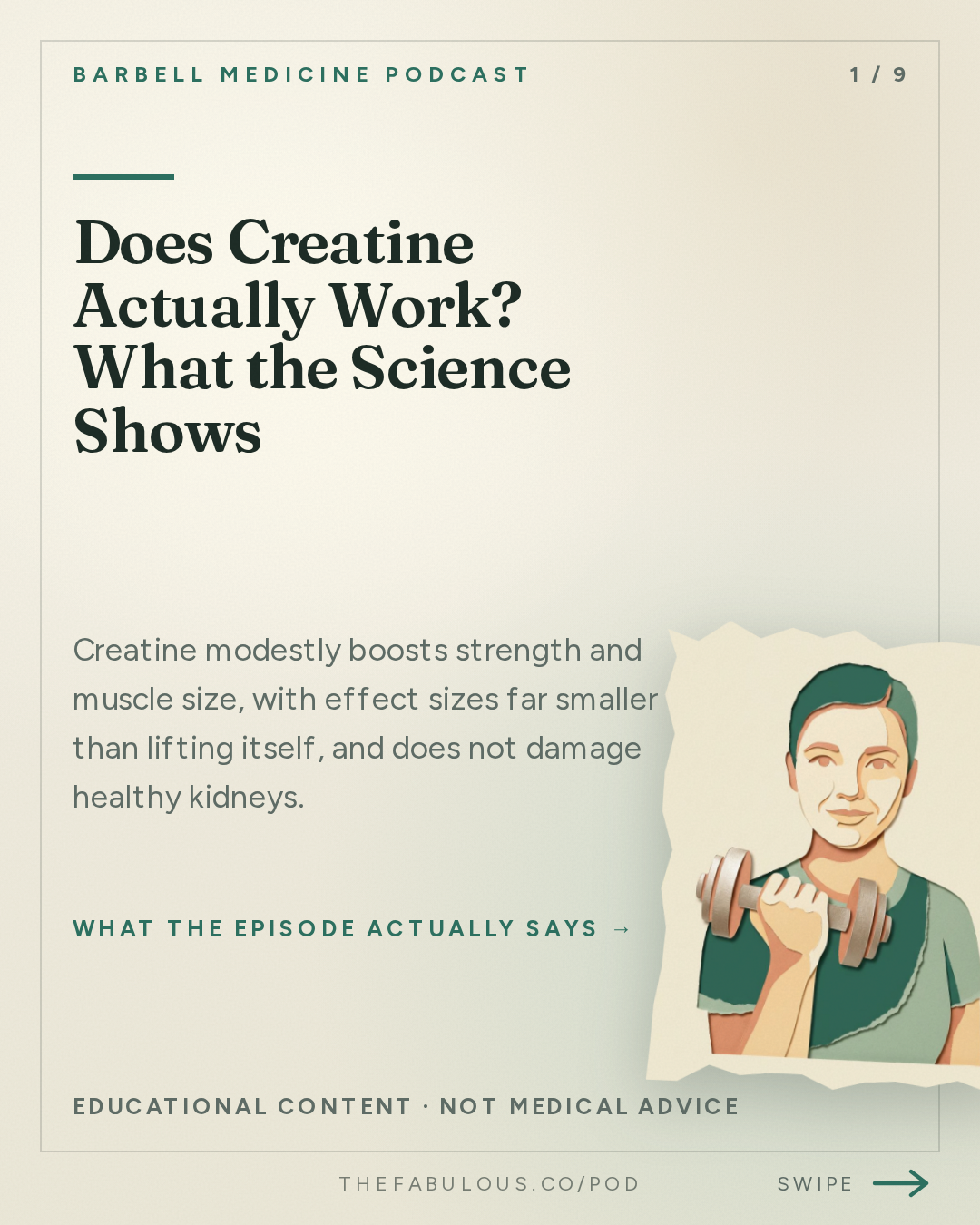
Creatine modestly boosts strength and muscle size, with effect sizes far smaller than lifting itself, and does not damage healthy kidneys. Claims about cognition, depression, Parkinson's, Huntington's, menopause, and bone density do not hold up in the best-run trials (14:24, 26:47, 48:26, 51:20).
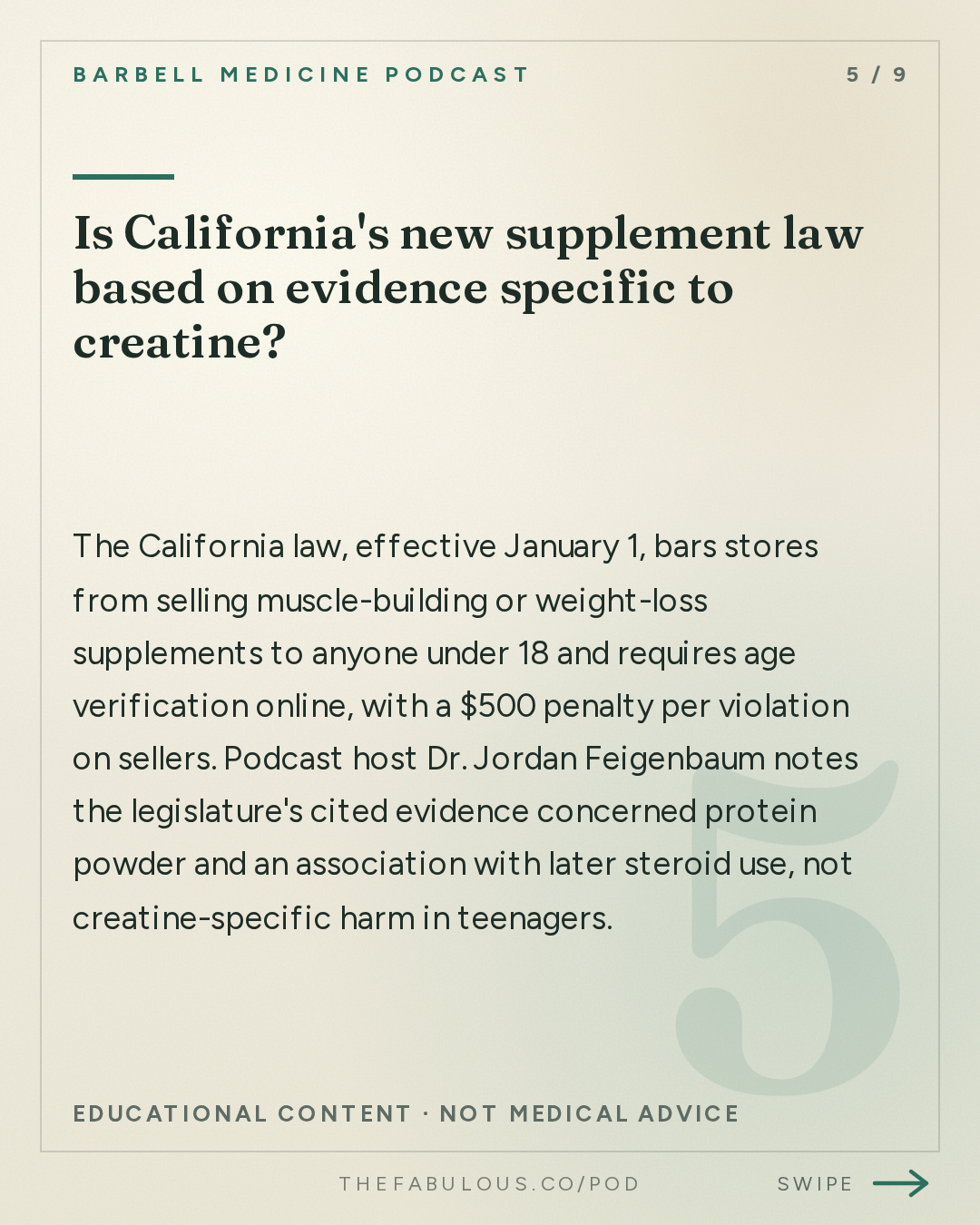
Starting January 1, a sixteen-year-old in California who wants a tub of creatine off a store shelf may need to prove an age that a clerk cannot simply eyeball. The law groups creatine with any supplement marketed for building muscle or losing weight, and sellers face a $500 fine per violation (01:11). It is a strange place for creatine to land. In the late 1990s it was the supplement blamed for wrecking kidneys. Today it is sold for memory, depression, menopause, and Alzheimer's disease. On the Barbell Medicine podcast, physicians Dr. Jordan Feigenbaum and Dr. Austin Baraki walked through the research behind both reputations, claim by claim.
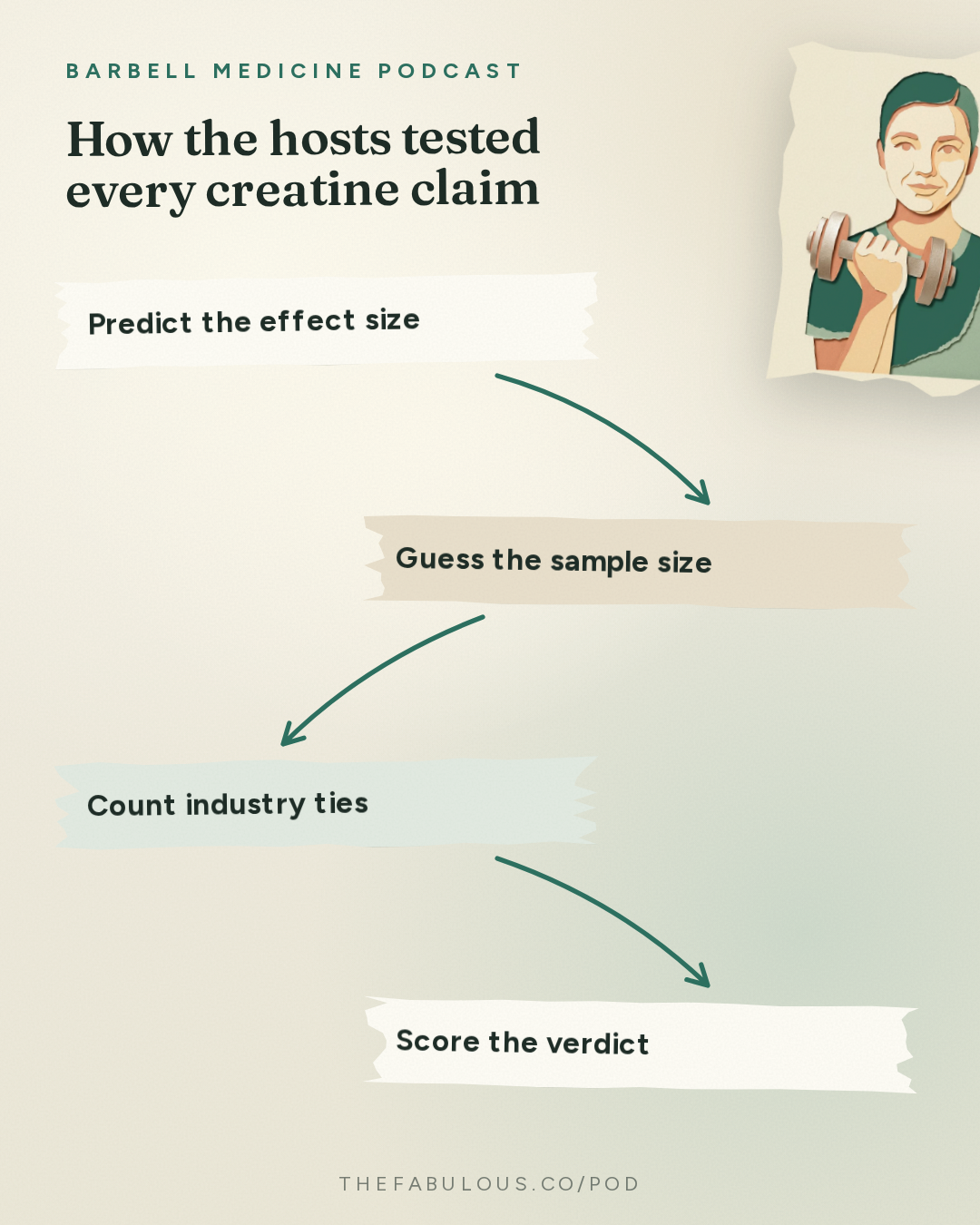
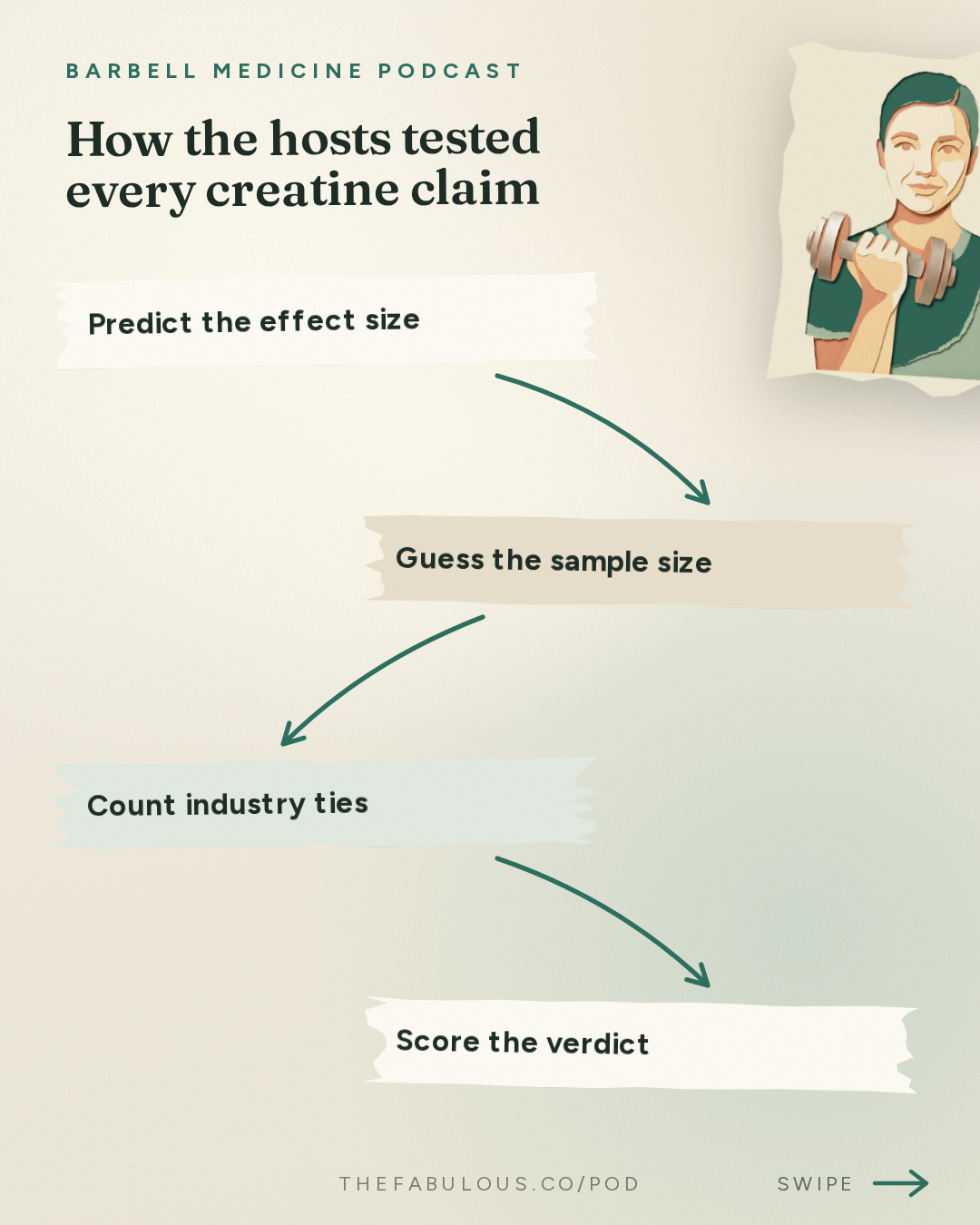
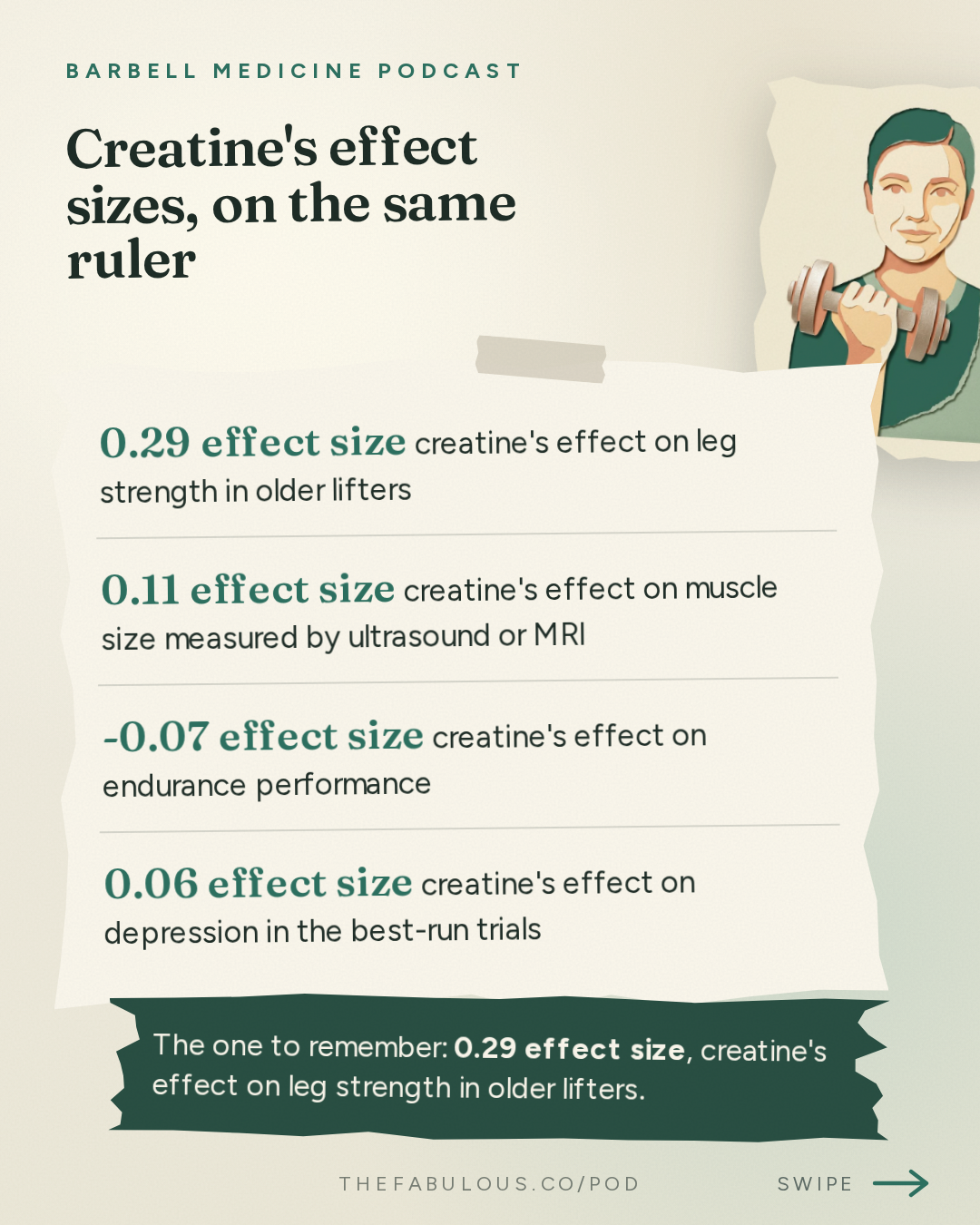
Their method hinges on one idea: the effect size. An effect size takes the difference between two groups, say people on creatine and people on placebo, and divides it by how much people vary within each group. That puts every outcome, strength, test scores, depression ratings, on the same ruler (02:20). A score of 0.2 counts as small, 0.5 as medium, 0.8 as large. In plain terms, with no effect at all, picking one person at random from each group gives a coin flip, 50 percent, that the creatine person comes out ahead. For comparison, lifting weights against not lifting carries an effect size of 0.75 to 1.6 across 178 trials, meaning the lifter comes out ahead 70 to 87 percent of the time (03:22).
"Lifting itself, though, gets you 70 to 87%, a much larger effect." — Dr. Jordan Feigenbaum [14:24]
Creatine itself is not new. French chemist Michel Chevreul isolated it from meat broth in the early 1830s and named it after the Greek word for meat (05:02). It took more than a century, until a muscle sampling technique called the Bergstrom needle biopsy arrived in the 1960s, before anyone could measure what supplementation actually did inside living tissue (06:11). A 1992 study found that about 20 grams a day for roughly a week topped off the muscle's creatine stores, a finding that sent British Olympic athletes reaching for it that same summer and put it on American shelves within a year (06:35). Then, in 1997, three college wrestlers died during rapid weight cuts, and creatine took the blame even though investigators traced the deaths to dehydration and overheating. For two decades the supplement carried a reputation as a kidney destroyer. Now the pendulum has swung so far the other way that it gets marketed as a near-cure-all.
What creatine actually does inside a muscle cell is specific and limited. About 95 percent of the body's creatine sits in muscle, mostly as phosphocreatine, a kind of spare part used to rebuild the ATP molecule that powers muscle contraction during the first seconds of a hard effort (10:30). On an ordinary diet, muscle stores run 60 to 80 percent full. Supplementation tops that off by about 20 to 40 percent, and then stops (10:51). There is a ceiling. Taking more does not raise the stores any further.
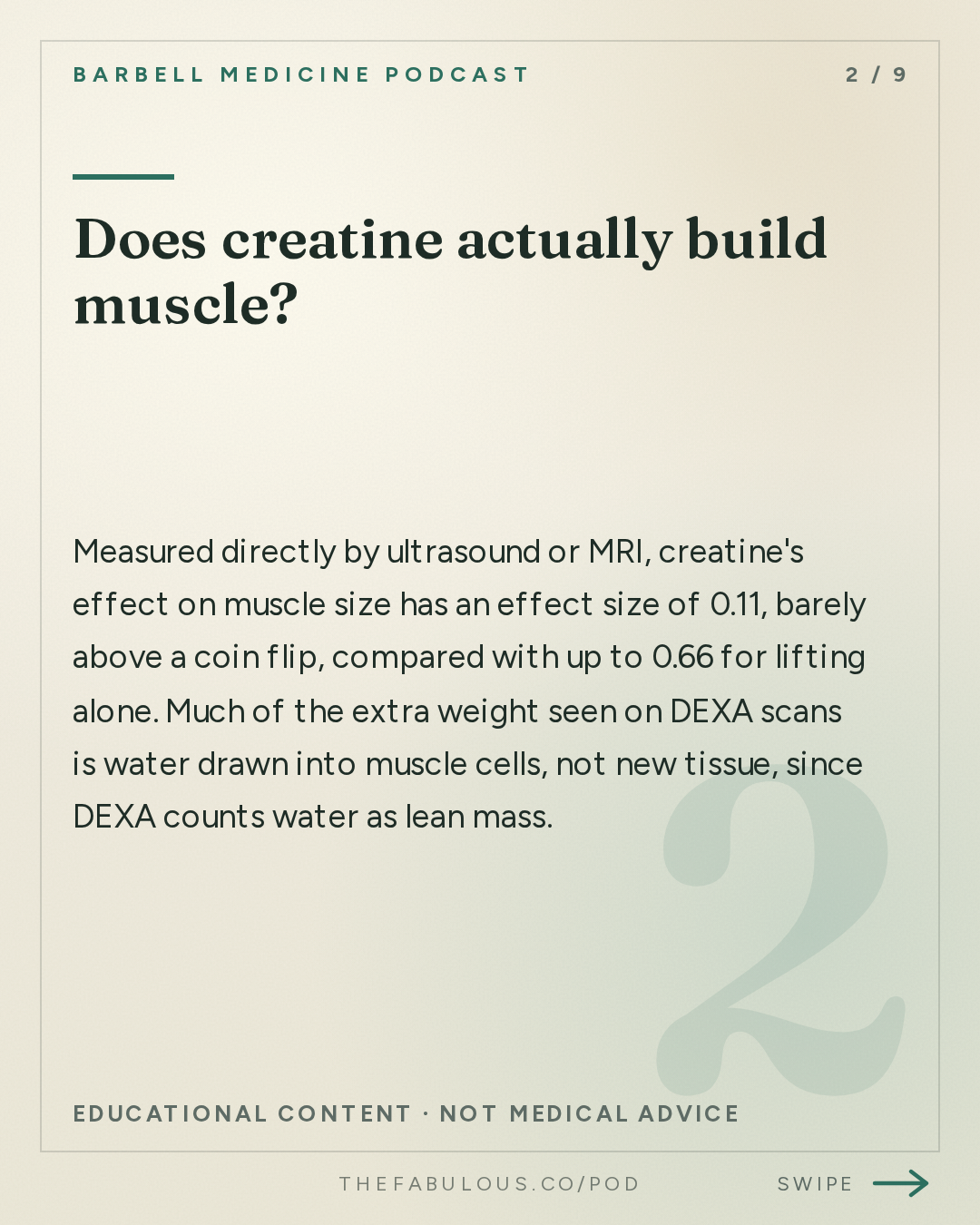
On strength, the number most often repeated is 10 to 15 percent. The actual best estimate for leg strength in older adults who lift is an effect size of 0.29, with a range running close to zero (14:24). On the ruler, that is a creatine lifter ahead of a placebo lifter about 58 percent of the time, a modest edge next to lifting's own 70 to 87 percent. Baraki translated the number into something concrete: if someone can usually complete ten reps at a given weight, a response to creatine might show up as an eleventh rep, not a transformed training career (15:56). Muscle size tells a similar, smaller story. Measured directly by ultrasound or MRI, creatine's effect size on muscle thickness is 0.11, barely different from a coin flip, against up to 0.66 for lifting alone (22:52). In real terms that is 1 to 1.6 millimeters of extra muscle thickness. DEXA scans, machines that estimate body composition from X-ray absorption, often report a bigger number, around 1.1 kilograms of added lean mass, but that is partly an illusion, since the scans read water as tissue and creatine pulls water into the muscle.
The Kidney Myth and the Smaller Claims
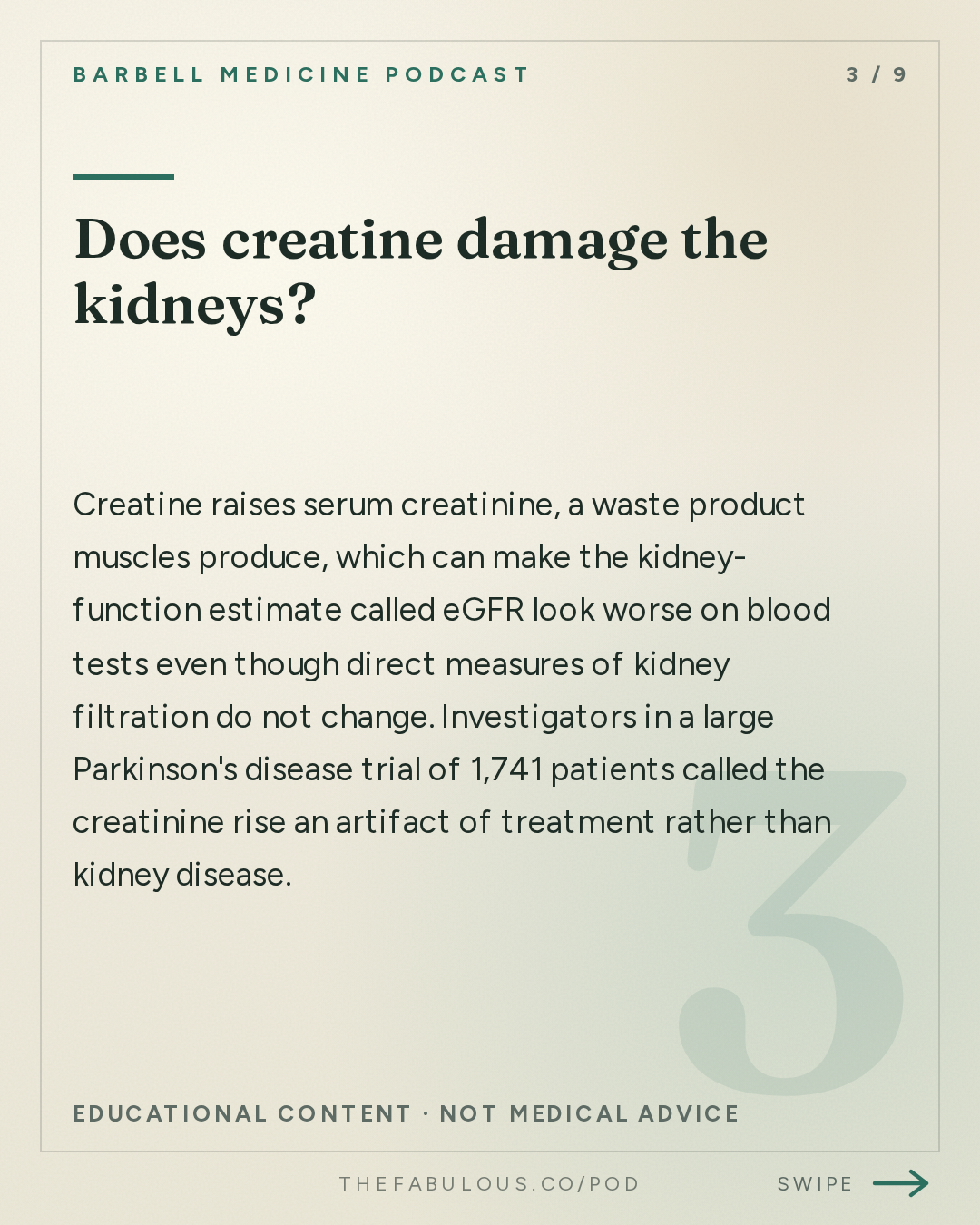
The kidney scare that defined creatine's reputation for twenty years rests on a mix-up. Creatinine is the waste product muscles make when they break down creatine, and doctors use blood creatinine to estimate kidney filtration through a number called eGFR. Taking creatine can drop that eGFR estimate by about 11 points (26:47), which looks alarming on a lab report. But when researchers measured actual kidney filtration directly, it did not fall. Investigators in the longest-running creatine trial in Parkinson's disease, which followed 1,741 patients for at least five years, called the creatinine bump an artifact of treatment rather than a sudden onset of renal disease (26:19).
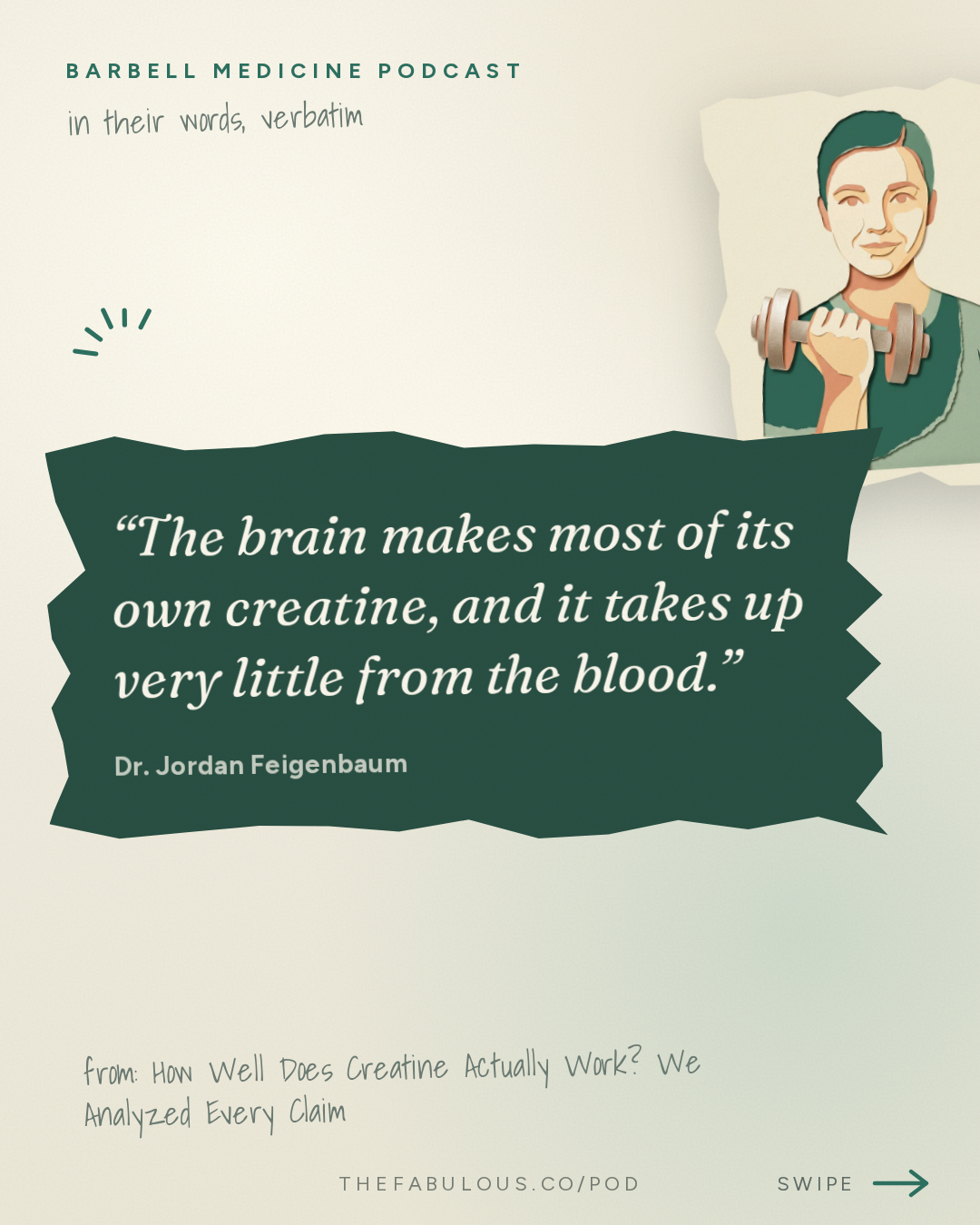
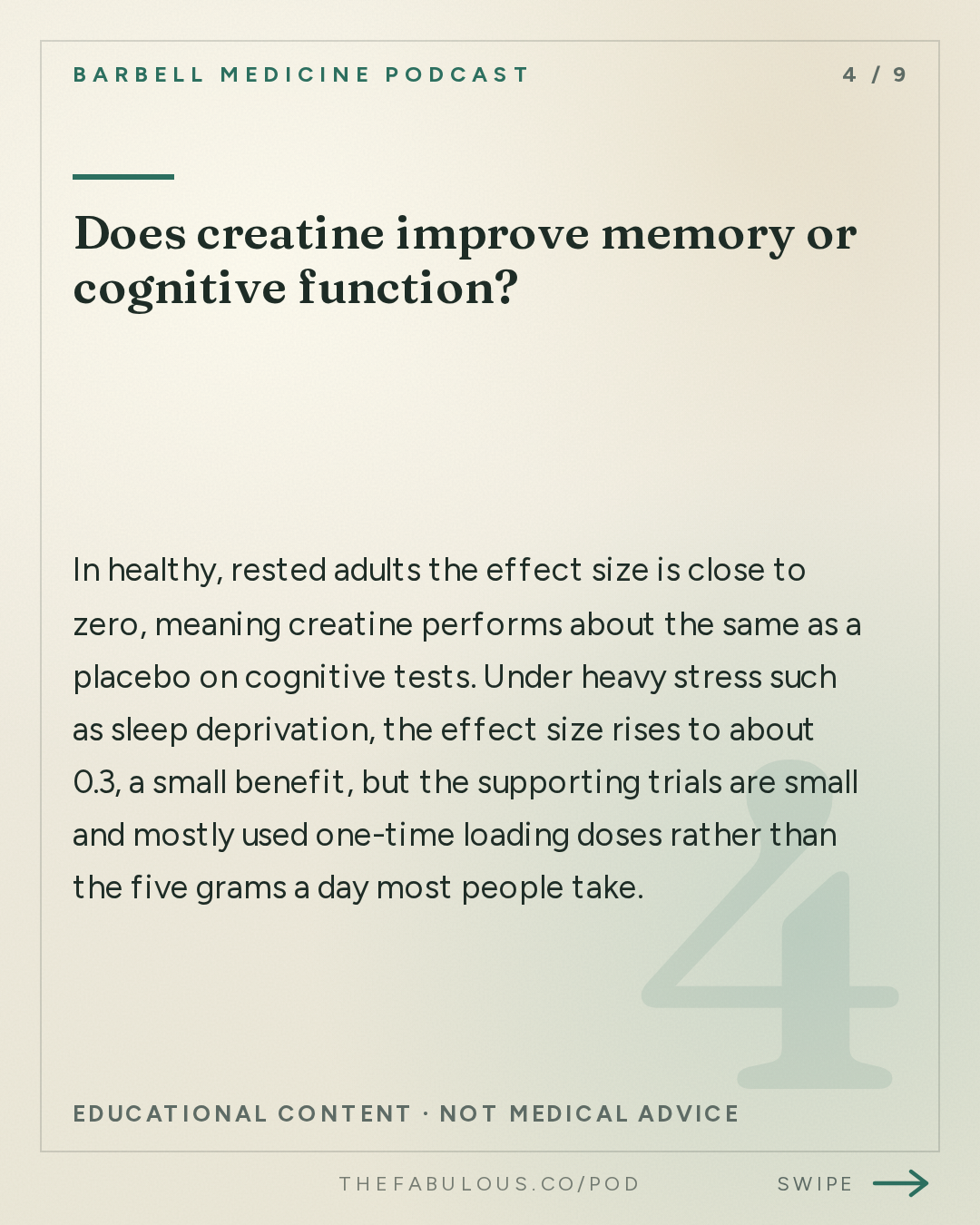
Endurance fares worse than strength. The largest meta-analysis of creatine on endurance performance found an effect size of negative 0.07, essentially zero, with the only positive signal appearing in rowing, a sport where the boat carries most of the athlete's body weight (30:45). The brain claims run into straightforward biology: the brain manufactures most of its own creatine and absorbs very little from the bloodstream. Loading doses of 20 grams a day for a month raised brain creatine by only about 9 percent on average, compared with the 20 to 40 percent rise seen in muscle (36:09). In healthy, rested people, the effect size on cognitive tests is close to zero (37:18). Under genuine stress, such as sleep deprivation, it rises to about 0.3, but the supporting trials are small and most did not use the daily low dose people actually take (38:16).
A similar gap shows up with depression. Across eleven trials the pooled effect size is 0.34, but in the most carefully controlled studies it falls to 0.06, which reviewers described as possibly trivial or null (43:24). Regular exercise of any kind carries an effect size of about 0.6 on depression, far above creatine's best showing. The two largest trials testing creatine against neurodegenerative disease, one with 1,741 Parkinson's patients and one with 553 Huntington's disease patients on doses up to 40 grams a day, were both stopped early because the data showed no benefit, and patients on creatine in the Huntington's trial declined slightly faster than those on placebo (48:26). Bone and menopause claims collapse in similar fashion. A two-year trial gave 200 women with low bone density creatine alone, with no other intervention, and the study's own authors wrote that the result refutes the long-lasting notion that creatine alone builds bone or muscle (51:20).
Running through all of this is a quieter finding: much of the evidence that undercuts the marketing comes from industry-funded research itself, including the bone trial, a two-year strength trial in women, and a European food safety regulator's rejection of a manufacturer's own cognition claim.
What the Evidence Actually Supports
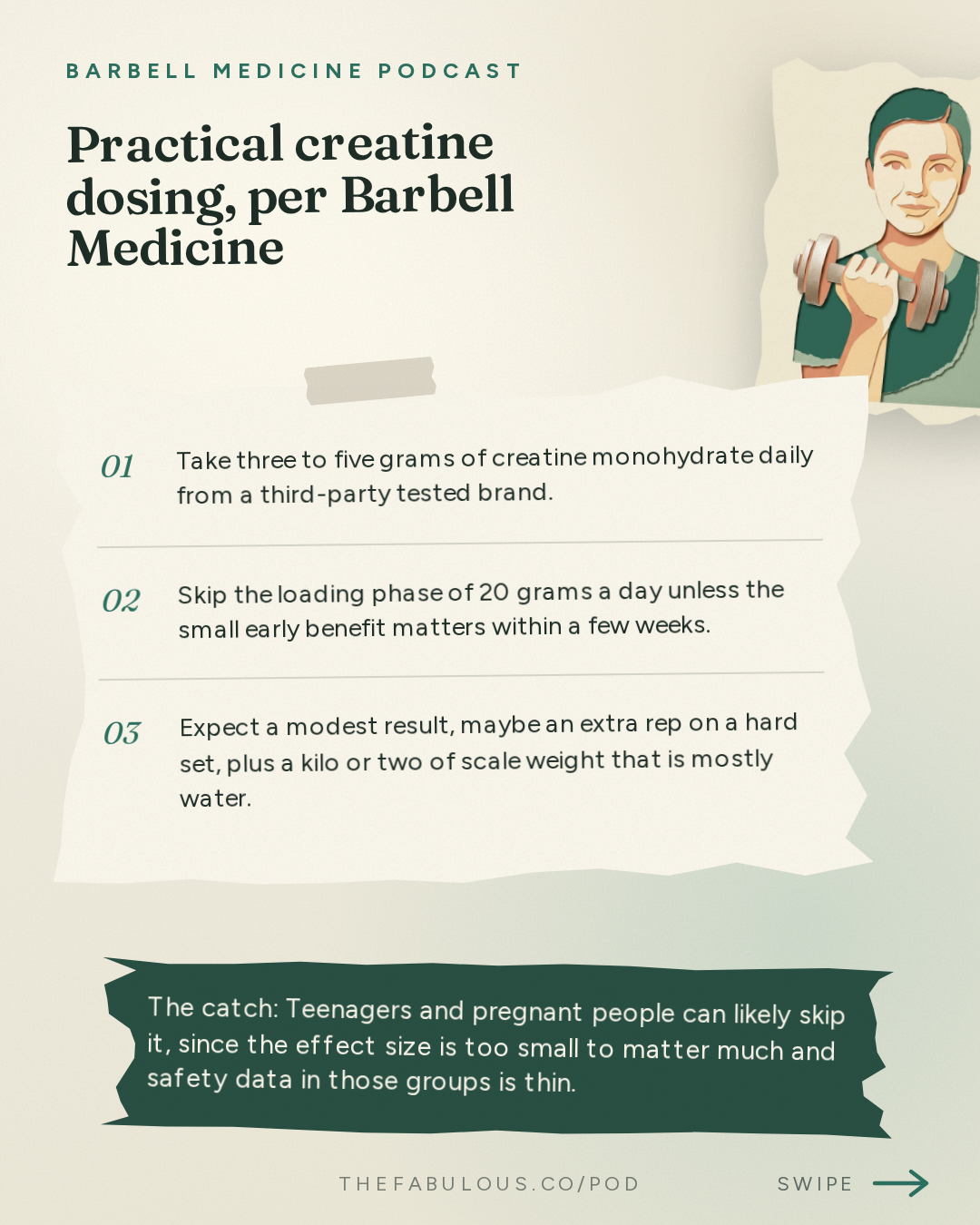
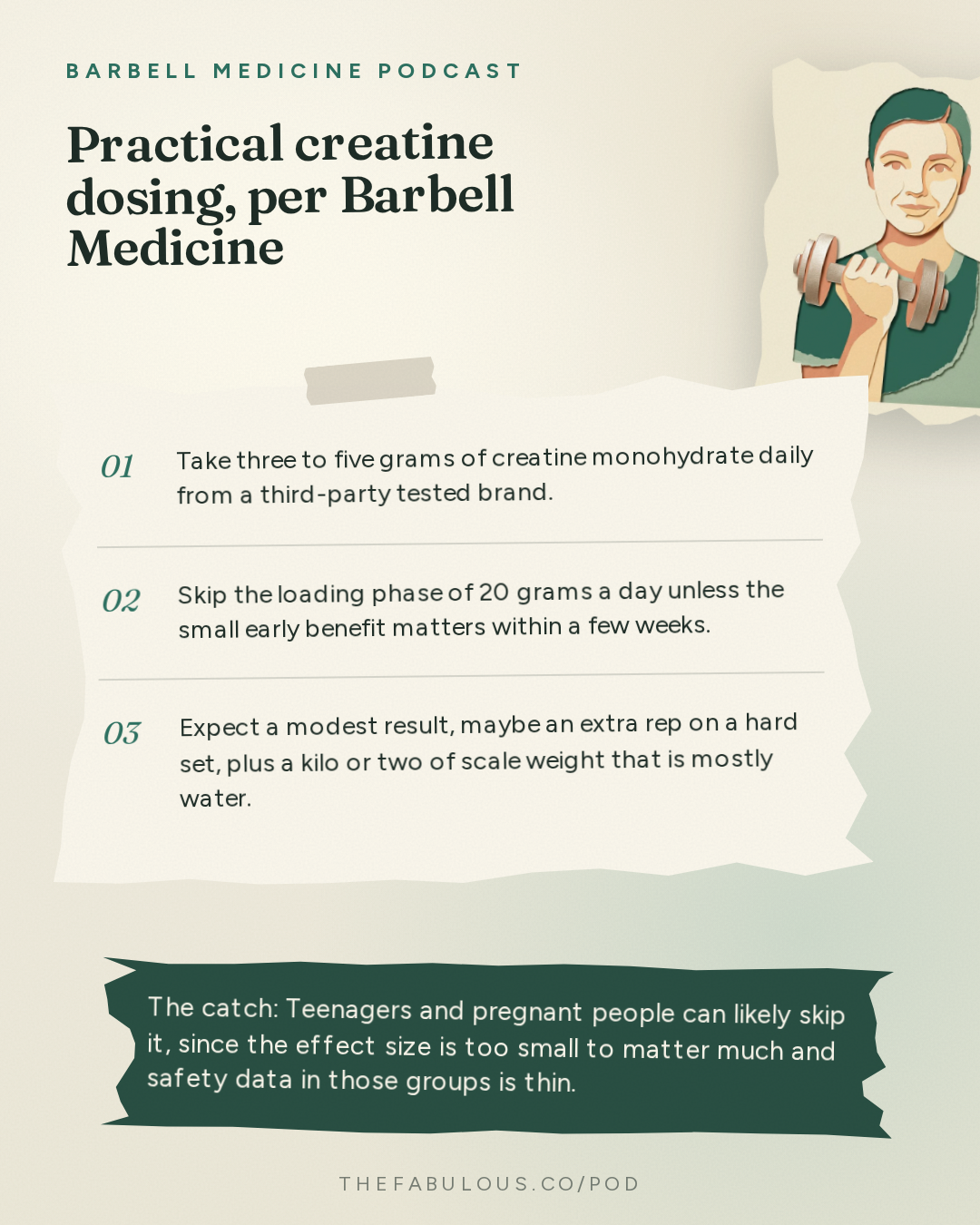
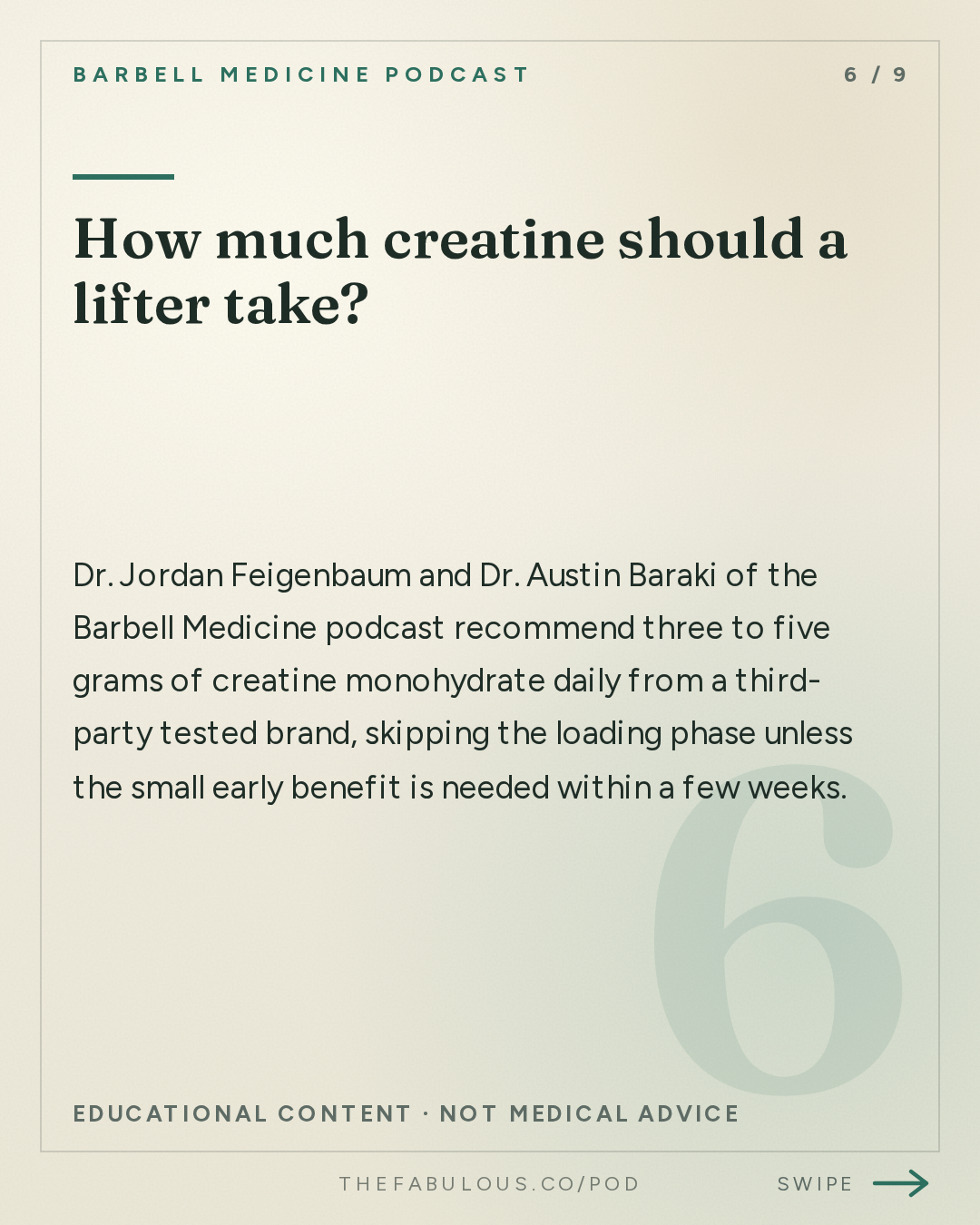
Add it together and the hosts land on a narrow recommendation. For people already lifting weights, three to five grams of creatine monohydrate a day, from a third-party tested brand, can add a small amount to strength and a little scale weight, most of it water, within weeks (65:40). Anyone taking creatine should mention it before routine blood work, since it raises creatinine as a normal side effect, not kidney damage. For memory, mood, bone density, or protection against Parkinson's or Alzheimer's disease, the evidence does not support the claim. Asked about his own mother taking it, Baraki framed the honest test this way.
"If I'm, if I would have a hard time identifying in which world you were taking creatine, then it's a little bit of a tougher case for me." — Dr. Austin Baraki [62:51]
Creatine works for lifting, a little, and on the same ruler used throughout the episode, that effect is a fraction of what lifting itself provides (66:19). Everything else, the brain, the mood, the bones, is a reputation built well beyond what the trials can support.
Ask this episode anything
Pod's AI answers from the episode itself, with the minute mark so you can hear it yourself.
Or start with one of these
Ask this episode
Pod's AI listens to the whole episode to answer, and points you to the minute it comes from.
The rest of this answer, and any question after it
Answers come from the episode itself, never from a summary of it.
ContinueKey takeaways
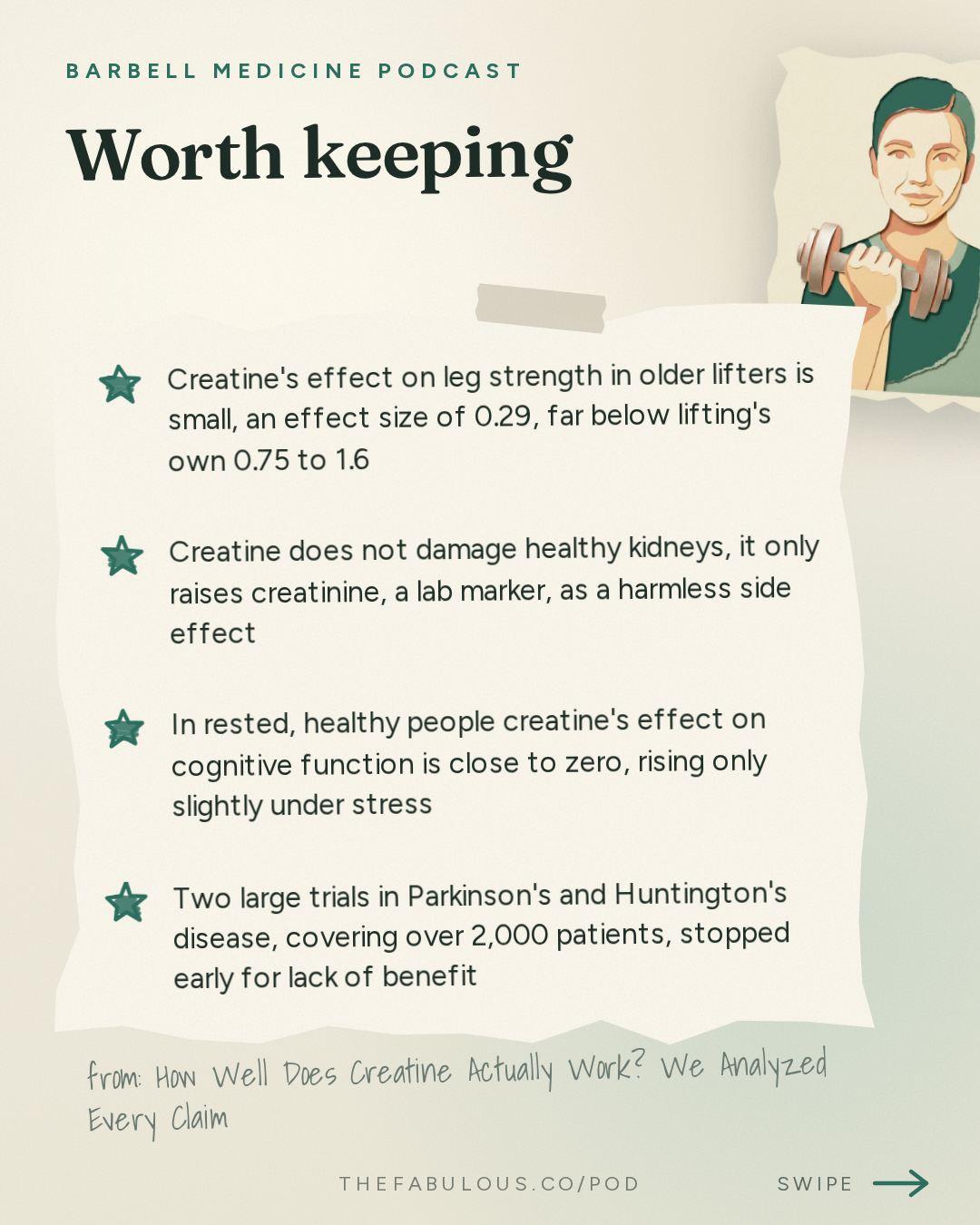
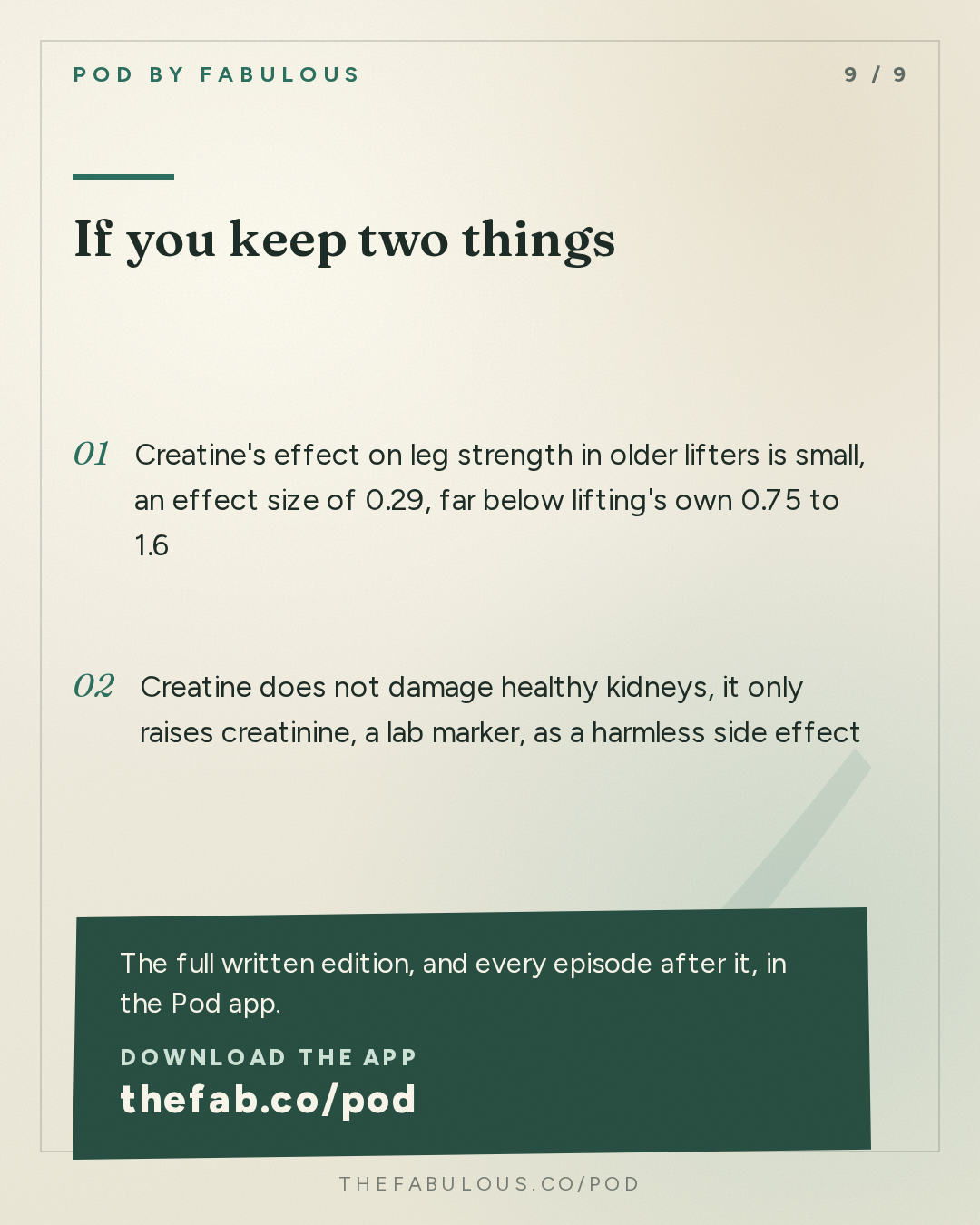
- Creatine's effect on leg strength in older lifters is small, an effect size of 0.29, far below lifting's own 0.75 to 1.6 (14:24)
- Creatine does not damage healthy kidneys, it only raises creatinine, a lab marker, as a harmless side effect (26:47)
- In rested, healthy people creatine's effect on cognitive function is close to zero, rising only slightly under stress (37:18)
- Two large trials in Parkinson's and Huntington's disease, covering over 2,000 patients, stopped early for lack of benefit (48:26)
- A two-year bone trial in 200 women found creatine alone does not build bone density or muscle (51:20)
The episode in cards

By the numbers
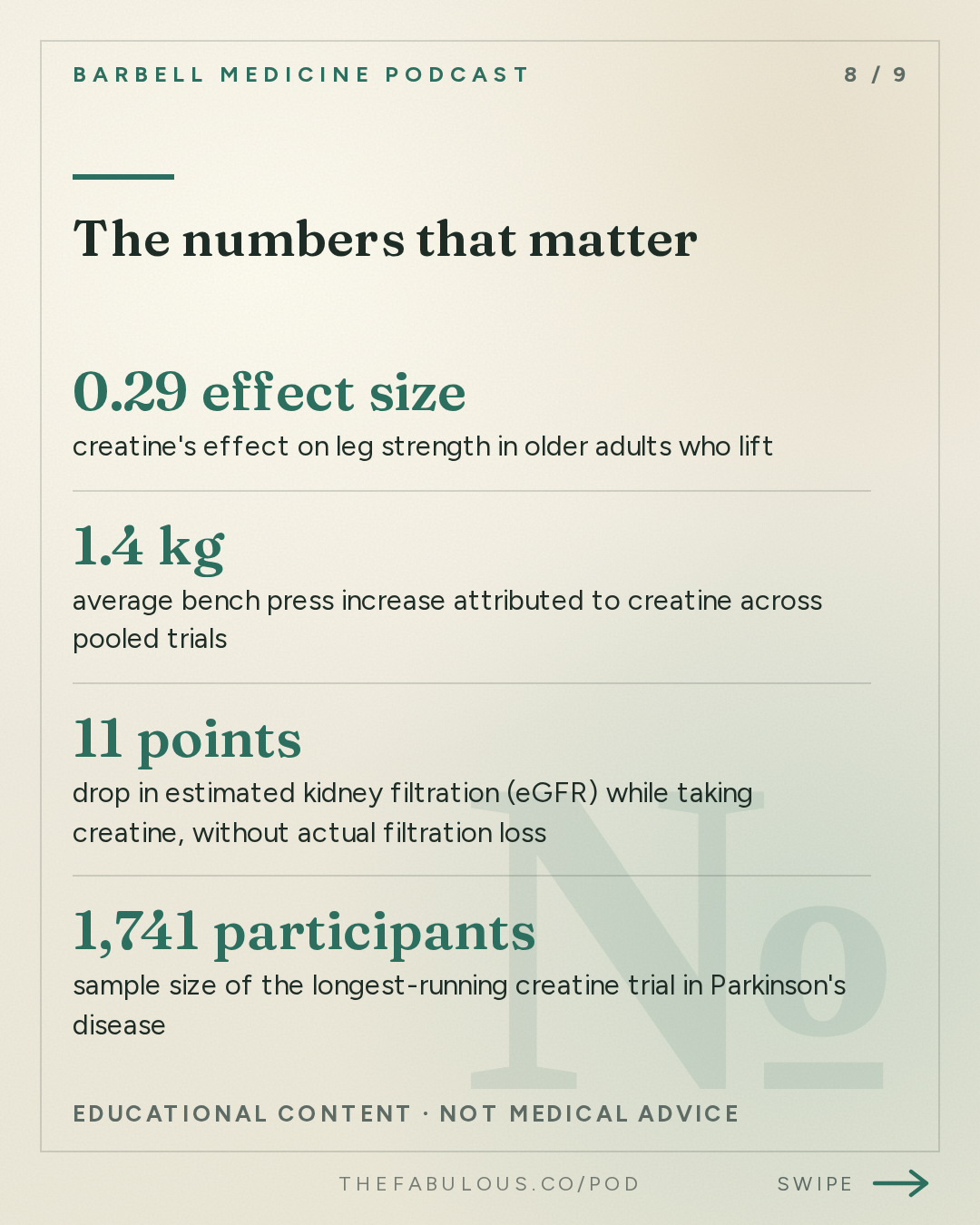
- 0.29 effect size creatine's effect on leg strength in older adults who lift
- 1.4 kg average bench press increase attributed to creatine across pooled trials
- 11 points drop in estimated kidney filtration (eGFR) while taking creatine, without actual filtration loss
- 1,741 participants sample size of the longest-running creatine trial in Parkinson's disease
- 0.06 effect size creatine's effect on depression scores in the best-run, most rigorous studies
In their words
“Lifting itself, though, gets you 70 to 87%, a much larger effect.”
“DEXA counts water as lean mass, and creatine pulls water into the muscle.”
“The brain makes most of its own creatine, and it takes up very little from the blood.”
“If I'm, if I would have a hard time identifying in which world you were taking creatine, then it's a little bit of a tougher case for me.”
Protocols
-
Daily creatine maintenance dose
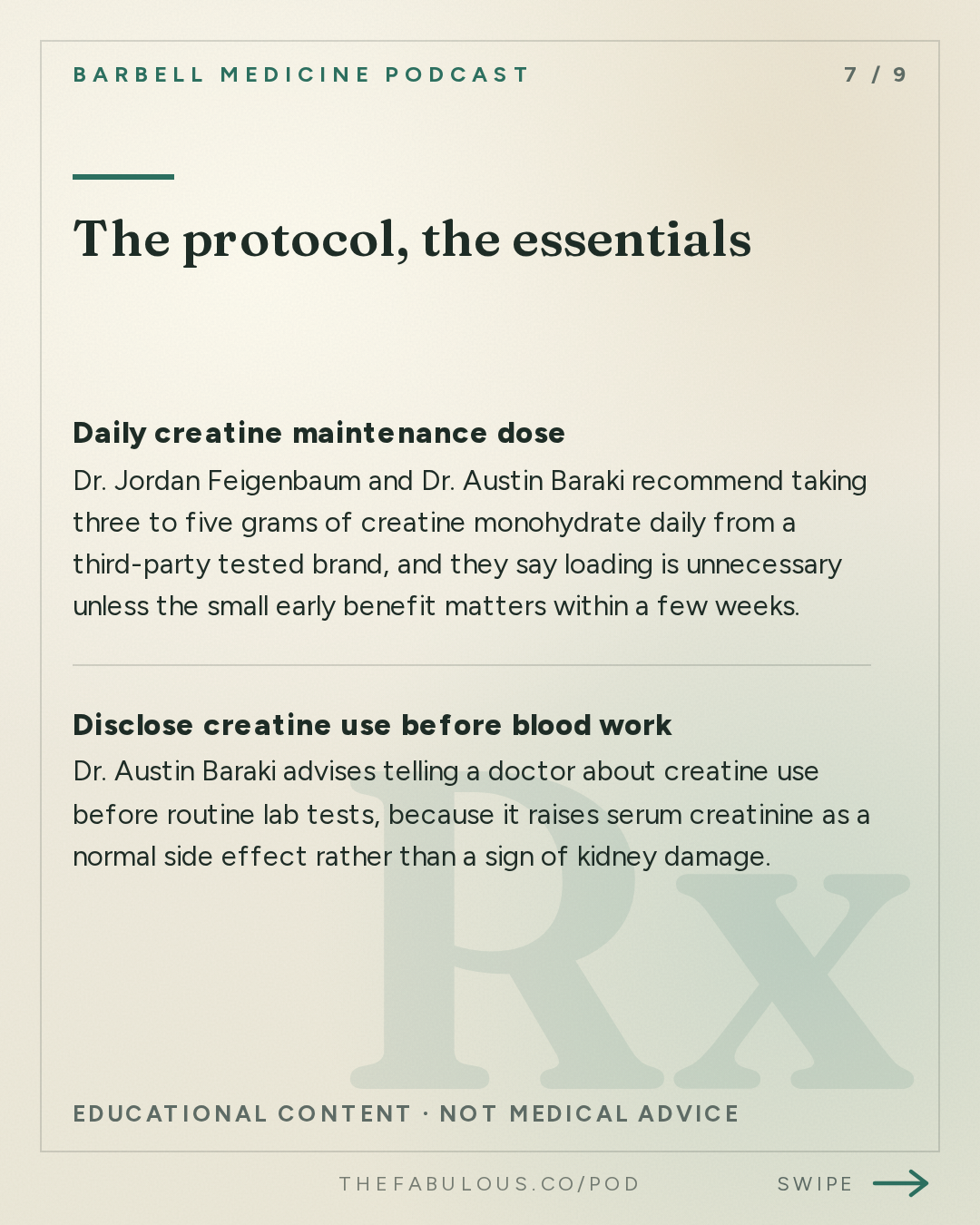
Dr. Jordan Feigenbaum and Dr. Austin Baraki recommend taking three to five grams of creatine monohydrate daily from a third-party tested brand, and they say loading is unnecessary unless the small early benefit matters within a few weeks.
Daily
-
Disclose creatine use before blood work
Dr. Austin Baraki advises telling a doctor about creatine use before routine lab tests, because it raises serum creatinine as a normal side effect rather than a sign of kidney damage.
Before each lab draw
-
Buy third-party tested creatine only
Dr. Austin Baraki recommends buying creatine only from manufacturers that use good manufacturing practices and third-party testing, because contamination, not creatine itself, is the main safety risk.
Every purchase
Questions this episode answers
Does creatine actually build muscle?
Measured directly by ultrasound or MRI, creatine's effect on muscle size has an effect size of 0.11, barely above a coin flip, compared with up to 0.66 for lifting alone (22:52). Much of the extra weight seen on DEXA scans is water drawn into muscle cells, not new tissue, since DEXA counts water as lean mass (23:16).
Does creatine damage the kidneys?
Creatine raises serum creatinine, a waste product muscles produce, which can make the kidney-function estimate called eGFR look worse on blood tests even though direct measures of kidney filtration do not change (26:47). Investigators in a large Parkinson's disease trial of 1,741 patients called the creatinine rise an artifact of treatment rather than kidney disease (26:19).
Does creatine improve memory or cognitive function?
In healthy, rested adults the effect size is close to zero, meaning creatine performs about the same as a placebo on cognitive tests (37:18). Under heavy stress such as sleep deprivation, the effect size rises to about 0.3, a small benefit, but the supporting trials are small and mostly used one-time loading doses rather than the five grams a day most people take (38:16).
Is California's new supplement law based on evidence specific to creatine?
The California law, effective January 1, bars stores from selling muscle-building or weight-loss supplements to anyone under 18 and requires age verification online, with a $500 penalty per violation on sellers (01:11). Podcast host Dr. Jordan Feigenbaum notes the legislature's cited evidence concerned protein powder and an association with later steroid use, not creatine-specific harm in teenagers (55:50).
How much creatine should a lifter take?
Dr. Jordan Feigenbaum and Dr. Austin Baraki of the Barbell Medicine podcast recommend three to five grams of creatine monohydrate daily from a third-party tested brand, skipping the loading phase unless the small early benefit is needed within a few weeks (65:40).
Does creatine help with depression?
Across eleven trials the pooled effect size is 0.34, but in the most rigorously controlled studies it drops to 0.06, which reviewers described as possibly trivial or null (43:24). Regular exercise of any kind has an effect size of about 0.6 on depression, far higher than creatine's best numbers (43:24).
The full read, in cards
Go deeper
- 1992 creatine loading study — showed about 20 grams a day for roughly a week tops off muscle creatine stores
- Longest Parkinson's disease creatine trial — 1,741 patients followed at least five years on 10 grams a day, stopped early for lack of benefit
- Huntington's disease creatine trial — 553 patients on up to 40 grams a day, stopped early; creatine group declined slightly faster
- Two-year post-menopausal bone trial — 200 women on creatine alone showed no change in bone mineral density
- Escitalopram plus creatine trial — 52 women on an SSRI; same response rate by week eight with or without creatine
Mentioned
Dr. Jordan Feigenbaum · Dr. Austin Baraki · Rhonda Patrick · DEXA · Cystatin C · Bergstrom needle biopsy · Michel Chevreul · Council for Responsible Nutrition
More from this show and category

Is Collagen Protein a Scam? What the Evidence Shows
Collagen counts as protein but scores zero on the standard protein quality test because it lacks the essential amino acid tryptophan entirely. Claims that it beats whey for muscle, tendons, joints, skin, or nails rely on flawed trials, mismatched placebos, and a statistical mix-up between standard error and standard deviation.
Is Huberman's Protocols Book Scientifically Accurate?
Barbell Medicine doctors Jordan Feigenbaum and Austin Baraki fact-check Andrew Huberman's book Protocols and find its own citations often contradict its advice. The 540-page book claims a once-weekly, low-volume lifting plan, cold plunges, cortisol hacks and nicotine pouches all work every time, but the hosts count zero protocols that hold up and at least eight financial conflicts of interest.
Athlete's Heart vs Hypertrophic Cardiomyopathy
A 22-year-old soccer player's thickened heart wall, 16mm versus a normal top of 11-12mm, led doctors to diagnose hypertrophic cardiomyopathy (13:29). Four months off training shrank the wall to 10mm but doctors kept the diagnosis (24:22). New 2025 AHA/ACC guidance says HCM alone should not bar competitive sport, favoring shared decision-making instead (47:42).
Biohacking Protocols: What the Evidence Shows
Barbell Medicine's Halloween episode uses a dystopian 2049 fiction, a man named Dale Mercer living under a machine called Soma, to grade today's real biohacking trends against clinical trial data. Morning light panels, cold plunges, NAD supplements, gray market peptides, HRV scores, and CGMs mostly fail to beat placebo in healthy people, while creatine, adequate protein, and consistent sleep hold up.
