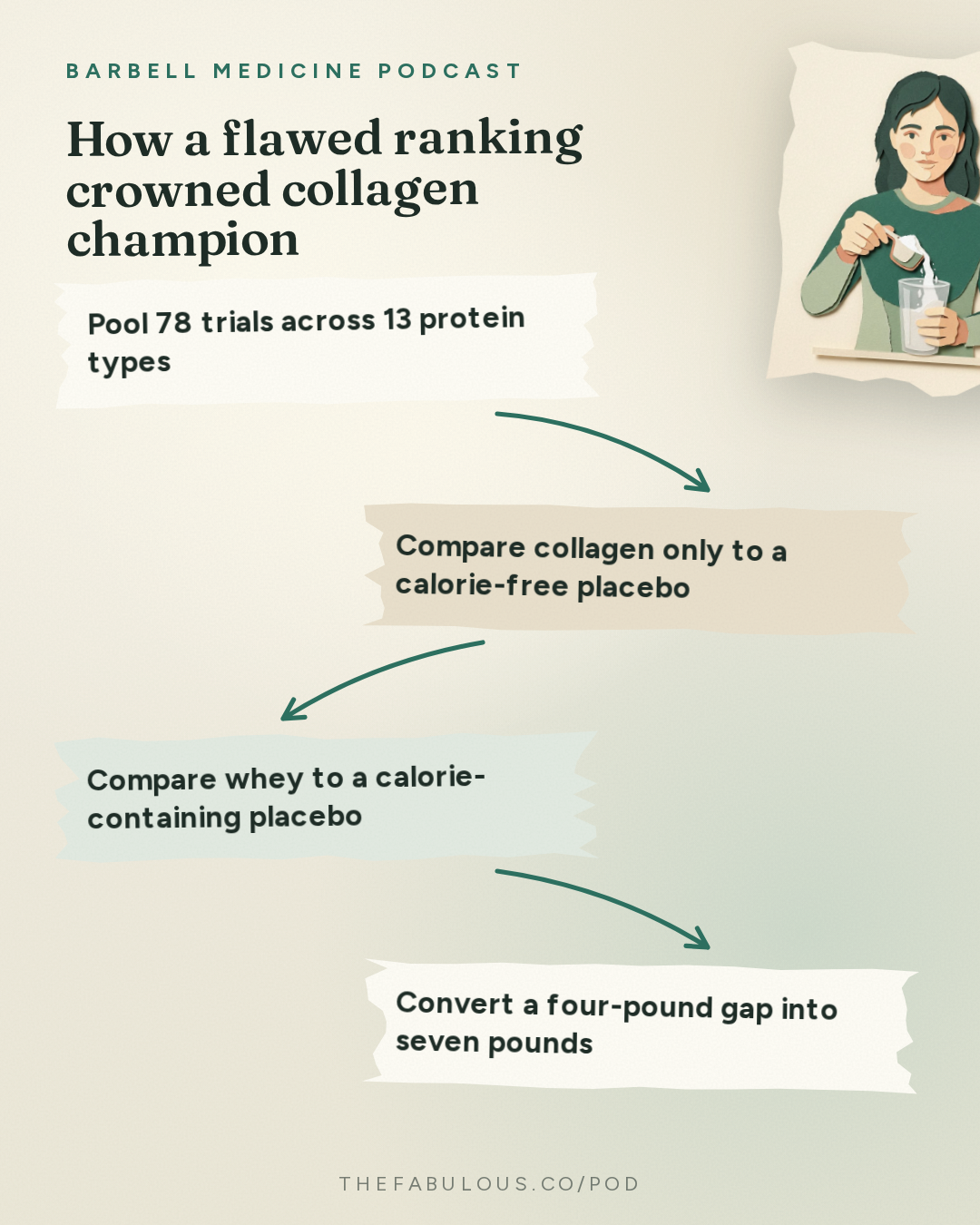
Is Collagen Protein a Scam? What the Evidence Shows
The Collagen Protein Update: Muscle, Skin, Tendons, Pain, and Nails
The brief
Collagen counts as protein but scores zero on the standard protein quality test because it lacks the essential amino acid tryptophan entirely. Claims that it beats whey for muscle, tendons, joints, skin, or nails rely on flawed trials, mismatched placebos, and a statistical mix-up between standard error and standard deviation.
Earlier this year a team of researchers ranked thirteen protein supplements by how much muscle and strength each one added on top of weightlifting. Collagen, the structural protein found in skin and tendons, came out first, beating whey protein on both counts (00:01). That is a strange result. Whey is cheap, complete, and the most studied sports supplement there is. Collagen is missing one essential amino acid outright. On the Barbell Medicine Podcast, physician Jordan Feigenbaum goes back through the papers behind that ranking and several others published this year, and finds that the collagen advantage keeps dissolving under a closer read.
Start with what collagen actually is. It makes up about a quarter of the protein in the human body, mostly in tendons, ligaments, bone, cartilage, and skin, and the supplement version is usually hydrolyzed, meaning broken into small pieces with water (02:35). Protein quality gets graded on a zero to one scale called PDCAAS, set by whichever essential amino acid, meaning one the body cannot make on its own, a protein runs shortest on. Whey scores a perfect one. Collagen scores zero, because it contains no tryptophan at all (03:00). It is also low in leucine, the amino acid most responsible for switching on muscle protein synthesis, the rate at which the body builds new muscle protein. None of this makes collagen useless. One modeling study found a typical American could swap up to 36 percent of daily protein for collagen before running short on any essential amino acid (03:52), though two of that paper's three authors work for a collagen manufacturer and a trade funded research institute.
The direct test of muscle building uses a biopsy: label an amino acid, then track how fast it shows up in new muscle tissue. A McMaster University trial gave women in their late sixties thirty grams of whey or collagen twice a day for six days, training one leg and resting the other (04:39). Whey raised muscle protein synthesis in both legs. Collagen raised it only slightly, and only in the trained leg, never above where the women started (05:30). A separate ten week trial in untrained young adults, with whey and collagen matched for leucine, found whey built more muscle in both the thigh and the upper arm, while strength gains were about the same (06:55).
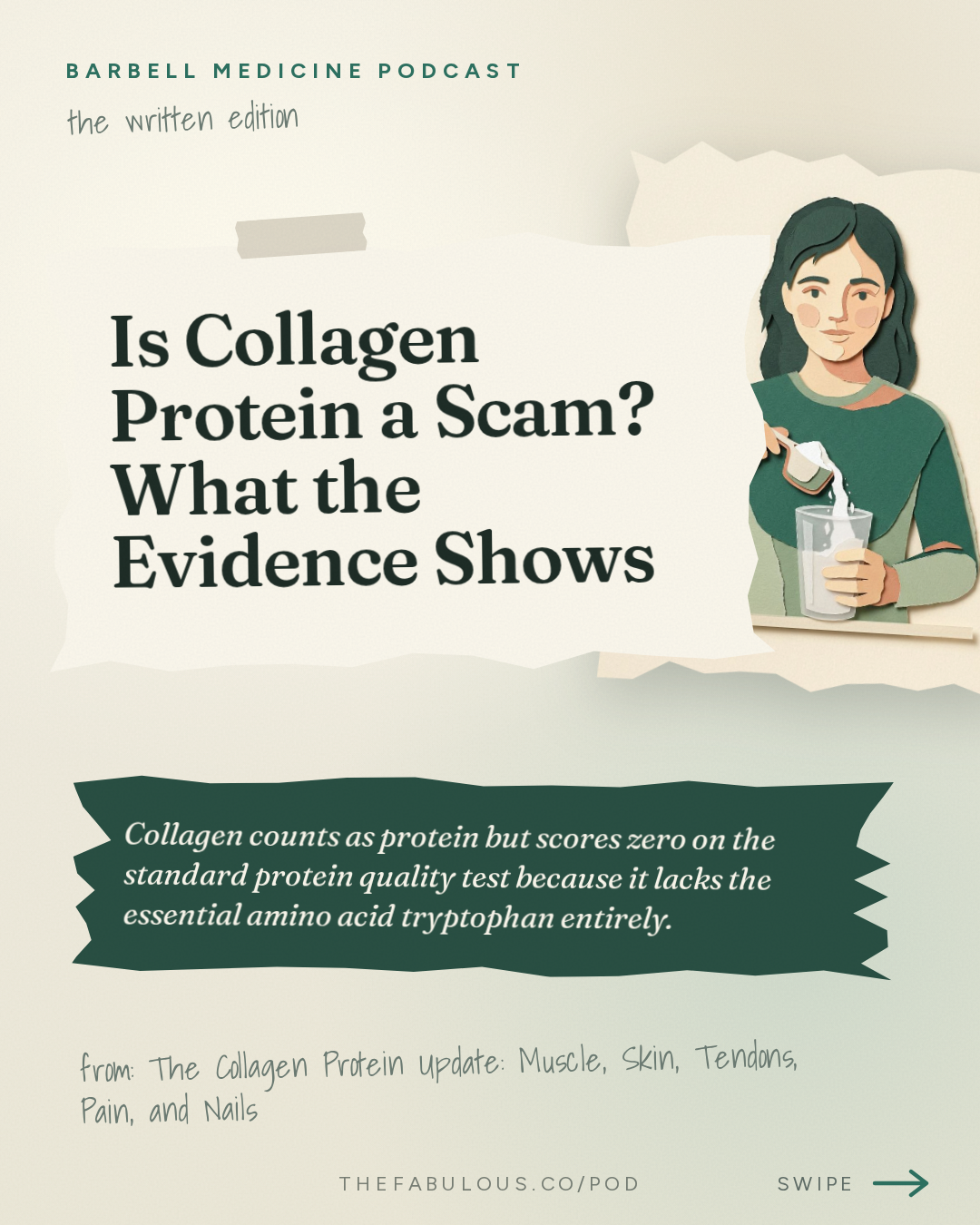
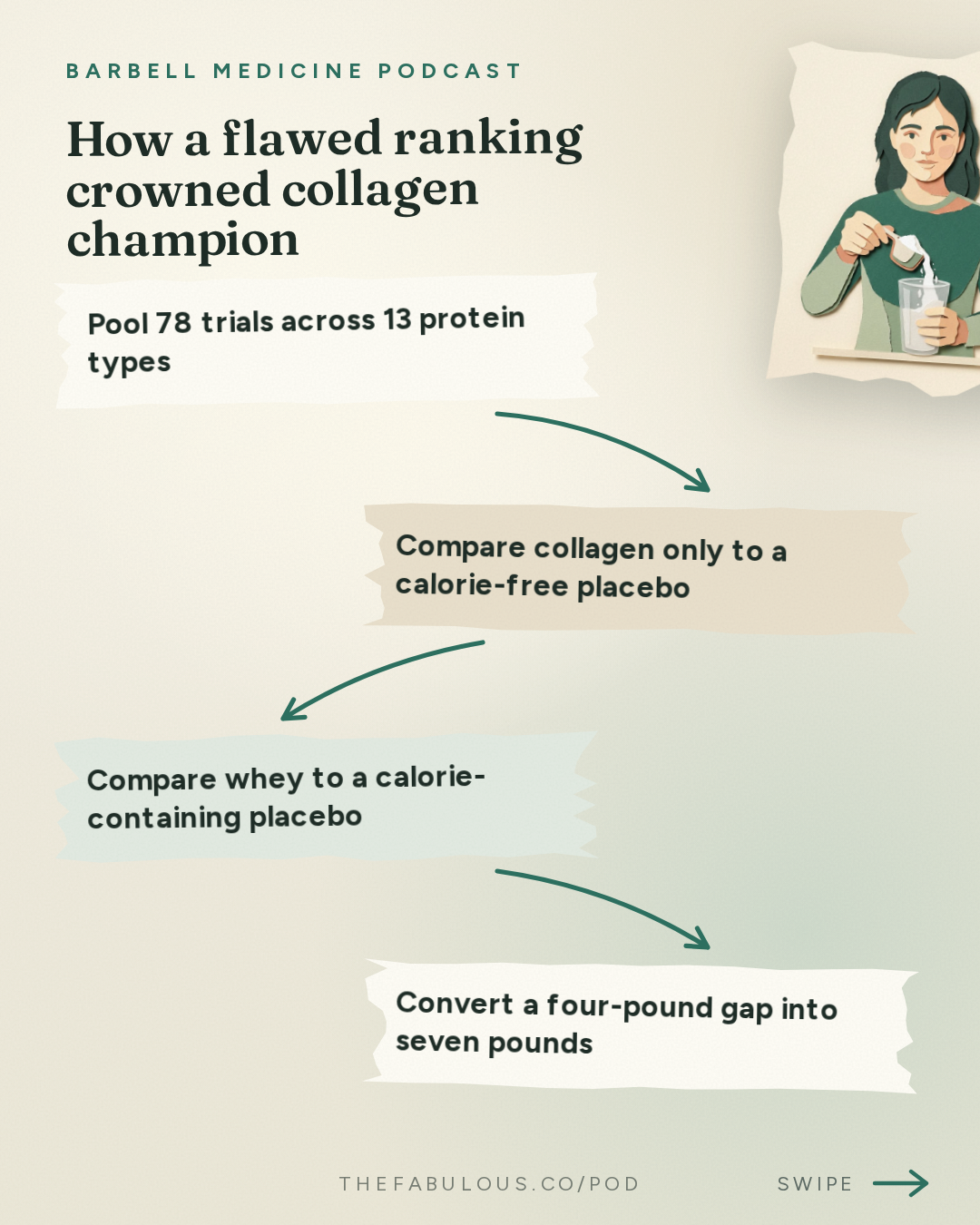
So how did collagen end up beating whey in the new ranking? The paper is a network meta-analysis, a method that lets researchers compare treatments that were never tested head to head by linking each one through a shared placebo. Feigenbaum's objection is about what counted as that shared opponent.
Ranking proteins this way is like ranking two fighters who never fought each other by how each one did against the same opponent. Jordan Feigenbaum, [09:01]
Of 78 pooled trials, only one gave both whey and collagen to the same people, and it measured recovery, not muscle growth, finding no difference between them. For the muscle mass claim, the collagen trials were compared against a placebo of silicon dioxide, a powder with no calories and no protein. Most of the whey trials, meanwhile, were compared against maltodextrin, a carbohydrate powder that supplies calories and can itself add muscle (09:26, 09:54). Protein had to beat extra calories in one case and beat essentially nothing in the other.
The arithmetic compounds the problem. The ranking credited collagen with a seven pound fat free mass advantage over placebo, compared with just over a pound for whey (10:20). But the two actual German trials behind that number found gains of three and four pounds, and the paper's own discussion section says about four pounds. The seven pound figure appeared only after researchers multiplied collagen's effect size, a unit-less measure of how large a gap is relative to how much people normally differ from one another, by a spread value borrowed from unnamed outside studies instead of the smaller spread measured in the actual trials (12:18).
So this ranking has 15 grams of supplemental collagen protein doing about 10 times what protein supplements usually do. I don't find that believable. Jordan Feigenbaum, [13:09]
And the two trials that built that effect size appear to be the same twenty five men, counted twice under two different papers from the same lab (13:32).
Connective tissue tells a similarly deflating story. A fifteen week training study had thirty nine young men take collagen or placebo daily and measured patellar tendon stiffness directly. Both groups got about 20 percent stiffer tendons; collagen added nothing beyond what training already produced (18:27). For joint pain, trials use a hundred millimeter line where patients mark how much something hurts. Research on people in acute pain found that a change a patient can actually notice runs around 12 to 13 millimeters (20:25). Most collagen trials for osteoarthritis land around a ten point drop, below that threshold, and the pooled effect across roughly 2,700 people reaches statistical significance without reaching a size anyone would feel (21:07).
Clinical significance asks whether the difference is big enough for a person to notice or care about. Jordan Feigenbaum, [22:19]
The Skin Audit
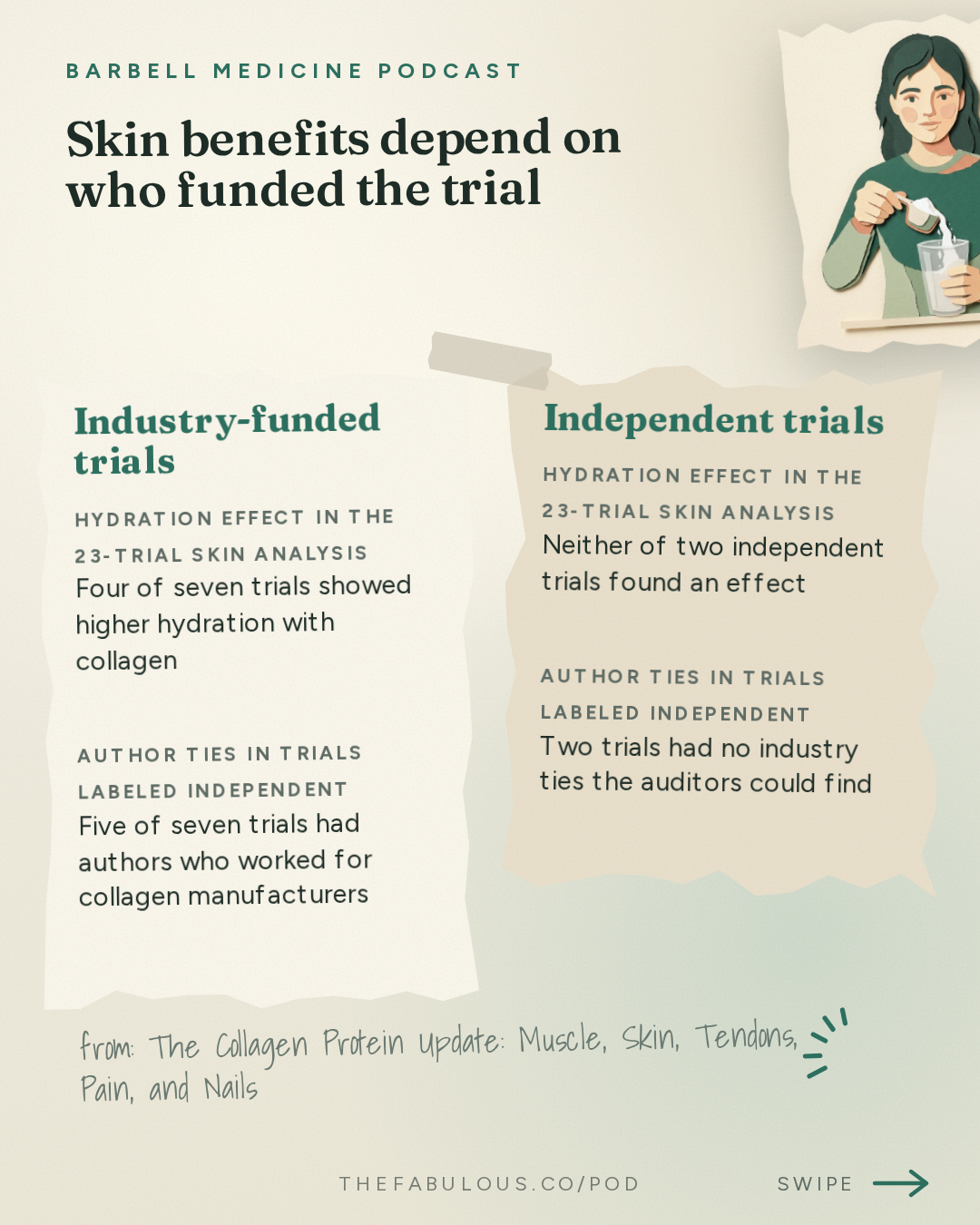
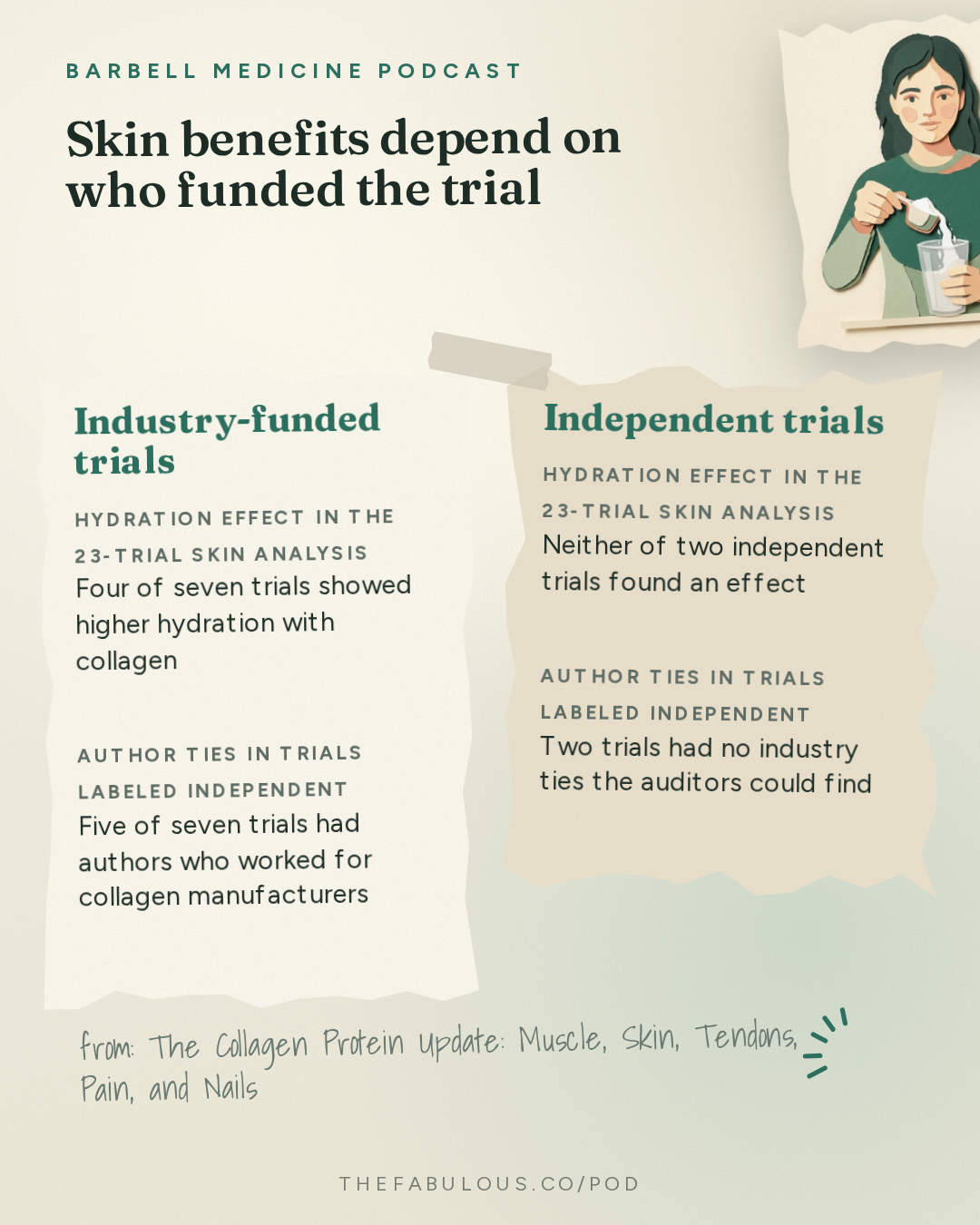
Skin claims rest on devices, not mirrors. A corneometer measures hydration by reading the electrical properties of the skin's outer dead cell layer, about 15 thousandths of a millimeter deep, and its readings shift with room temperature and humidity (30:03). This year, researchers Grimes and Mato audited the two biggest collagen and skin meta-analyses and found a recurring error: a trial's standard error, which measures how precisely an average is pinned down, had been entered where standard deviation, which measures how spread out individual results were, belonged. Divide an effect by too small a number and it balloons; the mistake made collagen's benefit look several times larger than it actually was (32:35). A separate analysis by Myung and Park pooled 23 trials and found hydration, elasticity, and wrinkle benefits, until the data was split by funding. Four of seven industry funded hydration trials showed an effect; neither of the two independent ones did (33:49). Strip out trials whose authors worked for collagen manufacturers and only two trials with no industry ties remain, and they disagree with each other (34:58). Even the strongest surviving result, a 65 percent jump in procollagen, the raw material the body assembles into collagen, after 2.5 grams a day of a Gelita peptide called Verisol, comes from a device measurement, not a photograph (31:07). No trial has used the blinded before and after photo grading that regulators require to approve a wrinkle drug like Daxxify.
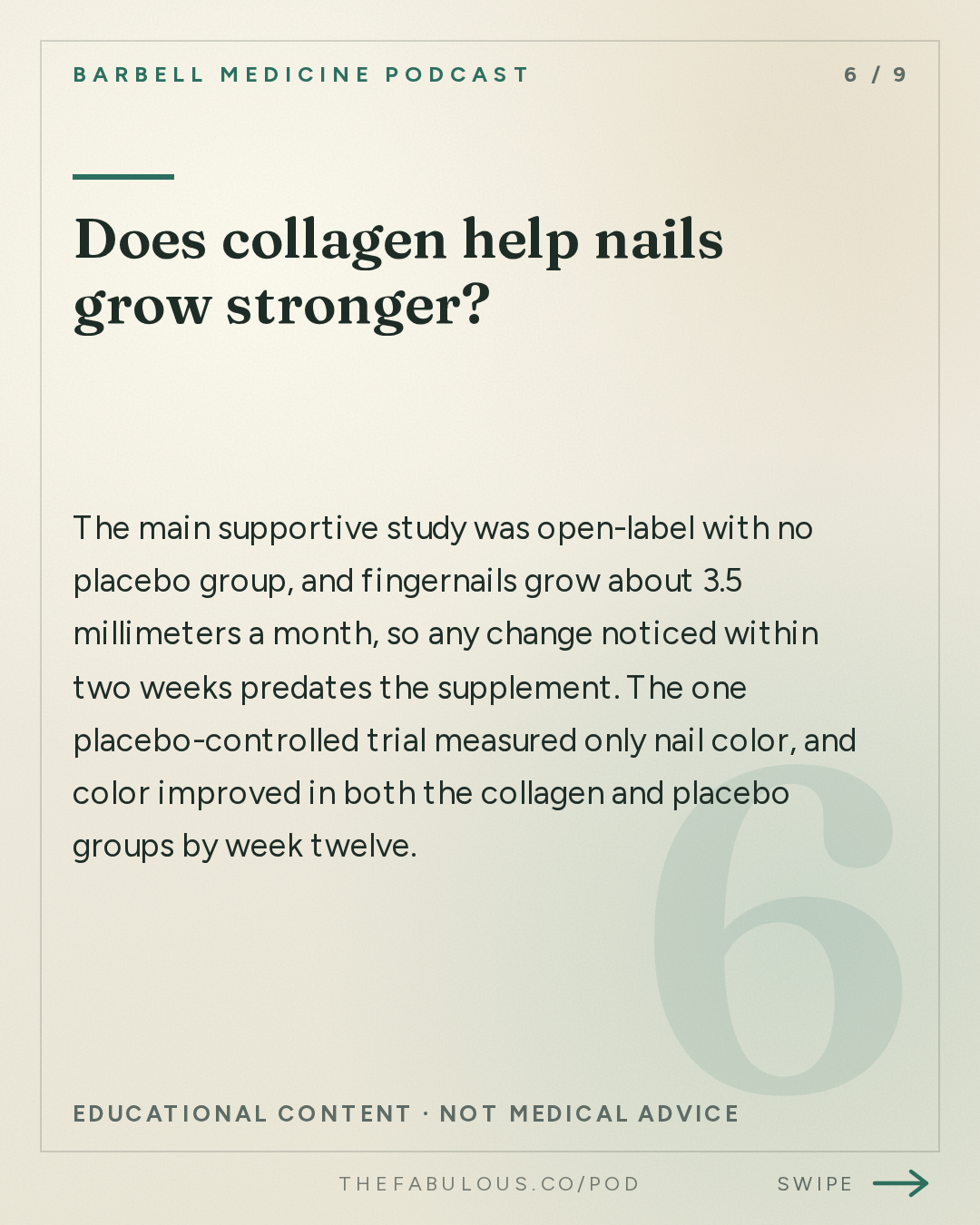
Nails fare no better. Nail hardness comes mostly from keratin and the sulfur containing amino acid cysteine, not collagen (37:57). Fingernails grow about 3.5 millimeters a month, so any change noticed within two weeks of starting a supplement grew before the supplement was taken (40:22). The main supportive trial was open label, meaning every participant knew they were taking collagen, with no placebo group at all. The one trial that did use a placebo measured only nail color, and color improved in both groups by week twelve (39:17). Feigenbaum adds a practical flag: about nine in ten people with an underactive thyroid have nail changes, worth ruling out with a doctor before reaching for a supplement (42:02).
Feigenbaum's verdict, after three years of revisiting the question, is not a flat no.
Where it turns into a scam is everything else on the label. Jordan Feigenbaum, [43:31]
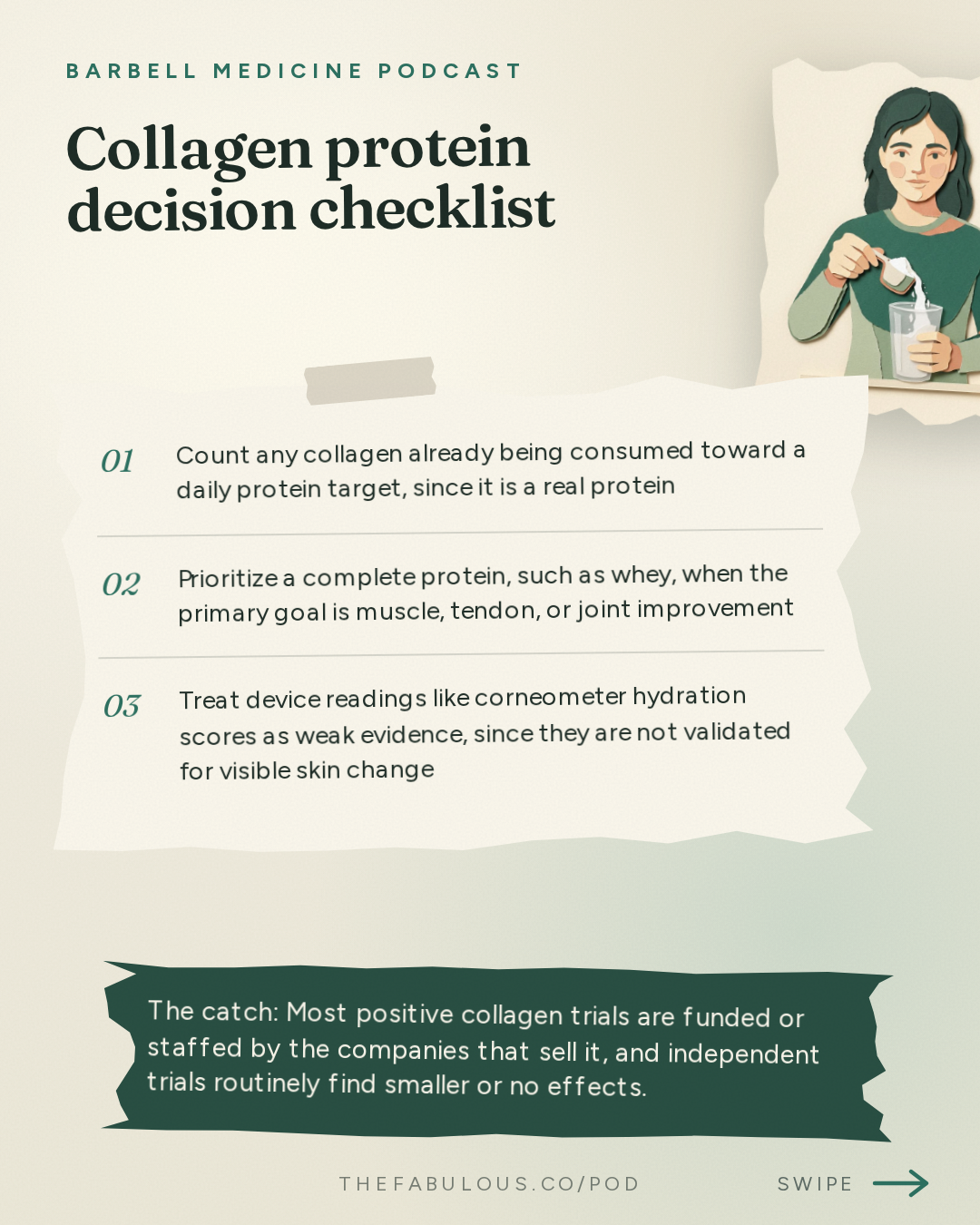
Collagen is a real protein and it counts toward a daily protein target. It is just an expensive and incomplete one, propped up by marketing claims that keep surviving one statistical error at a time. For anyone drinking it in coffee anyway, that is fine. For anyone buying it specifically for skin, joints, or nails, the better use of that money is a complete protein, aimed at an actual target, not a device reading.
Ask this episode anything
Pod's AI answers from the episode itself, with the minute mark so you can hear it yourself.
Or start with one of these
Ask this episode
Pod's AI listens to the whole episode to answer, and points you to the minute it comes from.
The rest of this answer, and any question after it
Answers come from the episode itself, never from a summary of it.
ContinueKey takeaways
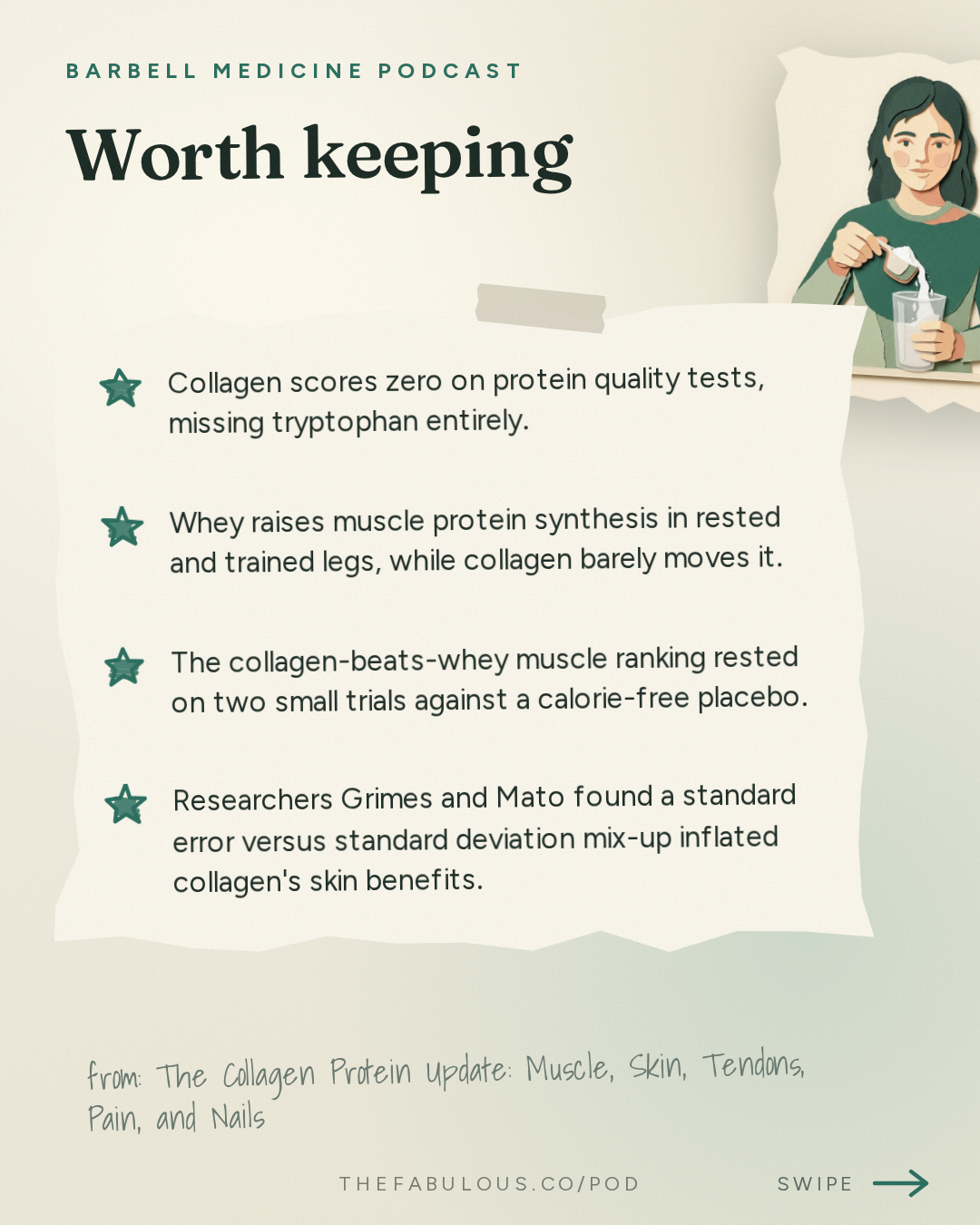
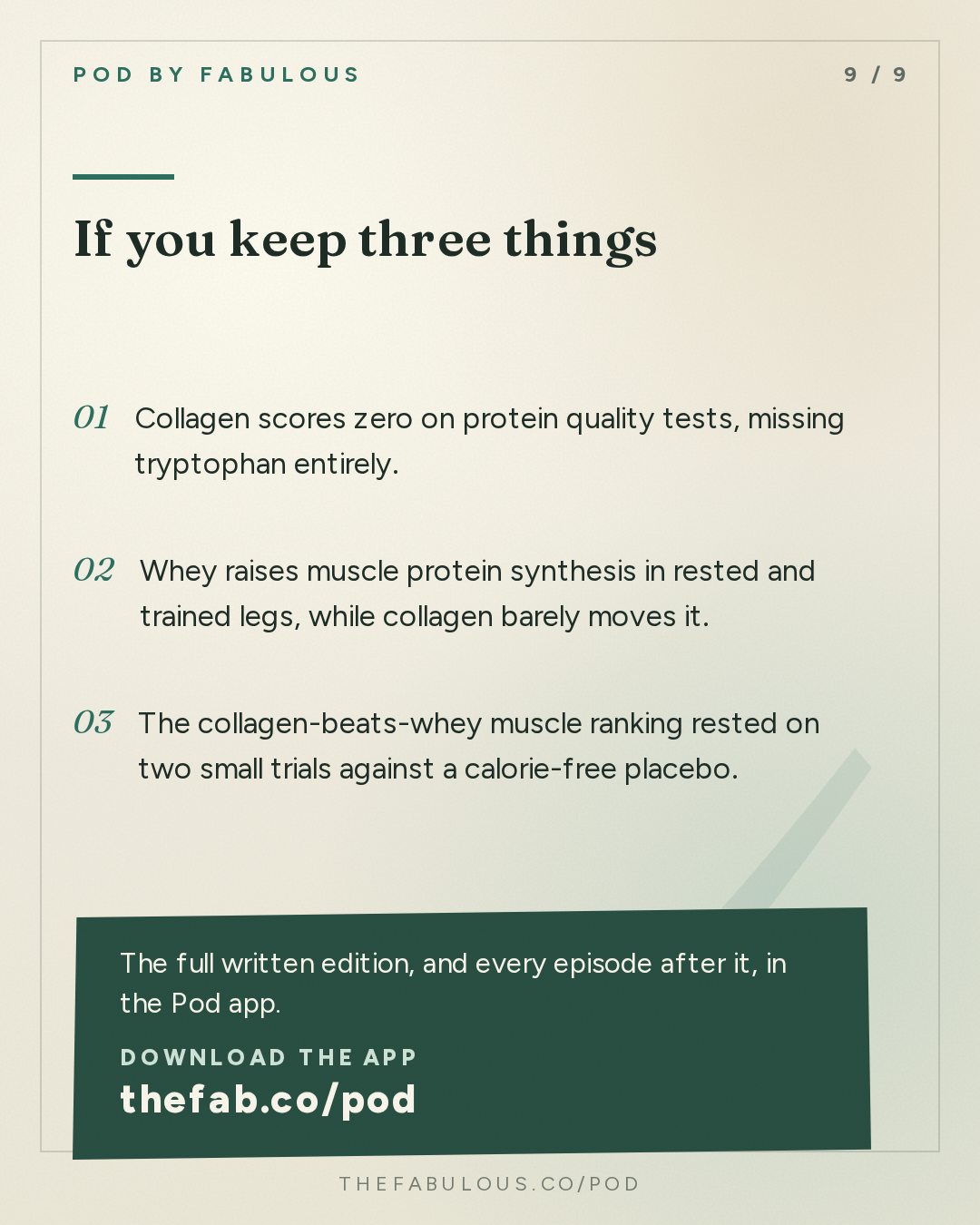
- Collagen scores zero on protein quality tests, missing tryptophan entirely.
- Whey raises muscle protein synthesis in rested and trained legs, while collagen barely moves it.
- The collagen-beats-whey muscle ranking rested on two small trials against a calorie-free placebo.
- Researchers Grimes and Mato found a standard error versus standard deviation mix-up inflated collagen's skin benefits.
- Nail and joint pain benefits from collagen fall below the threshold most people can actually notice.
The episode in cards


By the numbers
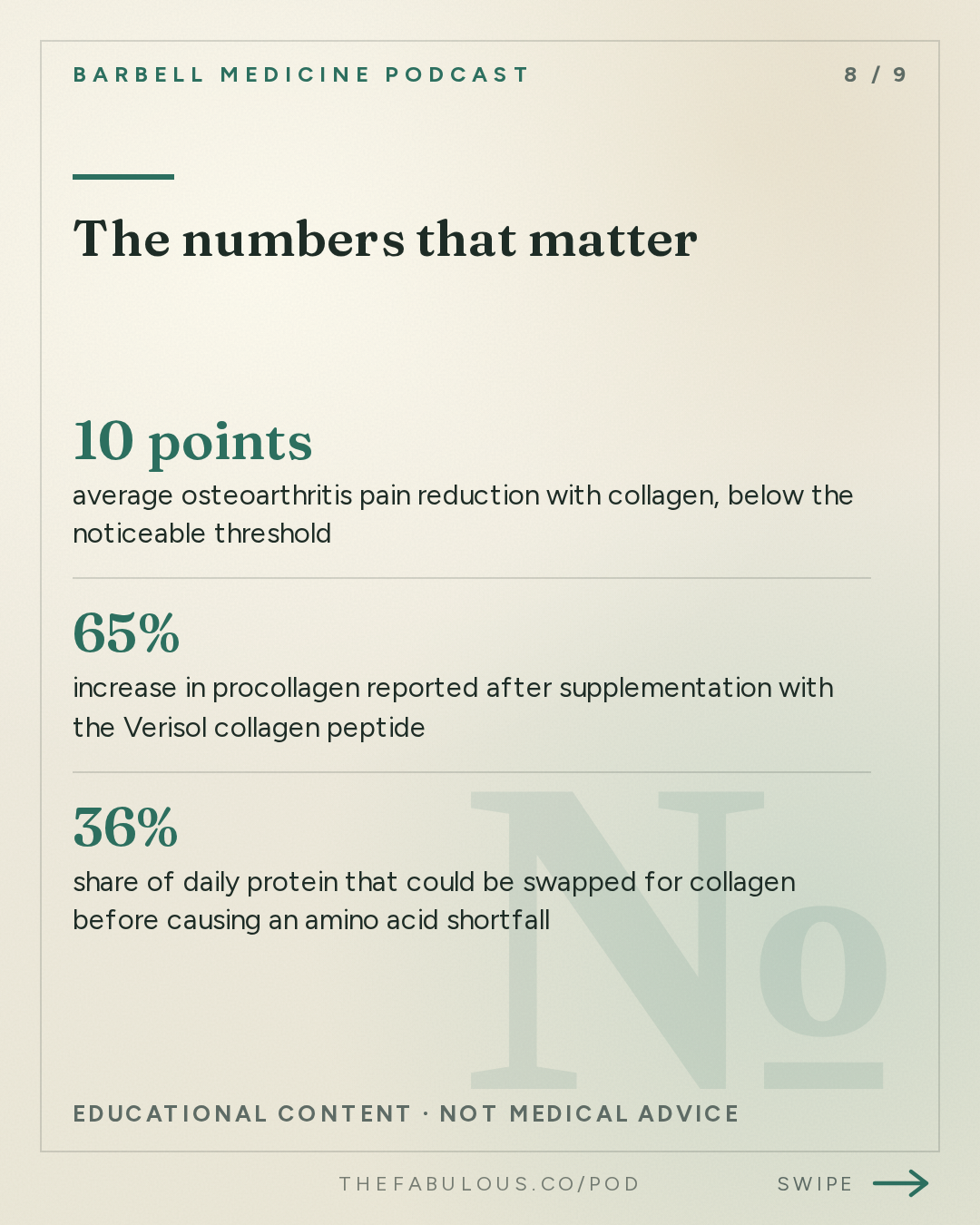
- 10 points average osteoarthritis pain reduction with collagen, below the noticeable threshold
- 65% increase in procollagen reported after supplementation with the Verisol collagen peptide
- 36% share of daily protein that could be swapped for collagen before causing an amino acid shortfall
In their words
“Ranking proteins this way is like ranking two fighters who never fought each other by how each one did against the same opponent.”
“This ranking has 15 grams of supplemental collagen protein doing about 10 times what protein supplements usually do. I don't find that believable.”
“Clinical significance asks whether the difference is big enough for a person to notice or care about.”
“Where it turns into a scam is everything else on the label.”
Protocols
-
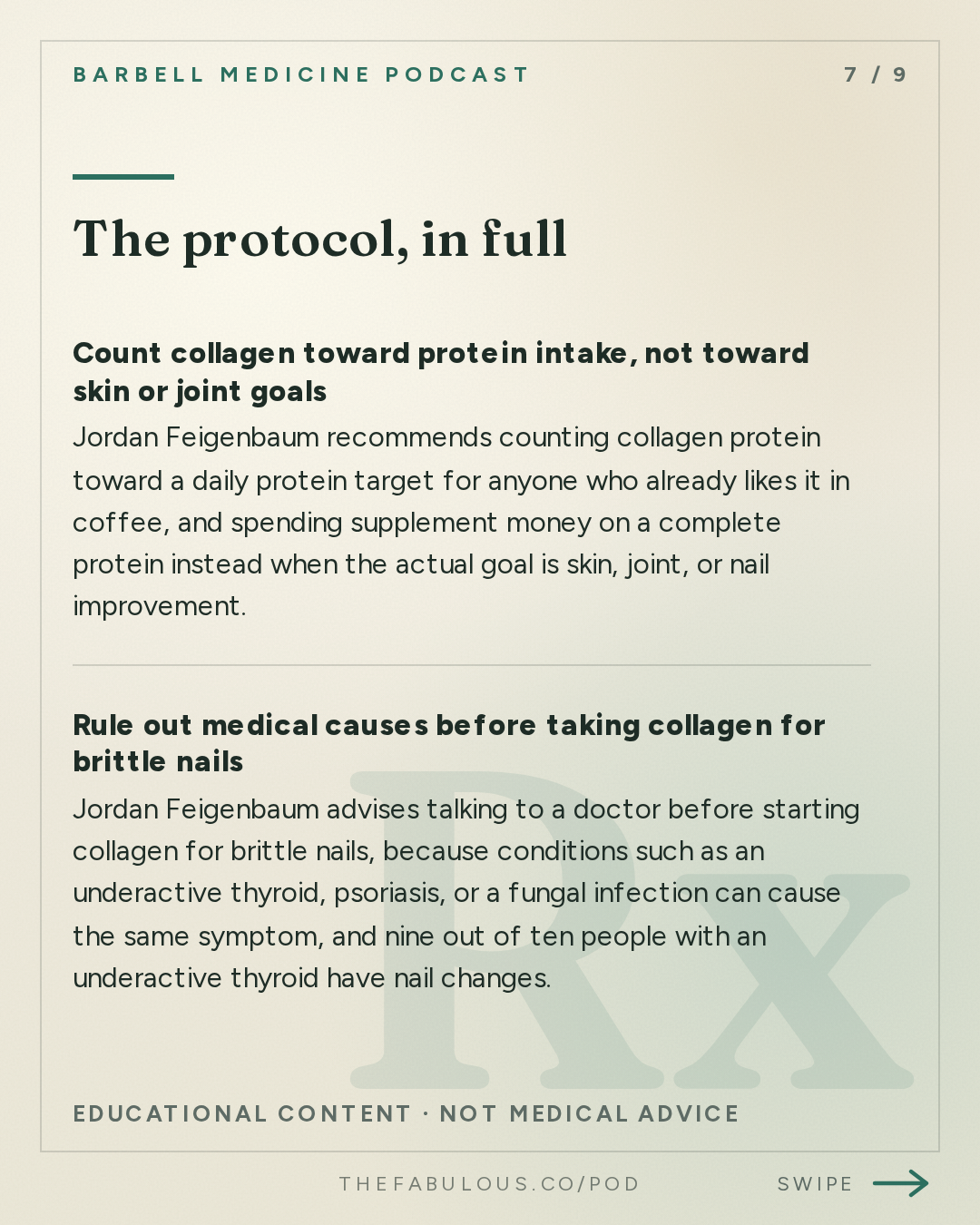
Count collagen toward protein intake, not toward skin or joint goals
Jordan Feigenbaum recommends counting collagen protein toward a daily protein target for anyone who already likes it in coffee, and spending supplement money on a complete protein instead when the actual goal is skin, joint, or nail improvement.
daily
-
Rule out medical causes before taking collagen for brittle nails
Jordan Feigenbaum advises talking to a doctor before starting collagen for brittle nails, because conditions such as an underactive thyroid, psoriasis, or a fungal infection can cause the same symptom, and nine out of ten people with an underactive thyroid have nail changes.
before starting supplementation
Questions this episode answers
Is collagen protein a scam?
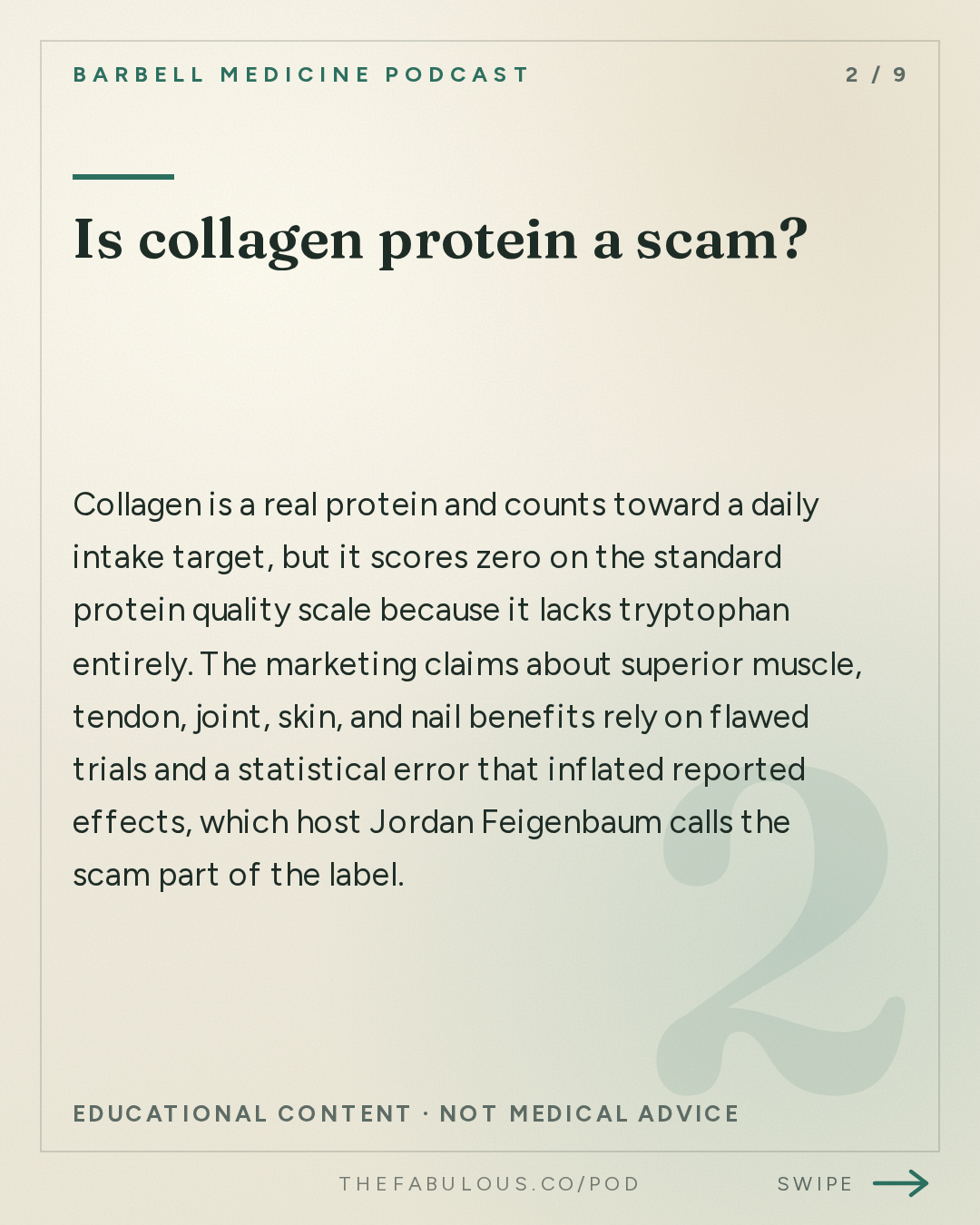
Collagen is a real protein and counts toward a daily intake target, but it scores zero on the standard protein quality scale because it lacks tryptophan entirely (03:00). The marketing claims about superior muscle, tendon, joint, skin, and nail benefits rely on flawed trials and a statistical error that inflated reported effects, which host Jordan Feigenbaum calls the scam part of the label (43:31).
Does collagen build muscle better than whey protein?
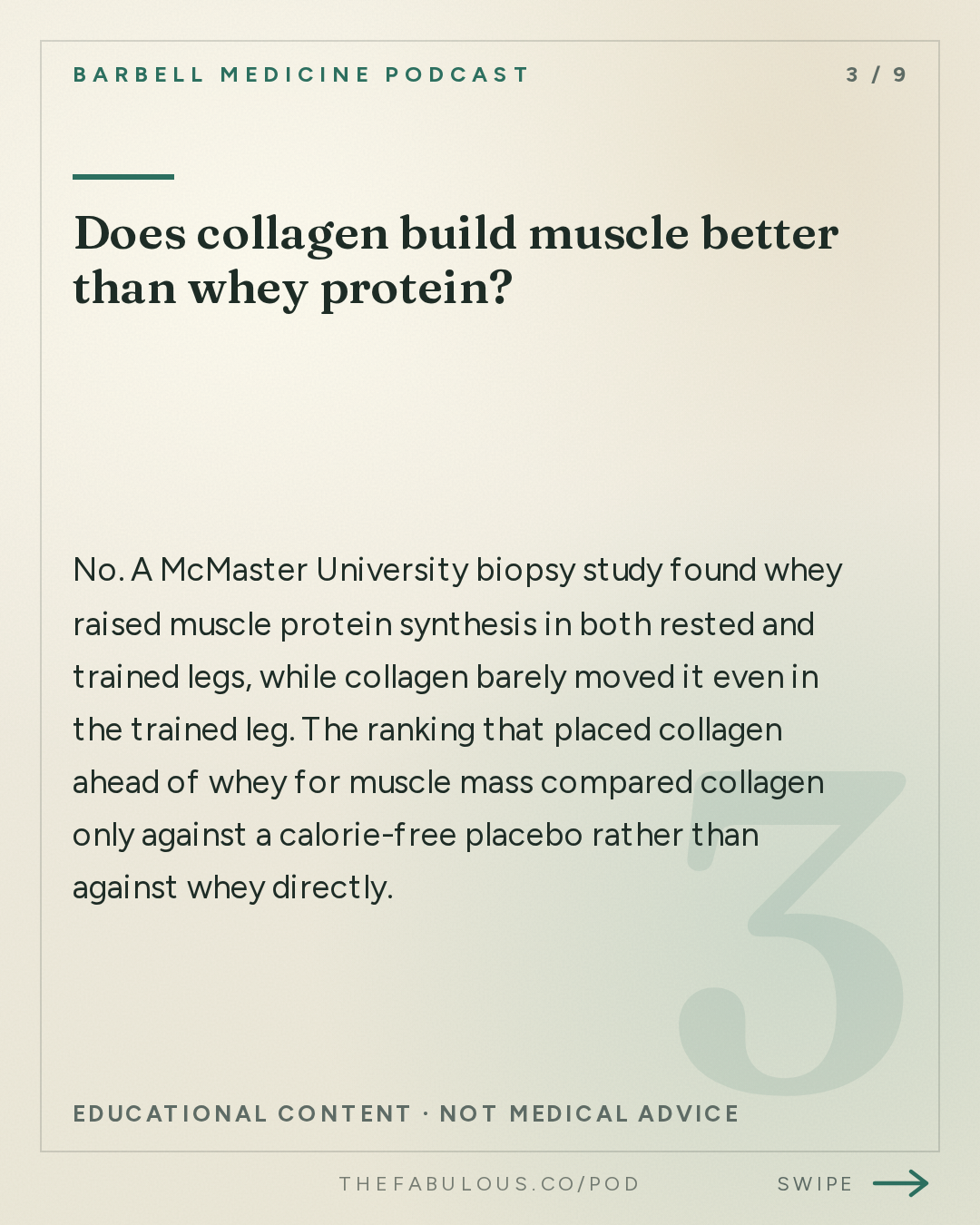
No. A McMaster University biopsy study found whey raised muscle protein synthesis in both rested and trained legs, while collagen barely moved it even in the trained leg (05:30). The ranking that placed collagen ahead of whey for muscle mass compared collagen only against a calorie-free placebo rather than against whey directly (09:26).
Does collagen help joint pain or osteoarthritis?
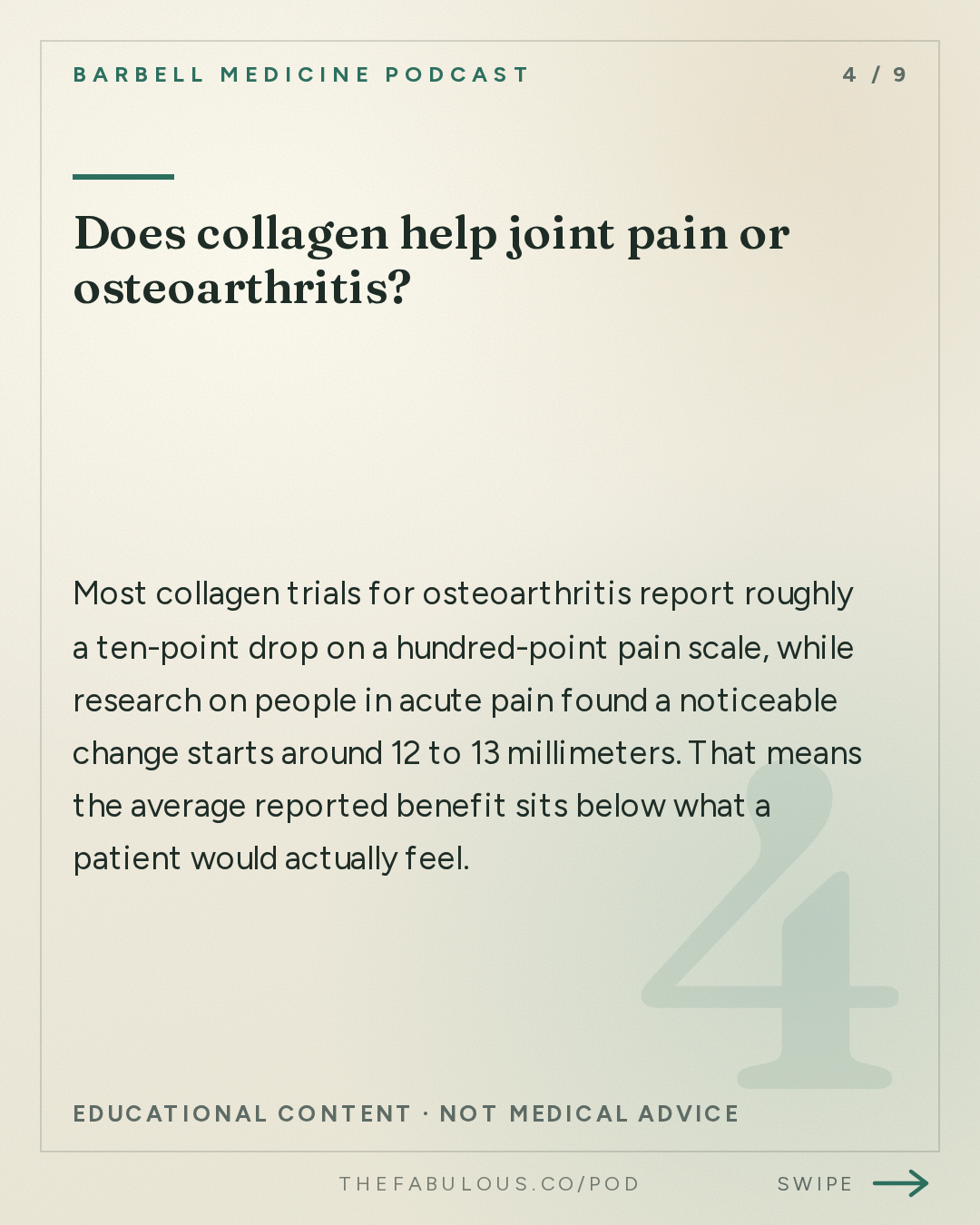
Most collagen trials for osteoarthritis report roughly a ten-point drop on a hundred-point pain scale, while research on people in acute pain found a noticeable change starts around 12 to 13 millimeters (20:25, 21:07). That means the average reported benefit sits below what a patient would actually feel.
Does collagen improve skin hydration or wrinkles?
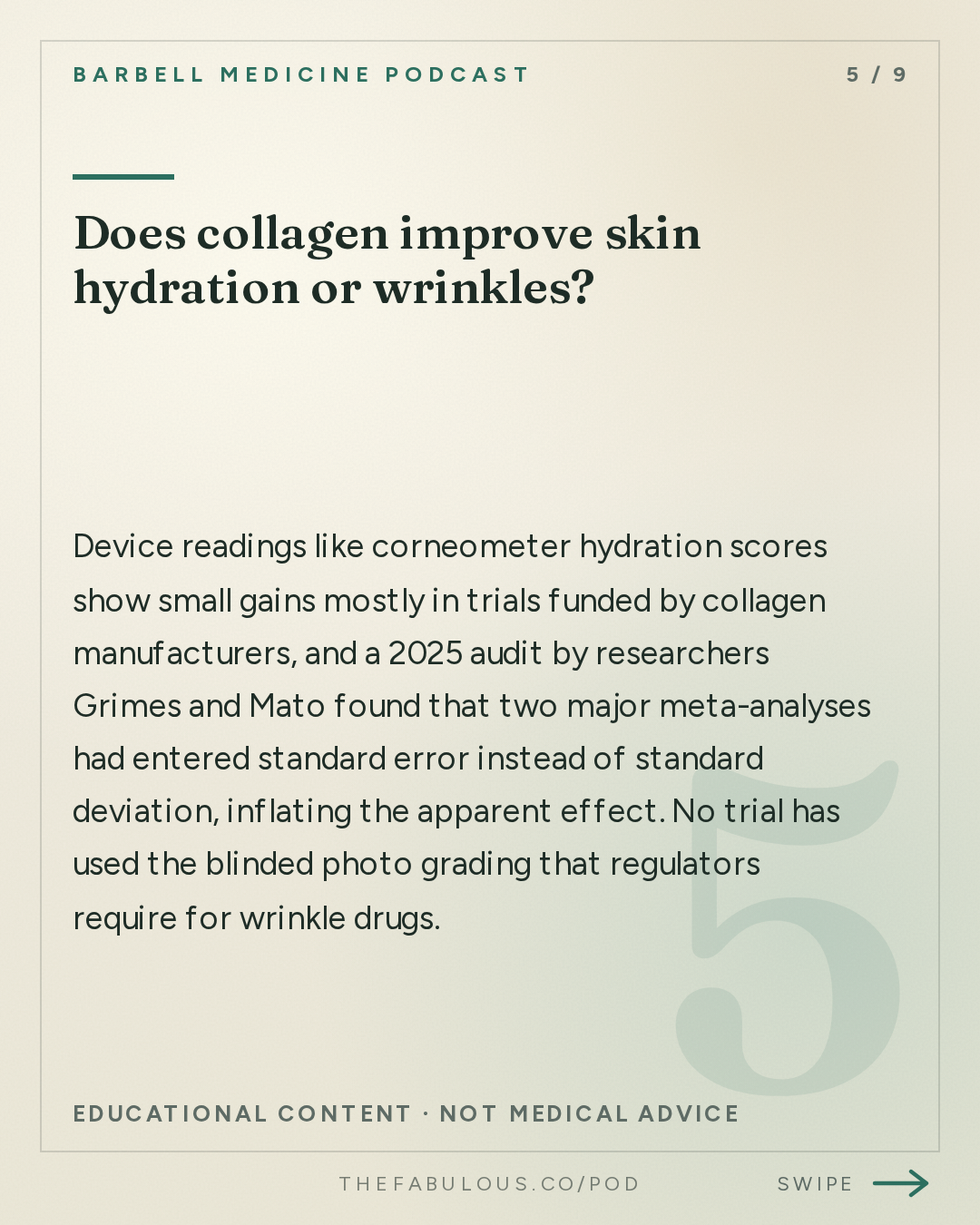
Device readings like corneometer hydration scores show small gains mostly in trials funded by collagen manufacturers, and a 2025 audit by researchers Grimes and Mato found that two major meta-analyses had entered standard error instead of standard deviation, inflating the apparent effect (32:35). No trial has used the blinded photo grading that regulators require for wrinkle drugs (31:47).
Does collagen help nails grow stronger?
The main supportive study was open-label with no placebo group, and fingernails grow about 3.5 millimeters a month, so any change noticed within two weeks predates the supplement (40:22). The one placebo-controlled trial measured only nail color, and color improved in both the collagen and placebo groups by week twelve (39:17).
What is the difference between standard error and standard deviation in these studies?
Standard deviation measures how spread out individual participants' results were, while standard error measures how precisely the average itself was estimated and is usually a much smaller number (33:01). Researchers Grimes and Mato found that trials mistakenly used the smaller standard error figure in effect-size calculations, making collagen's benefit look several times larger than it actually was (32:35).
The full read, in cards

Go deeper
- McMaster University muscle protein synthesis trial — Found whey raised muscle protein synthesis in rested and trained legs while collagen barely moved it
- Drummond et al. network meta-analysis of 78 protein trials — Ranked collagen above whey for fat-free mass using a calorie-free placebo comparison
- 113-trial umbrella review of collagen research — Rated 15 of 16 underlying meta-analyses as low or critically low quality
- Grimes and Mato statistical audit of collagen-skin meta-analyses — Found standard error entered as standard deviation, inflating reported skin benefits
- Myung and Park 23-trial skin analysis — Found no clinical evidence of skin benefit once industry-funded trials were removed
Mentioned
Jordan Feigenbaum · Gelita · Collagen Research Institute · McMaster University · Drummond · Verisol · Daxxify · Grimes · Mato
More from this show and category
Is Huberman's Protocols Book Scientifically Accurate?
Barbell Medicine doctors Jordan Feigenbaum and Austin Baraki fact-check Andrew Huberman's book Protocols and find its own citations often contradict its advice. The 540-page book claims a once-weekly, low-volume lifting plan, cold plunges, cortisol hacks and nicotine pouches all work every time, but the hosts count zero protocols that hold up and at least eight financial conflicts of interest.
Athlete's Heart vs Hypertrophic Cardiomyopathy
A 22-year-old soccer player's thickened heart wall, 16mm versus a normal top of 11-12mm, led doctors to diagnose hypertrophic cardiomyopathy (13:29). Four months off training shrank the wall to 10mm but doctors kept the diagnosis (24:22). New 2025 AHA/ACC guidance says HCM alone should not bar competitive sport, favoring shared decision-making instead (47:42).
Biohacking Protocols: What the Evidence Shows
Barbell Medicine's Halloween episode uses a dystopian 2049 fiction, a man named Dale Mercer living under a machine called Soma, to grade today's real biohacking trends against clinical trial data. Morning light panels, cold plunges, NAD supplements, gray market peptides, HRV scores, and CGMs mostly fail to beat placebo in healthy people, while creatine, adequate protein, and consistent sleep hold up.
How Much Cardio Is Too Much for Your Heart?
More cardio keeps lowering mortality risk with no measured ceiling, but atrial fibrillation risk rises past roughly 3.5 times the exercise guidelines. Barbell Medicine physician Jordan Feigenbaum recommends about 300 minutes of moderate cardio weekly, mostly at 60 to 80% max heart rate, while debunking the viral claim that hard running is as deadly as sitting.
