
The Overwhelm Recovery ProtocolWellness & Routines · ~5 min
About this template · Updated November 2026
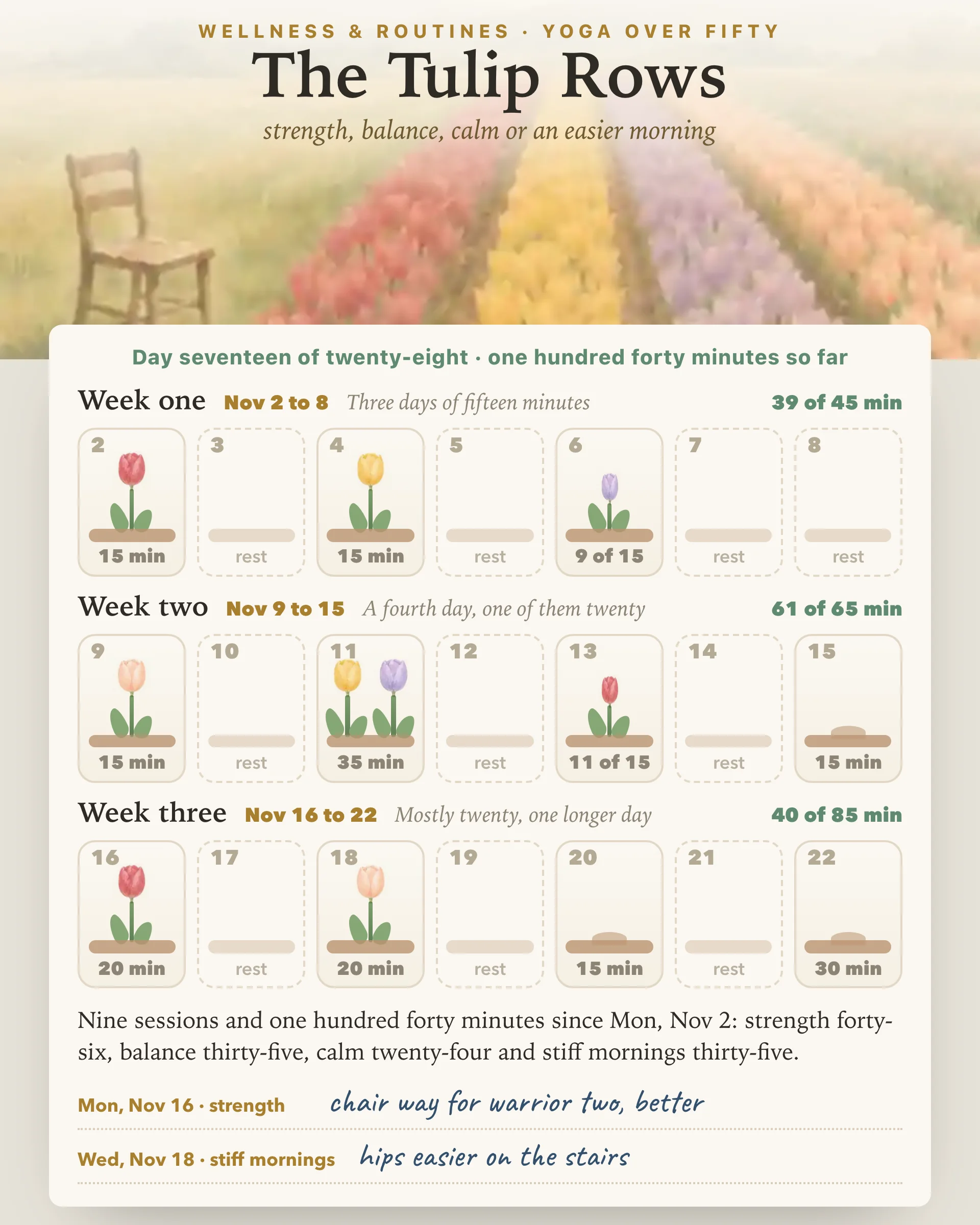
Most yoga routines for women over 50 hand you one fixed sequence, but your body rarely asks for the same thing twice. One morning your hips are slow to wake, another day you want your legs to work, and some evenings you only need a long breath out. This page builds a short session around today's aim and your time, and keeps four weeks of practice in rows of tulips.
Each aim comes in fifteen, twenty or thirty minutes, and the plan builds from three fifteen-minute days in week one to four longer days a week by week four. Leave the aim alone and the page suggests the one with the fewest minutes this week, so no aim quietly slips away.
Every pose carries a plain description and a second way using a chair or a wall, like tree with a hand on the wall. Switch a pose to that way once and it stays switched.
The player walks you through each pose on a clock that keeps real time, even if your phone locks, and a pause never counts. A pose counts only once its whole time has run. Skip one and neither the pose nor the minutes you jumped past count. Stop early and only your whole minutes go in the log.
A session run start to finish plants an open tulip on its day: rose for strength, gold for balance, lavender for calm, apricot for stiff mornings. One that ended early stands as a bud. Afterward you can tap how you felt and add a few words. The page sets this week's notes beside your own earlier weeks in plain counts, never beside anyone else's.
The Woven Mat keeps eight gentle poses for older adults, each in a chair, with support or on the mat. The Chair by the Window stays seated throughout, for days when standing is too much. The Yoga Mannequin teaches two new poses a week if the names are all new, and The Sea Glass Yoga Box chooses a session by how a menopause day feels. The Tulip Rows asks what you want from today's practice and how long you have.
A 2016 review by Youkhana and colleagues pooled six trials with 307 people aged 60 and over. Yoga improved balance a little and getting around moderately. The authors said nobody yet knew whether those gains meant fewer falls, and no trial looked at women in their fifties on their own.
For bladder leaks, one trial put 240 women aged 45 to 90 who leaked daily into twelve weeks of pelvic floor yoga or a general stretching and strengthening program (Huang and colleagues, Annals of Internal Medicine). Leaks fell in both groups, by about 2.3 a day with yoga and 1.9 with the other program, and yoga was not clearly better. With no group that skipped exercise, the trial cannot say how much of the drop came from moving at all.
The World Health Organization's 2020 guidelines ask every age group to strengthen muscles regularly, and adults to fit in 150 to 300 minutes of moderate aerobic activity a week. Unhurried yoga helps the strength side but adds little to those aerobic minutes, so keep walking alongside it.
With osteoporosis or low bone density, leave out deep forward folds and twists that round the back. A case series from a US rehabilitation physician described three healthy people with low bone mass who developed new pain or spine fractures after yoga poses that bend the spine forward. Three cases can't show how often that happens, but they are why every bend here comes from the hips with a long back and every twist stays small and tall. Nothing on this page takes your head below your heart, which matters with high blood pressure or glaucoma. For the pelvic floor, breathe out as you rise or press, never hold your breath or bear down, and tell your doctor about leaking or heaviness, since a pelvic floor physical therapist can help.
Talk with a doctor or physical therapist before you begin if you have had a fall, dizziness, a fracture or a joint replacement, or live with a heart or blood pressure condition, glaucoma, or pain that keeps returning. Keep a sturdy chair or counter within reach for every standing pose, and stop if anything hurts. If chest pain, faintness or sudden shortness of breath comes on, stop at once and call 911 or your local emergency number.
Stiff mornings suits the first hour after you get up, strength and balance fit late morning when your legs are warm, and calm belongs to the evening.
It can be one good part of staying strong and steady. A review of six trials with 307 people aged 60 and over found yoga improved balance a little and getting around moderately, but the trials did not test whether falls became less common, and none looked only at women in their fifties.
With osteoporosis or low bone density, leave out deep forward folds and any twist that rounds the back, since a published case series linked flexion poses to spine fractures. With high blood pressure or glaucoma, skip poses that drop the head below the heart. Every session on this page already leaves these out.
Possibly, though not more than other exercise. In a trial of 240 women aged 45 to 90 with daily leaks, twelve weeks of pelvic floor yoga cut leaks by about two a day, and a general stretching and strengthening class did nearly as well. Mention leaks to your doctor, since a pelvic floor physical therapist can help.
Yes. The sessions suit women in their forties, fifties and sixties, because each pose has a chair or wall way and you choose the length. In your forties the thirty-minute strength and balance days may feel right sooner, while in your sixties starting at fifteen minutes with a counter close by is a fine way in.
This plan asks for three days in week one and four days a week after that, fifteen to thirty minutes each, with rest days in between. World Health Organization guidance asks every age group to do regular muscle strengthening, so make some of those days strength days, and keep walking or other brisk movement alongside.
By the team behind Fabulous, the science-based self-care app used by over 30 million people.


