
The Overwhelm Recovery ProtocolWellness & Routines · ~5 min
About this template · Updated November 2026
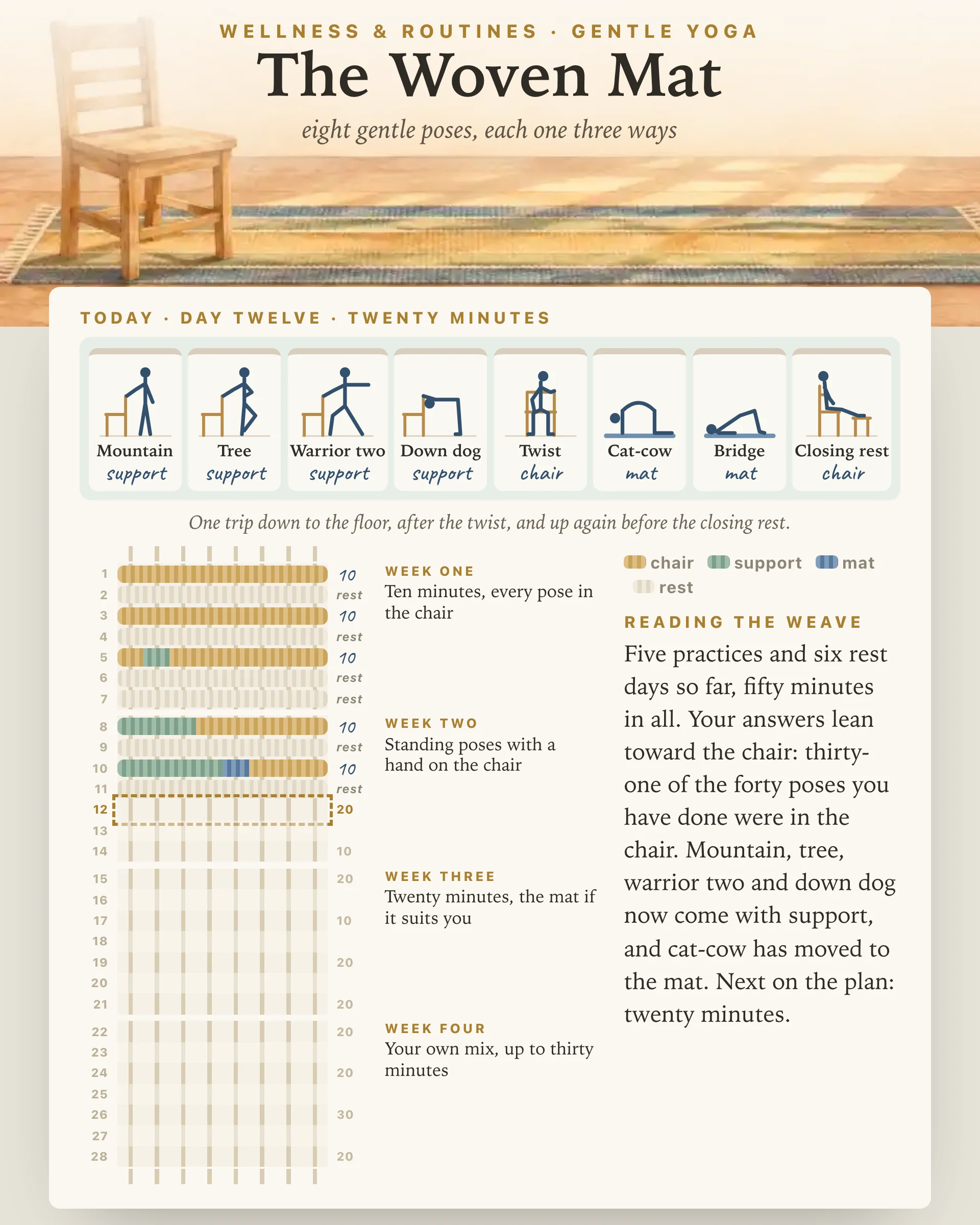
Yoga for seniors works best when each pose comes in more than one size. A knee that grumbles on Tuesday may be glad to stand on Thursday, and a balance that wobbles before breakfast can be steady by noon. Here every pose has three versions, and you choose each time you practice.
The eight poses are a short, classic sequence: mountain, tree, warrior two, down dog, cat-cow, bridge, a twist, and a closing rest with the legs raised. Each comes in three versions.
A seated warrior two is still warrior two. Starting every pose in the chair is a sound way to learn the shapes, and beginner yoga for seniors rarely needs more in the first week.
Pick ten, twenty or thirty minutes. The page sets the breaths and rounds for each pose and gives what remains to the closing rest, so the session lands on the length you chose. Set each pose in the chair, with support, or on the mat, and tap any figure to read how that version is done.
Many people dread getting down to the floor and up again, so the page plans for it. Floor poses gather near the end, which means one trip down at most, and the list says when. The timer talks you through both trips, using the chair seat to lower one knee at a time and to press back up.
Press begin and the timer counts slow breaths of about six seconds, one side and then the other. You can pause, go back, skip a pose or stop. When a session ends, one row is woven into a mat that holds four weeks, its eight stitches colored by where you did each pose: wheat for the chair, sage for support, blue for the mat. Rest days weave a plain row. Over a month the colors show where each pose has settled.
Week one asks for three ten-minute practices with every pose in the chair. Week two tries the standing poses with a hand on the chair. Week three brings twenty-minute sessions and the mat, if the floor suits you. Week four is your own mix, up to thirty minutes. You can always rest on a practice day, or move on a rest day.
A review of six trials in people aged sixty and over found that yoga-based exercise improved balance and mobility, with small gains in balance and medium ones in mobility. Its authors said it is not yet known whether those gains mean fewer falls. A larger review of twenty-two trials in older adults without a particular health condition found that yoga improved balance, leg strength, flexibility and mood compared with no exercise, and also came out ahead of active programs such as walking on leg strength and flexibility.
The broad evidence on falls comes from exercise in general. The 2019 Cochrane review of exercise for older people living in the community found that programs built on balance and functional exercises reduced the rate of falls by about a quarter. It does not single out yoga, so treat this page as practice for strength, balance and ease, not as a promise about falls.
Yoga can also hurt. A study of emergency room visits in the United States found that injury rates from yoga were highest in people sixty-five and older, most often sprains and strains, and most often to the trunk. That argues for going slowly and stopping when something feels wrong.
Before you begin, check with a doctor or physical therapist if you have had a fall or bouts of dizziness, have a replaced hip or knee, live with a heart or blood pressure condition, or have pain that keeps returning. Stop any pose that hurts. Keep a sturdy chair or a kitchen counter within reach for every standing pose, and set the chair's back against a wall before you lean on it. If you have been told to avoid head-down positions, for example because of glaucoma, keep down dog and the closing rest in the chair. With thinning bones, keep twists and forward bends gentle and ask a physical therapist which versions suit you.
Three or four days a week, when you are warm and unhurried. If you would rather stay seated for every move, The Chair by the Window is built for that. If balance is what you most want to work on, The Balance Ladder climbs one step at a time. And if the closing rest becomes your favorite part, Yoga Nidra on Still Water stretches it into a longer guided rest before sleep.
Reviews of trials in adults over sixty found that gentle yoga programs improved balance, mobility, leg strength and flexibility by small to moderate amounts compared with doing nothing. Whether those gains mean fewer falls has not been shown for yoga on its own.
This page uses eight: mountain, tree, warrior two, down dog, cat-cow, bridge, a twist and a closing rest with the legs raised. Each has a seated version, a version standing at the chair or leaning on it, and a version on the mat, so one practice works on a stiff morning and a strong one.
Yes. Every pose here has a version that never touches the floor. If you do use the mat, the floor poses are grouped so you lower yourself once, holding the chair seat, and rise once the same way. Ask a doctor or physical therapist first if you have had a fall or dizzy spells, a new hip or knee, a heart or blood pressure condition, or pain that keeps returning.
The plan here opens with three ten-minute practices in the first week and builds to four practices of twenty or thirty minutes by the fourth, with a rest day between most of them. Shorter is always allowed, and the woven mat keeps the minutes you really did.
A sturdy chair without wheels, a mat or a rug that grips the floor, a folded blanket for your knees, and a wall or kitchen counter close by. A cushion under your head makes the closing rest easier, and loose clothes help more than special gear.
By the team behind Fabulous, the science-based self-care app used by over 30 million people.


