
The Overwhelm Recovery ProtocolWellness & Routines · ~5 min
About this template · Updated November 2026
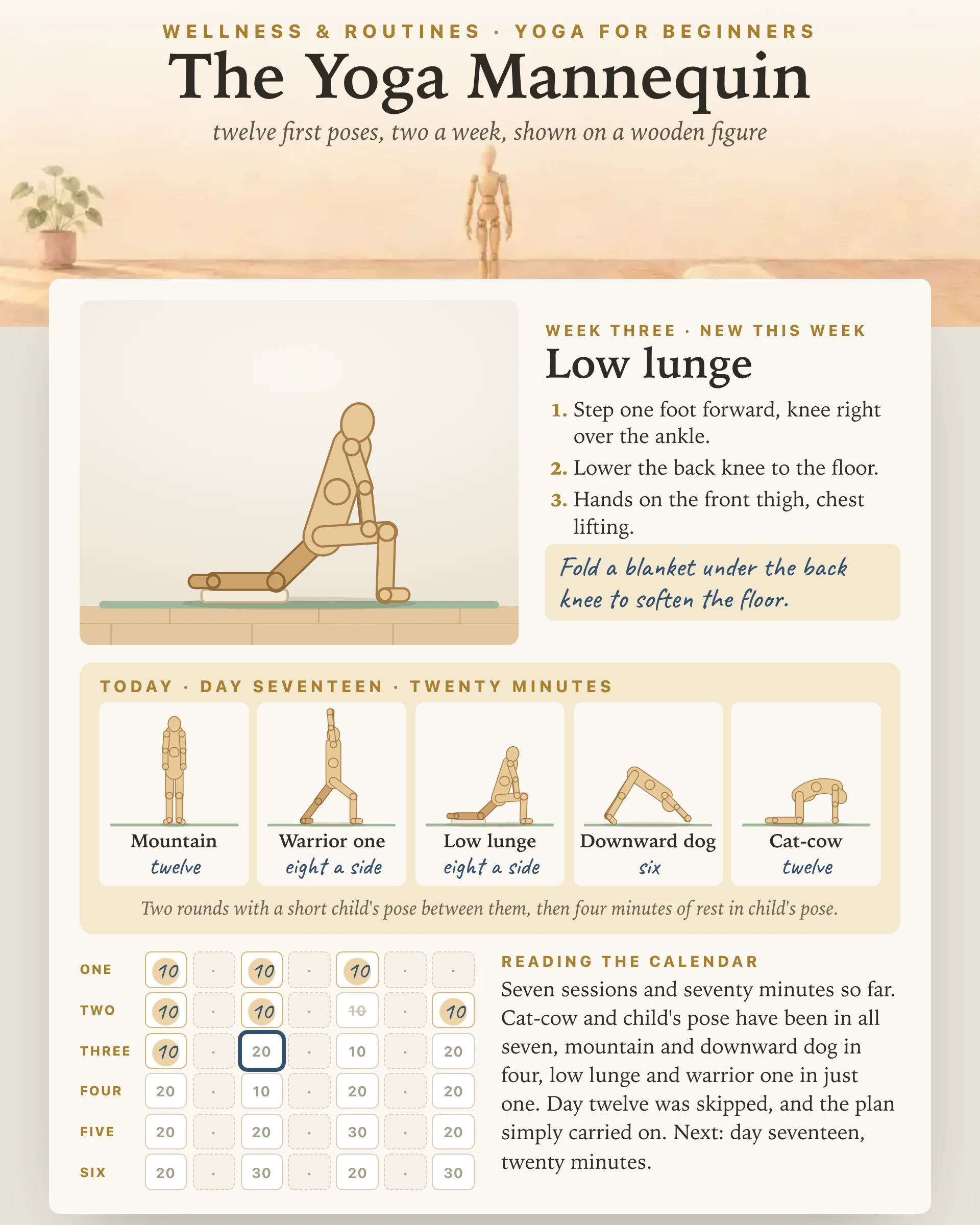
Most yoga for beginners goes wrong the same way: a forty-minute class asks for twenty unfamiliar shapes in a row, and the newcomer spends it copying whoever is on the next mat. This page slows the learning down to two poses a week. Over six weeks you meet twelve foundation poses, see each one on a jointed wooden figure before you try it, and practice only what you already know.
The twelve poses arrive in pairs that belong together:
Tap any pose on the shelf and the wooden figure moves into it. Beside it you get three plain cues and one prop version: a folded blanket under the knees, a block under a hand, a chair, a wall or a strap. Turn the prop on and the figure shows it too. The figure has no face and no age, which is the point: it shows the shape without suggesting what your body should look like inside it.
Each pose also has a hold button that counts five slow breaths, a breath being about six seconds in and out. Try the week's new pair that way first.
The session builder only uses the poses you have reached. You choose ten, twenty or thirty minutes, and it lays them out from standing to the floor, gives each the same number of breaths, repeats the round if there is time, and hands whatever is left to a closing rest. Downward dog and bridge never go past six breaths, and one-sided poses get the same count on each side.
Some lengths stay closed early on. With only a handful of poses, twenty minutes would turn into an endurance test, so for the first two weeks only ten minutes is open. The plan follows the same curve, from ten minutes three days a week to thirty by the last week, about six and a half hours in all. The timer reads the real clock, so a phone that locks mid-pose does not lose your place, and pausing stops the count until you come back.
When you finish, log the day. The calendar keeps each session's minutes and poses, and the reading below it says plainly which poses have been in every session, which ones you have barely met, and whether a day was skipped.
Yoga research is broad but often thin. The National Center for Complementary and Integrative Health summarizes it carefully: studies suggest yoga may help with stress, sleep and balance, with perhaps a small benefit for low-back pain. A 2022 Cochrane review of yoga for chronic low back pain found small improvements in pain and function compared with no exercise, too small to count as clinically important, and probably little or no difference in back function compared with other back exercises. In other words, yoga is a reasonable way to move, not a cure.
On consistency, there is one hint worth knowing. A survey of more than a thousand yoga practitioners found that how often people practiced at home predicted their well-being, sleep and fatigue better than how many years they had practiced or how many classes they attended. It was a survey, so it cannot prove cause, but it fits the shape of this plan: short sessions you can repeat at home.
The same federal summary calls yoga generally safe for healthy people when done properly, with sprains and strains the most common injuries and the knee or lower leg the most commonly hurt. A review of reported yoga injuries found headstands, shoulder stands, lotus position and forceful breathing cited most often, none of which appear here, and advised beginners to skip such extreme practices and people with glaucoma to avoid inversions. If you have glaucoma or high blood pressure, ask your doctor about downward dog, the one head-down pose in this plan.
Move into each pose slowly and come out the moment something hurts. Keep a wall or a sturdy chair close for tree and the two warriors. If you are pregnant, recovering from an injury, or managing a heart or balance problem, talk to a doctor or physical therapist before you begin, and use the prop versions freely.
Once all twelve poses feel familiar, The 30-Day Yoga Challenge gives you a month of daily practice with holds that grow as you go. If getting down to the floor and back up is the hard part, The Woven Mat offers each pose in a chair, with support or on the mat. And if the floor work was your favorite part, The Beginner's Pilates Mat brings in classic mat moves a week at a time, in much the same rhythm. For standing poses held longer, The Door Frame times six balance poses at the counter, the wall or free.
Start with shapes that ask little balance or flexibility: cat-cow, child's pose, mountain and downward dog with bent knees. Add lunges and the warrior poses next, then triangle, tree and bridge, and finish with a seated forward fold and a lying rest. That is the order this plan follows, two poses a week.
Ten minutes is plenty while you know only a few poses. From the third week, with six poses learned, twenty minutes fits comfortably, and this plan reaches thirty in its last two weeks. A short session you repeat three or four days a week is easier to keep than one long class you dread.
Three or four days a week, with rest days between, is a comfortable rhythm for the first weeks. Missing a day changes nothing: pick up with the next session on the calendar rather than doubling up.
For most healthy people, yes, when you move slowly and stop at pain. The injuries that do happen are mostly sprains and strains. People with glaucoma, high blood pressure, a recent injury or a pregnancy should ask a doctor which poses to change, especially head-down ones like downward dog.
A mat helps your hands and feet stay put, but a rug works for the first weeks. Every pose here has a prop version, and most use things you already own: a folded blanket, a firm pillow, a sturdy chair, a wall, or a belt or towel as a strap. A thick hardcover book can stand in for a block.
By the team behind Fabulous, the science-based self-care app used by over 30 million people.


