
The Overwhelm Recovery ProtocolWellness & Routines · ~5 min
About this template · Updated November 2026
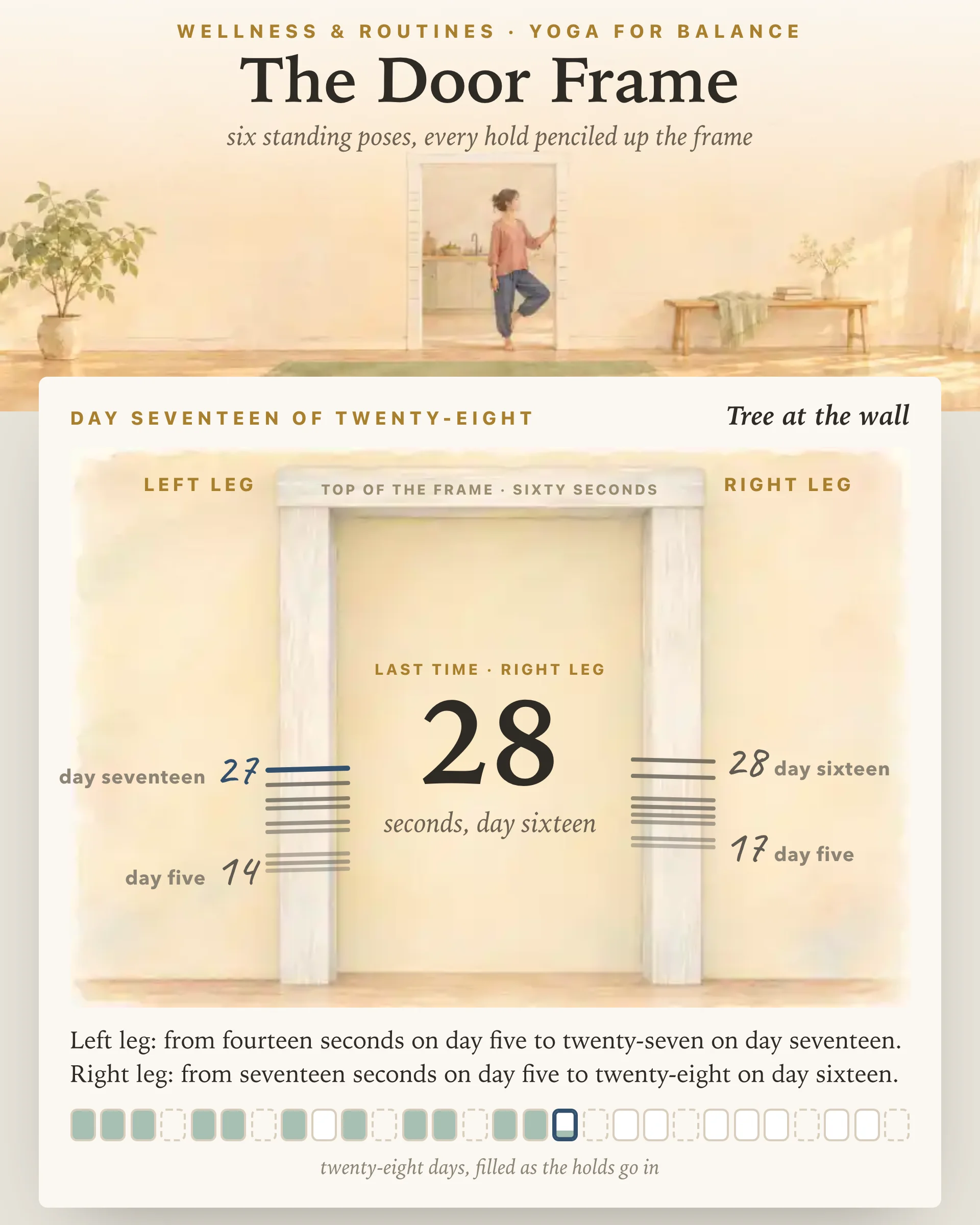
Yoga for balance usually arrives as a list of poses. This page keeps the poses and adds what a list leaves out: a way to see whether your balance is changing. Think of the pencil marks some families make on a door frame as the children grow, except that these marks record seconds. Each practice day, your best hold in each pose goes up the frame, left leg on the left jamb and right leg on the right, and over four weeks you watch your own marks climb.
The poses run from steady to demanding:
Each pose comes in three versions. At the counter, a hand rests on it. At the wall, the wall touches your back, side or palms. Standing free means no contact, with the counter still one step away. You choose the support pose by pose.
Pick a pose and a support, then tap start. Five seconds of get-set let you place your feet, then the clock counts up while a pencil line climbs the jamb for your standing leg. Tap again when you touch down. If you stay up, the clock stops by itself at the top of the frame: thirty seconds for most poses, a minute for tree and eagle arms.
Every pose gets two holds a side each day. After each one, the page sets the result beside your own last practice at the same support and tells you how many seconds you gained, or simply that holds rise and dip. Marks at the wall never mix with marks at the counter, because those are different tasks. Change the support and that pose starts a fresh set of marks, while the earlier ones wait for you.
The plan runs four weeks, five days a week. Week one has mountain, chair pose and tree. Eagle arms joins in week two, warrior three in week three and half moon in week four. A hold and its rest take about a minute, so the days grow from eight minutes to twenty, and a small chart draws each leg's best hold across the month.
A 2016 meta-analysis pooled six trials of physical yoga in 307 people aged 60 and over. Yoga had a small effect on balance and a medium effect on mobility, and the authors called for more research on whether those gains lead to fewer falls.
The firmer evidence on falls covers exercise programs in general. A 2019 Cochrane review of exercise for preventing falls gathered 108 trials of older people living at home. Programs built mainly on balance and functional exercise lowered the rate of falls by about a quarter, with high-certainty evidence. Those were whole programs tested in trials, not this page, and a group average promises nothing for one person. So the frame makes no claim about falls. It gives you a steady way to practice balance and an honest record of it.
The record compares you only with yourself, for a reason. When researchers timed one-leg stands with eyes open and closed in 549 healthy adults, times dropped with age in both conditions. An average for your age says little about whether your practice is working. Your marks from day one say more.
Talk with a doctor or physical therapist before you begin if you have had a fall, dizzy spells, a joint replacement, a heart or blood pressure condition, or pain that comes and goes. Come out of any pose that hurts and leave it for the day. Keep a sturdy counter or a clear stretch of wall within arm's reach for every pose, standing free included, and clear the floor around you. Bare feet or shoes with grip beat socks, and mountain with closed eyes belongs right beside your support.
Practice where the support already lives: at the kitchen counter while the kettle heats, or in a doorway with the frame on either side of you. A missed day simply stays blank on the grid. One leg is often steadier than the other, and the two jambs let you watch the slower side over the weeks.
If standing for long is hard right now, The Chair by the Window keeps your yoga seated. For a slower climb at the counter, The Balance Ladder goes from feet together to one leg. And The Footprint Trail works the feet every pose here stands on.
This page uses six standing poses that ask a little more of your balance each time: mountain with your eyes closed, chair pose with a heel raise, tree, eagle arms, warrior three and half moon. Each one can be done with a hand on a counter, at a wall, or standing free.
Stay up only as long as you feel steady, then come down and rest about as long as you held. The clock here stops at thirty seconds for most poses and at one minute for tree and eagle arms, and two holds a side each day is enough.
A 2016 meta-analysis of six trials in people aged 60 and over found that yoga improved balance by a small amount and mobility by a medium amount. Whether those gains mean fewer falls is still an open question, so the page makes no promise about falls.
Plenty of people find one side steadier, and it is a common thing to notice. The page times each leg on its own jamb, so you can see the gap and whether it narrows over the four weeks, without measuring yourself against anyone else.
Every pose has a version with a hand on a counter or a wall at your back, and the counter stays within reach even when you stand free. Check with a doctor or physical therapist first if you have fallen, felt dizzy, had a joint replaced, or live with a heart or blood pressure condition or pain.
By the team behind Fabulous, the science-based self-care app used by over 30 million people.


