
The Overwhelm Recovery ProtocolWellness & Routines · ~5 min
About this template · Updated November 2026
Your feet carry you through thousands of steps a day, and much of that work falls to muscles you never think about. Some start in the calf and run down into the foot. Others live entirely inside it, under the arch and between the long bones that lead to your toes. Supportive shoes and inserts do some of their holding for them, and muscles that are seldom asked for effort tend to get weaker as the years go by. Foot strengthening exercises give those small muscles a job again.
Researchers who study the foot have compared its small inner muscles to the deep core muscles of the trunk: quiet stabilizers that steady the arch while the bigger muscles do the visible work. Their paper on the foot core system points out that clinicians usually support the foot from outside, with shoes and inserts, and rarely train these muscles directly. The short foot exercise, where you lift the arch without curling your toes, grew out of that line of thinking.
The seven moves work from the toes up to the whole standing foot:
The plan runs four weeks, five sessions a week, with two rest days in each. Weeks one and two are seated, and weeks three and four move to standing at a kitchen counter. The choice at the top of each session stays yours, though: tap seated or standing and every move switches to that version. If standing feels unsure, stay in the chair. The session counts the same.
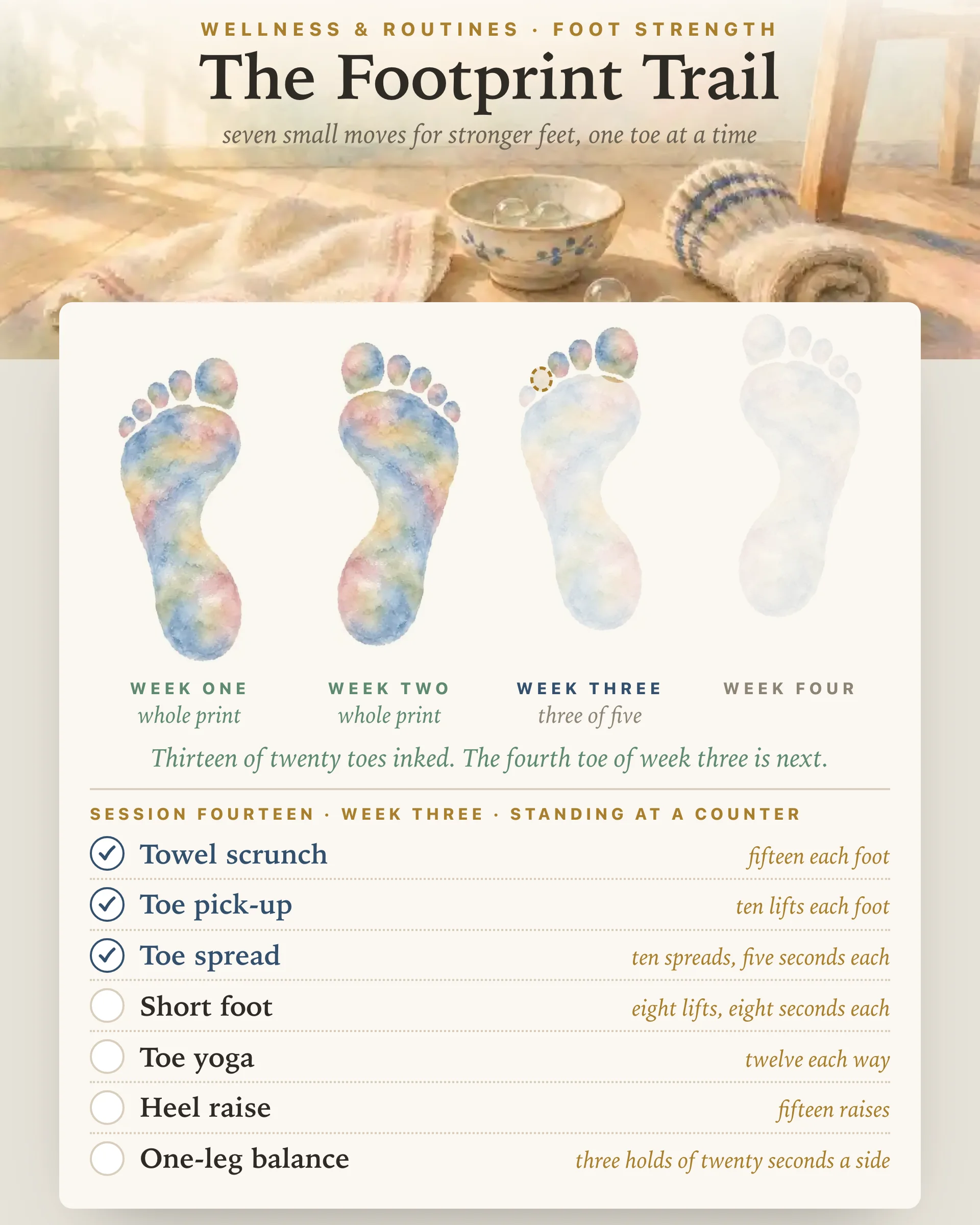
Each move shows its reps or holds for the week you are in, and the numbers climb as the weeks pass, from ten towel scrunches a foot in week one to fifteen by week three. Tick each move once it is done, then ink the toe.
The trail at the top is four painted footprints, one for each week. Every finished session inks one toe, big toe first, and when all five toes are in, the whole print fills with color. Below the session, a short reading counts your toes and your standing sessions, and names the move you skip most with a practical way around it. A toe inked by mistake comes back off with two taps.
A study that followed 176 people in a retirement village for a year found that those who fell had weaker toe muscles and more disabling foot pain than those who stayed on their feet, even after other known risk factors were accounted for. That is an association, so it cannot show that stronger toes would have prevented any of those falls.
Can practice bring that strength back? In a trial with adults aged sixty to ninety, twelve weeks of supervised foot classes with resistance that kept increasing raised toe strength by up to 36 percent and lengthened single-leg balance time. A second group that did simple exercises at home showed no change in toe strength. The lesson is that the load has to keep growing. This plan adds reps, longer holds and standing weeks for that reason, but it is still a home routine, so treat four weeks as a start and keep making the moves a little harder.
A larger trial gave older people with disabling foot pain a bundle of foot orthoses, footwear advice, a falls booklet and a home program of foot and ankle exercises. Over a year they had fewer falls than people who received routine podiatry care. Because the exercises came packaged with everything else, the trial cannot tell how much of that difference they made on their own.
These moves are practice for everyday feet, not a treatment for plantar fasciitis, bunions, flat feet or any other condition. If you have foot or heel pain, numbness in your feet, diabetes, a recent injury or surgery, or have fallen in the past year, talk with a podiatrist, doctor or physical therapist before your first session. Stop any move that hurts. Whenever you stand, keep a sturdy counter or the back of a heavy chair within reach, and work barefoot on a floor that does not slip.
Five times a week, tucked into a moment your day already has: while the coffee brews, during the evening news, or just before bed. Ten minutes is plenty to begin with. If standing on one foot feels shaky even with the counter close, The Balance Ladder builds steadiness one hold at a time. For the rest of your body, The Whole-House Strength Routine places eight moves around your home, and The Walking Workout Ribbon gives your feet somewhere to go once the trail is walked.
A short, steady set works the small muscles under the arch and the toes: towel scrunches, picking up marbles or a sock with your toes, toe spreads, the short foot, toe yoga and heel raises, with a supported one-leg balance once you stand. None needs equipment beyond a towel and a chair.
Every move has a seated version, and every standing one is done with a hand or fingertips on a sturdy counter. If you have foot pain, numb feet, diabetes, a recent injury or a fall in the past year, talk with a podiatrist, doctor or physical therapist first, and stop any move that hurts.
This plan uses five short sessions a week, ten to fifteen minutes each, with two rest days. Small muscles respond to regular practice more than to long sessions, so a few minutes most days is the rhythm to aim for.
This routine is general practice for everyday feet, not a treatment for any condition. Heel pain, a growing bunion, swelling or numbness are reasons to see a podiatrist or doctor, who can tell you which exercises, if any, suit your foot.
In one trial of adults aged sixty to ninety, toe strength rose over twelve weeks of supervised classes that kept adding resistance, while a simpler home routine showed no change. Treat four weeks as a start and keep adding reps, holds or standing time.
By the team behind Fabulous, the science-based self-care app used by over 30 million people.


