
The Overwhelm Recovery ProtocolWellness & Routines · ~5 min
About this template · Updated September 2026
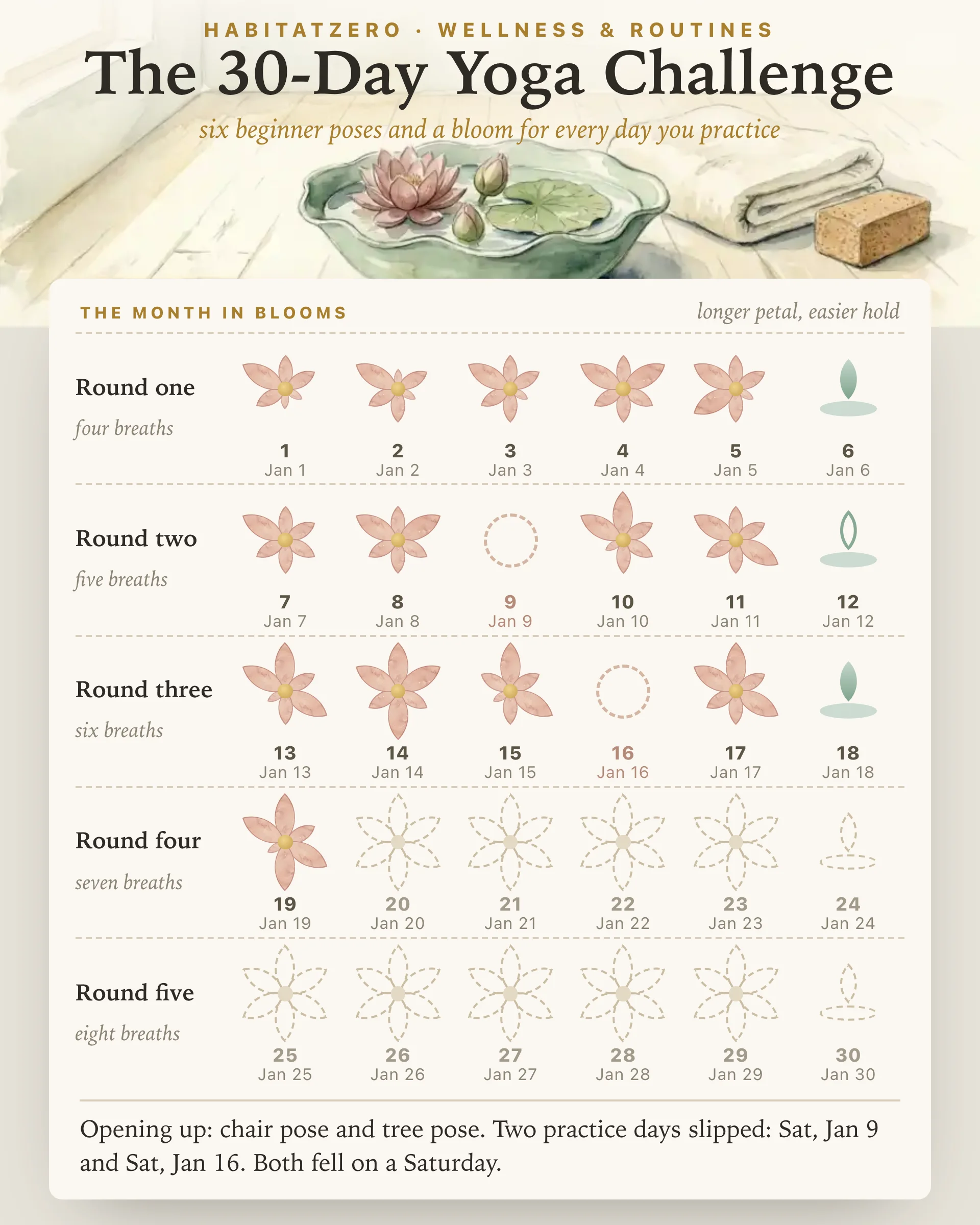
Most thirty-day yoga challenges hand you a new pose every morning and leave you guessing whether any of it is working. This one keeps the same six beginner poses all month and changes a single thing: every six days, each hold grows by one breath. Because the poses stay put, you can watch them change, and the sheet shows you where.
The practice runs from standing to the floor and takes about ten minutes.
Child's pose closes every session. Nothing here asks you to stand on your head or sit in full lotus, which fits the advice from the National Center for Complementary and Integrative Health that newcomers skip extreme practices such as headstands, shoulder stands and the lotus position. The lotus on this page is a flower you grow, not a pose you attempt.
The month runs as five rounds of six days. Round one holds each pose for four slow breaths, round five for eight. Counting breaths instead of seconds gives you a gauge you carry everywhere: when the breath turns short and ragged, the hold is long enough for today.
Every sixth day restores: child's pose, legs up the wall, a reclined twist each side and a few minutes lying still, or full rest. Both count.
Pick day one: today, tomorrow, the coming Monday, or New Year's Day once it is near. From then on the calendar keeps time, so every date belongs to one day of the thirty.
After each practice, mark every pose as out early, held it, with ease or skipped. Each mark grows one petal of that day's lotus: short for a hold you left early, medium for one you held, full length for one that felt easy, and a small stub for a pose you skipped. Add up to two words for how your body felt, like stiff or loose, and a short line if you like.
Restore days show as green buds, and a practice day that passes unmarked stays an empty ring. There is no catching up, though yesterday stays open until midnight for evenings you practiced and forgot to mark it.
Once a second round has two practice days in it, the sheet sets each pose's first round against its latest and says which poses are opening up, which are holding steady and which are asking more as the holds lengthen. It lists the slipped days by date and points out a pattern when one shows, such as two slips on a Saturday. Tap any pose to trace its petal through the month.
NCCIH describes yoga as generally safe for healthy people when it is done properly under a qualified instructor. Sprains and strains are the most common injuries, and serious ones are rare. The same page links learning alone, without supervision, to higher risk, so a class or two early on to check your form is worth it.
The research on balance is encouraging without being tidy. A systematic review of yoga for balance in healthy people found that 11 of 15 studies reported improvement in at least one balance measure, while warning that mixed study designs and weak reporting cloud the picture. Treat that as a reason to expect tree pose to settle with practice, not a promise of when.
Thirty days is also a beginning. When researchers followed people forming a new daily habit, the time it took for the habit to level off ranged from 18 to 254 days, and missing one chance to do it did not materially change the process. An empty ring on this sheet is news about your week, not the end of the month.
NCCIH names knee or hip injuries, lumbar spine disease, severe high blood pressure, balance issues and glaucoma among the conditions that can call for modified poses. If any of those apply to you, or you are pregnant, ask your doctor or physical therapist which poses to adjust before day one. During pregnancy it advises against long stretches of lying on your back, which is worth raising about bridge pose. A deep stretch can feel strong, but sharp, pinching or joint pain means come out of the pose and mark it skipped.
A New Year's start is the natural moment, though any run of thirty days works. For a lighter habit alongside it, The Daily Stretch Mat times short stretches for mornings and desk breaks, and on restore evenings Yoga Nidra on Still Water guides a rest lying down. When the thirty days end, The 30-Day Challenge holds any small daily task you choose next.
Six standard beginner poses in one short sequence: chair pose, Warrior II, tree pose, downward dog, low lunge and bridge pose, closing with child's pose. The standing poses come first and the floor poses after, so a whole practice fits in about ten minutes.
Count breaths instead of seconds. Round one holds every pose for four slow breaths, and each six-day round adds one more, up to eight in the last round. If your breath turns short or a pose starts to shake hard, come out early and mark it that way.
That day stays an empty ring on the sheet and the plan simply carries on from the calendar, so there is nothing to make up. Yesterday stays open until midnight, for the evenings you practiced and forgot to mark it.
For most healthy adults, a few gentle poses held for a handful of breaths is a sensible place to begin, and a class to check your form helps. Anyone pregnant, healing an injury, or managing high blood pressure, glaucoma or balance problems should ask a clinician which poses to change first.
The filled-in sample on this page is free to look through. To start your own thirty days and keep every bloom from one practice to the next, personalize the challenge in HabitatZero at no cost.
By the team behind Fabulous, the science-based self-care app used by over 30 million people.


