
The Overwhelm Recovery ProtocolWellness & Routines · ~5 min
About this template · Updated November 2026
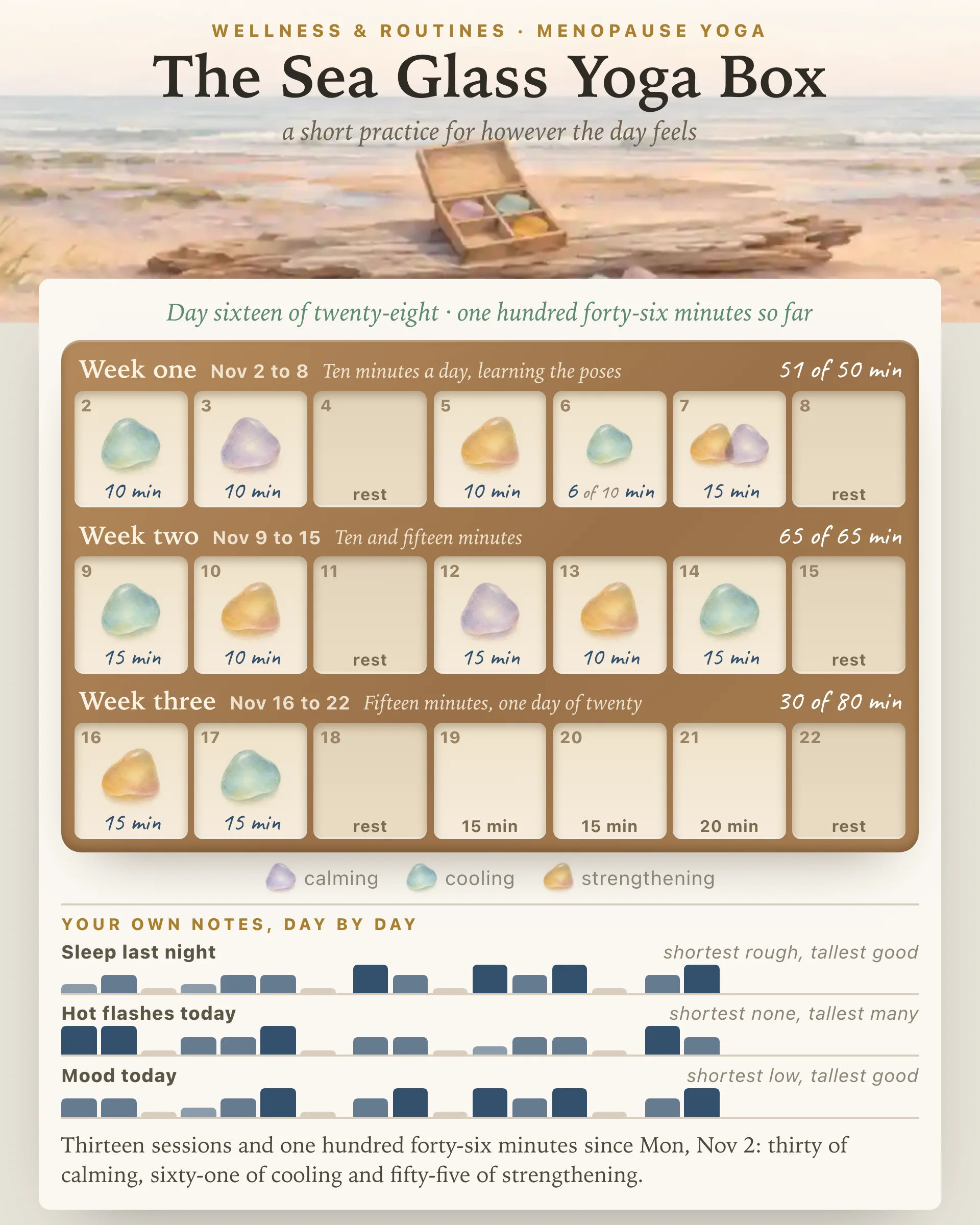
In the menopause years, one day can feel nothing like the next: a night of broken sleep, an afternoon that runs hot, then a week when you feel strong. A fixed routine fights that. This page builds a short yoga practice around how today actually feels, and keeps four weeks of it in one place: a wooden box that fills with sea glass.
Every pose comes with a plain description and a second way to do it with a chair or a wall, for days when the floor feels far away or your balance is shaky. There are no deep forward folds and nothing upside down.
Tap how today feels and the page offers the matching session, sized to the plan: ten minutes a day in week one, building to fifteen and twenty by week four, five days a week. Any day can be five, ten, fifteen or twenty minutes instead.
Press begin and the clock walks you through each pose, one side and then the other where a pose has two. It keeps real time, so a phone that locks does not stretch or shrink the session, and a pause never counts. Stop early and only the whole minutes you did go in the log.
Each session leaves a piece of sea glass in that day's compartment: lavender for calming, aqua for cooling, amber for strengthening. A session cut short leaves a smaller piece. By week four, the box shows which kind of day came up most.
There is also an optional daily note: how you slept, whether hot flashes came, how your mood is. The page lines your notes up as small bars and sets this week beside your own earlier weeks, in plain counts. It gives no score and draws no conclusion, because a few weeks of notes cannot separate yoga from everything else going on in your life.
The broadest look is a 2018 review that pooled thirteen randomized trials with 1,306 participants (Cramer, Peng and Lauche, Maturitas). Compared with no treatment, yoga eased menopause symptom scores, psychological, physical and hot-flash scores among them. Compared with other exercise, the only difference was a small one for hot flashes, and the authors warned that the results were not robust to how symptoms were rated or to people leaving the studies. A fair reading: yoga seems to help about as much as other ways of moving.
The largest single trial is more sobering. In it, 249 healthy women aged 40 to 62 with frequent hot flashes were assigned to twelve weeks of weekly yoga classes plus home practice, to an exercise program, or to their usual routine (Newton and colleagues, Menopause). Yoga did not change how often hot flashes came or how much they bothered people. Insomnia scores improved a little.
That is why the North American Menopause Society's 2023 position statement on non-hormone treatments does not recommend yoga, exercise or cooling techniques as a treatment for hot flashes: the evidence is limited or mixed. That does not make yoga pointless. The honest reasons to practice are the ones you can feel, like an unhurried quarter hour and legs that do more work, not a promise about symptoms.
Yoga here goes alongside your doctor's care and never stands in for it. Talk to your doctor before you begin if you have heavy or unexpected bleeding, chest pain, or a recent fracture. With osteoporosis, ask before any forward fold or deep rounding of the back: one case series of nine patients described spine fractures after yoga poses that bend the spine forward, mostly in people with low bone density. The Osteoporosis Exercise Pagoda shows strength and posture work that leaves those poses out. With high blood pressure, ask before any pose that puts your head below your heart. After a fall, dizziness or a joint replacement, or with a heart condition or ongoing pain, check with a doctor or physical therapist. During practice, keep a sturdy chair or counter within reach and stop if anything hurts. Chest pain, faintness or sudden breathlessness means stopping and calling 911 or your local emergency number.
Practice at whatever hour suits the day: calming in the evening, strengthening in the morning, cooling when the afternoon runs warm. If the floor is out of reach most days, The Chair by the Window keeps every pose seated. For steadier standing, The Door Frame works on balance with a counter or wall close by, and on restless nights The Bedtime Yoga Moon has slow poses you can do in bed.
It may help a little with overall symptoms. A 2018 review of thirteen trials found yoga eased symptom scores compared with doing nothing, about as much as other exercise, though the authors flagged weak points in the studies. Think of it as steady practice that goes with your medical care, not a cure.
Probably not on its own. In a large US trial of 249 women aged 40 to 62, twelve weeks of yoga did not change how often hot flashes came or how much they bothered people, though insomnia scores improved slightly. If hot flashes are wearing you down, ask your doctor what could help.
Ask your doctor or a physical therapist before you start. Doctors have described spine fractures after poses that round the back forward, mostly in people with low bone density. This page has no deep forward folds, keeps twists small and optional, and gives every pose a chair or wall way.
Many gentle poses suit most people, but check with your doctor first, especially before any pose that puts your head below your heart, such as a headstand or shoulder stand. Nothing on this page goes upside down, and you can rest or pause the clock at any point.
Short and regular tends to be easier to keep up than long and rare. This plan asks for five sessions a week, starting at ten minutes and building to fifteen or twenty by week four, with two rest days each week. A rest day can still hold a gentle five-minute session if you want one.
By the team behind Fabulous, the science-based self-care app used by over 30 million people.


