
The Overwhelm Recovery ProtocolWellness & Routines · ~5 min
About this template · Updated November 2026
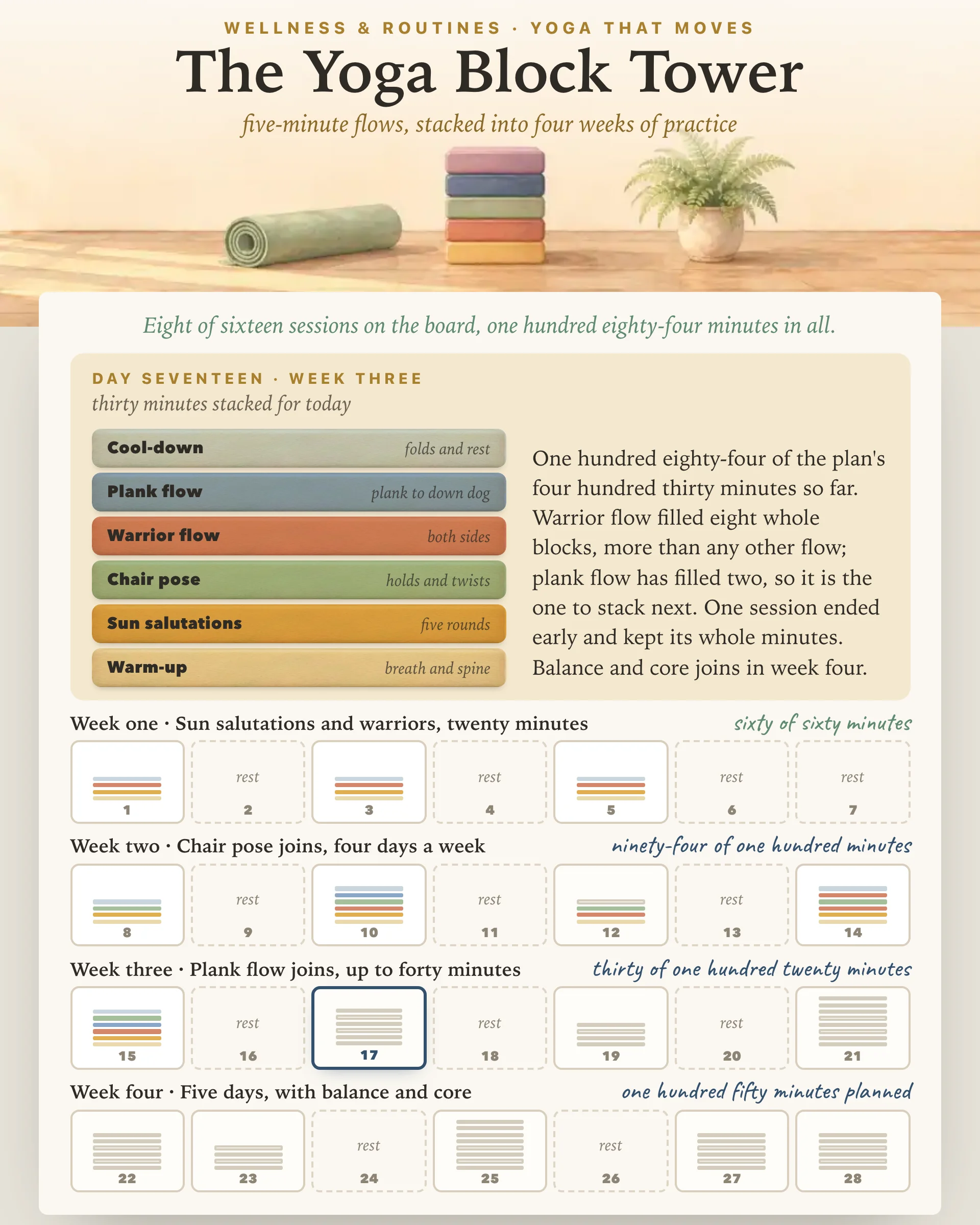
Yoga for weight loss works best when you treat it as a steady habit rather than a quick fix. This page gives each practice a shape you can see: a short tower of five-minute blocks, warm-up at the bottom and cool-down on top, with the moving flows stacked in between. You follow the tower on a live clock, and every session you finish lands on a four-week board as a small tower of its own.
Start with the honest part. A 2016 systematic review and meta-analysis pooled thirty randomized trials with more than two thousand people. Across all of them, yoga made no clear difference to weight, body fat or waist size. In trials of people with overweight or obesity, yoga did lower body mass index compared with usual care, but the authors warn that the result did not hold up well against bias in how those studies were run. So yoga may help, the evidence is thin, and no one can promise you a number.
Effort is part of the reason. A review of the energy cost of yoga found that most poses and full classes count as light activity when measured in a lab. Flowing sequences are the exception: sun salutations reached a moderate pace, and in one study a vigorous one. That is why this plan builds every session around flows that keep you moving, from sun salutations to plank and down dog, and keeps the long, still holds for the cool-down.
The other reason is habit. In interviews with twenty people who had lost weight through yoga, many described a shift toward healthier eating, support from the people they practiced with, and changes in how they felt in body and mind. That is a small interview study, not proof, but it hints that the habit reaches past the mat.
For a yardstick, the CDC's guidance for adults is 150 minutes of moderate activity a week plus two days of muscle-strengthening work. This plan reaches 150 minutes in its fourth week. Not every one of those minutes is moderate, so count your walks and other movement too.
Each planned day comes already stacked. The warm-up always sits at the bottom and the cool-down always sits on top. Between them go two to six flow blocks of five minutes each, chosen from five:
Tap a flow to stack it, or tap a middle block twice to take it off. The tower stops at forty minutes and will not begin with fewer than two flows, and it tells you why. Press begin and the page names each move, gives a cue and an easier version, and counts down the seconds. The clock runs on real time, so a dimmed phone keeps your place, and a pause holds it still.
Finish the tower and it goes on the board in full. Stop early and only your whole minutes count: a block you completed is solid, the one you were in shows as part done, and anything under a minute is not saved. Each week totals its minutes against the plan, and a short reading names the flow you have stacked most and the one still waiting for a turn.
Missed a planned day? Practice it the next one; the board counts sessions, not dates.
Your weight answers to more than practice: what you eat, how long you sleep and how much you move away from the mat all count. A daily journal for sleep, energy and the habits you kept shows the rest of the week next to these towers, and walks strung as cords of wooden beads fill the rest days with easy minutes. If twenty minutes of flows feels like too much right now, a thirty-day practice of six poses that grows a lotus is a quieter place to start. And if the poses themselves are new, a wooden figure that shows two new poses a week lets you learn them slowly.
Talk with a doctor or physical therapist before you begin if you have had a fall or dizzy spells, a joint replacement, a heart or blood pressure condition, or pain that keeps coming back. Stop any move that hurts. Keep a sturdy chair or a kitchen counter within reach for tree, warrior three and the other standing poses. If you have been told to avoid head-down positions, do down dog and the folds with your hands on a chair seat.
Use it three to five days a week for a month, at whatever time of day you can protect. Twenty kept minutes do more than forty you skip, so stack the tower you will actually finish.
It can play a part, though not on its own. A 2016 review of thirty trials found no clear change in weight or waist size from yoga across all groups, and a drop in body mass index only for people with overweight or obesity, in studies of uneven quality. Yoga keeps you moving and may steady habits around food and rest, but the scale answers to your whole week.
This one runs twenty-eight days. Week one has three twenty-minute practices of sun salutations and warriors; chair pose comes in during week two, plank flow in week three, and balance and core in week four, which reaches five practices of twenty to forty minutes. For a round thirty, repeat a favorite tower on days twenty-nine and thirty.
Most held poses count as light activity when researchers measure them, while flowing sequences such as sun salutations reach a moderate pace. US guidance asks adults for about 150 minutes of moderate activity a week plus two days of muscle work. This plan reaches 150 minutes in its last week, but not every one of those minutes is moderate, so add walks or other movement on the days between.
Three to five practices a week is a pace most people can hold for a month and beyond. The plan here starts with three and builds to five, leaving rest days between most sessions. Showing up often matters more than any single long practice, so a twenty-minute tower kept beats a forty-minute one skipped.
Every move on the page has an easier version: knees down for plank, hands on a chair seat for down dog and the folds, a hand on a chair back for tree and warrior three. Stop any move that hurts. If you have had a fall, dizzy spells, a joint replacement, a heart or blood pressure condition, or pain that keeps returning, ask a doctor or physical therapist before you start.
By the team behind Fabulous, the science-based self-care app used by over 30 million people.


