The Overwhelm Recovery ProtocolWellness & Routines · ~5 min
About this template · Updated September 2026
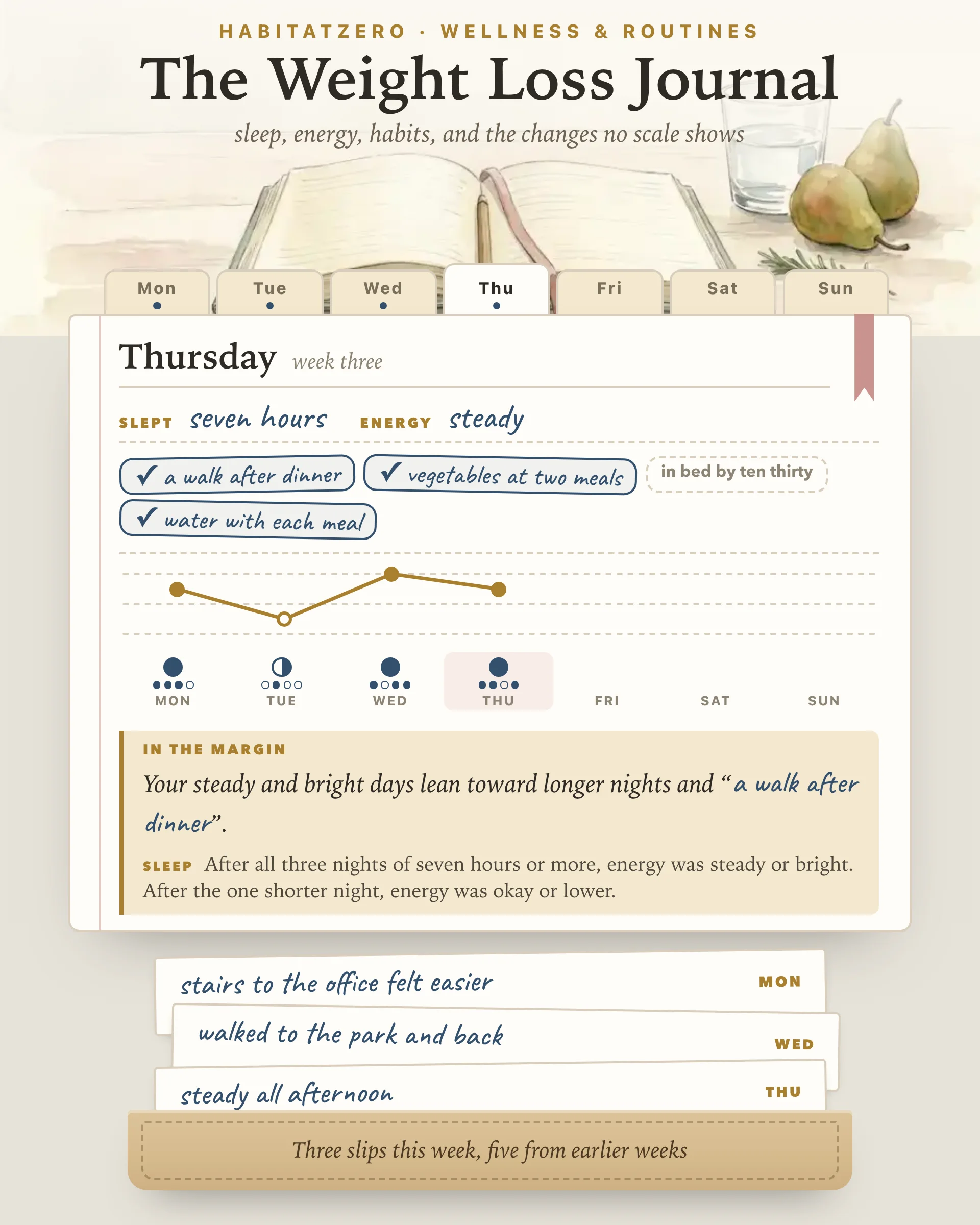
Most weight loss journals ask for two things every day: everything you ate and what the scale said. This one asks for less and hands more back. In about a minute you mark how long you slept, how your energy ran, which of your chosen habits you kept, and one change a scale would never register. At the end of the week, the journal reads its own pages and tells you what your better days had in common.
The journal opens to this week, with a tab for each day and a ribbon on the page you are writing. Tap the hours you slept last night, from under six to nine or more, and how your energy is running today, from drained to bright. Then stamp the habits you kept.
Choose up to five habits. The suggestions lean toward things you add rather than things you give up: a walk after dinner, vegetables at two meals, in bed by ten thirty. Five is a deliberate ceiling, because a short list you keep most days tells you more than a long one abandoned by Wednesday.
The last line on each page holds one change no scale would show: stairs that felt easier, an afternoon without the slump, the groceries carried in one trip. Those lines drop into a pocket at the back of the journal as paper slips, and the pocket keeps count from week to week.
Once three pages have energy marked, the margin starts comparing your steady and bright days with the rest. It looks at sleep first: after nights of seven hours or more, how often did a steady or bright day follow, and how often after shorter nights? Then it names the habit that shows up most on your better days compared with the others.
A reading might say your steady and bright days lean toward longer nights and "a walk after dinner". That is a pattern in your own pages, not a law of your body, and seven days make a small sample, so the margin says "lean toward" and nothing stronger. Treat it as a question to test next week.
Keeping track of what you do sits at the center of behavioral weight-loss programs. A systematic review of twenty-two studies found a consistent link between self-monitoring of eating, exercise or weight and the weight people lost. The same review is candid about its limits: the authors rated the evidence weak, the studies leaned on self-report, and the people studied were mostly white women. So a journal is not a treatment. It is a way to see your week clearly enough to change one thing on purpose.
Sleep is the entry people skip, and it may matter more than it looks. In a small laboratory study, ten adults followed the same weight-loss diet for two weeks, once with eight and a half hours in bed each night and once with five and a half. After the short nights, a smaller share of the weight they lost came from fat, they lost more lean mass, and they were hungrier. Ten people over two weeks cannot settle it, but it is a fair reason to watch your nights. The CDC puts the need for adults aged eighteen to sixty at seven or more hours, which is where the moon on the week strip turns full.
Plenty of people want a weigh-in, and the journal has room for one. The weight line stays hidden until you turn it on, asks for a single number each week, and never feeds the margin. To follow the number on its own with a running change, the Weight Loss Tracker is built for that. If food and movement need a plan more than a record, the Meal and Movement Planner puts both on one page, and the Training Consistency Planner turns workouts into four visible weeks of sessions.
Talk with your doctor before beginning a weight-loss plan, particularly if you take medication or manage a health condition. The NIDDK calls that conversation an important first step, and your doctor can refer you to a registered dietitian.
A journal should make the week clearer, not heavier. If food, eating or your weight begins to fill more of your thoughts than you want, put the pages down and talk it through with a doctor or a registered dietitian. In the US, the National Alliance for Eating Disorders runs a free helpline at 866-662-1235 answered by licensed therapists on weekdays, and ANAD offers free weekday support at 888-375-7767. If things ever turn into a crisis, call or text 988 at any hour in the US, or reach your local emergency number wherever you are.
Fill a page in the evening, when the day's energy is known and last night's sleep is still fresh. Read the margin on the weekend, file the week, and start the next one with the same habits or a better list. A month in, the back pages show which habits kept turning up on your good days and which slips you gathered, a record that says more than any single weigh-in.
Keep each entry small enough to finish every day: hours slept, how your energy ran, which of your chosen habits you kept, and one change you noticed that a scale would miss. A weekly weigh-in can sit alongside, but logging every bite is not what makes a journal like this one useful.
Tracking what you do is the backbone of behavioral weight-loss programs, and a 2011 review of twenty-two studies found tracking consistently linked with weight lost. The same review rated that evidence weak, because the studies leaned on self-report and on groups of people who were much alike.
They are signs of progress that carry no number: stairs that feel easier, steadier afternoons, deeper sleep, a longer walk, more patience with yourself. Here they become slips in a back pocket, so a slow week on the scale still holds proof that something changed.
No. The weight line stays hidden until you switch it on, and even then it asks for a single number each week. The margin notes never read it; they compare your sleep, your energy and your habits.
This page shows a sample week you can look through. Keeping your own pages, habits and back pocket happens in the free HabitatZero app, which saves every tap as you make it.
By the team behind Fabulous, the science-based self-care app used by over 30 million people.