
The Overwhelm Recovery ProtocolWellness & Routines · ~5 min
About this template · Updated November 2026
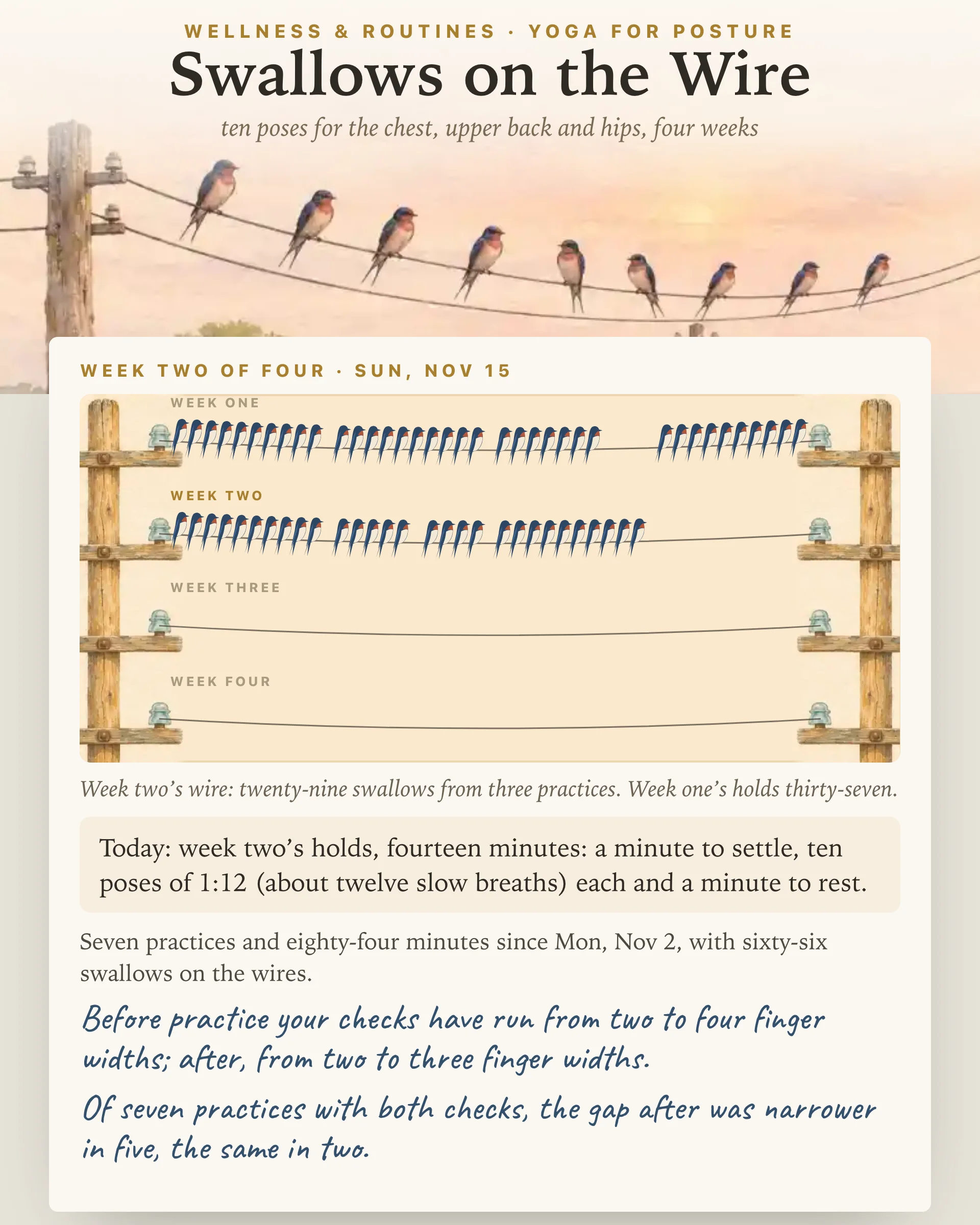
This is yoga for posture as a four-week practice: ten poses that open the front of the chest and put the upper back and hips to work, four days a week, from twelve minutes in week one to eighteen in week four. Every pose has an easier version that stays off the floor. Each pose that runs its whole time brings a swallow to that week's wire, so four wires fill as the month goes on.
A minute to settle opens each practice and a minute of rest closes it. Holds grow from a minute in week one to 1:12, 1:24 and 1:36, roughly ten to sixteen slow breaths, and one-sided poses tell you when to switch.
Pick a version of each pose and the list counts your trips down to the floor. Press begin and each cue appears in turn, timed by a clock that keeps real time even if the screen locks. Pause, skip a pose or stop early whenever you need to.
A pose brings its swallow only when its whole hold has run: skip it and that swallow flies on. An early end keeps only the whole minutes you practiced, so forty seconds keeps nothing, and skipped time never counts. The log keeps one practice a day, with its minutes, swallows and wall checks.
Stand with your heels, hips and shoulder blades against a bare wall, eyes level. Slide your fingers, flat and stacked, into the gap at the back of your head and count them: touching, one, two, three, four, or five and more. Do not tip your chin up to close the gap, because then you are measuring your chin.
Do it before a practice and within two hours after; the page sets the two side by side and beside your own earlier checks. It does not say what a good number is and never compares you with anyone else. A finger width is a coarse ruler, so a change of one can come from how you stood that morning. A curve that seems to change over months, or new back pain, belongs with a doctor, not a worksheet.
Posture gets blamed for more than the evidence supports. When Laird and colleagues pooled 43 studies comparing adults with and without low back pain, the two groups stood with the same lower back curve and the same pelvic tilt. People with back pain moved less far and more slowly, and no one knows which came first.
Yoga helps backs a little. A 2022 Cochrane review of 21 trials took in 2,223 adults with long-lasting low back pain, most of them women in their forties or fifties. Against no exercise, yoga brought improvements in pain and daily function at three months that were too small for most people to notice. Against other back exercise it made little or no difference, and its side effects, mostly a flare of back pain, were about as common as with other exercise.
On posture itself, the trial evidence is thin and the results are modest. Greendale and colleagues randomized 118 women and men aged sixty and over whose upper back curve measured forty degrees or more. After six months of hour-long classes three times a week, the yoga group's curve came out four to five percent smaller on two measures but not on the trial's main one, and their walking speed, chair stands and reach did not change. That is far more practice than four weeks here, and it says nothing about how anyone looks. Treat this month as practice in moving your chest and upper back, with no promise about the shape of your spine.
The Plumb Line Posture Plan is five corrective exercises, chin tucks and wall angels among them, ten minutes six days a week, with a weekly look at how your head, shoulders and hips meet a wall. This page is yoga instead: held poses, longer sessions on fewer days, and a measured gap before and after every practice. For older adults who would rather start every move seated, The Posture Suncatcher keeps eight moves at a chair and the counter. Your Postural Assessment, Hook by Hook is written for coaches looking at a client, not for your own practice. For gentle whole-body yoga, The Woven Mat offers every pose in a chair, with support or on the mat.
If you have had a fall, dizziness, a joint replacement, osteoporosis, a heart or blood pressure condition, or pain right now, ask a doctor or physical therapist which versions suit you. Stop any pose that hurts, keep a sturdy chair within reach whenever you stand, and use the chair version of the fish if lying back makes you dizzy.
The trials are small. In one, 118 adults over sixty with a rounded upper back took hour-long yoga classes three times a week for six months, and their curve measured four to five percent smaller on two measures but not on the trial's main one, with no change in physical tests. Treat four weeks of practice as time spent getting stronger and easier in these shapes, not as a way to reshape your spine.
Less often than people assume. A review of 43 studies found that adults with low back pain stood with the same lower back curve as adults without it. What differed was movement: people with back pain moved less far and more slowly.
Poses that open the front of the chest and work the muscles between and below the shoulder blades, such as the doorway chest opener, sphinx, locust, cobra and a supported fish over a rolled towel. Cat-cow and thread the needle move the upper back, and mountain at a wall and a low lunge with arms up bring in the hips.
You stand with your back on a wall and count how many flat fingers fit between the back of your head and the wall. The page names no normal number and gives no rating. It only sets your result beside your own earlier ones.
No. Each of the ten poses has an easier version done standing, at the wall or in a chair, so a whole practice can stay off the floor while you build up to the full versions.
By the team behind Fabulous, the science-based self-care app used by over 30 million people.


