
The Overwhelm Recovery ProtocolWellness & Routines · ~5 min
About this template · Updated November 2026
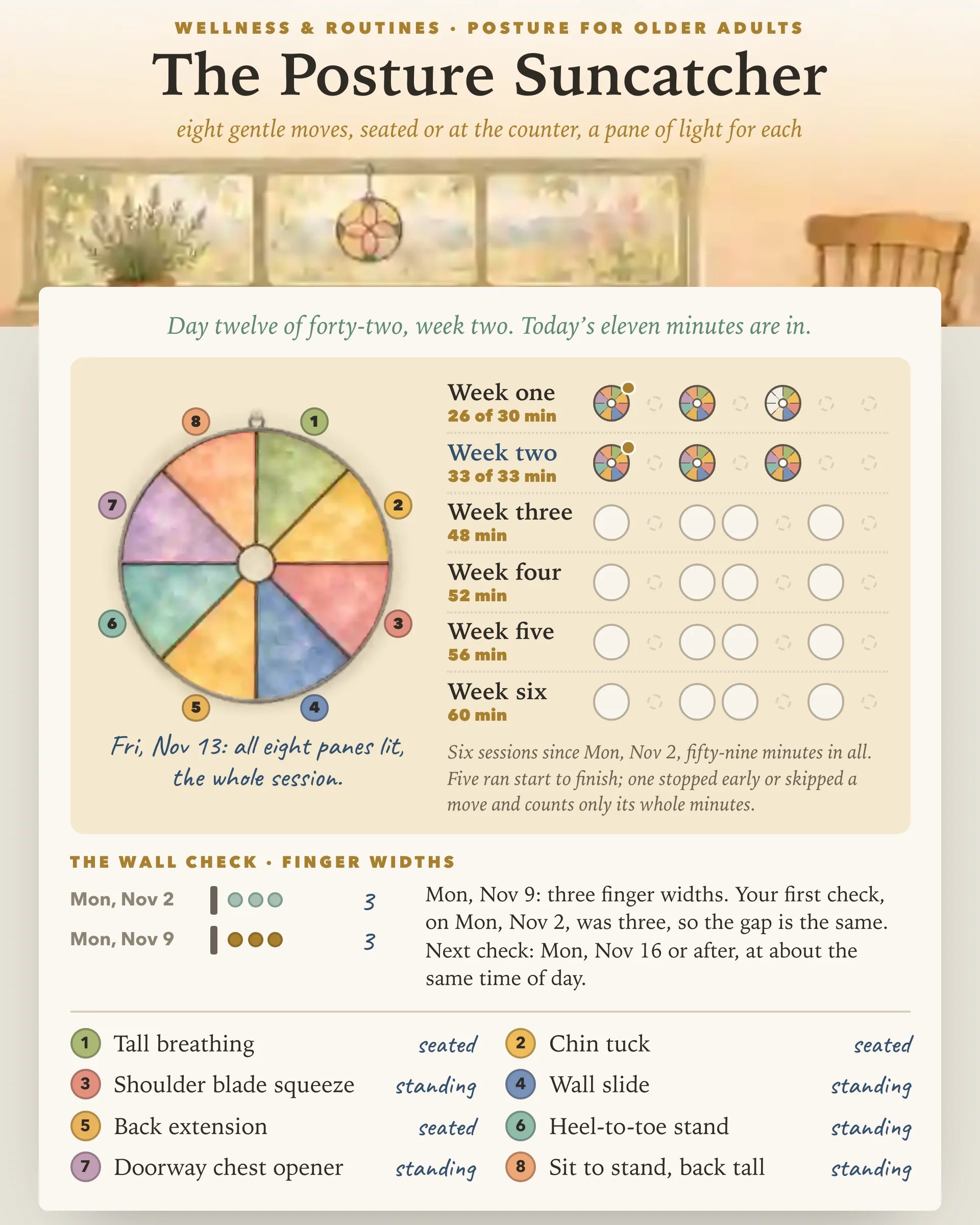
These posture exercises for elderly readers need only a sturdy chair and the kitchen counter. All eight gentle moves have a seated version, so you can begin sitting down and stand only when that feels right. A timer guides you, and a painted suncatcher fills pane by pane, one pane for each move.
See a doctor first if your upper back has started to round suddenly or it hurts, if you have had a fall, or if you have osteoporosis or a past spine fracture. A back that rounds quickly can come from an unnoticed break in a spinal bone, which needs a diagnosis before exercise. With osteoporosis, avoid bending forward under a load, such as rounding over to pick up a laundry basket; hinge at your hips and keep your back long instead.
Check with a doctor or physical therapist before you begin if you have had dizzy spells, a joint replacement, a heart or blood pressure condition, or pain right now. Stop any move that hurts, and keep the counter or a chair within reach whenever you stand.
Each seated version is spelled out on the sheet, from a chair-back chin tuck to leaning your weight onto your feet instead of standing.
Choose seated or standing for each move and press begin: each move gets a short get-set, then its holds, each followed by a rest. The clock keeps real time: it catches up if the screen dims, and a pause never counts.
A hold counts only when its full time runs. Each finished hold fills part of its move's pane, which is lit to the rim once every hold is done. Stop early and the session keeps its whole minutes only; skipped time never comes back. The plan lasts six weeks: three sessions a week of ten, then eleven minutes, then four a week growing to fifteen.
Once a week, before that day's moves, stand with your heels, hips and shoulder blades against a wall, a chair or the counter within reach. Look straight ahead with your chin level and count how many fingers, laid sideways, fit between the back of your head and the wall. Never tip your chin up to close the gap, and keep the same shoes and time of day.
The page reads each check only against your own first one and the one before it, with no score and no normal range. In a 2004 review of examination signs in women, any gap at the back of the head made an unnoticed spine fracture more likely, yet no single sign could rule a fracture in or out without further tests. Treat your number as a note for your next appointment, and see your doctor sooner if the gap grows quickly or your back starts to ache.
A 2014 systematic review gathered exercise studies in adults aged 45 and over with a pronounced upper back curve. Eight of its thirteen studies found an improvement in at least one posture measure, but the evidence was too thin and uneven for the authors to combine into a single estimate.
A later six-month trial of 99 adults aged 60 to 88, all with a curve of 40 degrees or more, offered hour-long group classes led by a physical therapist three times a week. On X-rays, their curve shrank by about three degrees more than in a group who attended four health talks, yet walking speed and the other physical function tests did not differ. That is far more supervised work than this routine, so the page makes no promise about the shape of your spine.
For people with osteoporosis, an international expert panel recommended daily balance practice and endurance work for the back muscles, hinging at the hips in everyday tasks, and a physical therapist's advice after a spine fracture, above all with pain or a marked curve. This page's heel-to-toe stands, back extensions and sit to stand follow that direction as a home routine, not a treatment plan.
The Plumb Line Posture Plan is a four-week routine at a door frame, a chair and a wall, with a weekly check of how your head, shoulders and hips meet the wall. This page is written for older adults: every move starts seated, two of the eight practice steadiness and rising from a chair, and the wall check counts one gap in finger widths. For held yoga poses instead, Swallows on the Wire opens the chest and upper back. If balance is your main concern, The Balance Ladder climbs ten holds at a counter, and The Whole-House Strength Routine builds leg and arm strength for daily tasks.
Gentle moves for the upper back, neck and shoulders, plus a little balance and getting up from a chair with a long back. No study names one best list, so choose moves you can repeat several days a week without pain. This page uses eight, from chin tucks to a doorway chest opener.
Yes. Every move on this page has a seated version in a sturdy chair without wheels, including the heel-to-toe stand and sit to stand. Move to the standing versions at the counter only when the seated ones feel steady.
Many are, but ask your doctor first, and a physical therapist if you have had a spine fracture. Expert advice for osteoporosis favors work for the back muscles and balance practice, and steers away from bending forward while carrying a load. Hinge at the hips and keep your back long.
The evidence is modest. In a six-month trial with three supervised classes a week, the curve ended about three degrees smaller than in a comparison group, with no difference on physical function tests. Treat these moves as practice for strength and ease, not a promise about the shape of your spine.
The gap between the back of your head and a wall while you stand against it with your chin level, counted in finger widths. The page compares it only with your own earlier checks and gives no verdict. If the gap grows quickly or your back aches, show your checks to a doctor.
By the team behind Fabulous, the science-based self-care app used by over 30 million people.


