
The Overwhelm Recovery ProtocolWellness & Routines · ~5 min
About this template · Updated November 2026
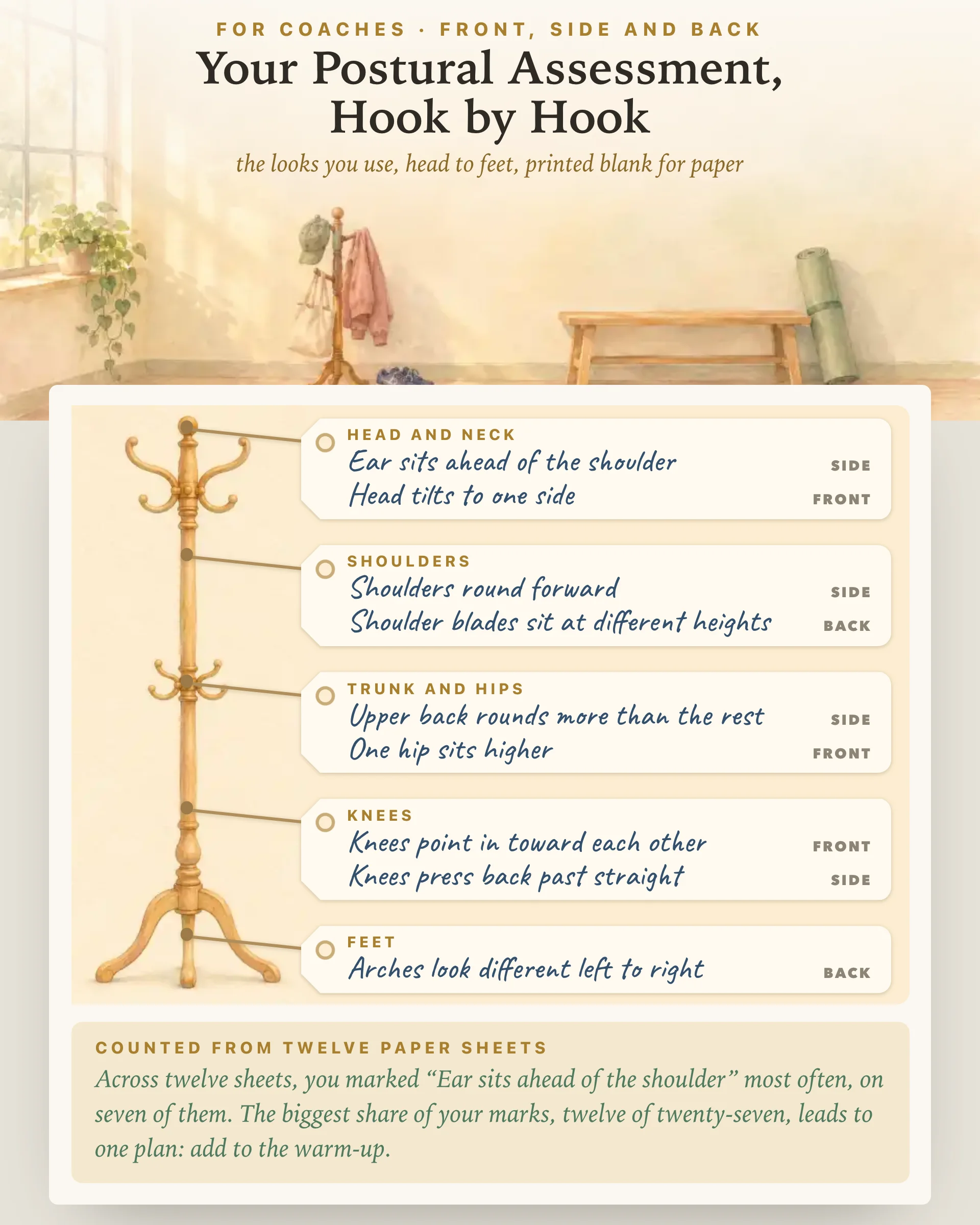
For a coach, a postural assessment is a few quiet minutes of looking. The client stands the way they usually do, and you note what you see from the front, the side and the back before you plan their training. This page sets that look up once. A painted coat stand stands in for the body, with a tag at each height from the head and neck down to the feet. You hang the looks you use at each height, word them your way, choose what you will do if you see each one, and print a blank sheet that you fill in by hand.
Standing still, a body shows how it settles today: one shoulder resting a little higher, the ear sitting ahead of the shoulder from the side, the knees pointing in. That gives you a starting picture to compare with how the same person squats, walks and reaches, and a few things worth asking about. It does not tell you why someone stands that way, whether it matters to them, or what will happen next. So write every look as something you can see, and never as the name of a problem.
Tap a height on the stand and a short list of looks for it appears below. Each one comes with the side you see it from, which you can change, and a plan for what you do when it shows up: look again in movement, ask whether it bothers them, add something to the warm-up, add a strength exercise, suggest a physical therapist checks it, or simply note it. Four looks fit at each height and twelve on the whole sheet, roughly what fits on one printed page and in a few minutes of standing.
Your own looks work too; keep them short and plain.
The page puts your looks in the order you will walk around the client: everything from the front first, then the side, then the back, head to feet within each. Every look gets three boxes, seen, not seen and unsure, with your plan printed under it. Two lines are fixed on every sheet. At the top sits a reminder to ask about pain, numbness, tingling or a recent injury before you start, and to skip the standing check and refer to a doctor or physical therapist if the answer is yes. At the bottom, a line says that what you see standing still does not predict pain or injury on its own.
The sheet is filled in by hand and stays with you. It asks for no photos, and nothing a client tells you comes back to this page.
When Fedorak and colleagues asked 28 clinicians to rate the curves of the neck and lower back in photographs of 36 people, agreement between clinicians was poor, and each one matched their own earlier rating only fairly well. Hold your reads of curves loosely, and lean on looks that are easier to see, like one side sitting higher.
Posture also predicts less than its reputation suggests. A systematic review by Christensen and Hartvigsen of 54 studies found no strong evidence tying the curves of the spine, seen from the side, to spinal pain or other health outcomes, though most of those studies were of low quality. Across 41 reviews, an umbrella review by Swain and colleagues found that the evidence had not settled whether spine postures or physical loads cause low back pain.
The picture is not empty. A meta-analysis by Mahmoud and colleagues pooled 15 cross-sectional studies and found that adults with neck pain held their heads farther forward than adults without it, while adolescents showed no such difference. Each study captured a single moment, so none can say whether the head position came first, the pain came first, or something else drove both. And none of these four papers tested whether changing how a client stands changes their pain.
After a standing check, add one sheet to the count, then add one to each look the paper marked as seen. The count holds only numbers: no names, no dates, no answers. Once a few sheets are in, it reads the counts back. It names the look you mark most, the plan most of your marks lead to, and, after five sheets or more, any look you have never marked, which may not need its place. That reading describes the people you coach as a group, so it can shape a group warm-up or the order of a first session. It says nothing about any one person's health.
Set it up before you add a standing look to first sessions, and print a fresh copy each time you change it. When a client wants something to do on their own, the Plumb Line Posture Plan is written for them rather than for you, while the daily stretching routine and the hip mobility routine can feed ideas into your warm-ups.
Pain, numbness, tingling or a recent injury belong with a doctor or physical therapist, never on this sheet.
It is a short, structured look at how someone stands, usually from the front, the side and the back. For a coach it is a starting picture to compare with how that person moves, not a test with a pass mark.
Common looks include whether the ear sits ahead of the shoulder, whether one shoulder or hip rests higher, how much the upper back rounds, which way the knees point and how weight spreads over the feet. This page offers looks like these at five heights and lets you word your own.
A trainer can watch and record what they see in order to plan training, as long as it stays an observation. Naming a condition, explaining pain or treating it is work for doctors and physical therapists, so the printed sheet sends any pain, numbness, tingling or recent injury their way.
The research is less certain than the advice. Reviews have found no strong link between the curves of the spine and back pain, and in adults a forward head goes along with neck pain without showing which came first. That is why this sheet treats what you see as a description, never a prediction.
Yes. You can hang your looks and print the blank sheet right on this page. Personalize keeps your stand in a free Salon account from the makers of Fabulous, so you can change a look later without starting over.
By the team behind Fabulous, the science-based self-care app used by over 30 million people.


