
The Overwhelm Recovery ProtocolWellness & Routines · ~5 min
About this template · Updated November 2026
Your core is not one muscle but a cylinder: the muscles down the front and sides of your trunk, the long muscles along your spine, the deep layer wrapped around your middle, with your breathing muscle and pelvic floor closing it at the top and bottom. Core strength is that cylinder holding steady while your limbs move. This page builds it with yoga poses held for counted breaths, and promises nothing about the shape of your belly.
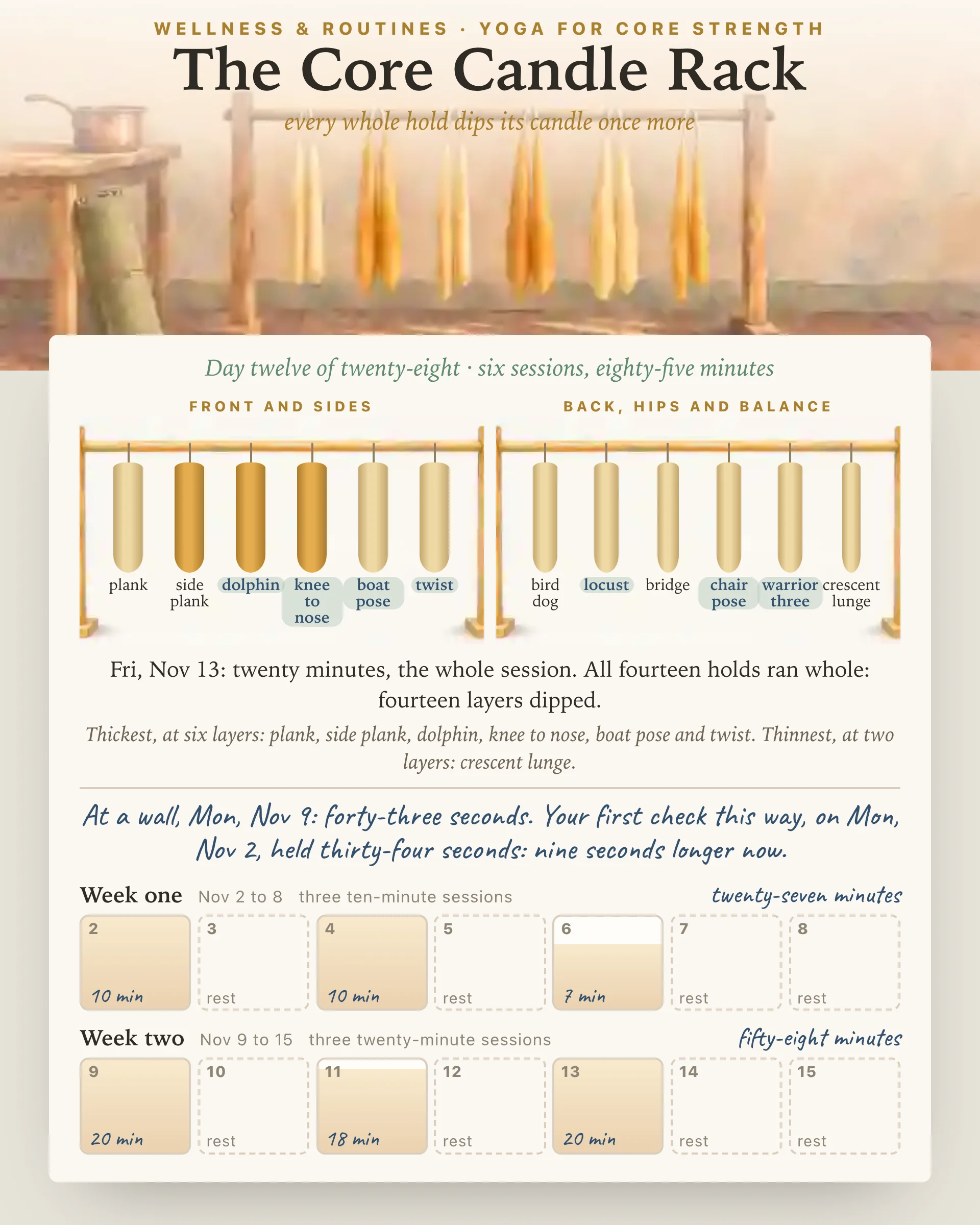
Twelve poses hang as hand-dipped candles on two racks. One holds the front and sides of your trunk: plank, side plank on the knee, dolphin at a wall, tabletop knee to nose, boat pose with your hands behind your thighs, and a low lunge twist. The other holds the back, hips and balance: bird dog, locust, bridge, chair pose, warrior three with your hands on a chair, and a crescent lunge with your arms forward.
Each pose has three levels: plank goes from a wall to a kitchen counter to the floor on your knees. The breaths climb too, from five slow breaths to six to eight. Every pose is held twice, right side then left where it has sides, in one-minute slots: ten seconds to get set, the hold, and the rest of the minute to ease out.
A session is ten, twenty or thirty minutes. Ten minutes is a two-minute warm-up, three poses of two minutes each and two minutes resting on your back; twenty is three, seven poses and three; thirty is five, ten poses and five. The thinnest candles go first, standing poses before floor ones, and a tap on any candle takes it out of today or asks for it.
The rule: a hold dips its candle only when its whole time runs. A skipped or stopped hold adds no layer, and a session ended early keeps only its whole minutes. When both holds of a pose ran whole in your last two sessions with it, the page offers the next level, and any level can go back down.
Week one is three ten-minute sessions and week two three of twenty. Week three adds a fourth day, and week four stretches two sessions to thirty minutes.
Once a week, time one plank, at a wall or on your forearms, and stop when your hips sag or rise or your breath catches. A timed plank is a fair yardstick for your own progress: in a study of the prone bridge test, 60 adults aged 20 to 35 and 60 aged 60 to 79 held a plank to their limit twice, five to nine days apart, and their two times agreed closely. Younger and more active people held longer, so this page compares you only with yourself.
The yoga trials on trunk strength are small. In a Slovenian study of hatha yoga with stabilizing exercises, 72 healthy adults aged 20 to 45, most of them women, either practiced for an hour twice a week for three months or carried on as usual. The yoga group held three of four trunk endurance tests longer at the end, but people were not assigned at random, and the authors name that as a main weakness.
A Hong Kong trial of twelve weeks of hatha yoga put 173 adults with an average age of 52 into yoga or a waiting list. The yoga group did better on a curl-up test, yet the older participants, looked at on their own, did not improve on curl-ups compared with their controls.
Neither shows that yoga is the best route to a strong middle, and neither followed people for long. Both fit the ordinary rule of strength: it builds from regular work over weeks, not from one hard session.
Breathe out on the effort, and never hold your breath or push down as if straining. Leaking, or heaviness or bulging low in your pelvis, means staying at level one and seeing a doctor or a pelvic floor physical therapist.
With osteoporosis or low bone density, turn on the bone switch, which leaves out boat pose and the twist. The caution comes from a case series by a rehabilitation physician at a large US medical center: three people with low bone mass developed pain or spinal fractures after yoga poses that round the spine. Three cases cannot show how often this happens, but they justify the caution.
Check with a doctor first if you are pregnant or had a baby in recent months, have had back or belly surgery or a hernia, have glaucoma or blood pressure that is not under control, or have back pain running down a leg. Stop anything that hurts sharply or makes you dizzy.
The Deep Core Geode works the same muscles with Pilates mat moves. The Core Rings never goes down to the floor, and The Standing Cairn keeps you on your feet throughout. The Yoga Mannequin teaches yoga from scratch, two poses a week. This page is for held yoga poses aimed at your trunk, with levels to climb.
It can, in the same way other strength work does: by holding poses that load your trunk a few times a week, for weeks on end. The studies are small. One followed 72 healthy adults through three months of twice-weekly hatha yoga and found longer trunk holds, without assigning people at random.
Poses that ask your trunk to stay still against gravity: plank, side plank, dolphin, boat pose, bird dog, locust, bridge, chair pose and warrior three. Each has a version at a wall or a chair, so the best one for you is the level you can hold while breathing steadily.
Held poses work the muscles that keep your trunk steady, and they get harder as you move up a level. They load your arms and legs only with your own body weight, so weights or bands go further for big gains there. Many people do both.
Three or four days a week, as this plan sets out, with a rest day between most sessions. Guidelines for adults suggest muscle-strengthening activity on at least two days a week, and steady weeks matter more than any single long session.
With osteoporosis or low bone density, leave out poses that round or turn the spine under load, such as boat pose and the low lunge twist. After a baby, or with leaking or a heavy feeling low in the pelvis, ask a doctor or a pelvic floor physical therapist before core work.
By the team behind Fabulous, the science-based self-care app used by over 30 million people.


