
The Overwhelm Recovery ProtocolWellness & Routines · ~5 min
About this template · Updated November 2026
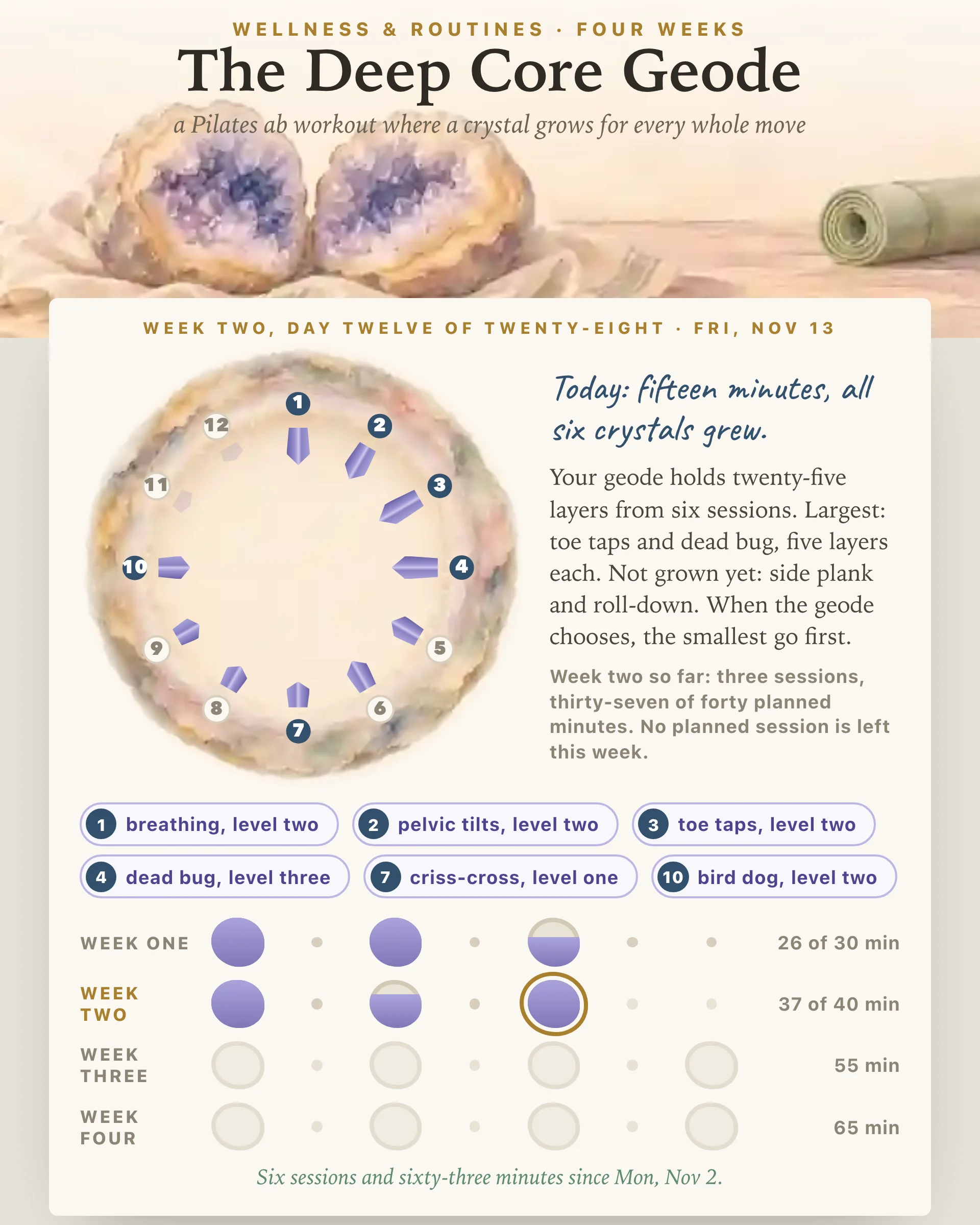
Credit first. The mat moves here come from the method Joseph Pilates built in the early twentieth century and called Contrology, and Penelope Latey's paper on its history and philosophy traces where it came from and what it set out to do. The geode is an independent worksheet: nobody who teaches under his name or certifies Pilates instructors wrote it, reviewed it or stands behind it.
A Pilates ab workout is slower and smaller than most people expect. You breathe out long, keep your low back still, and let your arms and legs move around a quiet middle. Most of the effort lands in the deep layer of the belly, the muscle that wraps your trunk underneath the ones you can see.
The moves run in the order a mat session should go: breathing with a long exhale, pelvic tilts, toe taps and dead bug on your back; then the hundred, single-leg stretch and criss-cross, the three that can curl your head up; a side-lying leg lift; swimming on your belly; bird dog on hands and knees; side plank on the knee; and a roll-down to finish sitting. Level one of every curling move keeps your head on the towel. Level three asks for longer reaches or longer holds, never for speed.
Each move runs two and a half minutes: fifteen seconds to get set, a minute, fifteen seconds to rest or switch sides, and a second minute. Ten minutes holds four moves, fifteen holds six and twenty holds eight.
Pick a length and the geode suggests the moves whose crystals are smallest, so over four weeks every move gets its turn. Tap moves in or out, set a level for each, and press begin. The clock keeps real time even when your phone locks, and a crystal grows a layer only when its move runs its whole time. Skip a move or stop partway and that crystal stays as it was; a stopped session keeps its whole minutes and nothing more.
Below it, four weeks of small stones fill as the minutes go in: three sessions a week at first, then four, from ten minutes up to twenty. The reading names your largest crystals and the ones that have not grown yet, which is usually the side work people quietly skip.
The evidence on Pilates and the core is real but small. In a pilot trial from a London university's physical therapy department, 34 pain-free gym members around thirty years old did Pilates mat exercises or ordinary strength training twice a week for eight weeks, on their own. Ultrasound showed the deepest belly muscle thicker in the Pilates group during the head-down hundred, a sign it was working harder. It did not change at rest, sitting or standing, and the strength group showed more activity in a second belly muscle during the same moves.
In a twelve-week class trial of 50 active middle-aged men and women, two one-hour mat sessions a week improved abdominal endurance, hamstring flexibility and upper-body endurance compared with a control group. Posture and balance did not improve.
None of it shows a flatter stomach. In a six-week trial of 24 sedentary adults, seven ab exercises five days a week left body fat, belly fat and waist size no different from a group that did nothing, though the exercisers managed more curl-ups. For low back pain, a Cochrane review of 10 trials with 510 people found low to moderate quality evidence that Pilates eases pain and disability more than doing little, and no clear sign that it beats other exercise.
Breathe out as you work, and never hold your breath and bear down. If you leak, feel heaviness, or see a ridge rise down your belly as you curl up, stay at level one and see a pelvic health physical therapist. A review of exercise for stress urinary incontinence found seven trials of other approaches, two of them Pilates, and no convincing evidence that any of them reduced leaks, which is why pelvic floor muscle training stays the exercise to ask about.
With osteoporosis or low bone density, mark the first check and the four curling moves leave the session. The 2022 UK consensus statement on exercise for osteoporosis, written by a multidisciplinary expert group, advises against a high degree of forward bending of the spine in exercise and daily life. For your back, keep every move small enough that your low back stays still, and stop any move that hurts.
The 30-Day Ab Challenge ramps five moves up day by day, and The Standing Cairn keeps the work off the floor. If Pilates itself is new, The Beginner's Pilates Mat brings in one move a week. This page sits in between: slow mat moves for the deep core, at the level you choose, counted only when you finish them.
Check with a doctor or physical therapist before you start if you are pregnant or had a baby in the past year, have had back or belly surgery or a hernia, or live with a heart or blood pressure condition.
Start on your back with the moves that teach control before effort: a long breath out, small pelvic tilts, heel slides and a dead bug with the arms only. Once your low back stays still through those, add the hundred with your head down, side-lying leg lifts and bird dog on hands and knees.
Small trials say it helps. In a trial of fifty active middle-aged adults, twelve weeks of twice-weekly mat classes improved abdominal endurance against a control group, and an eight-week pilot found the deepest belly muscle working harder during the head-down hundred. Neither showed that the change carried over into posture, balance or everyday sitting and standing.
No exercise takes fat off one spot. In a six-week trial, adults who did ab exercises five days a week ended with the same belly fat and waist size as a group that did none, though they could do more curl-ups. Expect a steadier, stronger middle rather than a different shape.
Usually, with changes. If you leak, feel heaviness or see a ridge down your belly when you curl up, keep your head down at level one and see a pelvic health physical therapist. With osteoporosis, leave out the moves that curl your spine forward, as a 2022 UK consensus statement on exercise for osteoporosis advises.
No. It is an independent worksheet built on mat moves that come from the method Joseph Pilates developed, and no Pilates school, studio or instructor certifier made or approved it.
By the team behind Fabulous, the science-based self-care app used by over 30 million people.


