Leaves on a StreamEmotional Fitness · ~3 min
About this template · Updated September 2026
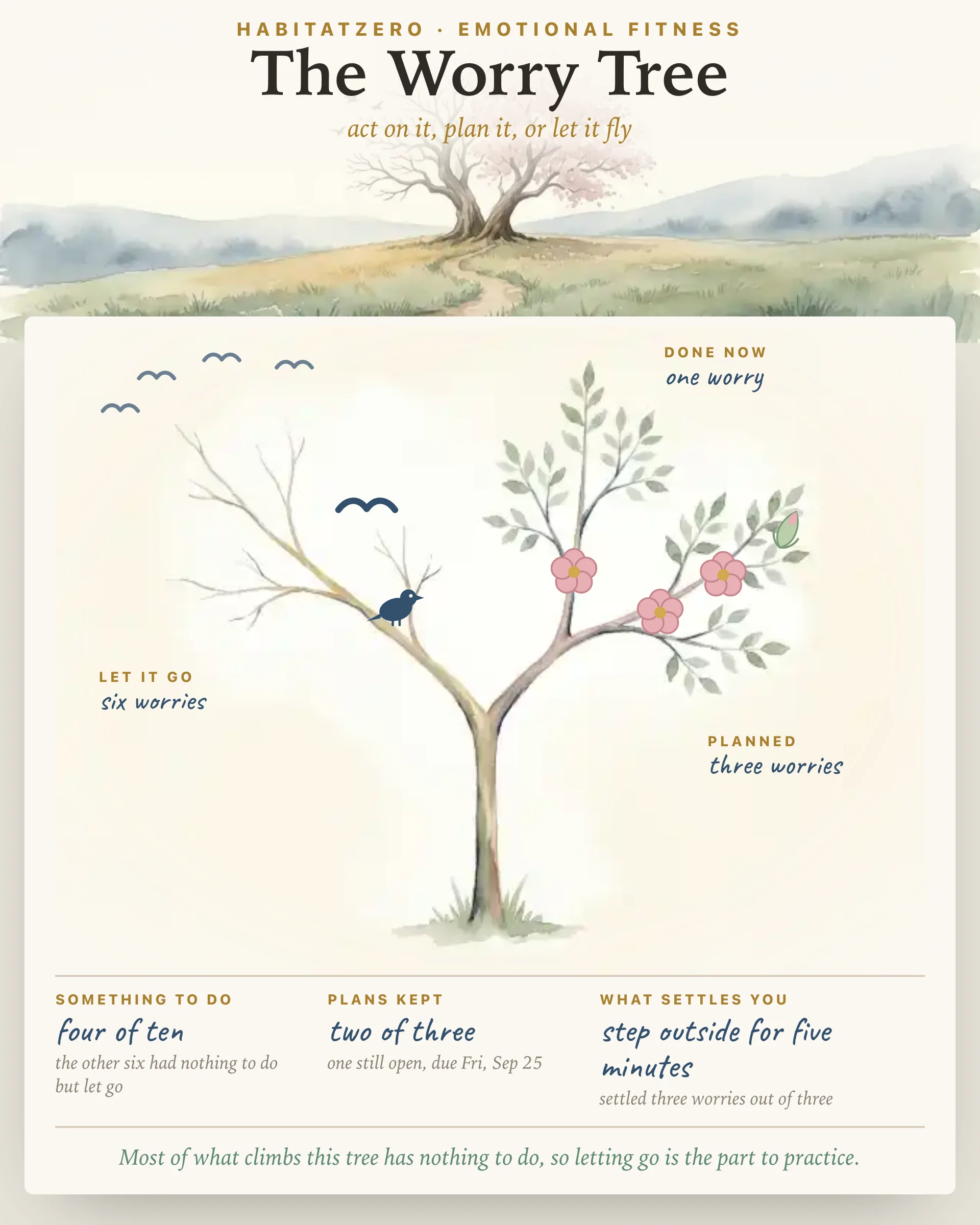
The worry tree comes from clinical psychologist Gillian Butler and psychiatrist Tony Hope, who set it out in their self-help guide Manage Your Mind. The book first came out in 1995 and is now in a third edition from Oxford University Press, written with Nick Grey and sold in the US as Managing Your Mind. What you see here is our own interactive version of their tree. Butler, Hope and their publisher had no part in making it, and they have not reviewed or endorsed it.
The tree starts where worry starts: you notice it. Then you pin it down in words, because "something about money" cannot be answered and "the bill due Friday" can. Then comes the question the whole method turns on. Is there anything you can do about it?
If the answer is no, the worry is a what-if, a waiting game, or a thing that sits in someone else's hands. You let it go and move your attention somewhere else on purpose. If the answer is yes, you work out what you will do and when. If it can be done now, you do it. If it can't, you give it a day. Then, and this is the part people skip, you let the worry go on that branch too.
Every branch of the tree ends in the same place. What changes is what you do before you get there.
Worry dresses up as problem solving. It feels busy and responsible, like thinking something through, but mostly it circles. A study by Graham Davey found that how much people worried was unrelated to how well they could solve problems. What went with heavy worry was low confidence in their own problem solving and a weak sense of control over it, which Davey read as trouble carrying solutions out rather than trouble finding them.
That is why the tree does not stop at yes. It asks for the step and for a time. A plan with a day attached is something you can finish, and a finished plan leaves the worry with nothing to do.
For a what-if, an honest no matters just as much. No amount of turning over "what if the flight is bumpy" will produce a step, because there isn't one. Saying so is your permission to stop.
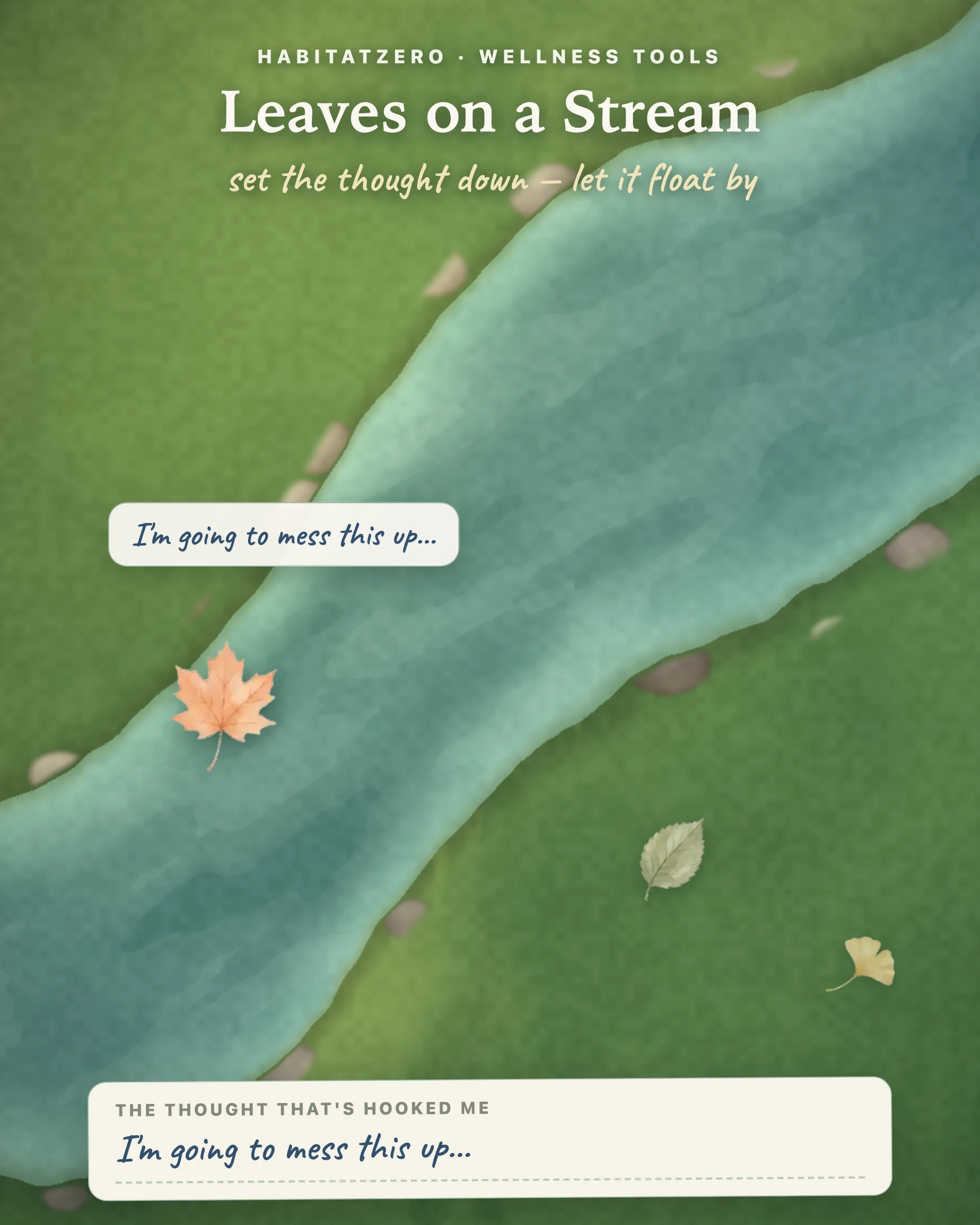
Write the worry in a few words, or tap one of the examples. The fork asks its question. Choose no and the page goes straight to letting go. Choose yes and it asks for the step and when you will take it, from right now to next week.
Every path finishes by choosing where your attention goes next: back to what you were doing, five minutes outside, five things you can see, or a move of your own. Then the worry leaves the path and comes to rest on the painted tree. A worry you let go becomes a bird. One you dealt with right away blossoms. One you planned waits as a bud, opens when you mark it done, and dries up if the plan fell through.
Come back later and check in. Did the let-go worry settle, or did it come back? A worry that returns can be walked up the tree again, and sometimes the second walk turns up a step the first one missed.
Under the tree, three readings build from your own entries: how many of your worries had something to do, how many of your plans happened, and which attention move has kept worries quiet most often. Give the first reading a couple of weeks and it shows how much of your worrying ever had a job to do. The tree holds twelve worries, so clear out the settled ones as you go.
No trial has tested the worry tree on its own, and this page is a self-help tool, not treatment. What the tree does is package moves from cognitive behavioral therapy for chronic worry. One such program, run in small groups for people with generalized anxiety, combined problem-solving training with a second look at the belief that worrying helps and what its authors call cognitive exposure, facing a feared outcome in imagination. Participants improved more than a wait-list group, and their gains kept growing over two years of follow-up.
The National Institute of Mental Health describes generalized anxiety disorder as worry that is hard to control on most days for at least six months, and it calls CBT the gold-standard talk therapy for it. If that sounds familiar, or if worry is constant or overwhelming, a therapist or doctor can help, and this tree can come along to your sessions.
Use it the moment a worry starts to loop, one worry per walk. If the same what-ifs return day after day, the Worry Journal gives them a set window so they stop taking over the afternoon. If a dozen worries are tangled together, The Circle of Control sorts the whole pile by how much say you have. And if the worry is really a prediction you half believe, test it against the evidence in the Thought Record Journal.
It is a short decision path for one worry at a time, set out by Gillian Butler and Tony Hope in their self-help book Manage Your Mind. You name the worry, ask whether anything can be done about it, and then act on it, schedule it, or let it go and give your attention to something else.
Walk one worry at a time. If there is a step you could take, decide what it is and when, then either do it now or put it on your calendar. If there is no step, pick something else to give your attention to. Every branch ends the same way, with the worry set down for now.
A practical worry is about a problem in front of you today, like a bill or a leak, and it usually has a next step. A hypothetical worry is a what-if about something that has not happened and may never happen. There is nothing to act on yet, so the tree sends it to letting go.
Yes. It grew out of cognitive behavioral therapy for worry, which pairs problem solving for real problems with ways of stepping back from what-ifs. Used on your own it is a self-help exercise rather than treatment, and if worry is constant or overwhelming, a therapist can help.
Browsing the filled-in example on this page needs no account. To walk your own worries and keep your tree growing between visits, open it in HabitatZero with the Personalize button, which costs nothing.
By the team behind Fabulous, the science-based self-care app used by over 30 million people.