Leaves on a StreamEmotional Fitness · ~3 min
About this template · Updated September 2026
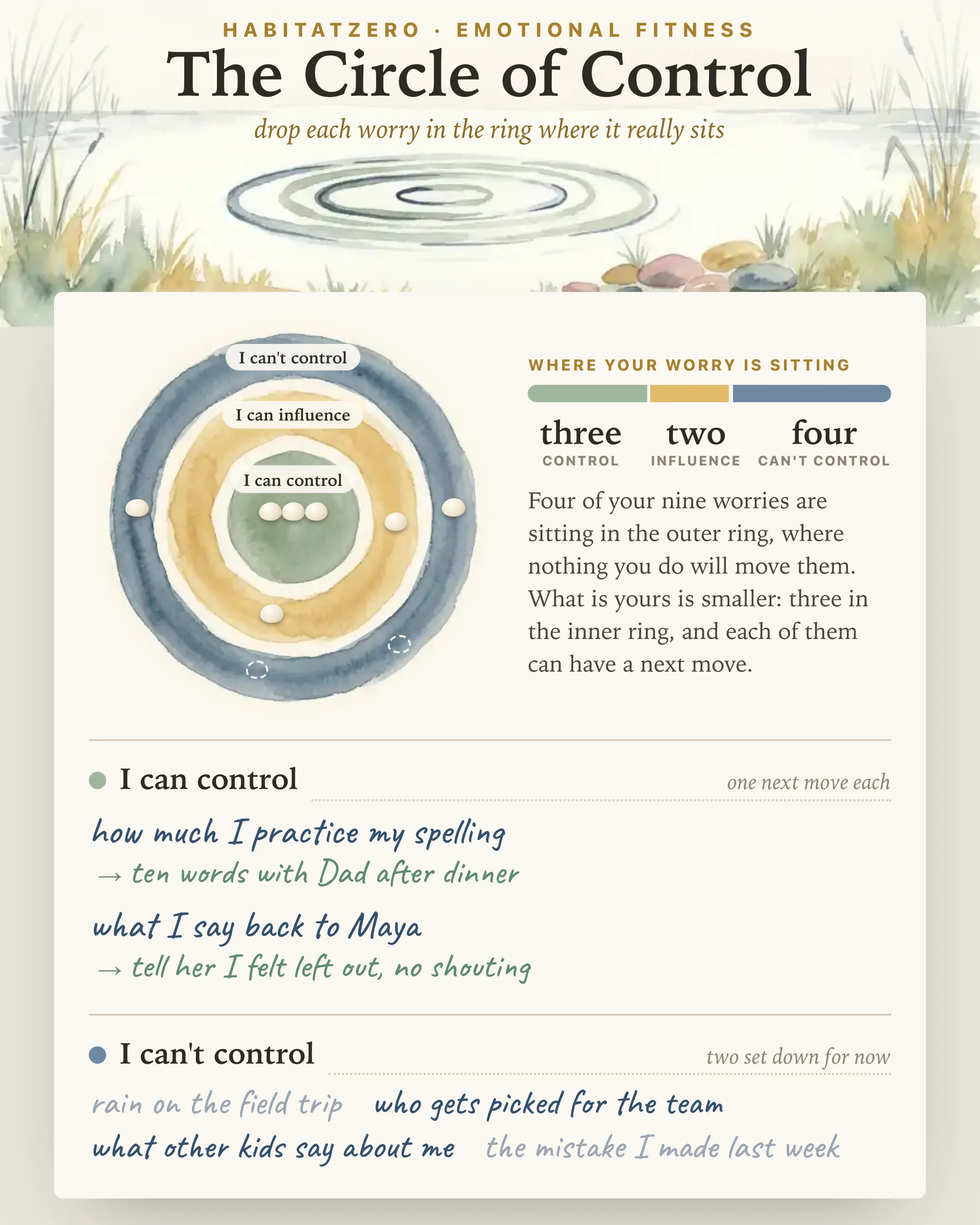
Stephen R. Covey drew a Circle of Concern with a smaller Circle of Influence inside it in The 7 Habits of Highly Effective People, and FranklinCovey's own summary of Habit 1 still describes the pair that way. The three-ring drawing on this page, with control at the center, is the adaptation that school counselors and therapists have made common since. This worksheet was built separately from Covey's company, which had no hand in it and has not reviewed or approved it.
The idea underneath is far older than the book. Epictetus, teaching around the year 100, sorted everything into what belongs to your own choosing and what lies outside it, and the Stanford Encyclopedia of Philosophy calls that split the foundation of his system of value. What Covey added was the middle band: a home for things you cannot decide but can nudge.
Most real worries are a knot of all three. The test on Friday is an outer-ring fact, because it is happening whatever you do. The grade is a middle-ring outcome. Tonight's studying is an inner-ring job. The skill these rings teach is untying that knot, so your effort goes to the one strand that answers to effort.
You begin by emptying your head. Tap a suggested worry or write your own, and each one becomes a pebble in your hand. Then tap the ring where that worry really sits, and the pebble drops in. Twelve pebbles is the ceiling, because a longer list becomes a second thing to worry about.
Then the sheet does what paper cannot. It counts the pebbles ring by ring, draws the proportions as a bar, and tells you in a sentence where your worry is sitting. The usual surprise is how much lands in the outer ring, the one place where thinking changes nothing.
Every worry in the inner ring gets a line for one next move, small enough to do today. "Ten words with Dad after dinner" is a next move. "Get better at spelling" is not. If you are stuck, a row of starter moves fills the first empty line. Worries in the outer ring get a different verb. You can set one down for now, and its pebble goes hollow on the board. It has not vanished. You have only stopped carrying it.
The rings carry a second, plainer label for exactly this use: up to me, I have a say, not up to me. Sit beside the child, let them name the worries, and type for them if that is quicker. Resist correcting where a pebble lands. A child who drops "Mom and Dad arguing" into the inner ring has just shown you something you needed to know, and the talk that follows matters more than a tidy board. Ask which part of it is up to them, then let them move the pebble. Finish on the inner ring, with one next move the child chooses.
Nobody has run a trial on a three-ring diagram, and this page does not claim to treat anything. The support is indirect. A meta-analysis covering close to fifty-nine thousand participants found that flexible coping goes with better psychological adjustment, a small to moderate link overall. The link was stronger in studies that measured strategy-situation fit, which is the match between how you cope and what the situation actually allows. Sorting worries by how much say you have is a way of practicing that match on purpose.
For children, a review by Chorpita and Barlow argued that early experience of having little control may build a habit of reading later events as out of one's hands, and that this habit may leave a child more open to anxiety. That is a good reason to help a child find the ring that is theirs. It is not proof that a worksheet prevents anything.
The rings can also be misused. "Not up to me" is never a reason to stay quiet about unfair treatment or an unsafe situation, and for a child, telling a trusted adult always counts as an inner-ring move. If worry is constant, costs you sleep, or keeps a child out of school, take that to a doctor or a licensed therapist and bring the filled-in rings along.
Use it when everything feels equally urgent: Sunday night, the week before exams, the evening after a rough day at school. If the outer ring keeps refilling with the same fears, the Worry Journal gives them a fixed appointment so they stop taking the whole day. If the hard part is making peace with what sits out there, The Open Hand works on that grip directly. If the Stoic root appeals to you, The Stoic Journal turns it into a morning and evening practice.
It is a drawing of three rings used to sort worries by how much say you have over them. The center holds what you can control, the middle band holds what you can influence, and the outside holds everything else. Sorting shows you where effort will pay off and where it will not.
Control is what you decide alone, such as your effort and your words. Influence covers outcomes you can nudge but not decide, such as a grade or a friendship. Concern is what you care about yet cannot change, such as the weather, the past or the choices other people make.
Stephen Covey introduced the Circle of Concern and the Circle of Influence in The 7 Habits of Highly Effective People in 1989. The three-ring version with control in the middle is a later adaptation by counselors and teachers, and the root idea goes back to the Stoic philosopher Epictetus. Covey's company did not make, review or approve this worksheet.
Use the plain labels on the rings: up to me, I have a say, not up to me. Let the child name a worry, ask which ring it belongs in, and leave the first answer uncorrected. Then ask which part of it is up to them and choose one small thing to do about that part.
You can study the filled-in example here without an account. To sort your own worries and have the rings remember them, open the sheet in HabitatZero through the Personalize button. There is no charge.
By the team behind Fabulous, the science-based self-care app used by over 30 million people.