Leaves on a StreamEmotional Fitness · ~3 min
About this template · Updated September 2026
Seneca kept a journal, and he tells us exactly how he used it. In his essay on anger he describes the philosopher Sextius closing each day with three questions, then admits he does the same: once the lamp is out and his wife has stopped talking, he goes back over the whole day, hiding nothing from himself, because the point is not to feel bad but to be able to say "see that you never do that again." Marcus Aurelius worked the other end of the day. Book Two of the Meditations opens with a morning rehearsal: today I shall meet the busy-body, the ungrateful, the arrogant, the deceitful, the envious. Neither man was being gloomy. They were making sure the day could not ambush them.
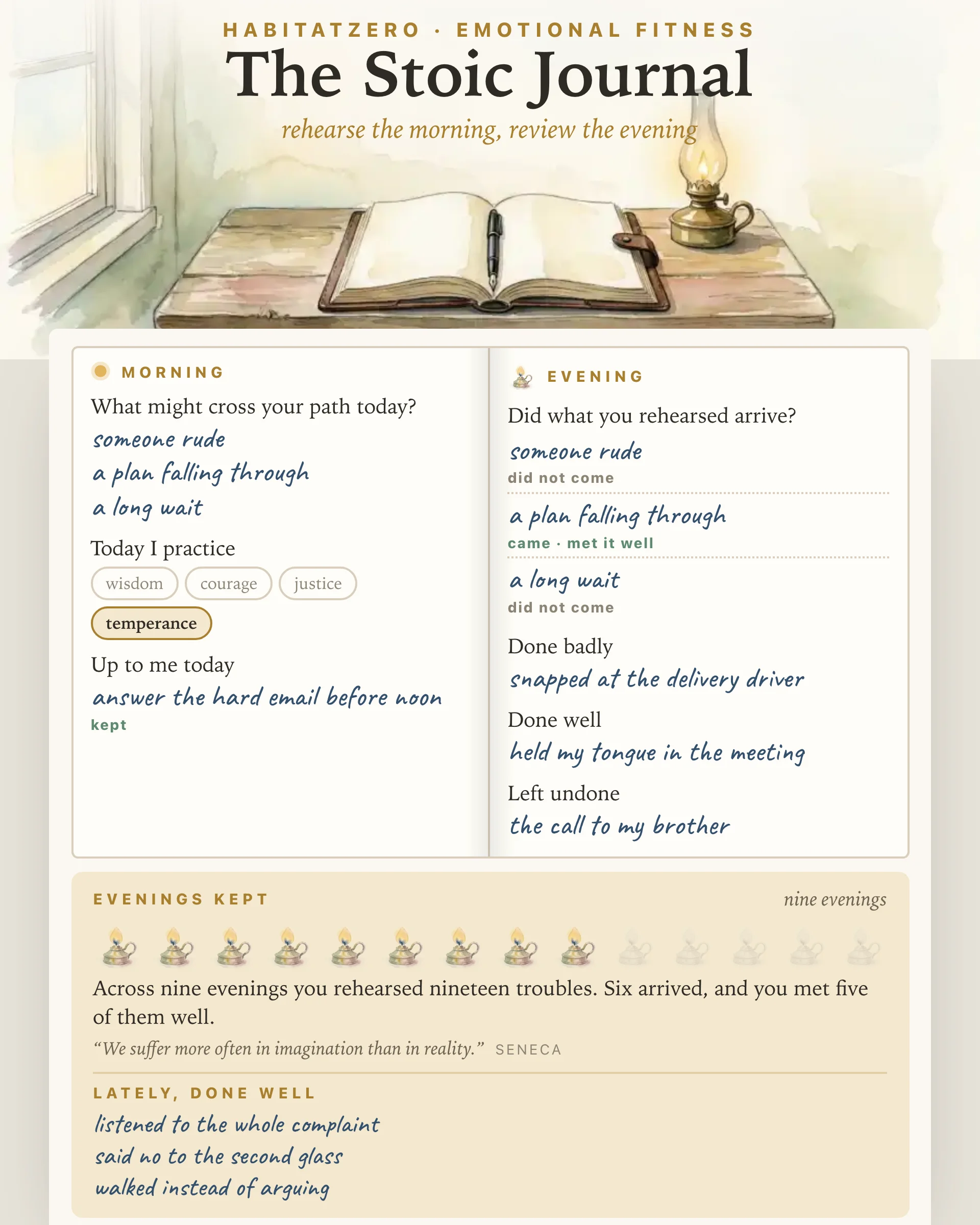
This page puts those two habits on facing leaves of one journal and adds what paper never could: a score of how much of what you rehearsed ever showed up.
Three things, none of them long. First, rehearse. The leaf offers a handful of ordinary troubles (someone rude, a delay, bad news, a plan falling through) and you tap the ones that might plausibly cross your path, up to four, or name your own on the line beneath. Four is a deliberate ceiling; rehearsing everything is just worrying with extra steps.
Second, choose one of the four Stoic virtues to practice today: wisdom, courage, justice or temperance. One, not all four, so that in the afternoon you can ask whether you are doing it.
Third, write one thing that is up to you today, whatever else happens. That line is Epictetus. The Enchiridion begins by sorting the world into what is in our control, our opinions, pursuits, desires and aversions, our own actions, and what is not: our bodies, our property, our reputation. A morning that ends with one line from the first category has a spine.
Seneca's three questions, in Aubrey Stewart's translation: what bad habit of yours have you cured today, what vice have you checked, in what respect are you better? The page asks them as three short lines: done badly, done well, left undone.
Before you write them, the leaf asks something Seneca could not. It lists the troubles you rehearsed that morning and asks, one by one: did it come? If it did, did you meet it well or lose your footing? Then it shows you the thing that was up to you and asks whether you kept it. When the leaf is honest enough, you close the day. A lamp lights in the ledger below and both leaves clear for tomorrow.
Every closed day lights one lamp. A running sentence beneath them keeps count: evenings, troubles rehearsed, how many arrived, how many met well. After a week or two the number is usually both uncomfortable and cheering: most of what you braced for never came.
Seneca said as much to Lucilius, that we suffer more often in imagination than in reality, and the data agrees with him more than you might expect. In a study that had people with generalized anxiety disorder write down their worries and then check the outcomes over thirty days, 91.4 percent of the worries did not come true, and the people whose worries failed most often improved the most. That is a clinical sample, not a promise about your week, but the mechanism is the one this page runs: predict, then check.
The "done well" line earns its place too. Writing down what went well each night was one of the exercises in Seligman's empirical test of positive psychology interventions, and a single week of it raised happiness and lowered depressive symptoms for months afterwards. That is why the ledger keeps your last few in view.
It is not the Daily Stoic Journal. That is a printed book by Ryan Holiday and Stephen Hanselman, and this worksheet is an independent piece of work with no connection to them or their publisher. The quotations on the sheet are from public-domain translations: Long for Marcus Aurelius, Stewart for Seneca on anger, Carter for Epictetus and Gummere for the letter to Lucilius.
It is not therapy either, and it gives no verdict on you; its only number is a count of what you predicted against what came. If the troubles you find yourself rehearsing are not ordinary ones, that count is a reason to talk to someone, not a reason to rehearse harder.
Morning, with the coffee, before anything with notifications. Evening, once the last screen is off, so the review happens by the lamp and not by the phone. Give it seven evenings before you judge the ledger.
If the trouble you keep rehearsing is one specific worry, park it in the Worry Journal instead and meet it at the appointed hour. If you want a nightly review without the Stoic framing, the Daily Reflection Journal asks a gentler three questions. And if the day's difficulty is a thought you cannot put down, the Thought Record Journal is cognitive therapy's descendant of the same Stoic idea.
Two leaves, two minutes each. The morning keeps the evening honest, and the evening teaches the next morning what is actually worth rehearsing.
A fixed structure for the two Stoic writing habits: a short morning entry that anticipates the day, and an evening entry that audits it. The template supplies the questions so you only supply the answers, which keeps each entry under a few minutes.
Marcus Aurelius opened Book Two of the Meditations by listing the difficult people he expected to meet that day. On this page that becomes rehearsing up to four likely troubles, choosing one virtue to practice, and naming one thing that is up to you whatever happens.
Seneca borrowed them from the philosopher Sextius: what bad habit have you cured today, what vice have you checked, in what respect are you better. The evening leaf asks them as three lines, done badly, done well and left undone, after you have judged whether the morning's rehearsed troubles actually came.
No. The Daily Stoic Journal is a printed book by Ryan Holiday and Stephen Hanselman, and this page has no connection to them or their publisher. It is an independent interactive journal built on the original texts of Seneca, Marcus Aurelius and Epictetus in public-domain translations.
The public page shows a filled example you can read but not edit. Personalizing it in HabitatZero is free and keeps your lamps and tally between days. A printed copy holds the day's two leaves but cannot count how many rehearsed troubles arrived, which is the part worth keeping.
By the team behind Fabulous, the science-based self-care app used by over 30 million people.