Leaves on a StreamEmotional Fitness · ~3 min
About this template · Updated September 2026
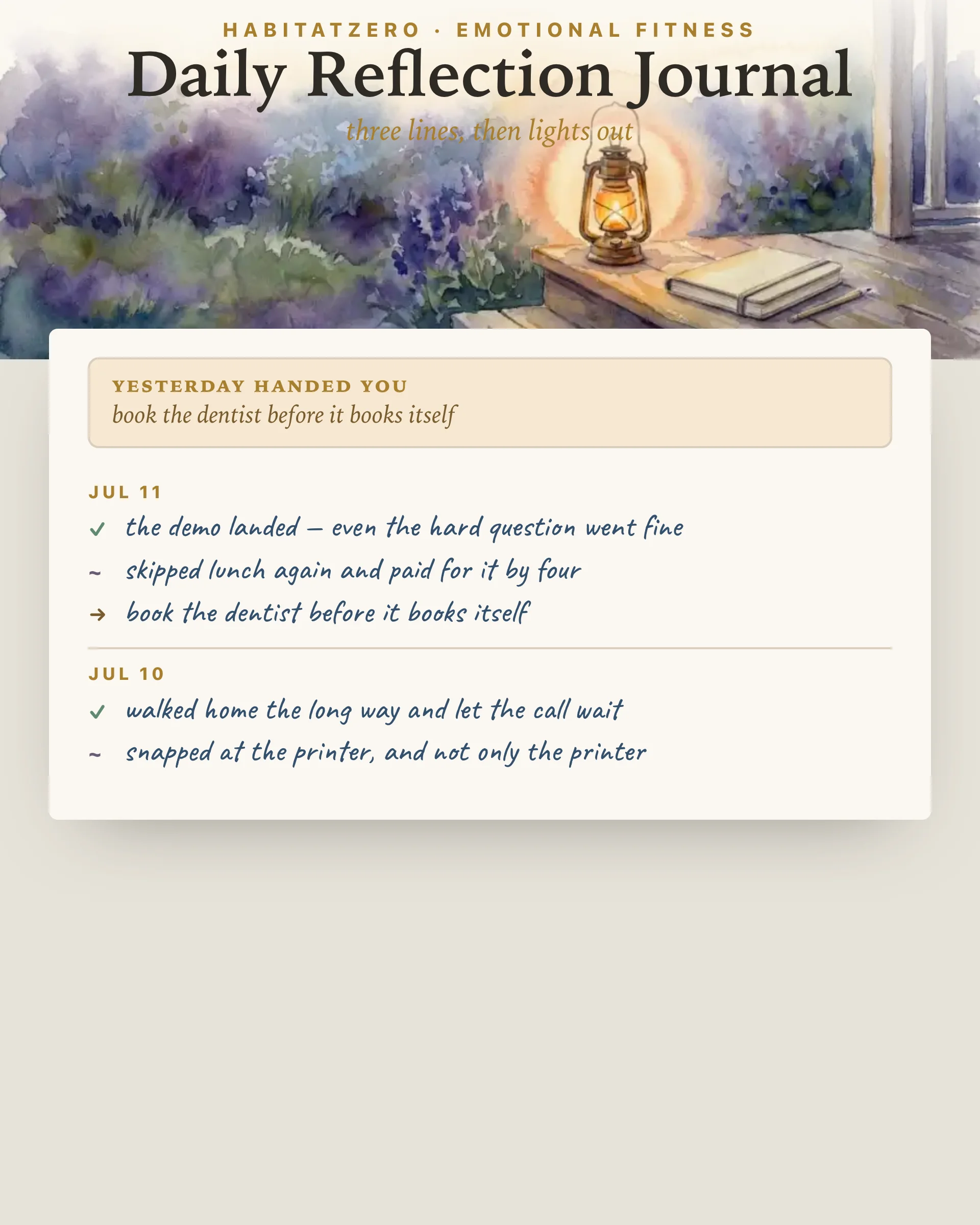
The graveyard of abandoned journals is full of beautiful ones — leather covers, thoughtful prompts, five entries. They die of the same cause: too much ceremony for 11pm. A daily reflection journal only works if it fits in the crack between brushing your teeth and turning off the light, which is why this one is built around a fixed trio you can answer at lights-out speed: what went well, what went rough, what carries forward.
Rotating prompts feel richer, and for deep work they are — that's what a dealt-question journal like the Self-Reflection Journal template is for. But a daily ritual lives or dies on friction, and a new question every night is friction: you have to understand it, weigh it, decide how to answer it, all with a day's worth of tiredness on board.
A fixed trio removes the deciding. By the fourth night the questions have stopped being questions and become slots — your attention goes straight to the day itself. One true thing that went well (small is fine). One thing that went rough (named, not litigated — the line matters). And the third slot, which is where this page earns its keep.
There's honest evidence behind the habit, too: field research on end-of-day written reflection found that a few minutes of reviewing the day measurably improved later performance compared with simply pressing on — the review is where experience converts into learning (DOI: 10.2139/ssrn.2414478). Three lines is a deliberately small dose of that, sized to be taken daily.
The third question — what carries forward — is optional, because some days genuinely close clean. But when you write one, something small and structural happens: tomorrow's page opens with it. Yesterday handed you: book the dentist before it books itself.
That single mechanic changes what the journal is. A pile of daily entries is a diary; entries that pass a baton are a thread. The dodged errand, the conversation owed, the bedtime actually meant — carried lines resurface at exactly the moment you're reflecting again, which is the moment you're most honest about whether they got done. It's the quiet version of what task apps do with badges and alarms, except it's in your handwriting and it doesn't beep.
Each trio files into the closed days — a compact strip of ✓, ~, and → lines, twenty-one days deep. Three weeks is the window on purpose: recent enough to re-read in one scroll, long enough to show the patterns that single days hide. The same rough entry three Thursdays running is not a Thursday problem; the page makes that visible without ever saying it.
When the page is full, the oldest day steps off as new ones close. No archive anxiety, no infinite scroll — a rolling three weeks of your actual life, closed properly.
And deliberately absent: a streak counter. Miss a night and the thread simply picks up where you do. Rituals that forgive get resumed; rituals that scold get abandoned — this journal is built to be resumed.
One line that went well. One line that went rough. If something should reach tomorrow, hand it forward — if not, close clean. Tap close the day, and go to bed with the day actually finished. Tomorrow evening the lantern is lit, the thread is waiting, and the whole ritual costs less time than deciding what to watch.
A nightly ritual page built around three fixed questions — what went well, what went rough, what carries forward — closed in about ninety seconds. Each new day opens with whatever the previous entry handed forward, so the days form a thread instead of a pile.
Because variety is friction at 11pm. A rotating prompt asks you to think about the question before you can think about the day; a fixed trio becomes automatic within a week, and automatic is what daily practices need to survive the tired nights — which are precisely the nights worth closing properly.
The one thing tomorrow should pick up — an errand dodged, a conversation owed, a bedtime actually meant. It is optional, because some days genuinely close clean. When you do write one, it greets you at the top of the page the next evening: the thread between days, doing quietly what to-do apps do loudly.
Depth versus rhythm. A prompted journal — like the Self-Reflection Journal template, which deals a pointed question from a deck — is for evenings when you want to dig. This page is the metronome version: identical questions, minimal friction, done before the kettle boils. Many people keep both and reach for each on different nights.
Nothing punitive — there is no streak counter here by design. The page holds three weeks of closed days, the thread picks up wherever you do, and a missed Tuesday is a missed Tuesday, not a broken anything. Rituals that forgive get resumed; rituals that scold get abandoned.
The evidence says the review is where experience turns into learning — brief end-of-day written reflection measurably improved later performance in field research, compared with simply doing more. Three honest lines are a small dose of that, taken daily, plus a carried thread that turns the noticing into follow-through.
By the team behind Fabulous, the science-based self-care app used by over 30 million people.