Leaves on a StreamEmotional Fitness · ~3 min
About this template · Updated July 2026
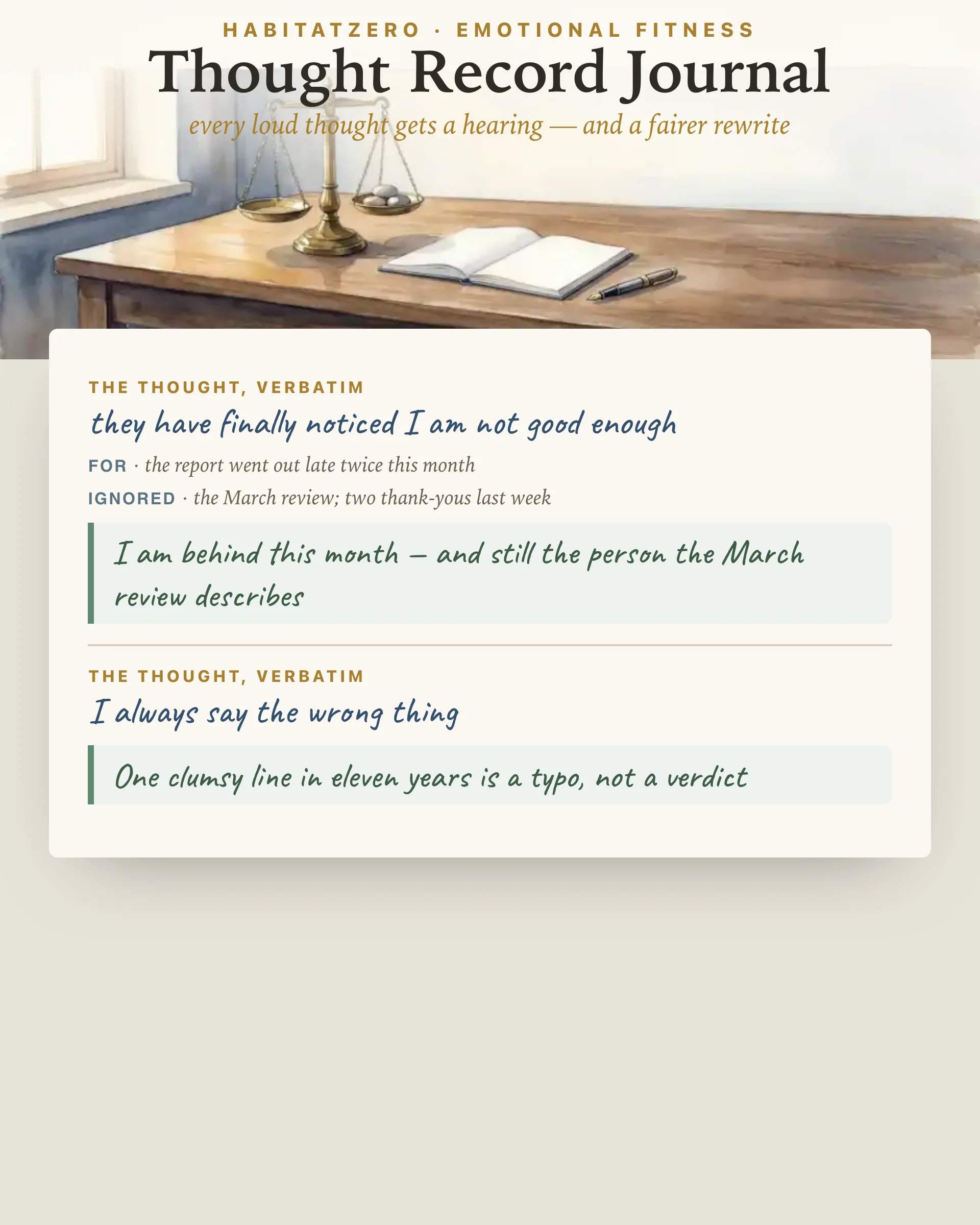
Some thoughts do not knock. They have finally noticed I am not good enough. I always ruin this. Nothing I start ever finishes. They arrive loud, sound like verdicts, and are gone before you can cross-examine them — which is convenient for the thought, because most of them would not survive cross-examination. The thought record is the CBT tradition's answer to exactly this, and it is the most portable exercise that tradition ever produced. This journal is that exercise, kept honest and made rereadable: the loud thought quoted word for word, the evidence heard on both sides, and a balanced line that gets the last word.
The first discipline is stenography. You write the moment — reading the meeting invite with no agenda attached — and then the thought in your head's exact phrasing, not the polite summary you would give a colleague. "I felt some imposter syndrome" is a paraphrase; they have finally noticed I am not good enough is testimony. The difference matters because a thought quoted precisely has edges you can examine, while a paraphrase has already been tidied into something reasonable-sounding. Catch it within a few hours if you can, while the wording is still fresh; loud thoughts are surprisingly exact, and so should the record be.
If you want to learn the recurring shapes these thoughts take — all-or-nothing, mind-reading, catastrophizing — the thinking trap spotter is this journal's natural companion: it names the pattern, this page tries the instance.
Here is what separates a thought record from positive thinking: the for column is real. If the report genuinely went out late twice this month, that goes in, in ink. A hearing your own mind can respect cannot be rigged — pretend the supporting evidence away and the loud thought will simply reconvene at 2 a.m. with the missing exhibit. Then the second column: what the thought conveniently ignores. This is usually where the surprise lives, because anxious and self-critical thoughts are superb prosecutors and lazy archivists — the March review, the two thank-yous last week, eleven years of a friendship that survived one clumsy line, all of it somehow off the docket. One honest line each side is enough. The point is not volume; it is that both columns exist.
The entry ends with the truer sentence that survives both columns — specific, believable, and yours. I am behind this month, and still the person the March review describes. Notice what that sentence is not: it is not a pep talk, not an affirmation, and not the original thought with a minus sign in front. It works because you can stand behind every word of it, including the uncomfortable half. That believability is the whole engine of the exercise, and it is why CBT's approach has held up under decades of scrutiny — reviews of meta-analyses across dozens of conditions and a comprehensive review of the efficacy literature place cognitive behavioral methods among the best-supported in all of psychotherapy. This journal borrows one exercise from that well-tested toolbox; it does not claim to deliver the rest.
The kept records build into a book of hearings, and the book is the long game. The same thought tends to return in the same costume — and rereading a balanced line you wrote three weeks ago, in your own handwriting, settles a returning thought faster than composing a new rebuttal from scratch ever could.
Honest labels, because the search results around "CBT" are full of clinical pages: this is not therapy, not a CBT course, and not a diagnostic tool of any kind. CBT itself is a structured course of treatment practiced with a trained professional, developed from the work of Aaron Beck and colleagues, and it involves far more than thought records. If you are in therapy, bring your kept records along — many therapists assign this exact exercise and will be glad you started. And two situations deserve more than a journal: if the same dark thought keeps winning every hearing no matter how honestly you run it, a therapist is the right next reader — and if your thoughts ever turn toward harming yourself, put the page down and call or text 988 (US), or your local emergency number, now.
A journal built on the thought record, the signature exercise of cognitive behavioral therapy. Each entry is a short hearing for one loud thought: the moment it arrived, the thought quoted word for word, one honest line of evidence that backs it, one honest line of what it ignores, and finally a balanced sentence you can actually stand behind. The kept records build into a book you can reread whenever the same thought returns.
Positive thinking overrules the thought; a thought record outvotes it, with evidence. The for column is filled in honestly — if the report really did go out late twice, that goes in — and the balanced line has to survive both columns, which is why it works. A sentence like I am behind this month and still the person the March review describes holds up at 2 a.m. in a way affirmations do not.
No. The thought record is the most widely shared exercise in the CBT tradition precisely because it travels well beyond the therapy room — it needs a pen, ten minutes, and a willingness to quote yourself accurately. That said, it comes from CBT, and if you are working with a therapist, kept records make excellent session material; many therapists assign exactly this.
No, and the page does not pretend otherwise. CBT — cognitive behavioral therapy, developed by Aaron Beck and colleagues — is a structured course of therapy with a trained professional, and it is one of the most thoroughly evaluated psychotherapies there is. This journal borrows its most portable exercise as self-help: no diagnosis, no treatment plan, just a fairer hearing for your own thoughts. If the same dark thought keeps winning every hearing, a therapist is the right next reader.
The CBT triangle is the tradition's simplest diagram: thoughts, feelings, and actions each pull on the other two. A thought like nobody wants me here feeds a heavy feeling, the feeling feeds an early exit from the party, and the exit hands the thought fresh evidence for next time. A thought record works the triangle at its most reachable corner — give the thought a fair hearing and a balanced rewrite, and the other two corners feel the tug. If you want the exercise on paper, print this page: the sheet is print-styled, and your browser can save the printout as a PDF.
The steps of a thought record make the strongest ones, because each asks for one thing. What was the moment, in plain facts? What went through my mind, in its exact words? What honestly supports that thought? What does not fit it? What truer sentence survives both columns? Answer them in order after a hard moment and keep the entries: rereading a balanced line you wrote weeks ago is where the practice builds.
The journal is free in your browser — what you see on this page is a working preview with example records so you can watch a hearing run start to finish. Inside Fabulous, your kept records save privately to your account: the book of balanced lines only becomes valuable once it is still there next month, when the loud thought tries its luck again.
By the team behind Fabulous, the science-based self-care app used by over 30 million people.