Leaves on a StreamEmotional Fitness · ~3 min
About this template · Updated July 2026
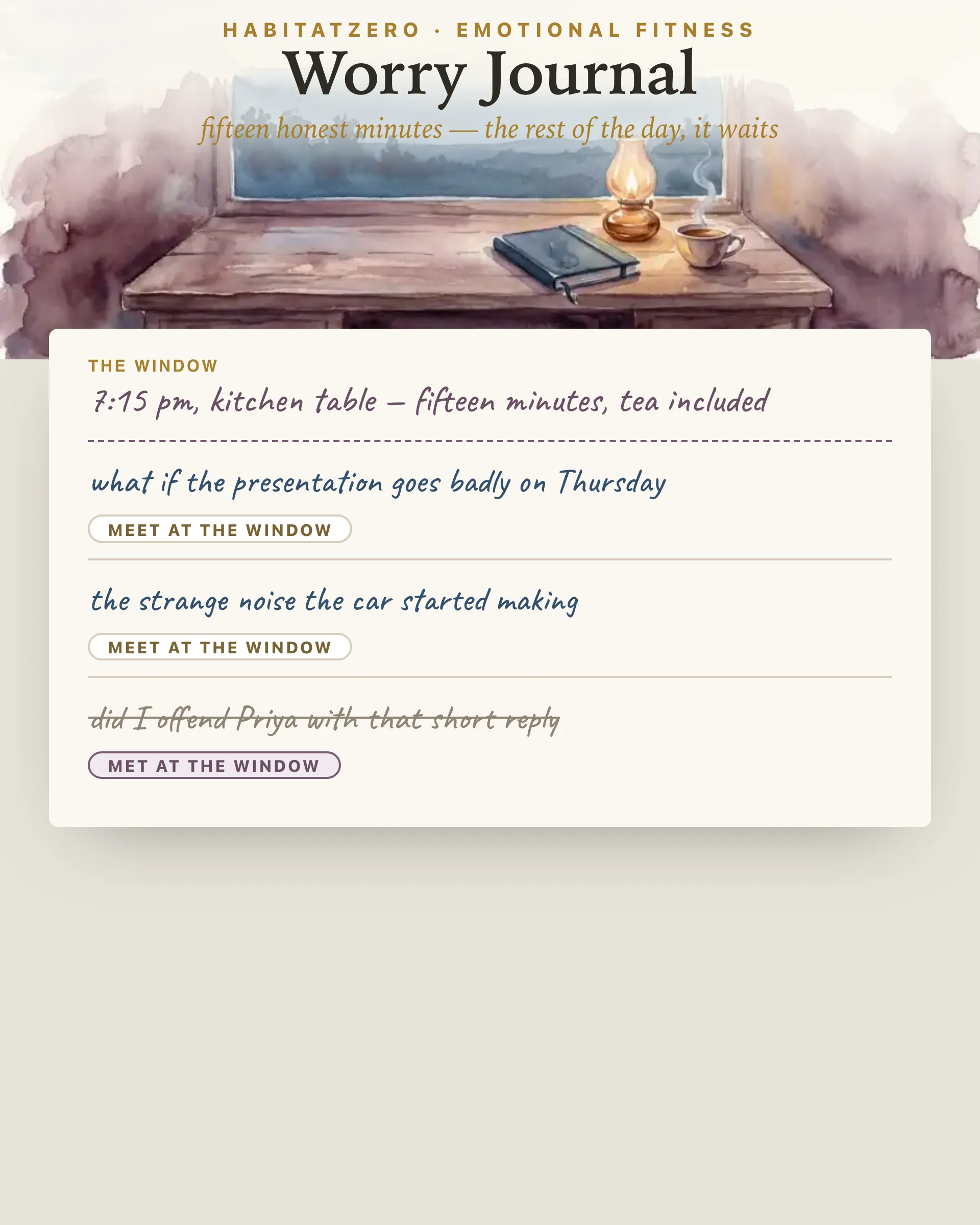
Worry is a terrible employee but a worse freelancer: give it no schedule and it will invoice you all day. It interrupts the meeting, rides along on the school run, and clocks back in at 2 a.m. This worry journal is built on the containment technique — the oldest and most counterintuitive move in the worry literature. You give worry a daily appointment, and in exchange it stops working around the clock. One window, same time and chair every day. One line to park each worry the moment it shows up early. One lot where the parked worries wait for their turn.
Behavioral researchers noticed something odd about chronic worriers decades ago: worry had become associated with everywhere. Bed, desk, car, shower — every place and hour cued it. The repair they proposed was stimulus control: confining worry to one scheduled time and place, so that the habit's cues shrink from "everywhere, always" back down to "the kitchen table, 7:15." Later controlled work on the same training found it meaningfully reduced worry — a rare case of a self-help technique with a genuine paper trail.
The rules of a good window are short: about fifteen minutes, the same slot daily so it becomes furniture, and never within an hour of bed — worry is a poor nightcap. When the timer ends, the notebook closes mid-thought if it has to. The boundary is not rudeness; it is the entire mechanism.
Between windows, the journal's job is speed. A worry starts tugging — what if the presentation goes badly — and you park it: one honest line, ten seconds, done. Not a paragraph. The window will do the thinking; you are only booking the appointment.
What surprises people is how much quieter a booked-in worry becomes. An unparked worry has to keep tugging your sleeve, because tugging is the only way it stays on the agenda. A parked one has a confirmed slot, in writing, and can finally go sit down. If your worst parking hours are the ones after lights-out, the bedtime brain dump is this same move purpose-built for the pillow.
The appointment must actually be kept — that is the half of the technique people skip. At the window, open the lot and give the parked worries real attention: think each one through on paper, ask what one next step would look like if there is one, and let the ones with no step be what they are. Mark each worry you genuinely worked as met. The met marker is not decoration; a lot full of worries that never get their window is avoidance wearing a clever disguise, and the whole point of parking is that it is not avoidance. Parking says at 7:15 — and then shows up.
Some worries, once met in good light, turn out to be predictions, and predictions can be tested. If you want that next step — write the worry down alongside what you expect to happen, then come back later and record what actually happened — the anxiety journal is built as exactly that ledger, and the two pages make a natural pair.
A window can hold worry to a schedule; it cannot shrink a worry that has outgrown scheduling. If the fretting fills most hours regardless of what you park, has been wrecking sleep for weeks, or keeps circling a fear you cannot bring yourself to say out loud, that is not a failure of technique — it is a sign the worry deserves a better-equipped room than a journal. A mental-health professional is the right appointment, and this page works alongside that help rather than instead of it. If you ever feel unsafe with your own thoughts, call or text 988 (US) or your local emergency number now.
A containment practice. You choose one daily slot — the worry window — and outside that slot, every worry that shows up gets parked in the journal in a single line instead of being chewed on. At the window, the parked worries get fifteen minutes of full, deliberate attention, and each one you work through is marked met. Worry still happens; it just stops happening all day.
It is one of the better-studied self-help moves for worry. The approach comes from stimulus-control research begun in the early 1980s, which found that confining worry to a set time and place weakens its habit of firing everywhere, and later controlled work on the same training has found meaningful reductions in worry. The technique asks two things: park the worry when it arrives, and genuinely keep the appointment.
No — the difference is the kept appointment. Avoidance tells a worry never; parking tells it at 7:15, and then actually shows up. That is why the met marker exists: a lot full of worries that never get their window is avoidance wearing a clever disguise. Met at the window, a worry has been faced more squarely than it ever is in scattered background fretting.
Some seasons of worry are bigger than a scheduling technique. If the fretting fills most hours no matter what you park, wrecks sleep for weeks on end, or centers on a fear you cannot bring yourself to say out loud, the right appointment is with a mental-health professional — this page works alongside that help, not instead of it. And if you ever feel unsafe, call or text 988 in the US, or your local emergency number, right away.
The journal is free and runs in your browser; this public page shows a filled-in preview so you can see the window, the parking line, and the lot working together. Inside Fabulous, your window and your lot save privately to your account and are waiting on every device — which matters, because parking only calms a worry when you trust the lot to still be there.
By the team behind Fabulous, the science-based self-care app used by over 30 million people.