Leaves on a StreamEmotional Fitness · ~3 min
About this template · Updated July 2026
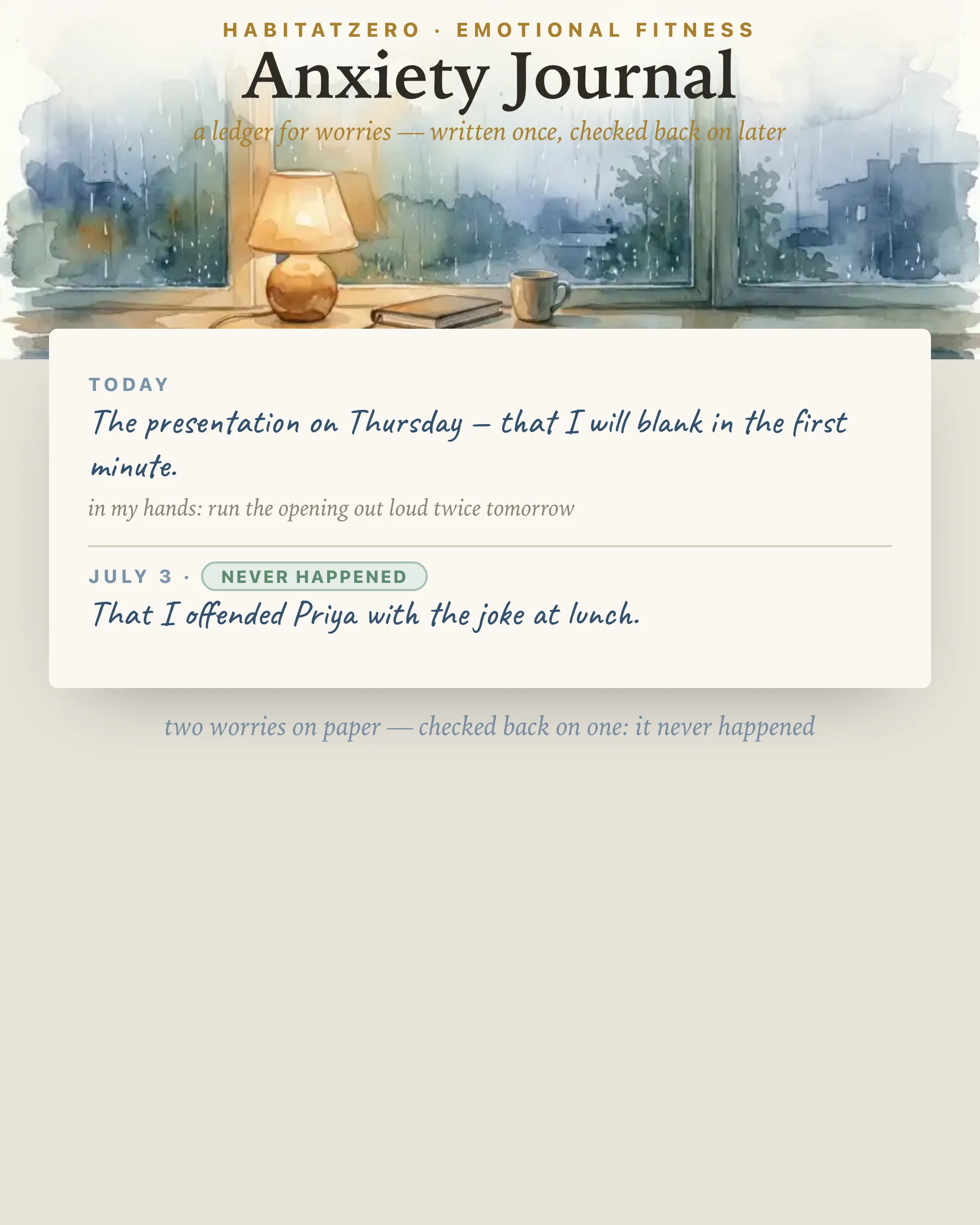
Worry has a memory problem: it forgets its own track record. Each new loop arrives feeling like a fresh emergency, unrelated to the hundred previous loops that quietly came to nothing. This journal is built around that gap. It is a ledger, not a diary — each worry gets written once, in the plain words it loops in, and then gets something almost no worry ever receives: a follow-up.
Trying hard not to think about something is famously bad strategy — the classic thought-suppression experiments found that pushing a thought away tends to invite it back more often. Writing works differently. Since the earliest expressive-writing studies, putting difficult material into words on a page has been associated with better outcomes than keeping it circling privately. You do not have to resolve a worry to park it; you only have to write it precisely enough that your head trusts the page to hold it.
That is why the first line asks for the worry the way it loops, not the polished version. "I might blank in the first minute on Thursday" parks better than "work stress" — vague worries cannot be shelved because the mind keeps reopening them to check what they meant.
Under each worry sits one optional line: anything in your hands right now? Sometimes there is a small doable step — run the opening out loud, book the garage, send the text — and writing it converts a loop into an errand. And sometimes there is nothing, because some worries are weather. The blank is deliberate: noticing that nothing is currently yours to do is not giving up, it is filing the worry correctly.
Days or weeks later, when the dust has settled, each ledger entry takes one of three stamps: never happened, happened — handled, or still open. This is the part a normal worry never gets. Loops are predictions, and predictions deserve scoring. As the stamps accumulate, the status line starts reading things like nine worries on paper — checked back on five: three never happened — not a slogan, just arithmetic from your own record. The next time the 2am loop starts, the ledger has receipts.
When a worry is more body than words, the 4-7-8 breathing and grounding exercises work below the neck first. If it is bedtime and the whole pile is loud, the bedtime brain dump locks everything away for the night wholesale; this ledger is the daytime tool, one worry at a time, with follow-through.
And a plain word about limits: this journal is a shelf, not a treatment. If worry is crowding whole days or shrinking your life, the strongest move on this page is the one it cannot do for you — bring in a professional. The ledger will still be here for the smaller stuff.
The worry itself, in the exact words it loops in, plus one optional line for whatever small step is genuinely in your hands. This ledger deliberately skips long analysis — one honest line beats a page of polished paragraphs you will never reread.
For most people the opposite is the common experience: a parked worry stops demanding to be mentally rehearsed. The ledger adds a second ingredient — the check-back column — so over time you also collect your own evidence about how often the feared thing actually arrived.
Each worry can later be marked never happened, happened and handled, or still open. That growing record is the journal quietly doing its best work: the next 2am loop gets answered by your own ledger instead of by imagination.
It is a self-help practice, not care. If worry is crowding whole days, waking you at night, or shrinking your life, bring a professional into the picture — a good therapist or doctor is backup this page cannot be, and the ledger pairs fine with that work.
By the team behind Fabulous, the science-based self-care app used by over 30 million people.