
The Overwhelm Recovery ProtocolWellness & Routines · ~5 min
About this template · Updated November 2026
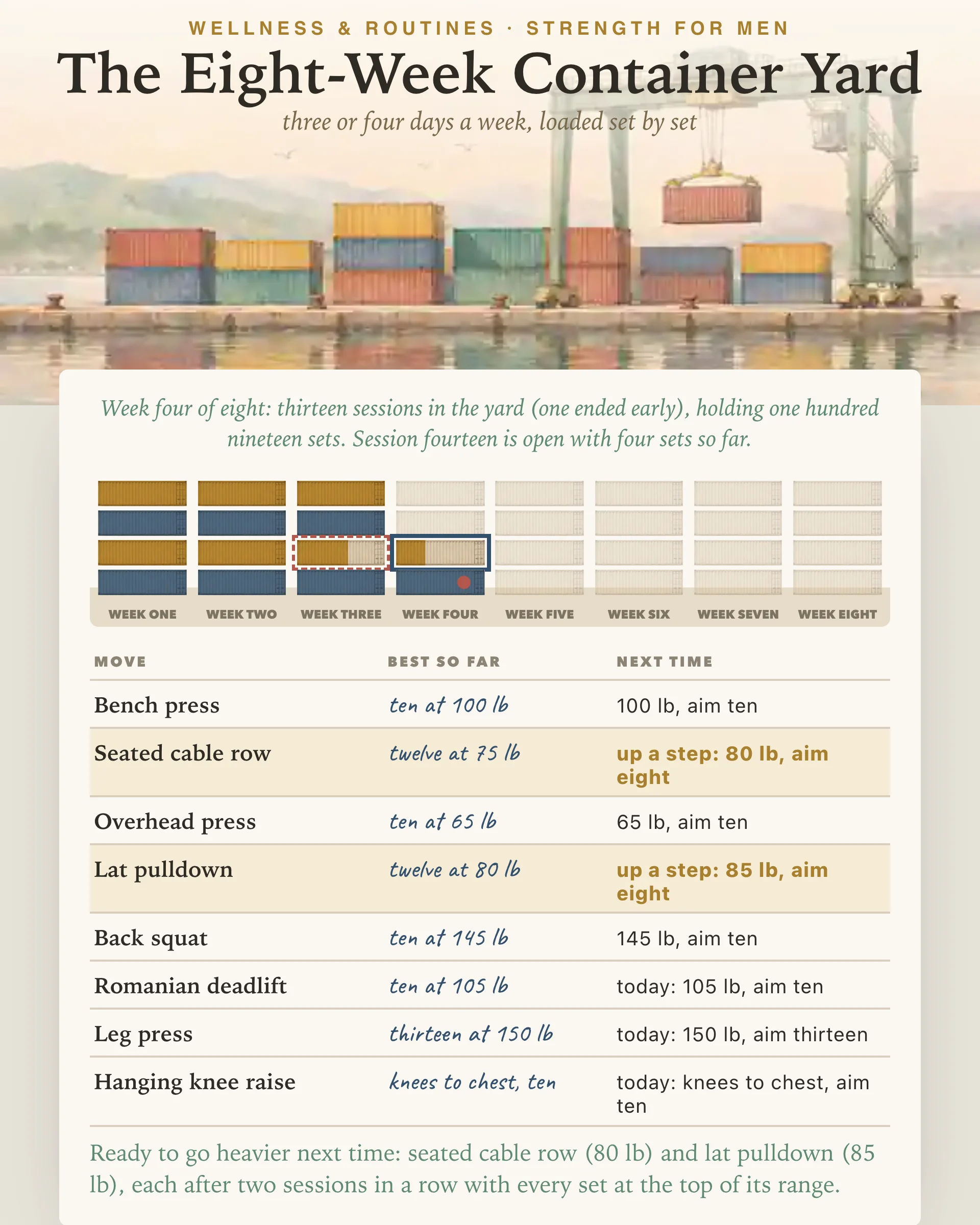
This page is a workout routine for men that starts from your week rather than someone else's. You tap the three or four days you can train, say whether you have a gym, a pair of dumbbells or only your body weight, and the page lays out every day: the moves, the sets, the rep range and the rest. Each session is a container you load set by set, and eight weeks of them stack into a yard you can read at a glance.
Two sibling pages cover narrower ground. The Twelve-Week Honeycomb is a dumbbell plan for men past fifty, with a joint-friendly swap for every move. The Eight-Week Chessboard mixes short strength circuits with brisk intervals and mobility days. This one is plain lifting with numbers to beat, for any adult man, at home or at a gym.
See your doctor before week one if you have a heart or blood pressure condition, chest pain or unusual breathlessness when you exert yourself, or a recent injury or surgery. Stop any set that brings sharp pain, and at a gym set the safety pins or ask for a spot on squats and bench presses.
Bodyweight trades a heavier weight for a harder version: a push-up climbs from the counter to a low step, the floor, then feet on the couch. Dumbbell and most gym moves go up five pounds at a time; the gym's squat, Romanian deadlift and leg press go up ten.
The two big levers are how many sets you do and how often. A 2025 set of meta-regressions pooled 67 studies with 2,058 participants, 79 percent of them men, average age 25. Muscle size and strength both grew as weekly sets went up, with diminishing returns that came sooner for strength. Training days mattered little for size once sets were counted, while strength kept rising with more frequent training, again with diminishing returns. These are averages across trials in mostly young adults, not a test of this plan or a number for you. The plan starts at two sets a move and adds a third in week three.
A 2021 network meta-analysis of 28 studies and 747 healthy adults, mostly in their early twenties, found similar growth from heavy loads of eight reps or fewer, moderate loads of nine to fifteen and light loads beyond fifteen, but bigger strength gains from heavy and moderate loads. Every set in those studies went to failure, most studies were of low quality, and the authors caution against applying the results to highly trained lifters. That is why the ranges here run from six to fifteen and every set stops with a rep or two still in you.
Adding reps works about as well as adding weight, at least for a while. In an eight-week trial of 43 trained volunteers, 27 men and 16 women averaging 23 years old, one group added load and the other added reps at the same load, twice a week, legs only. Strength leaned slightly toward the load group, thigh growth slightly toward the reps group. It tested two months of leg training in young lifters, and not the mix used here: reps first, then weight.
That mix follows a 2009 expert position stand on progression, which suggests eight to twelve reps for beginners and a two to ten percent jump in load once you can do one or two reps beyond the target. Waiting for two sessions in a row is this page's own caution, so one lucky day never decides it.
The planner refuses a fifth day, since rest days are part of the plan, and never drops below three. Once a set is in, the plan locks; a fresh start reopens it, and each move keeps the weight the rule reached.
Today's container lists its moves with the weight and reps to aim for. Do a set at your own pace and log it, or start the rep clock, which counts you in and paces three seconds a rep. A set stopped partway keeps only its whole reps, shows as stopped early and never counts toward going heavier. The rest clock runs from the end of each set in real time, so a locked phone does not stretch it.
The load sheet keeps each move's best and its next step. Two sessions in a row with every set at the top of the range send a move one step heavier, back to the bottom of the range; a session ended early, or one that skipped the move, breaks the run.
Unsure what two reps left in you feels like? The Effort Swatch Card helps you calibrate it before week one. For the step-up rule on its own, beside any routine, see The Rice Terrace Planner.
One you can repeat for months: three or four days a week, a squat, a hip hinge, a push and a pull in every week, two or three sets of each in a set rep range, and a plain way to add weight. This page builds that from the days and equipment you pick.
Three or four days suits most men starting out. A 2025 analysis of 67 training studies found that, for muscle size, the number of days mattered little once weekly sets were counted, while strength kept rising with more frequent training, with diminishing returns. Choose the number of days you can keep.
None wins outright. Full body on three days trains each move about one and a half times a week, upper and lower on four days trains each twice, and push, pull and legs trains each once, with an extra set on push and pull days. Pick the split that fits your week.
When every planned set reaches the top of its rep range in two sessions in a row, go one step heavier, usually 5 pounds, or 10 on the gym's squat, Romanian deadlift and leg press, and start again at the bottom of the range. A set you stopped early never counts toward it.
Yes. Pick bodyweight and every move becomes a home version, such as push-ups and table rows, with harder versions in place of heavier weights. Pick dumbbells if you have a pair and a bench or sturdy chair.
By the team behind Fabulous, the science-based self-care app used by over 30 million people.


