
The Overwhelm Recovery ProtocolWellness & Routines · ~5 min
About this template · Updated November 2026
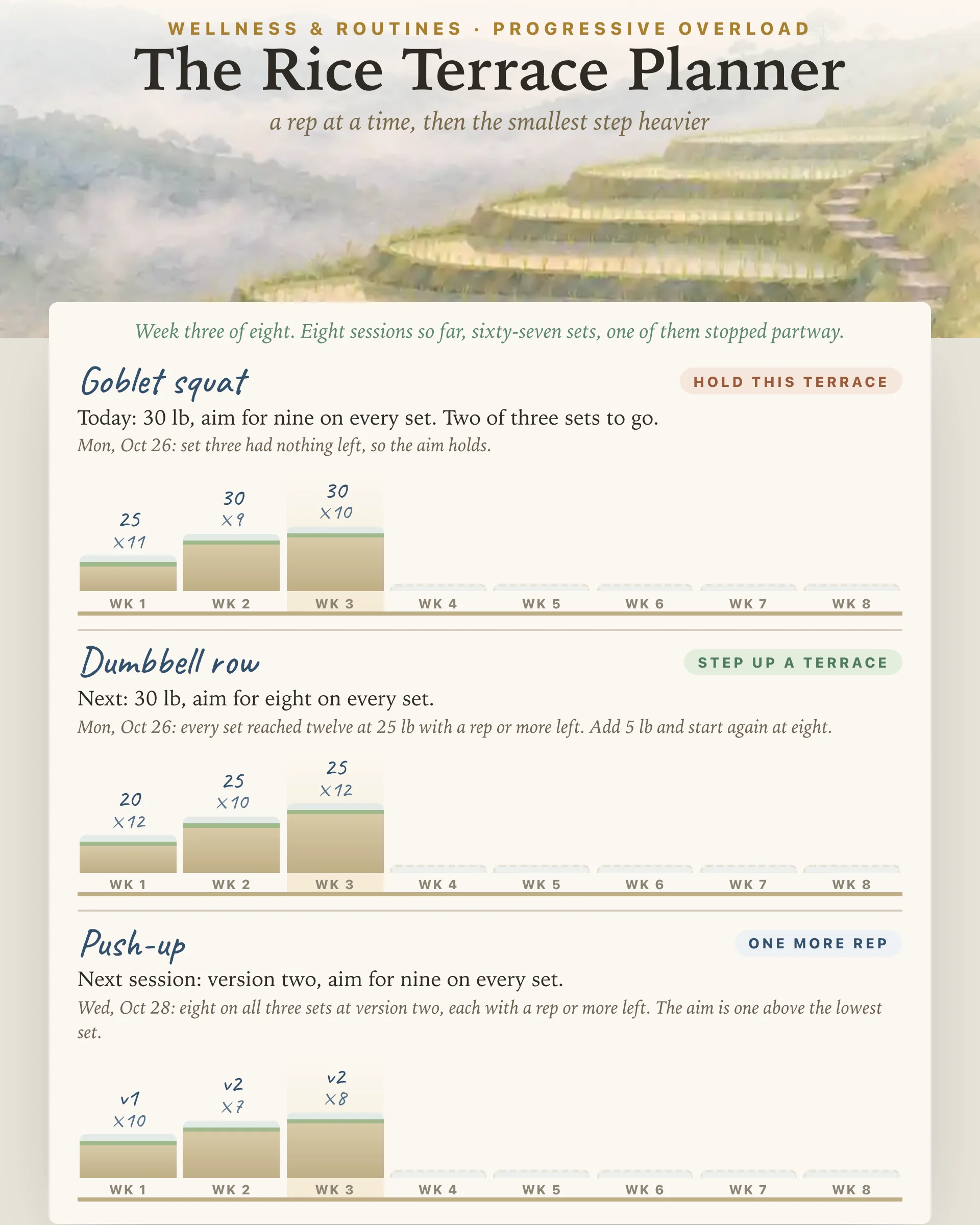
Progressive overload is the plain idea that muscles keep adapting only while the work keeps asking a little more of them. The hard part is rarely the idea. It is standing there with a 25-pound dumbbell, unsure whether today calls for one more rep, five more pounds, or the same again. This page answers that one move at a time, with a single rule you can read in full.
Add up to six moves you already do and give each a rep range, a number of sets and the smallest weight step your equipment allows. During a session, or right after, log each set: the weight, the reps you finished, and how many more you could have done with good form. That last number, often called reps in reserve, is what the rule reads.
Each move then gets one next step:
A set you stop partway, for pain or form that slipped, keeps its reps in the log, marked as stopped, and never moves the rule. The rest timer reads the clock, so a phone that locks between sets still ends the rest on time, and a rest is never logged as work.
Each move also gets an eight-week chart drawn as rice terraces. A terrace is one week's best whole set: it rises a little with every rep and a full step with every weight jump, so added reps make a slope and a heavier weight makes a new level. A week that holds still is no failure: on a real hillside, most ground is level.
The rule is this page's own choice. Coaches call its shape double progression: reps climb inside a range, then the weight climbs and the reps start over. It is one workable rule among several, not one research has crowned.
The American College of Sports Medicine's 2009 position stand, Progression Models in Resistance Training for Healthy Adults, was written for healthy adults, from newcomers to people with years of lifting. It suggested adding 2 to 10 percent to the load once you can beat your target by one or two reps. It graded its advice by the studies of its day, and the stand that replaced it notes the criticism it drew for weak rigor: one piece of advice with its top evidence grade rested on three studies and 59 people.
That replacement, the 2026 position stand on resistance training prescription, pooled 137 systematic reviews of randomized trials covering more than 30,000 healthy adults, in programs of six to 52 weeks. Lifting improved strength, power, balance and walking speed against not training. The authors write that progression is not needed for the first benefits and matters mostly for gains that keep coming over years. Training to failure was not required, and they found too little evidence to set an exact reps-in-reserve target. That is why this page reads "nothing left" as a reason to hold, never a goal.
Adding reps is no lesser path. In an eight-week trial of 43 people who already lifted, Plotkin and colleagues had one group add load and the other add reps at a fixed load, and strength and muscle measures moved about the same in both. Everyone in it had a year or more of training, so it says little about a first-time lifter.
The reps-left question comes from a scale tested on 29 squatters in a 2016 study, where ratings tracked how slowly the bar moved. Newer squatters rated a true maximum as easier than experienced ones did, so if you are new, your "two left" may really be one.
This page brings no moves of its own. For a program chosen for you, The Twelve-Week Honeycomb sets out two dumbbell workouts with a step-up rule built in, The Dumbbell Bookshelf runs a four-week circuit for a single pair, The Eight-Week Container Yard lays out three or four days from your equipment, and The Coil Pot Workout Plan builds a full-body routine over twelve weeks. Use the terraces beside any routine, even one you wrote yourself, to apply one rule the same way to every move.
The rule uses reps and weight. A third way is an extra set, for a move whose next weight is too big a jump. The fourth is a harder version: a slower lowering, a longer range, one arm or leg at a time. For body weight moves, each harder version is the step up.
Keep it open through a session, or fill it in right after. The plan is three sessions a week for eight weeks, about thirty minutes each: five minutes of warm-up and twenty-five of sets and rests. Then compare each terrace with week one and start a new block.
Stop any set that hurts. With a heart condition, an injury or pain that lingers, talk to a doctor or physical therapist before you add weight.
It means asking a little more of your muscles over the weeks of a program, so they keep having a reason to adapt. Most often that is one more rep or a slightly heavier weight, though an extra set or a harder version of a move also counts.
Choose a few moves, a rep range for each and the smallest step you can add. Each session, beat the last one by a single rep where you can, and add weight only once every set reaches the top of the range with a rep or more to spare.
Add the smallest jump your weights allow, often 5 pounds. An older guideline from the American College of Sports Medicine suggested adding 2 to 10 percent once you can pass your target by one or two reps.
Yes. Add reps first, then move to a harder version, such as a push-up from a counter to a low step and then the floor. This planner counts each harder version as a step up.
Hold the same weight and aim for a session or two, since a week without progress is normal. If a move stays stuck for weeks, try an extra set or a harder version, and check that sleep and rest days are keeping up.
By the team behind Fabulous, the science-based self-care app used by over 30 million people.


