
The Overwhelm Recovery ProtocolWellness & Routines · ~5 min
About this template · Updated November 2026
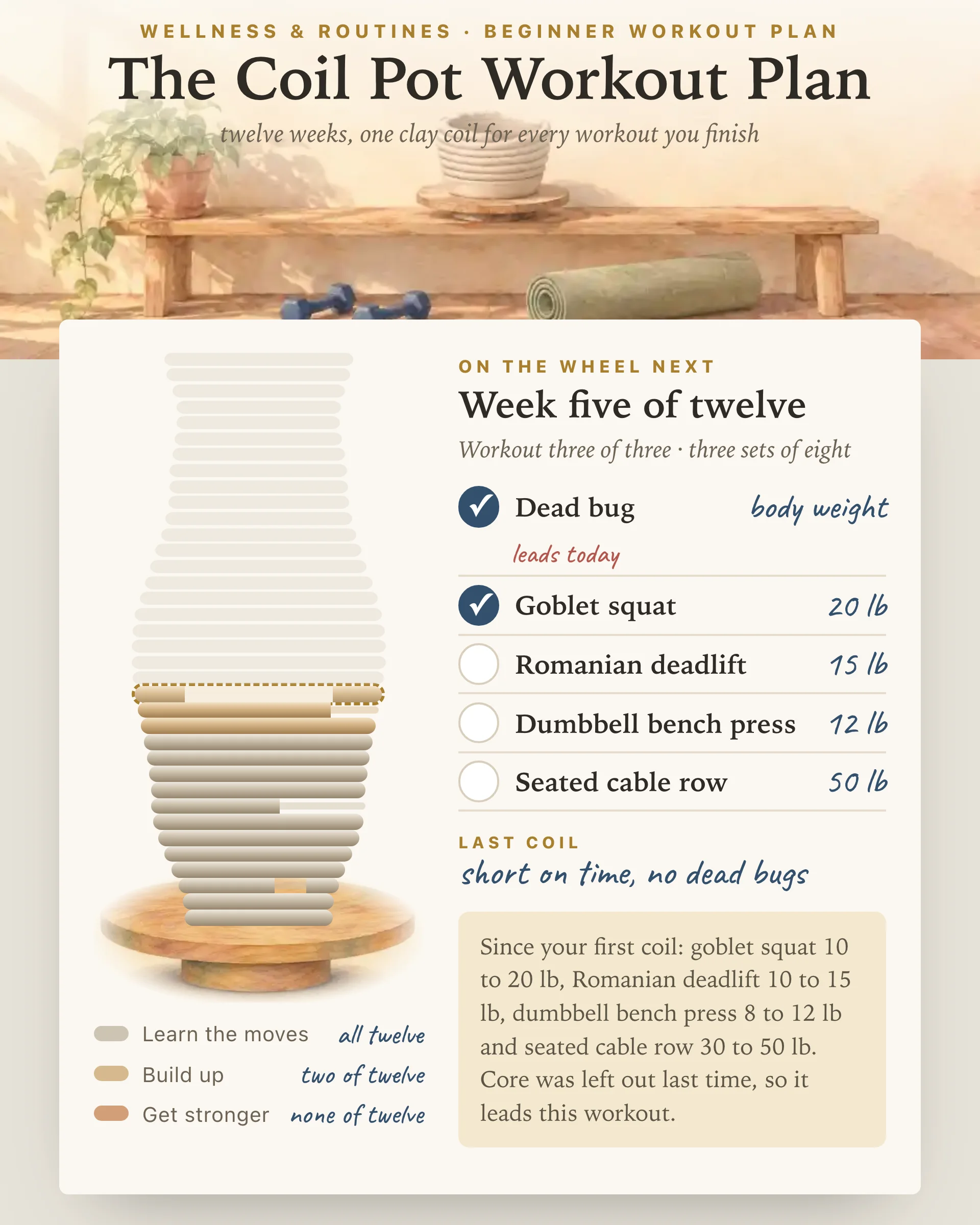
Most first pottery classes start with a coil pot. You roll a rope of clay, lay it in a ring, and set the next rope on top. Nobody finishes one in an afternoon, and nobody needs talent for it: the pot rises because the coils keep coming. A workout plan for a beginner works the same way. This page gives you twelve weeks of full-body workouts, at home or at a gym, two or three days a week, and lays one clay coil on a pot for every workout you finish.
Every workout uses the same five movement patterns: a squat, a hinge (folding at the hips with a long back, the way you pick a box up off the floor), a push, a pull and a core move that keeps your trunk steady. A short cardio finisher closes each one.
At home, that means chair squats, a hip hinge holding a loaded tote bag, counter push-ups, one-arm bag rows and bird dogs, then brisk marching. At a gym: goblet squats, Romanian deadlifts, a dumbbell bench press, a seated cable row and dead bugs, then a stationary bike or an uphill treadmill walk.
Choose home or gym and two or three days. The card beside the pot shows the workout on the wheel: each move with this week's sets and reps, a short cue, and the weight you used, set with minus and plus. Check off each move once its sets are done, then the finisher, then add today's coil.
Each coil has five segments, one for each move. Leave a move out and its segment comes out thin, and the next workout lists that move first, while you are fresh, with a note saying why. Over a few weeks, a column of thin spots shows which move you tend to dodge. A cue fades once you have done its move three times; tap how? to bring it back.
Weights carry from one workout to the next, and the first workout of week nine offers one step heavier on each loaded move. Switch from three days to two midway and the pot reshapes around the coils already laid. The plan moves when you do, not when the calendar does: miss a week and you pick up at the next coil. When the last one goes on, the pot is fired.
The structure follows the American College of Sports Medicine's position stand on progression in resistance training. For people new to lifting, it recommends loads you can move about eight to twelve times, two or three training days a week, and adding two to ten percent more load once you can do one or two reps beyond the target. Dumbbells jump in coarser steps, so the page offers one step at a time and asks you to drop back if your form slips.
Two days or three? A meta-analysis of training frequency found that people who trained more days a week gained more strength, but when total work was matched, the number of days made no clear difference. Three days simply fits in more sets, so choose the number you can hold for twelve weeks.
A review of sixteen cohort studies found that adults who did muscle-strengthening activities had roughly a ten to seventeen percent lower risk of death from any cause, cardiovascular disease, cancer and diabetes, with the largest difference at around thirty to sixty minutes a week. Those are associations. People who strength train differ from people who do not in many other ways, and studies like these cannot show that the training itself made the difference.
So this page makes no promise about your weight, your shape or your health numbers. What usually changes first is how the moves feel: the squat that wobbled in week one turns ordinary.
Start in a week where you can protect two or three slots with a rest day between them. If finding those slots is the hard part, plan them first with the Training Consistency Planner. If the counter push-up is still too much, The Wall Push-Up Ladder builds toward it from a standing position. On rest days, an easy indoor walk with The Living Room Mile keeps you moving. If you want a plan built only around strength, The Strength Doorframe runs twelve weeks in three blocks, at home or at a gym.
If you are coming back to exercise after a long break, pregnant or recently postpartum, or living with a heart or blood pressure condition, joint pain or an old injury, talk with your doctor or a physical therapist before week one. Stop any move that causes sharp pain, and keep a sturdy chair or counter within reach for balance.
One that trains the whole body two or three times a week with a few basic patterns: a squat, a hip hinge, a push, a pull and something for the core. Start with weights that feel easy, add a third set after a month, then add load. This plan runs twelve weeks in three phases of four.
Two or three full-body sessions with a rest day between them. A review of training frequency studies found that extra days helped mostly by adding total work, so the right number is the one you can keep for twelve weeks.
Chair squats, a hip hinge holding a loaded tote bag, push-ups against the kitchen counter, one-arm rows with the same bag, and bird dogs on a rug, followed by five minutes of brisk marching or stair steps. A chair, a bag and a counter cover all of it.
Yes. Nothing in it is built for one sex: the same five patterns and the same slow build suit anyone starting out, at any age. If you are pregnant, recently postpartum or managing a health condition, ask your doctor or a physical therapist which moves to adjust first.
Light enough that the last rep of each set moves as cleanly as the first, with two or three more left in you. In the first month that may mean body weight or a half-full bag. Go one step heavier once you could do a rep or two beyond what the plan asks.
By the team behind Fabulous, the science-based self-care app used by over 30 million people.


